Encyclopaedia of Martial Arts of the World · English
In attesa di approvazione / Pending approval
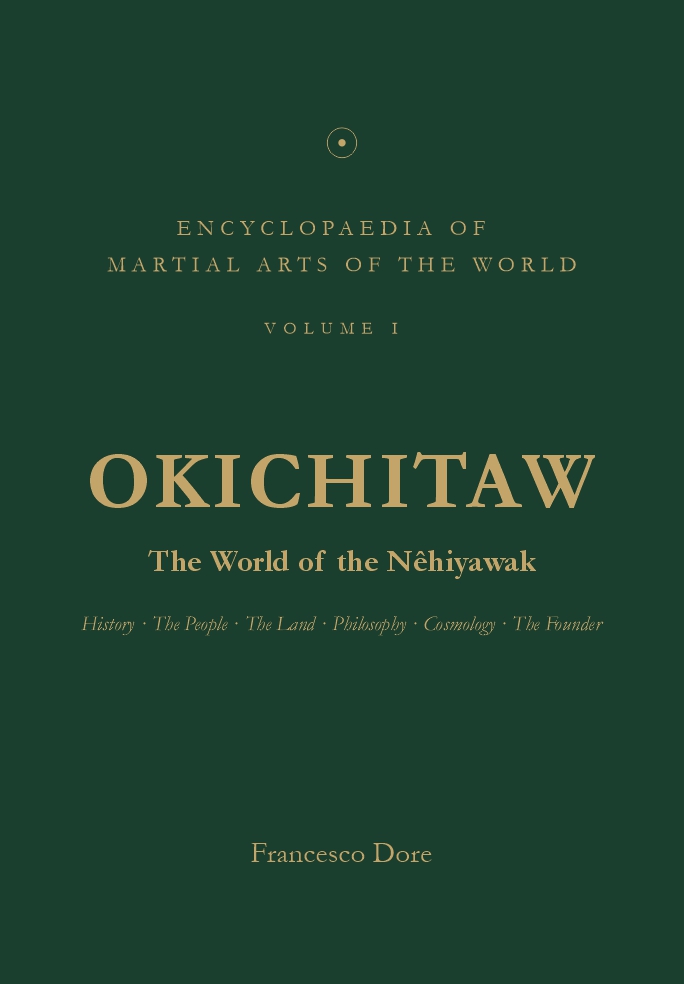
Okichitaw – The World of the Nêhiyawak – vol. 1a
The World of the Nêhiyawak - History · The People · The Land · Philosophy · Cosmology · The Founder
Okichitaw — Volume I
The World of the Nêhiyawak
History · The People · The Land · Philosophy · Cosmology · The Founder
Okichitaw — Volume I is an extensive study of the cultural, historical, philosophical, and spiritual world from which Okichitaw emerged.
Rather than treating martial arts as collections of techniques, this volume places Okichitaw within the world of the Nêhiyawak of the Canadian Plains. It explores the people and the land, the precolonial period, the fur trade, Treaty No. 6, the Resistance of 1885, the long period of cultural suppression, and the resurgence that preceded the emergence of modern Okichitaw. The final chapters examine George J. Lépine, the Medicine Wheel, the Seven Grandfather Teachings, and the ethical responsibilities of the Warrior.
Built around a transparent C1–C4 source-classification system, the book distinguishes independently verifiable primary evidence, OIMA/UNESCO documentation, academic scholarship, and the author’s own interpretation. It is intended not as a technical training manual, but as a documented journey into the history, identity, and worldview that give the martial system its meaning.
Okichitaw — Volume I
The World of the Nêhiyawak
History · The People · The Land · Philosophy · Cosmology · The Founder
A martial art does not begin with a technique.
It begins with a people.
With a landscape.
With a language.
With memory.
And, sometimes, with the determination to preserve what history tried to erase.
That is the starting point of Okichitaw — Volume I: The World of the Nêhiyawak.
This is not a manual of punches, throws, weapons, or fighting combinations. Those belong to Volume II. This first volume asks a more fundamental question:
What must we understand before a martial system can truly be understood?
The answer leads far beyond the training floor.
Okichitaw cannot be separated from the Nêhiyawak. The Nêhiyawak cannot be separated from the Canadian Plains, from the land that shaped their way of life, from Treaty No. 6, from the Resistance of 1885, from the decades of cultural suppression that followed, or from the long process of cultural resurgence through which traditions survived and returned to public life.
For this reason, Volume I deliberately begins with context rather than technique.
The reader first encounters Okichitaw as a layered system: a weapons-based martial tradition, a pedagogical framework, a vehicle for language and cultural transmission, a communal space, and an ethical system whose meaning cannot be reduced to physical combat alone.
From there, the book turns to the Nêhiyawak themselves.
Their language.
Their social organization.
Their systems of leadership and education.
Their spirituality.
Their relationships with neighbouring Nations.
And the land of the Canadian Great Plains—not as scenery behind history, but as one of the forces that shaped movement, subsistence, warfare, knowledge, and cosmology.
The land matters because Okichitaw is presented not as an abstract martial system transplanted onto Canadian soil, but as something whose logic is tied to a particular environment and a particular cultural history.
The historical journey then extends across centuries.
The precolonial Plains.
The buffalo economy.
The fur trade.
The arrival of the horse.
Treaty No. 6.
The political and economic pressures that culminated in the Resistance of 1885.
The reserve system.
The Indian Act.
The prohibition of ceremonies.
Residential schools.
And the less visible history of survival—the knowledge transmitted quietly within families and communities when public transmission could carry serious consequences.
This history is essential to understanding what follows.
Because the resurgence of Okichitaw is not presented as the sudden invention of a modern martial art.
It is examined within a much longer history of cultural continuity, interruption, adaptation, and recovery.
At the centre of that modern story stands George J. Lépine.
The volume examines his family roots, his martial training, the transmission he received, the role of the Elders, the development of the Lodge and curriculum, and the process through which Okichitaw emerged publicly and entered an international martial arts context.
Lépine is also important to the research behind the book itself.
The author was given access to the manuscript prepared by Lépine and Okichitaw International Martial Arts for OIMA/UNESCO documentation purposes—material not otherwise available to the general public and used throughout the volume as a distinct category of evidence.
That distinction matters because this book does something unusual for a work on martial arts:
it tells the reader how certain it is about what it says.
The C1–C4 methodology separates four different levels of source material:
C1 — independently verifiable primary sources and official records
C2 — OIMA/UNESCO documentation and material provided through George J. Lépine
C3 — academic historical, anthropological, and linguistic scholarship
C4 — the author’s own interpretation, comparison, or synthesis
The purpose is not to make the text look more academic.
It is to allow readers to distinguish documented fact from interpretation and to challenge the latter where appropriate.
That same transparency extends to the author’s own position.
The book explicitly acknowledges that it was written by a non-Indigenous researcher studying a culture that is not his own. It does not claim insider status, does not claim to speak on behalf of the Nêhiyawak, and identifies limitations of language, geography, and perspective rather than concealing them.
This is particularly important because The World of the Nêhiyawak is not interested in turning Indigenous culture into an exotic backdrop for martial arts.
Its purpose is almost the opposite.
The martial system is used as a doorway through which the reader encounters the civilization that gives the system meaning.
The final part of the volume makes that especially clear.
The Medicine Wheel provides an architecture of orientation, relationship, character, and practice.
The Seven Grandfather Teachings establish a framework of personal and communal values.
The Warrior’s ethical code then confronts one of the most important distinctions in any serious martial tradition:
the difference between possessing strength and knowing when strength should be used.
The book examines protection, responsibility, de-escalation, withdrawal, proportionality, contemporary Canadian law, responsibility toward future generations, and the meaning of training outside the Lodge.
Technique, in this framework, is not the final purpose.
A technically skilled practitioner who fails ethically has not reached the objective of the system. The physical competence of the Warrior exists within a larger obligation to character, community, and responsibility.
That is why Volume I and Volume II have been conceived as two halves of the same work.
Volume II can describe the weapons, movement, Four Gates, techniques, pedagogy, and living practice of Okichitaw.
But Volume I explains why those things mean what they mean.
Without that context, the reader may learn the syntax of the system while never understanding its language.
This volume is therefore written for martial arts practitioners, historians, readers of Indigenous and Canadian history, researchers, and anyone who has encountered the name Okichitaw and wanted something deeper than a short definition or a collection of techniques.
Ultimately, The World of the Nêhiyawak is a book about a martial art—but it is equally a book about memory, land, survival, cultural transmission, and the responsibility carried by knowledge.
Its central premise could be expressed very simply:
You cannot understand a martial tradition without first understanding the world that made it necessary.
And for the website, I would use this as the final claim:
“Before learning how a Warrior moves, understand the world that taught the Warrior why to move.”
EDIZIONI · FORMATI
Formati disponibili
Le edizioni fisiche e digitali associate a questa scheda.
NEL LIBRO
Contenuto / Contents
La struttura del volume così come presentata nell’edizione pubblicata.
Summary
- Preface. 11
- The Structure of the Work. 12
- The Sources and the Method. 13
- A Note on Positionality. 15
- Acknowledgements. 16
- Introduction. 19
- The Floor as a Starting Point 19
- The Question No Encyclopaedia Could Answer. 20
- III. The Encounter with Okichitaw.. 20
- The Decision to Write an Encyclopaedic Treatise. 22
- How This Book Was Written. 23
- For Whom This Book Was Written. 23
- Declaration of Positionality. 25
- Who I Am... 25
- From Which Perspective I Write. 25
- What I Am Not 26
- The Known Limits. 27
- Why I Wrote This Volume Despite These Limits. 28
- How to Use This Book. 29
- The C1-C4 System in the Section Notes. 29
- The Structure of the Volume. 30
- The Closing Apparatus. 31
- The CRO Transliteration Conventions. 32
- A Note on the Nêhiyawêwin Language. 33
- The CRO Standard. 33
- Variants in the OIMA Materials and Forms Marked (?) 34
- Proper Names, Place Names, and Nation Names. 35
- An Approximate Pronunciation Guide. 35
- Methodological Note. 37
- How to Read the Section Notes. 37
- Transliteration of the Nêhiyawêwin. 38
- The Treatment of Oral Sources. 39
- Editorial Conventions and Abbreviations. 40
- Terminological Choices. 41
- Chapter 1 — What Is Okichitaw: A Layered Definition. 43
- 1.1 — The Impossibility of a Simple Definition. 45
- 1.2 — Deep Etymology: okichitawak, the Worthy Warrior. 47
- 1.3 — The Systemic Duality: Two-Eyed Seeing. 50
- 1.4 — The Land as Biomechanics: The Art of the North. 53
- 1.5 — The Primacy of the Weapon: A Weapon-Based System.. 56
- 1.6 — Okichitaw as a Linguistic Ark. 59
- 1.7 — Non-Verbal Communication: The Hand Signals of Silent Warfare 61
- 1.8 — The Science of Animal Movement: Bear, Wolf, Eagle. 63
- 1.9 — The Lodge as Sanctuary: Intergenerational Healing. 66
- 1.10 — The Temporal Dimension: The Presence of the Ancestors. 69
- 1.11 — The Combat Structure: Close Quarters Combat 71
- 1.12 — The Medicine Wheel as the Architecture of the System.. 73
- 1.13 — Institutional Recognition as an Act of Cultural Sovereignty. 76
- 1.14 — Taxonomic Classification in the World Martial Arts Ecosystem.. 78
- Chapter Summary. 81
- Chapter 2 — Nomenclature, Variants, and Linguistic Questions. 83
- 2.2 — Orthographic Variants in the Sources: Systematic Documentation 90
- 2.3 — Alternative Denominations and the Risk of Confusion. 95
- 2.4 — The Distinction Between Historical Title and Name of the System 99
- Chapter Summary. 105
- Chapter 3 — The Nêhiyawak. 107
- 3.1 — The Name and Its Meaning: Endonyme and Identity. 108
- 3.2 — The Nêhiyawêwin Language: Structure and Thought 111
- 3.3 — Regional Variants and Nêhiyaw Groups. 114
- 3.4 — Social Structure: Band, Kinship, and Leadership. 117
- 3.5 — The Transmission of Knowledge and Education. 120
- 3.6 — Nêhiyaw Spirituality. 123
- 3.7 — Relations with Other Nations of the Plains. 126
- 3.8 — The Nêhiyawak Today: Resurgence and Challenges. 128
- Chapter Summary. 131
- Chapter 4 — The Land. 133
- 4.1 — The Geomorphology of the Great Canadian Plains. 134
- 4.2 — The Water System: Rivers, Lakes, and Wetlands. 137
- 4.3 — The Climate and the Cycle of the Seasons. 140
- 4.4 — The Flora of the Plains: Grass, Forest, and Medicinal Plants. 142
- 4.5 — The Fauna: The Buffalo and Other Species. 144
- 4.6 — The Sacred and Ceremonial Sites. 147
- 4.7 — Nêhiyaw Geographic Nomenclature. 149
- 4.8 — The Land in Cosmology and in Okichitaw.. 151
- Chapter Summary. 153
- Chapter 5 — The Precolonial Period. 155
- 5.1 — The Nêhiyaw Presence on the Plains: Settlement and Diffusion. 156
- 5.2 — The Buffalo Economy: Organisation and Technology. 159
- 5.3 — Political Organisation and Social Structure. 161
- 5.4 — The Inter-Tribal Exchange System.. 163
- 5.5 — Precolonial Warfare: Forms, Functions, and Ethical Code. 165
- 5.6 — Nêhiyaw Martial Practices: Techniques, Weapons, and Transmission 168
- 5.7 — Precolonial Spirituality as the Foundation of Martial Practice. 170
- Chapter Summary. 172
- Chapter 6 — The Fur Trade (1670–1879) 174
- 6.1 — The Hudson’s Bay Company: Origins, Structure, and Strategy. 176
- 6.2 — The North-West Company and the Competition. 178
- 6.3 — The Nêhiyawak as Economic Actors: Strategies and Negotiation 181
- 6.4 — Epidemic Diseases and Demographic Collapse. 184
- 6.5 — The Horse: Military and Cultural Revolution. 187
- 6.6 — Cultural Transformations and New Dependencies. 189
- 6.7 — The End of the System and the Disappearance of the Buffalo (1870–1882) 191
- Chapter Summary. 194
- Chapter 7 — Treaty No. 6 (1876) 195
- 7.1 — The Context: Why Canada Wanted a Treaty. 196
- 7.2 — The Commissioners and the Leaders: The Parties at the Table. 199
- 7.3 — The Text of the Treaty: Clauses and Ambiguities. 202
- 7.4 — Commissioner Dewdney and the First Violations (1877–1882). 206
- 7.5 — The Crisis of 1883–1884: Famine and Final Petitions. 209
- 7.6 — The Reserve System as an Institution of Control 212
- 7.7 — Treaty No. 6 in Contemporary Law and Memory. 214
- Chapter Summary. 217
- Chapter 8 — The Resistance of 1885. 219
- 8.1 — The Plains on the Eve of Crisis: 1879–1884. 220
- 8.2 — The Five Converging Causes of the Resistance. 223
- 8.3 — Louis Riel and the Métis Provisional Government 227
- 8.4 — Frog Lake, April 2, 1885: The Massacre and Its Causes. 229
- 8.5 — Cut Knife Hill, May 2, 1885: Poundmaker’s Victory. 232
- 8.6 — The Siege of Batoche: May 9–12, 1885. 235
- 8.7 — The Hangings at Fort Battleford: November 27, 1885. 237
- 8.8 — The Immediate Consequences: Disarmament, Pass System, Dismemberment 239
- 8.9 — The Long-Term Consequences for the Nêhiyaw Nations. 242
- Chapter Summary. 245
- Chapter 9 — The Century of Suppression (1885–1951). 246
- 9.1 — The Indian Act: Architecture of a Control System.. 247
- 9.2 — The Prohibition of Ceremonies (1885–1951). 250
- 9.3 — The Residential Schools: Structure and Ideology. 253
- 9.4 — The Residential Schools: Daily Life, Abuses, and Deaths. 256
- 9.5 — The Silent Resistance: Clandestine Transmission of Culture. 259
- 9.6 — Nêhiyaw Warriors in the World Wars. 262
- 9.7 — The Indian Act of 1951 and the End of Explicit Prohibitions. 264
- 9.8 — Toward Section 35: Indigenous Rights in the Constitution of 1982 267
- Chapter Summary. 269
- Chapter 10 — The Resurgence and the Birth of Okichitaw (1951–2002) 271
- 10.1 — The Ceremonial and Linguistic Resurgence (1951–1970). 272
- 10.2 — The Indigenous Political Movement (1960–1982). 275
- 10.3 — Nêhiyaw Cultural Revitalisation: Language, Ceremonies, and Identity 278
- 10.4 — Toronto and the Indigenous Urban Diaspora. 280
- 10.5 — The Intellectual Context: Indigenous Studies and Decolonisation 282
- 10.6 — Lépine’s Research: The Three Fronts (1988–1997) 284
- 10.7 — The Founding of the Lodge and the Curriculum (1997). 287
- 10.8 — The Community Response and the Healing Effects. 289
- 10.9 — International Recognition: WoMAU 2002 and the Global Panorama 290
- Chapter Summary. 292
- Chapter 11 — George J. Lépine: The Okimakahn-Kiskinahumakew.. 293
- 11.1 — The Family Roots: Plains Cree, Nakoda, and Métis. 294
- 11.2 — Ambroise-Dydime Lépine: Riel’s Adjutant-General 296
- 11.3 — Childhood, Lake Manitoba, and Uncle Ted’s Lessons. 298
- 11.4 — Training in the Oriental Martial Arts. 300
- 11.5 — The Elders’ Mandate: Community Legitimation. 301
- 11.6 — The Title: Okimakahn-Kiskinahumakew.. 303
- 11.7 — Institutional Recognitions: WoMAU (2002) and Diamond Jubilee Medal (2012) 305
- 11.8 — Alexander Lépine: The Second Generation. 306
- Chapter Summary. 308
- Chapter 12 — The Medicine Wheel: Cosmology, Orientation, and Practice 309
- 12.1 — Origins and Diffusion: The Medicine Wheel in Plains Cultures. 310
- 12.2 — The Four Directions: Character, Power, and Function. 312
- The East: Light, Beginning, and Awareness. 312
- The South: Growth, Heat, and Relationship. 314
- The North: Wisdom, Cold, and Discipline. 316
- 12.3 — The Sacred Colours, Guide Animals, and Natural Correspondences 318
- 12.4 — The Medicine Wheel as a Map of Human Life. 320
- 12.5 — The Medicine Wheel and the Lodge: Space, Ceremony, and Orientation 322
- 12.6 — The Medicine Wheel and the Pedagogy of the Okichitaw System 323
- Chapter Summary. 325
- Chapter 13 — The Seven Grandfather Teachings. 327
- 13.1 — Origins and Narrative Tradition of the Seven Teachings. 328
- 13.9 — The Seven Teachings as an Integrated System.. 340
- Chapter Summary. 341
- Chapter 14 — The Fundamental Ethical Principles of the Warrior. 343
- 14.1 — The Warrior’s Code in the Nêhiyaw Tradition. 344
- 14.2 — The Fundamental Distinction: Violence and Strength. 346
- 14.3 — The Warrior as Protector: The Hierarchy of Responsibilities. 347
- 14.4 — The Hierarchy of Responses: De-escalation, Withdrawal, Strength 349
- 14.5 — Proportionality: The Ethical Measure of Action. 351
- 14.6 — The Warrior and Contemporary Law.. 353
- 14.7 — Responsibility toward Future Generations. 355
- 14.8 — The Ethics of Training: The Lodge as a Safe Space. 357
- 14.9 — The Warrior’s Life Outside the Lodge. 359
- Chapter Summary. 362
- Afterword. 363
- The Structure of Volume II. 364
- What Remains Between the Two Volumes. 366
- Appendix A — Treaty No. 6 (1876) 368
- Preamble. 369
- Whereas Clauses. 370
- The Cession. 370
- Rights Reserved. 371
- The Reserves. 371
- Payments. 372
- Agricultural Equipment 372
- The Famine Clause. 373
- The Adhesion Clause. 373
- Appendix B — Selected Primary Documents. 377
- B.1 — Indian Act: The Cultural Suppression Clauses. 377
- B.1.1 The Prohibition of the Potlatch and Tamanawas (1885) 377
- B.1.2 The Extended Prohibition of All Indigenous Ceremonies (1895) 378
- B.1.3 The Prohibition of Traditional Dress (1914) 379
- B.1.4 The Prohibition on Collecting Funds for Legal Claims (1927) 379
- B.1.5 The 1951 Revision: Removal of Suppression Clauses. 379
- B.2 — TRC Calls to Action Nos. 88, 89, 90 (2015). 380
- Call to Action No. 88. 380
- Call to Action No. 89. 381
- Call to Action No. 90. 381
- Concluding Note on the Documentary Apparatus. 382
- Analytical Index. 383
- Glossary. 402
- A — Nêhiyawêwin Terms. 402
- B — Okichitaw System: Technical Terms. 407
- C — Institutions, Historical, and Legal Terms. 408
- D — Key Concepts of the System.. 411
- Indice analitico. 414
- About the Author. 434
L’AUTORE