
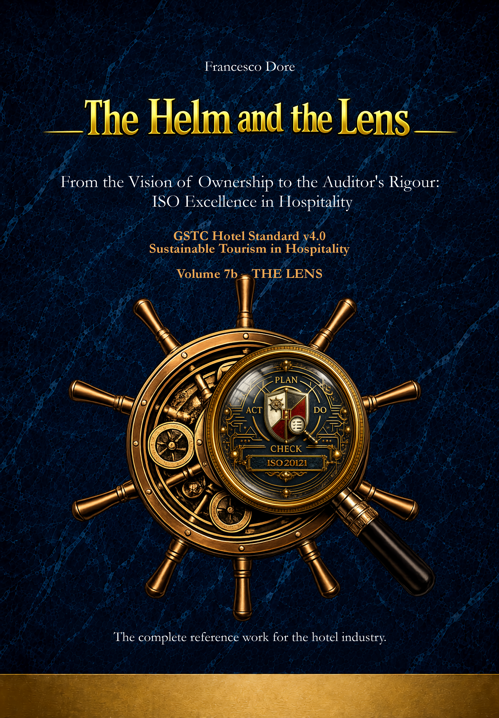
The Helm and the Lens · English
Pronto per la pubblicazione / Ready for publication
the Helm and the Lens – Vol. 8b
ISO 20121 · Event Sustainability Management Systems in Hospitality Volume 8b — The Lens
ISO 20121:2024 seen through the eyes of the internal auditor and the certification body: how to audit an event sustainability system while the event is actually happening, and what a certificate really proves. Thirty cases, framed by the same lakeside hotel in Annecy.
500
Pagine
The Helm and the Lens · Volume 8b — The Lens
ISO 20121:2024 · Event Sustainability Management Systems in Hospitality
Auditing the Celebration While It Lasts
An event has an awkward feature for an auditor: it ends. The banquet is cleared by midnight, the stage comes down the next morning, the waste leaves with the last van. If the evidence is not looked at while the event is running, much of it is gone for good. All that remains is the paperwork, and the paperwork usually says that everything went to plan.
This volume reads ISO 20121:2024 from the other side of the table. It picks up where its companion, 8a — The Helm, leaves off. Volume 8a showed how a hotel builds and runs an event sustainability management system. This book shows how to check whether that system works: on the day of a wedding, during a three-day congress, at the summer festival on the terrace.
Chapter 3, The Internal Auditor’s Lens, follows the hotel’s own auditor. It shows how to plan an audit programme around the events that carry the most risk, rather than around the calendar. It covers what to observe during set-up, service and teardown, how to sample food and waste records, purchasing decisions and supplier commitments, and how to talk to banquet staff, organisers and neighbours as well as managers. It ends with how to write findings that management will act on. Chapter 4, The Certifier’s Lens, explains what happens when the certification body arrives. It covers how audits are planned around a live event calendar, what stage 1 and stage 2 look for, and how surveillance works in a seasonal business. It also covers how nonconformities are graded and closed, and what an accredited certificate does and does not cover.
Every subchapter opens with a case set in a real place, built as a composite and clearly declared as fictional. The lakeside hotel in Annecy from Volume 8a returns to frame the story. Each subchapter carries a Verification Pact, which keeps apart what the standard requires of the hotel, what applies to the certification body, and what is the author’s recommendation. An appendix gives an internal audit checklist organised by clause, built only on requirements stated in the two volumes.
The author is a Lead Auditor and has spent over twenty years in international luxury hospitality. He writes as an author and publisher, for those who audit events and those whose events are audited. This is independent material, not affiliated with ISO or any certification or accreditation body.
Each subchapter ends with a concept card. Audit worksheets, evidence checklists and the cards in high resolution are available on the online platform.
EDIZIONI · FORMATI
Formati disponibili
Le edizioni fisiche e digitali associate a questa scheda.
NEL LIBRO
Contenuto / Contents
La struttura del volume così come presentata nell’edizione pubblicata.
Table of Contents
- Preface.
- 3.1 The Internal Auditor: Role and Independence in an Events Hotel
- 3.2 The Auditor’s Competence: Standard, Event Operations and Law..
- 3.3 The Audit Programme: Events, Cycle and Risk.
- 3.4 Audit Methods: Interview, Observation, Document and Sample.
- 3.5 Process Audit: The Event Cycle from Proposal to Final Invoice.
- 3.6 The Audit Before the Event: Planning, Contracts and the Banquet Event Order
- 3.7 The Audit During the Event: Auditing While the Celebration Runs.
- 3.8 The Audit After the Event: Breakdown, Waste, Invoicing and Lessons.
- 3.9 Auditing the Impact Assessment: Issues Register and Significance.
- 3.10 Findings: Criterion, Evidence, Conclusion.
- 3.11 Root-Cause Analysis: Why It Happens Again at the Next Event.
- 3.12 The Report to Top Management.
- 3.13 Follow-Up and Effectiveness.
- 3.14 Supply Chain and Service Providers in the Audit.
- 3.15 An Audit Culture in the Events Business.
- 4.1 The Certification Body: Accreditation, Role and Limits.
- 4.2 Choosing a Certification Body: Scope, Competence and Quotation.
- 4.3 Preparing for Certification: Self-Declaration, Second Party or Certificate
- 4.4 Stage 1: Readiness.
- 4.5 Stage 2: Effectiveness.
- 4.6 The Audit During a Real Event.
- 4.7 Nonconformities in Certification: Major and Minor.
- 4.8 Corrective Actions and Their Acceptance.
- 4.9 The Certification Decision and the Certificate.
- 4.10 Surveillance Audits.
- 4.11 Recertification and Transition to the 2024 Edition.
- 4.12 Integration with Other Management Systems.
- 4.13 Audit, Certificate and Reputation: What a Hotel May Say.
- 4.14 Auditor and Hotel: Impartiality, Limits and Complaints.
- 4.15 Certification as a Strategic Lever, and Its Limits.
- Afterword.
- Appendix A..
- Sources and Research Methodology — What This Book Verified, and How..
- Glossary.
- About the Author.
- Contact.
- The Series.
- The Online Platform..
PRIMA DELL’ACQUISTO
Estratti / Extracts
Passaggi selezionati dal libro disponibili per la consultazione.
01 3.14 Supply Chain and Service Providers in the Audit Apri / Open
GUIDING QUESTION
When your hotel promises a client something that a service provider delivers on your behalf, has anyone from your hotel seen how that provider works? And what would you actually be entitled to examine if you stood at its door tomorrow?
Opening
At nine o’clock on a Tuesday in early July, Elise Claes and Pieter Janssens stood in the production kitchen of a caterer in an industrial yard south of the canal in Brussels. Claes heads reservations at a hotel beside a conference centre in the city: 220 rooms, a meeting floor with twelve rooms and a hall for 350 guests. In the hotel’s cross-audit she is internal auditor for purchasing and banqueting. Janssens is the hotel’s purchasing manager.
Outside its own walls the hotel delivers about six events a year for its clients: receptions in a museum, summer parties in a marquee in a park. Its own kitchen does not leave the building for these. Food, tableware and kitchen staff have come for three years from the caterer, a family business with fourteen employees. For banquets inside the hotel, service staff come from a staffing agency in Antwerp, about 2,600 shift hours a year. The spring internal audit had found supplier criteria written but never checked. Management decided on two supplier audits this year: the agency and the caterer.
Claes had audited the agency the week before, remotely. The contract, renewed in March, gives the hotel the right to see induction records and working-time records for workers deployed in the hotel. She sampled fourteen shifts from April to June. The agency provided the records with initials instead of names and showed in a video call how it confirms shifts. Thirteen matched the hotel’s rota; one differed by half an hour, explained. With every confirmation the agency sends the worker the hotel’s information sheet: routes, emergency exits, separation, reusables. In the agency’s system it was last year’s version. The new one, with the emergency exits changed after the meeting floor was rebuilt, the hotel had never sent in February.
The caterer’s contract is older and contains no audit right. Janssens had attached an annex the previous year, three sentences long: the contractor uses reusable tableware, prefers regional produce and disposes of waste separately. Claes had telephoned the owner and asked whether they might visit. Come on Tuesday at nine, he had said; we are packing for Saturday. On Saturday a European trade federation holds its summer party in the marquee, 400 guests. The federation is event owner and organiser; the hotel supplies food, drinks and service as a package and has engaged the caterer to deliver it. Claes had the hotel’s proposal to the federation in her folder. It said: food waste will be weighed, unserved food will go to a food bank, and waste will be separated into four streams.
Crates of china were stacked high; delivery notes from a grower in Flemish Brabant hung on the wall. Claes went through her six questions with the owner, one page. At the fourth she asked how weighing would be done on Saturday. Weighing, he said, was nowhere in his order. He fetched the annex from his office. In the marquee he provides one bin for food waste and two for everything else; glass he takes back separately; cardboard goes with the rest. For him that is separation. He would gladly give a food bank what he was allowed to; nobody had ever asked him.
Janssens said that it was in the proposal. Claes laid the proposal and the annex side by side on the steel worktop. The proposal was the hotel’s promise to the federation, written by banqueting sales. The annex was the hotel’s order to the caterer, written by purchasing. Nothing connected the two documents.
It is worth being fair to everyone in that kitchen. The caterer had done exactly what his order said, with reusable china and regional produce. The agency had sent the information sheet as agreed. Sales and purchasing had each written their documents carefully. The gap lay between them, and it belonged to the hotel.
The Problem
The Structural Failure
The first structural failure was the double route of promises. What the hotel promises a client, sales writes into the proposal. What it orders from a provider, purchasing writes into the order. Both work conscientiously and neither reads the other’s documents. The second was the contract without an audit right. Claes could visit the caterer because he was obliging. A hotel that buys services against criteria needs the contractual right to see them fulfilled, and must use it.
The third was the information sheet, and it too belonged to the hotel. The agency had done what was agreed. The hotel had changed its emergency exits in February and forgotten to send the new version. A document used outside the house needs the same control as one used inside it. The fourth stood in last year’s issues register, which said that food and waste at outside events were the caterer’s service and lay outside the system. Contractual allocation alone does not justify such an exclusion. The hotel sells the package, advertises it and promises something about its waste. What it controls and what it can only influence must be evaluated, not written away.
Beneath these lies a structural fact. A large part of what is delivered at an event comes from suppliers. The hotel promises the client a whole and buys parts. Between promise and parts lie departments, contracts and vans. The supplier audit is the one point in the system where promise, order and work lie on the same table.
The Cultural Failure
Janssens had driven to the caterer expecting a supplier audit to be an inspection of the supplier, and an inspection looks for faults in the inspected. What Claes found lay in their own hotel: a promise to the client had never reached the order. A supplier audit always audits the customer too.
The opposite habit was present as well. For the visit Janssens had brought forty questions from an environmental audit template, from energy balance to emergency plan, which would have cost a business of fourteen people a day and frightened more than informed. Claes left them in the car. And he wanted to see the caterer’s hygiene training and asked about the kitchen assistants’ wages, neither of which the visit had been agreed to cover. Food hygiene is the caterer’s own legal duty, through HACCP-based procedures, and official controls belong to the authorities; a hotel that sells the food may still ask for proportionate evidence, agreed in advance. Wages are another employer’s data and need a lawful basis before anyone sees them.
The Principle
A supplier audit is a second-party audit: the hotel checks, as customer, whether a supplier meets what it requires of it. Its basis is the contract and the requirements that apply to what is delivered, not goodwill and not a general impression of the business. What is in the order, the hotel may audit, through the access the contract or the supplier allows. What is not, it can ask about, but cannot record as the supplier’s deviation; where an applicable duty or a relevant sustainability risk lies outside the order, the finding is that the order is incomplete. A supplier audit never replaces official controls. Three things are checked in this order: what is ordered, in the current version; how the supplier works, in documents and, where it adds value, on site; and whether both fit what the hotel has promised its clients.
| Area | What the hotel audits | What it does not audit, or who does |
| Order and promises | Whether every client promise is in the order; current version of annexes | The supplier’s contracts with other customers |
| Agency workers in the hotel | Induction and working time for shifts in the hotel, by initials | Personnel files, wages, shifts for other customers |
| Caterer’s work at outside events | Tableware, separation, weighing, passing on unserved food | Official food-hygiene control, which belongs to the competent authority; the caterer’s HACCP-based procedures only as agreed evidence |
| Supplier’s business beyond the order | As a note to purchasing: vehicles, energy, packaging | No nonconformity against the supplier unless it is in the order; a relevant gap in the order is the hotel’s finding |
| Effectiveness of agreed actions | At the next deployment, on site | A supplier’s certificate in place of looking |
The line between them is drawn by the difference between control and influence. What the hotel orders it controls through the contract; what the supplier does beyond it, its two diesel vans, the heating of its kitchen, the hotel can only influence, through conversation, criteria at the next award and partnership. Effort follows weight and size: the agency supplies 2,600 hours a year of people to whom the hotel owes duties and is audited yearly, including records; the caterer works six evenings a year for the hotel, and two hours in its kitchen and one observed event suffice. And findings belong where the cause lies: a promise missing from the order is a finding in the hotel’s own system.
What the Standard Says
This section rests chiefly on clauses 8.3 and 8.1 of ISO 20121:2024, on clauses 4.2 e) and 6.1.2, on the guidance in Annex B and A.24, with ISO 19011:2026 as guidance. What follows is what the standard requires, in this book’s own words; what a guideline or informative annex only recommends is called guidance.
Under 4.2 e) suppliers are interested parties, explicitly including venues and providers of products and services. The Brussels hotel stands on both sides: for the federation it is a supplier, for the caterer a customer. Under 8.1 the organisation plans, implements and controls its processes, including externally provided processes, products and services. Catering in the marquee is such a process, because the hotel sells it as part of its package.
Under 8.3 the organisation determines and applies criteria for selecting and evaluating suppliers and, where applicable, requests evidence. Requirements are set out in tender and procurement documents and must be taken into account in selection. Supplier conformity should be monitored on an ongoing basis; that is a recommendation, not a requirement. Documented information must be retained, and the tender process must be manageable for small businesses. The caterer’s annex is a procurement document: what the hotel promises clients must appear in it, or it cannot be considered in selection and evaluation. How a hotel manages its supply chain is the subject of Volume 8a (2.8). …
02 Preface Apri / Open
At five past two in the morning a woman with a black notebook stands in the passage to the yard of a hotel in Prague’s New Town. Upstairs, six hundred guests are dancing at a professional association’s ball. Beside her the night porter points his torch at the gate: eleven sacks, next to the orchestra’s van. At two, he says, they are always here, because the service lift then belongs to the orchestra, and they stay until the early shift takes them down at five. The same line has stood on his round sheet for three balls. The woman is the hotel’s revenue manager, who audits banqueting this year in a cross-audit and has been in the building since ten without intervening. On Monday she lays two lines of the banquet event order side by side in front of the banqueting director. Both are correctly written, and both need the same lift at two in the morning (3.7).
No binder in the house would have shown her that. What happened in the night stood only on the sheet of a man nobody asked, in a yard nobody with an audit brief entered at that hour. Her report ran to three pages, and its last sentence stated its limit: the findings apply to this ball.
This book is about auditing the system by which a hotel plans, runs and reviews its events under ISO 20121:2024. It is the second of two volumes on that standard. Volume 8a showed what a hotel builds so that what it says about its events is carried by a system. This volume shows who checks whether it carries, against what, and how far each verdict reaches, through thirty cases in hotels on four continents.
What a Lens Examines, and What It Does Not
No event is ever audited in this volume. Under the guidance in A.2, an event itself cannot be declared conforming or certified; only the system by which an organisation plans and runs events can conform. The ball in Prague was not the object of the audit. It was its place.
And yet that system shows whether it is effective only where an event is running: in the banquet event order three days before, in the dishwashing area at midnight, in the yard at breakdown, in the lessons-learned note on the Monday after. An audit that reads only binders examines the description of the system. Hence this volume’s working title, Auditing the Celebration While It Lasts. It does not mean that every event must be audited; the standard asks no such thing. It means that an audit which has never seen an event can say little about a system for events.
Why This Standard, and Why Hotels
ISO 20121 differs in kind from the other standards in this series. Its subject is the event, and the event is rarely the hotel’s own. An association books the congress, a couple owns the wedding, a company organises its gala; the hotel provides ballroom, kitchen, service, technology and rooms. In the standard’s language it is usually venue and supplier, sometimes organiser of its own formats. Yet it is the only party present from the first enquiry to the empty container in the yard, and what an event leaves behind is left behind at the hotel.
The second edition, published in April 2024, replaced the first edition of 2012. The change that matters for an audit is narrower than many summaries suggest. Only clause 6.3, on planning changes to the system, has no predecessor. Clause 4.5 on the guiding principles and the mission statement, 8.2 on managing change and 9.3.4 on evaluating performance against the guiding principles existed in another form and have been rewritten or moved. A hotel that renumbers its documents has not made the transition; one that measures a real decision against its statement of purpose and values has begun it (4.11).
Three Kinds of Audit, and Their Rules
A hotel is audited from three sides, and this volume keeps them apart. The first audit is the hotel’s own. Under 9.2 it conducts internal audits at planned intervals, with a programme, with objectives, criteria and scope for each audit, with auditors selected so that the process stays objective and impartial, and with results reported to relevant management. A.21 adds, as guidance, that internal auditors may come from inside or outside and should not audit their own work (3.1). The second comes from a client, who audits the hotel against its own list for what it buys; in Annecy an association’s counsel arrives from Paris with twenty-two questions and confirms at the end what she saw, and what she did not (4.3). The third comes from a certification body. Self-declaration, confirmation by a client and independent certification are, under clause 1, the three voluntary routes by which a hotel may demonstrate conformity. The standard ranks none of them, and neither does this book.
For the craft of auditing, a note in the standard points to ISO 19011, since May 2026 in its fourth edition, ISO 19011:2026. It is guidance, and this volume never writes “must” beside it. Certification is governed by ISO/IEC 17021-1:2015, read for this volume in full, and by ISO/IEC TS 17021-4:2013 on the competence of event-system auditors; both bind the certification body, not the hotel. Beside them stand the mandatory documents of the International Accreditation Forum, transferred on 1 January 2026 into its successor, the Global Accreditation Cooperation Incorporated, and reissued by it in 2026 under new numbers without substantive change. A body is usually accredited by the national accreditation body of the country where it is established, in some cases by one abroad, for the scope written in the annex to its accreditation certificate; whether ISO 20121 appears there must be asked in each case (4.1).
What the Book Holds On To
Three facts about hotels and their events shape what follows. The first: a hotel has time for an audit when its system has nothing to do. In Queenstown the internal audit took place for three years in the empty week between the seasons (3.3); in Sapporo the certification body’s auditor chose a ski competition and found two opened boxes of single-use cups at the terrace bar (4.10). The second: the records of one night lie in many hands. In Gdańsk fourteen bins of food waste in one month had never crossed a scale (3.4); in Bergen the lessons-learned note of a summer party was saved at 23:15, before the breakdown began (3.8). The third: what was audited is always a part, and what is said is usually the whole. In Seville the certificate named conferences, congresses and banquets in a congress hall and four seminar rooms, and the website draft said “certified sustainable event hotel” (4.9).
The subject adds a fourth: the texts beneath this volume bind different parties. In Banff a general manager asked the auditor which corrective action was right and was told she could not say (4.8). The answer stands in a text that does not oblige the hotel, and for that reason promises it something.
A Series Built the Same Way Twice
This volume belongs to a wider undertaking, first built in German for the hospitality market of Germany, Austria and Switzerland under the title Das Steuer und die Lupe, and built a second time for a global readership. This edition is not a translation: every case has been rebuilt in a new place, with new people, and the legal anchors of three countries have given way to the questions that apply everywhere. What the editions share is a method, and inside this series it has a name: the Verification Pact. Every significant claim this book makes about ISO 20121:2024 was checked against the standard’s full English text, and every claim about what a certification body must do against ISO/IEC 17021-1:2015; where a claim rests on a document read only in part or through an account of it, the Sources say so. That an event can be certified, that the internal auditor must come from outside, that the auditor decides on the certificate, that training is a corrective action: none survives as it circulates. And where this book looked for something and did not find it, it says so, rather than that it does not exist.
Two Volumes: The Helm and the Lens
The Helm, Volume 8a, takes the perspective of ownership and management and ends with the first management review of the lakeside hotel in Annecy and a qualified self-declaration that names three open nonconformities. The Lens, Volume 8b, the book you are holding, is the audit. Chapter 3, The Internal Auditor’s Lens, follows the hotel’s own audit from the auditor’s role to an audit culture; Chapter 4, The Certifier’s Lens, follows certification from the choice of a body to the decision whether to seek it. Each volume stands on its own.
Who This Book Is For
| Reader | What this volume offers directly |
| Internal auditors, quality and sustainability coordinators, heads of department who audit another department | A method for auditing an event system where it works: on the evening, at the handover, in records laid side by side |
| Owners, boards and general managers | What an audit can and cannot establish, what a certification body does and why, and how to choose between the three routes |
| Students and faculty at hospitality management institutions | A case-based introduction to auditing and certification, grounded in operational tension rather than abstract summary |
…
MATERIALI DI LAVORO
Materiali e download
Checklist, modelli, supplementi e file di lavoro collegati al volume.
34 materiali in 3 gruppi
Capitolo 316 materiali
FILES
1 · Worksheet 3.1: Not Auditing One's Own Work
Subchapter 3.1
Who in your hotel would carry out the first internal audit of your system, and which part of that system did that person build, or run every day? And to whom will he or she finally say what was seen: to top management, or to themselves?
FILES
2 · Worksheet 3.2: The Pre-filled Box
Subchapter 3.2
What does someone in your hotel need to know to see that a neatly completed banquet event order says nothing about the coffee break? And could you show that your internal auditors know it, or only that they once attended a course?
FILES
3 · Worksheet 3.3: Audit When the System Works
Subchapter 3.3
In which week did your hotel last carry out an internal audit, and how many events took place that week? If your audit programme has known only the quiet weeks for a whole year, which system has it been checking: the one at your events, or the one in your binders?
FILES
4 · Worksheet 3.4: Did You See It?
Subchapter 3.4
When your internal auditor writes that a house rule is being kept, from how many sources does he know it, and could any of them have contradicted him? And who decided which banquet event orders he was shown?
FILES
5 · Worksheet 3.5: Following One Event Through
Subchapter 3.5
When your sales team promises a client something beyond the hotel’s standard, on which document does that promise reach the kitchen, the bar and the accounts office? And has your internal audit ever followed a single event through all of those documents, from the first proposal to the last email?
FILES
6 · Worksheet 3.6: Three Weeks Before
Subchapter 3.6
Three weeks before your next large conference, could you show, for every commitment in the contract, which supplier has been ordered, in which room it will be kept and who will check it? And do you know the last day on which each of them could still be changed?
FILES
7 · Worksheet 3.7: Auditing While the Ball Runs
Subchapter 3.7
When did someone with an audit mandate last watch an entire ball night in your hotel without intervening? And what would that person have seen in the yard at two in the morning that no file contains on Monday?
FILES
8 · Worksheet 3.8: The Morning After
Subchapter 3.8
If you laid the kitchen’s weighing sheet from your last large event beside the waste contractor’s weighbridge ticket and the staffing agency’s invoice, would all three describe the same night? And was the lesson from that event written in your hotel before the breakdown, or after it?
FILES
9 · Worksheet 3.9: Thirty-Eight Times Medium
Subchapter 3.9
If every issue in your register carries the same rating, has your hotel evaluated everything with equal care, or has it evaluated nothing? And could an auditor take a single line and show how it came to stand where it stands?
FILES
10 · Worksheet 3.10: Criterion, Evidence, Conclusion
Subchapter 3.10
If your audit report says that waste separation is inadequate, could someone else go to the same place tomorrow and see what your auditor saw? And how would your banqueting manager tell, from that sentence, which rule was missed and what is only the auditor’s opinion?
FILES
11 · Worksheet 3.11: Why It Happens Again
Subchapter 3.11
Does your last internal audit report contain a finding you have read before? And what was written on the sheet that closed it last time: a cause, or a sentence such as “staff retrained”?
FILES
12 · Worksheet 3.12: Two Pages for the Owners
Subchapter 3.12
Who in your hotel read the whole of the last internal audit report, and what did they decide afterwards? If your auditor had only two pages, would the first one say whether your system holds, and where it does not?
FILES
13 · Worksheet 3.13: Done Is Not Effective
Subchapter 3.13
How many actions from your last internal audit are marked “done”, and at which event did anyone check that they work? How would you have recognised that one of them does not?
FILES
14 · Worksheet 3.14: The Promise and the Order
Subchapter 3.14
When your hotel promises a client something that a service provider delivers on your behalf, has anyone from your hotel seen how that provider works? And what would you actually be entitled to examine if you stood at its door tomorrow?
FILES
15 · Worksheet 3.15: An Audit Culture
Subchapter 3.15
When an internal auditor in your hotel writes a finding that concerns top management, who reads it first, and what happens afterwards to the person who wrote it? And does your night porter report what he sees after an event even when nobody has asked him?
XLSX
31 · Practical application: all thirty subchapters
Subchapters 3.1–4.15
120 steps from the book, with a summary by subchapter
Capitolo 415 materiali
FILES
16 · Worksheet 4.1: Accredited for What?
Subchapter 4.1
When a quotation for your certification carries the word “accredited”, do you know what the body is accredited for, and who confirmed it? And what do you expect from that body: a judgement on your system, or help in building it?
FILES
17 · Worksheet 4.2: Choose the Auditor, Not the Price
Subchapter 4.2
When you compare two quotations for your certification, do you know who will come, what that person understands about events and on which day they will see your hotel? And could you explain how the body arrived at its number of audit days?
FILES
18 · Worksheet 4.3: The Client Comes to See
Subchapter 4.3
If a client arrived tomorrow with its own list and wanted to audit your hotel for two days, would you know what it could confirm afterwards and what it could not? And would your scope tell a stranger which events, which services and which rooms to look at?
FILES
19 · Worksheet 4.4: Stage One Gives No Mark
Subchapter 4.4
If the certification body’s auditor read your scope tomorrow and pointed at every space named in it, could you show a trace in your system for each one? And would you know on which day of the year the auditor would need to see your hotel to judge whether it does what it describes?
FILES
20 · Worksheet 4.5: Follow One Thing Through
Subchapter 4.5
If the auditor picked a single objective of your system tomorrow and followed it from top management’s signature to the place where it is meant to be achieved, where would the trail hold, and where would it break? And could anyone in your hotel, including yesterday’s agency worker, show her the way without someone answering for them?
FILES
21 · Worksheet 4.6: Audit the Celebration Live
Subchapter 4.6
If the certification body’s auditor visited your hotel on a Tuesday in February, with no event running, what could he actually see of your system? And would you be ready to have him in the building on your busiest Saturday until midnight, without a single guest noticing?
FILES
22 · Worksheet 4.7: Weigh the Gap, Not the Cases
Subchapter 4.7
If the auditor laid three findings on the table at the closing meeting, which would you consider the most serious, and by what measure? And what would you put forward if you wanted to contest a grading?
FILES
23 · Worksheet 4.8: Find the Cause First
Subchapter 4.8
When your hotel sends a corrective action plan to the certification body after stage 2, does it say why each nonconformity arose, or only what you now intend to do? And how will the auditor recognise, weeks later, that your action has worked?
FILES
24 · Worksheet 4.9: Say Only What Was Audited
Subchapter 4.9
When the certificate lands on your desk tomorrow, who in your hotel will first read the sentence that describes the scope, and who will first open the file with the mark? And which of the two may appear on your website, your proposals and your menus?
FILES
25 · Worksheet 4.10: The Habit Lost Its Reader
Subchapter 4.10
What has your system recorded since the day the certificate arrived, and who would have noticed if it had stopped? And on which day of the year would an auditor need to see your hotel to see what it is when it matters?
FILES
26 · Worksheet 4.11: Three Years, Not Three Days
Subchapter 4.11
When the certification body asks not about your hotel today but about the years since its last certification, what trace have those years left in your records? And have you moved your system to the 2024 edition, or only its numbers?
FILES
27 · Worksheet 4.12: One Audit, Separate Claims
Subchapter 4.12
How many times a year does your banqueting manager tell an auditor the same story under a different standard number? And if a certification body offers to audit ISO 20121 alongside your other standards, do you know what it may audit together, and what each certificate will say about your hotel afterwards?
FILES
28 · Worksheet 4.13: Say No More Than It Carries
Subchapter 4.13
If a client printed your certificate on its invitation tomorrow, and a guest wrote online that the certificate was worthless, would you know which of the two sentences came closer to what your certificate actually says? And what would you put in front of the journalist who rang afterwards?
FILES
29 · Worksheet 4.14: Impartial, Not Unhelpful
Subchapter 4.14
What do you expect from the person your hotel pays for two days of auditing: advice, a verdict or a finding? And if you believe a finding is wrong, do you know the route by which you can challenge it, and do you have the evidence in hand?
FILES
30 · Worksheet 4.15: What Remains Our Own Work
Subchapter 4.15
If you decide on certification today, are you deciding to dispose of a question, or because you know what the certificate will do for your hotel and what it will not take off your hands? And what happens in your house on the more than three hundred days a year when no auditor is there?
Altri materiali3 materiali
XLSX
32 · Verification Pact
Verification Pact, all subchapters
191 common claims tested against ISO 20121:2024 and the certification rules, each marked binding or not
XLSX
33 · Common mistakes: a self-check
Common Mistakes, all subchapters
240 mistakes described in the book, with columns for the property
XLSX
34 · The thirty guiding questions
Guiding questions, all subchapters
One question per subchapter, with room for the answer
Immagini e tavole HD
Apri e proietta le foto direttamente dal sito, a schermo intero, oppure scarica gli originali.
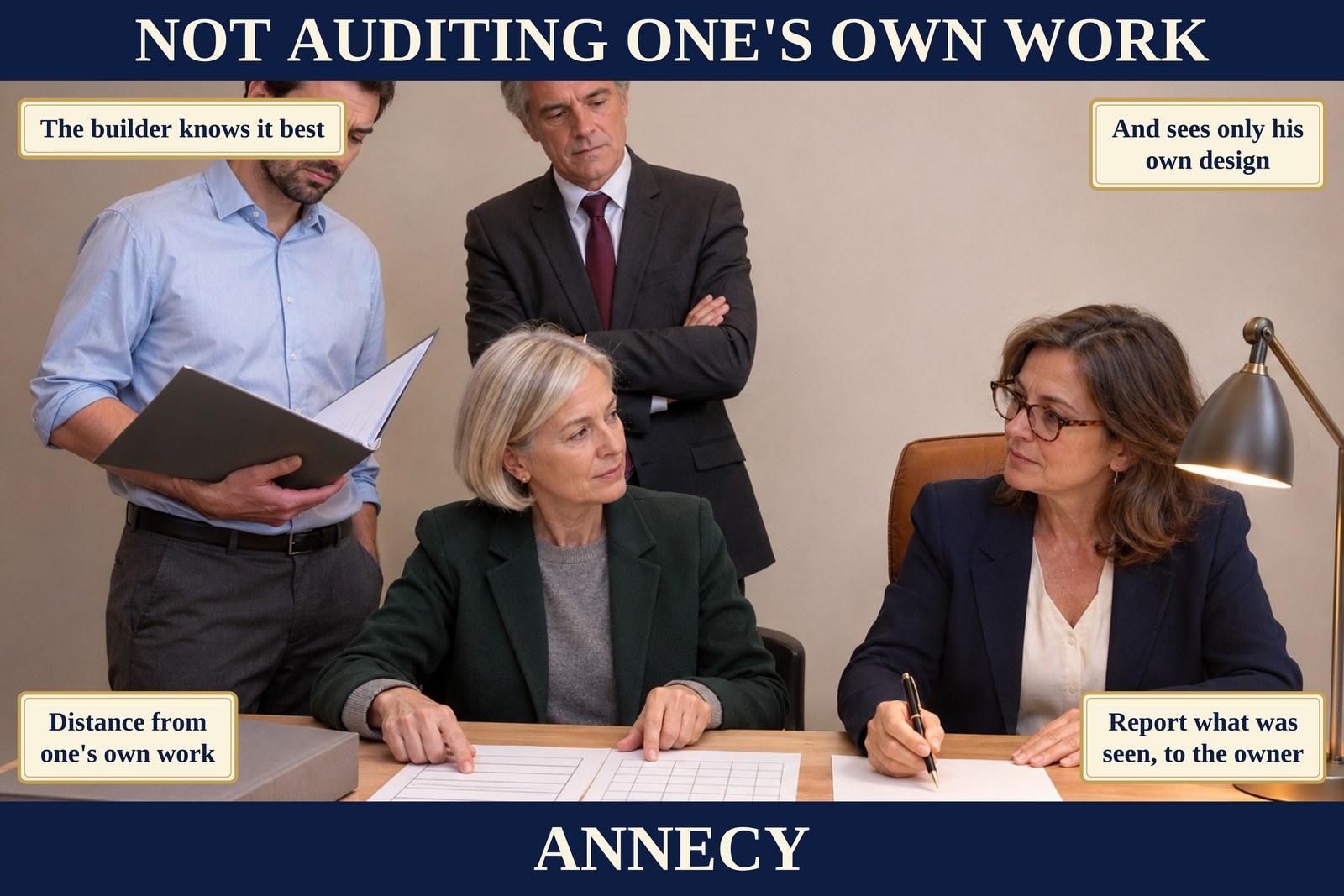
Concept Card 3.1 — Not Auditing One’s Own Work
Subchapter 3.1 · Annecy, France
Setting: Annecy, France
The owner's office of the lakeside hotel on a quiet August afternoon: pale plaster walls, a light oak desk, a brass desk lamp. Claire Duval, the owner, sits behind the desk in tortoiseshell glasses, pen above a blank mandate. Across from her Nathalie Rey, the independent auditor from Chambéry, rests two fingers on two sheets. Thomas Berthier, the events manager, stands reading his open grey binder; Marc Lenoir, the general manager, watches with arms folded.
The composition sets two kinds of knowledge against each other. On the left, held close, is the binder of sixty-four questions along the clauses, careful work by the man who built the system. At the centre, under the auditor's fingers, lie the two sheets he could bring back from a July party: a banquet form and a night round form. The audit begins with one real event, not with the builder's list.
The four plaques read as one argument. The builder knows it best, and sees only his own design: whoever made the system audits whether operations follow his plan, and an open task stays an open task to him. What the standard asks for instead is distance from one's own work, not from a department; and the auditor's duty is to report what was seen, to the owner, without the report passing first through the person audited.
The plate does not accuse Berthier, whose offer was honourable and whose binder was good, nor Lenoir, who looked for distance in the wrong place. Nobody in the room is hiding anything. What it shows is the moment a hotel decides that independence means that nobody audits what he or she built or runs every day, and writes that into a one-page mandate before the audit begins.
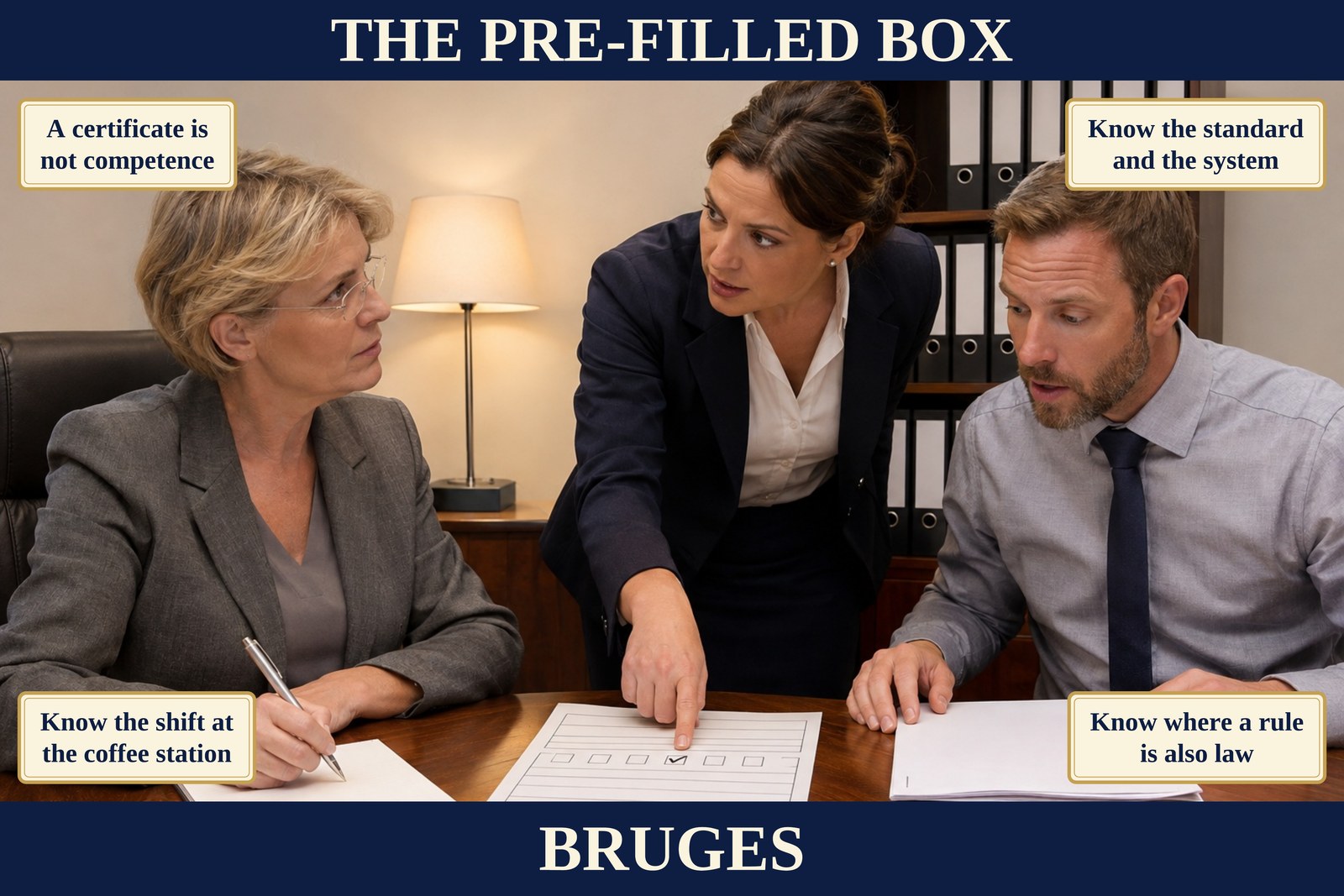
Concept Card 3.2 — The Pre-filled Box
Subchapter 3.2 · Bruges, Belgium
Setting: Bruges, Belgium
The general manager's office of a congress hotel near the convention centre, on a grey January morning under warm lamp light, a bookcase of plain binders behind. Griet Vermeulen, the general manager, sits on the left in rimless glasses and a grey suit, pen over a notepad. Ann Claeys, the front office manager, leans in and presses one finger on a banquet event order. Pieter De Smet, the quality manager, looks down at it in surprise.
Everything turns on the single ticked box under her finger. In the field for break crockery, reusable is marked; the software ticks it on every order, and nobody fills it in. The quality manager had sampled six such orders and found them complete. The front office manager, who has never audited anything, knew in one sentence what his course could not teach him, because the complaints land on her desk.
The four plaques read as one argument. A certificate is not competence: a lead auditor course teaches how to test records, not where a decision is made. The auditor must know the standard and the system, and must also know the shift at the coffee station, where 380 delegates meet 240 cups in twenty minutes. Finally the auditor must know where a rule is also law, enough to read the legal register, not to replace counsel.
The plate does not accuse De Smet, whose method was sound and whose report was accurate for what it tested; nobody had told him the field was pre-filled. It shows a hotel discovering that competence has three sources and a craft, and that only one of them comes with a certificate. The lesson is that a course teaches how to audit; only the coffee station teaches where the decision is made.
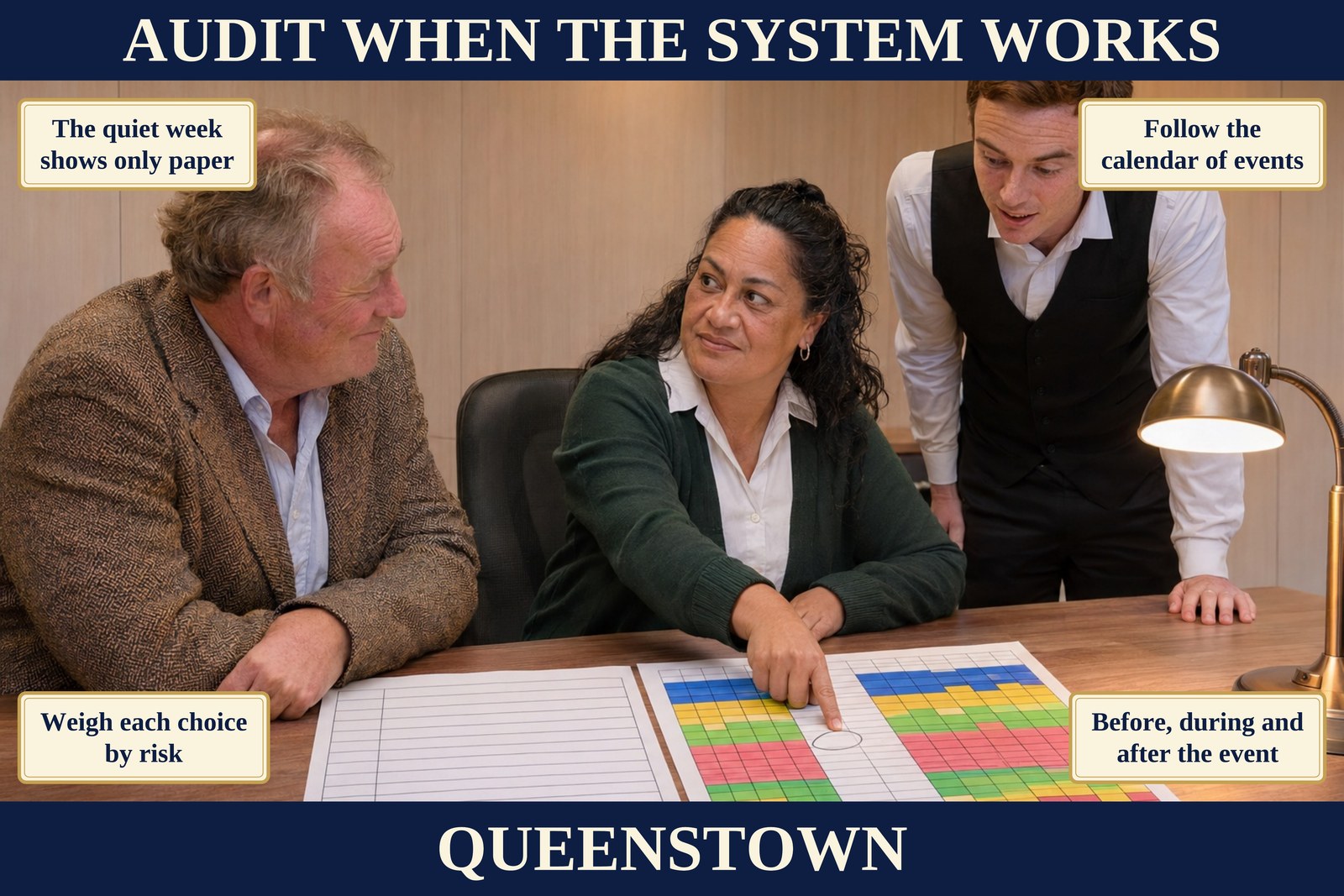
Concept Card 3.3 — Audit When the System Works
Subchapter 3.3 · Queenstown, New Zealand
Setting: Queenstown, New Zealand
The office of the quality and sustainability manager of a grand lakeside hotel, on an evening in late May between the seasons: timber panelling, a long desk, a brass lamp. Mere Tipene sits at the centre and points to one circled week on a large calendar. On her left the general manager, Hamish Wallace, in a tweed jacket, smiles with some scepticism. The banquet manager, Liam O'Connor, in a black waistcoat, leans over the sheets.
Two sheets lie side by side. On the left the audit plan, plain ruled rows along the clauses. On the right the year's events calendar, its coloured blocks dense through summer weddings and winter galas, and between them an empty column of weeks. Her finger rests on that gap, which is exactly where the audit has fallen for three years: the week in which the hotel has time and the system has nothing to do.
The four plaques read as one argument. The quiet week shows only paper, because the seasonal staff have gone and no wedding is running. The programme should therefore follow the calendar of events, choosing dates where the system works. It should weigh each choice by risk, giving weddings two dates and seminars none of their own, and it should place audits before, during and after the event, each phase at least once a year.
The plate does not accuse the two cross-auditors, who checked thoroughly what late May could show, nor the general manager, whose objection about January is a real one. The plan had been approved three times and nobody had asked for another. What the image shows is the moment a calendar reveals what an audit programme has been missing: an events system is audited at events, and the quiet weeks are kept for follow-up.

Concept Card 3.4 — Did You See It?
Subchapter 3.4 · Gdańsk, Poland
Setting: Gdańsk, Poland
The service yard behind a beach hotel at ten past six on a Monday morning in May, in cool low light with long shadows. A collection driver in a high-visibility orange jacket and work gloves guides a brown food-waste bin onto the lift of a white truck; four identical bins wait against the rendered wall. On the left, in a navy quilted jacket, the internal auditor, the head of housekeeping, writes in a small black notebook.
Behind the auditor, through an open door, stands the platform scale in the waste room, its display dark, its plate empty. That is the centre of the picture, even though it sits in the background. The five bins are leaving the hotel without ever crossing it, because the kitchen's early shift starts at half past six. The auditor does not stop the driver; he notes the time and the number.
The four plaques read as one argument. The binder says what was meant: twelve banquet orders, each with a figure for food waste. The yard shows what was done, at the hour the rule applies. The auditor reaches evidence through four routes, interview, observe, read, sample, chosen by the auditor rather than the department. And the finding appears only when he lays the sources side by side: weighing list against contractor invoice, fourteen bins missing.
The plate does not accuse the driver, who loads what he finds, nor the casuals who leave full bins by the back door, nor the banqueting manager whose orders were chosen in good faith for the first audit. Each source was credible on its own. What the image shows is the question the general manager asked of the first report, which of this did you see, and the lesson that a document shows what happened only when a second source agrees.
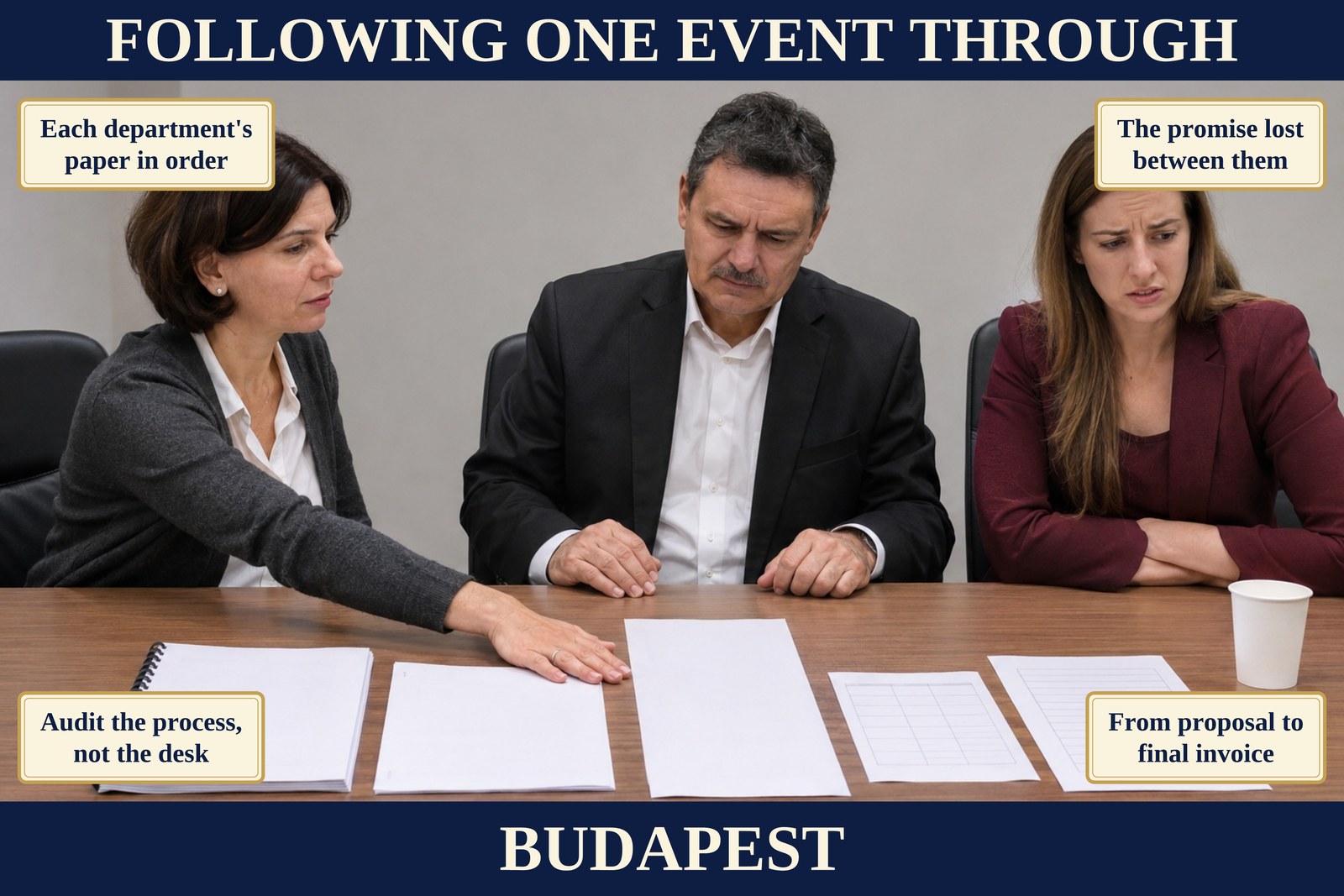
Concept Card 3.5 — Following One Event Through
Subchapter 3.5 · Budapest, Hungary
Setting: Budapest, Hungary
The banqueting office of a congress hotel on the Pest bank of the Danube, on a February morning under flat ceiling light; grey walls, a long wooden table. Eszter Varga, the financial controller and internal auditor, lays her hand on a row of papers. Gábor Tóth, the banqueting manager, studies his own banquet event order with a frown. Réka Szabó, the sales manager, sits with arms folded and an uneasy expression, close to a white paper cup.
Five documents lie in one line, in the order in which they were created: the bound proposal, the contract, the long banquet event order, the kitchen's weighing sheet and the invoice. At the far end stands the paper cup, the trace that started the audit. Each paper is complete in itself. The auditor's hand rests near the start of the row, where the promise of reusable ware left the proposal and never reached the working document.
The four plaques read as one argument. Each department's paper in order: sales promised correctly, banqueting wrote a complete form, the bar followed its house rule. Yet the promise lost between them is precisely what the client had asked for. So the auditor must audit the process, not the desk, choosing one real event and following it from proposal to final invoice, forward along the documents and backward along the traces.
The plate does not accuse the sales manager, who believed the promise kept, nor the banqueting manager, who filled in the template he was given, nor the bar, which banned glass on the terrace steps for a good reason. Every department was right by its own document. What it shows is a gap at a handover for which nobody was responsible, and the lesson that the process audit looks where the paper changes hands.
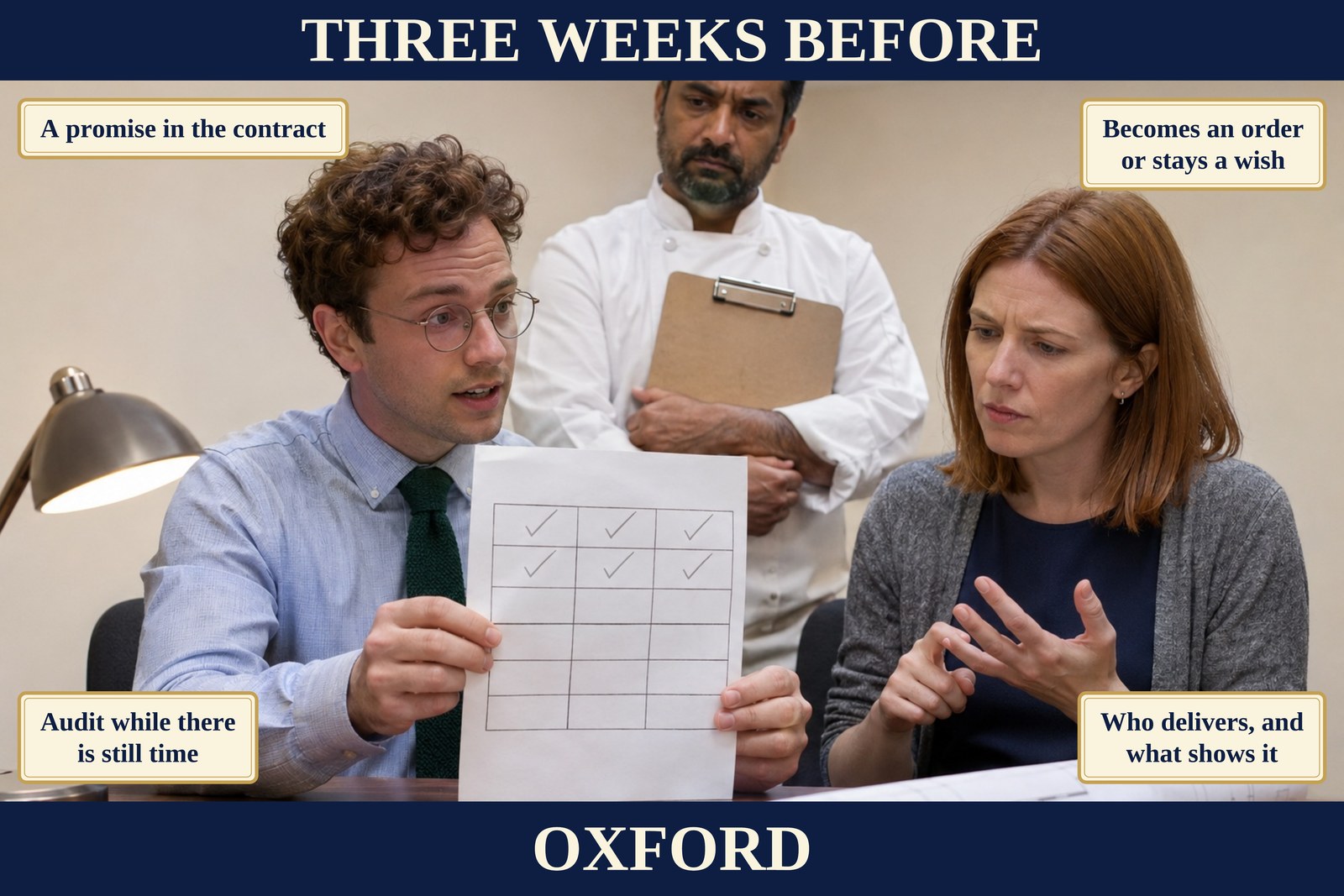
Concept Card 3.6 — Three Weeks Before
Subchapter 3.6 · Oxford, United Kingdom
Setting: Oxford, United Kingdom
The events office of a city centre hotel on a Monday morning in early September, under soft light and a desk lamp. Daniel Hughes, assistant to the general manager and internal auditor, sits in round wire glasses and a green knitted tie, holding up a single sheet. Beside him Hannah Price, the events manager, counts on her fingers with a tense face. Behind them the head chef, in white, holds a clipboard to his chest and listens gravely.
The sheet he holds is the commitments mirror: the six lines of the contract annex copied one below the other, three columns beside them. The top two rows are ticked, carafes and vegetarian lunches, both standard in the house. The four rows below are empty: regional produce never ordered, a workshop in a cellar fourteen steps down, travel information past its date, and no one tasked with the figures afterwards.
The four plaques read as one argument. A promise in the contract becomes an order or stays a wish; the grower in the Thames Valley needs ten days and twenty-one remain. That is why the auditor must audit while there is still time, three weeks ahead, when every line can still be changed. For each commitment the question is who delivers, and what shows it, both before the event and after it.
The plate does not accuse the events manager, who signed a reasonable annex and briefs every department before each large event, nor the chef, who found a grower in June. Nothing in the process asked anyone to turn a commitment into an order. The auditor does not ring the grower himself; he reports. The lesson is that before the event the audit looks at what can still be changed, and saving the event does not erase the finding.
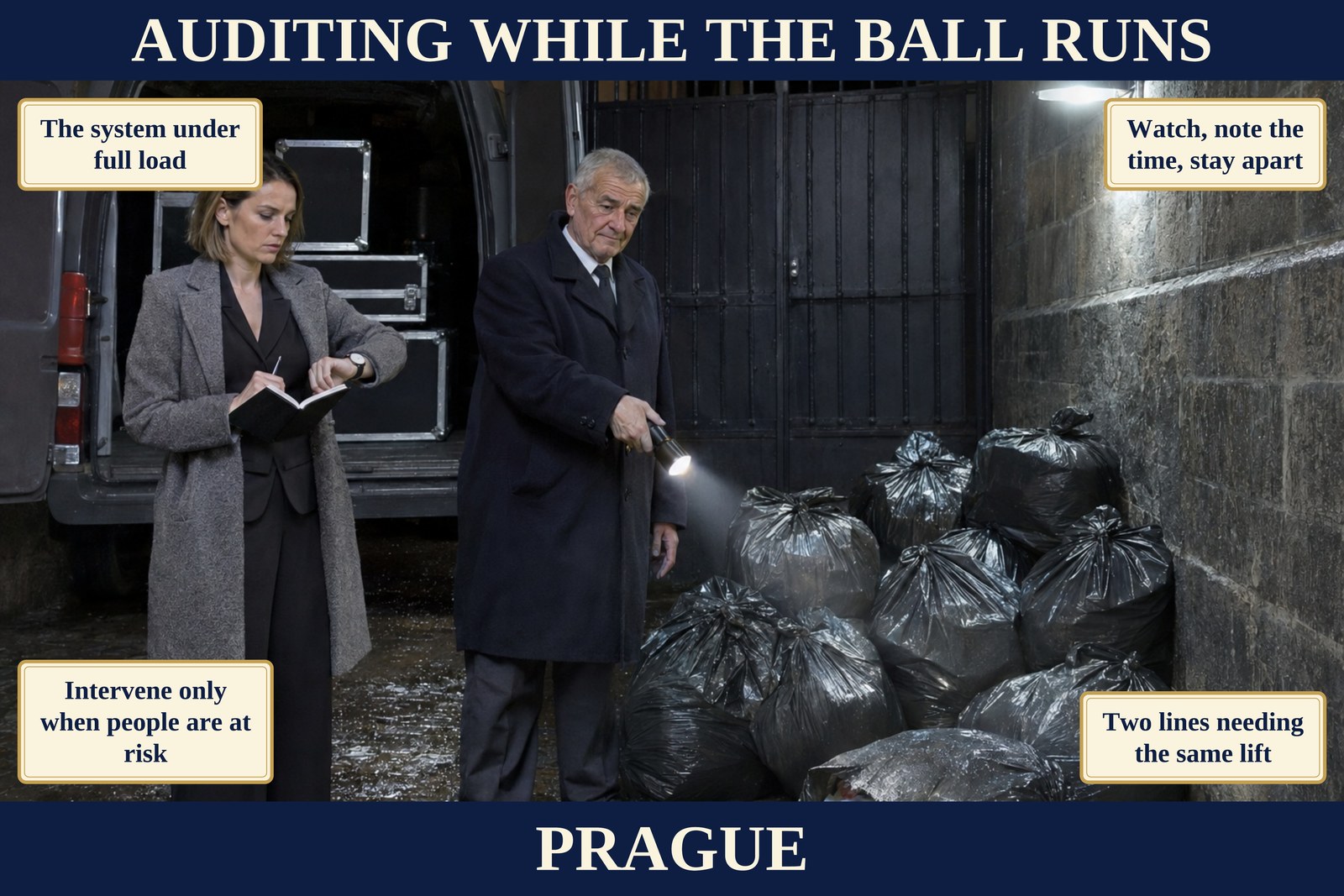
Concept Card 3.7 — Auditing While the Ball Runs
Subchapter 3.7 · Prague, Czech Republic
Setting: Prague, Czech Republic
The service yard behind a large hotel in Prague's New Town, at five past two on a February ball night, under one cold wall lamp: dark stone, wet cobbles, a closed iron gate. The night porter, grey-haired in a dark coat and tie, points a torch at a heap of black rubbish sacks. Beside him Kateřina Novotná, the revenue manager auditing banqueting, holds a black notebook and pen and checks the watch on her wrist.
Behind them stands the orchestra's van, rear doors open, instrument cases inside. That is the key to the picture. The sacks are by the gate because the service lift belongs to the orchestra's get-out from a quarter to two until three; the sacks will wait there until the early shift at five. The porter has written the same line on his round sheet for three balls. Tonight someone with a mandate is standing beside him.
The four plaques read as one argument. A ball night is the system under full load, and only then does effective implementation show itself. The auditor's rule is to watch, note the time, stay apart, and to intervene only when people are at risk, as she did once at a blocked emergency exit. Her finding on Monday is structural: two lines of the banquet event order, both needing the same lift.
The plate does not accuse the porter, who reported what he saw, nor the banqueting director, who was everywhere that night and whose every line was sensible on its own. Running a ball and watching how one's own system holds under load are different jobs. The lesson is that an auditor present while the event runs sees what no file contains on Monday, and one who intervenes saves an evening but loses the finding.

Concept Card 3.8 — The Morning After
Subchapter 3.8 · Bergen, Norway
Setting: Bergen, Norway
The service yard of a harbour hotel at half past seven on a Saturday morning in late June, in pale summer light against grey timber cladding. Two grey roll-off containers stand side by side. The night porter, white-bearded in a navy jacket over a white shirt, holds a phone in one hand and points into the full container with the other. Beside him Erlend Haugland, the maintenance manager and internal auditor, leans in with a notebook.
The cardboard container keeps what the night tried to forget: flattened cartons on top, and beneath them wooden pallets, stretch film and plastic planters of dried box shrubs. On the ground stand two tubs of leftovers under film beside a green food-waste bin, with no entry on the weighing sheet. The phone matters as much as the container: the porter's photographs, taken at four, are deleted every Sunday unless someone asks for them.
The four plaques read as one argument. The lesson written too early, saved at a quarter past eleven, said the breakdown had gone well before it began. The yard keeps what the note missed. So the auditor must read every record as it arrives over the following week, the weighbridge ticket, the agency invoice, the deployment list, and lay them side by side, because no single record knows the whole night.
The plate does not accuse the banqueting manager, who followed an order saying at the end of the event and whose shift ended at half past eleven, nor the kitchen, nor accounts, whose invoice matched the quotation. Every record was correct on its own. What the image shows is a porter who did not know whom to tell, and the lesson that only two records from different hands, read together, tell what the event was.

Concept Card 3.9 — Thirty-Eight Times Medium
Subchapter 3.9 · Whistler, Canada
Setting: Whistler, Canada
A small meeting room of a mountain congress hotel on a March morning, under warm light against pine boards; a round table of pale wood. Megan Clarke, the auditor from the sister hotel, sits with a pencil and lays a letter flat beside a long printed register. Ryan Tremblay, the sustainability coordinator, in a checked flannel shirt, rests his hands on an open folder with a rueful look. Patrick Leblanc, the general manager, stands behind and gestures with a question.
The register runs across three pages, and down every row runs the same small grey mark: thirty-eight issues, all rated medium, all justified by the same team meeting in October. The letter laid beside one row comes from the congress agency after the January highway closure, asking for a plan for natural hazards. It has been in the folder for weeks; the line for guest arrival and departure still carries its October rating.
The four plaques read as one argument. A wide register is a good start, and this one includes social issues and those the hotel only influences. But significance needs a reason: someone must be able to show who rated a line, by which criterion. What happened must reach the lines, so feedback is followed forwards until it lands somewhere. And the hotel's own procedure requires it to update after every season and every special event.
The plate does not accuse the coordinator, who gathered a broad set of issues and chose the middle rating out of caution, nor the team that handled the stranded delegates well. The auditor does not say whether medium is wrong; that is the hotel's decision by its own criteria. She asks whether the procedure holds, and whether the hotel can show why each line stands where it stands.
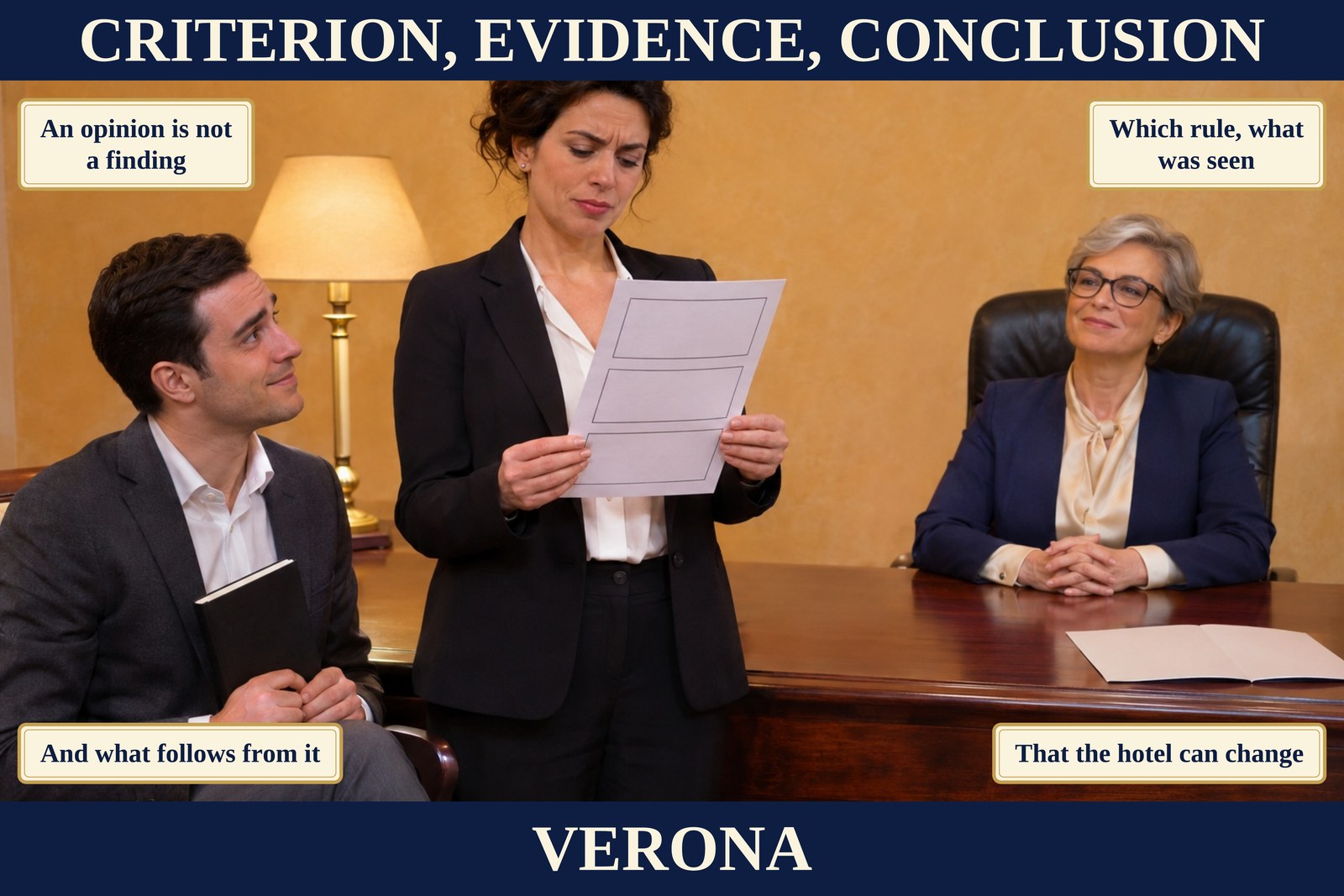
Concept Card 3.10 — Criterion, Evidence, Conclusion
Subchapter 3.10 · Verona, Italy
Setting: Verona, Italy
The general manager's office of a hotel on the Adige, on a Wednesday afternoon in October, in warm lamp light against ochre plaster. Giulia Marchetti, the banqueting manager, stands at the centre reading a single page with a wry, reluctant frown. Luca Ferrari, the head of front office and internal auditor, sits on the left with a closed notebook and watches her, hopeful. Chiara Bonetti, the general manager, sits behind a dark desk, hands folded, quietly satisfied.
The page in her hands is divided into three framed boxes, one above another. It is the first finding rewritten: criterion, evidence, conclusion. On the desk lies the earlier draft, set aside, twelve sentences of which three said major and one praised the team's mood. The picture is about that change of form. The same Friday evening, seen by the same auditor, has become something the banqueting manager can check and change.
The four plaques read as one argument. An opinion is not a finding: inadequate, insufficient and unattractive tell nobody what to do. A finding states which rule, what was seen, with place, time and document, and what follows from it, reaching exactly as far as the evidence. Written that way, it describes something that the hotel can change, and the person audited can agree with it without having to agree with the auditor.
The plate does not accuse Ferrari, whose observations were accurate and who had never been shown another way to write. Nor does it flatter the banqueting manager, whose nonconformities remain. What it shows is the moment a finding becomes usable: one bin out of three, frequency not established, photograph 17. The lesson is that a finding with criterion and evidence can be disputed or acted on, but not ignored.
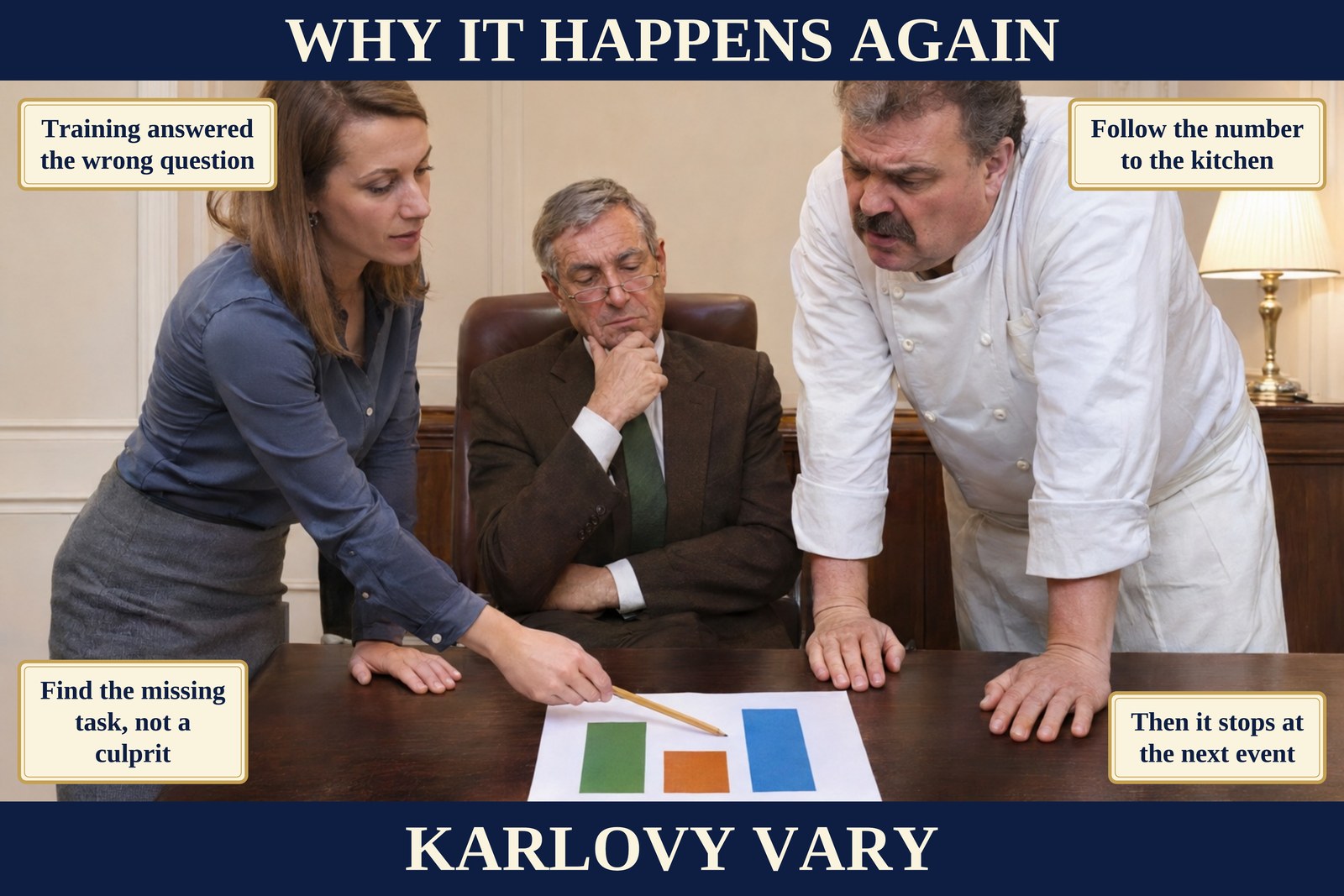
Concept Card 3.11 — Why It Happens Again
Subchapter 3.11 · Karlovy Vary, Czech Republic
Setting: Karlovy Vary, Czech Republic
The general manager's office of a turn-of-the-century spa hotel on an October morning, cream walls and stucco, a heavy dark desk and a side lamp. Lenka Horáková, assistant to the general manager and internal auditor, points with a pencil at a single sheet. Jiří Krejčí, the head chef, in white, leans over it with both hands on the desk, his frown turning to a question. Pavel Novotný, the general manager, sits silent, chin in hand.
The sheet holds three plain bars for the season's weddings: guests in the contract, guests actually seated, main courses cooked. The middle bar is clearly shorter; the right one is the tallest. Her pencil sits on the gap between them, twenty-one guests a wedding who were never there. The chef came in with folded arms; he has unfolded them because the bars point not at his portions but at the number he was given.
The four plaques read as one argument. Twice the finding was closed with training, and both times training answered the wrong question, how much to serve, rather than how many to cook for. So the auditor must follow the number to the kitchen, from contract to banquet order to the board. The task is to find the missing task, not a culprit: nobody carried the final count across. Then it stops at the next event.
The plate does not accuse the chef, who cooked exactly what the order told him and whose fear of an empty plate is real, nor the sales coordinator, who put the final number where her own work needed it. Both trainings were carried out honestly. What the image shows is the moment a recurring finding is read as the process speaking, and the cause is written by the function that owns it.
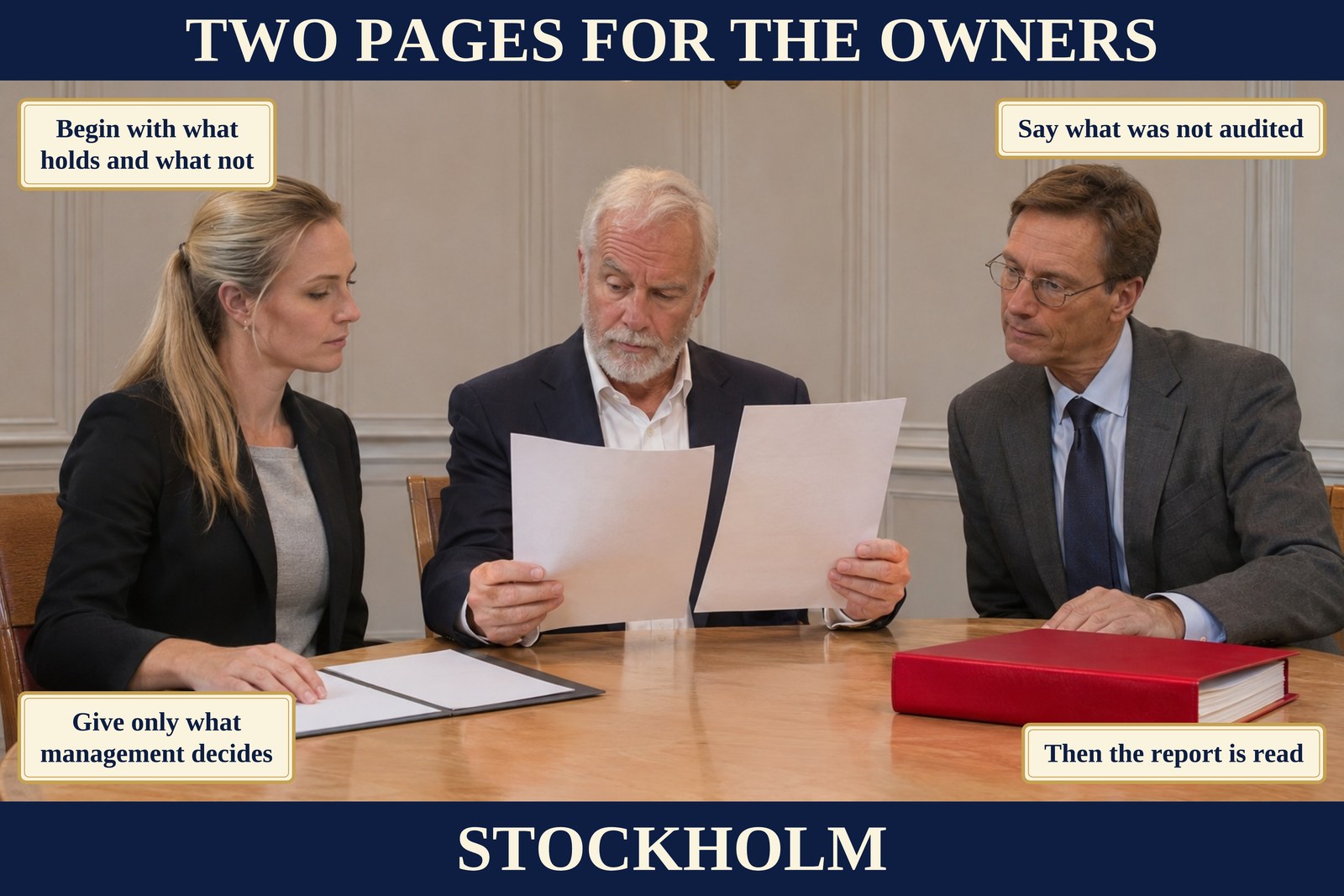
Concept Card 3.12 — Two Pages for the Owners
Subchapter 3.12 · Stockholm, Sweden
Setting: Stockholm, Sweden
The boardroom of a nineteenth-century villa hotel on the water, on an October afternoon: pale painted panelling, a polished birch table. Johan Lindqvist, the owners' representative, white-haired and bearded, holds two single pages and reads with full attention. On the left Maria Ekström, head of reservations and internal auditor, sits upright with a thin folder under her hand. On the right Erik Sandberg, the managing director, rests a hand near a thick red binder.
The red binder is last year's report: thirty-four pages, sixty-one findings, a page of unexplained traffic lights, sent for information and noted. It lies closed. The two pages in the owner's hands are this year's report, and the picture is built around the difference. One begins with a sentence on where the system holds and where it does not; the other was accurate and changed nothing.
The four plaques read as one argument. Begin with what holds and what not: the hall holds, garden parties above 120 guests do not. Say what was not audited, the Christmas parties and the night after breakdown, so the conclusion keeps its scope. Give only what management decides: make reusables possible in the park, or change the promise on the website. Then the report is read, in eight minutes, and ends in a question.
The plate does not accuse the authors of the red binder, whose findings were correct, nor the managing director, who forwarded it as reports had always been forwarded. The auditor shows the routes and does not choose between them; the decision stays with the owners. The lesson is that a report to the top is finished when its first page says whether the system holds and its second asks what only the top can decide.
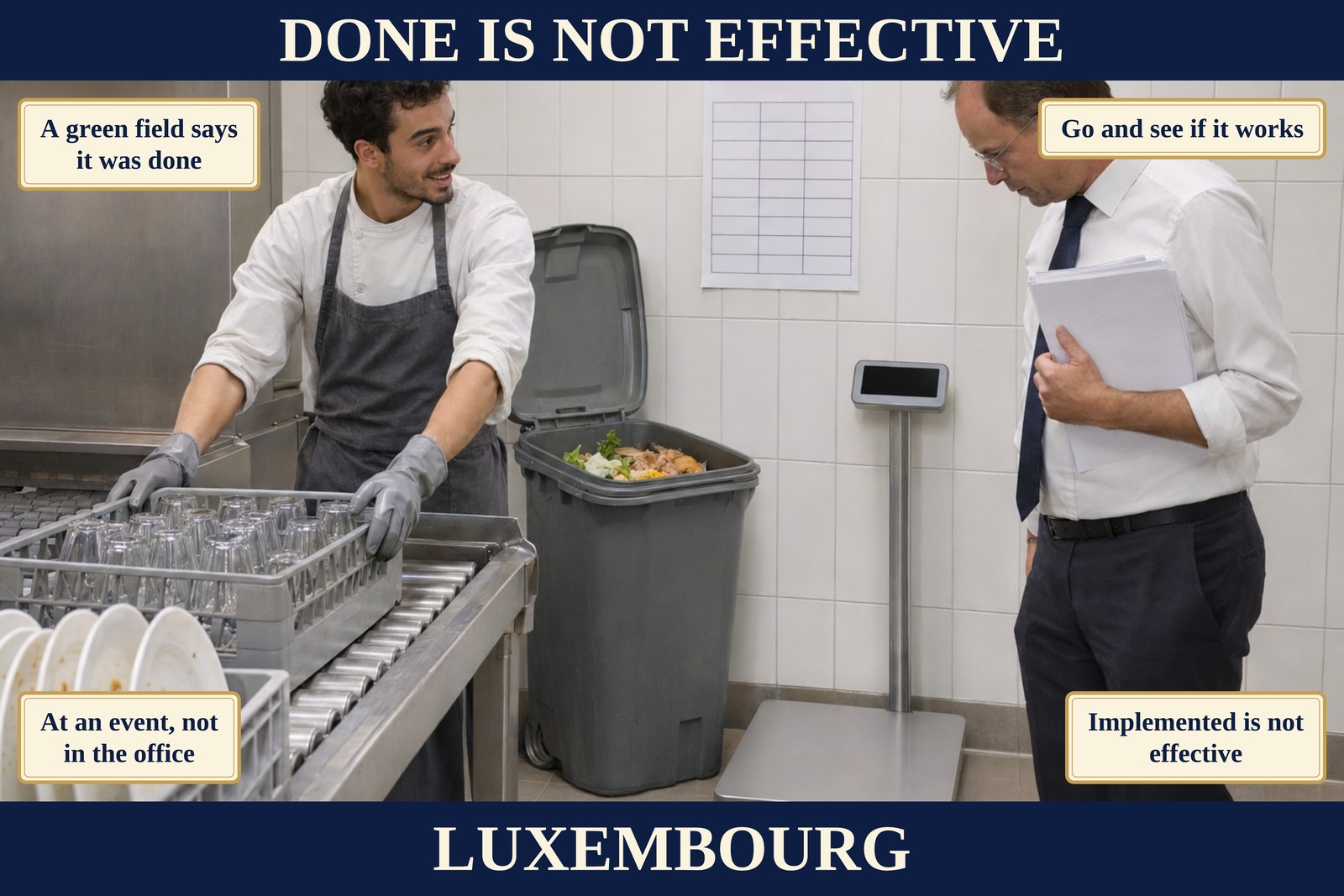
Concept Card 3.13 — Done Is Not Effective
Subchapter 3.13 · Luxembourg
Setting: Luxembourg
The dishwashing area of a business hotel at twenty to ten on a Thursday evening in late September, under bright white light against white tiles. A young dishwasher in an apron and grey gloves pushes a rack of glasses along the return conveyor and turns to explain, friendly and open. Luc Schmit, the finance manager and internal auditor, in shirtsleeves and tie, holds a stack of forms and looks down at a floor scale.
The new scale stands clean beside the conveyor, its display dark, its plate empty. Next to it a food-waste bin stands open, half full from the standing dinner in the foyer. Above it hangs the weighing sheet. The scale cost EUR 1,280 and its action turned green on the day it arrived; it is weighed only on Monday mornings, so none of the figures belongs to any event.
The four plaques read as one argument. A green field says it was done: the defined step took place. To know more, the auditor must go and see if it works, at an event, not in the office, at the hour the rule has to hold. There the difference becomes visible between an action carried out and an action that removes the cause, because implemented is not effective, and only the next event can prove the second.
The plate does not accuse the dishwasher, whose early shift arranged the weighing to fit its work and was never told each event needed its own figure, nor the banqueting manager, who answered exactly the question asked. Five actions were carried out. What the image shows is that only one could be shown to work, and the lesson that every action needs, from the day it is set, a sign of its effectiveness.

Concept Card 3.14 — The Promise and the Order
Subchapter 3.14 · Brussels, Belgium
Setting: Brussels, Belgium
The production kitchen of a family caterer in an industrial yard in Brussels, at nine on a Tuesday morning in July, under bright light, with crates of white china stacked behind. Elise Claes, head of reservations at the hotel and its internal auditor, in a hairnet and visitor's coat, lays one hand on each of two documents. The caterer, in chef's jacket and blue apron, scratches his cheek. Pieter Janssens, the purchasing manager, leans in, frowning.
Two papers lie on the steel worktop with bare metal between them. On the left the hotel's bound proposal to the federation, promising weighed food waste, a food bank and four waste streams. On the right the purchasing annex to the caterer, three short lines. The gap between them is the subject of the picture: nothing in the order carries the promise, so nobody will weigh anything at Saturday's party.
The four plaques read as one argument. The supplier does what is ordered, here reusable china and regional produce, faithfully. The promise to the client stays home, written by sales and never handed to purchasing. A supplier audit must therefore audit the link between them, order against promise, before it looks at how the supplier works. And where a promise is missing from the order, the gap belongs to the hotel, not to the caterer.
The plate does not accuse the caterer, who did exactly what his order said and would gladly give food to a food bank if asked, nor sales or purchasing, who each wrote carefully. It shows a second-party audit that examines two businesses at once. The lesson is that a supplier audit always examines the hotel that wrote the order, and that a missing line there is the hotel's own finding.
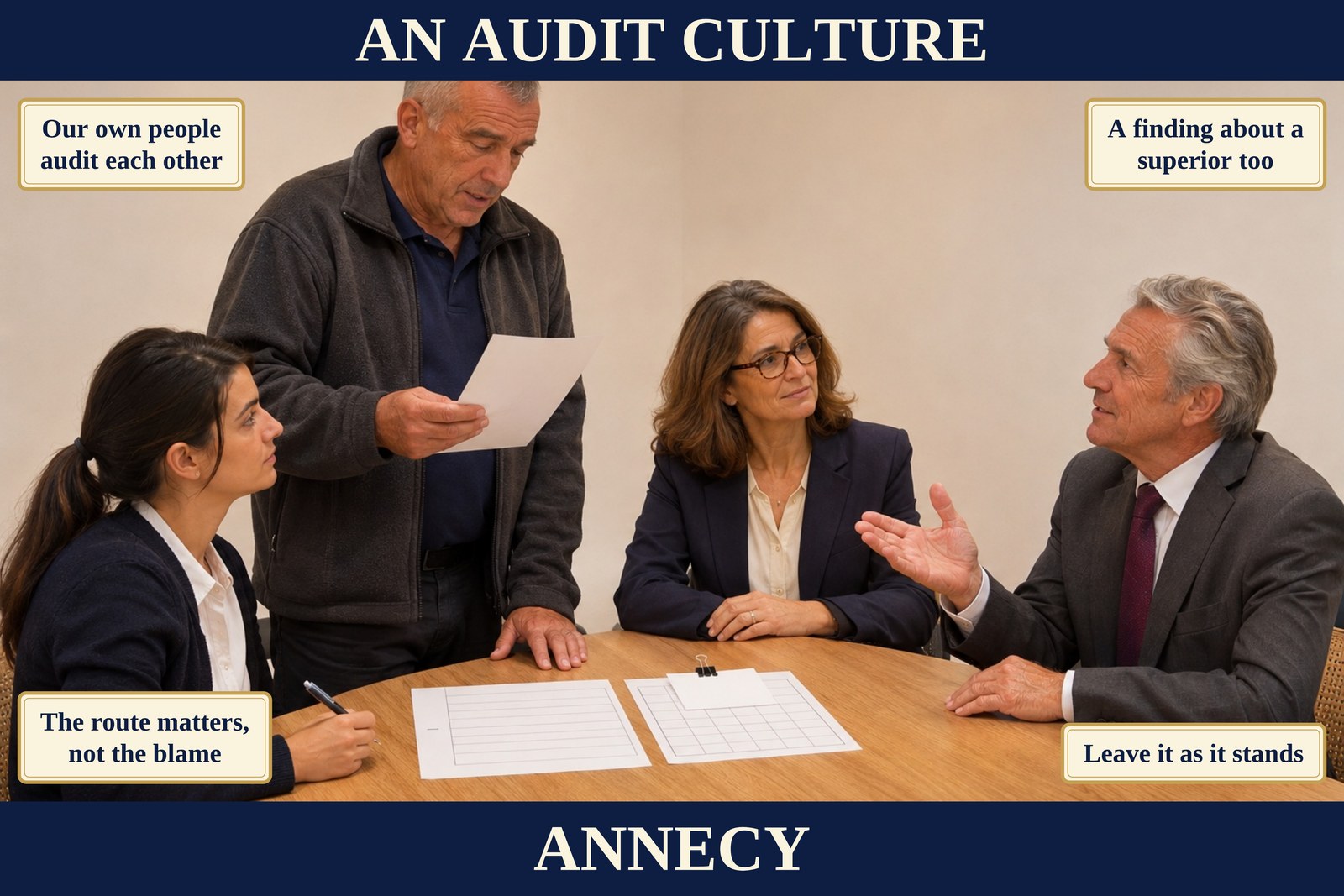
Concept Card 3.15 — An Audit Culture
Subchapter 3.15 · Annecy, France
Setting: Annecy, France
The smallest meeting room of the lakeside hotel on a September morning, plain white walls under warm light, a light oak table. Antoine Perrin, the maintenance manager and now an internal auditor, stands in a dark fleece and reads a finding aloud. Camille Fournier, receptionist and his fellow auditor, listens with a pen in hand. Claire Duval, the owner, sits quietly attentive. Marc Lenoir, the general manager, turns to him with an open hand.
Under Perrin's hand lie two sheets: the banquet form of 12 August, with one short line in the margin, and the night porter's round form with a slip clipped to it, left in Perrin's pigeonhole unasked. Together they show a change made by the general manager outside the route for changes. The picture's centre is not the paper but Lenoir's open hand: a superior accepting a finding about his own decision.
The four plaques read as one argument. Our own people audit each other: a receptionist audits maintenance, the maintenance manager audits banqueting. A finding about a superior too is written with the same criterion, evidence and conclusion as any other. The route matters, not the blame; Perrin does not say the decision was wrong, only that it bypassed the change record. And the answer from the top is the one that counts: leave it as it stands.
The plate does not accuse Lenoir, who decided under pressure in the client's interest when the agency had nobody, nor reward Perrin for courage; his finding is simply careful. It shows a hotel in its second year where reports arrive unasked and findings lead to processes, not culprits. The lesson is that an audit culture is recognised not by the first finding but by the answer to it, and the answer from the top weighs most.
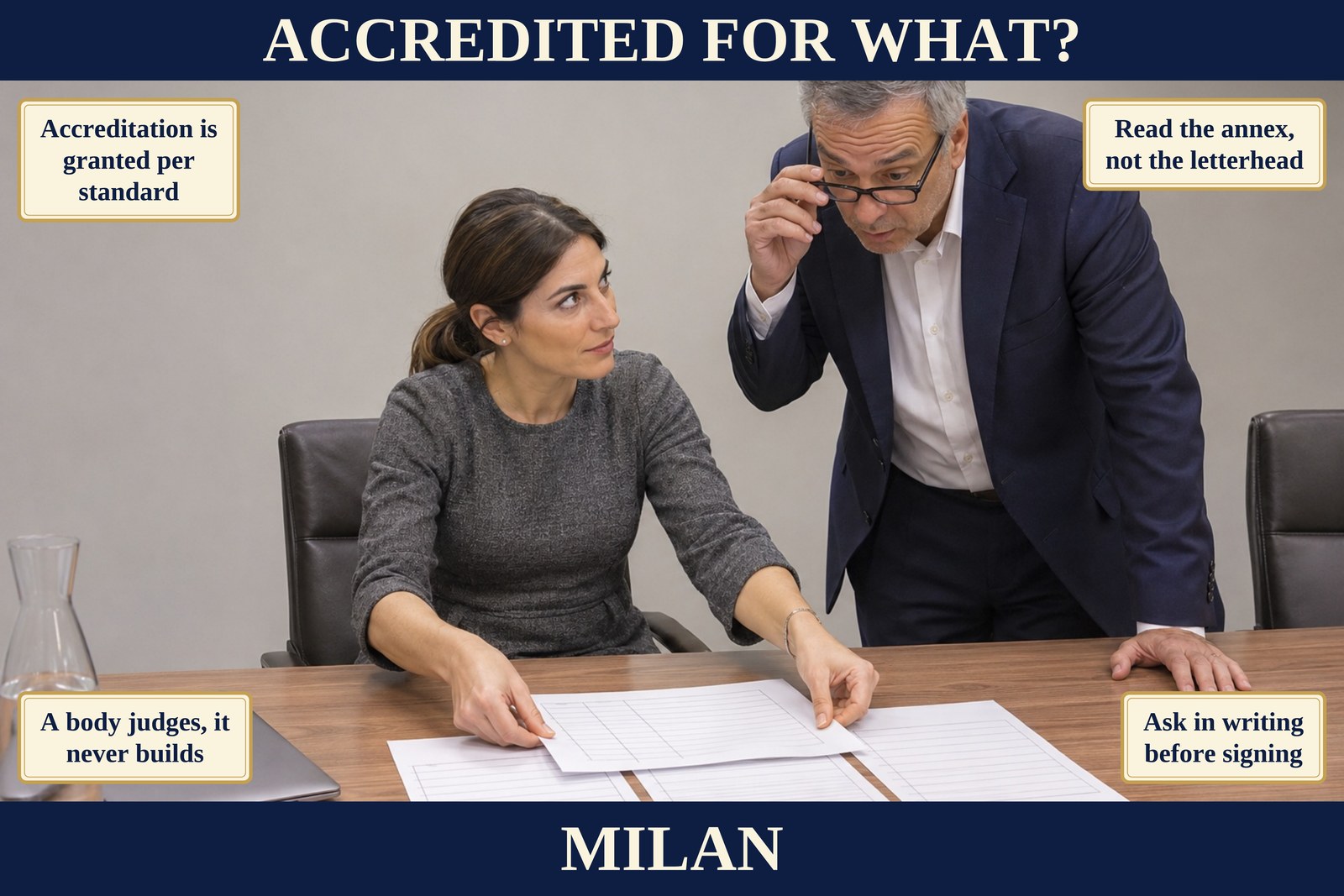
Concept Card 4.1 — Accredited for What?
Subchapter 4.1 · Milan, Italy
Setting: Milan, Italy
The meeting room of a large congress hotel beside the trade-fair grounds, under even white light: smooth grey walls, a long walnut table, dark leather chairs, a water carafe and a closed laptop pushed to one end. The sustainability manager, seated in a grey knitted dress, lays a single ruled sheet across the papers before her and looks up. The general manager, in a navy suit and open white shirt, leans over the table, one hand flat on its edge, the other at his glasses, studying the sheet.
The sheet in her hands is the annex to the accreditation certificate, and beneath it lie the three quotations, side by side. The general manager had already chosen the quotation whose letterhead used the word accredited. The composition places the annex above the letterhead, literally: the one page that lists what the body was actually examined for, and on which ISO 20121 does not appear. His surprise is the moment the word becomes a question.
The four plaques read as one argument. Accreditation is granted per standard, never to a body as a whole, so the hotel must read the annex, not the letterhead. A body judges, it never builds, which is why the consultancy offering a guaranteed certificate was offering something else entirely. And where accreditation does not cover the standard, the hotel must ask in writing before signing what no one else has checked: independence, the auditor, the decision, the handling of complaints.
The plate does not accuse the general manager, who read accredited as anyone reads a quality mark, nor the body, whose every sentence was true and only their order misled. The honest quotation had said the same thing plainly on its second page. What the image shows is a hotel learning that accreditation is the examination of the examiner, standard by standard, and that a hotel may claim only what the annex shows.
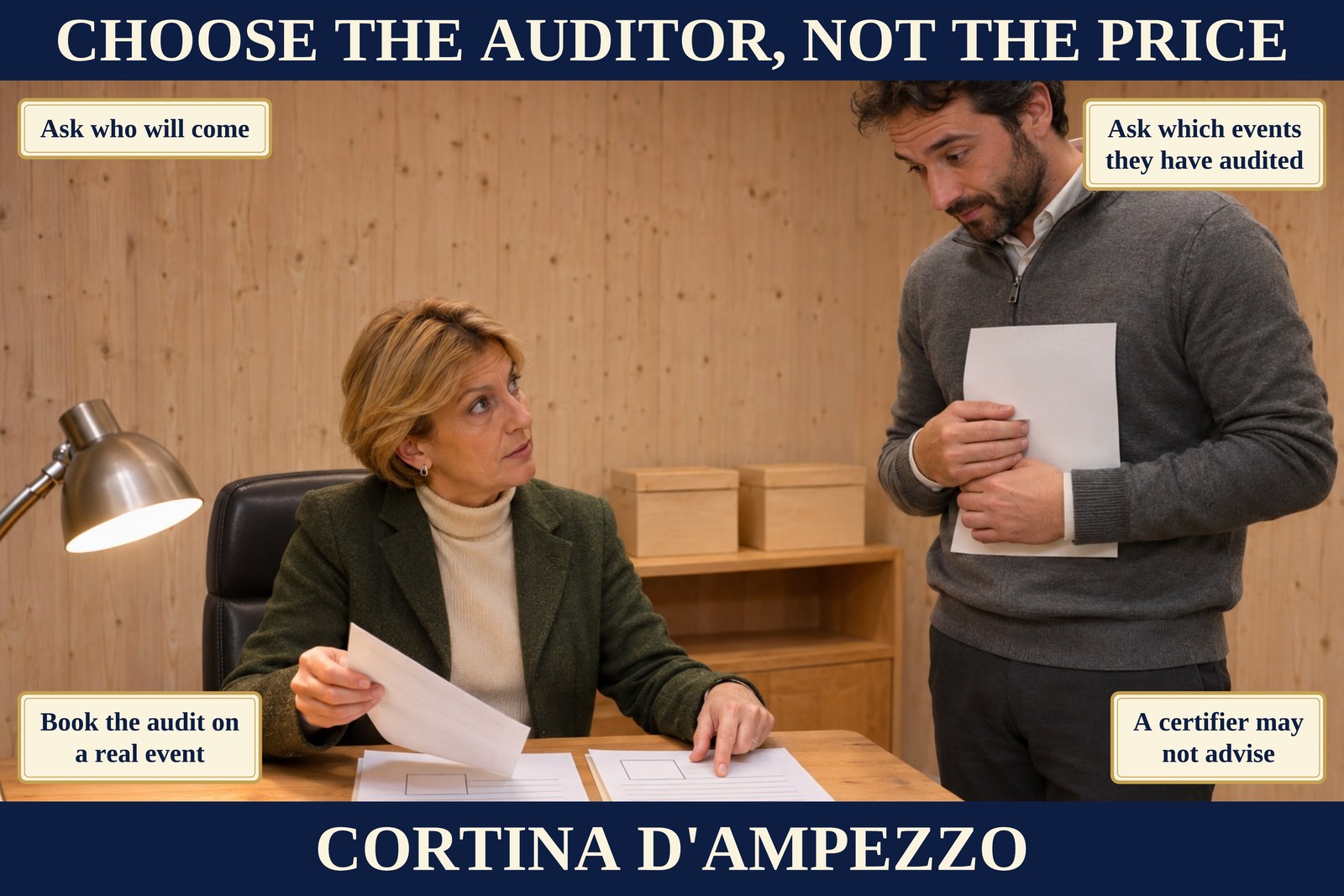
Concept Card 4.2 — Choose the Auditor, Not the Price
Subchapter 4.2 · Cortina d'Ampezzo, Italy
Setting: Cortina d'Ampezzo, Italy
The general manager's office of a conference and sports hotel, on a November afternoon: walls of pale larch panelling, a low shelf with two plain wooden boxes, a steel desk lamp casting warm light. The general manager, seated in a dark green wool jacket over a cream polo-neck, lifts one single-page curriculum in her right hand while her left index finger rests on the other, both laid over the quotations. The events manager stands across the desk in a grey quarter-zip jumper, a sheet held against his chest, looking down.
The two pages on the desk are the curricula of the auditors each body proposes, and they lie on top of the prices, which is the order the composition argues for. One belongs to an auditor from the food industry who has never audited an event; the other to an auditor who organised congresses for twelve years. The sheet the events manager holds is his recommendation for the cheaper quotation, written before anyone had asked who would come.
The four plaques read as one argument. Ask who will come, because a hotel engages a person, not a letterhead; then ask which events they have audited, since competence in events decides the questions an auditor will think to ask. Book the audit on a real event, not on an empty week in late April when the hut is closed and the seasonal staff have gone. And remember that a certifier may not advise, however kindly the request is put.
The plate does not accuse the events manager, whose recommendation followed the logic by which hotels buy bed linen and whose wish for a quiet week came from care for his team. Neither body claimed more than it held. What the image shows is the difference between two audits sold as the same certificate: the certificate looks alike from every body, and what differs is who looked beforehand, on which day and in which places.
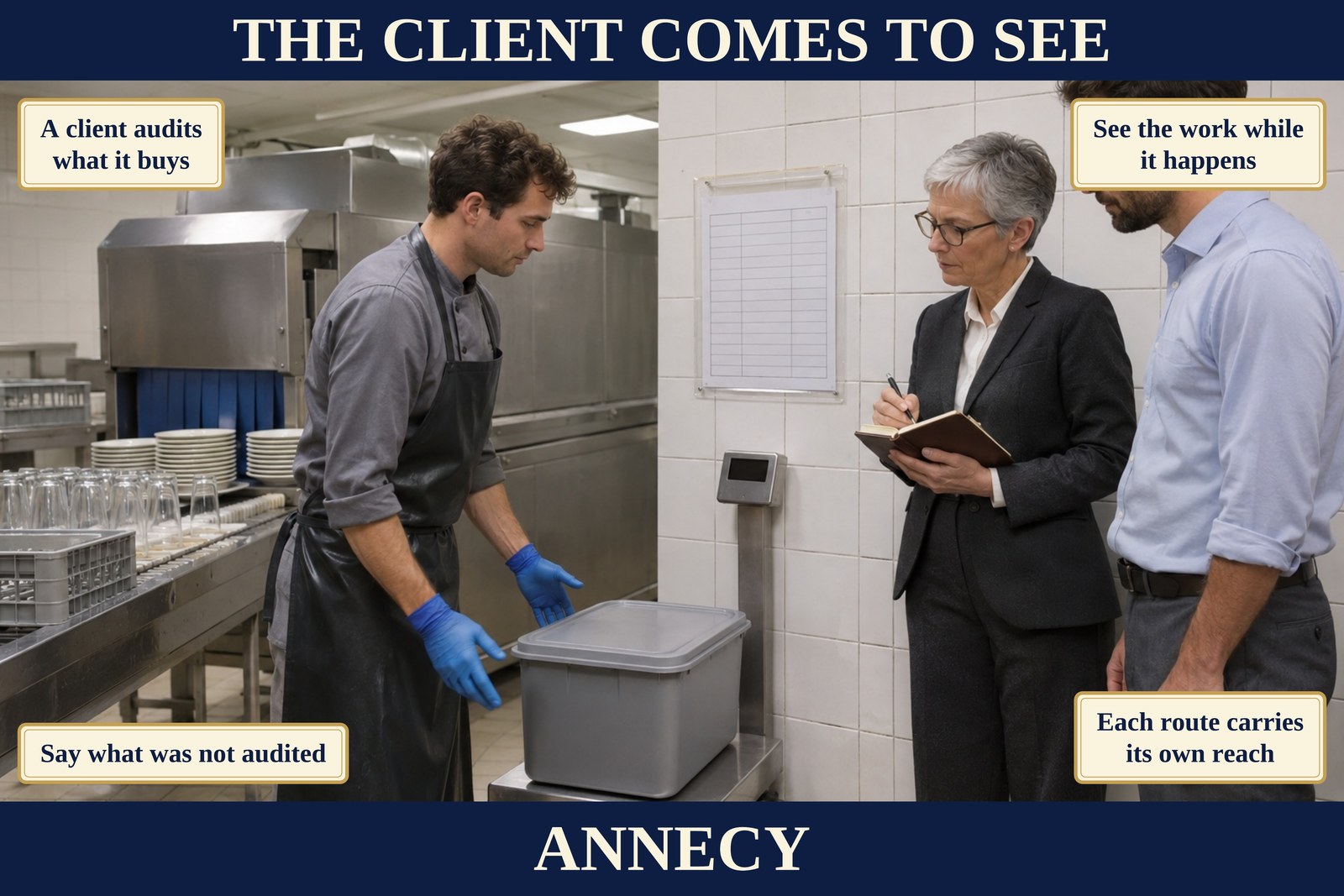
Concept Card 4.3 — The Client Comes to See
Subchapter 4.3 · Annecy, France
Setting: Annecy, France
The dishwashing area behind the ballroom kitchen of the lakeside hotel, close to midnight, under bright white light: white tiles, a long conveyor machine, racks of glasses and stacked plates from the reception. A dishwasher in a grey tunic, black rubber apron and blue gloves has just set a grey lidded container on a low floor scale whose display is dark. The association's counsel, in a charcoal trouser suit, writes in a small leather notebook. The events manager, in a light blue shirt, stands beside her and watches.
The container on the scale beside the clearing belt is the point of the picture. The scale was moved here in December, after the first internal audit, and the ruled list on the wall above it records every event weighed since. The counsel has not asked for the hotel's new binder of evidence; she has come to watch the first container weighed and to copy the figure herself. Her notebook is the client's own record, made while the work happens.
The four plaques read as one argument. A client audits what it buys, and the association buys rooms, catering, staffing and the care of its participants, nothing more. So it must see the work while it happens, here at twenty to midnight. An honest client will then say what was not audited: the management review, the evaluation against the guiding principles, weddings, other clients' seminars. Each route of demonstration carries its own reach, and this one reaches exactly as far as the association looked.
The plate does not accuse the general manager, whose binder was made in good faith, nor the counsel, who audited closely and said plainly where she had not. The hotel had issued a qualified self-declaration with three open nonconformities, and the client came to check it on its own ground. What the image teaches is that a hotel chooses its route of demonstration not by what it wants to say, but by who needs the statement, and for what.
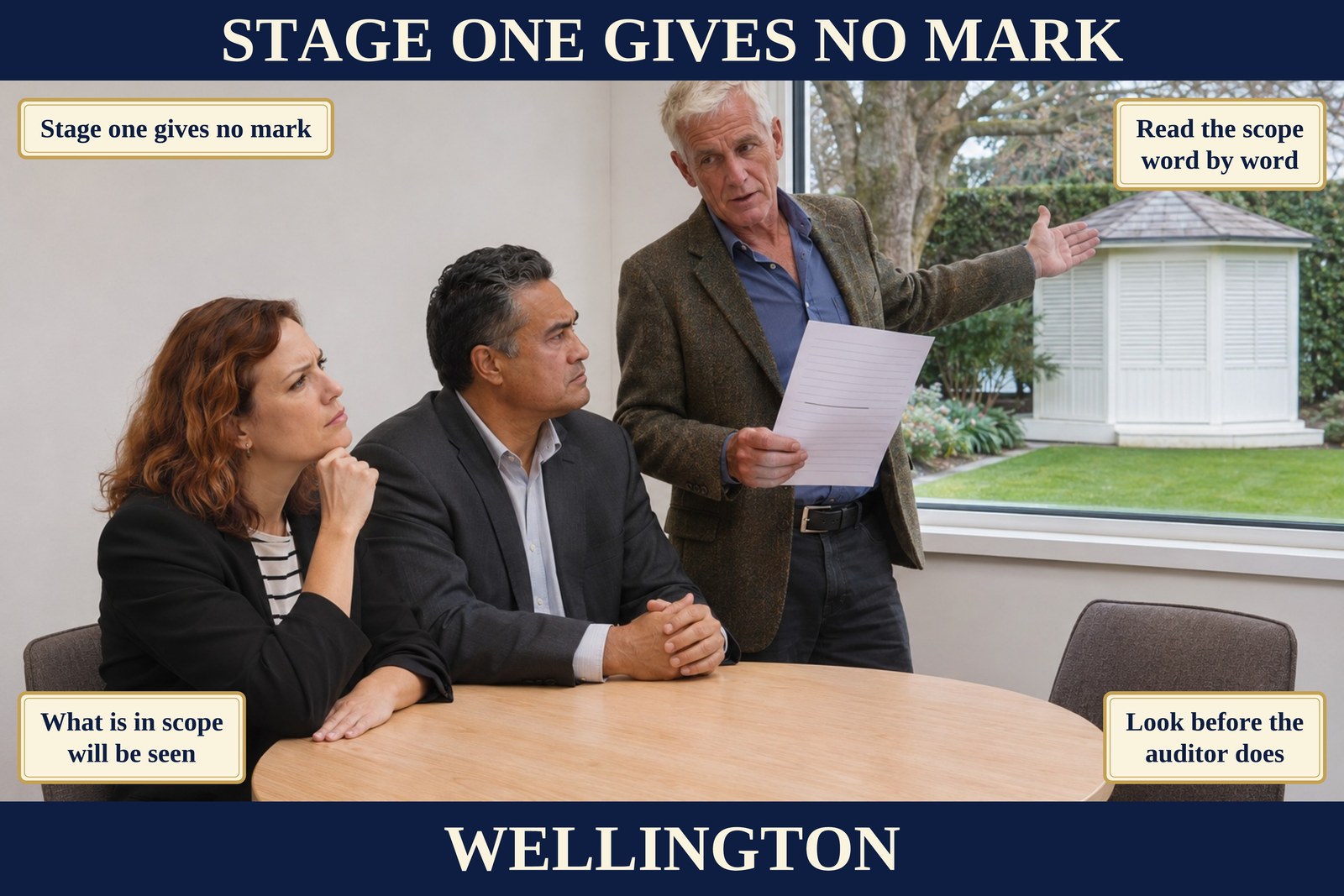
Concept Card 4.4 — Stage One Gives No Mark
Subchapter 4.4 · Wellington, New Zealand
Setting: Wellington, New Zealand
A small ground-floor meeting room of a city hotel on a grey September afternoon, late winter in Wellington: white walls, a round light timber table, and a wide window onto the hotel garden, its lawn, old trees and a white pavilion with every shutter closed. The certification auditor, white-haired, in a tweed jacket over a blue shirt, holds a single page and gestures towards the pavilion. The quality manager, chin on her fist, and the general manager, hands folded, follow his gesture in silence.
The page is the scope, and on it one short pencil line underlines three words: and the garden. The pavilion stands outside the glass, closed since April, and the composition sets the written sentence and the shuttered building side by side. The garden was in the scope but outside the measurements: no scales at the buffet trolley, no figures in the indicator sheet, no internal audit sample, no line in the legal register on amplified sound outdoors.
The four plaques read as one argument. Stage one gives no mark; it establishes whether the hotel is ready for stage two and what stage two must see. That is why the auditor reads the scope word by word, because what is in scope will be seen, whether or not the hotel has looked at it first. The last plaque is addressed to the hotel itself: look before the auditor does, and give each part of the scope its own trace.
The plate does not accuse the hotel. The garden events were real, the scope was not written to impress, and the internal auditor had worked properly within the months she was given. Nobody decided to leave the garden out; nobody decided how it would be measured, and so it was not. What the image shows is the first day an outsider lays the window of the audit beside the calendar of the year.

Concept Card 4.5 — Follow One Thing Through
Subchapter 4.5 · Dubai, United Arab Emirates
Setting: Dubai, United Arab Emirates
The stewarding area behind the ballroom kitchen of a large business hotel, at lunchtime during a trade fair: white tiles, steel benches, stacked plates, and a grey bin standing on a floor scale whose display is dark. An agency worker in a grey tunic, hairnet and blue gloves scrapes a plate into the bin and turns to answer. The certification auditor, in a navy trouser suit, holds a clipboard with a ruled weighing list. The banquet manager stands beside her, his open hand turned towards the worker.
The bin on the scale and the list on the auditor's clipboard are the two ends of one trail. The auditor did not ask for the objectives sheet; she followed a single figure, leftovers per cover, from the general manager's policy down to this scale and back. The worker knows exactly why she weighs. The question that matters is where the number of covers on the list comes from, and only the person at the belt can say.
The four plaques read as one argument. Effectiveness lives in traces, not in explanations, so the auditor will follow one figure to the scale and see how it arose. She will let the worker answer, because an answer given for someone else is a statement the hotel makes about itself. And the trail ends in a lesson for every indicator: define what the indicator counts, since a figure per cover is only as good as the cover count beneath it.
The plate does not accuse anyone in the stewarding area. The scale weighed correctly, the kitchen cooked to the right figure, and the supervisor copied the number he had been shown, the contract figure rather than the guests who ate. Nobody had fixed the denominator. What the image teaches is that effectiveness is not found in the binder; it is found by following one thing from management's signature to the scale and back again.
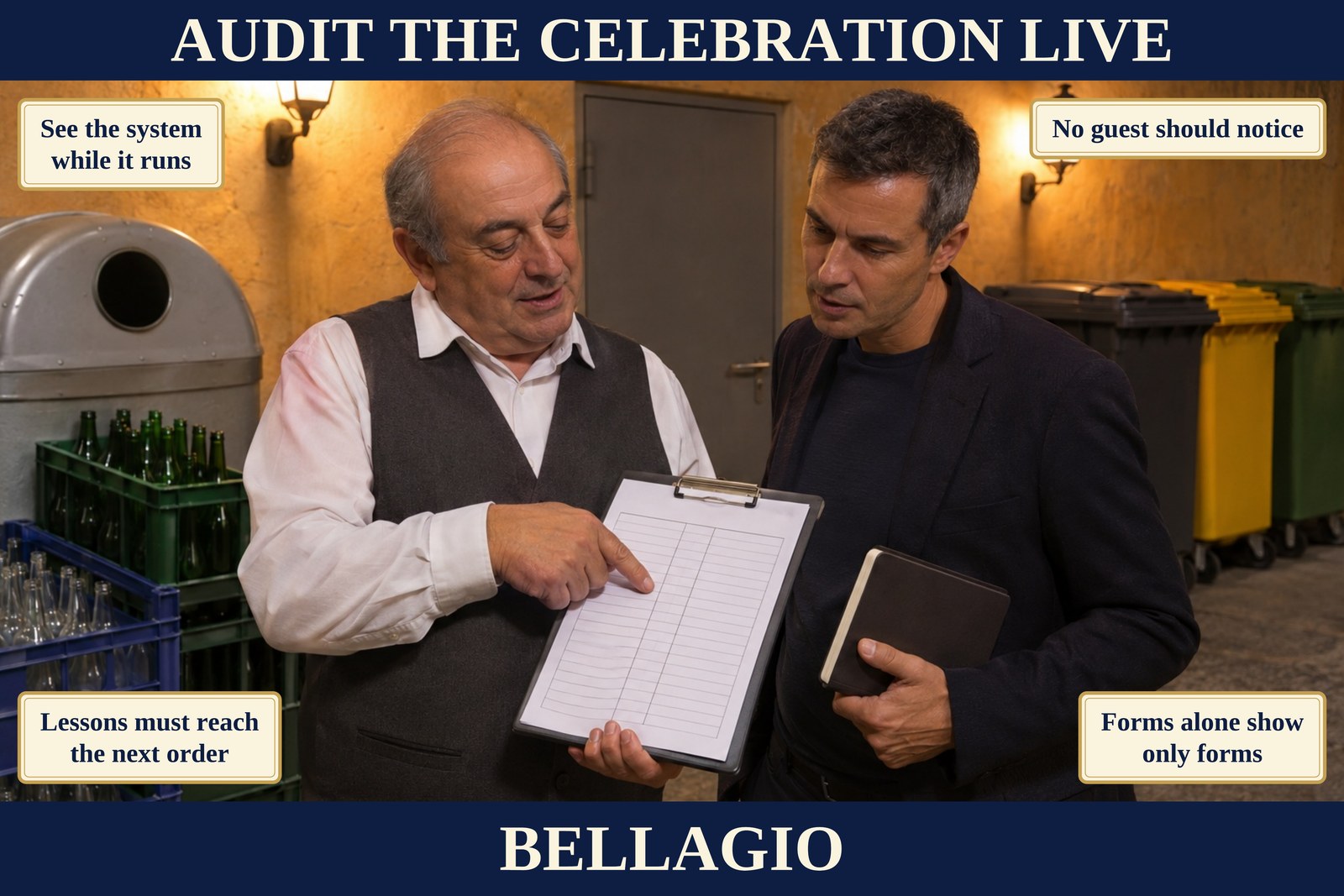
Concept Card 4.6 — Audit the Celebration Live
Subchapter 4.6 · Bellagio, Italy
Setting: Bellagio, Italy
The service courtyard of a lakeside wedding hotel at midnight on a summer Saturday, lit by two warm wall lamps on old ochre plaster: a closed service door, a grey glass bank with its lid shut, crates of empty bottles beside it, wheeled bins along the wall. The night porter, in a dark grey waistcoat over a white shirt, points at a ruled sheet on his clipboard. The auditor, in a plain dark jacket without a badge, holds a closed notebook and leans in to read.
The sheet is the porter's round form, with a column for each container, the time and anything unusual. It shows that the empties now wait in their crates until morning, a lesson the hotel turned into a rule. Leafing back, it also shows three June wedding nights with the same entries: a neighbour telephoned about the music, the doors were open because the hall was hot. The crates are the lesson learned; the sheet holds the one that never reached the next order.
The four plaques read as one argument. To see the system while it runs, the auditor must stay until the courtyard at midnight, and the hotel must agree rules so that no guest should notice he is there. What he finds is that lessons must reach the next order, not wait for the management review in October. On a quiet Tuesday he would have read the same notes and concluded nothing, because forms alone show only forms.
The plate does not accuse the server who opened the terrace doors in a hall at twenty-eight degrees, nor the porter, who wrote down exactly what he saw. The lessons notes were complete. What was missing was the step that carried one of them into the next banquet event order. The image teaches that an event system works while the celebration runs, and whoever audits only the other days audits the forms.

Concept Card 4.7 — Weigh the Gap, Not the Cases
Subchapter 4.7 · Bologna, Italy
Setting: Bologna, Italy
A small kitchen in the restored carriage house across the hotel courtyard, on a December evening, under a low vault of brick and a brass pendant lamp: white tiles, steel benches crowded with stacked plates and bowls from a party. A kitchen porter in a white jacket and apron tips a steel tray of leftovers into a brown organic bin. Just inside the room the general manager, in a dark red coat, watches with folded arms; the events manager beside her holds a hand to his chin.
Nothing in the room weighs anything. The courtyard kitchen serves the vaulted hall, where more than a third of the hotel's events take place, yet it had no scale, no weighing list and no internal audit, because the programme said kitchen and everyone read the main kitchen. The leftovers falling into the bin are the figures that never reached the management review, which declared the objective achieved for the whole house on the basis of half of it.
The four plaques read as one argument. Grade the effect, not the count: three orders without adjustment can be seen and corrected, while a blind spot weighs the most because it leaves a whole part of the system unexamined. The remedy is to audit every kitchen in scope, as the manual defines it rather than as the hotel speaks. And the hotel keeps one right: evidence can change a finding, though not a grading argued like a price.
The plate does not accuse the internal auditor, who read the word as the hotel uses it, nor the two managers, one counting cases and the other counting dates. Nobody hid the courtyard kitchen; nobody had ever looked at it. The image shows the evening after the closing meeting, when they crossed the courtyard to see for themselves. Cases can be counted, but a system must be judged.

Concept Card 4.8 — Find the Cause First
Subchapter 4.8 · Banff, Canada
Setting: Banff, Canada
A conference foyer of a mountain resort hotel at half past twelve in late November: pale timber and natural stone, a buffet in white cloth with a row of nine covered plates, each with a small folded white card in front of it. A cook in a white jacket and black apron holds up an event order sheet and gestures towards the plates. The certification auditor, in a teal jacket, holds a closed notebook and smiles; the banquet manager, in black, looks on with quiet relief.
The sheet in the cook's hand is the event order, and the nine plates are its proof. At the stage 2 audit, dietary and mobility notes from clients had reached no banquet order. Now the client's list arrived seven days ahead with nine notes, and all nine stand on the order with the initials of kitchen and engineering. The auditor asked the cook where he had the notes from. From the form, he answered, as for the wedding on Saturday.
The four plaques read as one argument. Training is not a cause: the cooks knew how to prepare the dishes, and what they lacked was the information that never left a mailbox. So a plan must name, for each finding, correction, cause, action, proof. The auditor will not say what the right action is, because the certifier does not advise. And the hotel cannot prove an action by a date on paper: proof shows at the next event, on the plates.
The plate does not accuse the general manager whose first plan, written in one evening, offered the same training for three different findings. Speed is the virtue every hotel teaches its managers. What the image shows is the result of a second attempt, in which someone followed one participant list from the email to the plate and found where it stopped. A body accepts a cause and the evidence that it is gone.
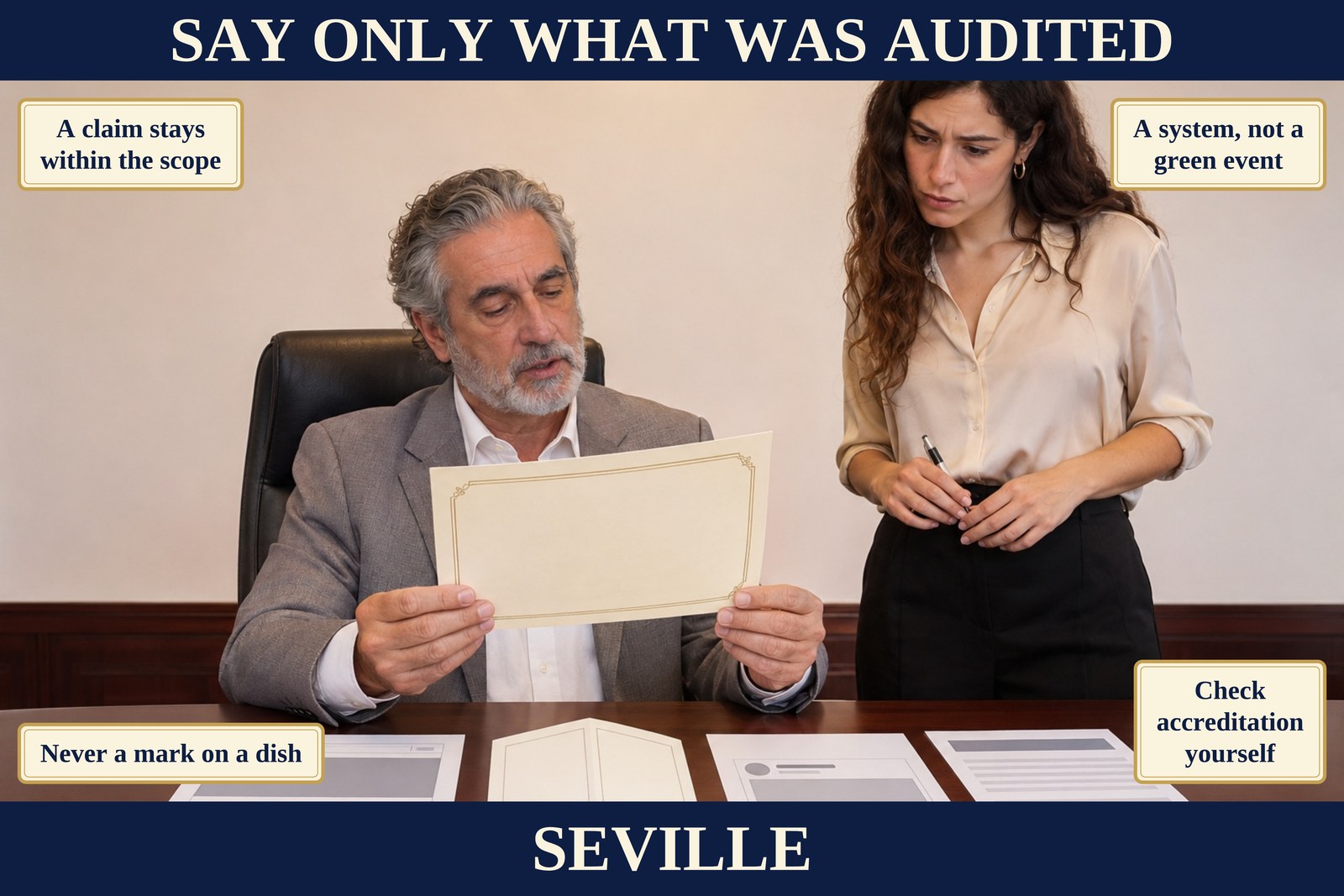
Concept Card 4.9 — Say Only What Was Audited
Subchapter 4.9 · Seville, Spain
Setting: Seville, Spain
The general manager's office of a city hotel on a March afternoon, under soft warm light: white plaster walls, a dark timber skirting, a broad dark wood desk. The general manager, grey-haired and bearded, in a light grey suit, holds up a cream certificate with a thin gold border and reads from it aloud. Before him lie four drafts side by side: a web page layout, a folded menu card, a printed social media post and a press release. The marketing manager, pen in hand, looks down at them, troubled.
The certificate he holds and the drafts on the desk speak in two different units. The drafts speak of the whole hotel, of sustainable events, of a mark on every menu, of an accredited body. The certificate speaks in one sentence of scope: the planning and delivery of conferences, congresses and banquets in the congress hall and four seminar rooms. He is reading that sentence aloud, and as he reads, each draft shrinks to what was actually audited.
The four plaques read as one argument. A claim stays within the scope, so the restaurant, the rooms and the rooftop terrace are outside it. What is certified is a system, not a green event, and so the mark is never a mark on a dish. The last plaque came from a telephone call that afternoon: check accreditation yourself, because the body was accredited for other standards, and the certificate had been issued without accreditation for ISO 20121.
The plate does not accuse the marketing manager, who invented nothing; each element of her drafts was true somewhere, and she wanted to show what the team had worked a year to earn. What none of the drafts did was say only what had been audited. The image shows the order of reading put right, scope before mark. A certificate carries every sentence that stays within its scope, and no sentence beyond it.

Concept Card 4.10 — The Habit Lost Its Reader
Subchapter 4.10 · Sapporo, Japan
Setting: Sapporo, Japan
Behind the terrace bar of a hotel at the foot of a ski hill, at dusk on a January race day: a timber counter and screen, snow and blue light beyond. Dirty reusable cups crowd the sink and the open glass washer below, and two opened cardboard boxes of white paper cups stand on the counter. The seasonal bar chief, in a padded jacket and apron, pulls out a paper cup with a shrug. The auditor, in a dark overcoat and grey scarf, writes in a small notebook.
The two open boxes are the finding. A year earlier the hotel's own lessons note for race day had recorded six hundred single-use cups and planned eight hundred reusable ones and a dishwasher until ten. The note sat in a folder; this year's event order had been copied from last year's proposal. The bar chief, who arrived in December, could not have known. The auditor writes down the time, twenty to six, and the number of boxes.
The four plaques read as one argument. Surveillance checks the habit, not the day of certification, and the habit here had stopped in May. Lessons must reach planning, as clause 9.1 c) requires of each event where applicable, or they remain sheets in a folder. That is why the auditor chose to audit the hardest day, a race evening with a reception in the hall. And the plate's title holds the last plaque: records need a reader.
The plate does not accuse the events manager who introduced the notes herself, nor the seasonal worker who did what bars do on race days. Nobody decided to stop learning; the notes had been written for the auditor, and after he left nobody asked for them. The image teaches that a certificate speaks of the day it was decided, while surveillance asks whether the system still writes its records when nobody is coming to read them.
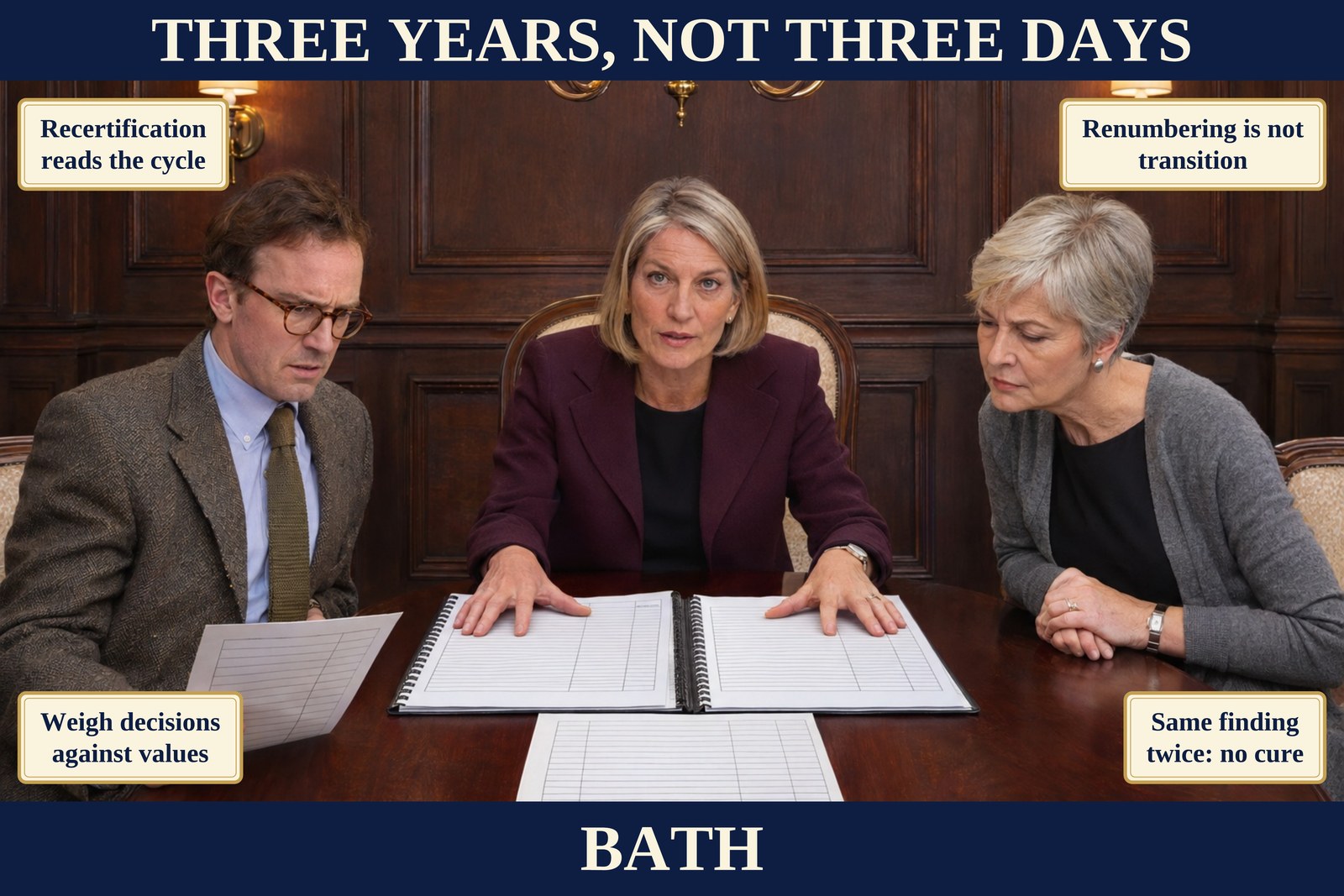
Concept Card 4.11 — Three Years, Not Three Days
Subchapter 4.11 · Bath, United Kingdom
Setting: Bath, United Kingdom
A panelled salon of a historic city hotel on a late January afternoon, under brass wall lamps: dark oak panelling and an oval mahogany table. At the head sits the certification auditor in a plum jacket, both hands flat on an open bound report, two ruled pages facing each other, a loose sheet before it. To one side the events manager, in tortoiseshell glasses, tweed and a knitted tie, frowns over his own list. To the other the general manager, silver-haired in a grey cardigan, leans in to read.
The open report under the auditor's hands stands for what she reads that afternoon: the two surveillance reports of the cycle, side by side, recording the same finding on food leftovers in different words. The list of sixty-four renumbered references, the events manager's careful preparation, has been set aside. It shows the system's new numbers; the reports show its last three years, and only the years are being audited.
The four plaques read as one argument. Recertification reads the cycle, not the three days of the visit. Renumbering is not transition: a heading renamed is not a frame, and the 2024 edition asks the hotel to weigh decisions against values, as nobody had done when bread for banquets moved to a cheaper wholesaler. And the reports carry the hardest sentence of the afternoon: same finding twice, no cure, because a new scale had corrected equipment where the cause lay in a rule.
The plate does not accuse the events manager, whose list was thorough and necessary, nor the general manager, whose purchasing decision was made in good faith. The scale had been a sincere answer to the first finding. What was missing was not effort but a look back across the cycle. The image teaches that a recertification lasts three days, while what it audits took three years to make, and those years are written in reports.
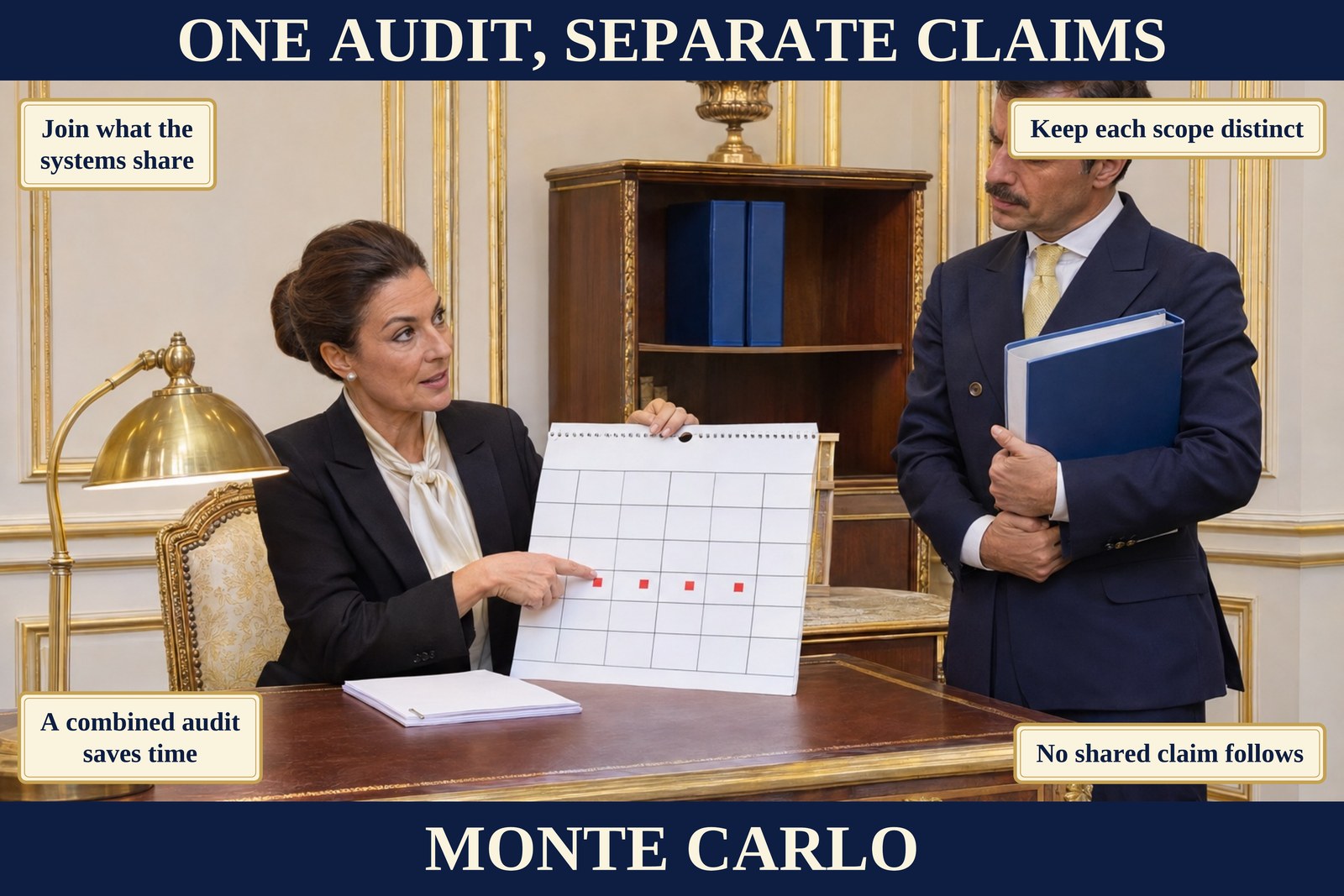
Concept Card 4.12 — One Audit, Separate Claims
Subchapter 4.12 · Monte Carlo, Monaco
Setting: Monte Carlo, Monaco
The general manager's office of a grand hotel on a February morning: ivory walls with gilded mouldings, a brass desk lamp, a Louis XVI desk, and behind it a shelf with two binders with blue spines. The general manager, in a black jacket and white silk blouse, holds up a calendar sheet and points at four small red marks in a single row; a stapled quotation lies beside her. The quality manager stands opposite in a navy double-breasted suit, a third blue binder held to his chest.
The four red marks are one department, banqueting, audited four times in a year: the quality internal audit in April, a client's audit in June, the environmental internal audit in October, the certification body's combined audit in November. Each time the banqueting manager told the same story under a different standard number. The blue binder is the draft of a third manual. Calendar and binder face each other across the desk as two ways of adding a standard.
The four plaques read as one argument. Join what the systems share: one policy, one document control, one corrective-action register, since the hotel has one banqueting department and one scullery. But keep each scope distinct, because ISO 14001 covers the whole hotel and ISO 20121 only its events, with requirements of its own. A combined audit saves time, removing only what the body would have seen twice. And from one shared audit no shared claim follows.
The plate does not accuse the quality manager, whose concern for the two scopes was entirely correct, and whose wish that the new standard should not be swallowed by the old ones was the right instinct. What the image shows is the small print the general manager had underlined: two certificates under accreditation and one without. A combined audit saves time, not content, and each certificate must still say exactly what it is.

Concept Card 4.13 — Say No More Than It Carries
Subchapter 4.13 · Rotorua, New Zealand
Setting: Rotorua, New Zealand
The general manager's office of a conference and spa hotel, on an October morning under bright daylight: white walls, a pale timber table, a green plant in a ceramic pot. The general manager, fair-haired, in a grey suit and open white shirt, runs a finger along one short line of a certificate lying on the table, reading aloud. Beside it lie a printed web page and, at the edge, a cream and green invitation card. The marketing manager, wearing a pounamu pendant, holds another printout and looks down, conceding.
The line under his finger is the scope: meetings, congresses and the hotel's own formats on its premises. The invitation beside the certificate is a bank's, announcing a certified green event and carrying the certification body's mark, sent from a logo pack the hotel handed over. The homepage places the same mark above four tiles, two of them outside the scope. The composition sets the narrow sentence among the wider ones that grew from it.
The four plaques read as one argument. A claim stays inside the scope, and a certificate is not a green event, only a statement about the system that plans and delivers events. Once the mark leaves the hotel, others' claims fall on you: the bank changed one word of the hotel's own proposal template. And when a participant writes that the certificate is greenwashing, the hotel must answer criticism with facts, not with the certificate itself.
The plate does not accuse the marketing manager, who wanted to show what the hotel had worked for, nor the bank, which wanted to honour its partner. The reviewer was right about the plates at the forest lodge, which lay outside the scope. The auditor's observation on the homepage had sat in a filed report for five months. A certificate protects a reputation only as far as the hotel says no more than it carries.
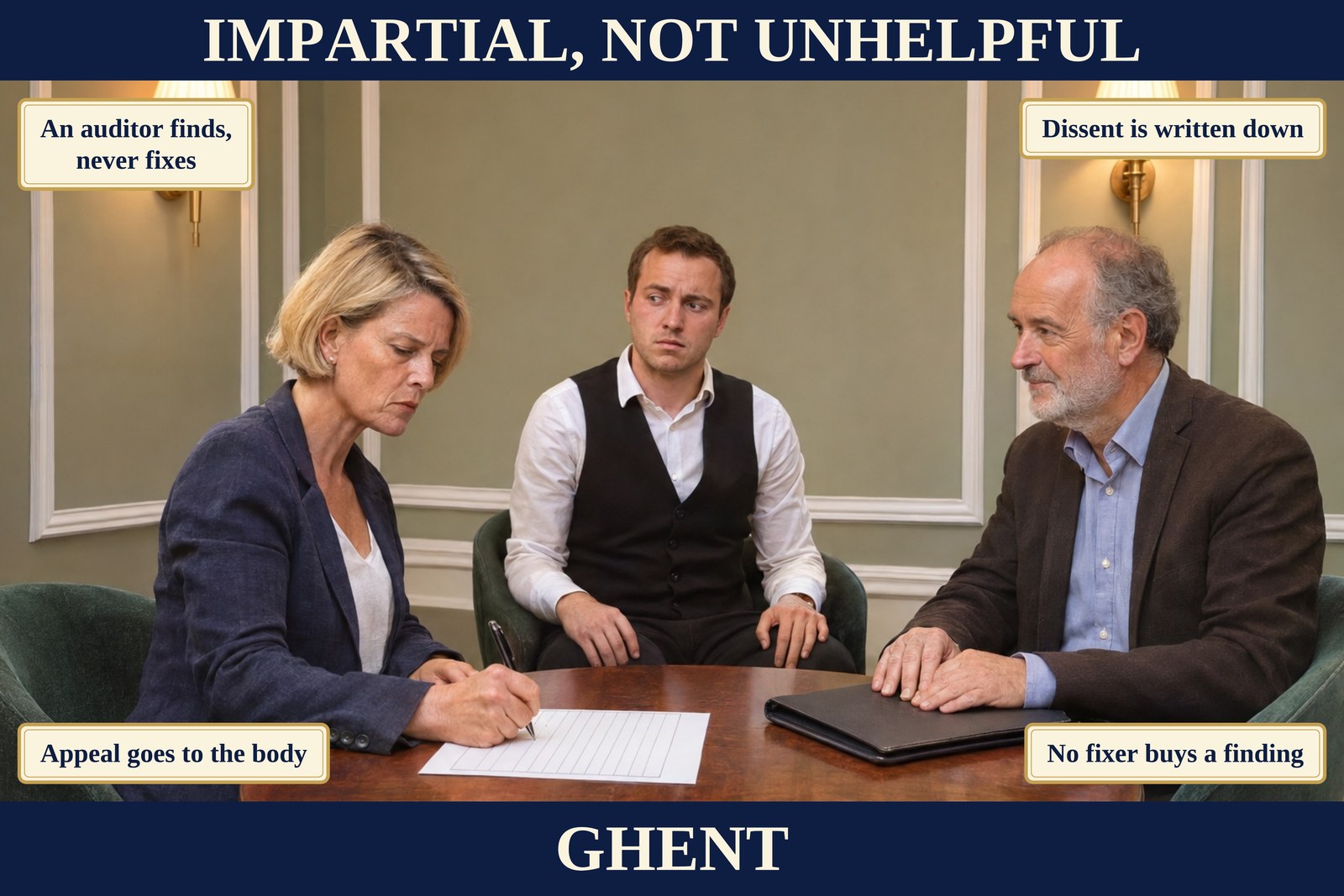
Concept Card 4.14 — Impartial, Not Unhelpful
Subchapter 4.14 · Ghent, Belgium
Setting: Ghent, Belgium
A small salon of a riverside hotel on a late August afternoon: sage green walls, white mouldings, two warm wall lamps, a round walnut table. The general manager, blonde, in a navy linen jacket, signs a single ruled sheet, her mouth set firmly. Across from her the certification auditor, grey-bearded, in a brown jacket and blue shirt, rests both hands on a closed folder and waits calmly. Between them the deputy banqueting manager, in a white shirt and black waistcoat, looks from one to the other, uneasy.
The sheet is the closing-meeting minutes, and the general manager is signing them with her disagreement added: not in agreement with the grading of finding 1. The auditor has recorded her dissenting view in her own words and explained the routes of complaint and appeal. The closed folder in front of him is the composition's other half. He has named the requirement and the evidence; the cause and the solution he leaves, deliberately, to the hotel.
The four plaques read as one argument. An auditor finds, never fixes: he cannot tell the hotel what belongs in its register. Dissent is written down, in the hotel's words, and the decision is taken at the certification body by someone not involved in the audit, so an appeal goes to the body, with evidence, not to the auditor. And when a consultant offers a preferred auditor for a fee, the rule is plain: no fixer buys a finding.
The plate does not accuse the general manager, who had built a terrace evaluation in good faith and was right that it existed, though it lay in a locked office and outside the register the system uses. Her frustration is that of a hotelier whose working life rewards helpfulness. What the image teaches is that impartiality is not a lack of help; it is what a hotel pays for when it engages an auditor rather than an adviser.
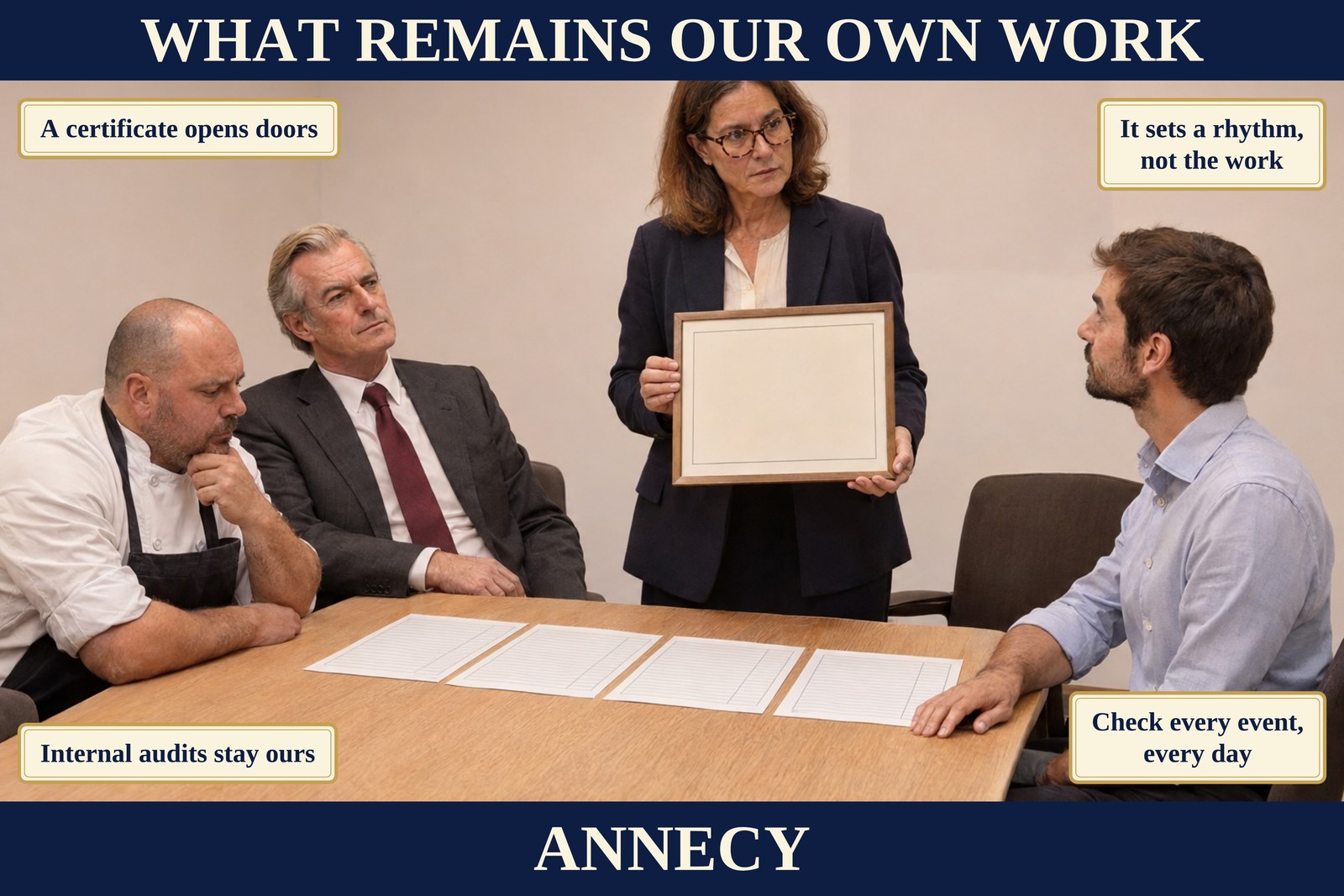
Concept Card 4.15 — What Remains Our Own Work
Subchapter 4.15 · Annecy, France
Setting: Annecy, France
The smallest meeting room of the lakeside hotel, plain walls under warm ceiling light, a rectangular light oak table. The owner stands at its head in a navy blazer and tortoiseshell glasses, holding a framed document in both hands above four ruled pages laid in a row. The chef, in a white jacket and black apron, frowns with a hand at his chin; the general manager, in a charcoal suit and burgundy tie, leans back. Opposite, the events manager keeps one hand flat beside his four pages.
The framed document is the self-declaration that has hung on the wall for a year, and the owner has just taken it down. The four pages beneath it are the events manager's decision paper: the year's figures, the internal audits, the clients' demands, the scope and the certification body's offer. She holds the old statement over the new evidence and asks what a certificate would let the hotel do that it cannot do today, and what it would still have to do itself.
The four plaques read as one argument. A certificate opens doors: the association from Paris, the engineering company and the insurer will accept it as evidence, though none promises a contract. It sets a rhythm, not the work, with an auditor in the house a few days a year. Internal audits stay ours, required by the standard and part of what is certified. And between two visits the hotel must check every event, every day.
The plate does not accuse the general manager, who wanted the whole scope and the mark on every page, nor the chef, whose question about dropping internal audits is the one most kitchens would ask. The owner decided to certify what the system carries, with weddings outside the certificate in the first cycle, and to list what continues. The self-declaration goes back on the wall; what holds between two visits remains the hotel's own work.
L’AUTORE