
The Helm and the Lens · English
Pronto per la pubblicazione / Ready for publication
the Helm and the Lens – Vol. 9a
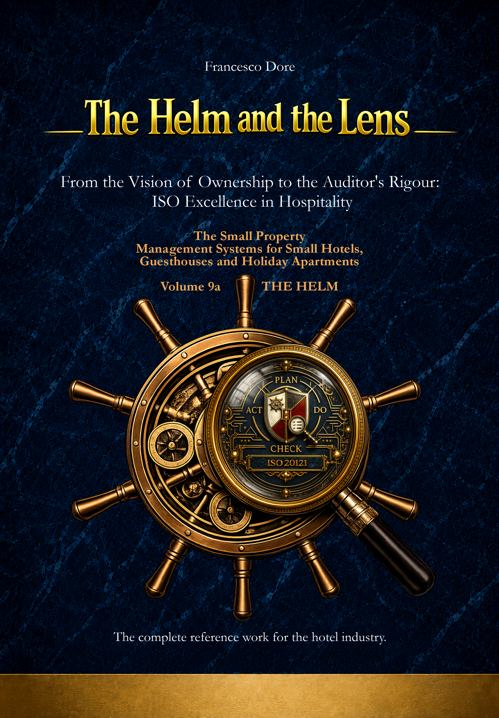
The Small Property · Management Systems for Small Hotels, Guesthouses and Holiday Apartments Volume 9a — The Helm
Management systems rebuilt for guesthouses, small hotels and holiday apartments, where one person often carries every role: what a small property must govern, what it can leave out, and how to start without a quality manager. Thirty cases, from Bohinj to Santorini.
539
Pagine
The Helm and the Lens · Volume 9a — The Helm
The Small Property · Management Systems for Small Hotels, Guesthouses and Holiday Apartments
One House, One Pair of Hands
Most books on management systems are written for organisations with departments, a quality manager and a meeting room. Most of the world’s guest beds are not in organisations like that. They sit in family guesthouses, small hotels and holiday apartments. There, the owner checks guests in, orders the bread, fixes the boiler, answers the reviews and, in the evening, fills in the forms. When that person is ill or on holiday, the house runs on memory and goodwill.
This volume starts from that reality and rebuilds the whole method for properties too small to carry their own coordinator. It does not shrink a large-hotel manual. It asks what the standards actually require, what they leave to the organisation’s judgement, and where the rules change with size. It also asks which proof a small house really needs: a classification, a label, a certificate, or simply records that hold up when a tour operator, a platform or an inspector asks.
The book has two chapters of fifteen subchapters each. The Vision of Ownership covers the decisions that belong to the owner or the owning family:
what a small property is, and what it already proves;
the harmonised structure shared by management-system standards, and proportionality;
size thresholds and the owner as a bottleneck;
family leadership, cost and return;
requirements from tour operators and platforms, and honest sustainability claims;
holiday apartments without a reception, seasonal staff and energy;
choosing the right proof, and a stepwise start.
The Operational Perspective follows the method into daily work, from the first booking to the last guest of the season, with tools sized for one or two people.
Every subchapter opens with a case set in a real place, built as a composite and clearly declared as fictional. A fourteen-room family guesthouse with two holiday apartments in Bohinj, Slovenia, opens the story and comes back to frame it. In the opening scene the owner faces forty questions from a tour operator and finds that she holds seven roles herself, four of them with no one to stand in for her. Each subchapter carries a Verification Pact, which keeps apart what a standard requires, what is guidance, and what is this book’s method. Figures in the cases are modelled, not sector data.
The author is a Lead Auditor and has spent over twenty years in hospitality, including small properties where the certificates on the wall came from the chamber of commerce, not from ISO. He writes as an author and publisher, for those who run small houses and those who will take them over. This is independent material, not affiliated with ISO or any certification, accreditation or scheme-owning body. Legal duties always need to be confirmed locally.
Each subchapter ends with a concept card. Worksheets, templates and the cards in high resolution are available on the online platform. The companion volume, 9b — The Lens, covers internal audit, inspections, labels and certification for small properties, and closes the series.
EDIZIONI · FORMATI
Formati disponibili
Le edizioni fisiche e digitali associate a questa scheda.
NEL LIBRO
Contenuto / Contents
La struttura del volume così come presentata nell’edizione pubblicata.
Table of Contents
- Preface.
- 1.1 One House, One Pair of Hands: What a Small Property Is.
- 1.2 The Certificates on the Wall: What a Small House Already Proves.
- 1.3 One Structure for Every Topic: The Harmonized Structure of Management-System Standards
- 1.4 Proportionality: What Standards and Guidance Say About Size.
- 1.5 Thresholds: Where Rules Change with Size.
- 1.6 The Owner as Bottleneck: Absence, Deputies and Knowledge Held in One Head
- 1.7 Family and Leadership: Who Decides in a Family Business.
- 1.8 What the Method Costs and What It Returns. 1
- 1.9 Requirements from Outside: Tour Operators, Platforms and Corporate Clients
- 1.10 Advertising with Sustainability: What a Small House May Say.
- 1.11 Holiday Apartments: Letting Without a Reception.
- 1.12 Staff in Small Houses: Seasonal Workers, Family and Helpers.
- 1.13 Energy and Resources Without an Energy Manager.
- 1.14 Label, Classification or Certificate: Which Proof Fits Which Property.
- 1.15 Starting Small: Scope and a Stepwise Plan.
- 2.1 Determining the Context on a Single Page.
- 2.2 Interested Parties in the Village.
- 2.3 Policy and Responsibilities: Five Sentences and a Board.
- 2.4 Risks and Opportunities with Simple Means.
- 2.5 Objectives and Indicators You Read off the Meter.
- 2.6 Competence and Induction: The Seasonal Worker’s First Day.
- 2.7 Health and Safety in a Small Business: Assessing Hazards Without an In-House Specialist
- 2.8 Documented Information: One Folder and One Directory on the Computer
- 2.9 The Guest from Enquiry to Departure: Registration, Data and Routines
- 2.10 Breakfast and Evening Kitchen: Hygiene with a Sense of Proportion.
- 2.11 Suppliers, Laundry and Tradespeople.
- 2.12 The Night Without a Porter: Emergencies, Fire Safety and Reachability
- 2.13 Measuring with What Is There: Meters, Complaints and Reviews.
- 2.14 Errors, Complaints and Corrections.
- 2.15 The Management Review at the Kitchen Table.
- Afterword.
- Appendix A..
- Sources and Research Methodology — What This Book Verified, and How..
- Glossary.
- About the Author.
- Contact.
- The Series.
- The Online Platform..
PRIMA DELL’ACQUISTO
Estratti / Extracts
Passaggi selezionati dal libro disponibili per la consultazione.
01 Preface Apri / Open
On Monday, 23 March 2026, when the last cross-country tracks above Lake Bohinj had turned to slush, Maja Kovač laid a questionnaire on the kitchen table of her family’s guesthouse in Ribčev Laz: fourteen rooms, two holiday apartments in the annex, a breakfast room and a small evening kitchen. A walking-tour operator that has sent groups every summer for nine years wanted forty questions answered on sustainability, safety and data protection by the end of April. Her son Luka said the house needed a system. Her mother Ana said they had always done it this way. When both had gone, Maja wrote down what she is in the house: owner, accounts, reception, purchasing, staff, breakfast cover and night duty, through the house phone diverted to the mobile on her bedside table. Under each role she wrote who covers it. For four of the seven lines there was nobody (1.1).
That evening she walked to the office, where frames have hung for years: her son’s cook’s diploma, a confirmation of allergen training, the star classification certificate, a letter of thanks from the local tourist board. There was no ISO certificate. More proof hung there than she had thought, and for the first time she asked what each sheet actually proves.
This volume begins with that wall, and with an honest observation. In decades of hospitality work the author of this book has seen many houses from the inside, and in small ones he has never seen a certified management system on the wall. There is no figure for this, and this volume gives none. It takes the observation for what it is: in many small houses no ISO certificate hangs, but much evidence does, and what is missing is the view that lays the two side by side (1.2).
Why This Volume, and Why at the End
This is the first of two volumes for small properties, and with its companion the series closes. The eight pairs before it each treated one standard or scheme. This volume rebuilds the method of the whole series for houses too small to carry a coordinator of their own: guesthouses, inns, family hotels, boutique hotels and holiday apartments. It rests on the common core of the management-system standards, on the questions the law asks of every small house wherever it stands, and on the author’s practice.
The method of the earlier volumes presupposes departments. In a house with fourteen rooms, owner, department and coordinator are the same person, often at the kitchen table in the evening with a sheet of paper. Whoever simply scales the method down asks nine people for the order of ninety. A small house is not a shrunken large hotel, and its method must be rebuilt, not shrunk (1.1). It stands at the end because it needs the others, and because that is where most houses are.
In this volume a small property has up to about thirty rooms or twenty people employed, holiday apartments included. The line is a working line, not a legal one. The law draws such lines in many places and never in the same place, so that one house can be small under one rule and not small at all under another (1.5). The ISO handbook for small enterprises (2016, written for the 2015 edition of ISO 9001) recommends looking at how a business is run: few people, many tasks per person, decisions taken by a few or by one. That is guidance, and it fits these houses better than any number.
One System for Every Topic
A small house cannot afford eight management systems, and it does not need them. The management-system standards share one structure, the harmonized structure, formerly known as Annex SL: the same clauses from 4 to 10, common titles and core definitions, and a common core text. Each specific standard adds its own requirements, and the additional requirements and deviations of the edition applied must always be checked (1.3). There is one system, and the topics are parts of it: a context on one page (2.1), one list of interested parties (2.2), five sentences and a board (2.3), a short risk list (2.4), one folder that mirrors the computer (2.8), one review a year at the kitchen table (2.15).
| Topic | In this volume’s framework | Depth in the series |
| Environment and resources | 1.13, 2.5, 2.13 | Volume 1a (ISO 14001); Volume 7a (GSTC Hotel Standard) |
| Quality and the guest | 2.9, 2.11, 2.14 | Volume 2a (ISO 9001) |
| Safety of the people who work | 1.12, 2.6, 2.7 | Volume 3a (ISO 45001) |
| Energy | 1.13, 2.5 | Volume 4a (ISO 50001) |
| Data and information security | 1.3, 2.9 | Volume 5a (ISO/IEC 27001) |
| Food and allergens | 2.10, 2.14 | Volume 6a (ISO 22000) |
| Emergencies and the night | 1.6, 1.11, 2.12 | Volumes 1a and 3a, on emergency preparedness |
| Events | 1.3 | Volume 8a (ISO 20121) |
The framework also holds topics for which the house applies no standard at all. Data protection is a law, the hazard assessment a duty of workplace-safety law, hygiene at breakfast a duty of food law, and where such laws apply, they bind a house that has never heard of a standard. The framework gives them a place: the list of legal duties, the policy’s commitment to satisfy applicable requirements, and the review that asks once a year whether they are met. Certification, in this volume, is one possible route and not its goal; for small houses it is the exception, the system is not (1.14).
This volume describes the standards as they stand in October 2026. ISO 9001:2026 was published on 16 September 2026 and ISO 14001:2026 on 15 April 2026. ISO 45001:2018 still follows the earlier version of the structure, without clause 6.3, and a new edition is in preparation. Since the 2024 amendments, the standards so amended require the organisation to determine whether climate change is a relevant issue (2.1). How long certificates to earlier editions remain valid follows the rules that apply to certification bodies, so this book names no general deadline. Where a standard or rule moves, dated notices on the platform will say what a small house must now do differently.
A Series Built the Same Way Twice …
02 2.10 Breakfast and Evening Kitchen: Hygiene with a Sense of Proportion Apri / Open
2.10 Breakfast and Evening Kitchen: Hygiene with a Sense of Proportion
GUIDING QUESTION
If a food-safety inspector stood in your kitchen at half past ten this morning, would you show her what you actually do, or a folder that nobody fills in? And would your weekend helper know where to find the answer if a guest asked whether the breakfast spread contains nuts?
Opening
Early October in Kalambaka is a quiet, clear month. The tour coaches to the monasteries of Meteora thin out, and the walkers who stay several nights begin to arrive. The guesthouse of the Papadakis family stands on a lane at the foot of the rocks: an old stone house with fifteen rooms, a dining room with fifty covers and a courtyard where dinner is served under a plane tree in summer. Eleni Papadaki runs the house, her husband Kostas cooks, and the olive oil on the tables comes from the family’s own trees. In season nine people work there: the two owners, a young cook, two waiting staff, a breakfast cook, a housekeeper, a kitchen porter and, at weekends, Sofia Liakou, a student from Trikala who helps at breakfast.
On a Thursday at half past ten a food-safety inspector stood at the door. She was unannounced, polite, and carried a bag and a probe thermometer. Kostas had left at seven for the family grove outside Kastraki, where the first table olives were being picked that day. Eleni came out of the office; Sofia was clearing the breakfast buffet.
The inspector began in the breakfast room. A glass-fronted fridge there holds butter, yoghurt, a soft-cheese spread, ham and cheese. It had no thermometer. Eleni said it cooled well; you could feel it. The inspector probed the soft-cheese spread, wrote down the reading and said nothing.
Then she asked about allergen information. A notice in the dining room said that staff would answer questions about allergens, and a folder behind the bar held a list of dishes with their allergens. The list was from the previous year. Three dishes on the current autumn menu were missing from it: trout baked with an almond crust, a pie of wild greens and a new honey pastry that Kostas had introduced that season. Since August the buffet had also offered a pumpkin spread that the breakfast cook made herself. It was not on the list either.
The inspector turned to Sofia and asked what she would do if a guest wanted to know whether the pumpkin spread contained nuts. Sofia said she would ask the cook. And if the cook was not there? Sofia looked at Eleni. Eleni did not know for certain either. The breakfast cook had the day off.
Finally the inspector asked for the records of the kitchen’s own checks. Eleni fetched the HACCP folder from the office: eighty pages in a blue binder, adapted for the house three years earlier by a consultant who worked mainly for large catering kitchens. It listed twenty-two critical control points, fourteen forms for daily records and a chapter on the cold chain for deliveries by lorry. The last completed sheet was from March of the previous year. The inspector leafed through it, closed it and laid her hand on the cover. “Show me what you actually do,” she said. “Not what it says here.”
It is worth being fair to everyone involved. The kitchen was clean, Kostas knew his cold room and his recipes, and the breakfast cook’s spread was made with care. The consultant had delivered a thorough document in good faith, and Eleni had paid for it precisely because she wanted to do things properly. What was missing was not diligence but a system that fitted the hands that cook and the head of the helper who stands alone at breakfast on a Sunday.
The Problem
The Structural Failure
The first structural failure is the borrowed folder. Twenty-two control points for a kitchen where two people cook, and fourteen daily forms for fifty covers in the evening: nobody fills that in, and so nobody did. A folder that is not lived is not a system; it is proof that there is none. The second failure is control in the wrong place. The folder described lorry deliveries at length, while the breakfast fridge, from which guests take butter and ham every morning, did not appear in it at all.
The third failure is a list that does not live with the kitchen. The allergen list was correct last year. Since then the menu had changed twice and a spread had been invented, and nobody had updated the list because nobody was responsible for it. The fourth is an answer tied to one person. “Ask the cook” works while the cook is in the building; in October he is in the olive grove.
Beneath all four lies a structural fact. In a small kitchen the cook is at once the hazard team, the buyer, the cold chain and the record-keeper. Whatever he cannot do with his hands while cooking does not happen, and any check that needs its own hour beside the cooking falls away on the first full Saturday.
The Cultural Failure
Eleni had heard that small businesses need not write everything down. That may be true in a given place, but it does not mean writing nothing and measuring nothing. Less paper does not mean less care; a fridge without a thermometer is not a proportionate simplification but a gap.
The second cultural failure is a ranking between the two kitchens. The evening kitchen is Kostas’s domain, with a cold room, thermometers and experience. Breakfast was considered simple: set up, refill, clear. Yet at the breakfast buffet food stands open for hours, and breakfast is where the helpers work.
The Principle
Hygiene with a sense of proportion means a few checks that are actually carried out, at the places where something can go wrong in this house, and around them good hygiene practice that runs every day without a form: clean hands, clean surfaces, separate boards, chilled food in the fridge. The path begins with the route the food takes. Where does it enter the house, where is it chilled, prepared, offered openly, and where do the leftovers go? In Kalambaka there are two routes: breakfast, with its fridge and buffet, and the evening kitchen, with its cold room, its stove and the stocks cooled overnight.
For each control point the house fixes four things: what is checked, how one knows it is right, who checks, and what happens if it is not. What is written down is above all the deviation and the response. A sheet stating that the breakfast fridge was too warm on Tuesday and the food was discarded says more than thirty ticks. That holds for the everyday checks of good hygiene practice. Where the house’s own hazard analysis shows a step at which a hazard must be kept within a limit to keep food safe, such as cooling the evening stocks overnight, that step is a critical control point: it has its limit, a fixed frequency of monitoring and a record of the readings themselves, not only of the deviations, together with the correction and a periodic check that the control works. How much is recorded depends on the activity, its hazards and the local food rules, not on how many pages the folder has.
| Feature | Folder for a large kitchen | Folder for this house |
| Size | Eighty pages | Six pages and a deviation sheet |
| Control points | Twenty-two | Two or three per route that matter |
| Breakfast | Not covered | Its own route, with fridge and buffet |
| Records | Fourteen daily forms | Deviations and actions; readings where a step is a critical control point or the local rules ask for them |
| Allergens | Not addressed | List tied to recipes, with an owner and a deputy |
| Who knows it | The consultant | Everyone who works in the kitchen or at breakfast |
Allergen information is the exception to proportion. There is no simplification that protects a guest less. The list must be right every day, for every dish and every spread. Proportion applies only to the route: the list is tied to the recipes, so that it changes when a recipe changes, and it lies where the helper will find it.
What the Standard Says …
MATERIALI DI LAVORO
Materiali e download
Checklist, modelli, supplementi e file di lavoro collegati al volume.
FILES
1 · Working material 1.1 — One House, One Pair of Hands: What a Small Property Is
The Small Property · 9a · 1.1
Editable Word worksheet: Verification Pact, mistakes self-check, checklist and evidence questions
FILES
3 · Working material 1.2 — The Certificates on the Wall: What a Small House Already Proves
The Small Property · 9a · 1.2
Editable Word worksheet: Verification Pact, mistakes self-check, checklist and evidence questions
FILES
5 · Working material 1.3 — One Structure for Every Topic: The Harmonized Structure of Management-System Standards
The Small Property · 9a · 1.3
Editable Word worksheet: Verification Pact, mistakes self-check, checklist and evidence questions
FILES
7 · Working material 1.4 — Proportionality: What Standards and Guidance Say About Size
The Small Property · 9a · 1.4
Editable Word worksheet: Verification Pact, mistakes self-check, checklist and evidence questions
FILES
9 · Working material 1.5 — Thresholds: Where Rules Change with Size
The Small Property · 9a · 1.5
Editable Word worksheet: Verification Pact, mistakes self-check, checklist and evidence questions
FILES
11 · Working material 1.6 — The Owner as Bottleneck: Absence, Deputies and Knowledge Held in One Head
The Small Property · 9a · 1.6
Editable Word worksheet: Verification Pact, mistakes self-check, checklist and evidence questions
FILES
13 · Working material 1.7 — Family and Leadership: Who Decides in a Family Business
The Small Property · 9a · 1.7
Editable Word worksheet: Verification Pact, mistakes self-check, checklist and evidence questions
FILES
15 · Working material 1.8 — What the Method Costs and What It Returns
The Small Property · 9a · 1.8
Editable Word worksheet: Verification Pact, mistakes self-check, checklist and evidence questions
FILES
17 · Working material 1.9 — Requirements from Outside: Tour Operators, Platforms and Corporate Clients
The Small Property · 9a · 1.9
Editable Word worksheet: Verification Pact, mistakes self-check, checklist and evidence questions
FILES
19 · Working material 1.10 — Advertising with Sustainability: What a Small House May Say
The Small Property · 9a · 1.10
Editable Word worksheet: Verification Pact, mistakes self-check, checklist and evidence questions
FILES
21 · Working material 1.11 — Holiday Apartments: Letting Without a Reception
The Small Property · 9a · 1.11
Editable Word worksheet: Verification Pact, mistakes self-check, checklist and evidence questions
FILES
23 · Working material 1.12 — Staff in Small Houses: Seasonal Workers, Family and Helpers
The Small Property · 9a · 1.12
Editable Word worksheet: Verification Pact, mistakes self-check, checklist and evidence questions
FILES
25 · Working material 1.13 — Energy and Resources Without an Energy Manager
The Small Property · 9a · 1.13
Editable Word worksheet: Verification Pact, mistakes self-check, checklist and evidence questions
FILES
27 · Working material 1.14 — Label, Classification or Certificate: Which Proof Fits Which Property
The Small Property · 9a · 1.14
Editable Word worksheet: Verification Pact, mistakes self-check, checklist and evidence questions
FILES
29 · Working material 1.15 — Starting Small: Scope and a Stepwise Plan
The Small Property · 9a · 1.15
Editable Word worksheet: Verification Pact, mistakes self-check, checklist and evidence questions
FILES
31 · Working material 2.1 — Determining the Context on a Single Page
The Small Property · 9a · 2.1
Editable Word worksheet: Verification Pact, mistakes self-check, checklist and evidence questions
FILES
33 · Working material 2.2 — Interested Parties in the Village
The Small Property · 9a · 2.2
Editable Word worksheet: Verification Pact, mistakes self-check, checklist and evidence questions
FILES
35 · Working material 2.3 — Policy and Responsibilities: Five Sentences and a Board
The Small Property · 9a · 2.3
Editable Word worksheet: Verification Pact, mistakes self-check, checklist and evidence questions
FILES
37 · Working material 2.4 — Risks and Opportunities with Simple Means
The Small Property · 9a · 2.4
Editable Word worksheet: Verification Pact, mistakes self-check, checklist and evidence questions
FILES
39 · Working material 2.5 — Objectives and Indicators You Read off the Meter
The Small Property · 9a · 2.5
Editable Word worksheet: Verification Pact, mistakes self-check, checklist and evidence questions
FILES
41 · Working material 2.6 — Competence and Induction: The Seasonal Worker’s First Day
The Small Property · 9a · 2.6
Editable Word worksheet: Verification Pact, mistakes self-check, checklist and evidence questions
FILES
43 · Working material 2.7 — Health and Safety in a Small Business: Assessing Hazards Without an In-House Specialist
The Small Property · 9a · 2.7
Editable Word worksheet: Verification Pact, mistakes self-check, checklist and evidence questions
FILES
45 · Working material 2.8 — Documented Information: One Folder and One Directory on the Computer
The Small Property · 9a · 2.8
Editable Word worksheet: Verification Pact, mistakes self-check, checklist and evidence questions
FILES
47 · Working material 2.9 — The Guest from Enquiry to Departure: Registration, Data and Routines
The Small Property · 9a · 2.9
Editable Word worksheet: Verification Pact, mistakes self-check, checklist and evidence questions
FILES
49 · Working material 2.10 — Breakfast and Evening Kitchen: Hygiene with a Sense of Proportion
The Small Property · 9a · 2.10
Editable Word worksheet: Verification Pact, mistakes self-check, checklist and evidence questions
FILES
51 · Working material 2.11 — Suppliers, Laundry and Tradespeople
The Small Property · 9a · 2.11
Editable Word worksheet: Verification Pact, mistakes self-check, checklist and evidence questions
FILES
53 · Working material 2.12 — The Night Without a Porter: Emergencies, Fire Safety and Reachability
The Small Property · 9a · 2.12
Editable Word worksheet: Verification Pact, mistakes self-check, checklist and evidence questions
FILES
55 · Working material 2.13 — Measuring with What Is There: Meters, Complaints and Reviews
The Small Property · 9a · 2.13
Editable Word worksheet: Verification Pact, mistakes self-check, checklist and evidence questions
FILES
57 · Working material 2.14 — Errors, Complaints and Corrections
The Small Property · 9a · 2.14
Editable Word worksheet: Verification Pact, mistakes self-check, checklist and evidence questions
FILES
59 · Working material 2.15 — The Management Review at the Kitchen Table
The Small Property · 9a · 2.15
Editable Word worksheet: Verification Pact, mistakes self-check, checklist and evidence questions
XLSX
82 · Verification Pact register
The Small Property · 9a · 1.1–2.15
Every Verification Pact row of the thirty subchapters, filterable, with counts by answer
XLSX
83 · Common Mistakes register
The Small Property · 9a · 1.1–2.15
All 240 common mistakes with a Yes/Partly/No/N.A. column and counts by subchapter
Immagini e tavole HD
Apri e proietta le foto direttamente dal sito, a schermo intero, oppure scarica gli originali.
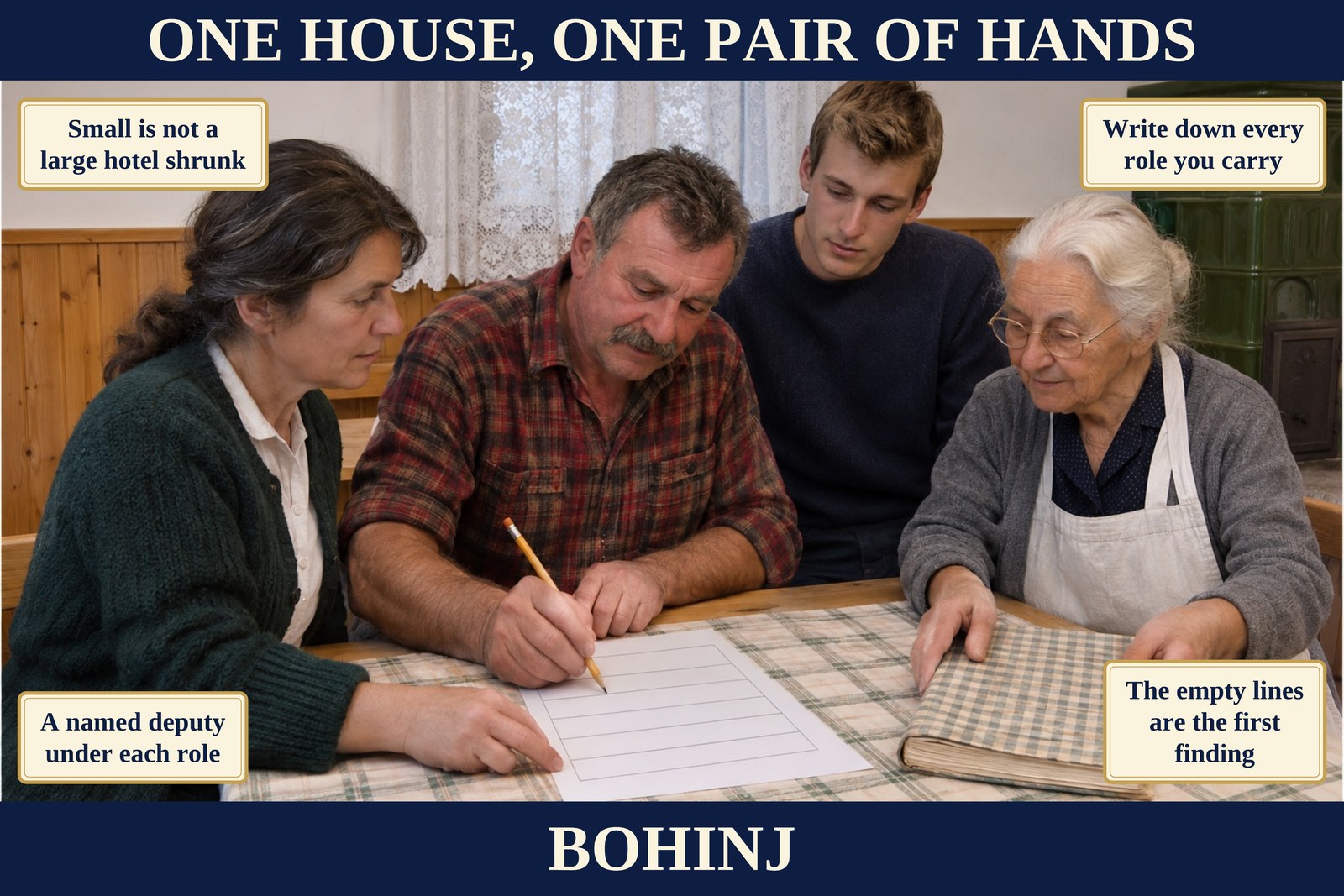
Concept Card 1.1 — One House, One Pair of Hands
Subchapter 1.1 · Bohinj, Slovenia
Setting: Bohinj, Slovenia
The breakfast room of the Kovač guesthouse in Ribčev Laz, in the soft grey light of a March morning: whitewashed walls above pine panelling, lace curtains drawn, a green tiled stove cold in the corner, a checked cloth on the table. Maja, the owner, in a dark green cardigan, keeps her fingers at the edge of a ruled sheet. Her husband Tomaž bends over it with a pencil; their son Luka reads in silence; the grandmother, Ana, slides her checked notebook alongside.
The ruled sheet stands for Maja's work of the night before: the seven roles she carries in the house, from the accounts to the night phone, each with a line beneath it for whoever covers it. Four of those lines stayed empty. The notebook beside it holds half a century of suppliers, regular guests and the chimney sweep's number. The centre of the picture is the meeting of the two: what the house knows, laid next to what it has never written down.
The plaques read as one argument. Small is not a large hotel shrunk, so the system cannot begin with departments the house does not have; it begins with one instruction, write down every role you carry, and Maja found seven. Then comes a named deputy under each role, and the honest result of that exercise: the empty lines are the first finding, and the most useful one the house will make all year.
The plate does not accuse Luka, who offered the only system he had seen work, nor Ana, whose notebook has carried the house for decades, nor Maja, who neglected nothing and had simply never been asked. Seven roles in one pair of hands are not disorder; they are how a small house is organised. The danger lies only where no second name stands, and the system begins with the hands that carry it.
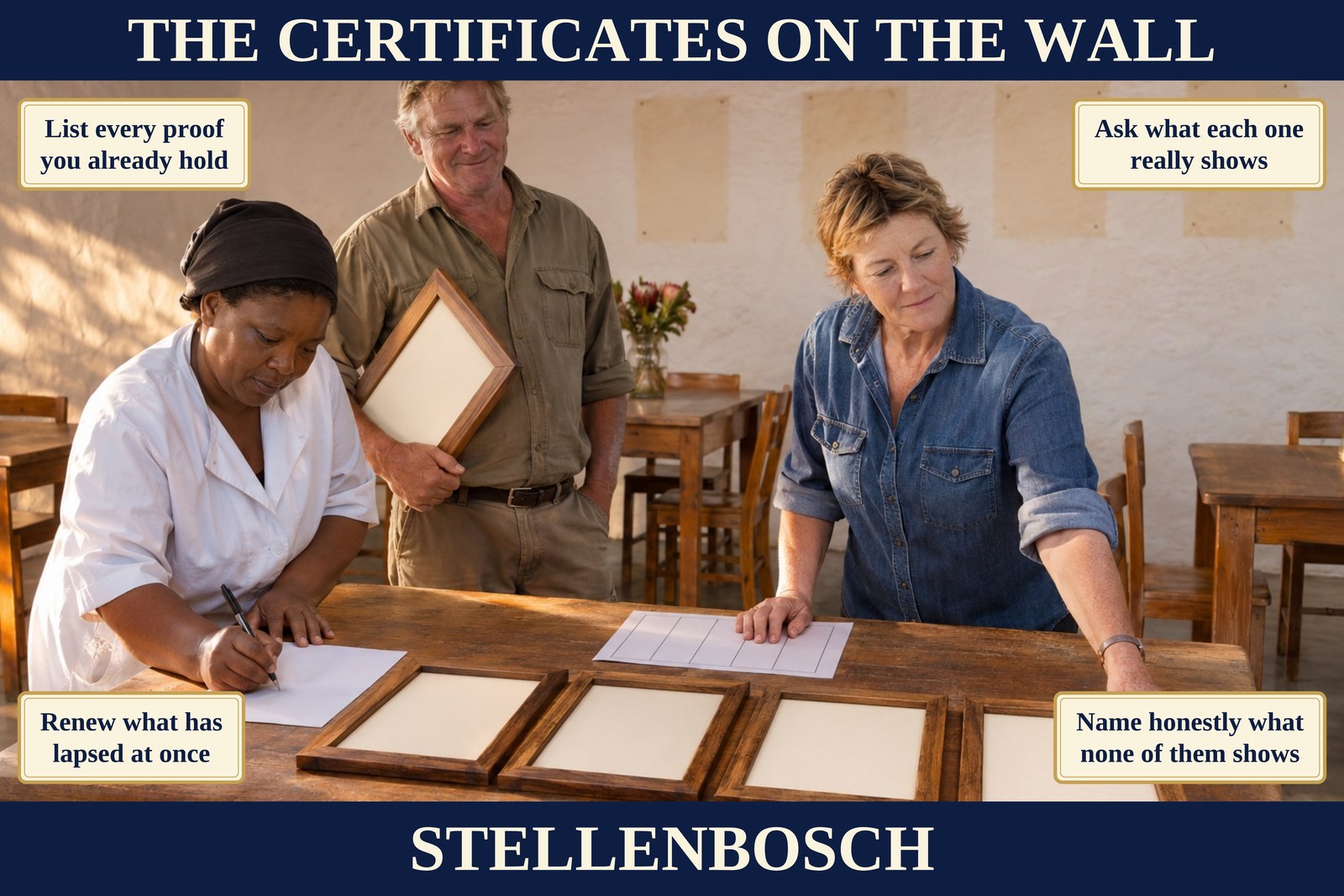
Concept Card 1.2 — The Certificates on the Wall
Subchapter 1.2 · Stellenbosch, South Africa
Setting: Stellenbosch, South Africa
The breakfast room of a guesthouse in an old cellar building on a wine farm at Stellenbosch, in low golden autumn light. On the whitewashed wall behind, pale rectangles show where frames used to hang. Annelie, the owner, in a denim shirt, lays four wooden frames in a row beside a sheet ruled into five columns. Thandiwe, the breakfast cook, in a white tunic and dark headscarf, signs a separate sheet; Annelie's husband Pieter holds one more frame under his arm and smiles.
The frames have come down from the wall to the table, and that is the whole movement of the picture. On the wall they were decoration; on the table, beside five empty columns, they become evidence to be sorted: what each one proves, for whom, and until when. The signature on the left is the first consequence, a hygiene briefing nearly three years out of date, renewed at once.
The plaques follow the order of Annelie's two evenings. First list every proof you already hold, from the grading certificate on the wall to the inspection report in the drawer. Then ask what each one really shows, since a grading looks mainly at facilities and a training letter at one trainee. Renew what has lapsed at once, as the briefing is renewed here; and name honestly what none of them shows: policy, objectives, risks and review, the part only the house can build.
The plate does not accuse the grading body, the training authority or the inspector, each of whom did exactly their job for their own purpose, nor the client whose procurement form was written for factories. Nobody was careless; nobody had ever put the sheets side by side. The lesson is that a small house can prove more than it believes, once it knows what each certificate shows and is willing to say, without shame, what none of them shows.

Concept Card 1.3 — One Structure for Every Topic
Subchapter 1.3 · Dublin, Ireland
Setting: Dublin, Ireland
A first-floor office in a Georgian building in Dublin on a Sunday evening in October, grey panelled walls lit by a green-shaded desk lamp. Orla, the owner, in a cream cable-knit jumper, sits with an index finger on each of two open booklets, her mouth open in sudden recognition. Beside the lamp stand three ring binders, blue, green and grey. The head receptionist, in a navy cardigan over a white shirt, holds a further grey binder against his chest and looks on, puzzled.
The two booklets are ISO 9001 and ISO 14001, open at their contents pages, and the two fingers trace the same line in both: clauses 4 to 10, the same numbers, the same titles. The coloured binders behind stand for one system per topic, the advice she had been given. The binder still held against the receptionist's chest is the fourth, meant for health and safety, and the picture catches the moment it becomes unnecessary.
The plaques give the reasoning of that evening. The standards share one structure, the harmonized structure once called Annex SL, so the owner can describe the house only once: one context, one policy, one list of risks, one review. Each topic adds only what it adds, environmental aspects here, hazards or energy use there, and legal duties such as data protection find their place in the same frame. One house, one framework, as Orla wrote on her sticky note.
The plate does not mock the neighbouring hotelier whose fourteen folders work in a house with consultants and an assistant to keep them, nor Orla's instinct to buy the standards first, which was the instinct of someone who takes a client seriously. It shows only that the duplication was never required. A small house needs one framework, not one system per topic, and the pile of pages that appeared twice is the proof.
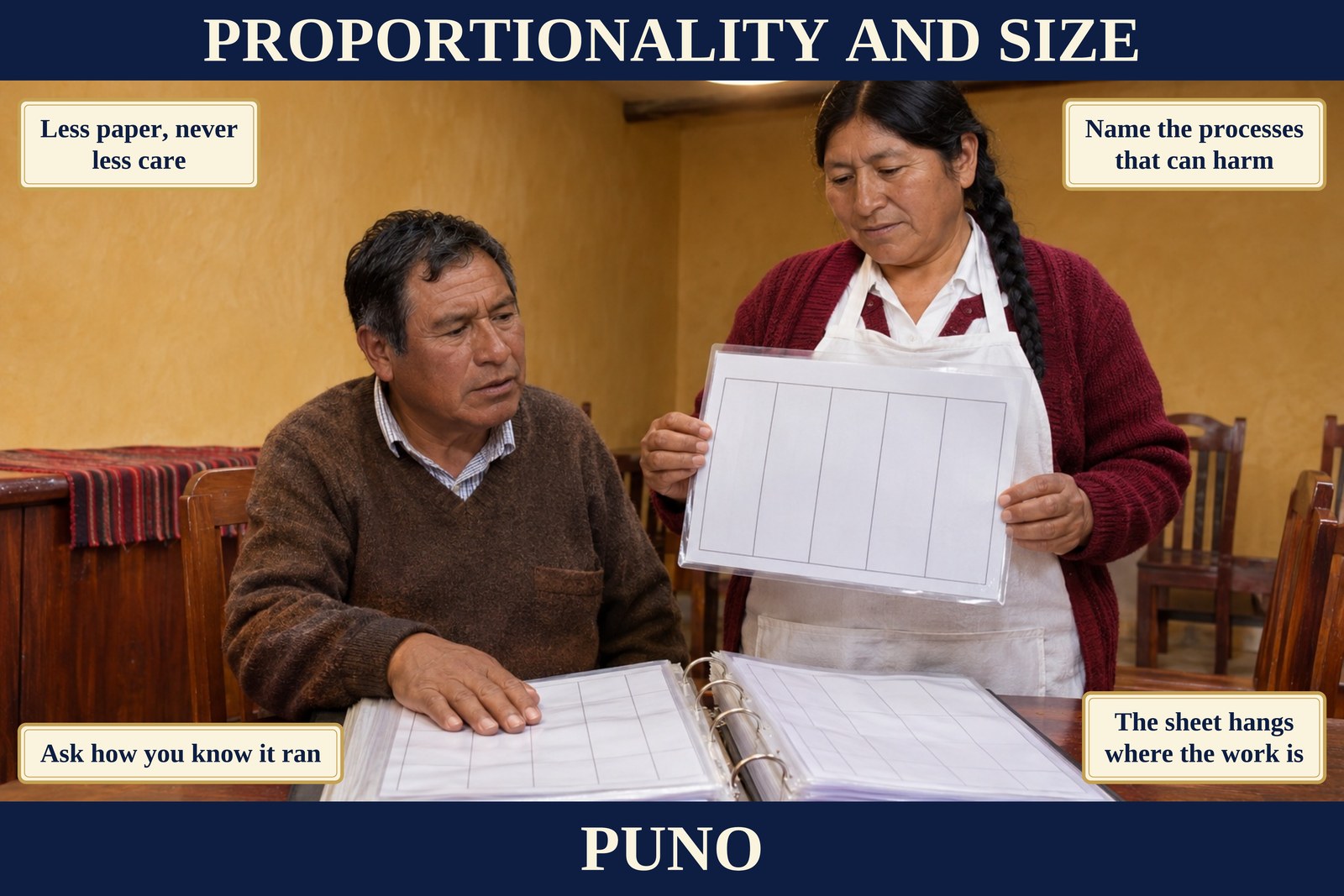
Concept Card 1.4 — Proportionality and Size
Subchapter 1.4 · Puno, Peru
Setting: Puno, Peru
The empty dining room of an inn on the lakeshore road in Puno, on a rainy January afternoon: ochre walls, dark beams, wooden chairs, a striped woven runner on the sideboard. Rubén, the owner, in a brown jumper, sits with one hand on a thick ring binder lying open on the table, its plastic sleeves full of blank forms. Beside him Rosa, his wife, in a white apron and dark red cardigan, her long plait over her shoulder, holds up one laminated sheet ruled into five columns.
The binder is the consultancy's offer: a manual of 140 pages, twenty-eight procedures and forty-six forms, each to be signed weekly by a quality representative the inn does not have. The laminated sheet is the kitchen temperature list, with columns for date, time, unit, temperature and initials. Rosa holds the one beside the forty-six, and the picture asks the question she asked: who fills these in during July, with the terrace full?
The plaques turn her gesture into a rule. Less paper, never less care: the terrace freezer must be as cold at a small inn as in a large kitchen. So name the processes that can harm, cooling, allergens, induction and emergency exits, and for each ask how you know it ran. The answer is rarely a procedure in an office. The sheet hangs where the work is, on the freezer, kept while restocking rather than filled in from memory at night.
The plate does not ridicule the consultancy, which offered in good faith a template that serves factories well, nor the inspector, who criticised one gap rather than any shortage of paper. Rubén's hesitation is the reasonable one of an owner shown a price. The lesson is the one the standards themselves state: documentation may follow the size of the house, the requirements may not, and six lines with eight lists closed the inspector's remark.
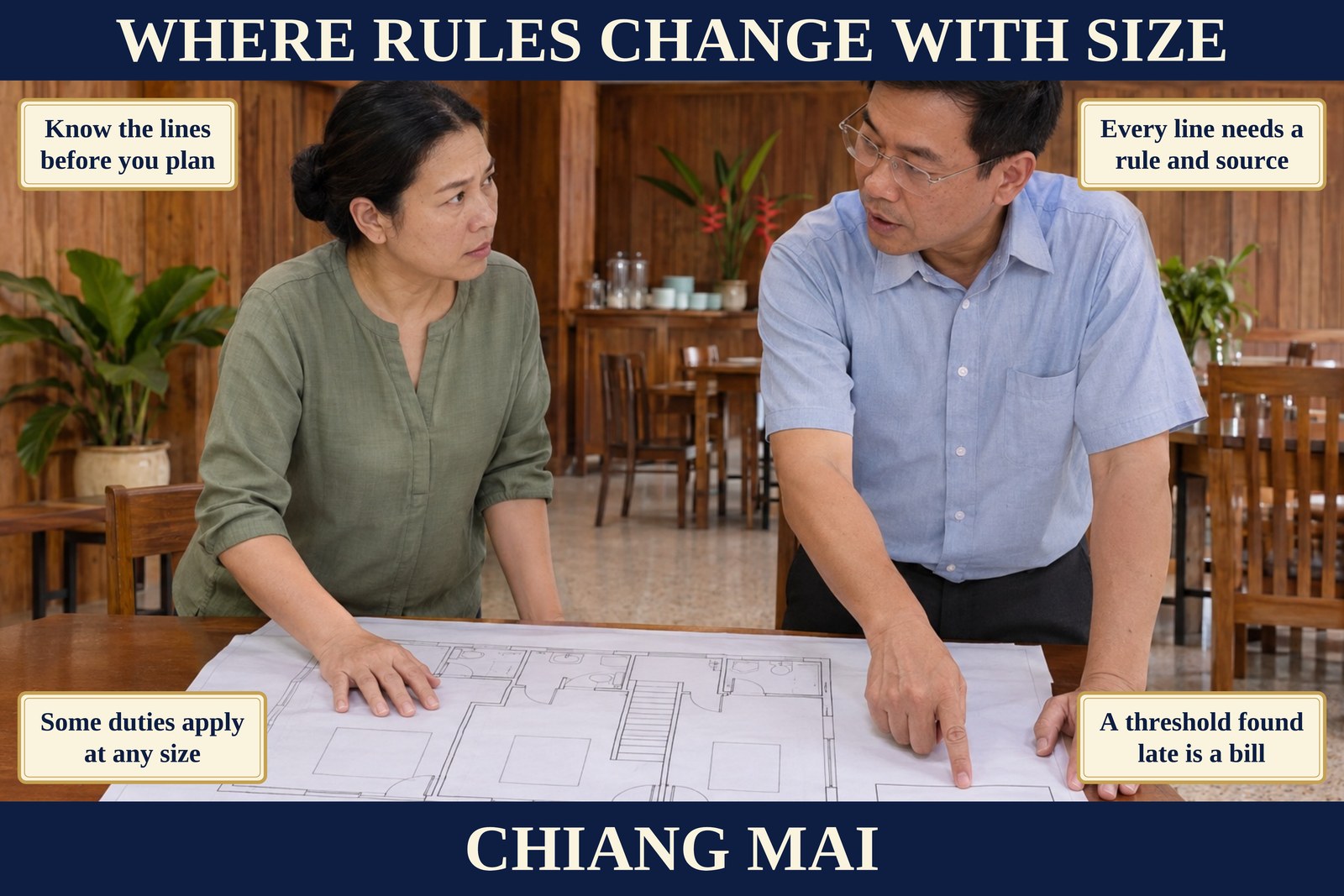
Concept Card 1.5 — Where Rules Change with Size
Subchapter 1.5 · Chiang Mai, Thailand
Setting: Chiang Mai, Thailand
The breakfast room of a family guesthouse in Chiang Mai on a quiet June morning: teak-panelled walls, a terrazzo floor, plants and a sideboard behind. Across the table lie the architect's plans for the top floor, with rooms, bathrooms and a stair. Anan, the architect, in a pale blue short-sleeved shirt and rimless glasses, leans over and points at the lower corner of the drawing. Siriporn, the owner, in a sage green blouse, her hand flat on the plan, looks across at him, alert and worried.
His finger rests on the small table in the corner of the drawing where areas and beds are listed, and where the total has risen from twenty-eight beds to thirty-four. Everything else on the sheet concerns stairs, roof and insulation; this corner concerns law. The architect speaks casually, the owner hears of a line in the fire-safety rules that may reach the whole building, and the picture holds the distance between those two readings.
The plaques set out what Siriporn did next. Know the lines before you plan, beds, staff, guest data, payment by card, rather than meeting them in the design. Every line needs a rule and source, its version and how it counts, not a colleague's rumour about ten staff and the internet. Some duties apply at any size, and they deserve a column of their own. And a threshold found late is a bill, where one found early is a choice between variants.
The plate does not blame the architect, who raised the question the moment he saw it, nor the accountant, who answered within his field. Siriporn had planned carefully, in the order most owners use. Nor does it treat a threshold as an enemy: a house with twenty-eight beds has the same stairs at night as one with thirty-four. The lesson is one page of lines and sources, kept before every investment, new post or booking channel.
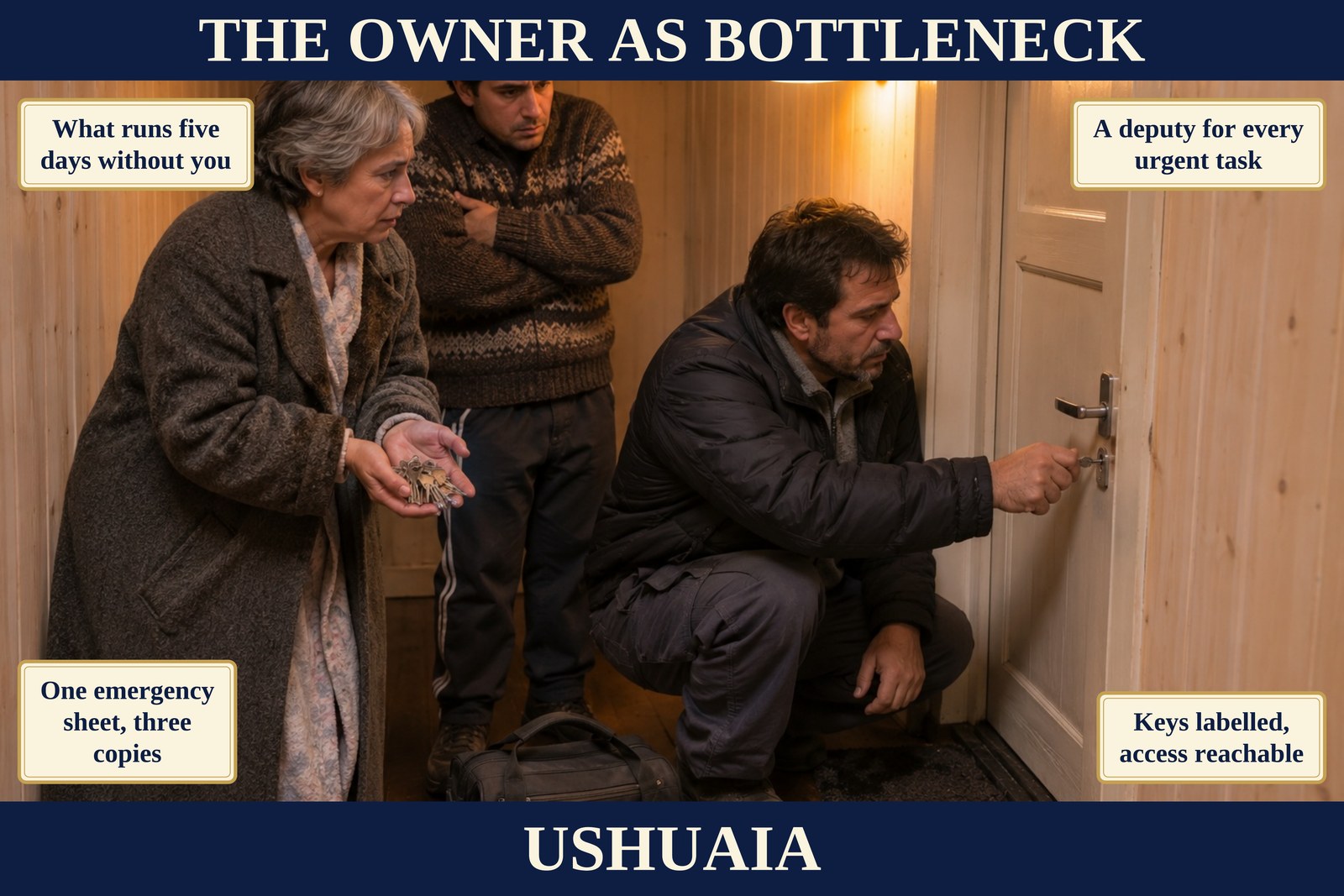
Concept Card 1.6 — The Owner as Bottleneck
Subchapter 1.6 · Ushuaia, Argentina
Setting: Ushuaia, Argentina
A narrow corridor in the annex of a bed-and-breakfast in Ushuaia, before dawn on a July night, lit by one warm lamp on pale wooden panelling. The heating engineer, in a padded black jacket, crouches at a closed white door and tries a key in the lock, his bag at his feet. Graciela, the owner's sister, grey-haired, in a heavy coat over her nightclothes, holds out a loose bunch of untagged keys in her open hand. Behind them the guest, a father, stands with arms folded, watching.
The bunch of keys is the centre. Fourteen hung on the board behind reception, none labelled, and the boiler room of the annex lies behind one of them while a child in apartment two is cold. Every other gap of those five days has the same shape: the register password, the wholesaler's customer number, the apartment promised by telephone. The owner is in hospital with a broken wrist, and the house she carried in her head is locked.
The plaques read as the owner's five-day question. Ask what runs five days without you, with no duty missed and no guest endangered. Then a deputy for every urgent task, guest registration, allergens and the night above all, settled in advance. One emergency sheet, three copies, kept where every deputy knows to look, leads to the knowledge without replacing it. Keys labelled, access reachable: passwords in a sealed envelope whose place the deputy knows, not on a screen and not in one head.
The plate does not accuse Graciela, who did in five days everything possible without records, nor Mariela, who never hid her knowledge; it had simply never occurred to anyone to write it down. The engineer and the guest wait for a key nobody can name. The lesson is Graciela's own sentence: the whole house was in one head, and that head was in hospital. A house that works only with one person works only while she is well.
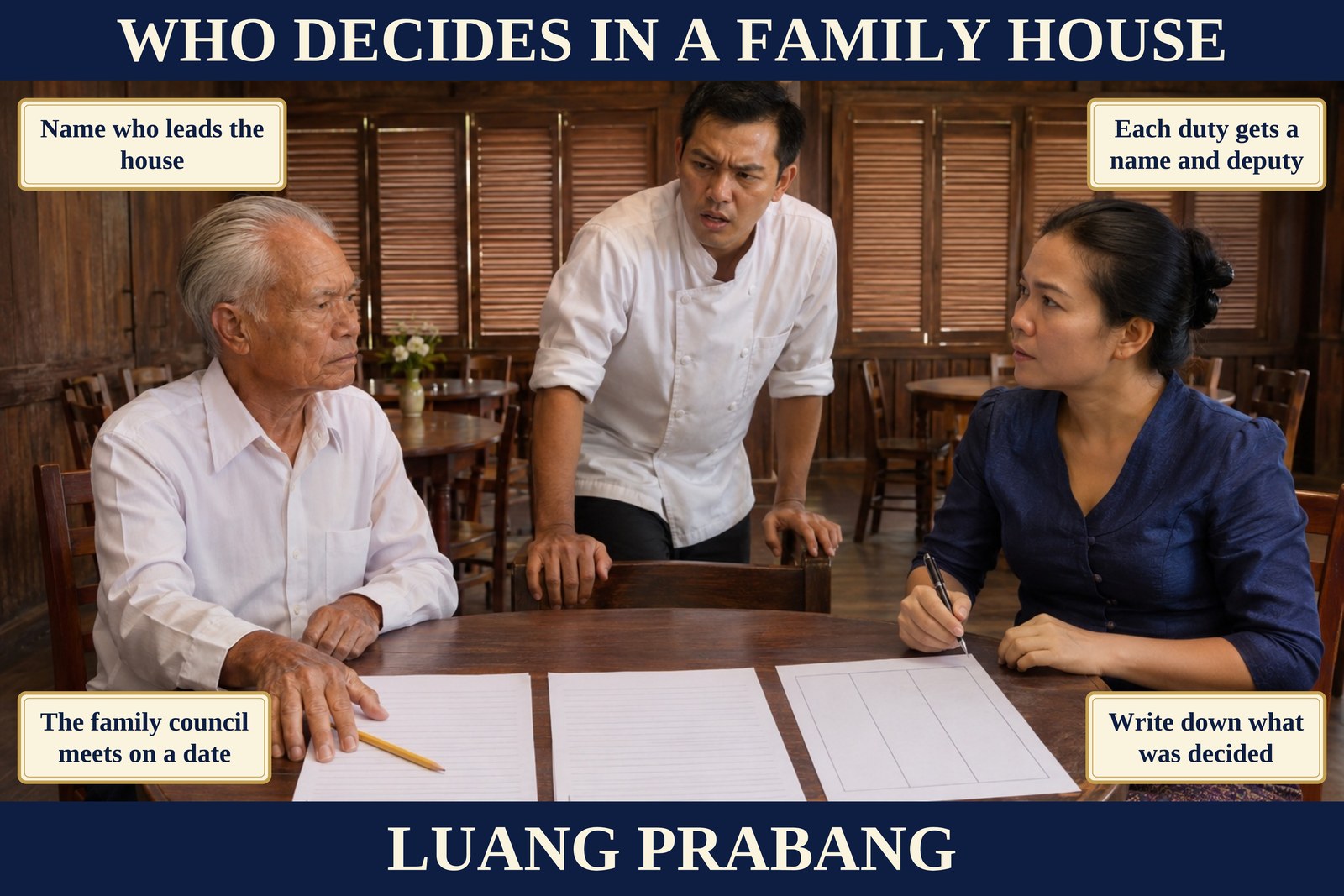
Concept Card 1.7 — Who Decides in a Family House
Subchapter 1.7 · Luang Prabang, Laos
Setting: Luang Prabang, Laos
The empty dining room of a family inn in a teak house in Luang Prabang, on a closing-day morning in late October, warm light through closed wooden shutters. At a round table sit Bounmy, the father, white-haired, in a white shirt, his fingers beside a pencil on the first quote, and his daughter Khamla, in a dark blue blouse, her pen poised over a sheet of three columns. Between them her brother Somphone, the cook, in whites, has risen and leans on a chair back, frowning.
Three sheets lie in a row: the kitchen quote, the rooms quote and Khamla's figures. Bounmy has just laid his pencil on the first, where he had written that it was too expensive, and the gesture answers more than the price: it says who decides. The son already half gone and the pen waiting at the foot of the daughter's sheet show what the family has never said aloud, and what the bank will soon ask.
The plaques give the four steps the standards leave to the family. Name who leads the house, one person or a group, because top management is a decision, not a given. Each duty gets a name and deputy, with signing limits and a voice for the bank. The family council meets on a date, with an agenda and figures prepared, and in time becomes the management review. And write down what was decided, so that staff receive one answer to one question.
The plate does not side with the kitchen or with the rooms. Bounmy has carried the house for four decades, and his answer described how it had always worked; Khamla and Somphone each brought a sound case and real evidence. Nobody at the table is wrong about the inn. What is missing is a spoken, written answer to who leads it. The family table is a good place for decisions, as soon as someone writes them down.
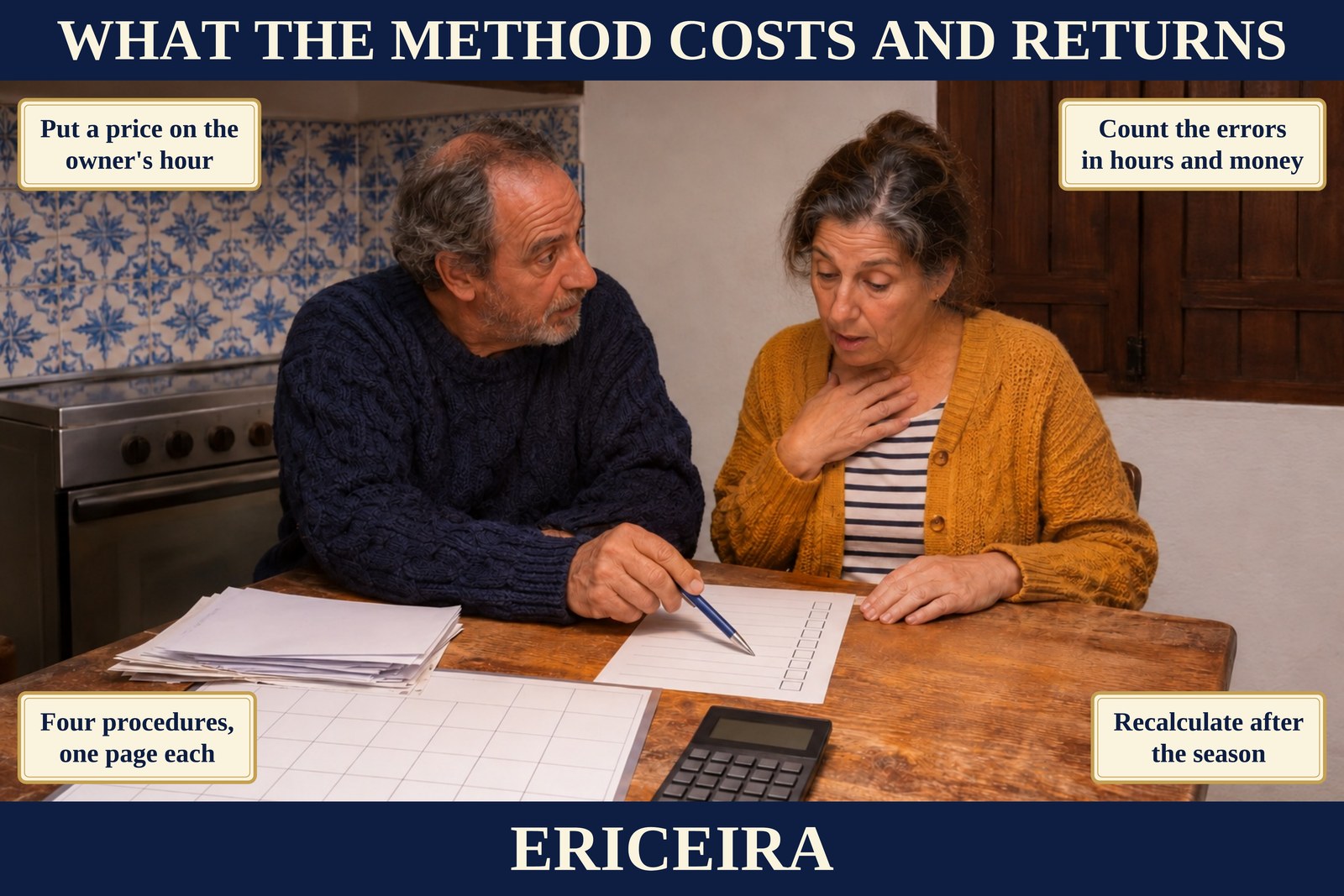
Concept Card 1.8 — What the Method Costs and Returns
Subchapter 1.8 · Ericeira, Portugal
Setting: Ericeira, Portugal
The owners' kitchen in a guesthouse in Ericeira on a windy February evening: blue and white tiles behind a cold stove, dark shutters closed. At the wooden table Rui, in a navy fisherman's jumper, points his pen at a short column of boxes on a lined sheet and turns to his wife. Teresa, in a mustard cardigan over a striped top, has a hand at her throat and looks at the column, surprised. Beside them lie bank statements, a gridded calendar and a calculator with a blank display.
The column holds the season's errors, and the line under the pen is June: seventy hours Teresa spent making up rooms while the housekeeper was ill. The calculator is dark because the question it cannot answer has just been asked: what is an hour of hers worth? The bank statements show the euros; the column shows the hours that reached no statement, and the picture turns on her realising she has never counted them.
The plaques follow the evening's arithmetic. Put a price on the owner's hour, because the method costs hours above all, and both sides of the sum must use the same value. Count the errors in hours and money: the double booking, the spoiled delivery, the cold shower, the housekeeper's absence. Four procedures, one page each, written before the season, close the four gaps. Then recalculate after the season, at the same rate, and judge the method over three years rather than one.
The plate does not blame the helper who signed for the delivery as told, nor the room attendant who wrote the fault down, nor the housekeeper for falling ill. Nobody was careless; what failed four times was the passing of a task from one pair of hands to the next. Nor does it promise that the method prevents every error. It costs hours, not certificates, and its largest return appears on no line of the accounts.
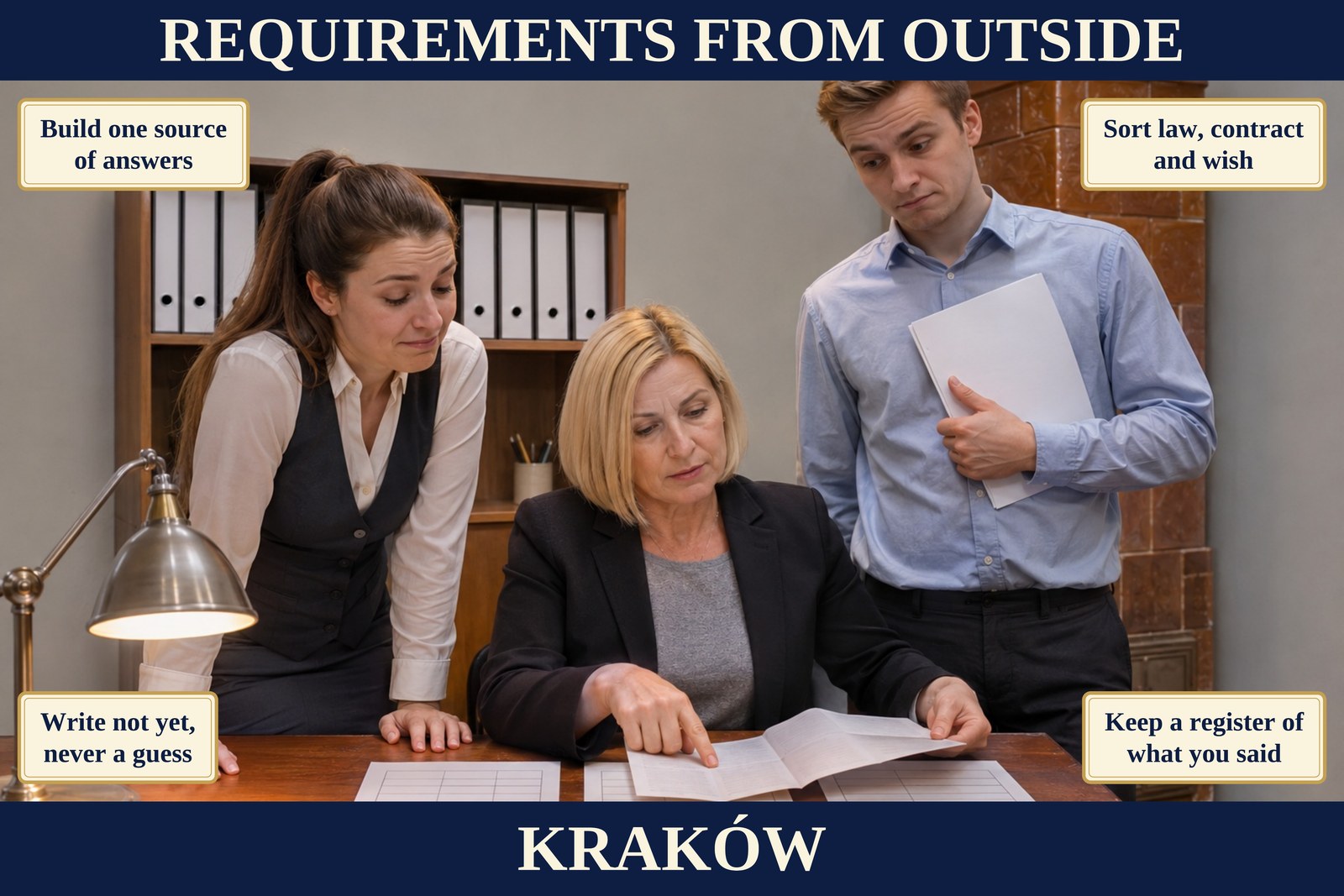
Concept Card 1.9 — Requirements from Outside
Subchapter 1.9 · Kraków, Poland
Setting: Kraków, Poland
A narrow office behind the reception of a small hotel in a Kazimierz tenement house, on an October afternoon: pale grey walls, a shelf of white binders, a tall brown tiled stove in the corner. Monika, the owner, in a black blazer, sits at the desk and lays a folded electricity bill over printed questionnaires, pointing at it. The head receptionist, in a white blouse and dark waistcoat, leans in with an uneasy smile; the office helper, in a light blue shirt, holds his own draft against his chest.
The questionnaires on the desk hold the same question answered three ways: one hundred per cent renewable, partly renewable, renewable for three years. None was exactly right. The bill laid across them is the document that decides: three meters on a renewable contract for twenty months, while the lift and stairwell draw on a common supply of unknown source. The picture shows the moment the source of answers moves from memory to evidence.
The plaques describe the remedy. Build one source of answers, a fact sheet with evidence and dates, and answer every questionnaire from it rather than from whoever is on duty. Sort law, contract and wish, because a framework agreement can bring duties the house does not want, and that choice belongs to the owner. Write not yet, never a guess, with a date where something is planned. And keep a register of what you said, so that a changed fact reaches everyone told.
The plate does not accuse the head receptionist, who remembered correctly that the hotel had changed its electricity contract, nor the helper, who repeated what he had heard, nor the colleague abroad who shared a template out of kindness. Every answer was given honestly with what was to hand. The lesson is that a questionnaire does not decide what the house does; it only asks, and the answer must come from the house, not from the form.
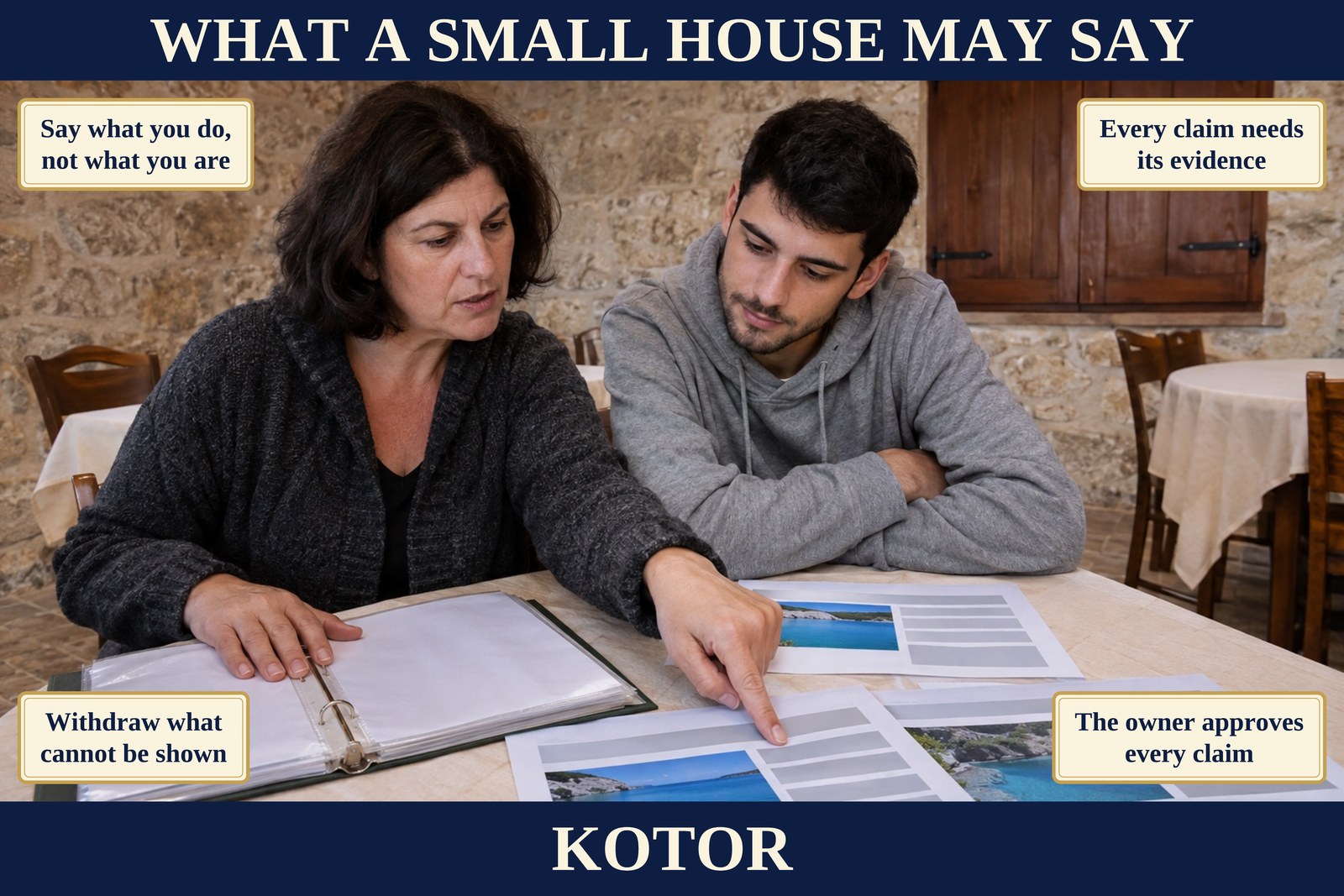
Concept Card 1.10 — What a Small House May Say
Subchapter 1.10 · Kotor, Montenegro
Setting: Kotor, Montenegro
The small breakfast room of a guesthouse in a stone house in Kotor's Old Town, on a quiet Sunday in October after the season: rough pale stone walls, closed wooden shutters, tables in cream cloths. Jelena, the owner, in a charcoal cardigan, keeps one hand on an open ring folder of plastic sleeves and points with the other at a printed page. Beside her, her nephew Nikola, in a grey hooded sweatshirt, leans on his folded arms and follows her finger, attentive and a little sheepish.
The printed pages are the website he built: large photographs of blue water and, beside them, the bars where the text stood, carbon-neutral stays, one hundred per cent green energy, a sustainable house with heart. The folder holds the invoices for the solar panels and the LED lamps, facts the website never mentioned. Her finger moves between the two, testing each sentence against the paper that should carry it.
The plaques give the host's rule for every promise. Say what you do, not what you are: no single-portion packs at breakfast for three years is a fact a guest can see the next morning, while a sustainable house is a character nobody can prove. Every claim needs its evidence, specific and current. Withdraw what cannot be shown, the carbon-neutral line and the home-drawn leaf first among them. And the owner approves every claim, from the same fact sheet that answers questionnaires.
The plate does not reproach Nikola, who worked for almost nothing and wrote what he had read on dozens of other sites; nobody had told him about the farms, the towels or the lamps. Nor does it suggest the house did too little. It had done much and said the wrong things about it. The lesson is that character cannot be proved but a deed can, and a small house has the advantage of few, concrete facts.
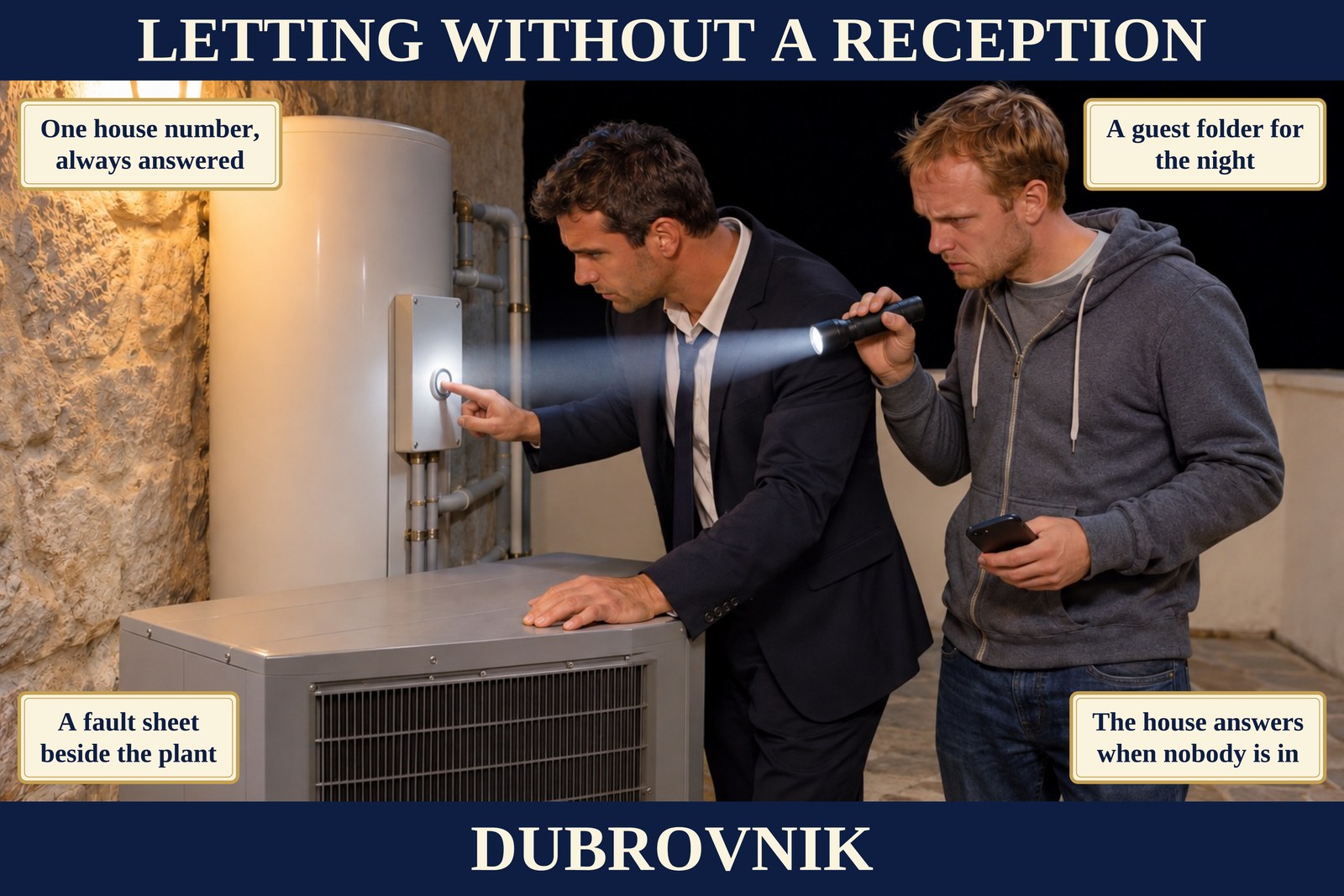
Concept Card 1.11 — Letting Without a Reception
Subchapter 1.11 · Dubrovnik, Croatia
Setting: Dubrovnik, Croatia
The roof terrace of a stone house of holiday apartments above Lapad bay in Dubrovnik, at ten to ten on an October night; a warm wall lamp lights the stone, and beyond the parapet there is only darkness. Ivan, the owner's son, in a dark wedding suit with the tie loosened, presses the reset button on the heat pump controller, one hand on its casing. Beside him the father from Leeds, in a grey hoodie, holds a torch on the box and his phone in the other hand.
The button is the centre and the whole repair: a brief power dip had tripped the heat pump into a fault, and ten minutes set it right. What took an hour and a half was everything before it, the listing number ringing in a handbag at a wedding, six calls, an automatic reply, a folder that named the boat to Lokrum but not the night doctor. The torch beam shows how near the answer always was.
The plaques list what replaces a front desk. One house number, always answered, tied to a rota rather than a person, with a second name behind it. A guest folder for the night, with emergency numbers, the out-of-hours medical service and what to do when the water runs cold. A fault sheet beside the plant, so that a reset needs no expert and no wedding guest. Together they mean the house answers when nobody is in.
The plate does not accuse the Marić family. For twenty years Vesna had almost always been at home, and guests had praised exactly that; Ivan drove back the moment he saw the missed calls, and the cleaner was a guest at the same wedding. Nobody neglected the guests; on the one evening nobody was there, there was simply no plan. A holiday apartment has no front desk, so the house itself must answer.
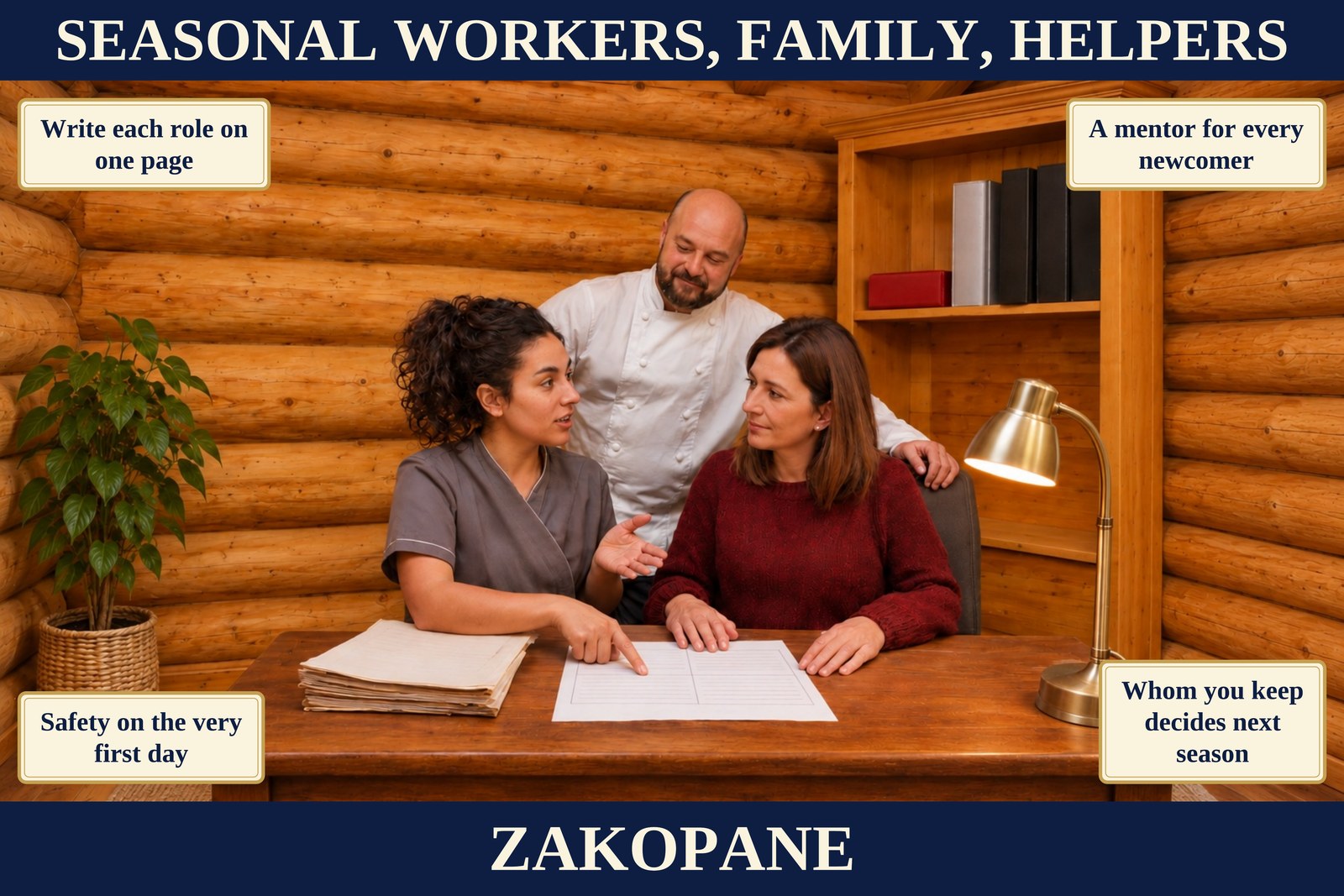
Concept Card 1.12 — Seasonal Workers, Family, Helpers
Subchapter 1.12 · Zakopane, Poland
Setting: Zakopane, Poland
A small office behind the reception of a hotel in Zakopane on a December evening before Christmas: walls of honey-coloured pine logs, a brass desk lamp, a shelf of binders. Ewa, the co-owner, in a dark red jumper, sits holding a ruled page flat and turns to listen. Beside her Inês, the returning room attendant, in a grey tunic, points to one block on the page and explains with her other hand open. Behind them Bartek, in chef's whites, rests a hand on the chair and nods.
The page is the first written description of the house's roles, and Inês's finger rests on the one she knows best: the rooms, which last winter she made wrong for two weeks because nobody told her. The pile of older staff lists beside it holds names, countries and arrival dates, and nothing about what each role must know. The point of the picture is who is explaining: the worker who missed an induction now helps to write one.
The plaques give the method in order. Write each role on one page: what it does, what it must know and which hazards belong to it. A mentor for every newcomer, someone who shows the breakfast routine or the allergen list in the first days, and a check after one week. Safety on the very first day, the way to the cellar emergency exit included, on a signed page. And whom you keep decides next season, because whoever leaves in April decides December.
The plate does not blame the cook who left for a year-round post nearer his family, nor Bartek, whose twenty-minute tour was meant kindly and ended each time with his phone ringing. More than half the seasonal staff were new every year, and each newcomer cost two weeks of half-output in the dearest weeks. What was missing was not goodwill but a method for passing on what the house knows, and a reason for people to return.
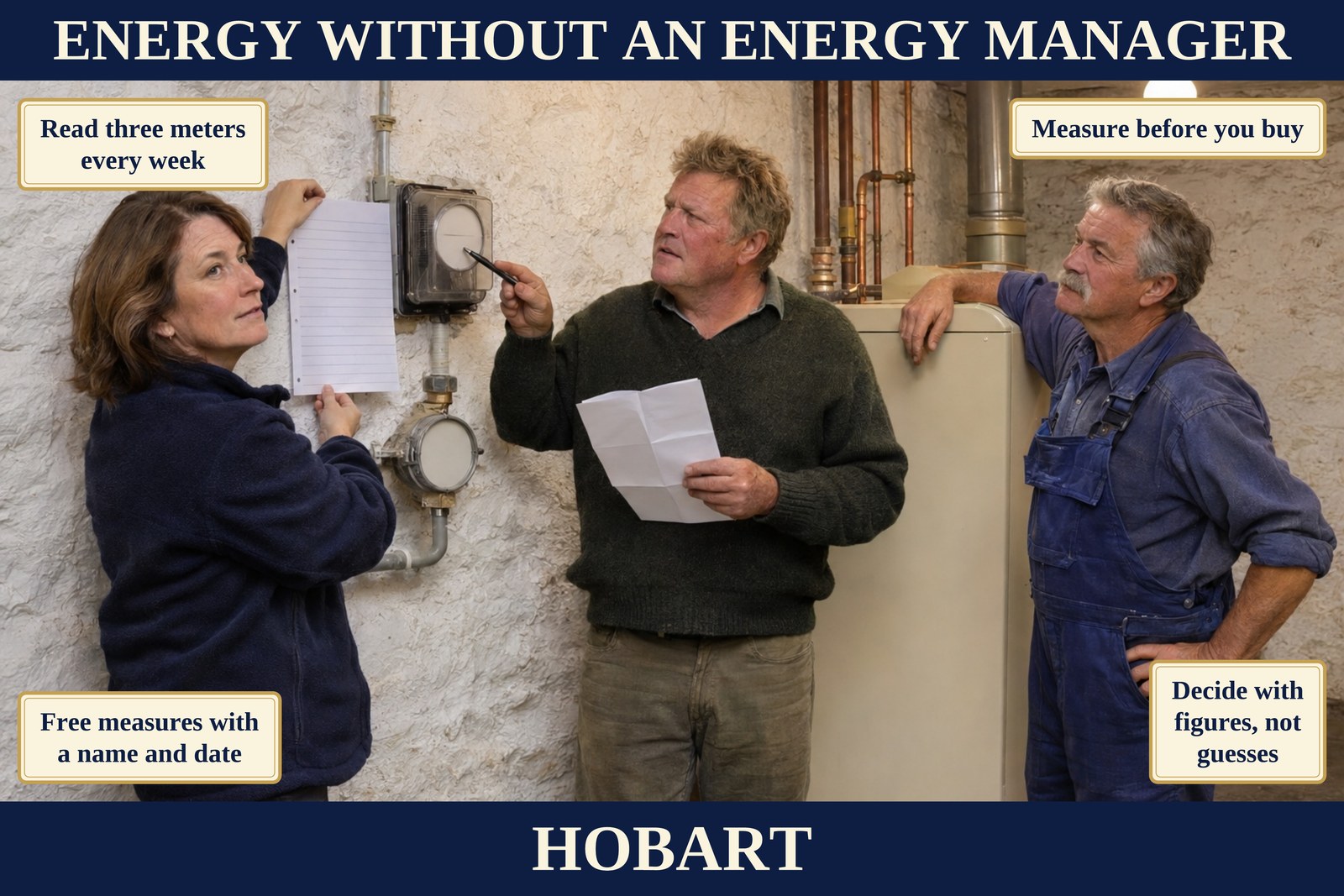
Concept Card 1.13 — Energy Without an Energy Manager
Subchapter 1.13 · Hobart, Australia
Setting: Hobart, Australia
The whitewashed sandstone cellar of an inn in West Hobart on a cold May morning: copper pipes rising behind a cream oil boiler, an electricity meter and a water meter on the wall. Hamish, the owner, in a dark green jumper, holds a folded sheet in one hand and points a pen at the electricity meter with the other. Kate, his wife, in a navy fleece, holds a ruled sheet against the wall beside the meters. The heating contractor, in blue overalls, leans on the boiler and watches.
The folded sheet is the quotation for a new heating system, AUD 82,000, and on its back Hamish has written three figures and a question: for what? The pen points to where the answer has hung all along, a meter he had never read. The ruled sheet Kate is about to pin up is the weekly reading list. The old boiler stands behind them, and the decision about it now waits for the house's own numbers.
The plaques reduce energy management to what a small house can carry. Read three meters every week, electricity, water and the oil gauge, on the same day, with a deputy. Measure before you buy, because only a winter of weekly values shows how much heat the inn needs on a frosty night. Free measures with a name and date come first and cost nothing. Then decide with figures, not guesses, between heat pump, pellets or oil.
The plate does not dismiss the contractor, whose warning about an ageing boiler in July was sound, nor Kate and her son, reading what many owners read. Hamish had paid every bill to the cent; nobody had ever asked him to measure. The lesson is modest and exact: a small house needs no energy manager, only someone who reads three meters every Monday. After one winter the quotation came down, because the coldest week showed a smaller peak.
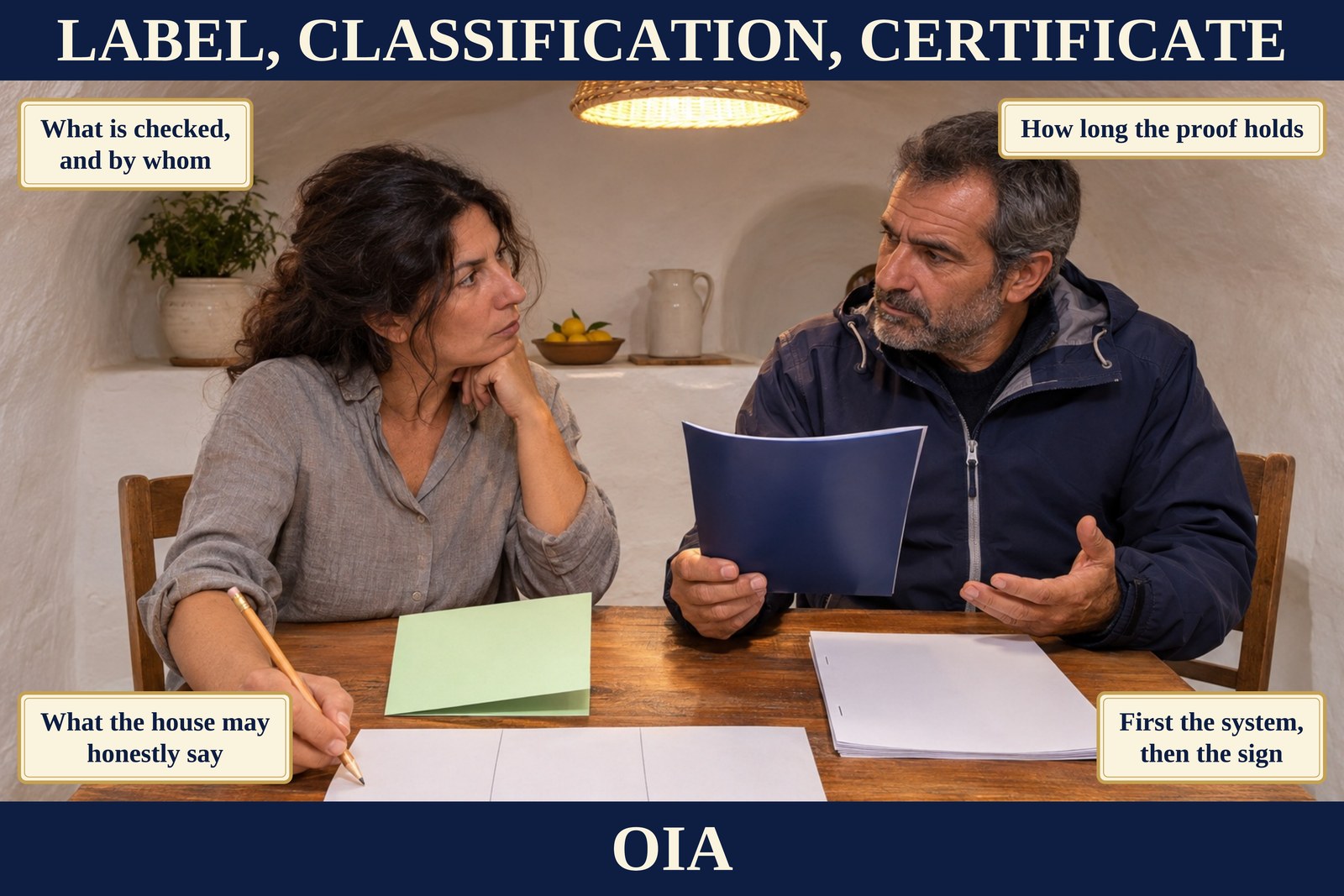
Concept Card 1.14 — Label, Classification, Certificate
Subchapter 1.14 · Oia, Greece
Setting: Oia, Greece
The owner's kitchen inside a cave house hotel in Oia, on a Tuesday evening at the end of October, after closing: a woven pendant lamp, a vaulted white ceiling, a jug and a bowl of lemons in a niche. Eleni, the owner, in a grey linen shirt, rests her chin on one hand and holds a pencil above a sheet of three columns. Opposite her, Nikos, her husband, still in his navy sailing jacket, holds up a dark blue brochure and opens his other hand in a question.
Between them lie the three papers: a pale green invitation to a regional sustainability programme, the classification brochure in his hand, and the stapled quotation for ISO 14001 certification. The sheet before Eleni carries the columns she drew after Nikos asked which of these guests believe: what is checked, who checks it, how long it holds. In every row a different box stays empty, and her pause is the honest answer.
The plaques give the questions for any sign. What is checked, and by whom: rooms and services for a classification, chosen criteria for a label, a whole system for a certificate. How long the proof holds, and what renewal costs in fees and hours. What the house may honestly say with it, and nothing more. And the order, which matters more than the choice: first the system, then the sign, which only makes visible what the system already does.
The plate does not accuse the tourism association, the classification scheme or the certification body; each described honestly what it offers, and the agency and the platform asked fair questions in their own words. Nor does it judge the house, which reads its meters monthly, heats water with the sun and buys from island producers. What is missing is a way to tell what each sign proves. A sign says only as much as one knows of how it was checked.
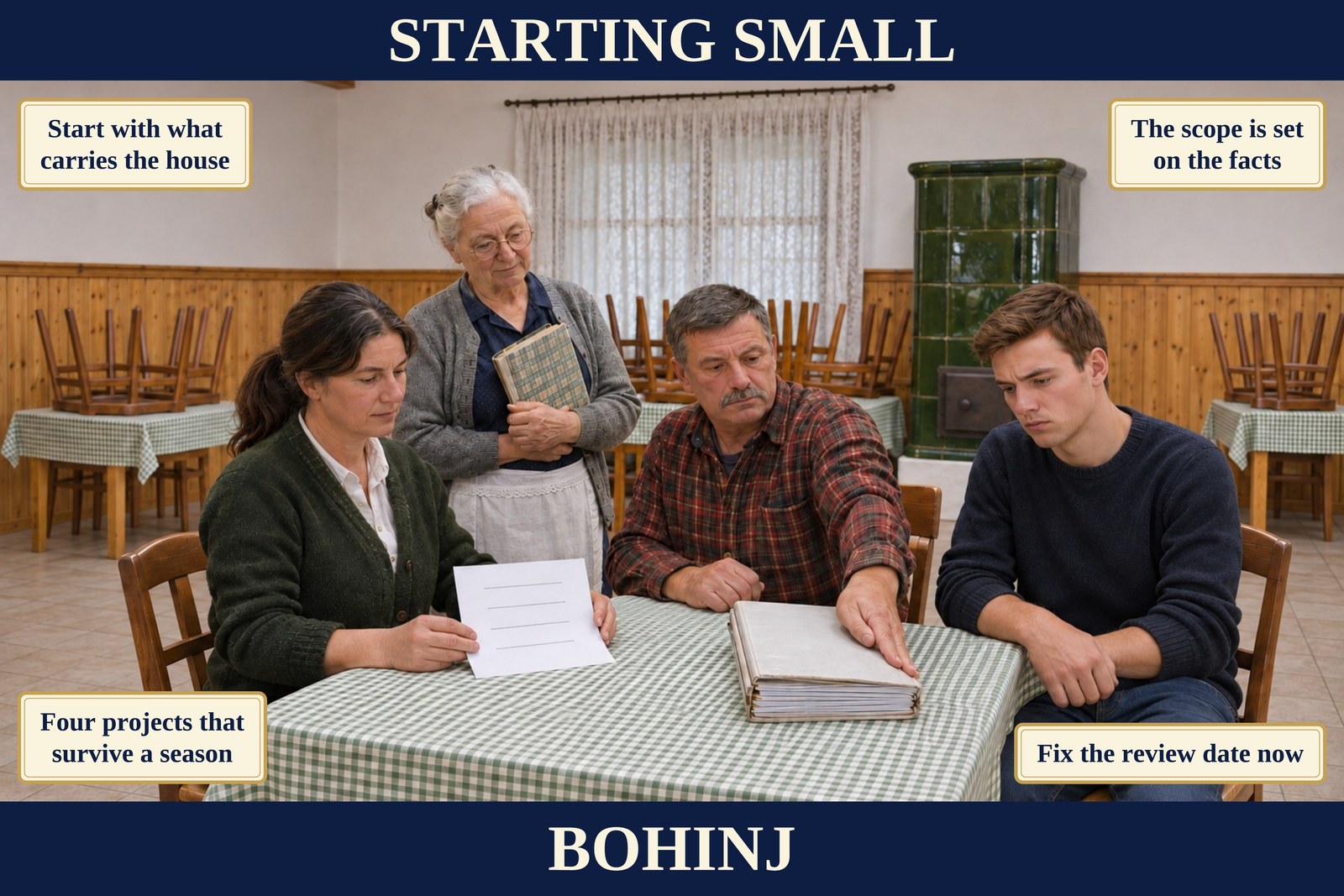
Concept Card 1.15 — Starting Small
Subchapter 1.15 · Bohinj, Slovenia
Setting: Bohinj, Slovenia
The breakfast room of the Kovač guesthouse in Ribčev Laz on an April afternoon, closed before the season: chairs upside down on the checked tables, lace curtains drawn, the green tiled stove cold. At the family table Maja holds a sheet of four short lines in both hands. Tomaž pushes a thick bound stack aside with the back of his hand; Luka watches it go, disappointed. Behind them Ana stands with her checked notebook held against her chest.
The thick stack is the Amsterdam project plan: twenty-six work packages, ten months and software on subscription. The four lines are Maja's: the legal duties the house has anyway, who covers whom, the house on one page, the meters once a month. The composition sets them on the same table, the large plan sliding away and the small one held up. Ana's notebook, kept close, is the knowledge both must in the end serve.
The plaques give the shape of a first step. Start with what carries the house: a duty owed anyway, the greatest risk, the base for everything else, or work light enough to run beside the season. The scope is set on the facts, so the evening kitchen and the apartments belong and the farm is an interface, not a part. Four projects that survive a season, each with a person, hours and a date. And fix the review date now.
The plate does not dismiss Luka's plan, which worked in a hotel with departments, nor Tomaž's objection, since summer truly leaves no hours and his question about the farm was the right one. Ana is not refusing; she is protecting knowledge that carried the house for half a century, and offers to let her grandson copy it. A small house begins not with a project but with four lines that survive a season, and a date to look again.
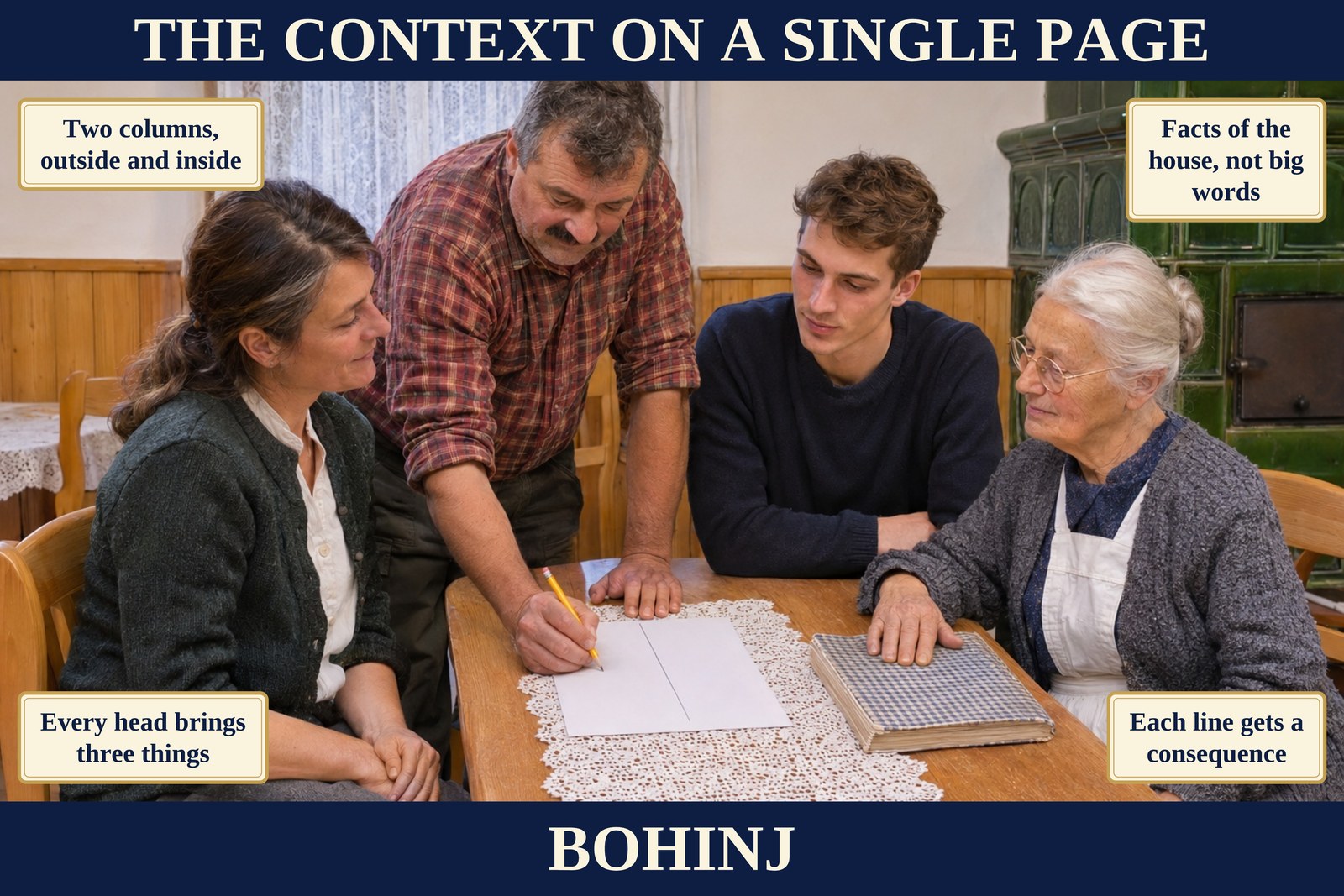
Concept Card 2.1 — The Context on a Single Page
Subchapter 2.1 · Bohinj, Slovenia
Setting: Bohinj, Slovenia
The breakfast room of the Kovač guesthouse on a May evening, before the season opens: pine panelling to waist height, lace curtains drawn, the green tiled stove cold in its corner. Maja sits to the left, Luka in the middle, Ana to the right with her hand on her checked notebook. Tomaž, in from the barn in his flannel shirt, stands and leans over the table, pencil touching a white sheet divided by a single ruled line.
The composition gathers four heads over one page. Each person holds a part of the house's context: Tomaž the slope and the cellar, Ana fifty years of guests and winters, Luka the market for cooks, Maja the bookings and the bank. The sheet at the centre is that table written down, and the pencil is in the hand of the one who arrived last, adding the line about heavy rain that nobody else had thought of.
The four plaques read as one method. Two columns, outside and inside, are enough; a template with four boxes invites filling, not deciding. The lines must be facts of the house, not big words, which is why climate change becomes the winter without snow and the mud against the cellar wall. Every head brings three things, because nobody holds the whole. And each line gets a consequence: a decision, an observation or a hand-over to another sheet.
The plate does not accuse Ana, who called climate change a matter for Ljubljana and then told the best story on the table, nor Luka, whose template came from a serious hotel. Nobody here is careless. What the image shows is a family discovering that the house's context already lives in its four heads and needs only one page, and the discipline that a line from which nothing follows does not belong there.
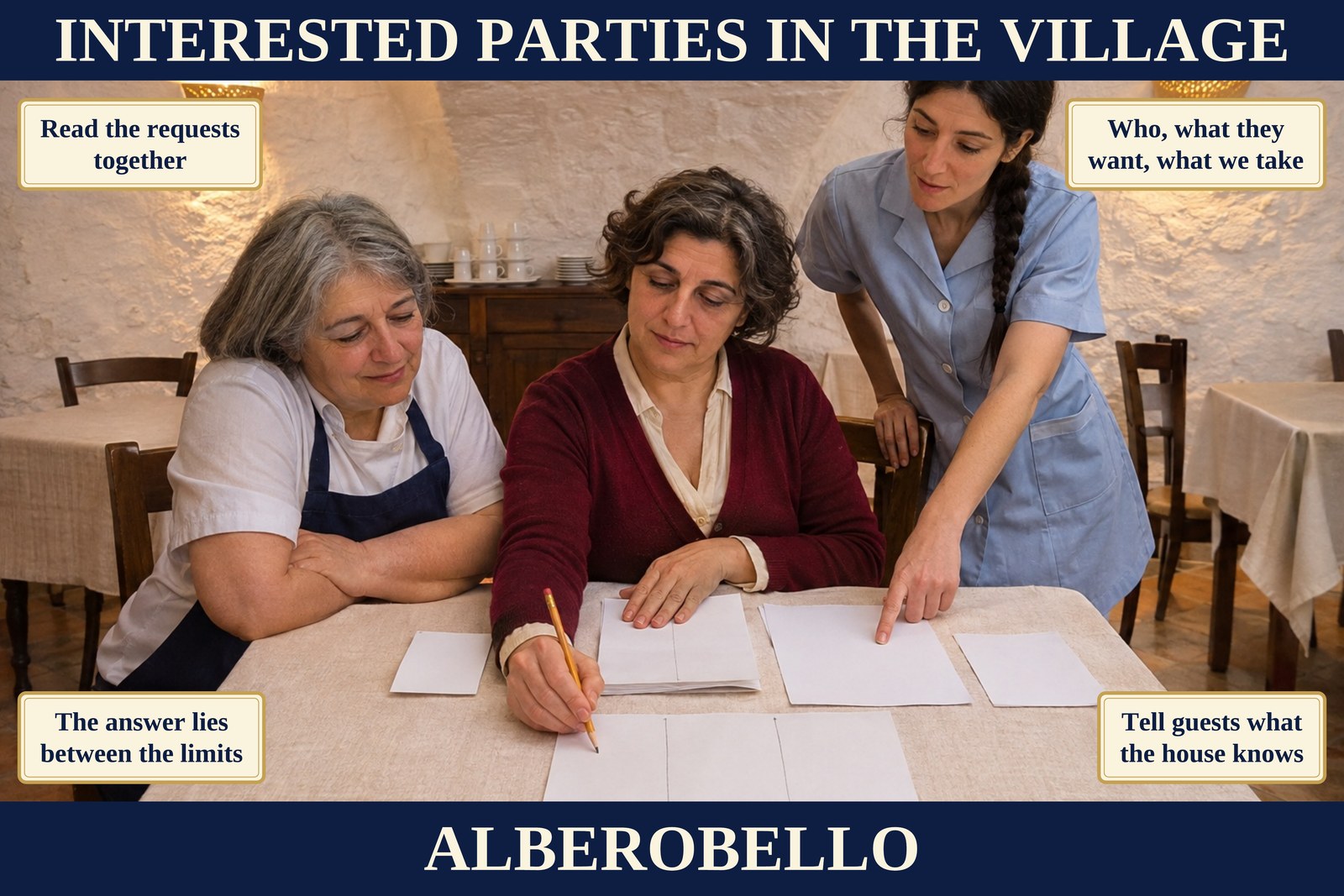
Concept Card 2.2 — Interested Parties in the Village
Subchapter 2.2 · Alberobello, Italy
Setting: Alberobello, Italy
The breakfast room of a small guesthouse in a stone house, on a Friday evening after the guests have gone up, under a low whitewashed vault and two warm wall lamps. Rosa Lippolis, the owner, sits at a linen-covered table, pencil poised over a sheet ruled into three empty columns. Beside her the breakfast cook leans on folded arms; a housekeeper in a blue tunic stands and points at one of the papers laid out in a row.
The papers on the table are the week itself: a slip with the neighbour's sentence, the bank's letter, the cyclist's email, a note about the baker. Each request arrived alone and was answered alone. The composition lays them side by side for the first time, and the empty columns in front of Rosa are where they will finally be read together, under three headings: who, what they want, what the house takes up.
The four plaques read as one sentence of method. Read the requests together, because each thread runs through the same house. Then ask who, what they want and what we take, deciding every line with a reason rather than with an apology. The answer often lies between the limits, as the early breakfast does between a baker's round and a cook's new hours. And tell guests what the house knows, so that six parking spaces stop being a secret.
The plate does not accuse the neighbour, the bank, the baker or Teresa, whose changed hours set the week in motion; each asked for something reasonable. Nor does it accuse Rosa, who had answered every request politely. What it shows is a small house whose interested parties have names, live close and depend on one another, and the lesson that a house need not meet every expectation in the village, only know each one and decide what it takes up.
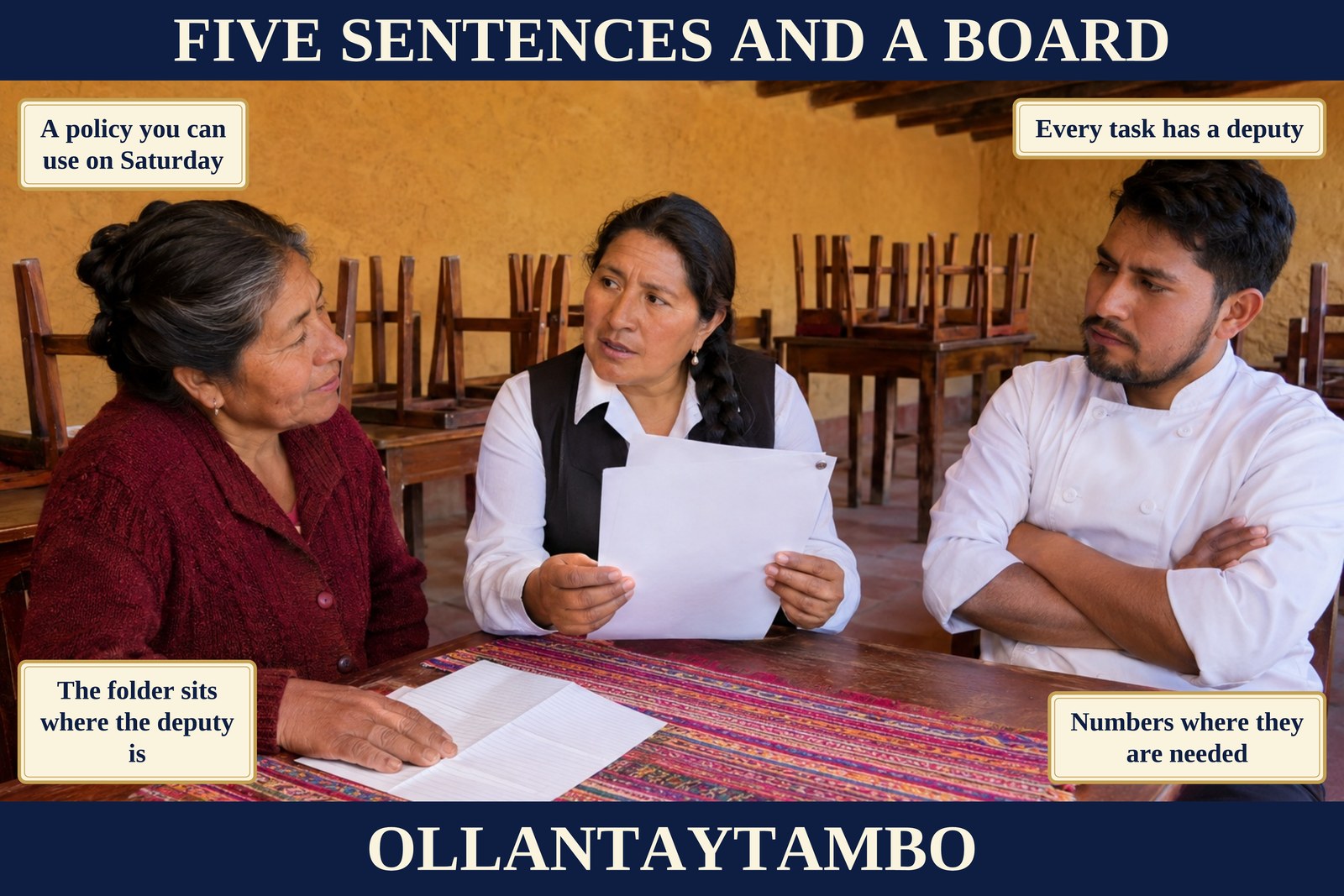
Concept Card 2.3 — Five Sentences and a Board
Subchapter 2.3 · Ollantaytambo, Peru
Setting: Ollantaytambo, Peru
The dining room of a family inn on its closing day, a Monday in late January: ochre adobe walls, dark ceiling beams, chairs turned up on the tables. At a corner table with a woven runner sit three people. In the centre Julia Mamani, the long-serving waitress, holds up two white pages and asks her question across the table. Carmen Huamán, the owner, rests her hand on a folded lined sheet and listens; her son Diego, the head chef, sits back with his arms crossed.
The two documents face each other. In Julia's hands is the mission statement Diego downloaded, two neat pages that could hang in any inn in the valley. Under Carmen's hand is Julia's own note about Saturday evening, when a coeliac guest asked about a sauce and the allergen folder lay behind a locked door. The composition sets the waitress between them, because her question decides which of the two papers the house will act on.
The four plaques answer Julia's question in order. A policy you can use on Saturday has a few sentences, each one checkable on an ordinary day. Every task has a deputy, because a responsibility held by one person lasts only while she is in the house. The folder sits where the deputy is, at the pass and not in the office. And numbers belong where they are needed, on the board, not stored in the owner's phone.
The plate does not accuse Diego, whose template was meant to help, nor the kitchen, which did not pretend to know, nor Julia, who told the guest the truth. Diego's folded arms show a son who is a little hurt and already thinking. What the image shows is a house whose answers hung on two absent people, and the lesson that a policy is worth what an employee can do with it on Saturday.
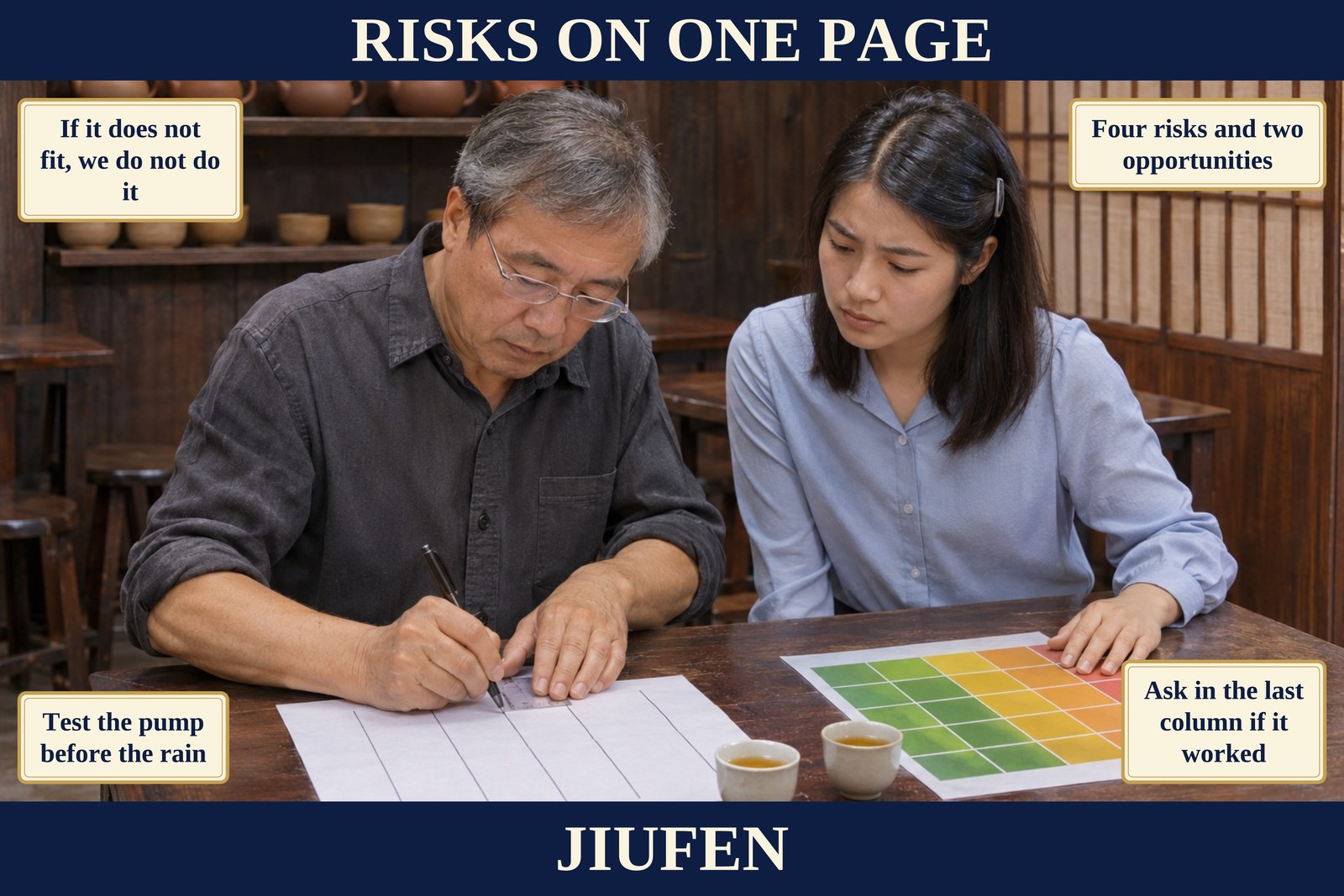
Concept Card 2.4 — Risks on One Page
Subchapter 2.4 · Jiufen, Taiwan
Setting: Jiufen, Taiwan
The corner table of the teahouse in a hillside guesthouse, on a damp afternoon in early May, in soft grey light: dark timber walls, clay teapots on a shelf, a closed sliding screen. Lin Cheng-hao, the owner, draws the last of five vertical lines on a plain white sheet, pen and short ruler in a steady hand. Beside him his daughter Yu-ting rests her hand on the coloured risk matrix she has pushed aside and studies the empty columns. Two small cups of tea stand between them.
Two documents share the table and point in different directions. The matrix, five by five in green, amber and red, holds thirty-one risks and the hour spent arguing over a single digit. The white sheet holds nothing yet, but its five columns already carry a decision: what can happen, what we do, who, by when, and did it work. The composition leaves the colourful sheet at the edge and puts the plain one in the hand that writes.
The four plaques read as the owner's rule unfolded. If it does not fit, we do not do it: one page forces a choice. Four risks and two opportunities are enough for sixteen rooms, provided the uncomfortable one about the cook is among them and the choir's enquiry is not left in the inbox. Test the pump before the rain, because an untested action reassures until the water comes. And ask in the last column if it worked.
The plate does not accuse Yu-ting, who did carefully what her course had taught her, nor Cheng-hao, who knew his house better than any list but kept it in his head. Each held half of what was needed. What the image shows is a matrix that sorts risks and a sheet that acts on them, and the lesson that only a row with a name, a date and a tested effect makes a small house safer.
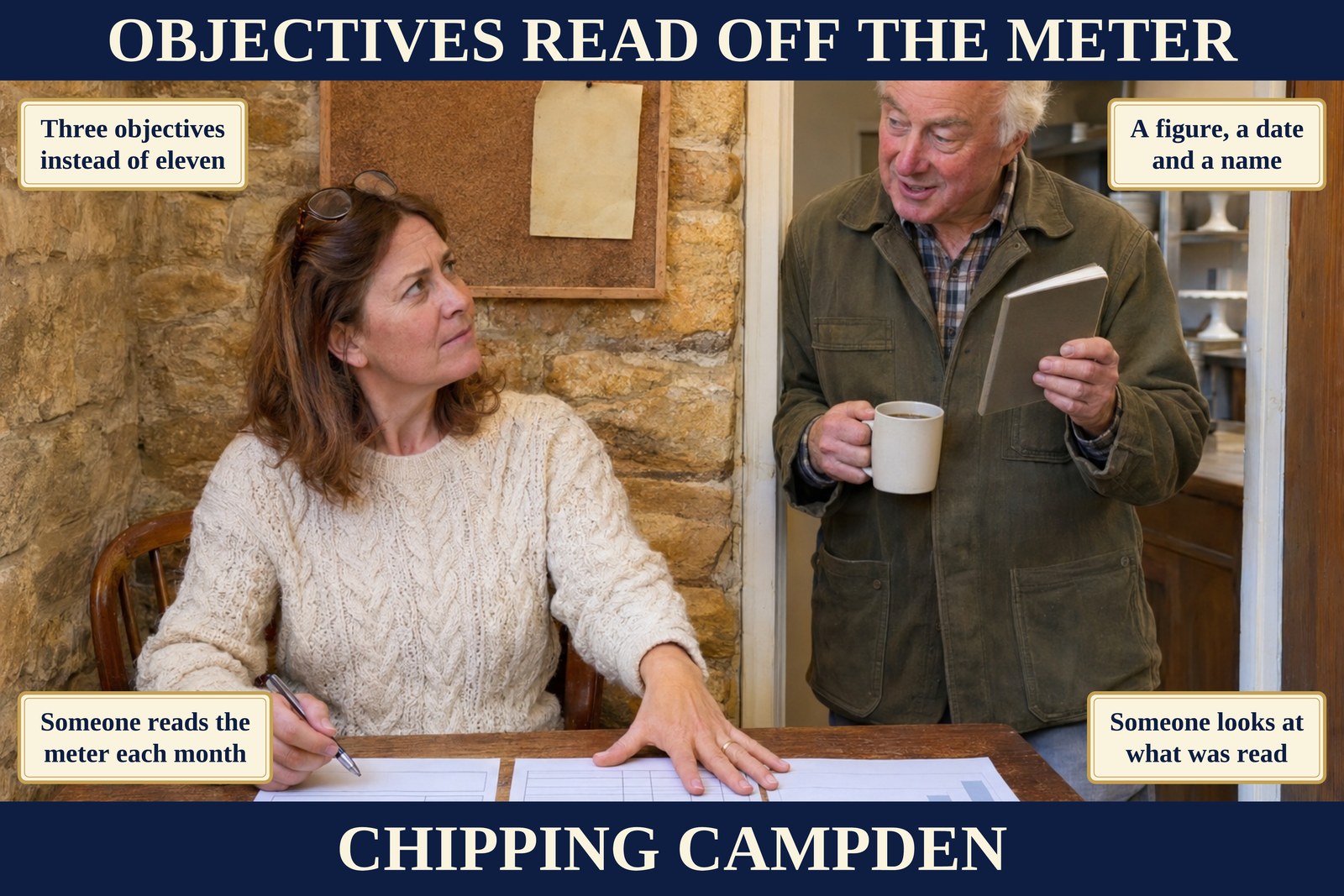
Concept Card 2.5 — Objectives Read off the Meter
Subchapter 2.5 · Chipping Campden, United Kingdom
Setting: Chipping Campden, United Kingdom
A small office behind the cake counter of an old stone inn, at midday in January while the house is closed: honey-coloured walls, a cork board with one faded slip, a narrow desk. Harriet Fenwick, the owner, sits with reading glasses pushed up on her head, pen in one hand, the other laid flat across three documents. In the doorway Ken, the retired handyman, holds a mug of coffee and a small notebook, and turns to her with his question.
The three papers on the desk are the electricity statement, the accountant's figures and the occupancy report, laid side by side for the first time. Harriet's hand joins them, and from that joining the first useful figure appears: kilowatt hours per guest night. The faded slip on the board is the only objective the house ever wrote. Ken's notebook is the other half of the picture, the place where a monthly reading will live.
The four plaques follow the line from wish to evidence. Three objectives instead of eleven, because seven people cannot carry eleven projects beside the business. A figure, a date and a name for each, so that an objective can be met or missed for a known reason. Someone reads the meter each month, while consumption can still be linked to a cake cabinet or a washing machine. And someone looks at what was read, which is the question Ken is asking.
The plate does not accuse Harriet, whose eleven objectives were all sensible and who had already gathered the bills and found a reader. Nor does it smile at Ken's question; it is the most useful sentence in the room. What the image shows is a house that already had its figures in three folders and lacked only a question for them to answer, and the lesson that an objective becomes real when someone else looks at the reading that same morning.
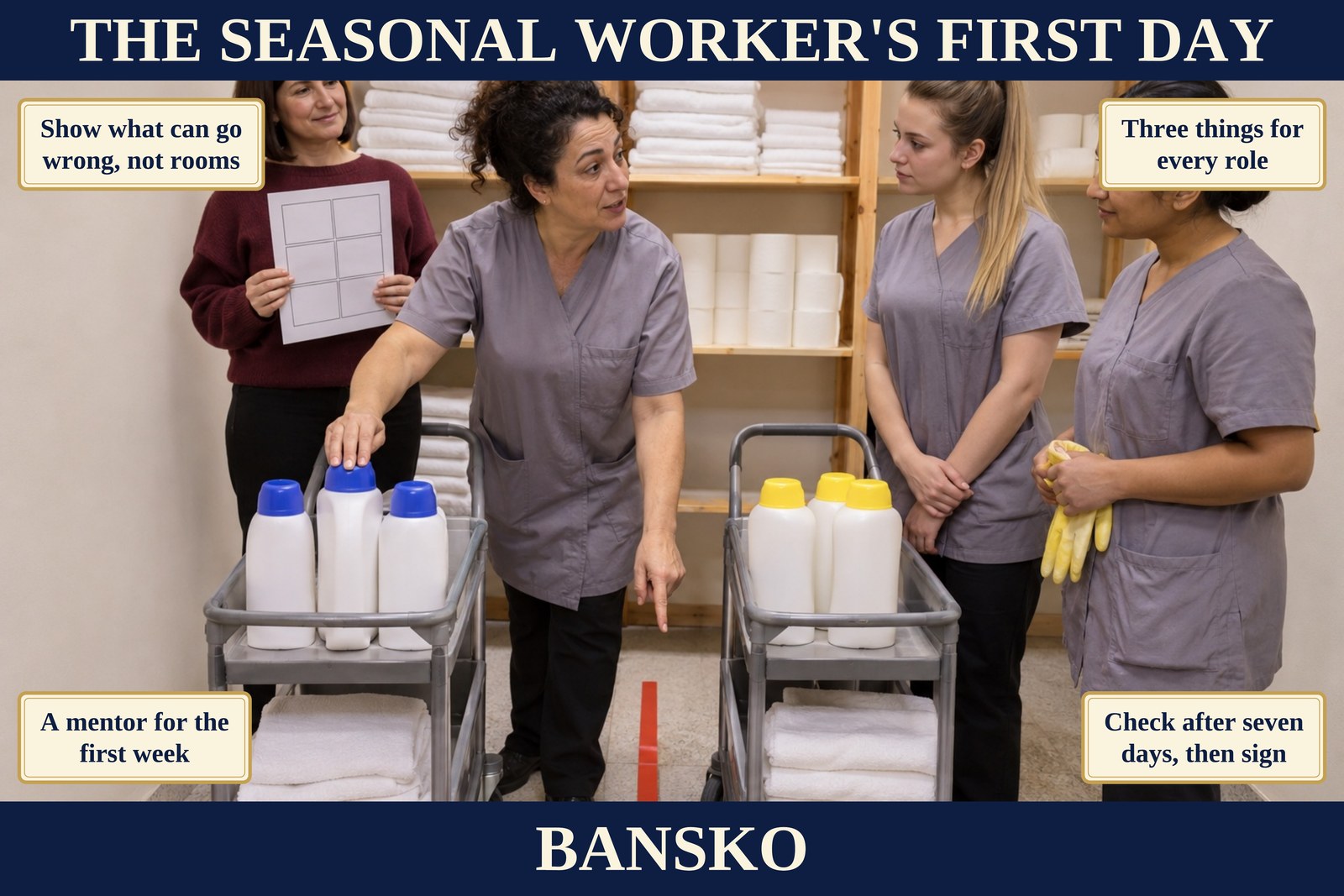
Concept Card 2.6 — The Seasonal Worker’s First Day
Subchapter 2.6 · Bansko, Bulgaria
Setting: Bansko, Bulgaria
A narrow housekeeping store in a small mountain hotel on a December morning, under bright light: pine shelves of white towels and paper rolls, two trolleys side by side with a strip of red tape on the floor between them. Rosa Mendes, the experienced room attendant, stands between the trolleys, one hand on a blue-capped bottle, the other pointing at the tape. Two new attendants listen, one holding rubber gloves. A step behind, Desislava Ivanova, the owner, holds a sheet of six empty boxes.
The red tape is the centre of the image and the simplest measure in the book. Chlorine stands on the left trolley, acids on the right, so that the mistake Rosa made in her first week last season can no longer be made by hand. The composition gives the speaking part to the woman who coughed on the balcony, not to the owner. Desislava's page of six boxes waits in the background, because the story persuades and the page records.
The four plaques describe the first day as the book designs it. Show what can go wrong, not rooms: a tour shows where the linen is kept, an induction shows which bottles must never meet. Three things for every role, because the room attendant, the waiter and the receptionist need different knowledge. A mentor for the first week, which is what Rosa has become. And check after seven days, then sign, so that the page records what was learned, not only who attended.
The plate does not accuse Rosa, who had cleaned carefully for years in other houses, nor Desislava, whose tours were friendly and kept being interrupted by the phone that paid everyone's wages. Nobody was careless; they had been shown the rooms and not what could go wrong in them. The lesson is that a tour shows where things are, an induction shows what must never happen, and a question a week later shows whether it landed.

Concept Card 2.7 — Hazards Without a Specialist
Subchapter 2.7 · Cartagena, Colombia
Setting: Cartagena, Colombia
The narrow service staircase of a small hotel in a restored colonial house, on a bright morning. The tiled steps are worn in the middle and now carry yellow anti-slip nosings; a wooden handrail runs along one wall and a new steel rail along the other. At the top, through a door, stands a washing machine. Yolanda Herrera, the room attendant, climbs with a basket on her hip and one hand on the steel rail, looking back with a half-smile. Below, Julián Montoya, the owner, writes on a clipboard.
The staircase is both the hazard and its answer. Here Yolanda slipped on wet tiles with twelve kilos in front of her and broke her wrist; here, on her return after five weeks, she walks up first beside the owner to see what has changed. The nosings, the second rail, the light and the dry drip tray are causes removed, not rules written. The clipboard records the walk, and the person carrying the basket is the one who knows what to look for.
The four plaques read as a walk with open eyes. Assess what the house really does, activity by activity, rather than ticking a template that knows a fryer and a lift the hotel never had. Walk round with the staff, at the time they work, because they know the hazards first. Remove the cause first: repair the inlet before writing a rule about care. And the line stays open until it works, so effectiveness is checked on the steps themselves.
The plate does not accuse Julián, who had an assessment and insured his staff, nor Yolanda, who had warned him twice in passing. The in-house laundry was a sound decision; it simply created an activity no binder described. The steps are dry and both stand firmly, because the picture shows the measure, not the fall. The lesson is that whoever assesses the work done on the stairs, with the people who do it, finds the fall before it happens.
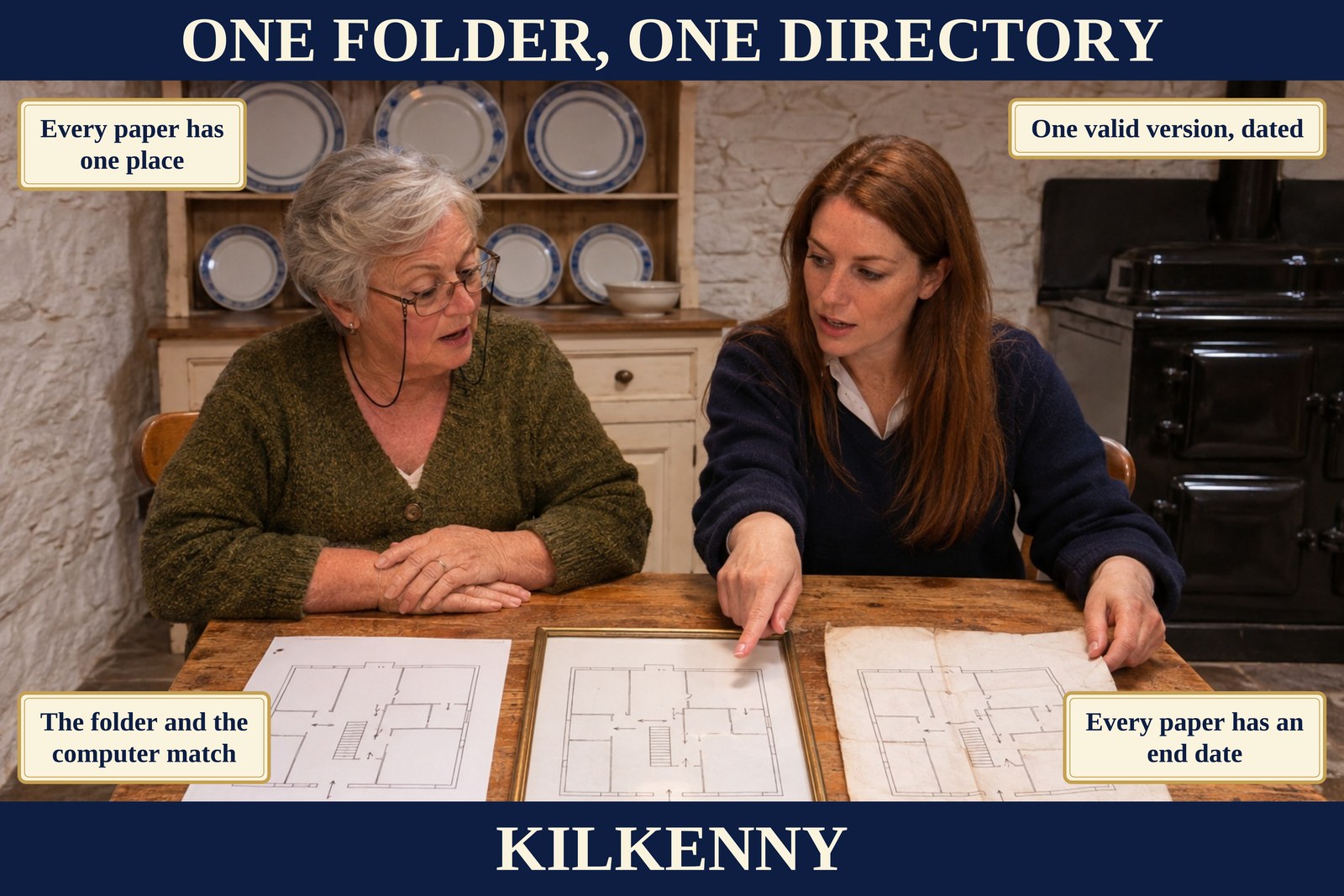
Concept Card 2.8 — One Folder, One Directory
Subchapter 2.8 · Kilkenny, Ireland
Setting: Kilkenny, Ireland
The family kitchen of an old stone inn on a November evening while the house is closed: whitewashed walls, a dresser of blue and white plates, a dark range cooker standing cold. At the scrubbed pine table Niamh Walsh, the daughter, points at one of three floor plans laid in a row, her other hand on a creased sheet. Opposite her Brigid, the owner, silver-haired, reading glasses on a cord, keeps her hands folded and looks at the row with mild surprise.
The three plans show the same house and are not the same document. One comes from the binder, one in a thin glass frame from the corridor, one folded and worn from Brigid's bedside table, where two numbers were added by hand. None carries a date. The composition puts the framed version, the one guests read, at the centre under Niamh's finger, because the oldest plan hung where most people would trust it.
The four plaques are the sentence the two women agreed on, set out in parts. Every paper has one place, so that someone other than the owner can find it. One valid version, dated, so that nobody has to know which copy counts. The folder and the computer match, register for register, rather than moving the disorder onto a screen. And every paper has an end date, which is where the guest cards in the attic finally meet the law.
The plate does not accuse Brigid, who lost nothing in thirty years, nor Niamh, whose wish to scan everything came from a group with a back office. Each was right about something. What the image shows is a house whose order lived in one memory, and the moment that memory meets a question it cannot answer. Whatever lacks one place, one valid version and an end date is not kept, merely left lying.
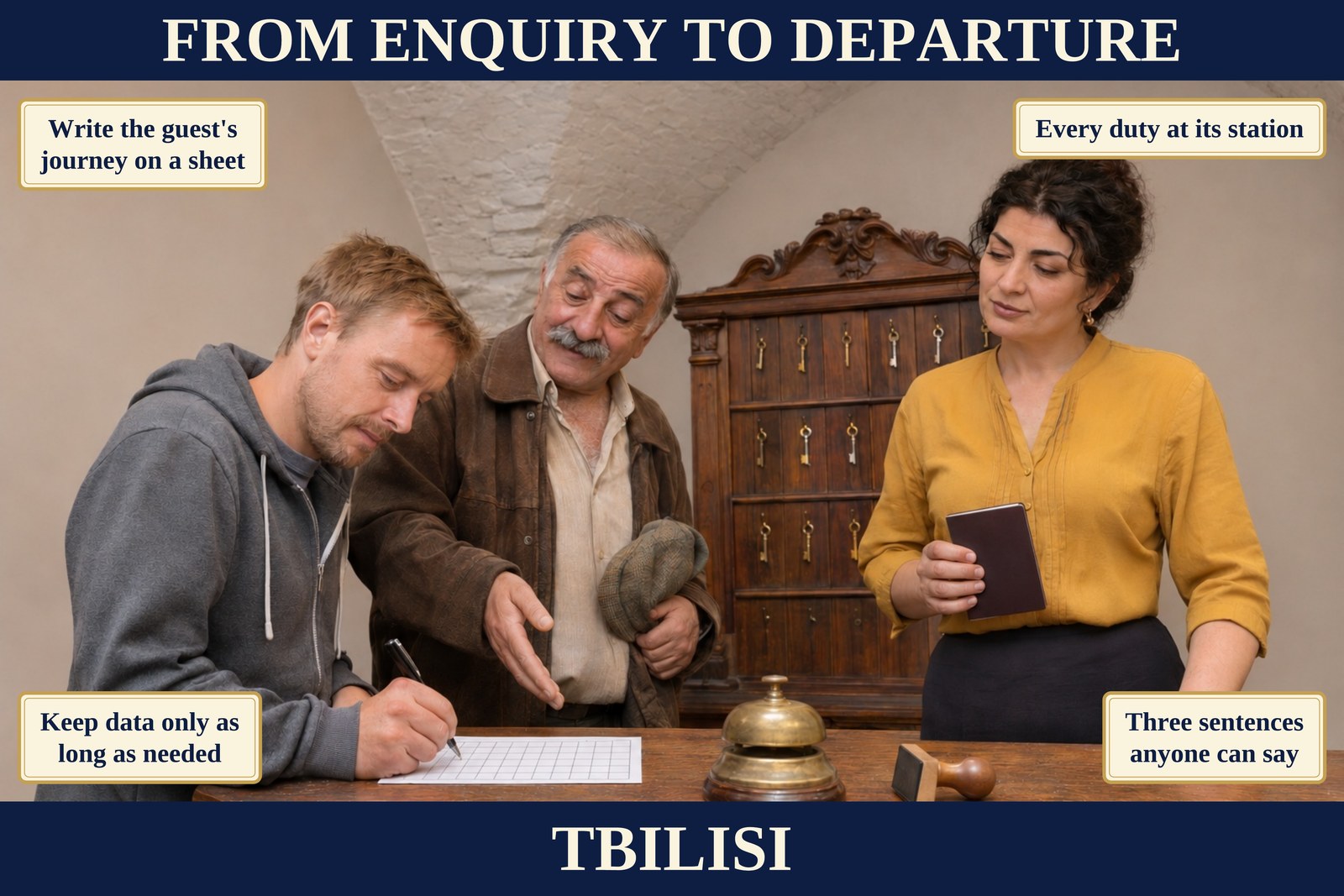
Concept Card 2.9 — From Enquiry to Departure
Subchapter 2.9 · Tbilisi, Georgia
Setting: Tbilisi, Georgia
The small reception of a guesthouse in an old house, at half past seven on a Saturday in late June, under a white vaulted ceiling: a walnut desk with a brass bell and a wooden stamp, a carved cabinet of keys behind. A tired guest in a grey hoodie, arrived after midnight, bends to sign a registration form. Beside him an older guest with a grey moustache, cap in hand, gestures at the form. Nino Beridze, the owner, stands behind the desk holding a closed passport.
The form on the desk is the step that fell away. Guests arriving by day meet a routine of welcome, form, passport and key; those who arrive late find only a key box at the gate, and the form stays under the stamp. The passport in Nino's hand recalls the drawer of copies her predecessor left behind. The older guest's question, what happens to the paper afterwards, turns her thoughtful, and the picture holds that moment.
The four plaques describe the guest journey as one process. Write the guest's journey on a sheet, station by station, from enquiry to departure, so that the late arrival follows the same path as the morning one. Every duty at its station: registration, data protection and routine belong to the same path. Keep data only as long as needed, with a date for deletion and a deputy. And prepare three sentences anyone can say when a guest asks what the house records, why and for how long.
The plate does not accuse Nino, who kept every form she was given and lost none, nor her predecessor, whose copies once had a reason. Nobody had explained what the house should do with guests' data, and the journey ran well because she was always there. What the image shows is the gap at the edges: the late arrival, the weekend helper, a guest's honest question. A house that cannot say when data leave it has only a drawer that fills.
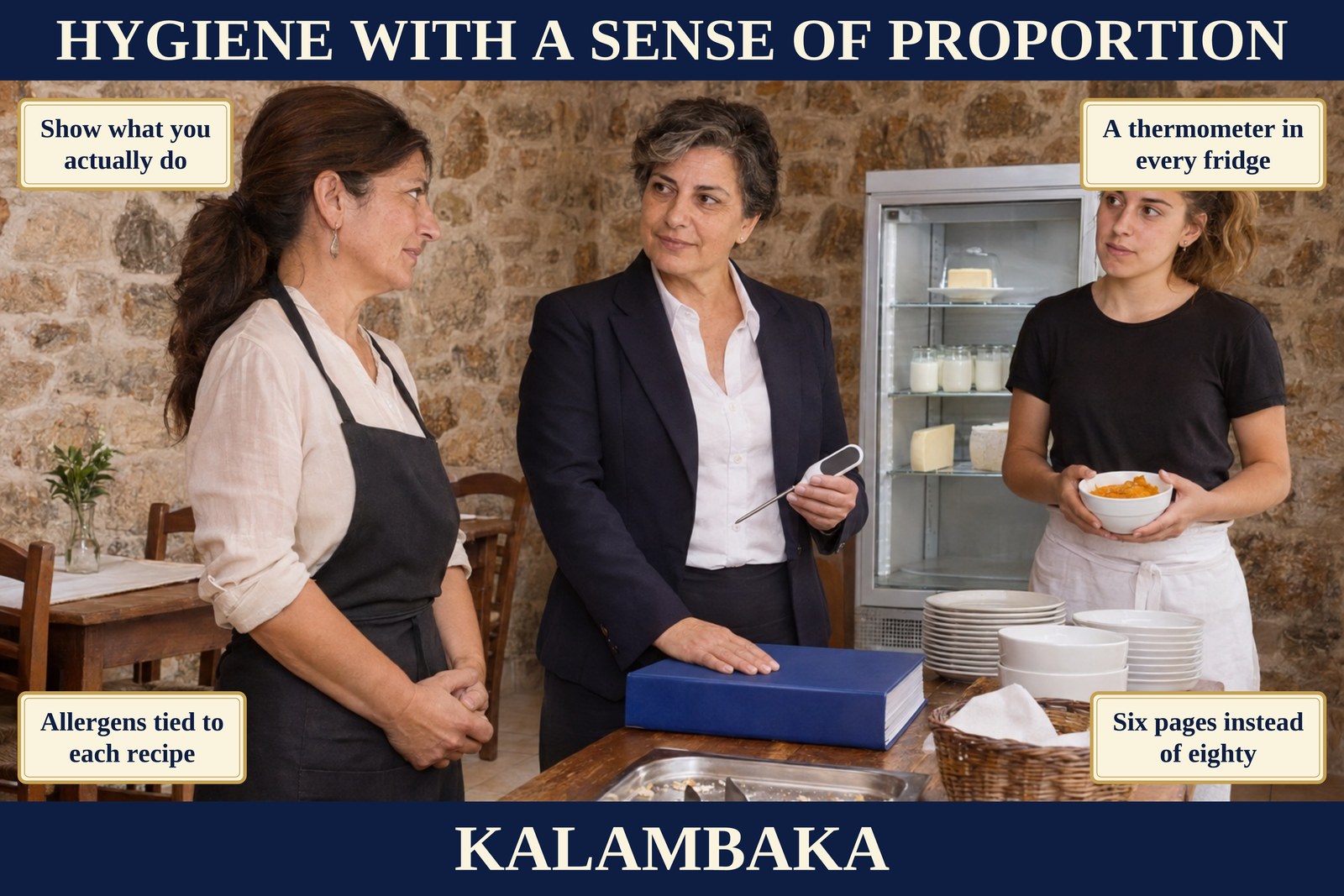
Concept Card 2.10 — Hygiene with a Sense of Proportion
Subchapter 2.10 · Kalambaka, Greece
Setting: Kalambaka, Greece
The breakfast room of a family guesthouse in an old stone house, at half past ten on a clear October morning: rough stone walls, a buffet half cleared, a glass-fronted fridge holding butter, yoghurt and cheese. In the centre a food-safety inspector in a navy blazer holds a probe thermometer and lays her other hand flat on a thick blue binder. Eleni Papadaki, the owner, stands facing her with hands clasped. At the buffet Sofia, the student helper, holds a bowl of pumpkin spread.
The closed binder under the inspector's hand is the centre of the plate: eighty pages, twenty-two control points, fourteen daily forms, the last one filled in a year and a half ago. Her gesture closes it rather than opens it. Around it stand the real places where something can go wrong, the fridge without a thermometer and a homemade spread that is not on the allergen list. The helper holding the bowl has the question in her hands and no answer.
The four plaques are the inspector's sentence unfolded. Show what you actually do, not what a folder borrowed from large catering kitchens describes. A thermometer in every fridge, because the breakfast fridge is where guests serve themselves and an unmeasured one is a gap, not a simplification. Allergens tied to each recipe, so that a new spread changes the list the same day. And six pages instead of eighty, which the house fills in because they fit its hands.
The plate does not accuse the consultant who wrote in good faith, nor Eleni, who paid for the binder because she wanted to do things properly, nor Sofia, who said honestly that she would ask the cook. The kitchen was clean and the spread made with care. What was missing was a system that fitted two cooks and a helper alone on a Sunday. Less paper is never less care: flexibility belongs to the documents, not to the aims of hygiene.

Concept Card 2.11 — Suppliers, Laundry, Tradespeople
Subchapter 2.11 · Pucón, Chile
Setting: Pucón, Chile
The linen room of a small timber guesthouse on a November afternoon, under warm light: varnished pine walls, open shelves of folded towels and pillowcases, a wide folding table. Carolina Muñoz, the hostess, holds up two bed sheets by their corners, one dull and grey, one bright white. Her husband Andrés takes the edge of the grey sheet between finger and thumb to compare. Across the table a housekeeper rests her hands on a neat pile of folded white linen and looks on, satisfied.
The two sheets are the whole argument in fabric. The grey one came back from the laundry the house had trusted for years; the white one came from a second laundry, ten sheets sent on trial. Guests had already noticed the difference and asked whether the bedding was fresh. The composition places Carolina between the two, because the house, not the laundry, answers for what lies on the bed, and the housekeeper's pile shows what the criterion looks like when it is met.
The four plaques read as a short procedure. Find the eight suppliers that matter among the thirty-one on the invoices: those a guest would notice, or on which safety, law or data depend. Give each a criterion the supplier knows, such as white sheets without stains, delivered on Saturday by ten. Test substitutes before you need them, as the trial sheets did. And keep a way out of every online service, because the booking program holds the house's rooms and its guests' data.
The plate does not accuse the laundry, which announced its change by letter, nor the plumber who never promised Sunday cover, nor the baker who does what he has always done. The hosts trusted people who had served them well, which is how small houses work. What was missing was a statement of what the house required. A house can hand its work to others, but never the question of whether that work is done right.
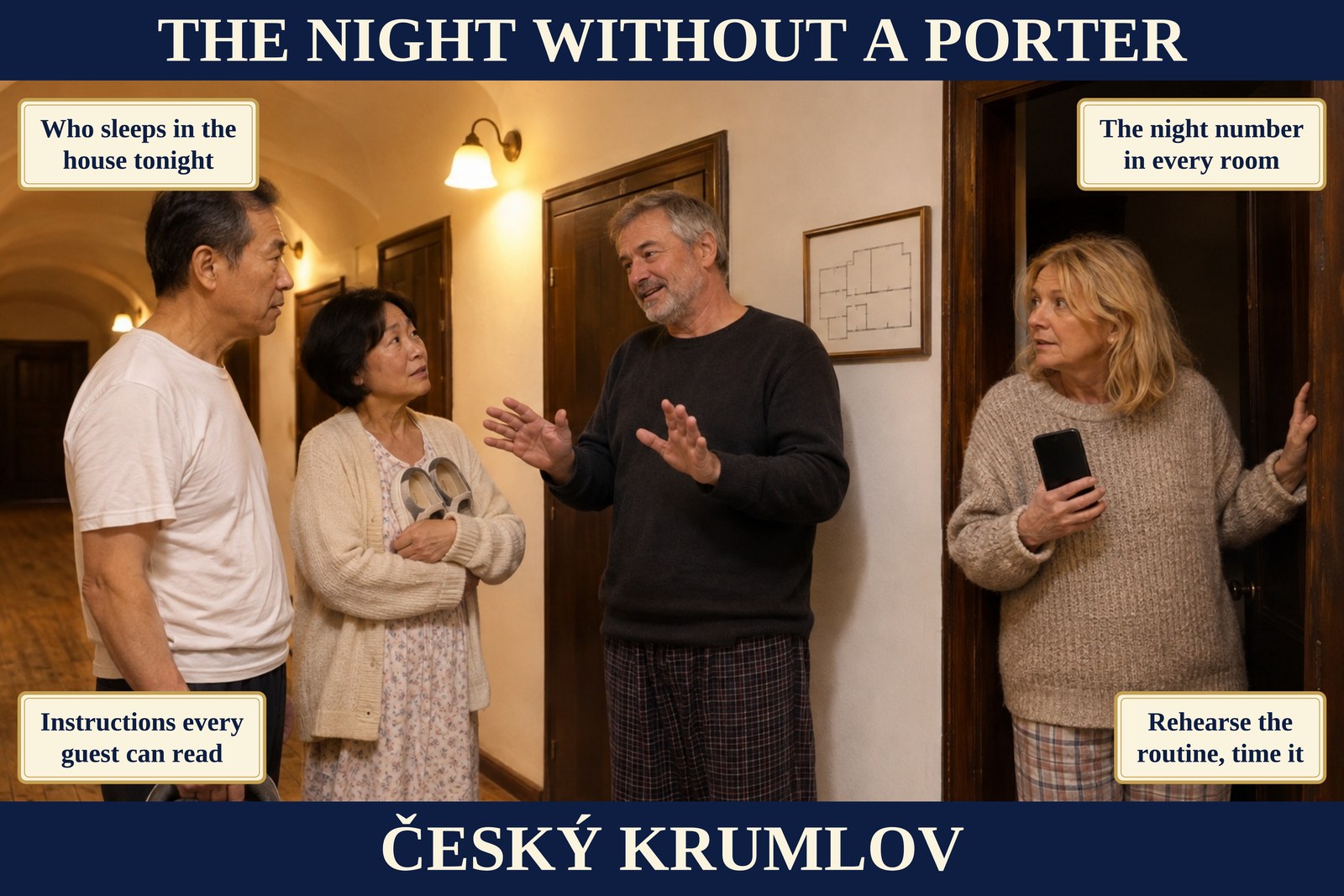
Concept Card 2.12 — The Night Without a Porter
Subchapter 2.12 · Český Krumlov, Czech Republic
Setting: Český Krumlov, Czech Republic
The first-floor corridor of a guesthouse in an old burgher house, at a quarter to three on an October night, lit by low yellow lamps: a vaulted ceiling, dark doors, a framed floor plan on the wall. Tomáš Horák, in a jumper over pyjama trousers, explains with open hands and a reassuring smile. Facing him are two guests from Seoul; the woman holds her shoes against her chest. At an open door stands Jana Horáková, the owner, phone in hand, steadying herself on the frame.
The shoes are the quiet centre of the scene. The couple did exactly the right thing: they stepped out ready to leave. They had simply not understood a word, because the sheet inside the door and the voice in the corridor were both in Czech. The phone in Jana's hand is the house's reception at night. Four people stand in the corridor, and of the forty beds in the building only two people are awake to answer for them.
The four plaques describe the night as a routine rather than luck. Who sleeps in the house tonight: a printed occupancy list from the evening round, so that the guest with a rollator is known to both owners. The night number in every room and every confirmation, not only by the front door. Instructions every guest can read, drawn from the building's own fire plan, in pictograms and the guests' languages. And rehearse the routine, time it, so that it holds when it is not a shower.
The plate does not accuse the Horáks, who were in the corridor within two minutes and calmed thirty-three guests, nor the print studio whose template assumed a reception that never sleeps. The alarm was only steam, and nobody is in danger in the picture. What the image shows is a false alarm read as the drill the house did not have to plan. The phone on the owner's bedside table deserves the same care as the desk by day.
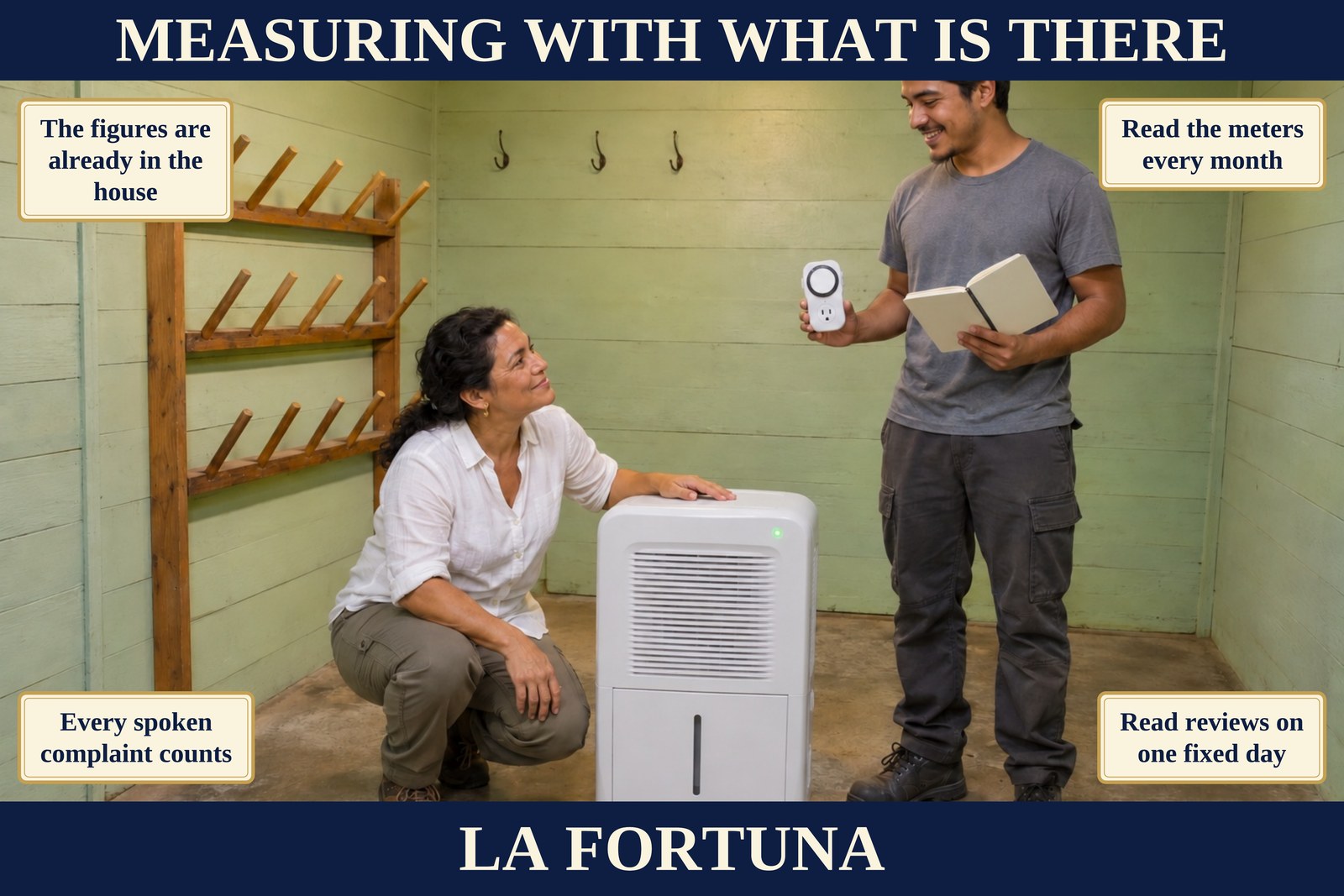
Concept Card 2.13 — Measuring with What Is There
Subchapter 2.13 · La Fortuna, Costa Rica
Setting: La Fortuna, Costa Rica
A small gear room off the veranda of a guesthouse, at ten o'clock on a February night, under a bare bulb: pale green timber walls, an empty boot rack, bare hooks, a concrete floor. In the middle stands a white dehumidifier, its small light glowing, running in a room with nothing to dry. Mariela Solís, the owner, crouches with her hand on top of it and looks up, satisfied. The young handyman stands beside her, smiling, holding an open notebook and a plug-in timer.
The machine is the answer to a question the annual bill could not answer: why the house used almost sixteen per cent more electricity with the same occupancy. It had run day and night since the previous season, even when the room was empty. The notebook found it, because monthly readings narrowed the search. The timer in the handyman's hand is the remedy, worth about forty dollars, and the composition sets cause, evidence and remedy within one reach.
The four plaques describe measuring without new instruments. The figures are already in the house: meters, invoices, guest records, the booking program. Read the meters every month, so that an increase can be traced to a room and a season rather than to a year. Every spoken complaint counts, because guests tell the breakfast assistant over coffee and never write in the cloth-bound book. And read reviews on one fixed day, to evaluate them, instead of every evening, to be annoyed by them.
The plate does not accuse Mariela, who read her reviews because she cared, nor the staff, who passed on what guests said whenever asked. Nobody failed to listen; the house had no place where what it heard was put together. What the picture shows is the moment a figure becomes a decision. Measure what is already in the house; what is new is only that it lands on one sheet each month and someone draws a conclusion from it.
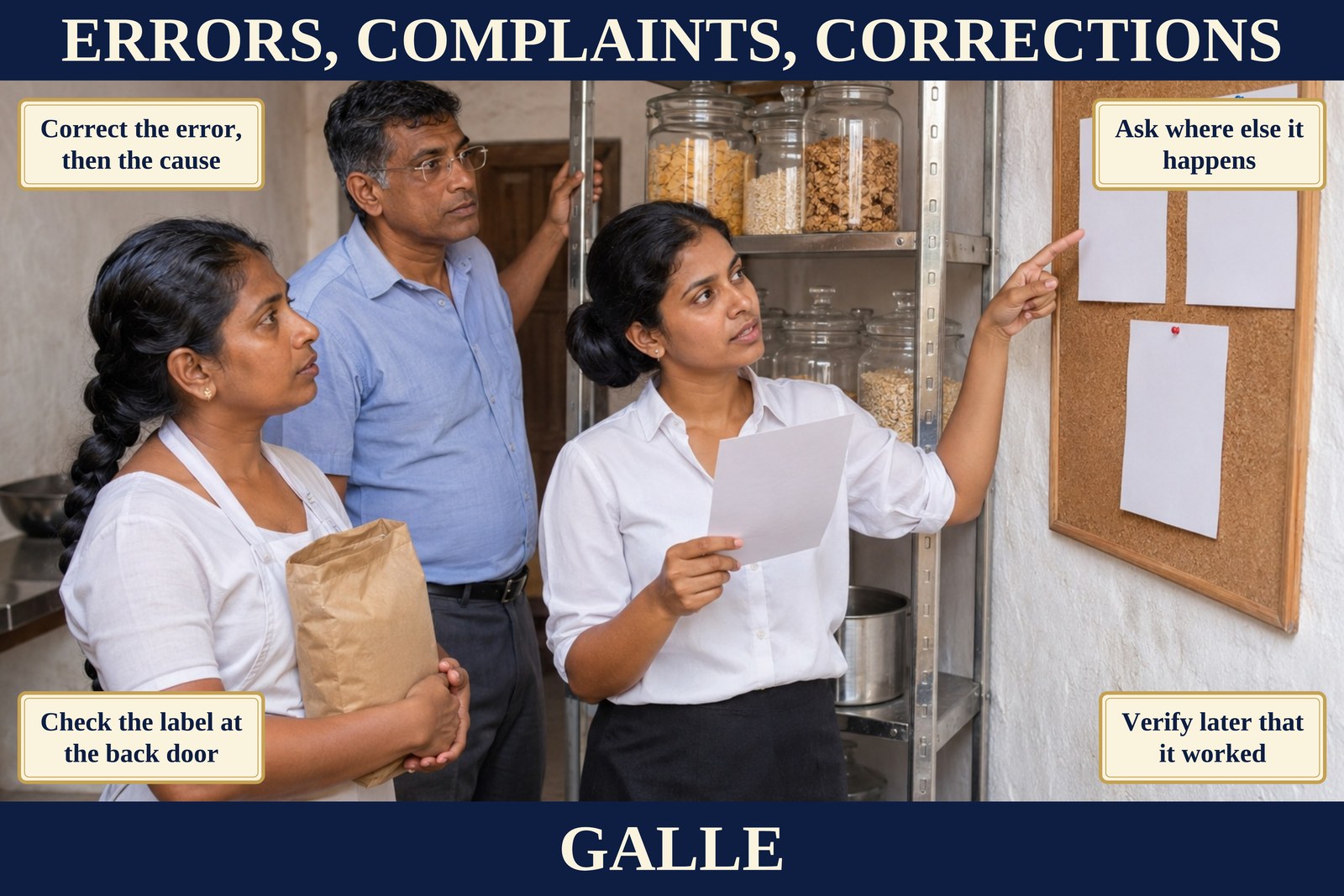
Concept Card 2.14 — Errors, Complaints, Corrections
Subchapter 2.14 · Galle, Sri Lanka
Setting: Galle, Sri Lanka
The back door area of a hotel kitchen in an old merchant house, on an October morning shortly before eight: lime-washed walls, a steel shelf of large glass jars of cereals, a cork board with plain delivery notes pinned to it. Tharushi Silva, the reservations clerk, holds a single delivery note and points at the board. Nimal Fernando, the host, turns towards it from the shelf with sudden attention. The breakfast attendant holds a kraft paper bag of granola against her chest and looks at the board too.
Two kinds of paper meet here. In Tharushi's hand is the granola delivery note with its line in small print about a new recipe, the information that existed and stopped at the back door. On the board hang the bakery's notes, which nobody has yet read against the allergen list. The glass jars behind them have no labels, because the product was decanted. Her pointing hand carries the question that turns a correction into a corrective action: and the bread?
The four plaques read as the route from apology to cause. Correct the error, then the cause: the granola leaves the buffet, but the list must stop being wrong at the next delivery. Ask where else it happens, because the same gap sits wherever a recipe can change. Check the label at the back door, the point where the information stopped. And verify later that it worked, on a set date, so the action is known to have changed something.
The plate does not accuse the breakfast attendant, who received the delivery exactly as she always had and was never asked to compare labels, nor the producer, who printed the change, nor Nimal, who responded quickly and kindly. Nobody was harmed, and that was owed to the guest's attention, not the house's. A quick apology deals with the consequence; only the question of where the same error is still hiding deals with the cause.
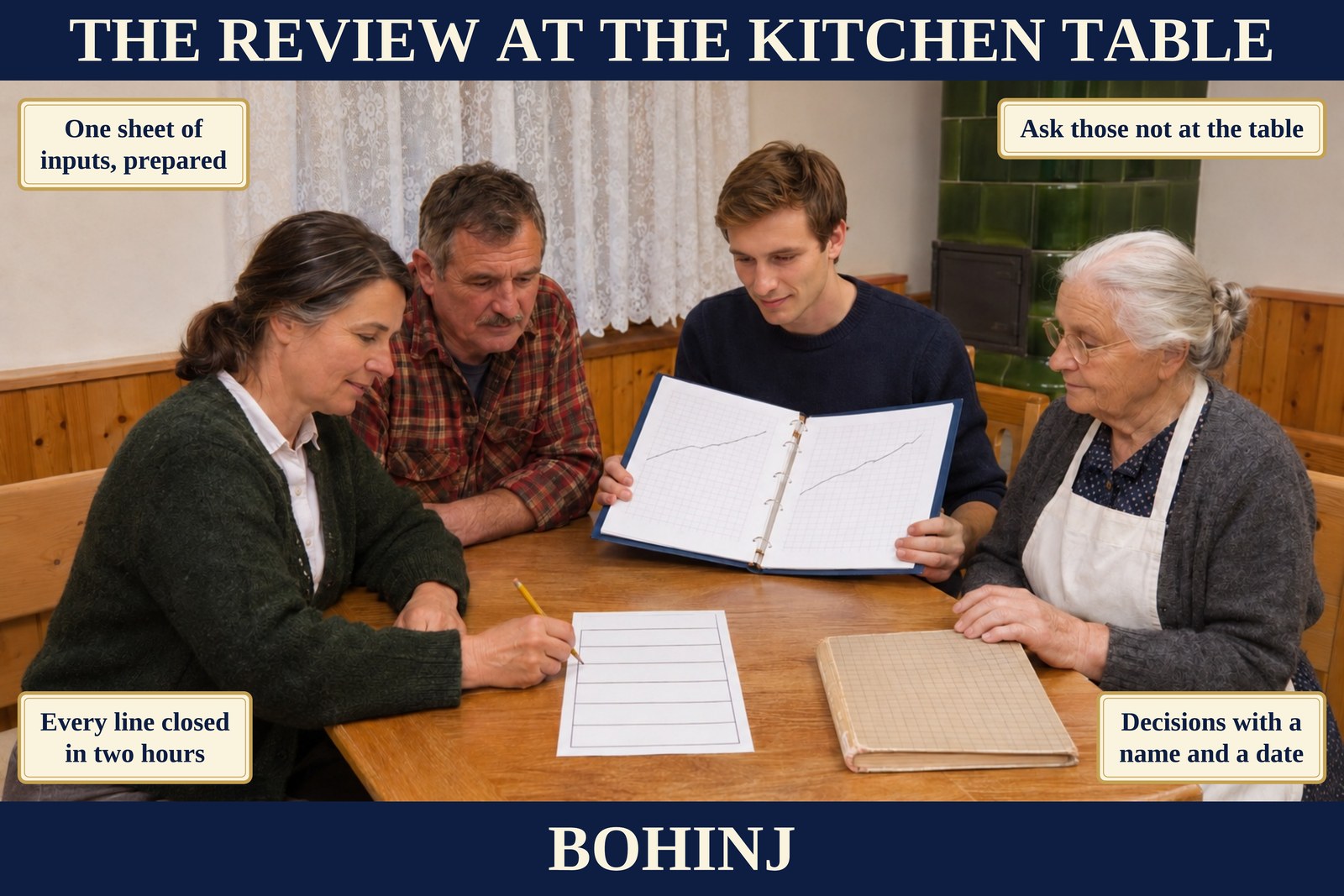
Concept Card 2.15 — The Review at the Kitchen Table
Subchapter 2.15 · Bohinj, Slovenia
Setting: Bohinj, Slovenia
The breakfast room of the Kovač guesthouse on a November afternoon, lace curtains drawn, the green tiled stove cold in its corner. Maja sits with a pencil over a white sheet ruled into empty rows. Tomaž sits beside her and leans in. Opposite, Luka holds open a folder of monthly sheets showing plain line graphs. Ana, beside him, rests her hand on her checked notebook, laid next to the sheet. It is the same table, and the same four people, as in May.
The sheet at the centre holds seven lines, one for each input, and on its back will stand the decisions. The folder in Luka's hands carries the figures that give the cold room a voice against the louder question of the bathrooms. Ana's notebook lies beside the sheet as fifty years of the house's memory, now largely copied into the folder. The composition closes a year: the table where the context was written becomes the table where the house is reviewed.
The four plaques describe the review as a conversation with data. One sheet of inputs, prepared beforehand by the owner, rather than a template with twenty headings. Ask those not at the table: the seasonal housekeeper and the evening server saw what no monthly sheet records. Every line closed in two hours with one of three answers, carry on, adjust or decide. And decisions with a name and a date, because someone should is not a decision.
The plate does not take sides between Tomaž, who favoured the bathrooms that guests photograph, and Maja, whose figures spoke for the cold room. Neither was wrong; they had never had the same facts in front of them at once. What the image shows is a family deciding about the whole house once a year, with the year on the table. The figures do not decide, but they keep the loudest voice from deciding.
L’AUTORE