
The Helm and the Lens · English
Pronto per la pubblicazione / Ready for publication
the Helm and the Lens – Vol. 9b
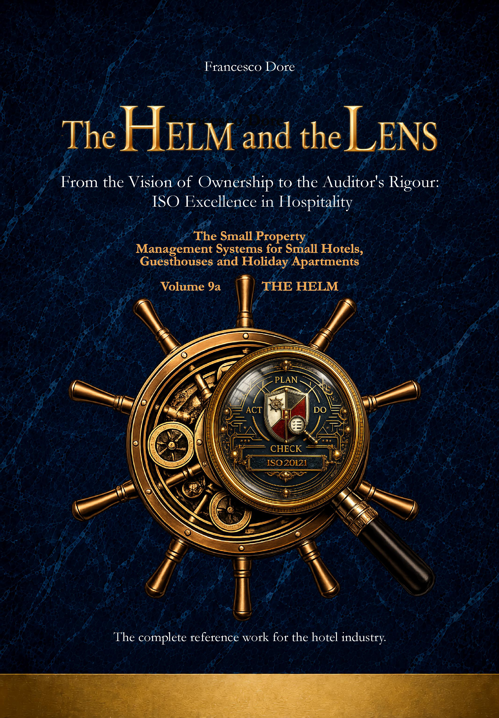
The Small Property · Management Systems for Small Hotels, Guesthouses and Holiday Apartments Volume 9a — The Helm
How to audit a small property where everyone does everything: internal audits without an independent auditor, inspections, labels and certification for guesthouses, small hotels and holiday apartments. The volume that closes the series.
552
Pagine
The Helm and the Lens · Volume 9b — The Lens
The Small Property · Management Systems for Small Hotels, Guesthouses and Holiday Apartments
Auditing Where Everyone Does Everything
The standards say an auditor must not audit their own work. In a fourteen-room guesthouse, everyone does everything. The owner keeps the books, cooks the breakfast, trains the seasonal staff and writes the procedures. So who audits? And how do you audit a house that runs with two people in winter and eight in summer, without turning one quiet afternoon a year into a ritual nobody believes in?
This volume answers those questions, picking up where its companion, 9a — The Helm, leaves off. Volume 9a rebuilt the method for properties too small to carry their own coordinator. This book shows how to check that the method works, and how to prove it to people outside the house.
Chapter 3, The Internal Auditor’s Lens, rebuilds internal audit for the small property. It covers:
arranging independence through a cross-audit with another small house, or through a trusted outside person;
planning an audit programme around the two seasons;
walking the house with a checklist that fits one sheet;
writing findings a family can read and act on;
following them up without a quality department.
Chapter 4, The Certifier’s Lens, looks at proof from outside. It covers what inspectors and platforms check, and how labels and certification schemes differ in what they actually assess. It explains when a certificate is worth its cost for a small house, and what stage 1 and stage 2 mean when the person being audited is also the owner, the manager and the receptionist.
Every subchapter opens with a case set in a real place, built as a composite and clearly declared as fictional. The family guesthouse in Bohinj, Slovenia, from Volume 9a returns to frame the story. Each subchapter carries a Verification Pact, which keeps apart what a standard requires, what applies to certification bodies and scheme owners, and what is this book’s method. A postscript closes the series and leaves the door open to the volumes still to come.
The author is a Lead Auditor and has spent over twenty years in hospitality, small houses included. He writes as an author and publisher, for those who run small properties and for those who audit them with respect for their size. This is independent material, not affiliated with ISO or any certification, accreditation or scheme-owning body. Legal duties always need to be confirmed locally.
Each subchapter ends with a concept card. The online platform offers ready-to-use tools and the cards in high resolution:
a cross-audit agreement template;
an audit programme for a two-season house;
a walk-through checklist;
a finding sheet;
a follow-up log;
a stage 1 readiness checklist for a small house.
EDIZIONI · FORMATI
Formati disponibili
Le edizioni fisiche e digitali associate a questa scheda.
NEL LIBRO
Contenuto / Contents
La struttura del volume così come presentata nell’edizione pubblicata.
Table of Contents
- Preface.
- 3.1 Who Audits Where Everyone Does Everything: Independence in a Small House
- 3.2 The Cross-Audit Between Two Houses: Agreement, Confidentiality, Reciprocity
- 3.3 The External Auditor for Hire: Selection, Mandate, Cost.
- 3.4 The Audit Programme for a House with Two Seasons.
- 3.5 Audit Methods Without an Office: Walk-Through, Conversation and Record
- 3.6 Auditing the Obligations: Checking the List of Legal Duties Without a Lawyer
- 3.7 Auditing the Live Operation: Breakfast, Arrival and the Night.
- 3.8 Auditing Within the Family: When Mother Is Audited.
- 3.9 Holiday Apartments and Outsourced Services in the Audit.
- 3.10 Writing Findings a Family Will Read.
- 3.11 Causes in a House Without Departments.
- 3.12 The Report to an Owner Who Was Also Audited.
- 3.13 Follow-Up with Little Time: Does the Action Work Next Season?.
- 3.14 Auditing Suppliers Without Power: The Small Customer.
- 3.15 An Audit Culture in a Small House.
- 4.1 Who Checks from Outside: Authority, Classifier, Label Holder, Certifier
- 4.2 The Authority on the Premises: An Inspection Is Not an Audit.
- 4.3 Which Proof for Which House: The Decision.
- 4.4 Classification as an Inspection: The Guesthouse Assessment.
- 4.5 Stars with System Points: Complaints, Reviews and Quality Management
- 4.6 The GSTC Route for a Small Property.
- 4.7 Programmes Without a Certificate: Destination and Association Schemes
- 4.8 Ecolabels Compared: The EU Ecolabel and Other Independent Labels.
- 4.9 ISO Certification of a Small House: Process and Effort.
- 4.10 The Certifier in a Small House: Stage 1 and Stage 2 Without Departments
- 4.11 Certified Together: Groups, Associations and Clusters.
- 4.12 Advertising with Proof: What a Label and a Certificate Allow..
- 4.13 Costs and Benefits of the Proofs Compared.
- 4.14 When a Proof Ends: Expiry, Withdrawal and a New Start.
- 4.15 The System Stays, the Certificate Changes.
- Afterword.
- Postscript.
- Appendix A..
- Sources and Research Methodology — What This Book Verified, and How..
- Glossary.
- About the Author.
- Contact. 445
- The Series. 447
- The Online Platform.. 449
MATERIALI DI LAVORO
Materiali e download
Checklist, modelli, supplementi e file di lavoro collegati al volume.
FILES
1 · Working material 1.1 — One House, One Pair of Hands: What a Small Property Is
The Small Property · 9a · 1.1
Editable Word worksheet: Verification Pact, mistakes self-check, checklist and evidence questions
FILES
3 · Working material 1.2 — The Certificates on the Wall: What a Small House Already Proves
The Small Property · 9a · 1.2
Editable Word worksheet: Verification Pact, mistakes self-check, checklist and evidence questions
FILES
5 · Working material 1.3 — One Structure for Every Topic: The Harmonized Structure of Management-System Standards
The Small Property · 9a · 1.3
Editable Word worksheet: Verification Pact, mistakes self-check, checklist and evidence questions
FILES
7 · Working material 1.4 — Proportionality: What Standards and Guidance Say About Size
The Small Property · 9a · 1.4
Editable Word worksheet: Verification Pact, mistakes self-check, checklist and evidence questions
FILES
9 · Working material 1.5 — Thresholds: Where Rules Change with Size
The Small Property · 9a · 1.5
Editable Word worksheet: Verification Pact, mistakes self-check, checklist and evidence questions
FILES
11 · Working material 1.6 — The Owner as Bottleneck: Absence, Deputies and Knowledge Held in One Head
The Small Property · 9a · 1.6
Editable Word worksheet: Verification Pact, mistakes self-check, checklist and evidence questions
FILES
13 · Working material 1.7 — Family and Leadership: Who Decides in a Family Business
The Small Property · 9a · 1.7
Editable Word worksheet: Verification Pact, mistakes self-check, checklist and evidence questions
FILES
15 · Working material 1.8 — What the Method Costs and What It Returns
The Small Property · 9a · 1.8
Editable Word worksheet: Verification Pact, mistakes self-check, checklist and evidence questions
FILES
17 · Working material 1.9 — Requirements from Outside: Tour Operators, Platforms and Corporate Clients
The Small Property · 9a · 1.9
Editable Word worksheet: Verification Pact, mistakes self-check, checklist and evidence questions
FILES
19 · Working material 1.10 — Advertising with Sustainability: What a Small House May Say
The Small Property · 9a · 1.10
Editable Word worksheet: Verification Pact, mistakes self-check, checklist and evidence questions
FILES
21 · Working material 1.11 — Holiday Apartments: Letting Without a Reception
The Small Property · 9a · 1.11
Editable Word worksheet: Verification Pact, mistakes self-check, checklist and evidence questions
FILES
23 · Working material 1.12 — Staff in Small Houses: Seasonal Workers, Family and Helpers
The Small Property · 9a · 1.12
Editable Word worksheet: Verification Pact, mistakes self-check, checklist and evidence questions
FILES
25 · Working material 1.13 — Energy and Resources Without an Energy Manager
The Small Property · 9a · 1.13
Editable Word worksheet: Verification Pact, mistakes self-check, checklist and evidence questions
FILES
27 · Working material 1.14 — Label, Classification or Certificate: Which Proof Fits Which Property
The Small Property · 9a · 1.14
Editable Word worksheet: Verification Pact, mistakes self-check, checklist and evidence questions
FILES
29 · Working material 1.15 — Starting Small: Scope and a Stepwise Plan
The Small Property · 9a · 1.15
Editable Word worksheet: Verification Pact, mistakes self-check, checklist and evidence questions
FILES
31 · Working material 2.1 — Determining the Context on a Single Page
The Small Property · 9a · 2.1
Editable Word worksheet: Verification Pact, mistakes self-check, checklist and evidence questions
FILES
33 · Working material 2.2 — Interested Parties in the Village
The Small Property · 9a · 2.2
Editable Word worksheet: Verification Pact, mistakes self-check, checklist and evidence questions
FILES
35 · Working material 2.3 — Policy and Responsibilities: Five Sentences and a Board
The Small Property · 9a · 2.3
Editable Word worksheet: Verification Pact, mistakes self-check, checklist and evidence questions
FILES
37 · Working material 2.4 — Risks and Opportunities with Simple Means
The Small Property · 9a · 2.4
Editable Word worksheet: Verification Pact, mistakes self-check, checklist and evidence questions
FILES
39 · Working material 2.5 — Objectives and Indicators You Read off the Meter
The Small Property · 9a · 2.5
Editable Word worksheet: Verification Pact, mistakes self-check, checklist and evidence questions
FILES
41 · Working material 2.6 — Competence and Induction: The Seasonal Worker’s First Day
The Small Property · 9a · 2.6
Editable Word worksheet: Verification Pact, mistakes self-check, checklist and evidence questions
FILES
43 · Working material 2.7 — Health and Safety in a Small Business: Assessing Hazards Without an In-House Specialist
The Small Property · 9a · 2.7
Editable Word worksheet: Verification Pact, mistakes self-check, checklist and evidence questions
FILES
45 · Working material 2.8 — Documented Information: One Folder and One Directory on the Computer
The Small Property · 9a · 2.8
Editable Word worksheet: Verification Pact, mistakes self-check, checklist and evidence questions
FILES
47 · Working material 2.9 — The Guest from Enquiry to Departure: Registration, Data and Routines
The Small Property · 9a · 2.9
Editable Word worksheet: Verification Pact, mistakes self-check, checklist and evidence questions
FILES
49 · Working material 2.10 — Breakfast and Evening Kitchen: Hygiene with a Sense of Proportion
The Small Property · 9a · 2.10
Editable Word worksheet: Verification Pact, mistakes self-check, checklist and evidence questions
FILES
51 · Working material 2.11 — Suppliers, Laundry and Tradespeople
The Small Property · 9a · 2.11
Editable Word worksheet: Verification Pact, mistakes self-check, checklist and evidence questions
FILES
53 · Working material 2.12 — The Night Without a Porter: Emergencies, Fire Safety and Reachability
The Small Property · 9a · 2.12
Editable Word worksheet: Verification Pact, mistakes self-check, checklist and evidence questions
FILES
55 · Working material 2.13 — Measuring with What Is There: Meters, Complaints and Reviews
The Small Property · 9a · 2.13
Editable Word worksheet: Verification Pact, mistakes self-check, checklist and evidence questions
FILES
57 · Working material 2.14 — Errors, Complaints and Corrections
The Small Property · 9a · 2.14
Editable Word worksheet: Verification Pact, mistakes self-check, checklist and evidence questions
FILES
59 · Working material 2.15 — The Management Review at the Kitchen Table
The Small Property · 9a · 2.15
Editable Word worksheet: Verification Pact, mistakes self-check, checklist and evidence questions
PER CORSI E SCUOLE
Slide didattiche da proiettare
Apri le slide a schermo intero per lezioni e corsi oppure scarica i file alla risoluzione originale. Usa le frecce per passare da una slide all’altra. Dove disponibile, apri la spiegazione e scegli la lingua da leggere e ascoltare.
Slide 3.1
Leggi la spiegazione
English (UK)
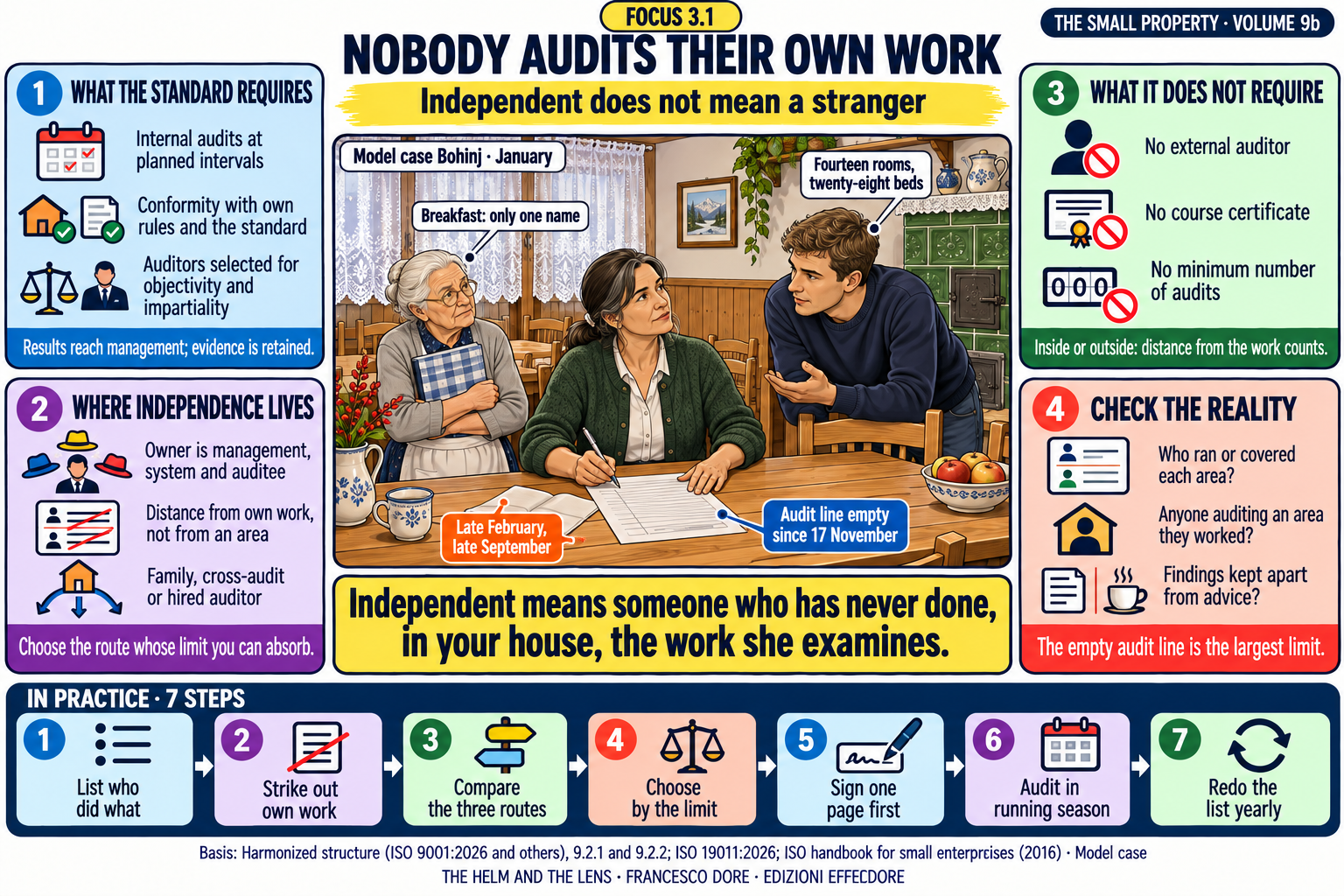
This first slide of chapter three opens on the question every small house asks when it starts internal audits: who can audit us, if there are only three of us? The yellow banner gives the answer in one line: independent does not mean a stranger.
The picture takes us to the model case in Bohinj, in January. Fourteen rooms, twenty-eight beds, one family. At the kitchen table the daughter fills in the audit sheet, the grandmother holds the breakfast folder close, and the son leans in to argue. On the breakfast list there is only one name. The audit line has been empty since the seventeenth of November, and the two dates that matter, late February and late September, are still waiting.
The first panel says what the standard requires: internal audits at planned intervals; checking conformity with the house’s own rules and with the standard; and auditors chosen so that the audit is objective and impartial. The results reach management, and the evidence is kept.
The second panel shows where independence really lives. In a small house the owner is often management, the system and the person audited, all at once. What counts is distance from one’s own work, not distance from an area. There are three routes: the family audits itself crosswise, two houses audit each other, or an auditor is hired. Choose the route whose limit you can absorb.
The third panel lists what the standard does not require: no external auditor, no course certificate, no minimum number of audits. Inside or outside the house, what counts is the distance from the work.
The fourth panel asks you to check your own reality. Who ran or covered each area this year? Is anyone auditing an area they worked in? Are findings kept apart from advice? And remember: the empty audit line is the largest limit of all.
The central sentence is the idea to keep: independent means someone who has never done, in your house, the work she examines.
The seven steps below turn it into practice: list who did what; strike out your own work; compare the three routes; choose by the limit; sign one page first; audit in the running season; and redo the list every year.
Slide 3.2
Leggi la spiegazione
English (UK)
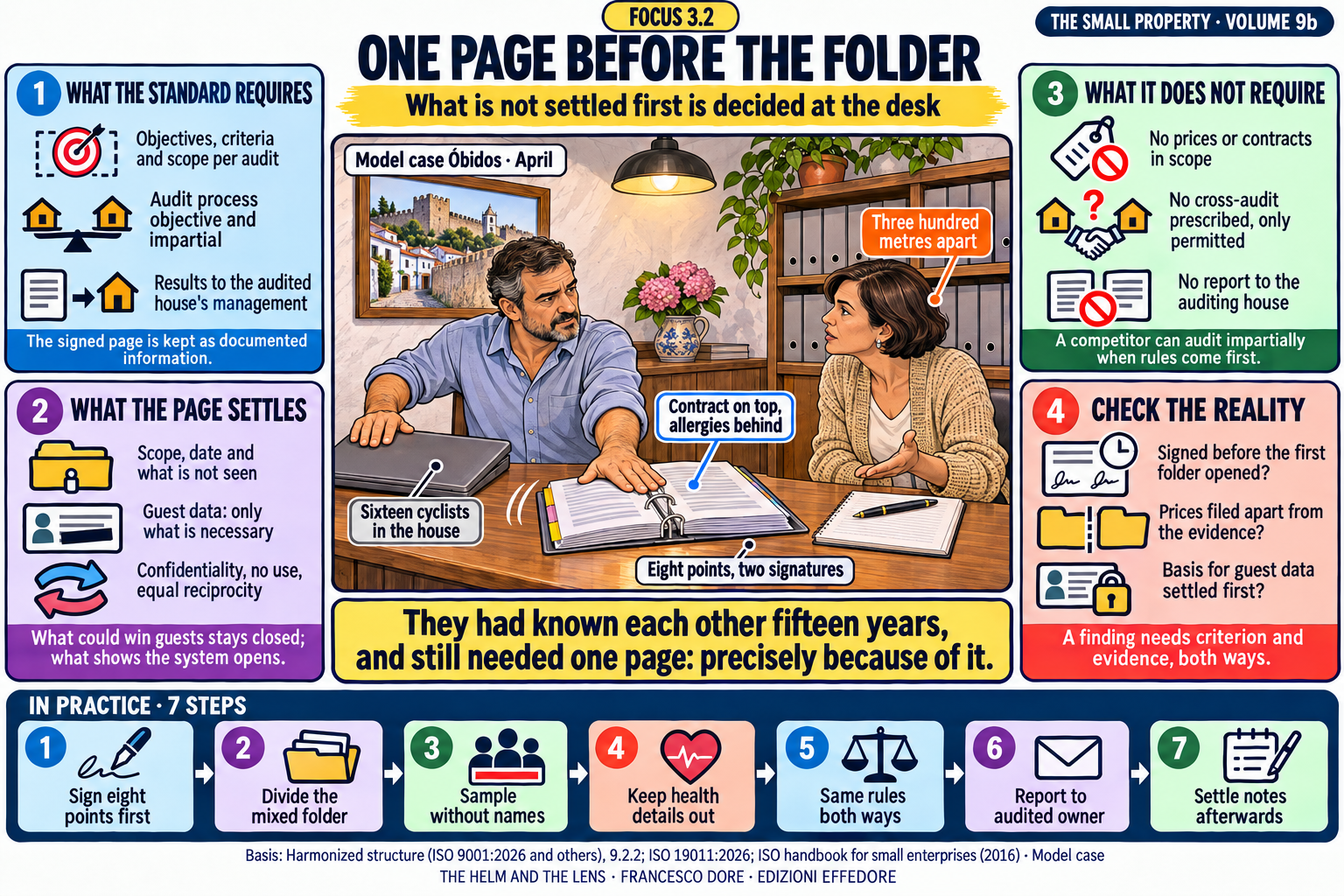
This slide is about the moment before a cross-audit between two houses begins. The banner warns: what is not settled first is decided at the desk.
The model case is in Óbidos, in April. Two owners who have known each other for fifteen years run houses three hundred metres apart. He has a laptop closed under one hand and the other hand on a mixed folder: the contract on top, the guests’ allergies behind. Sixteen cyclists are in the house. She has a notebook and a pen ready, and on the table lies the page they still have to sign: eight points, two signatures.
The first panel recalls the standard: objectives, criteria and scope for each audit; an audit process that is objective and impartial; and results that go to the management of the audited house. The signed page is kept as documented information.
The second panel shows what that single page settles: the scope, the date and what will not be seen; for guest data, only what is necessary; confidentiality, no use of what is learned, and equal reciprocity. What could win guests stays closed; what shows the system opens.
The third panel says what the standard does not require: no prices or contracts in scope; no cross-audit is prescribed, it is only permitted; and no report goes to the auditing house. A competitor can audit impartially when the rules come first.
The fourth panel asks: was the page signed before the first folder was opened? Are prices filed apart from the evidence? Was the basis for handling guest data settled first? A finding needs a criterion and evidence, in both directions.
The central sentence sums it up: they had known each other fifteen years, and still needed one page, precisely because of it.
The seven steps: sign the eight points first; divide the mixed folder; sample without names; keep health details out; apply the same rules both ways; report to the audited owner; and settle the notes afterwards.
Slide 3.3
Leggi la spiegazione
English (UK)
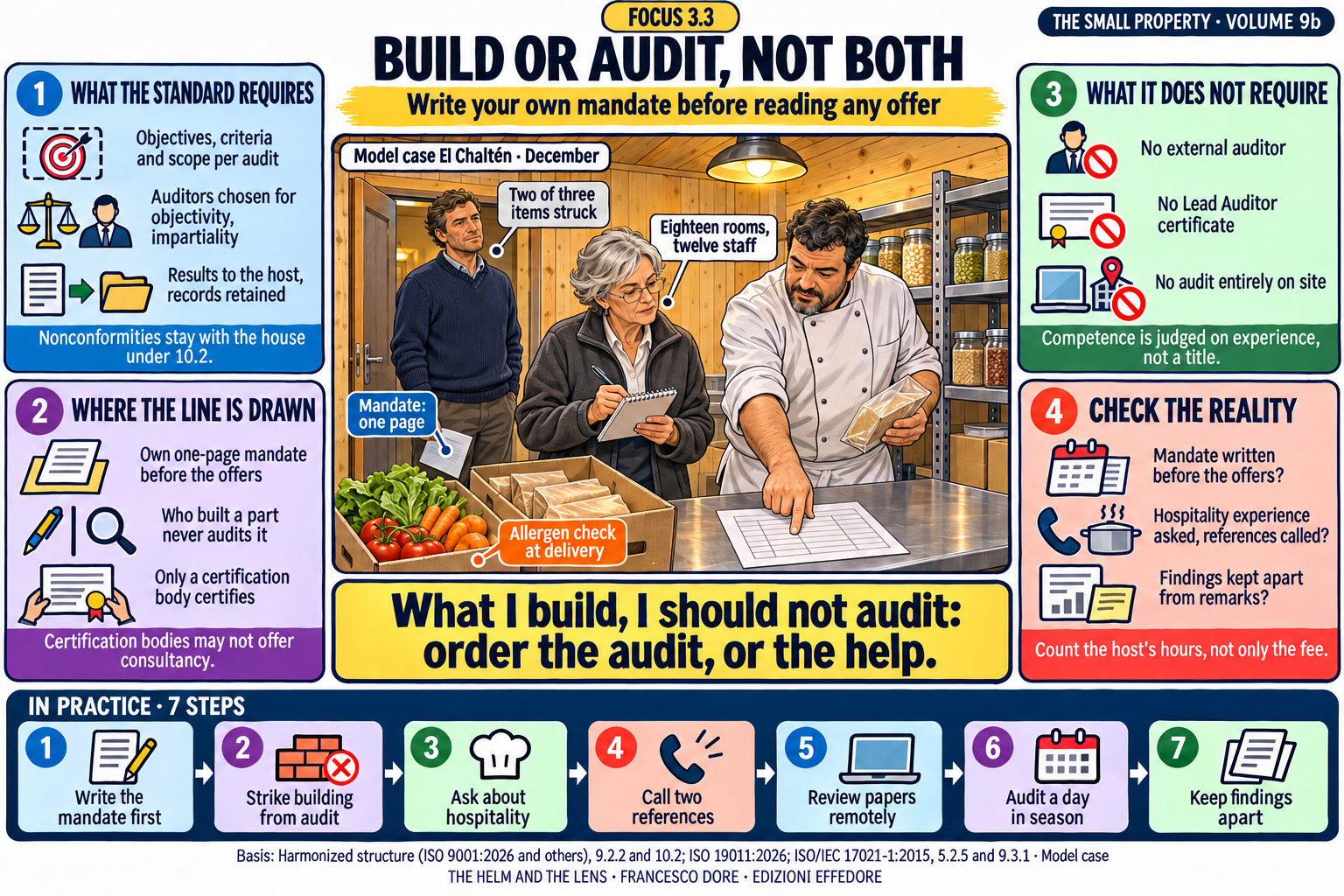
This slide is about hiring an external auditor for a small house. The banner gives the order of work: write your own mandate before reading any offer.
The model case is in El Chaltén, in December. Eighteen rooms, twelve staff. In the store room the owner takes notes while the cook points at the goods-in sheet, a bag of flour in his hand; behind them stands the consultant whose offer they are weighing. Two of his three items have been struck out. The mandate is one page, and the allergen check at delivery is what the audit will look at.
The first panel: objectives, criteria and scope for each audit; auditors chosen for objectivity and impartiality; and results that go to the host, with records retained. Nonconformities stay with the house, under clause 10.2.
The second panel shows where the line is drawn: your own one-page mandate comes before the offers; whoever built a part never audits it; and only a certification body certifies. Certification bodies may not offer consultancy.
The third panel lists what is not required: no external auditor, no Lead Auditor certificate, and no audit carried out entirely on site. Competence is judged on experience, not on a title.
The fourth panel checks the reality: was the mandate written before the offers? Was hospitality experience asked for, and were the references called? Are findings kept apart from remarks? And count the host’s hours, not only the fee.
The central sentence: what I build, I should not audit. Order the audit, or the help.
The seven steps: write the mandate first; strike building out of the audit; ask about hospitality; call two references; review the papers remotely; audit a day in season; and keep the findings apart.
Slide 3.4
Leggi la spiegazione
English (UK)
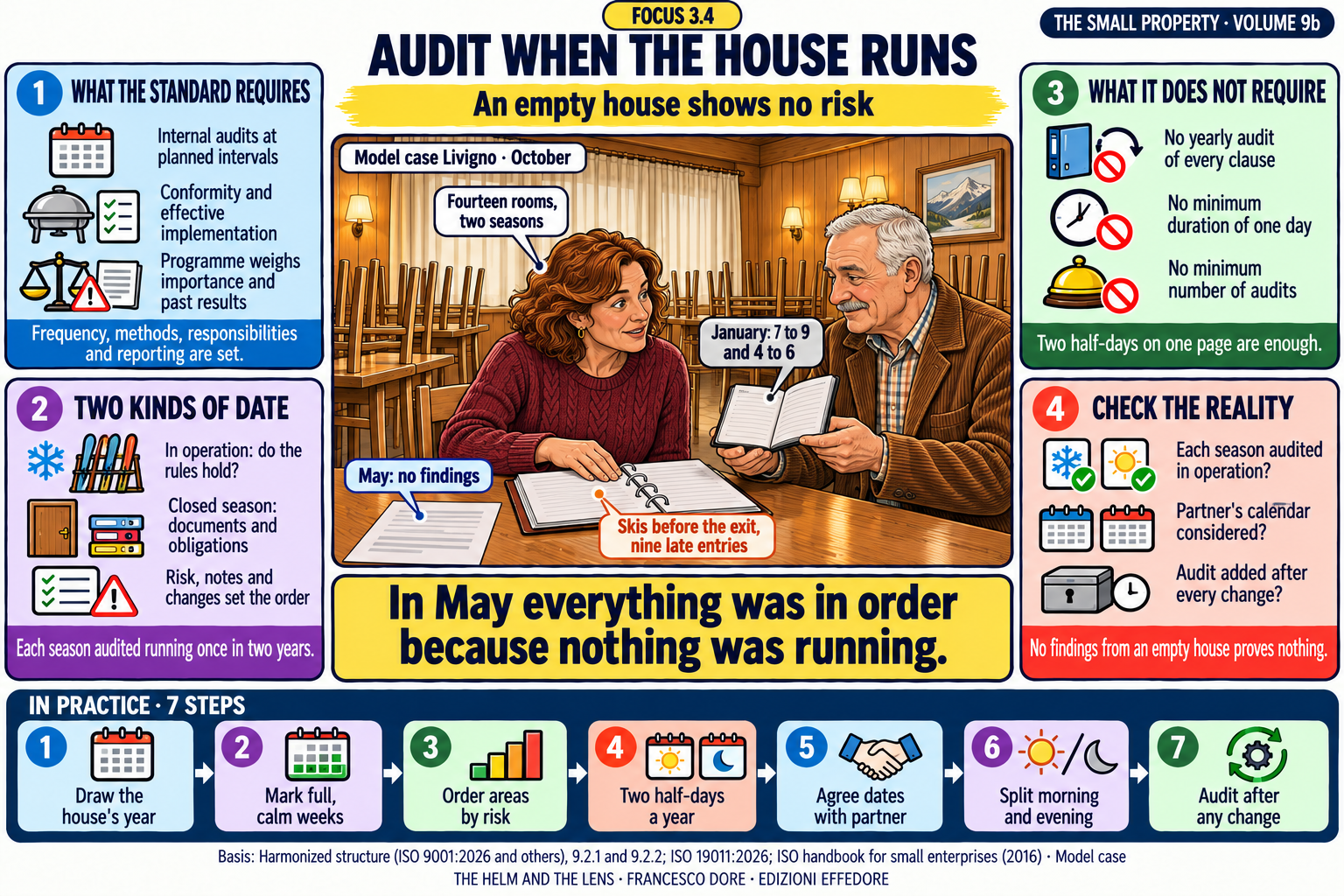
This slide is about the calendar of internal audits in a seasonal house. The banner says it plainly: an empty house shows no risk.
The model case is in Livigno, in October. Fourteen rooms, two seasons. In the empty dining room the owner and her partner look at last May’s report, which found nothing. He holds the small diary of the winter: in January, from seven to nine and from four to six, skis were carried past the exit, and there were nine late entries.
The first panel: internal audits at planned intervals; checking conformity and effective implementation; and a programme that weighs importance and past results. Frequency, methods, responsibilities and reporting are set in advance.
The second panel distinguishes two kinds of date. In operation, the audit asks whether the rules hold. In the closed season, it looks at documents and obligations. Risk, previous notes and changes set the order, and each season is audited while running at least once in two years.
The third panel: there is no yearly audit of every clause, no minimum duration of one day and no minimum number of audits. Two half-days on one page are enough.
The fourth panel asks: was each season audited in operation? Was the partner’s calendar considered? Was an audit added after every change? No findings from an empty house proves nothing.
The central sentence: in May everything was in order because nothing was running.
The seven steps: draw the house’s year; mark the full and the calm weeks; order the areas by risk; plan two half-days a year; agree the dates with the partner; split morning and evening; and audit after any change.
Slide 3.5
Leggi la spiegazione
English (UK)
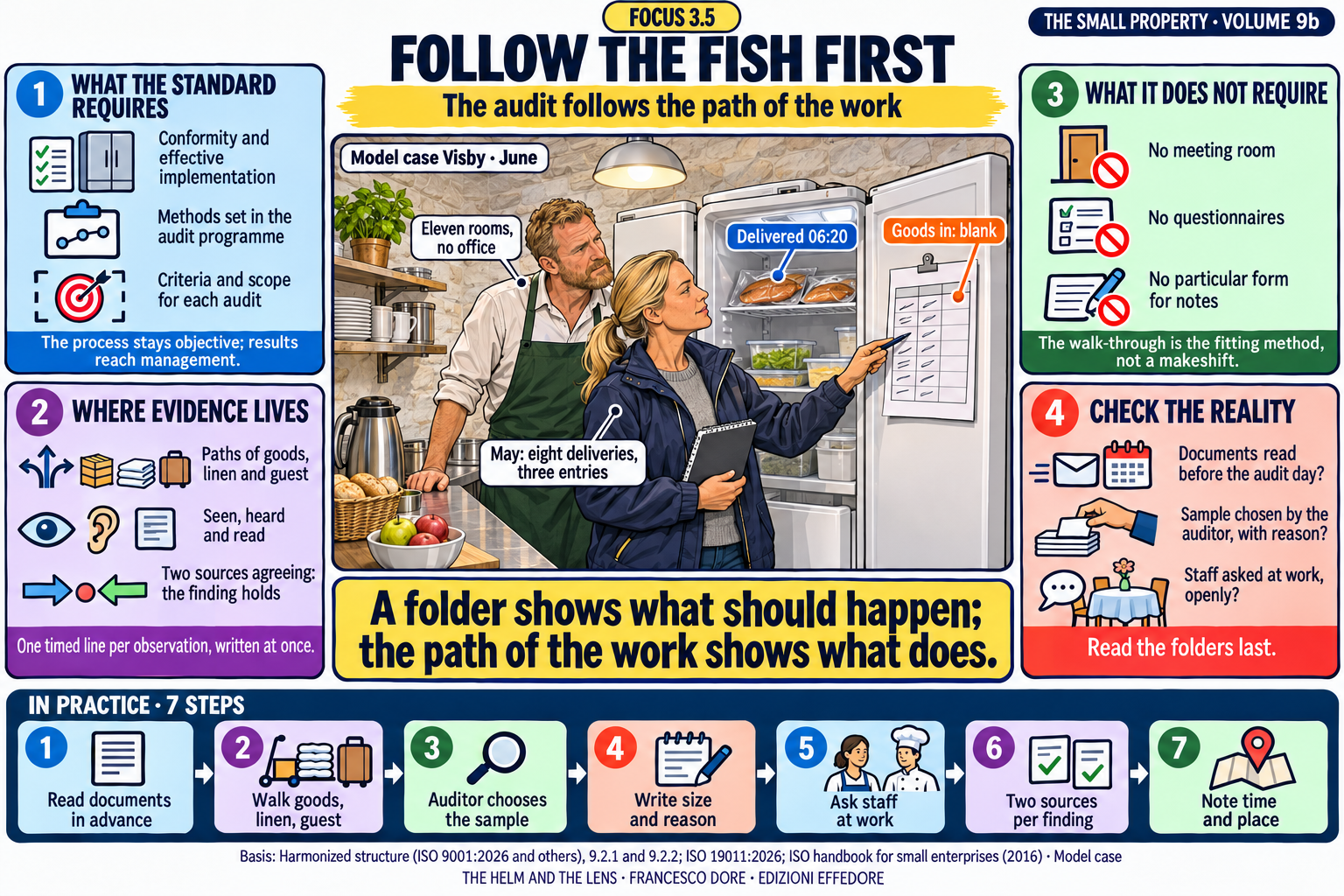
This slide is about method on the audit day. The banner: the audit follows the path of the work.
The model case is in Visby, in June. Eleven rooms and no office. The cook in his green apron and the auditor stand at the open fridge. The fish was delivered at twenty past six, but the goods-in sheet is blank. In May there were eight deliveries and only three entries.
The first panel: the audit checks conformity and effective implementation, with methods set in the audit programme, and criteria and scope for each audit. The process stays objective, and the results reach management.
The second panel shows where evidence lives: in the paths of goods, linen and guests; in what is seen, heard and read; and when two sources agree, the finding holds. One timed line per observation, written at once.
The third panel: no meeting room, no questionnaires, no particular form for notes. The walk-through is the fitting method, not a makeshift.
The fourth panel asks: were the documents read before the audit day? Did the auditor choose the sample, and with a reason? Were staff asked at work, openly? Read the folders last.
The central sentence: a folder shows what should happen; the path of the work shows what does.
The seven steps: read the documents in advance; walk the goods, the linen and the guest; let the auditor choose the sample; write its size and reason; ask staff at work; find two sources per finding; and note the time and the place.
Slide 3.6
Leggi la spiegazione
English (UK)
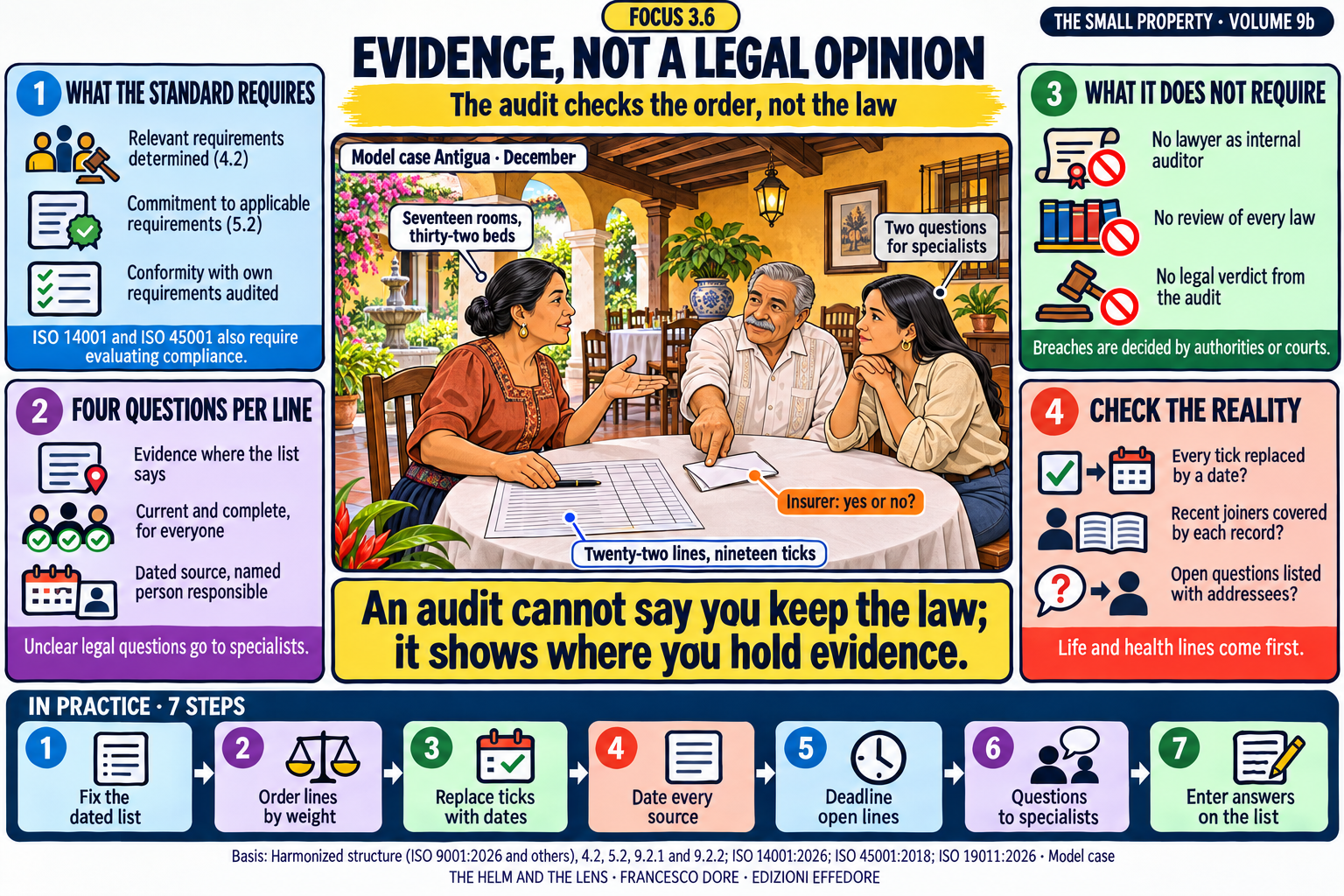
This slide is about legal obligations in an internal audit. The banner sets the limit: the audit checks the order, not the law.
The model case is in Antigua, in December. Seventeen rooms, thirty-two beds. On the patio the owner, her father and her daughter go through the list of obligations: twenty-two lines, nineteen ticks. The father points at a note with one open question, insurer, yes or no? Two questions are for specialists.
The first panel: the relevant requirements are determined, under clause 4.2; there is a commitment to the applicable requirements, under 5.2; and conformity with the house’s own requirements is audited. ISO 14001 and ISO 45001 also require evaluating compliance.
The second panel asks four questions of each line: is the evidence where the list says? Is it current and complete, for everyone? Is there a dated source and a named person responsible? Unclear legal questions go to specialists.
The third panel: no lawyer as internal auditor, no review of every law and no legal verdict from the audit. Breaches are decided by authorities or courts.
The fourth panel asks: has every tick been replaced by a date? Are recent joiners covered by each record? Are open questions listed with their addressees? Life and health lines come first.
The central sentence: an audit cannot say you keep the law; it shows where you hold evidence.
The seven steps: fix the dated list; order the lines by weight; replace ticks with dates; date every source; set a deadline for open lines; send questions to specialists; and enter the answers on the list.
Slide 3.7
Leggi la spiegazione
English (UK)
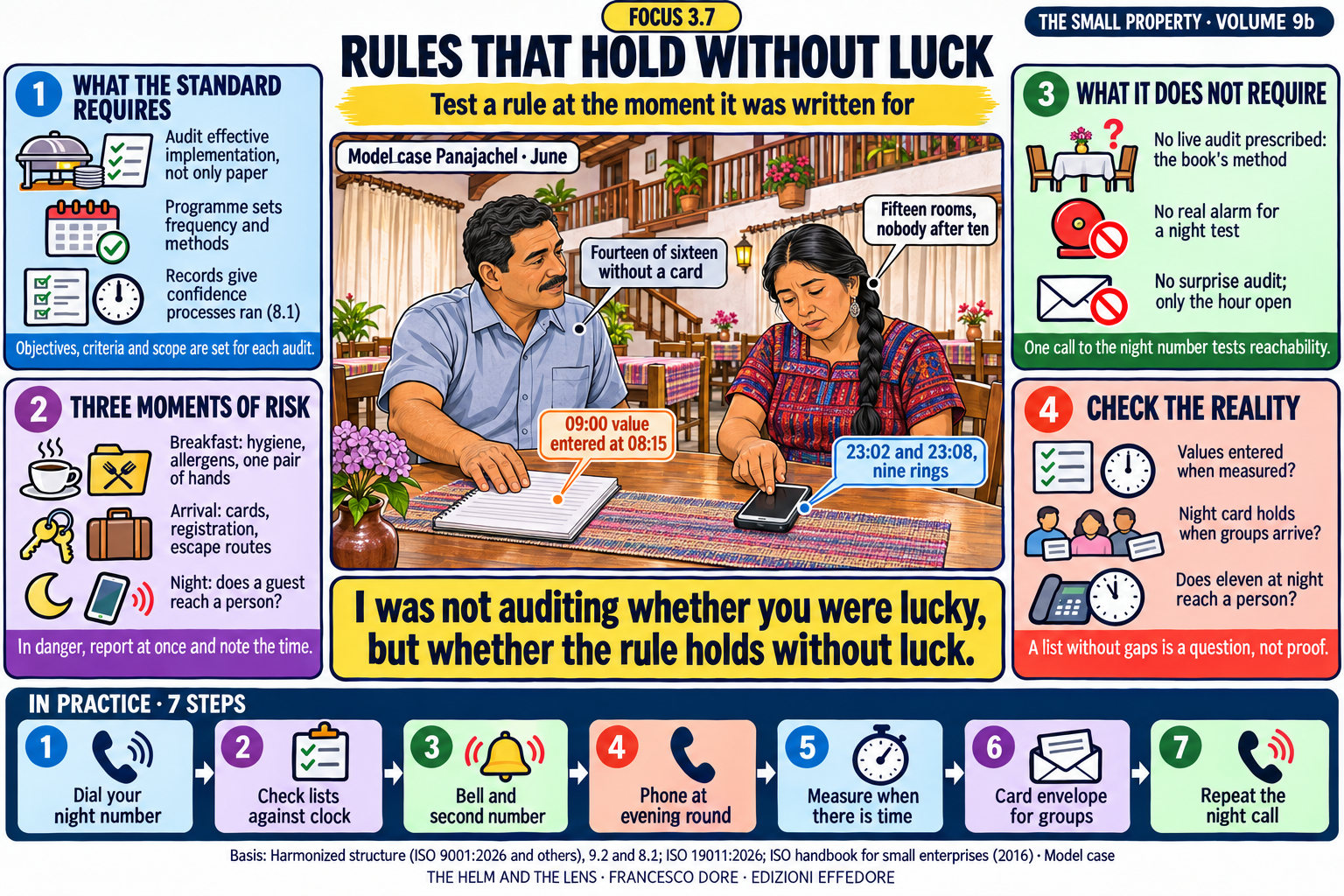
This slide is about testing operational rules. The banner: test a rule at the moment it was written for.
The model case is in Panajachel, in June. Fifteen rooms, and nobody at the desk after ten at night. In the courtyard the owner rests a hand on the breakfast notebook: the nine o’clock value was entered at a quarter past eight. His sister checks the phone: calls at 23:02 and 23:08, nine rings. Fourteen of sixteen guests arrived without a card.
The first panel: audit effective implementation, not only paper; a programme that sets frequency and methods; and records that give confidence the processes ran, as clause 8.1 asks. Objectives, criteria and scope are set for each audit.
The second panel names three moments of risk: breakfast, with hygiene, allergens and one pair of hands; arrival, with cards, registration and escape routes; and night, when the question is whether a guest reaches a person. In danger, report at once and note the time.
The third panel: no live audit is prescribed, it is the book’s method; no real alarm for a night test; and no surprise audit, only the hour is left open. One call to the night number tests reachability.
The fourth panel asks: are values entered when measured? Does the night card hold when groups arrive? Does eleven at night reach a person? A list without gaps is a question, not proof.
The central sentence: I was not auditing whether you were lucky, but whether the rule holds without luck.
The seven steps: dial your night number; check the lists against the clock; test the bell and the second number; phone at the evening round; measure when there is time; use a card envelope for groups; and repeat the night call.
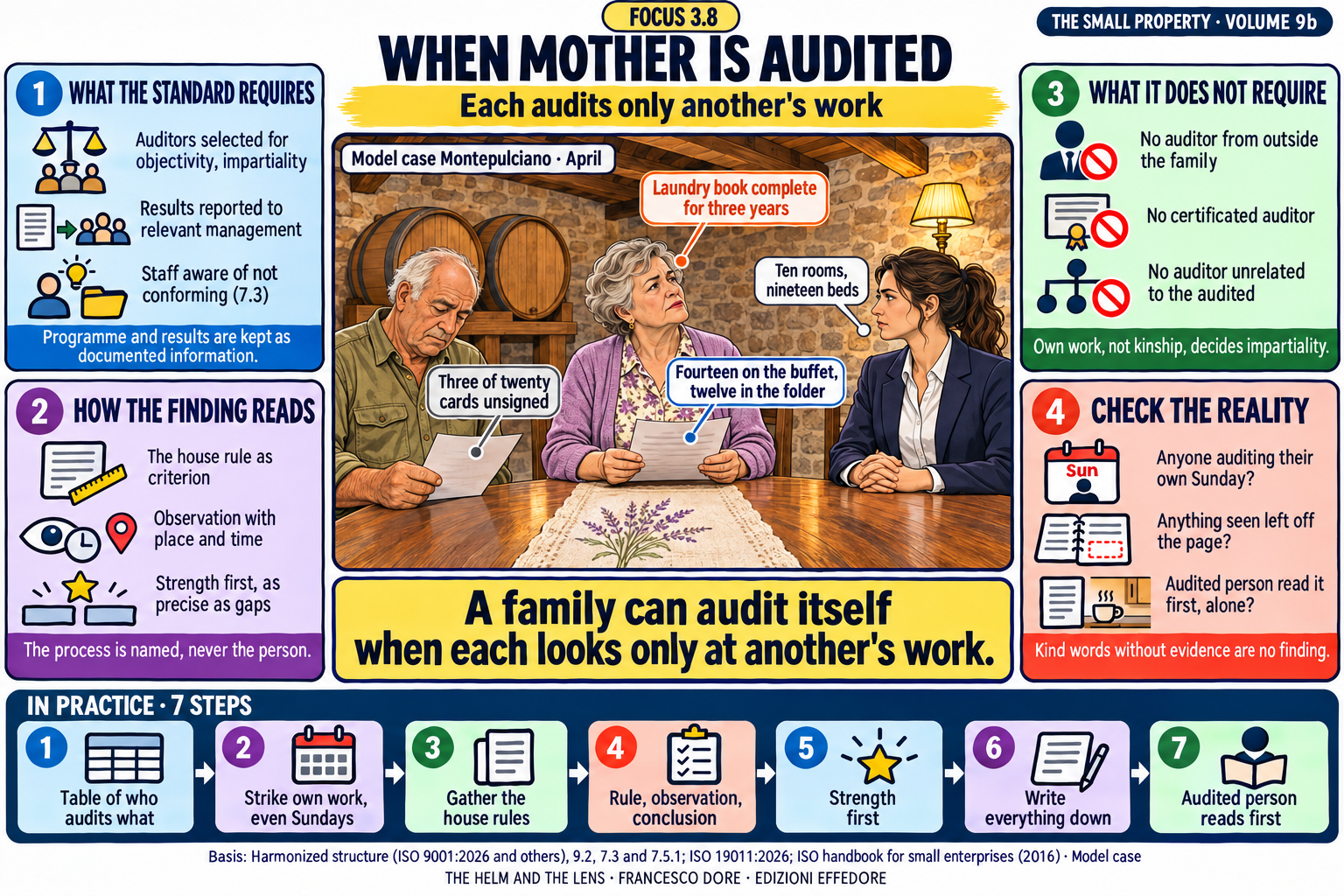
Slide 3.8
Leggi la spiegazione
English (UK)
This slide is about the family audit. The banner gives the rule: each audits only another’s work.
The model case is in Montepulciano, in April. Ten rooms, nineteen beds, in an old cellar with barrels. The father reads his sheet, the mother listens and the daughter, who audited, waits. The findings are on the table: the laundry book complete for three years; three of twenty cards unsigned; fourteen items on the buffet, twelve in the folder.
The first panel: auditors are selected for objectivity and impartiality; results are reported to the relevant management; and staff are aware of what it means not to conform, under clause 7.3. Programme and results are kept as documented information.
The second panel shows how a finding reads: the house rule is the criterion; the observation has a place and a time; and a strength comes first, written as precisely as a gap. The process is named, never the person.
The third panel: no auditor from outside the family, no certified auditor and no auditor unrelated to the audited. Their own work, not kinship, decides impartiality.
The fourth panel asks: is anyone auditing their own Sunday? Was anything seen left off the page? Did the audited person read it first, alone? Kind words without evidence are no finding.
The central sentence: a family can audit itself when each looks only at another’s work.
The seven steps: draw a table of who audits what; strike out your own work, even on Sundays; gather the house rules; write rule, observation and conclusion; put the strength first; write everything down; and let the audited person read first.
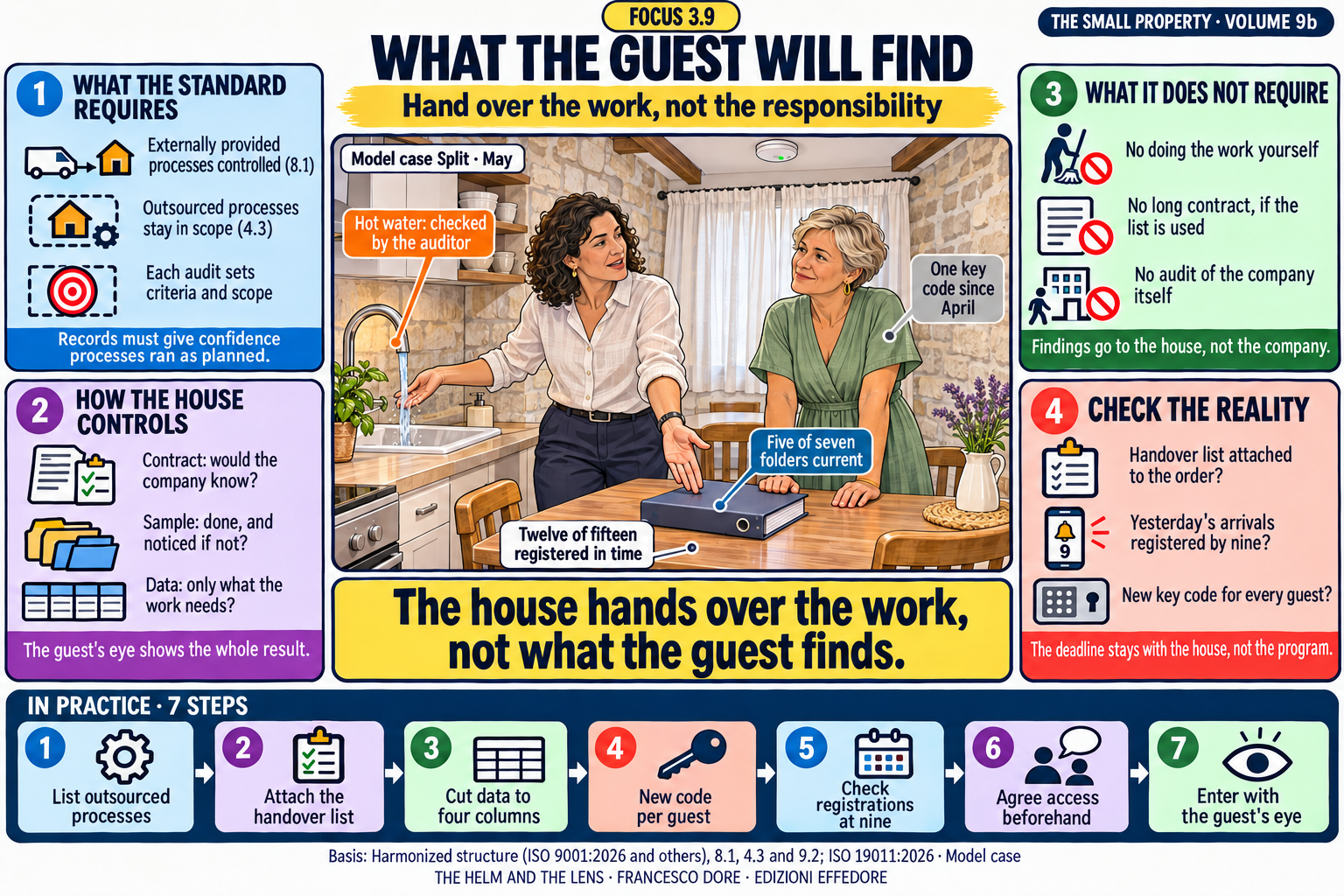
Slide 3.9
Leggi la spiegazione
English (UK)
This slide is about auditing outsourced work, such as the cleaning company and the check-in program of holiday apartments. The banner: hand over the work, not the responsibility.
The model case is in Split, in May. In the apartment kitchen the auditor runs the hot water while the owner leans on the folder. One key code has been used since April; five of seven folders are current; twelve of fifteen guests were registered in time.
The first panel: externally provided processes are controlled, under clause 8.1; outsourced processes stay in the scope, under 4.3; and each audit sets its criteria and scope. Records must give confidence that the processes ran as planned.
The second panel shows how the house controls: the contract, would the company know what to do? The sample, was the work done, and would the house notice if not? The data, only what the work needs. The guest’s eye shows the whole result.
The third panel: you do not have to do the work yourself; you do not need a long contract, if the list is used; and the company itself is not audited. Findings go to the house, not to the company.
The fourth panel asks: is the handover list attached to the order? Were yesterday’s arrivals registered by nine? Is there a new key code for every guest? The deadline stays with the house, not with the program.
The central sentence: the house hands over the work, not what the guest finds.
The seven steps: list the outsourced processes; attach the handover list; cut the data to four columns; set a new code for each guest; check registrations at nine; agree access beforehand; and enter with the guest’s eye.
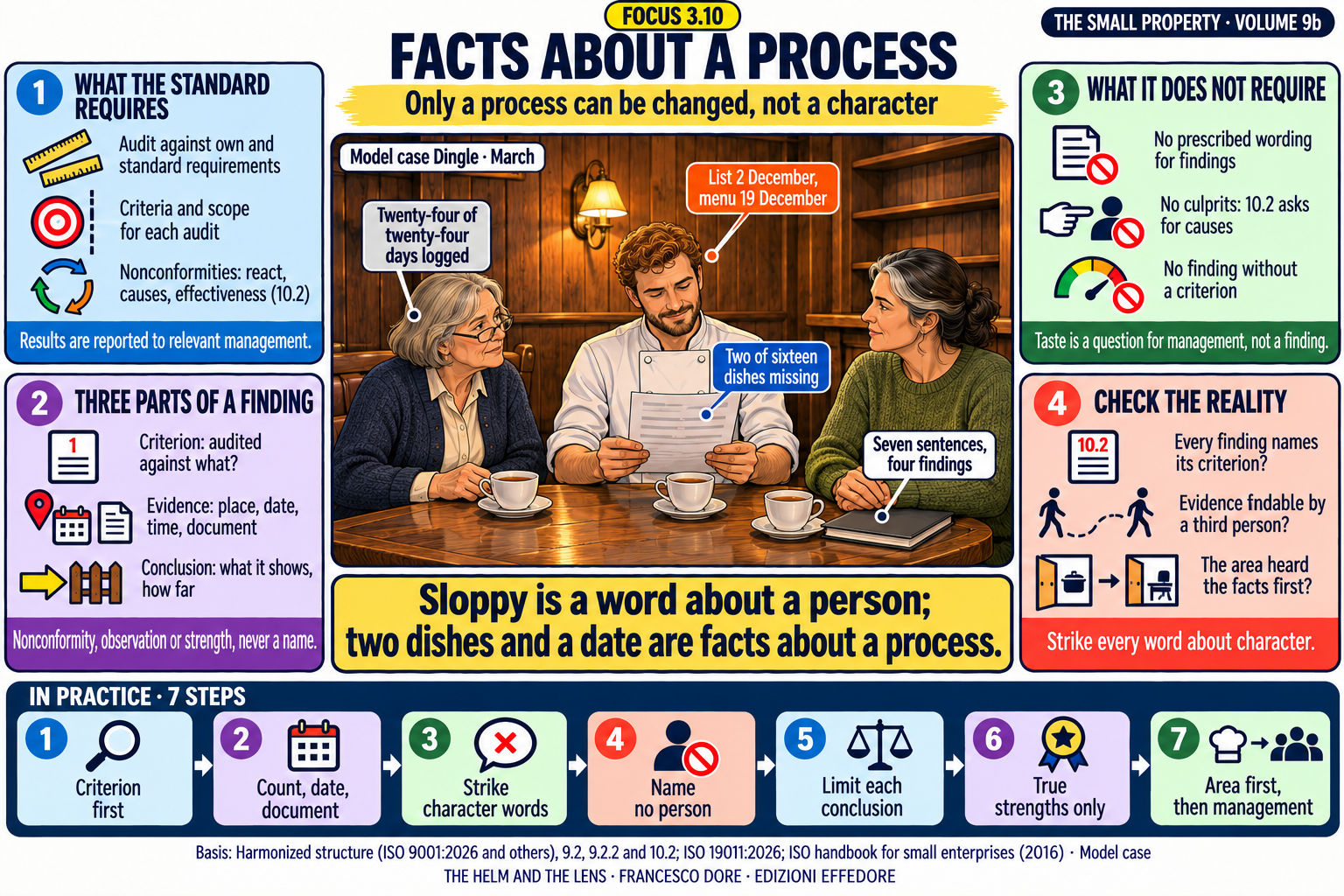
Slide 3.10
Leggi la spiegazione
English (UK)
This slide is about writing findings. The banner: only a process can be changed, not a character.
The model case is in Dingle, in March. In the pub-restaurant the young cook reads the audit report, between the owner’s mother and the owner. Twenty-four of twenty-four days logged; the allergen list dated the second of December, the menu the nineteenth; two of sixteen dishes missing from the list. Seven sentences, four findings.
The first panel: the audit checks against the house’s own requirements and the standard; criteria and scope are set for each audit; and nonconformities need reaction, causes and a check of effectiveness, under clause 10.2. Results are reported to the relevant management.
The second panel gives the three parts of a finding: the criterion, audited against what; the evidence, with place, date, time and document; and the conclusion, what it shows and how far. Nonconformity, observation or strength, never a name.
The third panel: there is no prescribed wording for findings; no culprits, since 10.2 asks for causes; and no finding without a criterion. Taste is a question for management, not a finding.
The fourth panel asks: does every finding name its criterion? Could a third person find the evidence? Did the area hear the facts first? Strike every word about character.
The central sentence: sloppy is a word about a person; two dishes and a date are facts about a process.
The seven steps: criterion first; count, date and document; strike the character words; name no person; limit each conclusion; record true strengths only; and report to the area first, then to management.
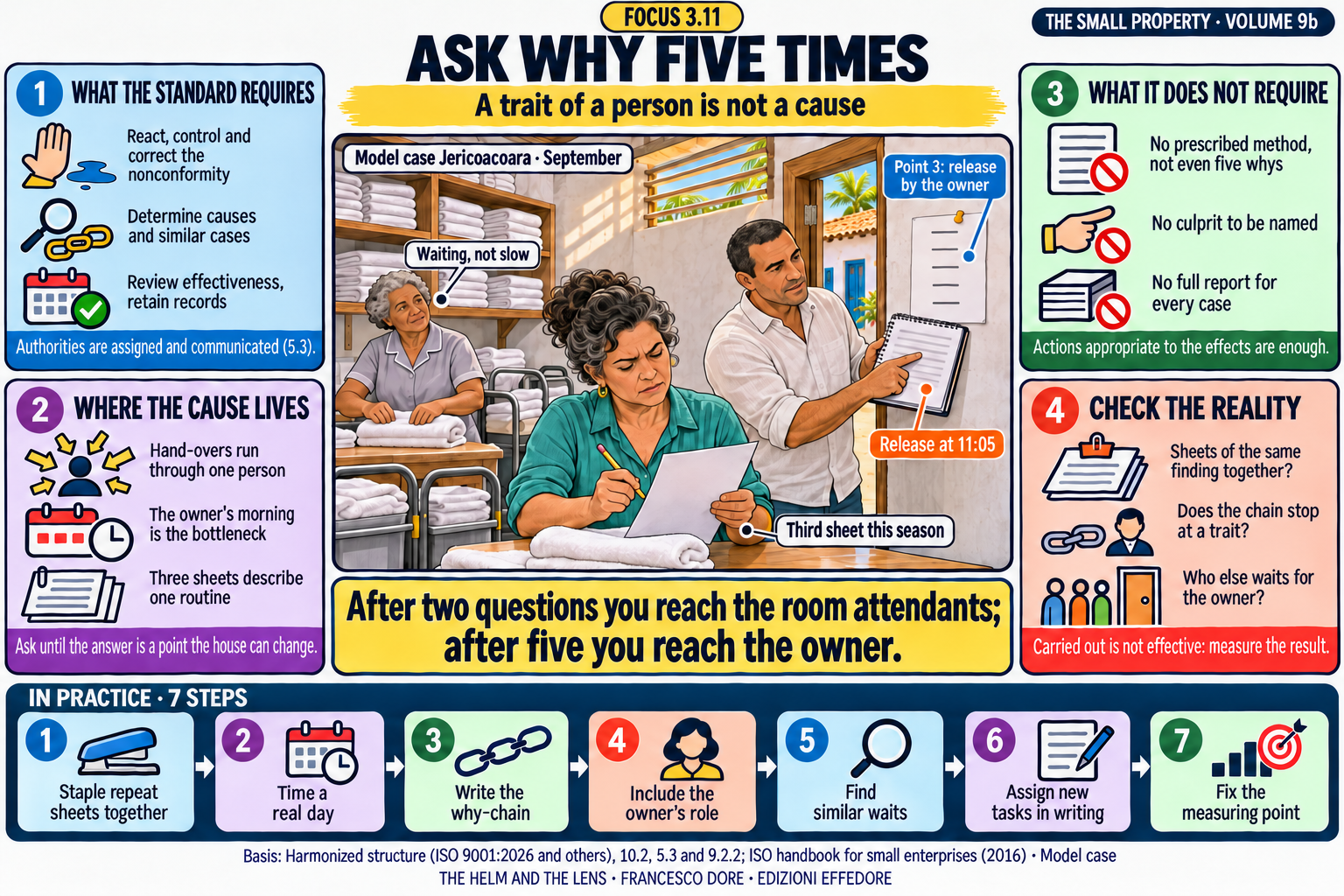
Slide 3.11
Leggi la spiegazione
English (UK)
This slide is about finding causes after a nonconformity. The banner: a trait of a person is not a cause.
The model case is in Jericoacoara, in September. In the linen room the owner reads the third sheet of the season about rooms not ready in time. Her partner points at point three of the routine: release by the owner, at five past eleven. In the background the room attendant folds towels: she is waiting, not slow.
The first panel: react to the nonconformity, control it and correct it; determine its causes and look for similar cases; review the effectiveness of the action and retain records. Authorities are assigned and communicated, under clause 5.3.
The second panel shows where the cause lives: hand-overs run through one person; the owner’s morning is the bottleneck; and the three sheets describe one routine. Ask until the answer is a point the house can change.
The third panel: no prescribed method, not even five whys; no culprit to be named; and no full report for every case. Actions appropriate to the effects are enough.
The fourth panel asks: are sheets of the same finding stapled together? Does the chain stop at a trait? Who else waits for the owner? Carried out is not effective: measure the result.
The central sentence: after two questions you reach the room attendants; after five you reach the owner.
The seven steps: staple repeat sheets together; time a real day; write the why-chain; include the owner’s role; find similar waits; assign the new tasks in writing; and fix the measuring point.
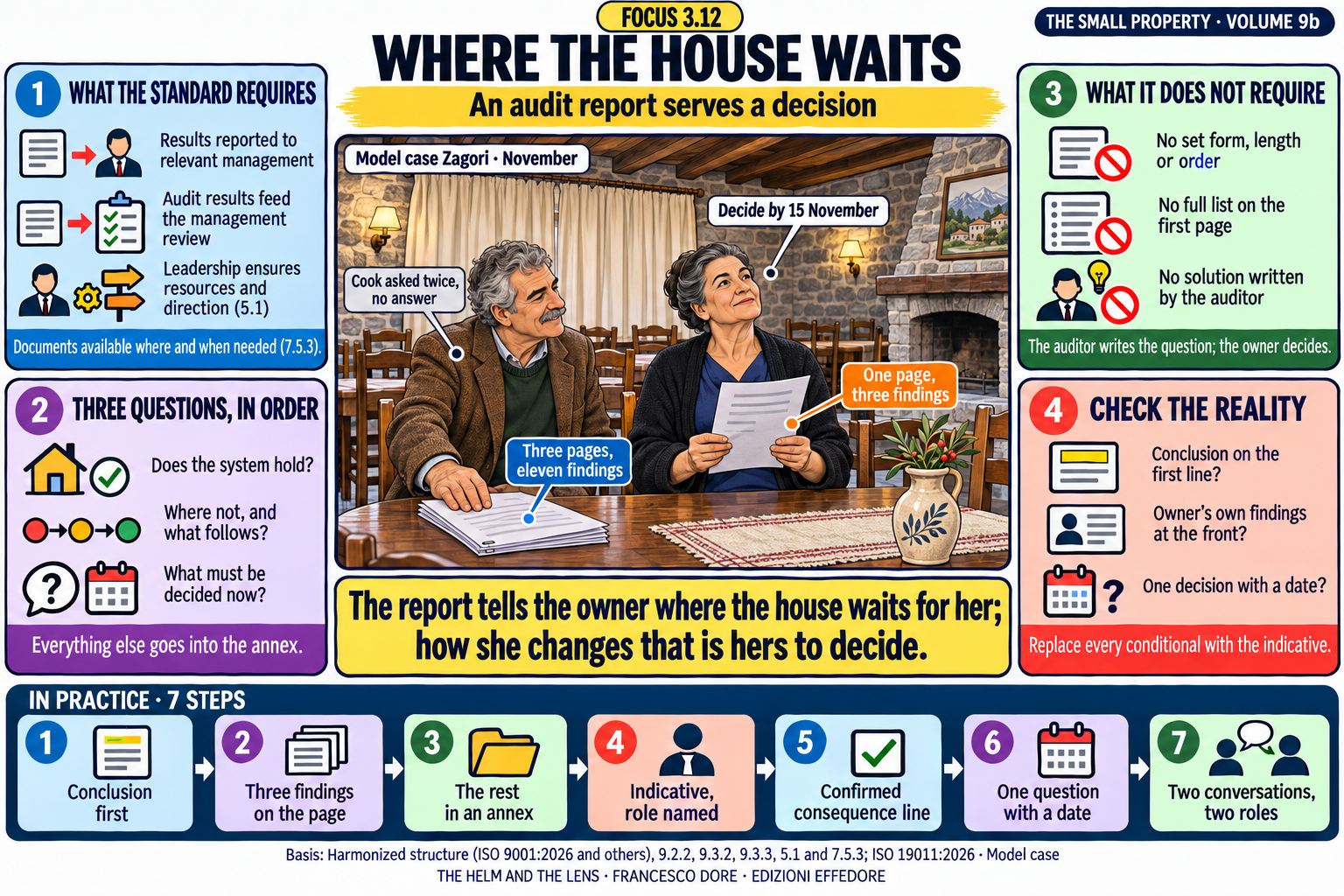
Slide 3.12
Leggi la spiegazione
English (UK)
This slide is about the audit report. The banner: an audit report serves a decision.
The model case is in Zagori, in November. In the stone dining room the auditor has two versions on the table: three pages with eleven findings, under his hand, and the one page with three findings that the owner is reading. The cook has asked twice, with no answer. The decision is due by the fifteenth of November.
The first panel: results are reported to the relevant management; audit results feed the management review; and leadership ensures resources and direction, under clause 5.1. Documents must be available where and when needed, under 7.5.3.
The second panel puts three questions in order: does the system hold? Where not, and what follows? What must be decided now? Everything else goes into the annex.
The third panel: no set form, length or order; no full list on the first page; and no solution written by the auditor. The auditor writes the question; the owner decides.
The fourth panel asks: is the conclusion on the first line? Are the owner’s own findings at the front? Is there one decision with a date? Replace every conditional with the indicative.
The central sentence: the report tells the owner where the house waits for her; how she changes that is hers to decide.
The seven steps: conclusion first; three findings on the page; the rest in an annex; the indicative, with the role named; a confirmed consequence line; one question with a date; and two conversations for two roles.
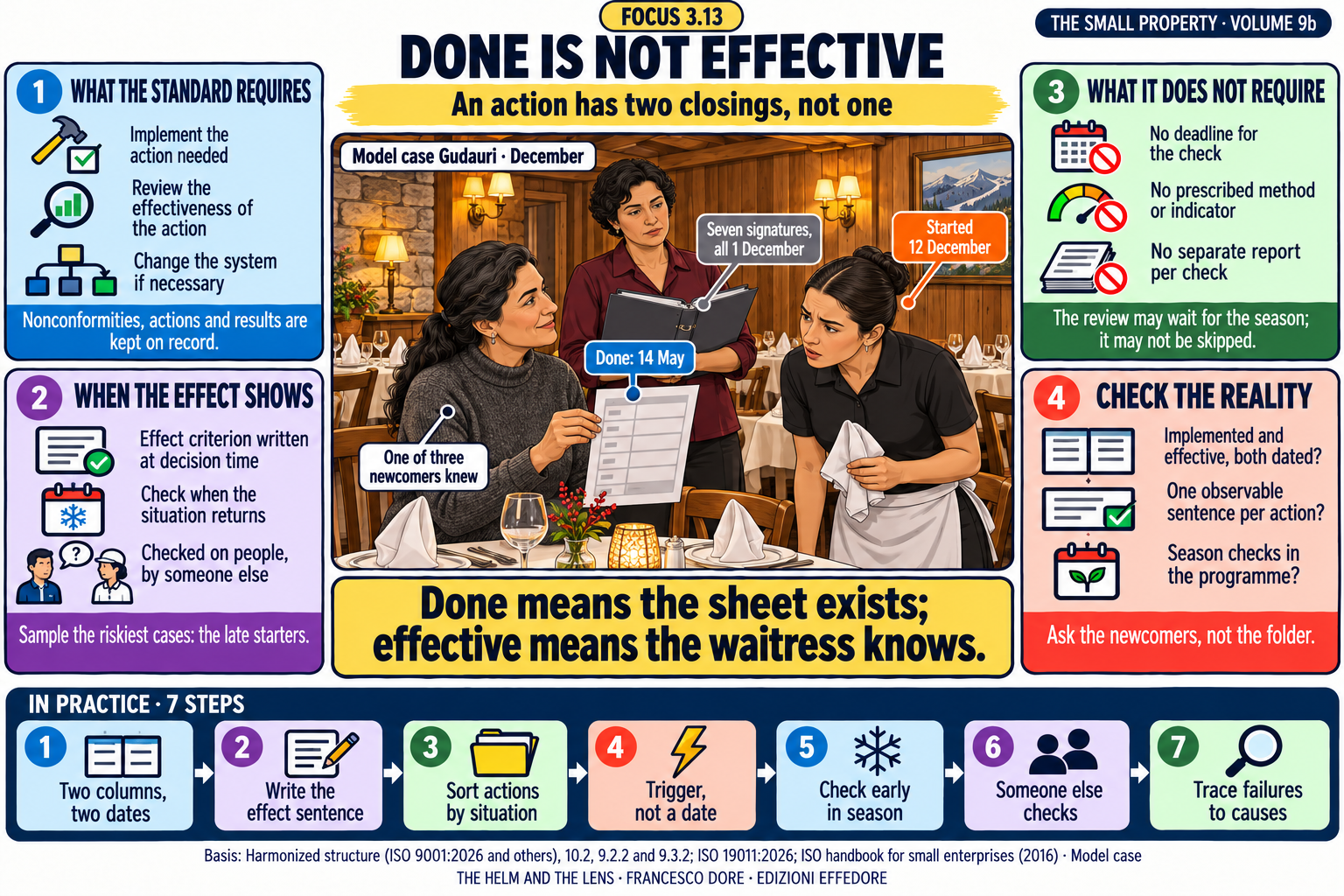
Slide 3.13
Leggi la spiegazione
English (UK)
This slide is about checking whether a corrective action worked. The banner: an action has two closings, not one.
The model case is in Gudauri, in December. In the restaurant the owner holds the action sheet, closed as done on the fourteenth of May. The manager holds the folder: seven signatures, all dated the first of December. The new waitress, who started on the twelfth of December, is asked the question; only one of three newcomers knew the answer.
The first panel: implement the action needed; review the effectiveness of the action; and change the system if necessary. Nonconformities, actions and results are kept on record.
The second panel shows when the effect shows: the effect criterion is written at decision time; it is checked when the situation returns; and it is checked on people, by someone else. Sample the riskiest cases: the late starters.
The third panel: there is no deadline for the check, no prescribed method or indicator, and no separate report per check. The review may wait for the season; it may not be skipped.
The fourth panel asks: are implemented and effective both dated? Is there one observable sentence per action? Are season checks in the programme? Ask the newcomers, not the folder.
The central sentence: done means the sheet exists; effective means the waitress knows.
The seven steps: two columns, two dates; write the effect sentence; sort the actions by situation; set a trigger, not a date; check early in the season; let someone else check; and trace failures back to causes.
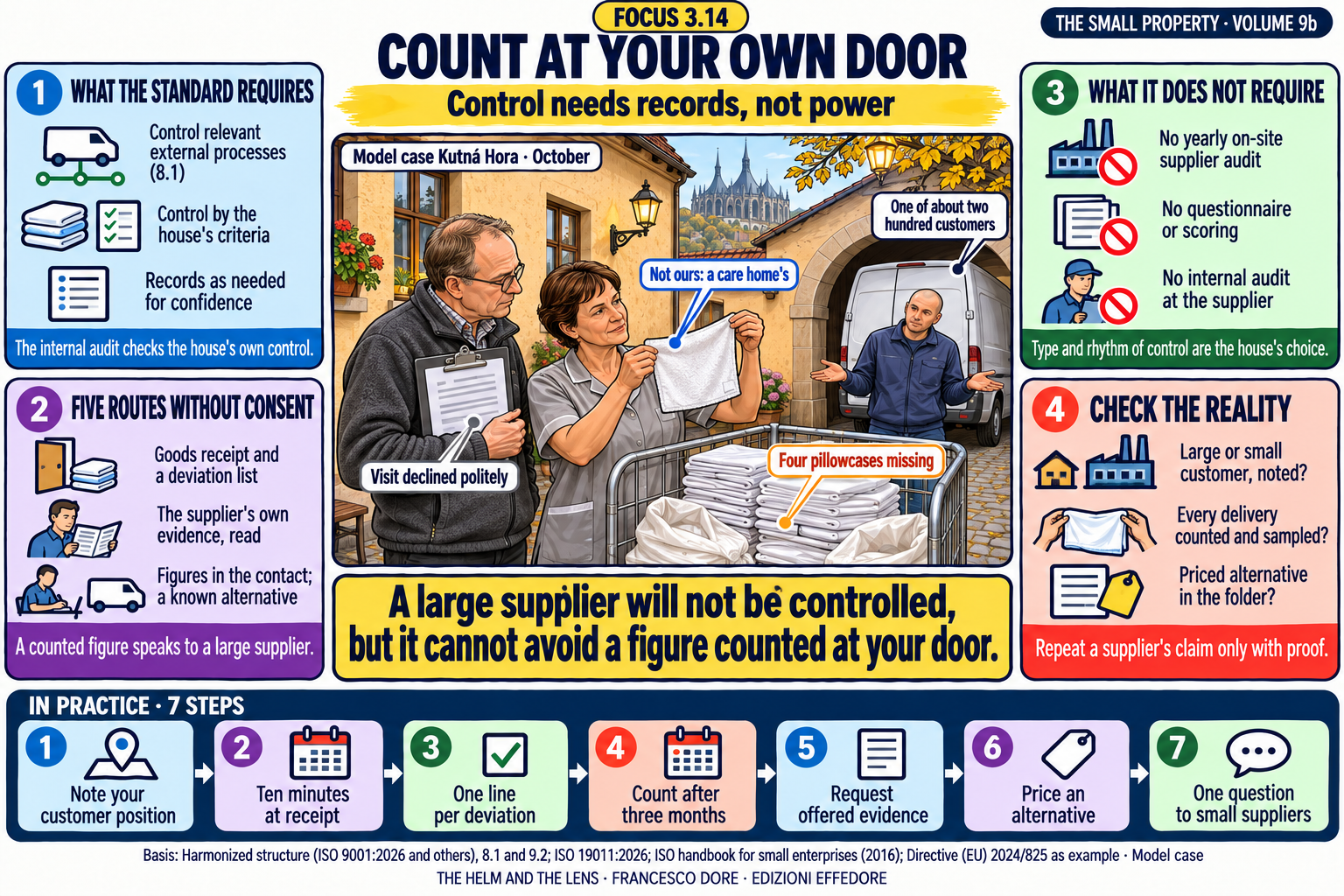
Slide 3.14
Leggi la spiegazione
English (UK)
This slide is about controlling a large supplier, such as an industrial laundry. The banner: control needs records, not power.
The model case is in Kutná Hora, in October. In the courtyard the housekeeper holds up a pillowcase that is not theirs: it belongs to a care home. Four pillowcases are missing. The owner holds his clipboard; the laundry had politely declined his visit. The driver shrugs: the house is one of about two hundred customers.
The first panel: control the relevant external processes, under clause 8.1; control them by the house’s own criteria; and keep records as needed for confidence. The internal audit checks the house’s own control.
The second panel shows five routes that need no consent from the supplier: a goods receipt and a deviation list; the supplier’s own evidence, read; figures in the contact with the supplier; and a known alternative. A counted figure speaks to a large supplier.
The third panel: no yearly on-site supplier audit, no questionnaire or scoring, and no internal audit at the supplier. The type and rhythm of control are the house’s choice.
The fourth panel asks: is the house’s position as a large or small customer noted? Is every delivery counted and sampled? Is there a priced alternative in the folder? Repeat a supplier’s claim only with proof.
The central sentence: a large supplier will not be controlled, but it cannot avoid a figure counted at your door.
The seven steps: note your customer position; ten minutes at receipt; one line per deviation; count again after three months; request the evidence the supplier offers; price an alternative; and ask small suppliers one question.
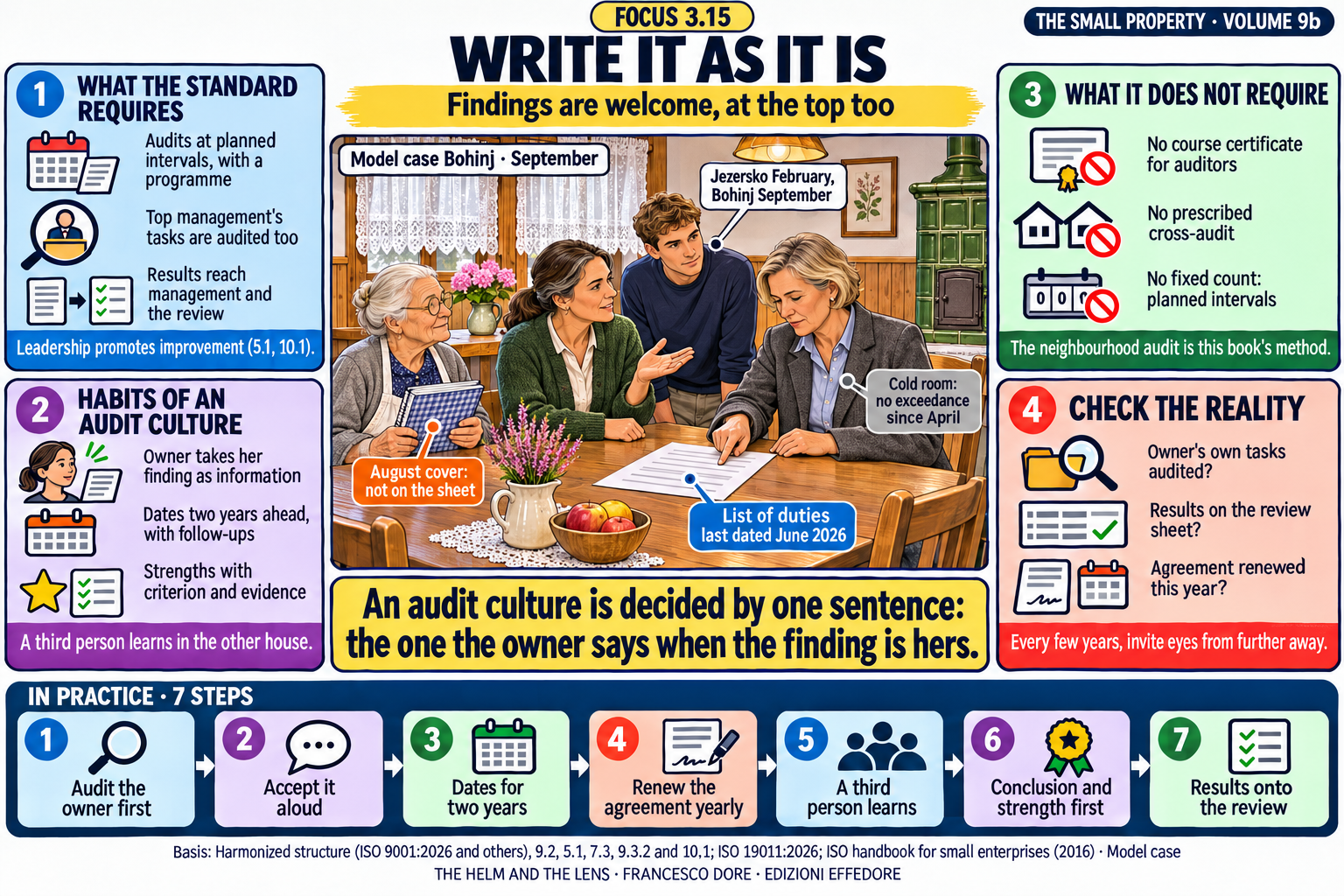
Slide 3.15
Leggi la spiegazione
English (UK)
This slide closes chapter three and returns to Bohinj, in September. The banner: findings are welcome, at the top too.
In the same kitchen as the first slide, the neighbouring owner who came to audit points at the list of duties, last dated June 2026. The finding is about the owner herself, and she takes it as information. The grandmother holds the August cover, which is not on the sheet; the son recalls the dates, Jezersko in February, Bohinj in September. The cold room has had no exceedance since April.
The first panel: audits at planned intervals, with a programme; top management’s tasks are audited too; and results reach management and the review. Leadership promotes improvement, under clauses 5.1 and 10.1.
The second panel names the habits of an audit culture: the owner takes her finding as information; dates are set two years ahead, with follow-ups; and strengths are written with criterion and evidence. A third person learns in the other house.
The third panel: no course certificate for auditors, no prescribed cross-audit and no fixed count, only planned intervals. The neighbourhood audit is this book’s method.
The fourth panel asks: are the owner’s own tasks audited? Are the results on the review sheet? Was the agreement renewed this year? Every few years, invite eyes from further away.
The central sentence: an audit culture is decided by one sentence, the one the owner says when the finding is hers.
The seven steps: audit the owner first; accept it aloud; set dates for two years; renew the agreement every year; let a third person learn; put the conclusion and the strength first; and bring the results onto the review.
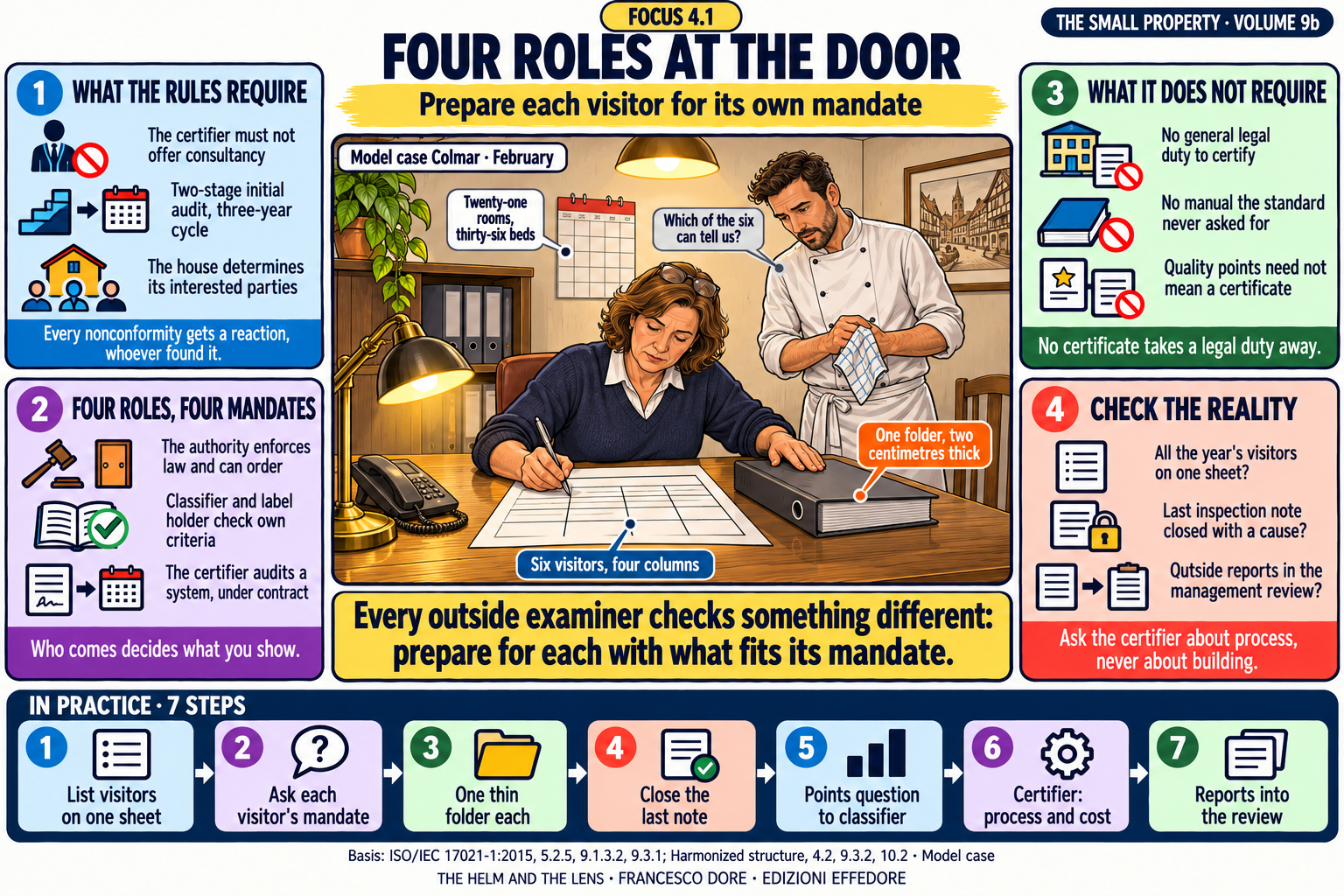
Slide 4.1
Leggi la spiegazione
English (UK)
This first slide of chapter four looks at everyone who comes from outside to examine a small house. The banner: prepare each visitor for its own mandate.
The model case is in Colmar, in February. Twenty-one rooms, thirty-six beds. At the office desk the owner fills in a sheet with six visitors in four columns, next to one folder two centimetres thick. The cook, drying a glass, asks the right question: which of the six can tell us something useful?
The first panel says what the rules require: the certifier must not offer consultancy; certification starts with a two-stage initial audit and runs on a three-year cycle; and the house determines its interested parties. Every nonconformity gets a reaction, whoever found it.
The second panel shows four roles and four mandates: the authority enforces the law and can order; the classifier and the label holder check their own criteria; and the certifier audits a system, under contract. Who comes decides what you show.
The third panel: there is no general legal duty to certify; no manual the standard never asked for; and quality points in a classification need not mean a certificate. No certificate takes a legal duty away.
The fourth panel asks: are all the year’s visitors on one sheet? Was the last inspection note closed with a cause? Do outside reports go into the management review? Ask the certifier about process, never about building.
The central sentence: every outside examiner checks something different; prepare for each with what fits its mandate.
The seven steps: list the visitors on one sheet; ask each visitor’s mandate; one thin folder each; close the last note; put the points question to the classifier; ask the certifier about process and cost; and bring the reports into the review.
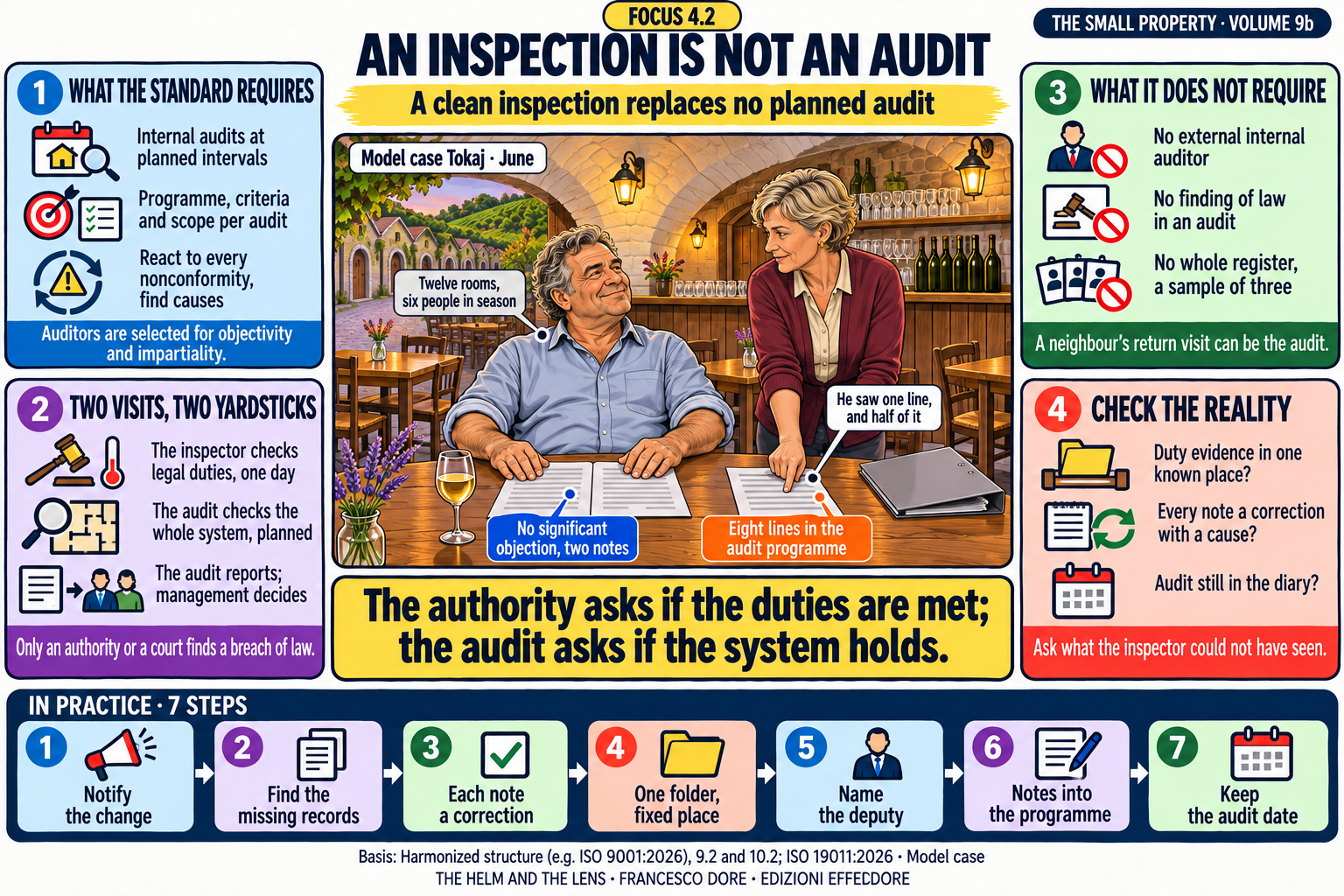
Slide 4.2
Leggi la spiegazione
English (UK)
This slide separates the visit of an authority from an internal audit. The banner: a clean inspection replaces no planned audit.
The model case is in Tokaj, in June. Twelve rooms, six people in season. In the wine cellar the owner smiles at the inspection report: no significant objection, two notes. His wife points at the other sheet: eight lines in the audit programme. The inspector saw one line, and half of it.
The first panel: internal audits at planned intervals; a programme, with criteria and scope for each audit; and a reaction to every nonconformity, with causes found. Auditors are selected for objectivity and impartiality.
The second panel: two visits, two yardsticks. The inspector checks legal duties, on one day. The audit checks the whole system, as planned. The audit reports, and management decides. Only an authority or a court finds a breach of law.
The third panel: no external internal auditor; no finding of law in an audit; and no whole register, a sample of three will do. A neighbour’s return visit can be the audit.
The fourth panel asks: is the evidence of duties in one known place? Is every note a correction with a cause? Is the audit still in the diary? Ask what the inspector could not have seen.
The central sentence: the authority asks if the duties are met; the audit asks if the system holds.
The seven steps: notify the change; find the missing records; make each note a correction; one folder in a fixed place; name the deputy; bring the notes into the programme; and keep the audit date.
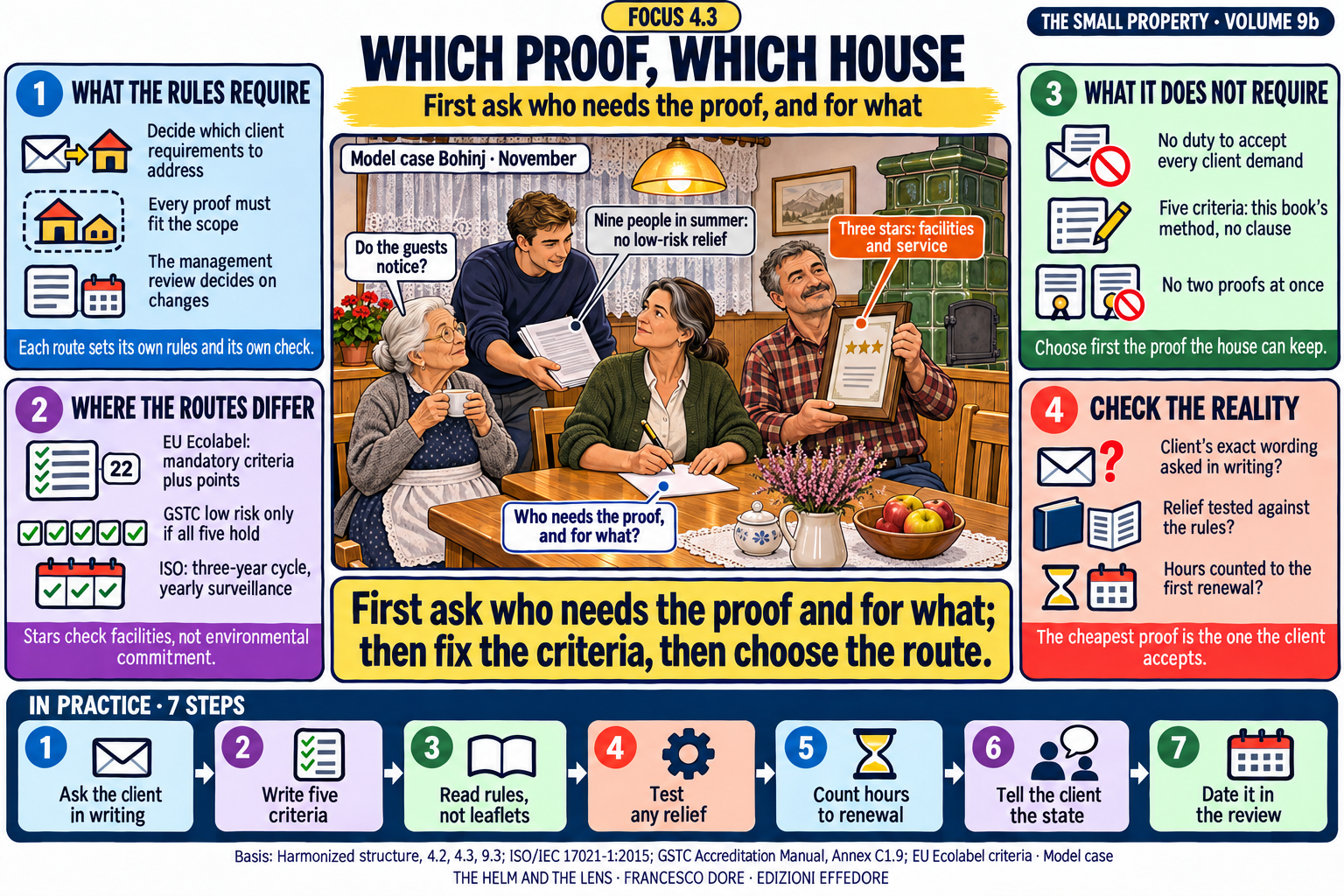
Slide 4.3
Leggi la spiegazione
English (UK)
This slide is about choosing an external proof: stars, a label, a sustainability certificate, an ISO certificate. The banner: first ask who needs the proof, and for what.
We are back in Bohinj, in November. Around the kitchen table the family discusses a client’s request. The grandmother asks: do the guests notice? The son brings the papers: with nine people in summer, there is no low-risk relief. The father holds up the three-star plaque, which checks facilities and service. The owner writes the question that matters: who needs the proof, and for what?
The first panel: decide which client requirements to address; every proof must fit the scope; and the management review decides on changes. Each route sets its own rules and its own check.
The second panel shows where the routes differ: the EU Ecolabel has mandatory criteria plus points; the GSTC low-risk route holds only if all five conditions hold; and ISO certification runs on a three-year cycle with yearly surveillance. Stars check facilities, not environmental commitment.
The third panel: no duty to accept every client demand; the five criteria are this book’s method, not a clause; and there is no need for two proofs at once. Choose first the proof the house can keep.
The fourth panel asks: was the client’s exact wording asked for in writing? Was any relief tested against the rules? Were the hours counted up to the first renewal? The cheapest proof is the one the client accepts.
The central sentence: first ask who needs the proof and for what; then fix the criteria, then choose the route.
The seven steps: ask the client in writing; write five criteria; read the rules, not the leaflets; test any relief; count the hours to renewal; tell the client the state of things; and date it in the review.
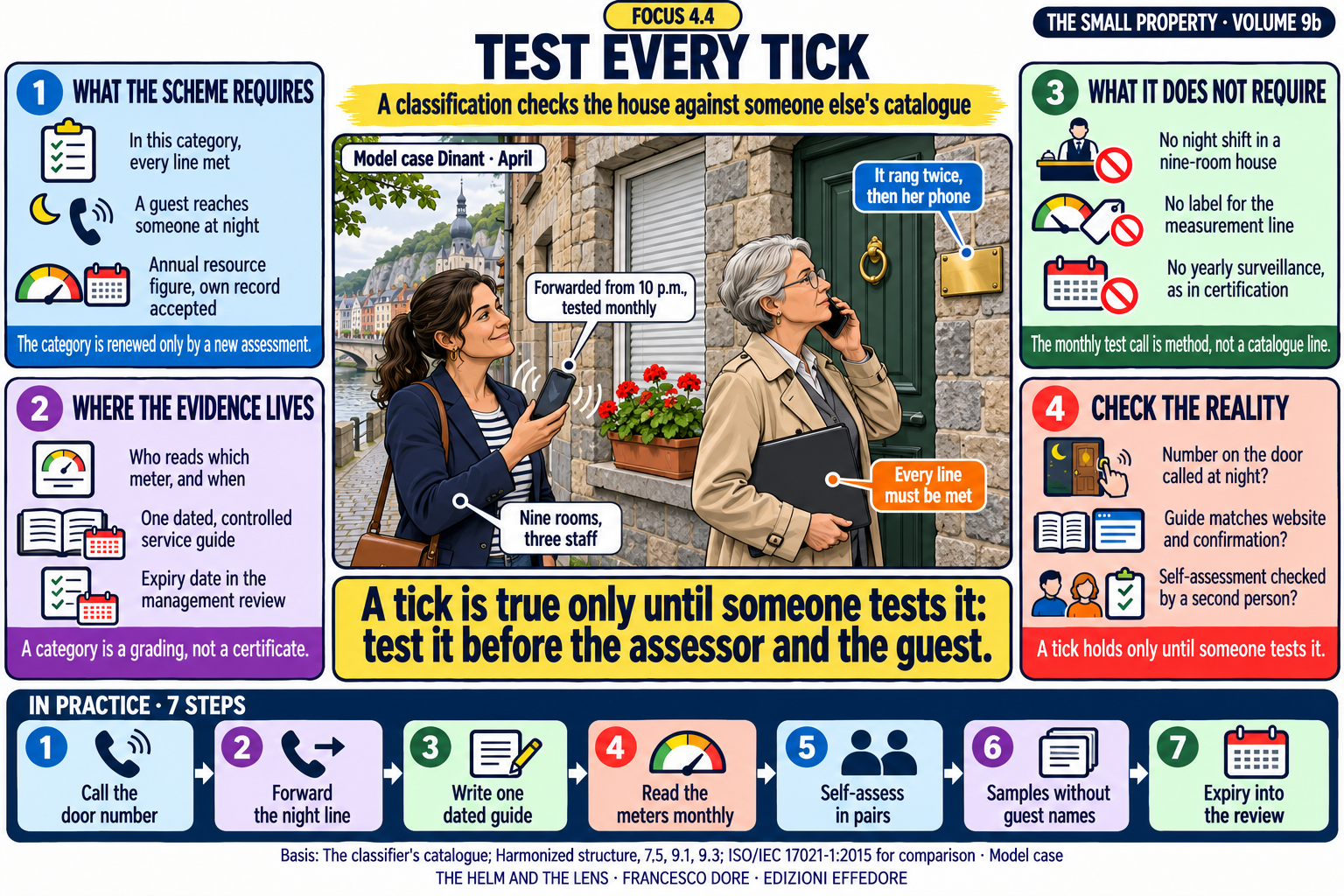
Slide 4.4
Leggi la spiegazione
English (UK)
This slide is about star classification. The banner: a classification checks the house against someone else’s catalogue.
The model case is in Dinant, in April. Nine rooms, three staff. At the front door the assessor calls the number on the door; the owner’s phone rings beside her. The line is forwarded from ten at night and tested every month. It rang twice, then reached her phone. For this category, every line must be met.
The first panel says what the scheme requires: in this category, every line met; a guest reaches someone at night; and an annual resource figure, where the house’s own record is accepted. The category is renewed only by a new assessment.
The second panel shows where the evidence lives: who reads which meter, and when; one dated, controlled service guide; and the expiry date in the management review. A category is a grading, not a certificate.
The third panel: no night shift in a nine-room house; no label for the measurement line; and no yearly surveillance, as in certification. The monthly test call is the book’s method, not a catalogue line.
The fourth panel asks: is the number on the door called at night? Does the guide match the website and the confirmation? Is the self-assessment checked by a second person? A tick holds only until someone tests it.
The central sentence: a tick is true only until someone tests it; test it before the assessor and the guest.
The seven steps: call the door number; forward the night line; write one dated guide; read the meters monthly; self-assess in pairs; keep samples without guest names; and put the expiry into the review.
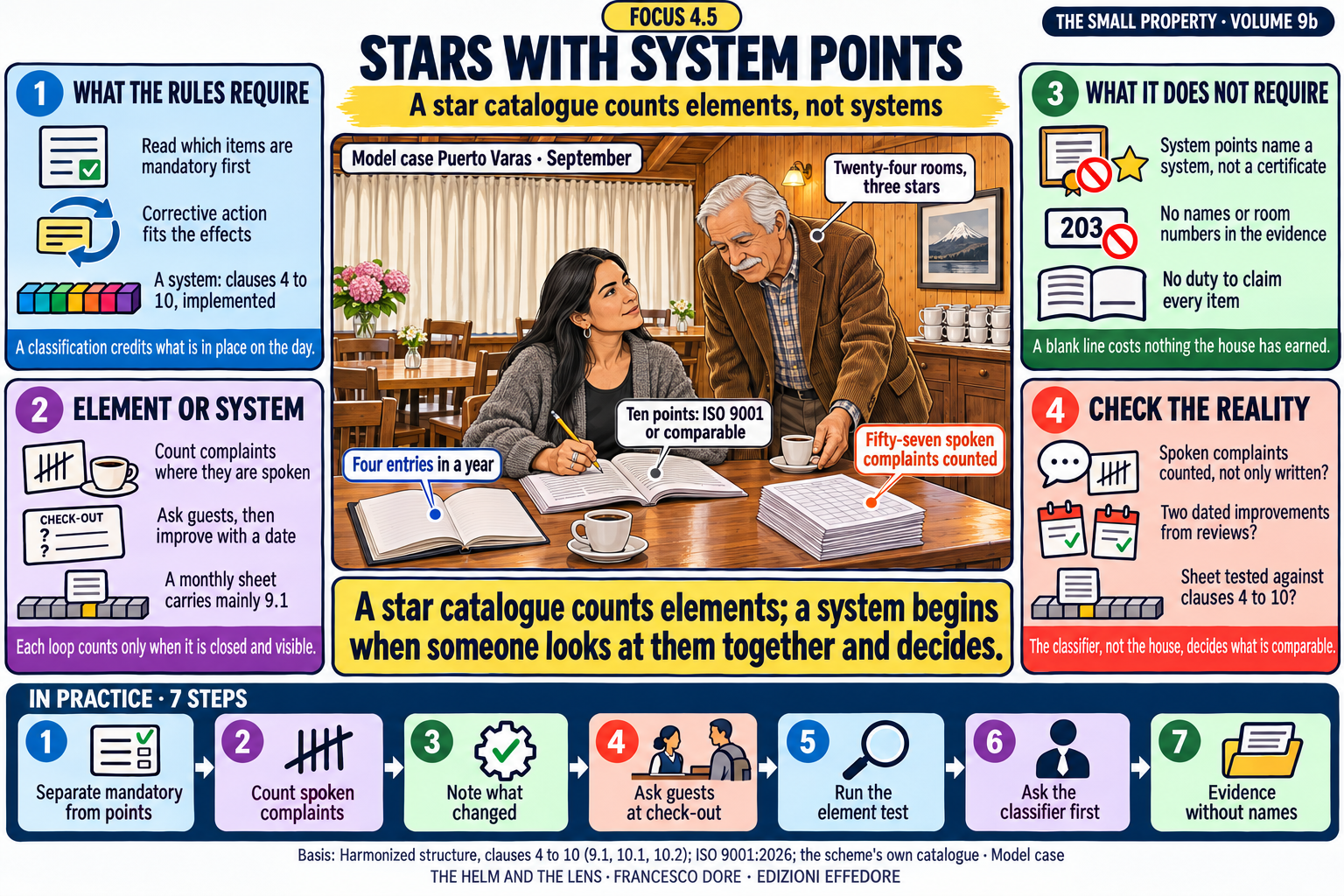
Slide 4.5
Leggi la spiegazione
English (UK)
This slide is about the points some star catalogues give for a management system. The banner: a star catalogue counts elements, not systems.
The model case is in Puerto Varas, in September. Twenty-four rooms, three stars. The daughter reads the catalogue line: ten points for ISO 9001 or comparable. Her father has brought the pile of the year: fifty-seven spoken complaints counted. The complaints book holds only four entries in a year.
The first panel: read which items are mandatory first; corrective action must fit the effects; and a system means clauses four to ten, implemented. A classification credits what is in place on the day.
The second panel: element or system? Count complaints where they are spoken; ask guests, then improve with a date; a monthly sheet carries mainly clause 9.1. Each loop counts only when it is closed and visible.
The third panel: system points name a system, not a certificate; no names or room numbers in the evidence; and no duty to claim every item. A blank line costs nothing the house has earned.
The fourth panel asks: are spoken complaints counted, not only written ones? Are there two dated improvements from reviews? Was the sheet tested against clauses four to ten? The classifier, not the house, decides what is comparable.
The central sentence: a star catalogue counts elements; a system begins when someone looks at them together and decides.
The seven steps: separate mandatory items from points; count spoken complaints; note what changed; ask guests at check-out; run the element test; ask the classifier first; and keep evidence without names.
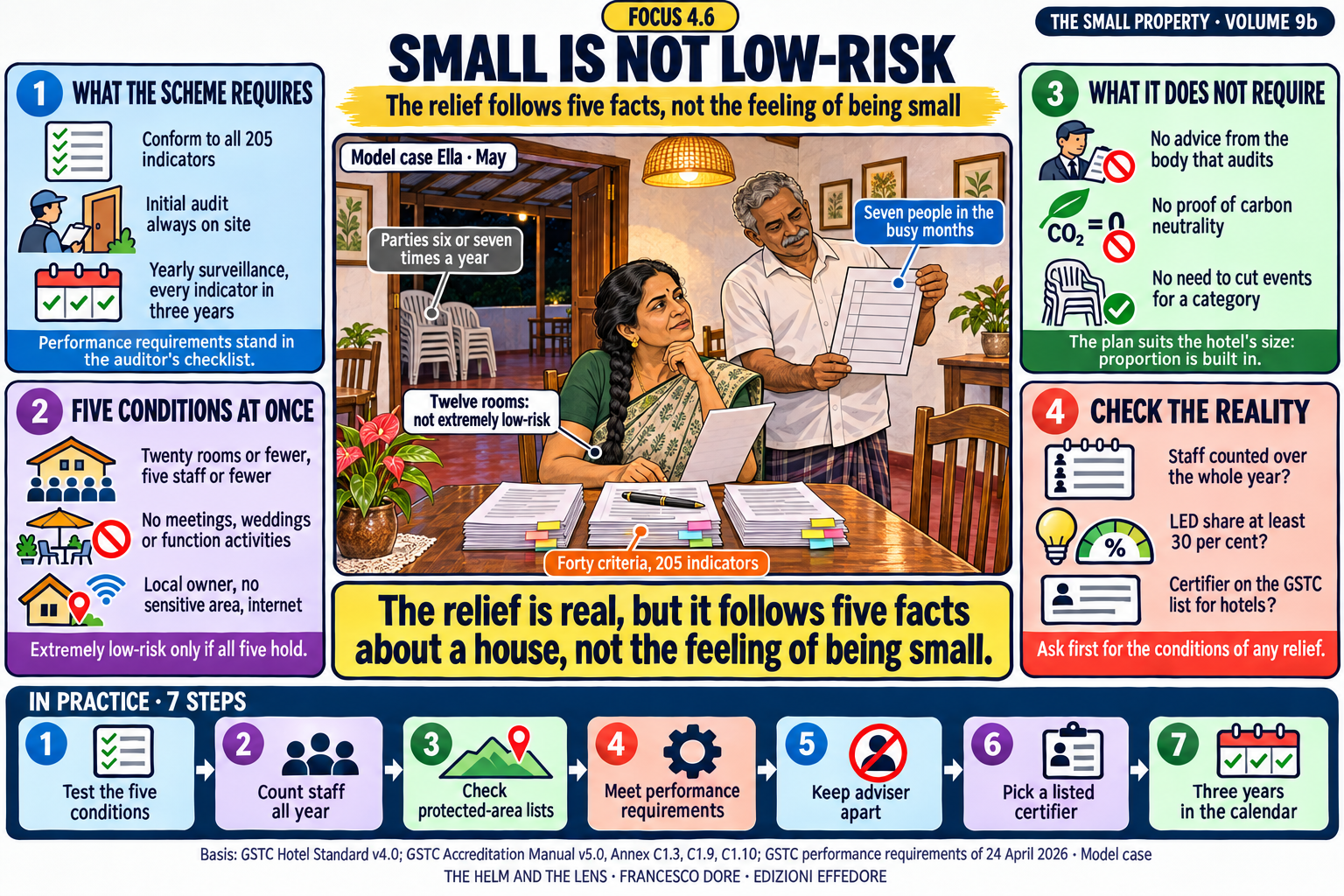
Slide 4.6
Leggi la spiegazione
English (UK)
This slide is about the relief that the GSTC scheme gives to very small hotels. The banner: the relief follows five facts, not the feeling of being small.
The model case is in Ella, in May. Twelve rooms, but not extremely low-risk. On the table lie three piles: forty criteria, two hundred and five indicators. The owner’s husband reads the staff list: seven people in the busy months. Behind them, the stacked chairs of the terrace: parties six or seven times a year.
The first panel says what the scheme requires: conformity with all two hundred and five indicators; an initial audit always on site; and yearly surveillance, with every indicator covered in three years. Performance requirements stand in the auditor’s checklist.
The second panel lists the five conditions, all at once: twenty rooms or fewer and five staff or fewer; no meetings, weddings or function activities; and a local owner, no sensitive area, and an internet connection. A house is extremely low-risk only if all five hold.
The third panel: no advice from the body that audits; no proof of carbon neutrality; and no need to cut events to fit a category. The plan suits the hotel’s size: proportion is built in.
The fourth panel asks: were staff counted over the whole year? Is the share of LED lighting at least thirty per cent? Is the certifier on the GSTC list for hotels? Ask first for the conditions of any relief.
The central sentence: the relief is real, but it follows five facts about a house, not the feeling of being small.
The seven steps: test the five conditions; count staff all year; check the protected-area lists; meet the performance requirements; keep the adviser apart; pick a listed certifier; and put the three years in the calendar.
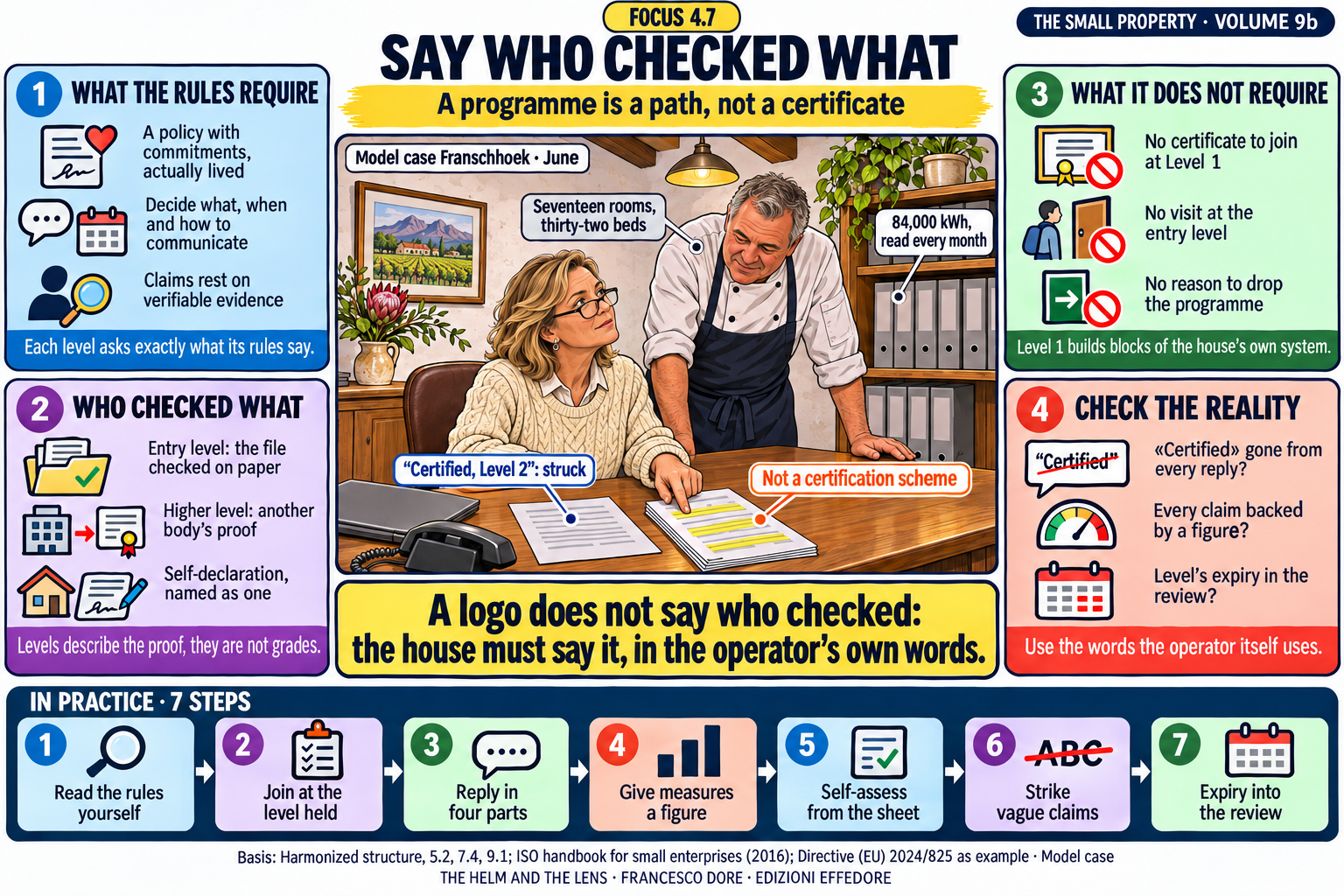
Slide 4.7
Leggi la spiegazione
English (UK)
This slide is about sustainability programmes with levels. The banner: a programme is a path, not a certificate.
The model case is in Franschhoek, in June. Seventeen rooms, thirty-two beds. The owner has struck out the words «certified, Level 2» from a reply to a client; the cook points at the programme’s rules, which say it is not a certification scheme. On the shelf, the meter readings: eighty-four thousand kilowatt hours, read every month.
The first panel says what the rules require: a policy with commitments, actually lived; deciding what, when and how to communicate; and claims that rest on verifiable evidence. Each level asks exactly what its rules say.
The second panel: who checked what. At entry level, the file is checked on paper. At a higher level, another body’s proof is needed. A self-declaration must be named as one. Levels describe the proof; they are not grades.
The third panel: no certificate is needed to join at Level 1; no visit at the entry level; and no reason to drop the programme. Level 1 builds blocks of the house’s own system.
The fourth panel asks: is the word «certified» gone from every reply? Is every claim backed by a figure? Is the level’s expiry in the review? Use the words the operator itself uses.
The central sentence: a logo does not say who checked; the house must say it, in the operator’s own words.
The seven steps: read the rules yourself; join at the level you hold; reply in four parts; give each measure a figure; self-assess from the sheet; strike vague claims; and put the expiry into the review.
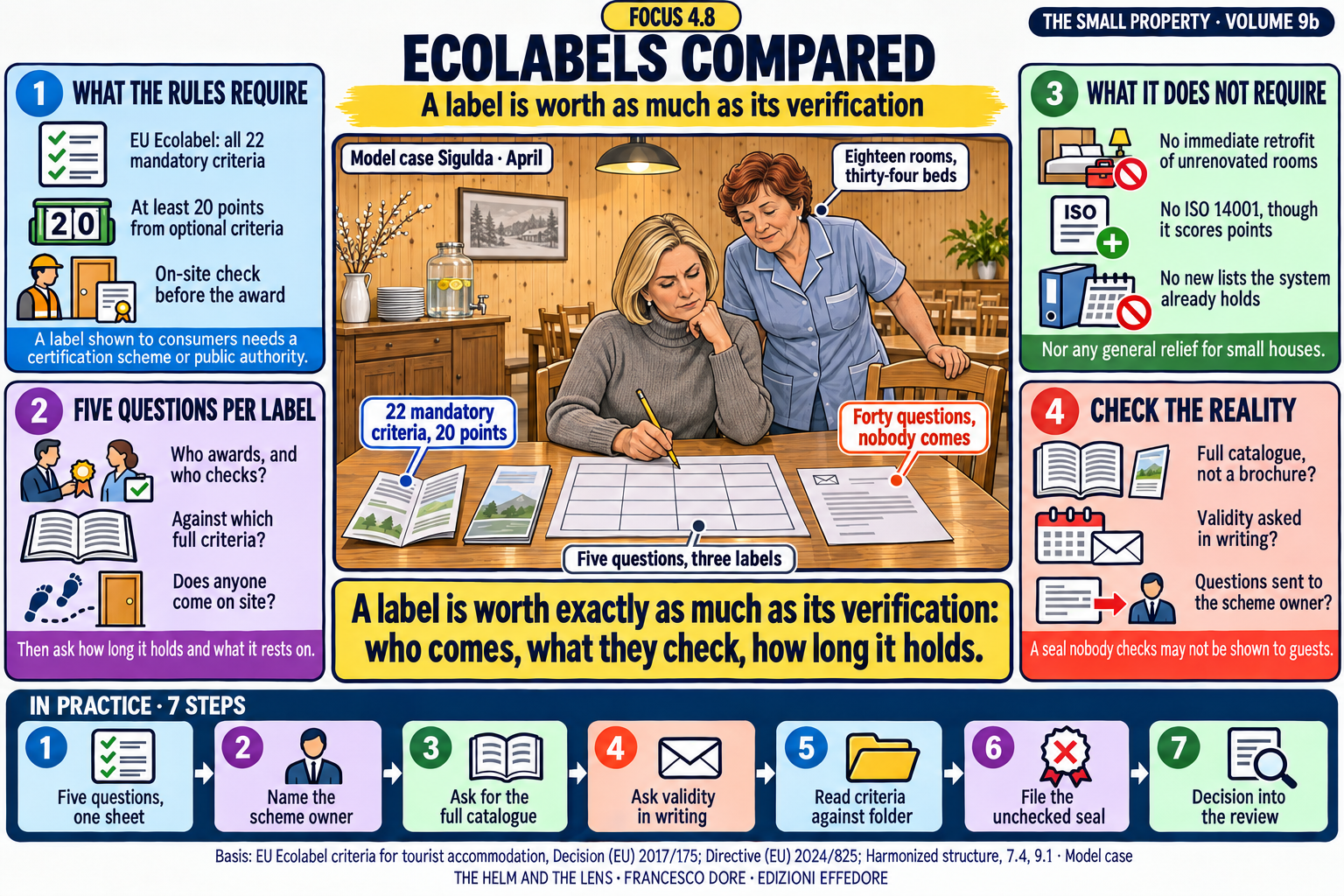
Slide 4.8
Leggi la spiegazione
English (UK)
This slide compares ecolabels. The banner: a label is worth as much as its verification.
The model case is in Sigulda, in April. Eighteen rooms, thirty-four beds. The owner fills in a comparison sheet, five questions for three labels, while the housekeeper looks over her shoulder. On the left, the EU Ecolabel leaflet: twenty-two mandatory criteria and twenty points. On the right, another label: forty questions, and nobody comes.
The first panel: for the EU Ecolabel, all twenty-two mandatory criteria; at least twenty points from the optional criteria; and an on-site check before the award. A label shown to consumers needs a certification scheme or a public authority behind it.
The second panel asks five questions of every label: who awards it, and who checks? Against which full criteria? Does anyone come on site? Then ask how long it holds and what it rests on.
The third panel: no immediate retrofit of unrenovated rooms; no ISO 14001, though it scores points; and no new lists the system already holds. Nor is there any general relief for small houses.
The fourth panel asks: was the full catalogue read, not a brochure? Was the validity asked for in writing? Were the questions sent to the scheme owner? A seal nobody checks may not be shown to guests.
The central sentence: a label is worth exactly as much as its verification: who comes, what they check, how long it holds.
The seven steps: five questions on one sheet; name the scheme owner; ask for the full catalogue; ask about validity in writing; read the criteria against the folder; file away the unchecked seal; and bring the decision into the review.

Slide 4.9
Leggi la spiegazione
English (UK)
This slide is about choosing an ISO certification body. The banner: the certifier audits and never advises.
The model case is in Évora, in January. About eleven hundred and fifty room nights a year. The owner has two offers in front of him: two pages promising certification in ninety days, and six pages for three years, accredited. His partner, the cook, points at the short one and asks the decisive question: who audits what he wrote himself?
The first panel says what the rules require: an initial audit in two stages; surveillance each calendar year, on a three-year cycle; and a certification decision taken by someone who did not audit. The body must not offer consultancy.
The second panel shows what the house sets: the scope on one page, set by the house; the family bakery controlled as a supplier; and an internal audit and a management review before stage one. Only accreditation brings oversight of the body.
The third panel: ISO 9001 itself demands no certificate; no certificate is needed for the family bakery; and there is no general legal duty to certify. Here the duty comes from a contract, not from the law.
The fourth panel asks: have you seen the body’s accreditation and its scope? Were the offers compared over three years? Is any consultancy hidden in the offer? Reject any offer with a preparation day.
The central sentence: a certificate is a three-year contract with someone who audits and never advises.
The seven steps: get the client’s demand in writing; write the scope on one page; reject consultancy offers; check the accreditation and the edition; compare three-year totals; do the audit and the review first; and put the three years in the calendar.
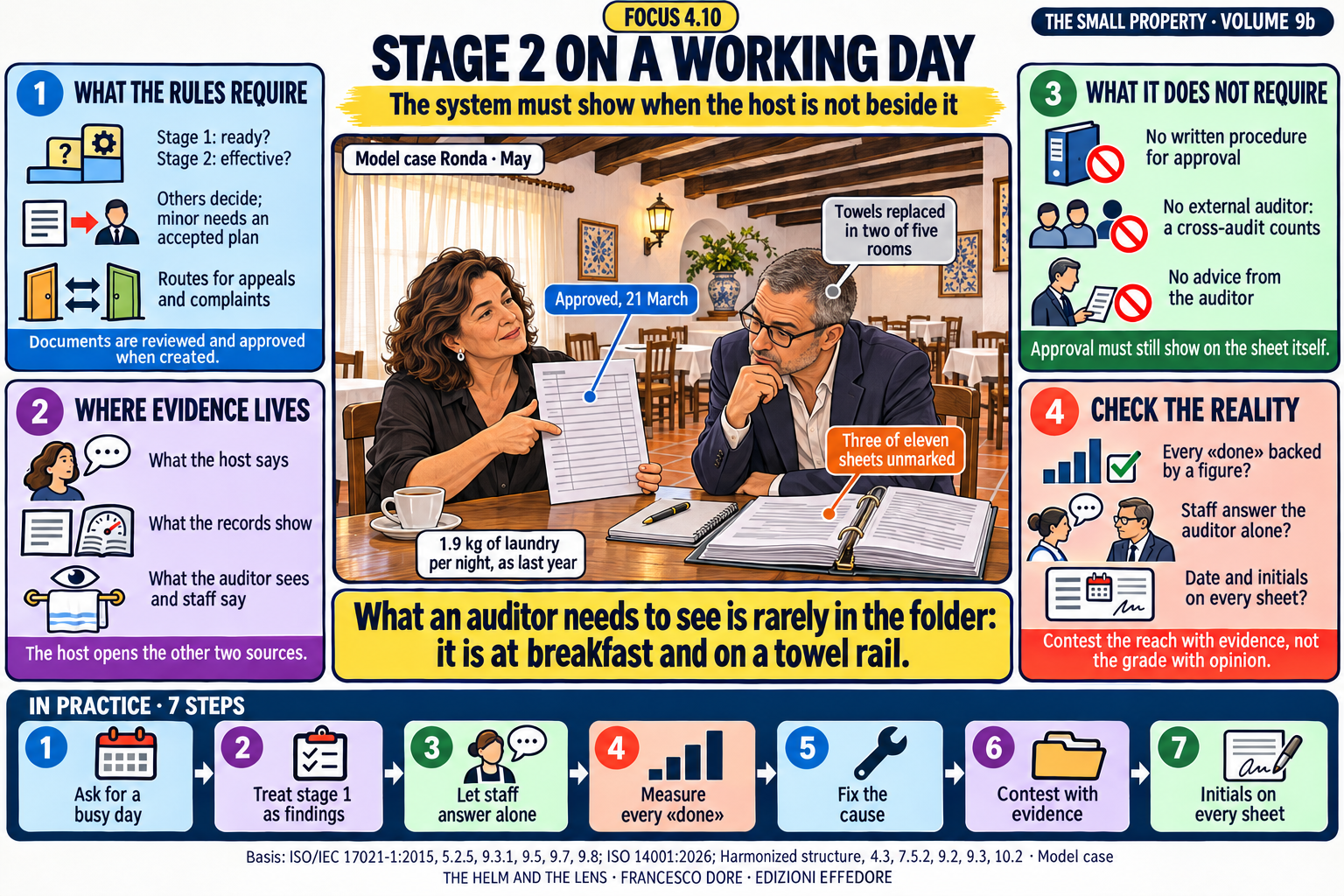
Slide 4.10
Leggi la spiegazione
English (UK)
This slide is about the stage two audit. The banner: the system must show when the host is not beside it.
The model case is in Ronda, in May. In the breakfast room the owner shows the auditor a sheet approved on the twenty-first of March. He has already found what the folder could not show: towels replaced in two of five rooms, three of eleven sheets unmarked, and one point 9 kilograms of laundry per night, as last year.
The first panel says what the rules require: stage one asks whether the house is ready, stage two whether the system is effective; others decide, and a minor nonconformity needs an accepted plan; and there are routes for appeals and complaints. Documents are reviewed and approved when created.
The second panel shows where the evidence lives: what the host says; what the records show; and what the auditor sees and staff say. The host opens the other two sources.
The third panel: no written procedure for approval; no external internal auditor, since a cross-audit counts; and no advice from the auditor. Approval must still show on the sheet itself.
The fourth panel asks: is every «done» backed by a figure? Do staff answer the auditor alone? Are there a date and initials on every sheet? Contest the reach of a finding with evidence, not the grade with opinion.
The central sentence: what an auditor needs to see is rarely in the folder; it is at breakfast and on a towel rail.
The seven steps: ask for a busy day; treat stage one as findings; let staff answer alone; measure every «done»; fix the cause; contest with evidence; and put initials on every sheet.
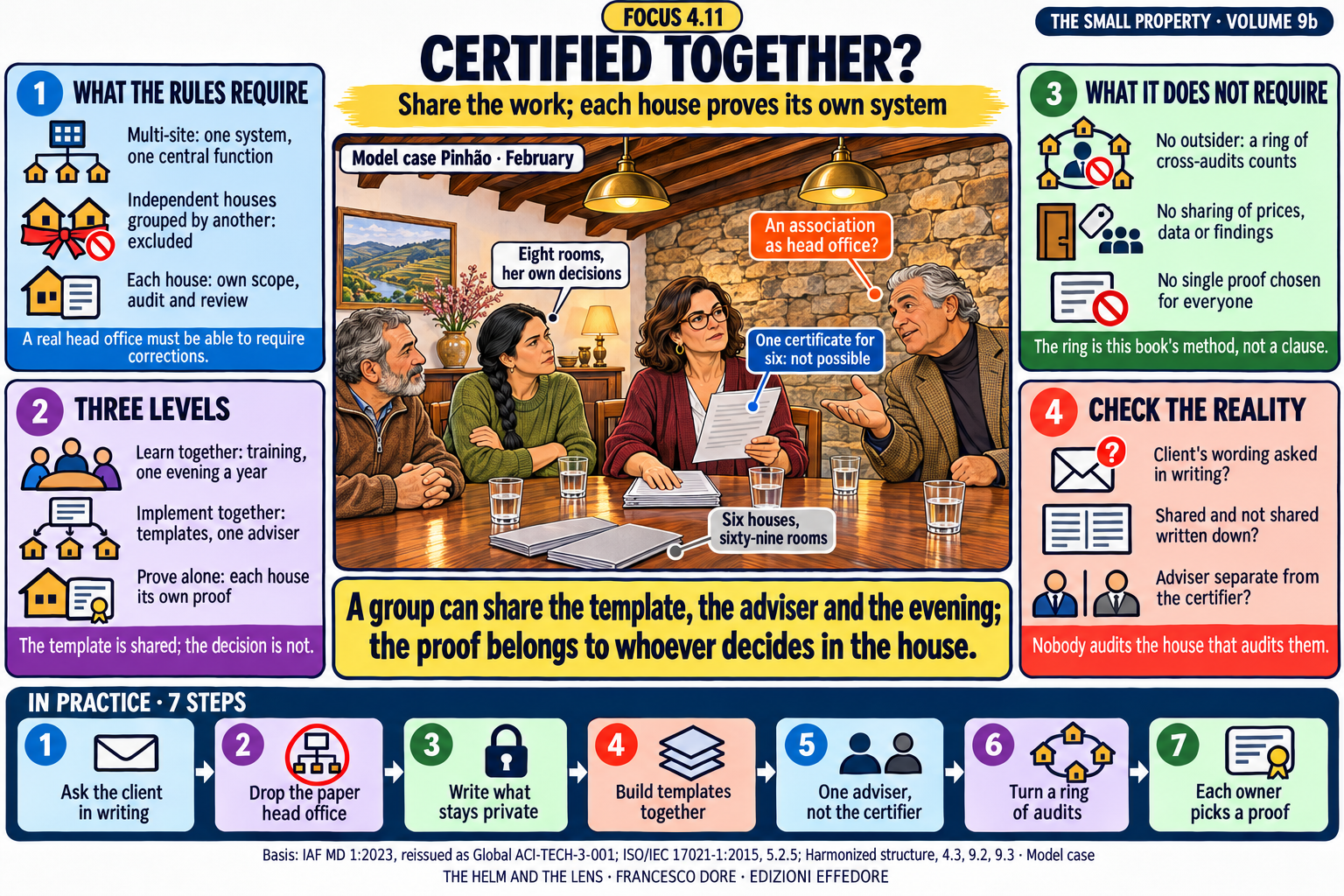
Slide 4.11
Leggi la spiegazione
English (UK)
This slide is about small houses that want to be certified as a group. The banner: share the work; each house proves its own system.
The model case is in Pinhão, in February. Six houses, sixty-nine rooms in all, around one table. One owner reminds the others that she has eight rooms and takes her own decisions. Another proposes an association as head office. The woman in the middle reads the answer: one certificate for six is not possible.
The first panel says what the rules require: multi-site certification needs one system and one central function; independent houses grouped by someone else are excluded; and each house has its own scope, audit and review. A real head office must be able to require corrections.
The second panel shows three levels: learn together, with training one evening a year; implement together, with templates and one adviser; and prove alone, each house with its own proof. The template is shared; the decision is not.
The third panel: no outsider is needed, a ring of cross-audits counts; no sharing of prices, data or findings; and no single proof chosen for everyone. The ring is this book’s method, not a clause.
The fourth panel asks: was the client’s wording asked for in writing? Is what is shared and what is not shared written down? Is the adviser separate from the certifier? Nobody audits the house that audits them.
The central sentence: a group can share the template, the adviser and the evening; the proof belongs to whoever decides in the house.
The seven steps: ask the client in writing; drop the paper head office; write what stays private; build the templates together; one adviser, not the certifier; turn a ring of audits; and let each owner pick a proof.
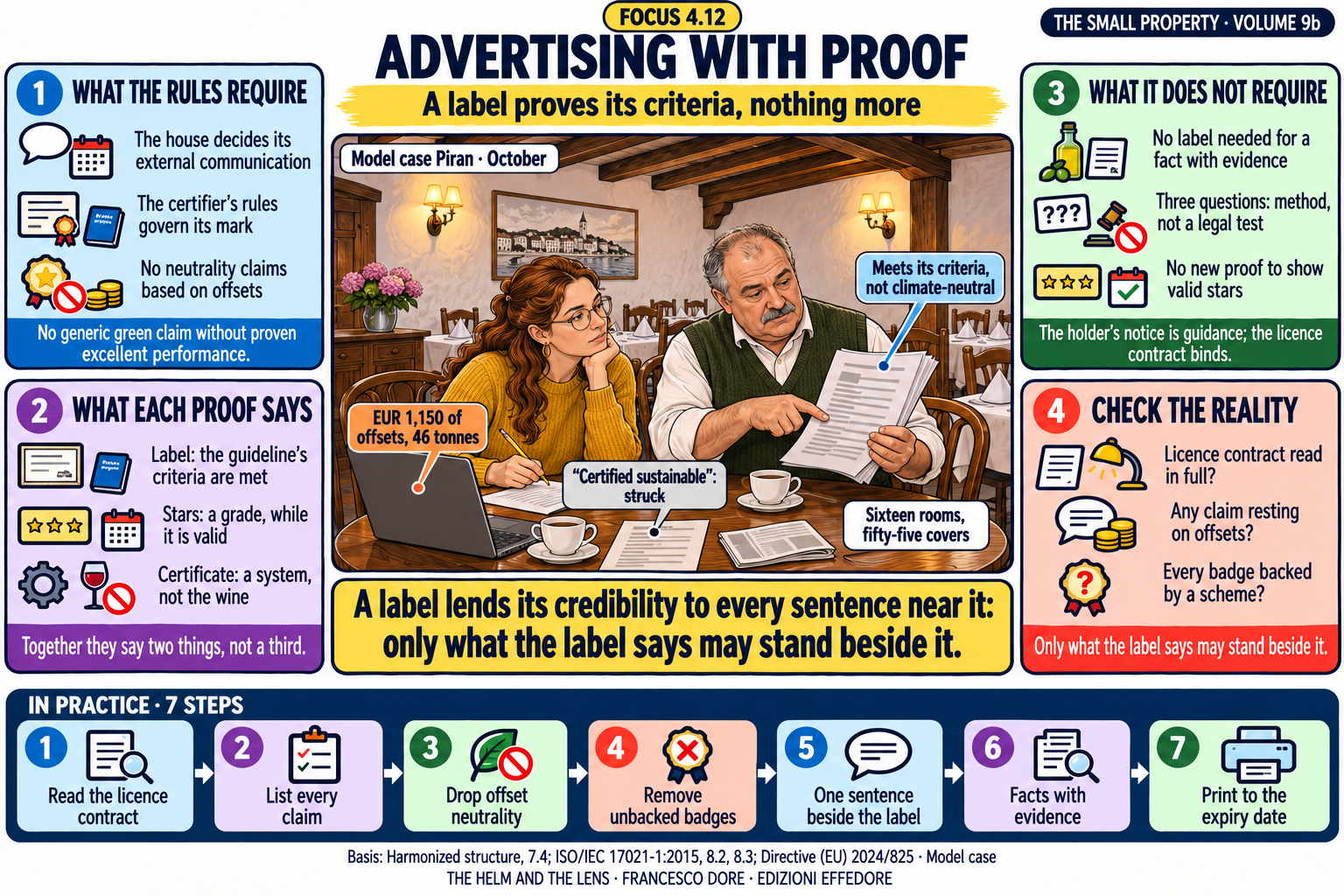
Slide 4.12
Leggi la spiegazione
English (UK)
This slide is about what a house may say in its advertising. The banner: a label proves its criteria, nothing more.
The model case is in Piran, in October. Sixteen rooms, fifty-five covers. The owner reads the text of the new brochure: the label meets its criteria, but the house is not climate-neutral. His daughter has found the offsets on the laptop, one thousand one hundred and fifty euros for forty-six tonnes, and has struck out «certified sustainable».
The first panel says what the rules require: the house decides its external communication; the certifier’s rules govern its mark; and no neutrality claims may be based on offsets. No generic green claim without proven excellent performance.
The second panel shows what each proof says: a label, that the guideline’s criteria are met; stars, a grade while it is valid; a certificate, a system, not the wine. Together they say two things, not a third.
The third panel: no label is needed for a fact with evidence; the three questions are a method, not a legal test; and no new proof is needed to show valid stars. The holder’s notice is guidance; the licence contract binds.
The fourth panel asks: was the licence contract read in full? Does any claim rest on offsets? Is every badge backed by a scheme? Only what the label says may stand beside it.
The central sentence: a label lends its credibility to every sentence near it; only what the label says may stand beside it.
The seven steps: read the licence contract; list every claim; drop offset neutrality; remove unbacked badges; one sentence beside the label; state facts with evidence; and print only up to the expiry date.
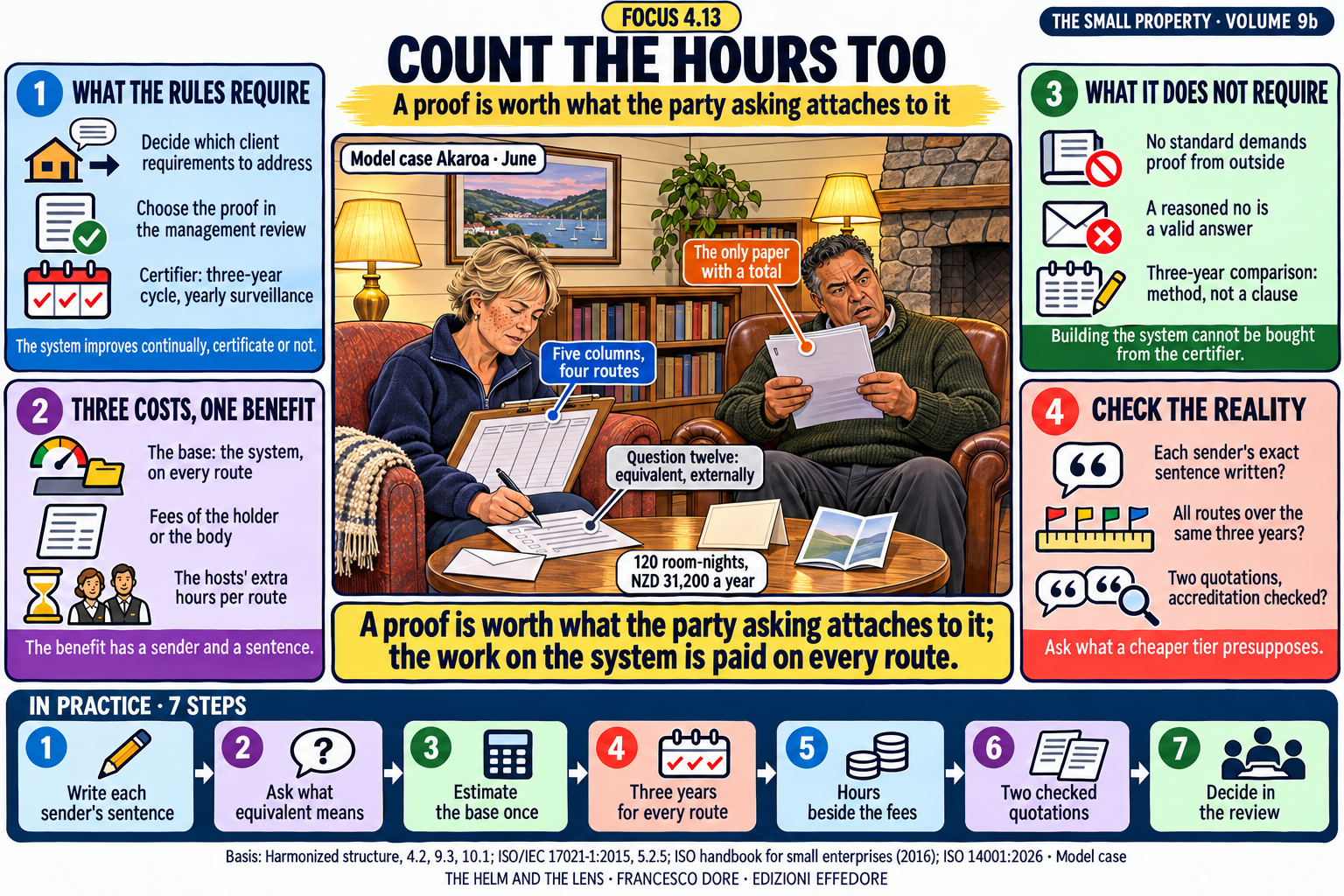
Slide 4.13
Leggi la spiegazione
English (UK)
This slide is about the cost of an external proof. The banner: a proof is worth what the party asking attaches to it.
The model case is in Akaroa, in June. By the fireplace the owner fills in a table of five columns for four routes. Her husband reads the only paper with a total, from a client: question twelve asks for an equivalent, externally verified. That client is worth one hundred and twenty room nights, thirty-one thousand two hundred New Zealand dollars a year.
The first panel says what the rules require: decide which client requirements to address; choose the proof in the management review; and, for a certifier, a three-year cycle with yearly surveillance. The system improves continually, certificate or not.
The second panel shows three costs and one benefit: the base, the system itself, paid on every route; the fees of the scheme holder or the body; and the hosts’ extra hours on each route. The benefit has a sender and a sentence.
The third panel: no standard demands proof from outside; a reasoned no is a valid answer; and the three-year comparison is a method, not a clause. Building the system cannot be bought from the certifier.
The fourth panel asks: is each sender’s exact sentence written down? Are all routes compared over the same three years? Are there two quotations, with accreditation checked? Ask what a cheaper tier presupposes.
The central sentence: a proof is worth what the party asking attaches to it; the work on the system is paid on every route.
The seven steps: write each sender’s sentence; ask what equivalent means; estimate the base once; three years for every route; put the hours beside the fees; get two checked quotations; and decide in the review.
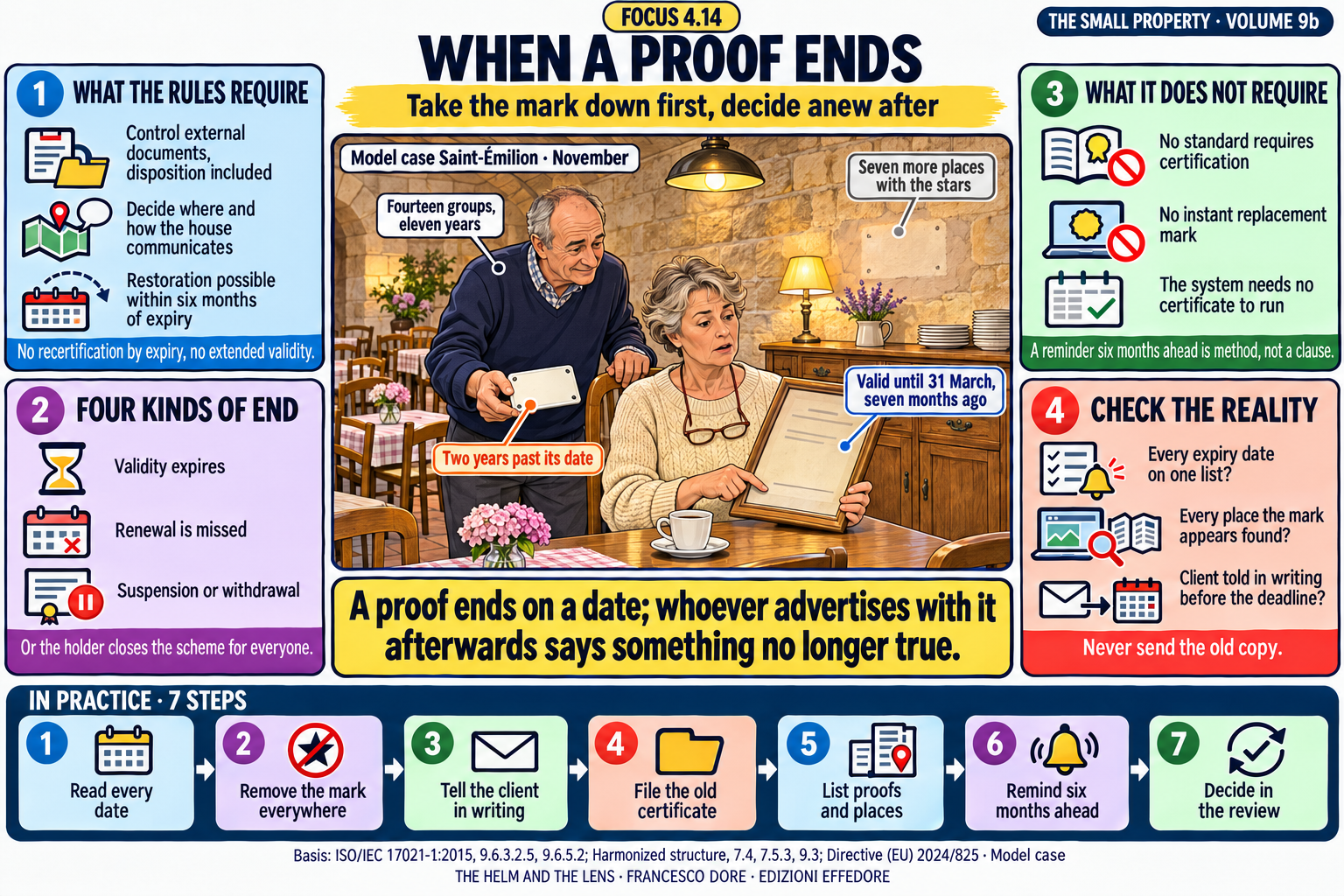
Slide 4.14
Leggi la spiegazione
English (UK)
This slide is about the end of a proof. The banner: take the mark down first, decide anew after.
The model case is in Saint-Émilion, in November. The owner holds the framed certificate: valid until the thirty-first of March, seven months ago. Her husband holds a plaque two years past its date. The stars still appear in seven more places, and a client with fourteen groups over eleven years is waiting for an answer.
The first panel says what the rules require: control external documents, disposition included; decide where and how the house communicates; and restoration is possible within six months of expiry. There is no recertification by expiry and no extended validity.
The second panel shows four kinds of end: validity expires; renewal is missed; suspension or withdrawal; or the holder closes the scheme for everyone.
The third panel: no standard requires certification; no instant replacement mark; and the system needs no certificate to run. A reminder six months ahead is a method, not a clause.
The fourth panel asks: is every expiry date on one list? Has every place where the mark appears been found? Was the client told in writing before the deadline? Never send the old copy.
The central sentence: a proof ends on a date; whoever advertises with it afterwards says something no longer true.
The seven steps: read every date; remove the mark everywhere; tell the client in writing; file the old certificate; list the proofs and the places; remind six months ahead; and decide in the review.
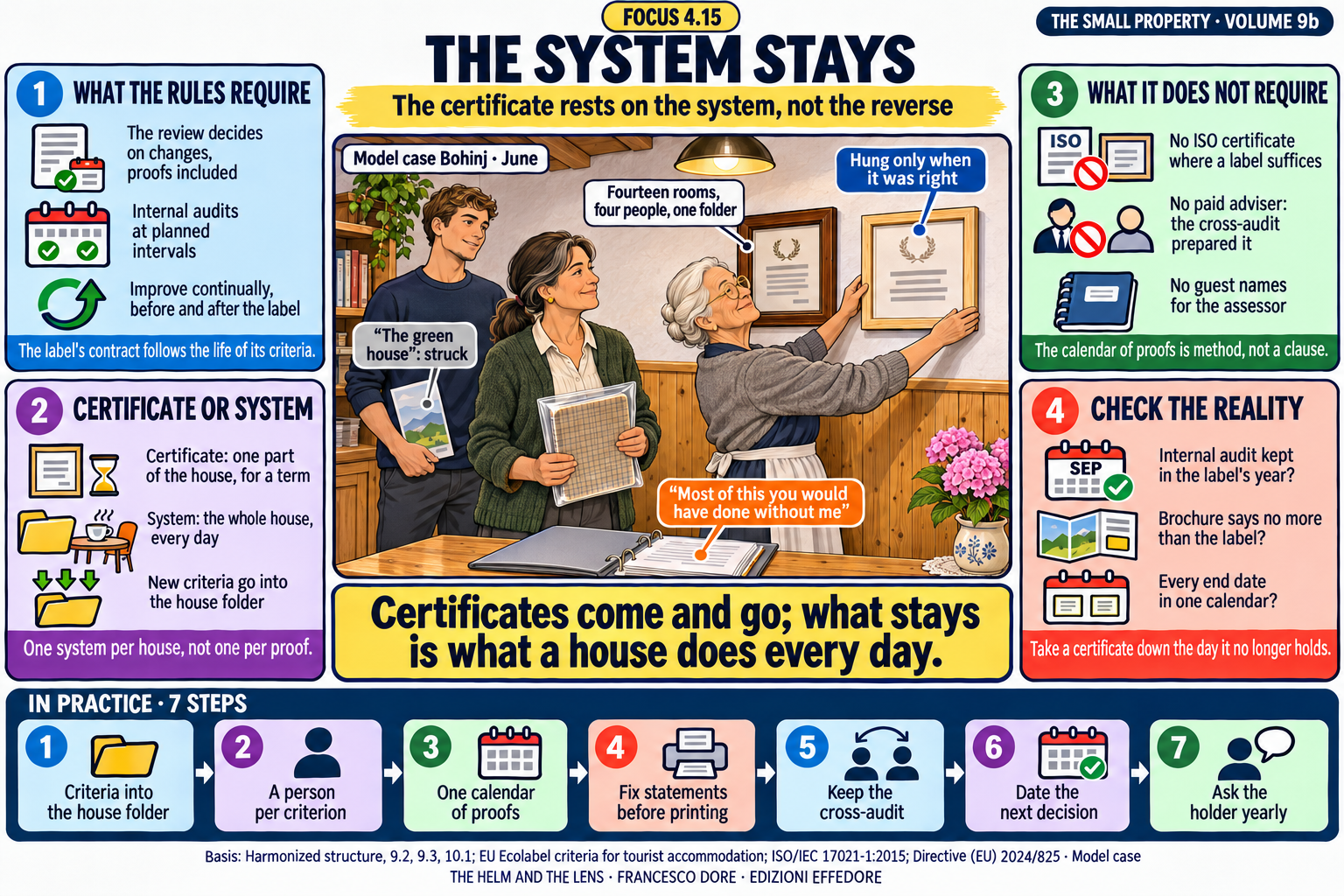
Slide 4.15
Leggi la spiegazione
English (UK)
This last slide closes the volume where chapter three began, in Bohinj, now in June. The banner: the certificate rests on the system, not the reverse.
Fourteen rooms, four people, one folder. The grandmother hangs the new certificate on the wall: it was hung only when it was right. The son holds the old brochure, where «the green house» has been struck out. On the table the folder of the auditor’s visit, with the sentence the owner remembers: «most of this you would have done without me».
The first panel says what the rules require: the review decides on changes, proofs included; internal audits at planned intervals; and continual improvement, before and after the label. The label’s contract follows the life of its criteria.
The second panel: certificate or system? A certificate covers one part of the house, for a term. The system covers the whole house, every day. New criteria go into the house folder. One system per house, not one per proof.
The third panel: no ISO certificate where a label suffices; no paid adviser, since the cross-audit prepared it; and no guest names for the assessor. The calendar of proofs is a method, not a clause.
The fourth panel asks: was the internal audit kept in the label’s year? Does the brochure say no more than the label? Is every end date in one calendar? Take a certificate down the day it no longer holds.
The central sentence: certificates come and go; what stays is what a house does every day.
The seven steps: criteria into the house folder; a person for each criterion; one calendar of proofs; fix the statements before printing; keep the cross-audit; date the next decision; and ask the scheme holder every year.
Immagini e tavole HD
Apri e proietta le foto direttamente dal sito, a schermo intero, oppure scarica gli originali.
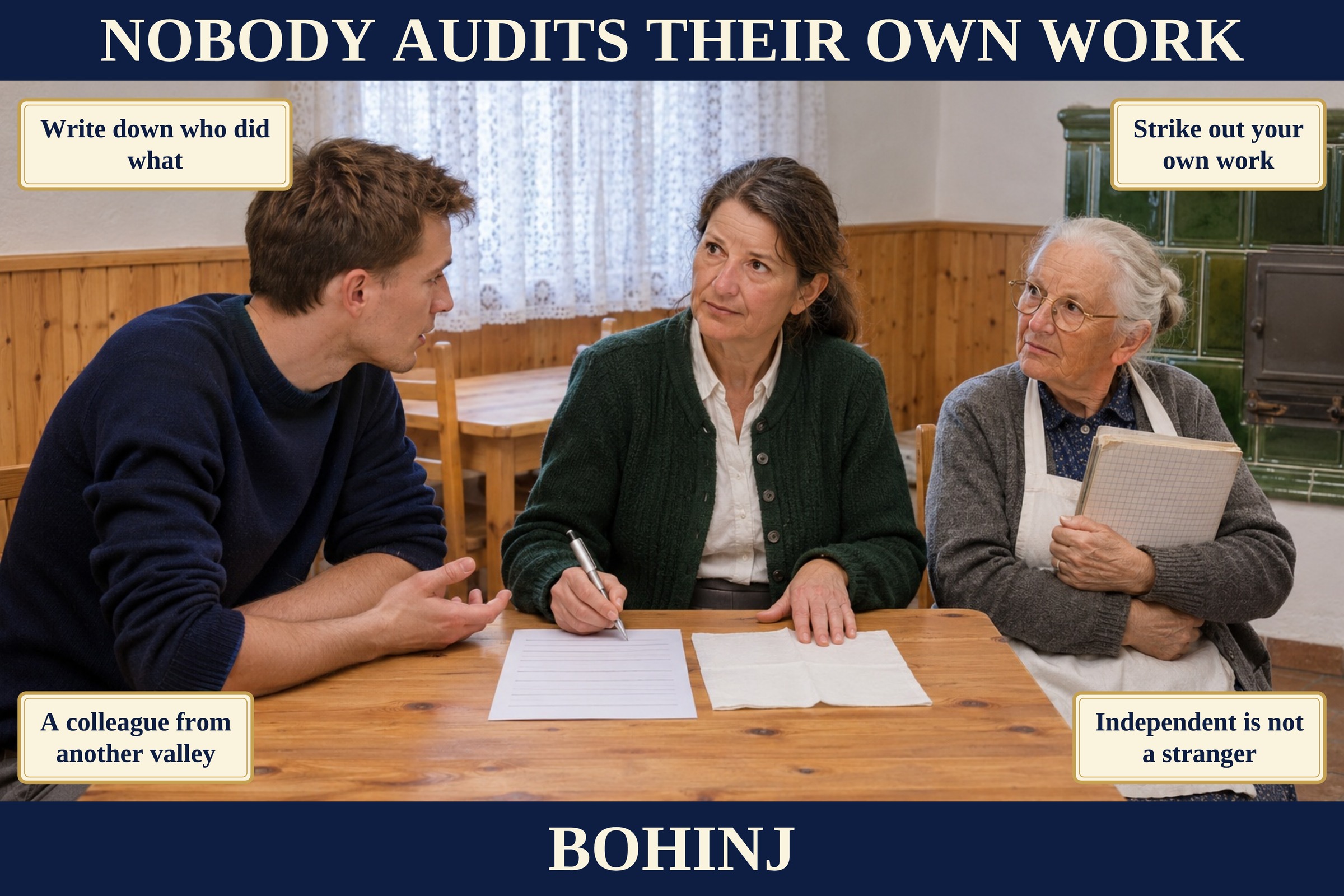
Concept Card 3.1 — Nobody Audits Their Own Work
Subchapter 3.1 · Bohinj, Slovenia
Setting: Bohinj, Slovenia
The breakfast room of the Kovač guesthouse in Ribčev Laz, which the family uses as its kitchen table, the day after an evening in Kranj, in soft daylight behind white lace curtains: whitewashed walls, pine panelling to waist height, a green tiled stove, cold. Maja sits at the centre with a pen over a fresh ruled sheet, her other hand on a paper napkin, looking up. Luka leans across the table, asking; Ana, in her white apron, holds her checked notebook against her chest, not entirely convinced.
Two papers lie side by side, and the composition rests on them. The napkin carries four lines written in an inn by a colleague from another valley; the sheet beside it will carry the list of who ran or covered which area of the house in the past year. The pen sits between them because the napkin is only an idea, and the family can act only on the sheet. Beside breakfast, one name will stand alone: Ana's.
The four plaques read as one argument. Write down who did what, because in a house without departments everyone has stood in somewhere; then strike out your own work, area by area, until it is plain how little the family can audit of itself. What remains needs a colleague from another valley, near enough to know the season and far enough not to compete for the same guests. And independent is not a stranger: it means distance from the work, not from the person.
The plate does not accuse Maja of delay, Luka of wanting too much, or Ana of distrust; each option the family weighed had a real limit, and Luka would have audited honestly. What it shows is a family discovering that consideration is a virtue at table and a filter in an audit. The rule is stricter than it sounds and milder than people fear: nobody audits their own work, and the list of who did what is redone every year.
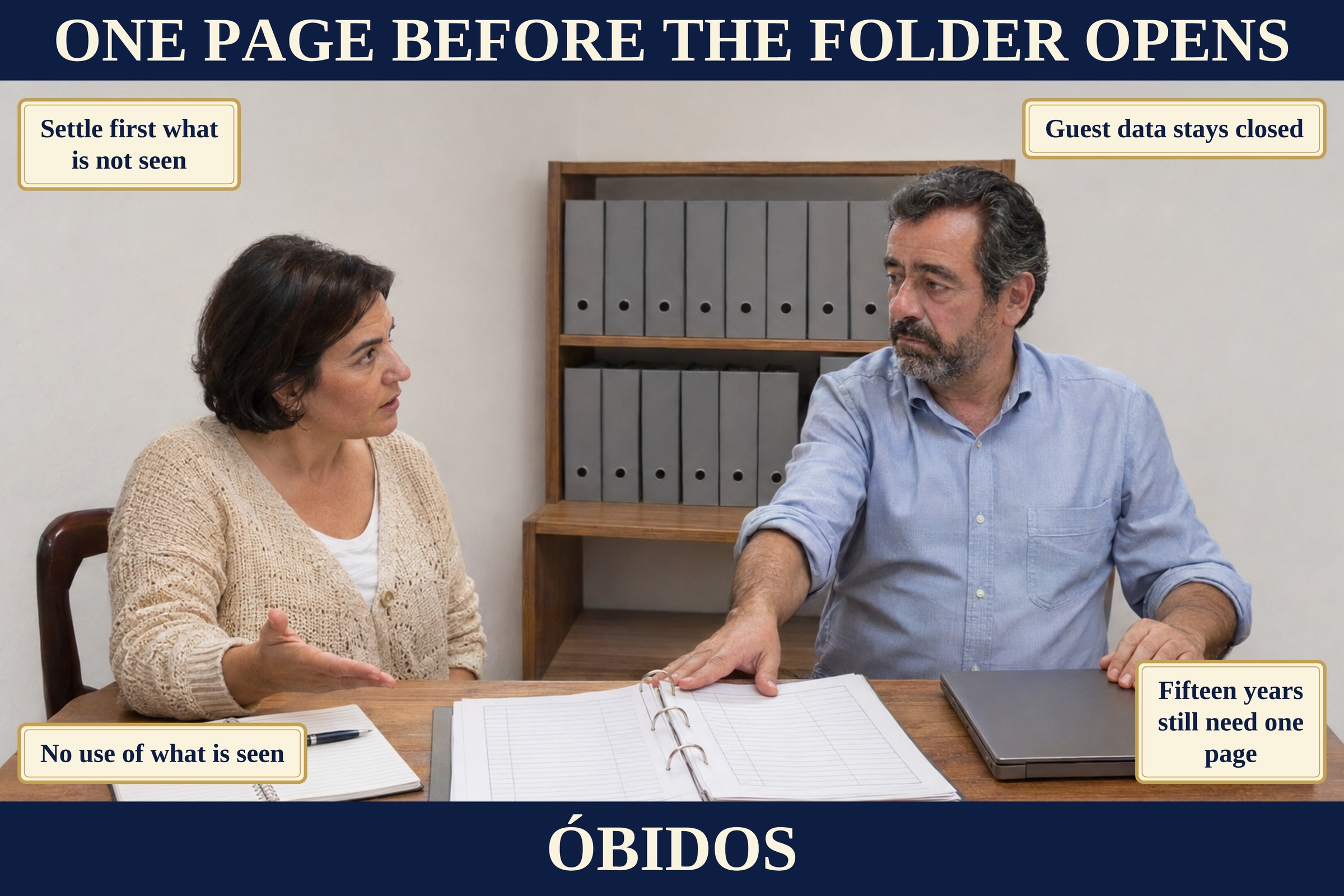
Concept Card 3.2 — One Page Before the Folder Opens
Subchapter 3.2 · Óbidos, Portugal
Setting: Óbidos, Portugal
A small windowless office behind the reception of a guesthouse inside the walls of Óbidos, lit from above: pale walls, a wooden desk, a shelf of plain grey box files. Rui Fonseca, the owner, in a light blue shirt, draws the open group folder back across the desk with one hand while the other rests on his closed laptop. Opposite him Helena Sarmento, who runs a guesthouse three hundred metres away and has come to audit, has laid her pen on her notepad and turns a palm up, asking.
The folder lies halfway between them, and that is the point of the picture. Fonseca opened it for the room list; the tour operator's contract, with its price on the second line, lay on top, and the group's dietary wishes behind it. Sarmento had read a name before he drew it back. Nothing dishonest has happened, yet the closed laptop and the retreating hand show two competitors who began an audit on a telephone call, without settling what one may see of the other.
The four plaques read as one argument. Settle first what is not seen: prices, contracts, payroll and lists of regular guests stay in the cupboard. Guest data stays closed, opened only as far as the audit needs and never copied. No use of what is seen covers whatever slips through anyway, such as an operator's name already read: it is not used to win guests. And fifteen years still need one page, signed before the folder opens, precisely because the friendship is long.
The plate does not accuse Fonseca of secrecy or Sarmento of curiosity; he had nothing to hide, and she raised her question openly. It shows two houses that trusted each other enough to skip a step they needed. The lesson of the subchapter is practical: forty minutes at a table by the window and eight points on one sheet let the audit resume shortly after ten, with two signatures and a closed folder.
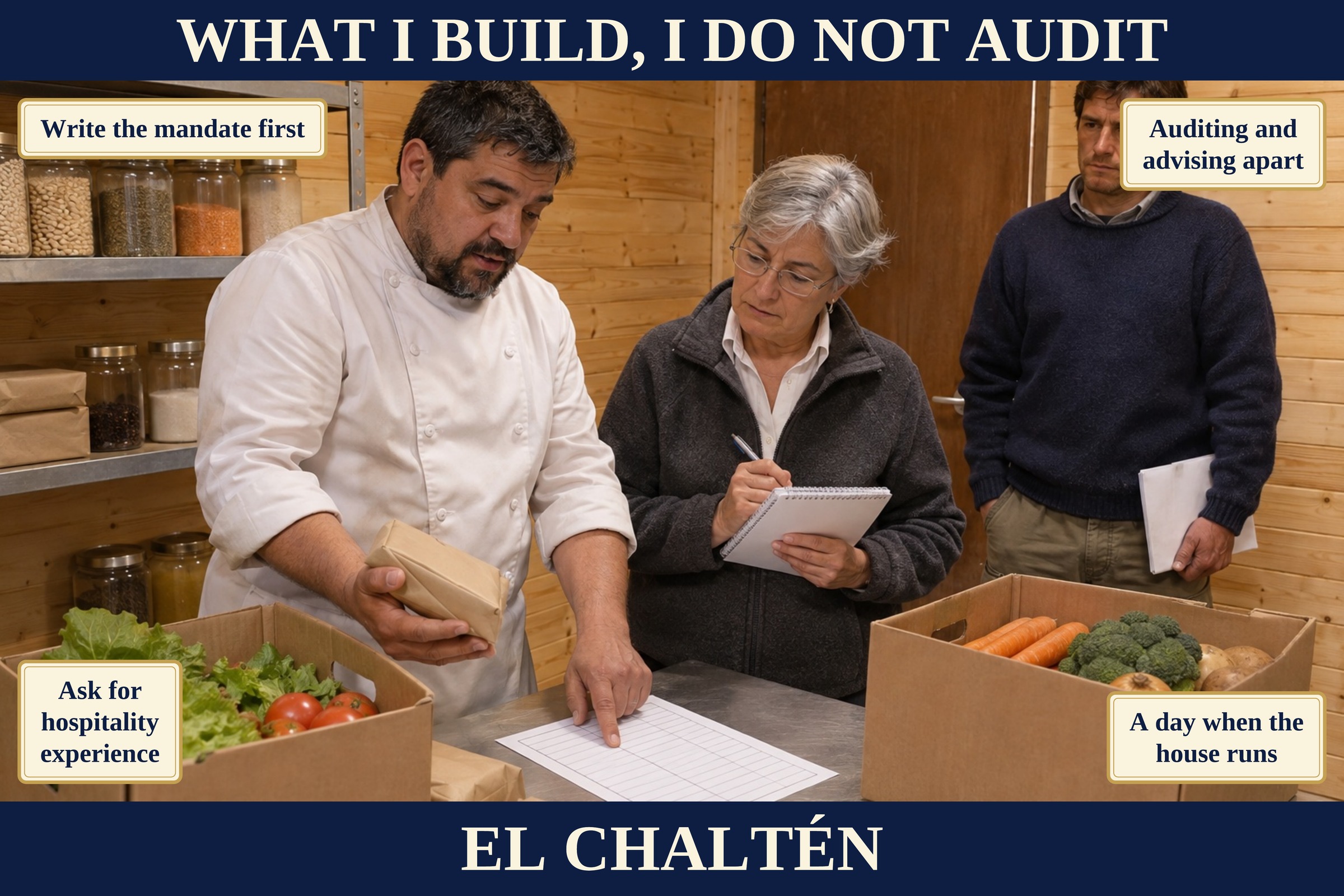
Concept Card 3.3 — What I Build, I Do Not Audit
Subchapter 3.3 · El Chaltén, Argentina
Setting: El Chaltén, Argentina
The goods receiving room behind the kitchen of an eighteen-room timber lodge in El Chaltén, at dawn under a warm ceiling light: pine-boarded walls, metal shelves of jars, two open crates of vegetables. The head cook, in white, holds a wrapped packet and runs a finger down a ruled sheet on the steel table, the allergen list. Beside him Valeria Montes, the external auditor, writes in a small notepad and watches closely. A step back, the owner, Tomás Ibarra, holds a folded sheet at his side and keeps silent.
Three distances organise the room. The cook stands at the work, the auditor beside it, the owner behind both. The folded page in Ibarra's hand is his mandate, written before he accepted any offer: objective, criteria, scope, day, report, role and data. It is why he does not step forward. Valeria Montes is there to verify what the house built, not to build it, and the cook explains to her unasked because a running morning shows more than any folder.
The four plaques read as one argument. Write the mandate first, so that the house orders what it needs rather than what is offered. Keep auditing and advising apart, because whoever builds a part of the system cannot judge that part afterwards. Ask for hospitality experience, since a title on a letterhead says less than two guesthouses one may telephone. And choose a day when the house runs: a delivery at dawn, a group arriving, an allergy ordered at dinner.
The plate does not accuse the auditor of selling a package; she drew the line herself, on the telephone, at the cost of three days' work. Nor does it fault Ibarra for wanting help after building the system alone at night. What it shows is an internal audit that belongs to the house: ordered on its own sheet, carried out by someone who builds nothing she audits, and leaving certification to a separate body with its own procedure.
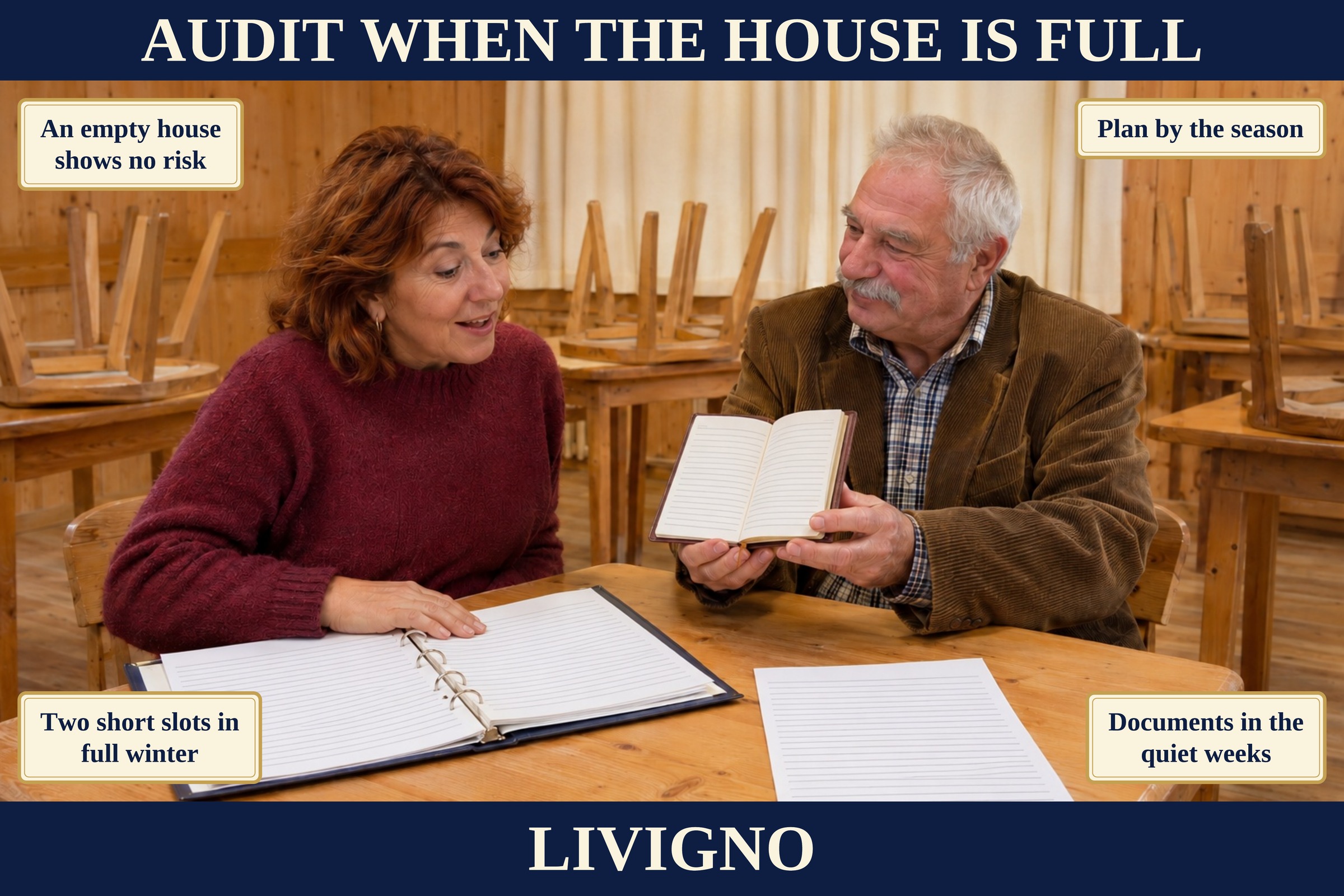
Concept Card 3.4 — Audit When the House Is Full
Subchapter 3.4 · Livigno, Italy
Setting: Livigno, Italy
The breakfast room of an alpine guesthouse in Livigno on the last Sunday in October, the season over: honey-coloured larch panelling, cream curtains drawn, chairs upturned on every table but one. There Elena Bormolini, in a burgundy jumper, rests her hand on her open register of notes beside a single ruled report. Opposite her Sergio Rodigari, a neighbouring host who audits her house, holds a small open diary towards her with both hands and smiles; she leans in, surprise turning to agreement.
The upturned chairs make the argument before a word is read. They show the house as it was in May, when Sergio audited it and wrote no findings: honestly, and blind. The register beside his report holds what the winter knew, a second exit in the ski room blocked by skis and nine late registrations. The diary at the centre is open at January, offering what a full season can spare: two hours in the morning and two in the evening.
The four plaques read as one argument. An empty house shows no risk, because rules written for skis and late arrivals hold easily when neither is there. So plan by the season, over two years, ordered by risk. Two short slots in full winter, in the week after Epiphany, show breakfast, the ski room and the key box at work without holding anyone up. Documents in the quiet weeks complete the programme, in November before the management review.
The plate does not accuse Elena of choosing convenience or Sergio of a careless report; her May date suited documents, and his conclusion was true for the house he saw. What it shows is an audit placed where there was time instead of where there was risk. The lesson is one of the calendar: the audit goes to the house when it is full, in pieces small enough for two neighbours who are busy at the same time.
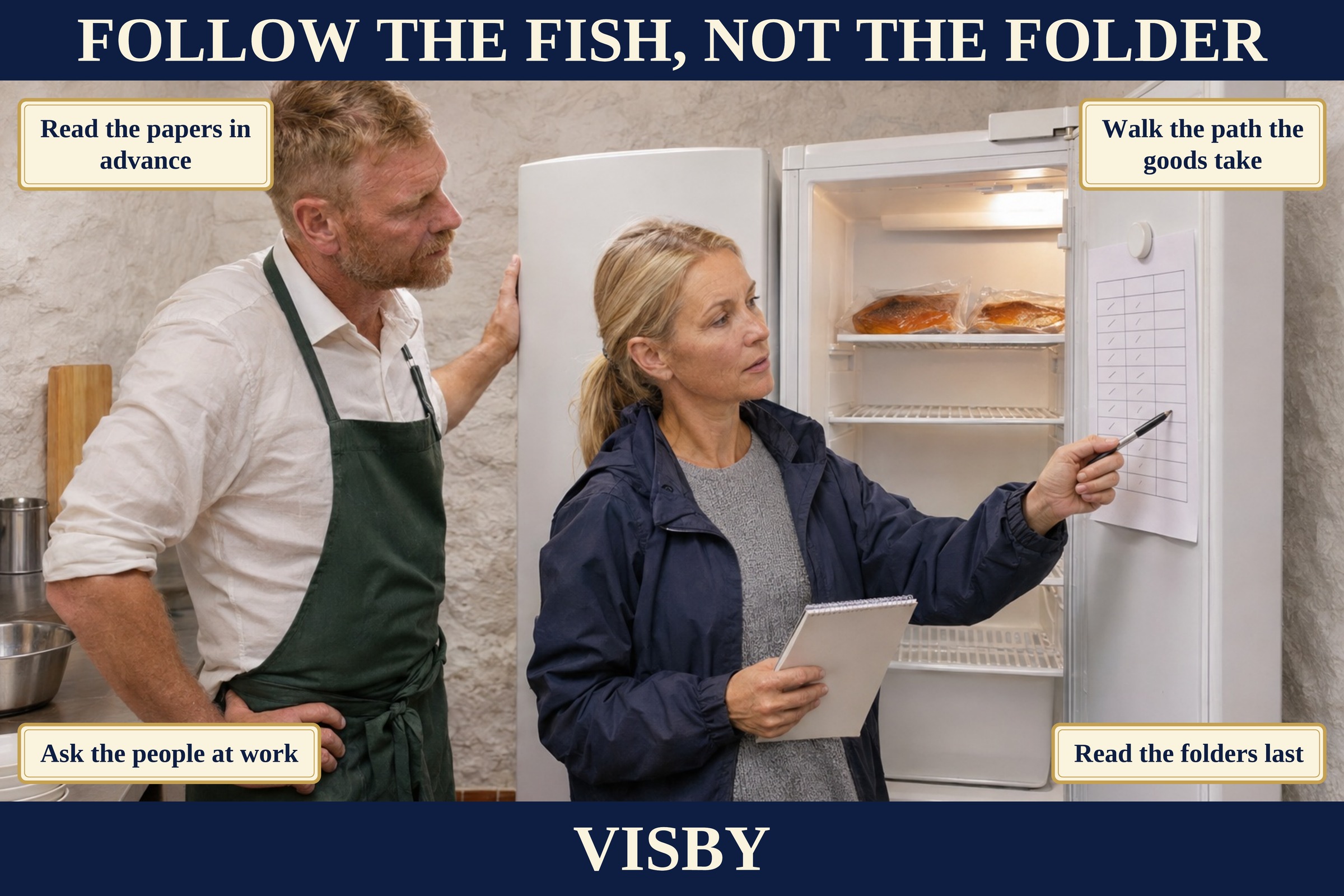
Concept Card 3.5 — Follow the Fish, Not the Folder
Subchapter 3.5 · Visby, Sweden
Setting: Visby, Sweden
The tiny breakfast kitchen of a guesthouse in a limestone merchant's house in Visby, early on a June morning: rough whitewashed stone, two white fridges side by side, the right one open. On its top shelf lie two vacuum packs of smoked fish; on its door hangs a ruled temperature list. Karin Ekström, the visiting auditor, in a navy jacket, points her pen at the list, a notepad in her other hand. Beside her the owner, Johan Berg, in a green apron, leans on the closed fridge and looks.
The fish and the list share the open door, and between them lies the morning's finding. The smokehouse delivered at twenty past six, before anyone was on shift, through a back door to which the driver has a key. The columns for each fridge are kept, morning by morning; the third, for chilled goods received, is empty for this Tuesday and for the Friday before. Five folders wait on a table in the breakfast room. The auditor has not sat down.
The four plaques read as one argument. Read the papers in advance, by email and without guest data, so the morning is free for the house. Walk the path the goods take, from the back door through the fridge to the buffet and on to the invoice. Ask the people at work, with open questions, while they lay the tables. And read the folders last, when what was seen can be laid beside what was written.
The plate does not accuse Johan, who laid out the folders to make his guest's morning easy, nor the assistant, who measures every delivery she receives, nor the driver, who used the key he was given. The gap lay between three people each doing their part. The lesson is one of method in a house with no office: a fridge, a delivery note and a quiet answer at work show what a folder can only promise.
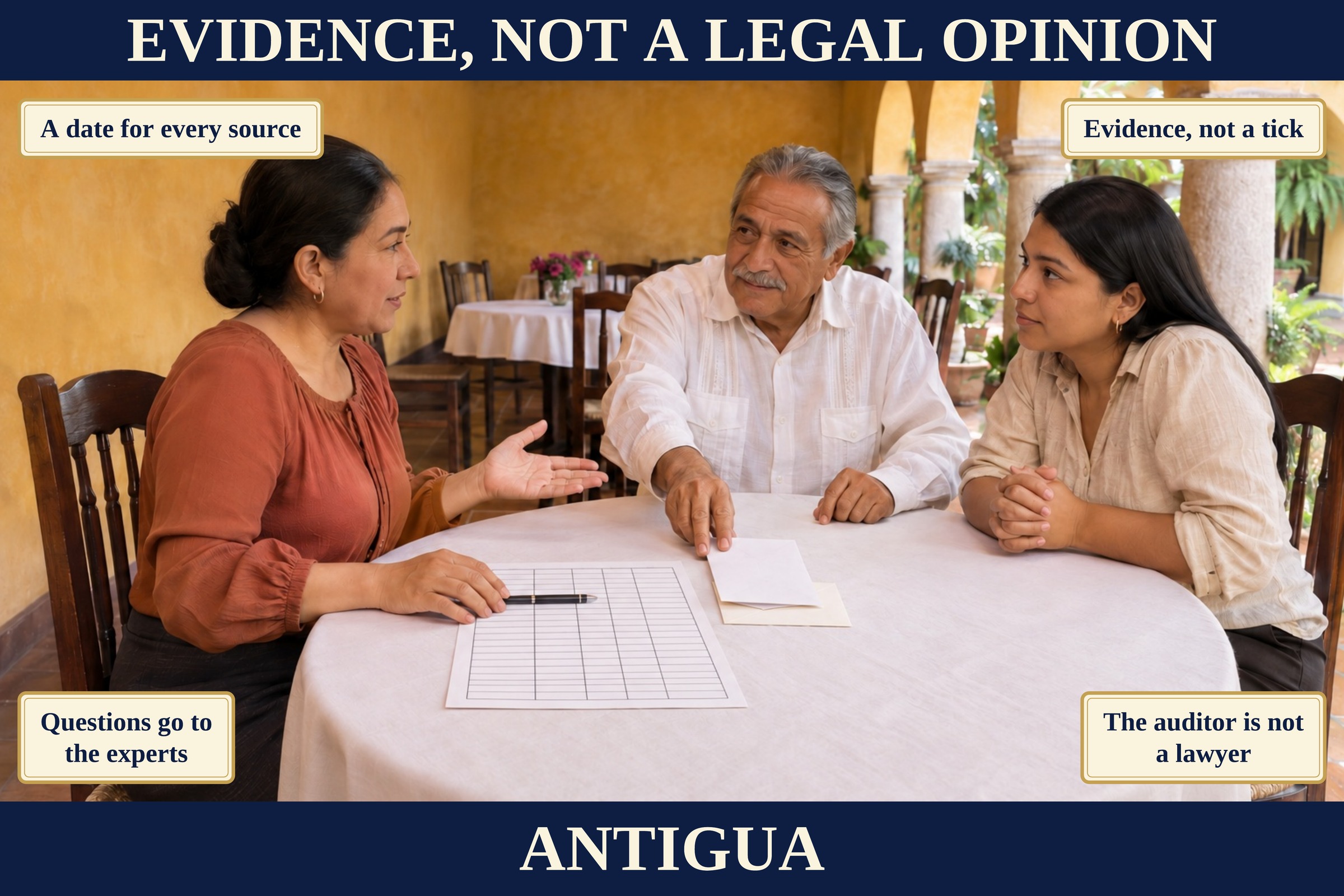
Concept Card 3.6 — Evidence, Not a Legal Opinion
Subchapter 3.6 · Antigua, Guatemala
Setting: Antigua, Guatemala
The dining room of a guesthouse in a colonial house in Antigua on the restaurant's day of rest, in warm light from the arcade, with the plants of the courtyard behind: ochre walls, a round table under a white cloth. Carmen Ajú, the visiting auditor, in a terracotta blouse, has laid her pen across a ruled list and opens a palm as she explains. Héctor Morales, the owner, slides a folded letter towards her; his daughter Lucía waits, hands clasped, for the answer to her own question.
Two papers meet on the cloth. The list holds twenty-two legal duties in six columns, built by Lucía the year before, most of them ticked. The letter is the insurer's, asking for a yes or no on fire safety, with a signature. The pen lying across the list is the gesture of the afternoon: the auditor will go through every line, but she will not turn it into the yes the letter wants, nor rule on whether the smoke alarms must be interconnected.
The four plaques read as one argument. A date for every source shows when each rule was last read, so that a line citing only building rules, without a version, becomes an observation. Evidence, not a tick, replaces the status column with what was found, where and when. Questions go to the experts, collected in their own part of the report with an addressee: the fire authority, the municipality, the accountant. For the auditor is not a lawyer, and says so.
The plate does not accuse Héctor of wanting a shortcut or Lucía of trusting her own ticks; both brought honest questions to the one person who would read the list that year. What it shows is the limit of an audit and its value. An audit of obligations checks the house's order in dealing with the law, not the law itself: it shows where evidence exists, and writes down the questions only others can answer.
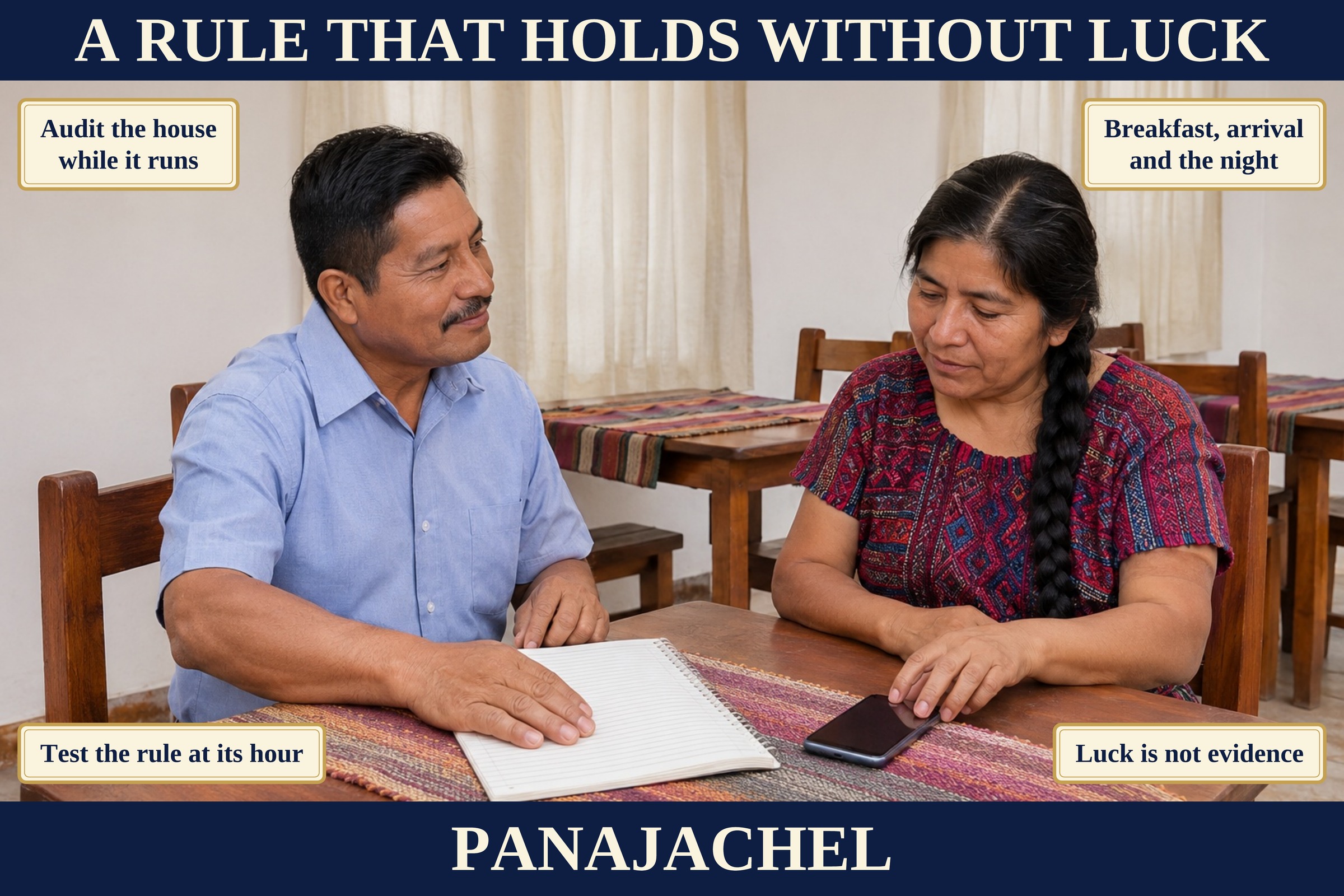
Concept Card 3.7 — A Rule That Holds Without Luck
Subchapter 3.7 · Panajachel, Guatemala
Setting: Panajachel, Guatemala
The breakfast room of a small hotel in Panajachel at ten in the morning, breakfast cleared, in soft light through drawn linen curtains: white walls, wooden tables with woven runners. Tomás Reyes, the visiting auditor, in a pale blue shirt, has laid his ruled notepad flat on the table and looks at the host steadily and kindly. Opposite him Elena Batz, in a woven huipil, touches a dark mobile phone with her fingertips and looks down at it, her shrug fading into thought.
The phone is the evidence of the night before. At two minutes past eleven Tomás rang the number on the card by the front door; it rang nine times, and again six minutes later. In the morning Elena found it in her car with two missed calls. The notepad lies beside it, holding timed lines from breakfast, the group arrival and the night. Placed next to each other, the two objects turn an explanation of bad luck into a finding.
The four plaques read as one argument. Audit the house while it runs, because a folder read first makes the auditor see what he expects. Breakfast, arrival and the night are the three moments that carry almost everything a guest experiences. Test the rule at its hour: a call to the night number, the hour left open, is no alarm and wakes nobody. And luck is not evidence, in either direction, on a good night or a bad one.
The plate does not accuse Elena, who keeps her phone by the bed almost every night, nor the attendant who entered a later temperature early, nor the student at reception who did not know how the rule applied to a group. Each was doing their best in a busy week. What it shows is the difference between a person and a rule. The audit does not ask whether the host was lucky; it asks whether a guest reaches someone at night without luck.
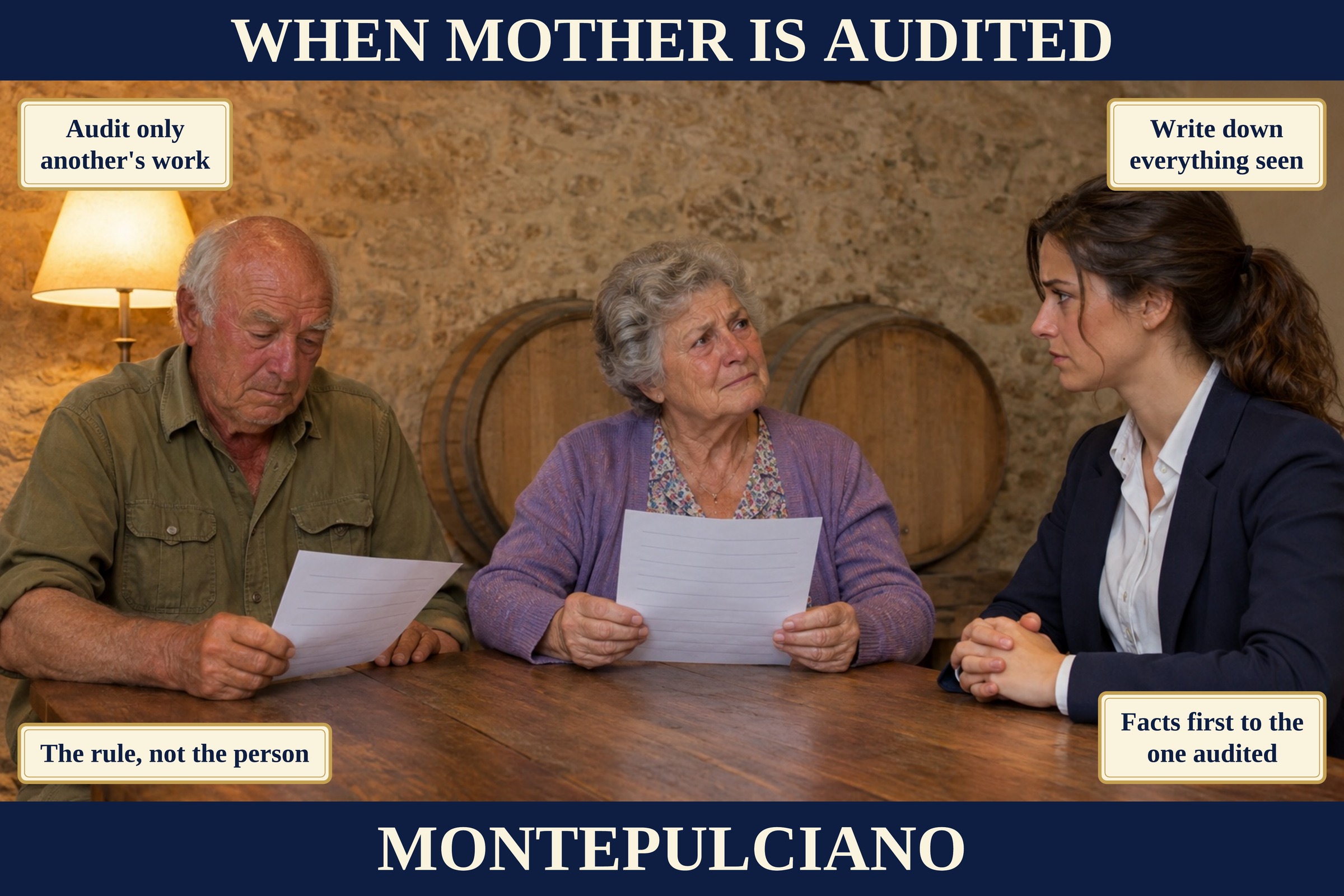
Concept Card 3.8 — When Mother Is Audited
Subchapter 3.8 · Montepulciano, Italy
Setting: Montepulciano, Italy
The tasting room of the Bellandi wine estate below Montepulciano at three on an April afternoon, in warm lamplight: rough stone walls, two plain oak barrels, a long dark table. Rosanna, the mother, sits at the centre holding a single sheet in both hands and has looked up from it at her daughter, hurt and proud at once. Giulia, in a navy blazer, sits upright with her hands folded, uneasy but firm. Sergio, the father, holds a second sheet and looks down at it.
Two pages from the same Saturday lie in two pairs of hands. The mother's page, written by her daughter, says that fourteen items stood on the buffet and twelve in the allergen folder. The father's page, written about his daughter's work, holds one kind sentence and leaves out three unsigned arrival cards. The composition sets them side by side: one sharp, one gentle, both shaped by consideration, pointed in different directions.
The four plaques read as one argument. Audit only another's work: the daughter takes her mother's weekday breakfast but not the Sunday she covers herself. Write down everything seen, including what would hurt to write, because its weight is decided afterwards. The rule, not the person, is named in each finding, so that the mother can answer without defending herself. And facts first to the one audited, alone, before anything reaches the family council.
The plate does not accuse Giulia of harshness or Sergio of weakness, and it does not doubt Rosanna's forty years of breakfast or the best-kept laundry book in the house. It shows a family learning that respect and evidence need each other. A family can audit itself when each member looks only at another's work, writes down everything, and lets the person audited hear the facts first.
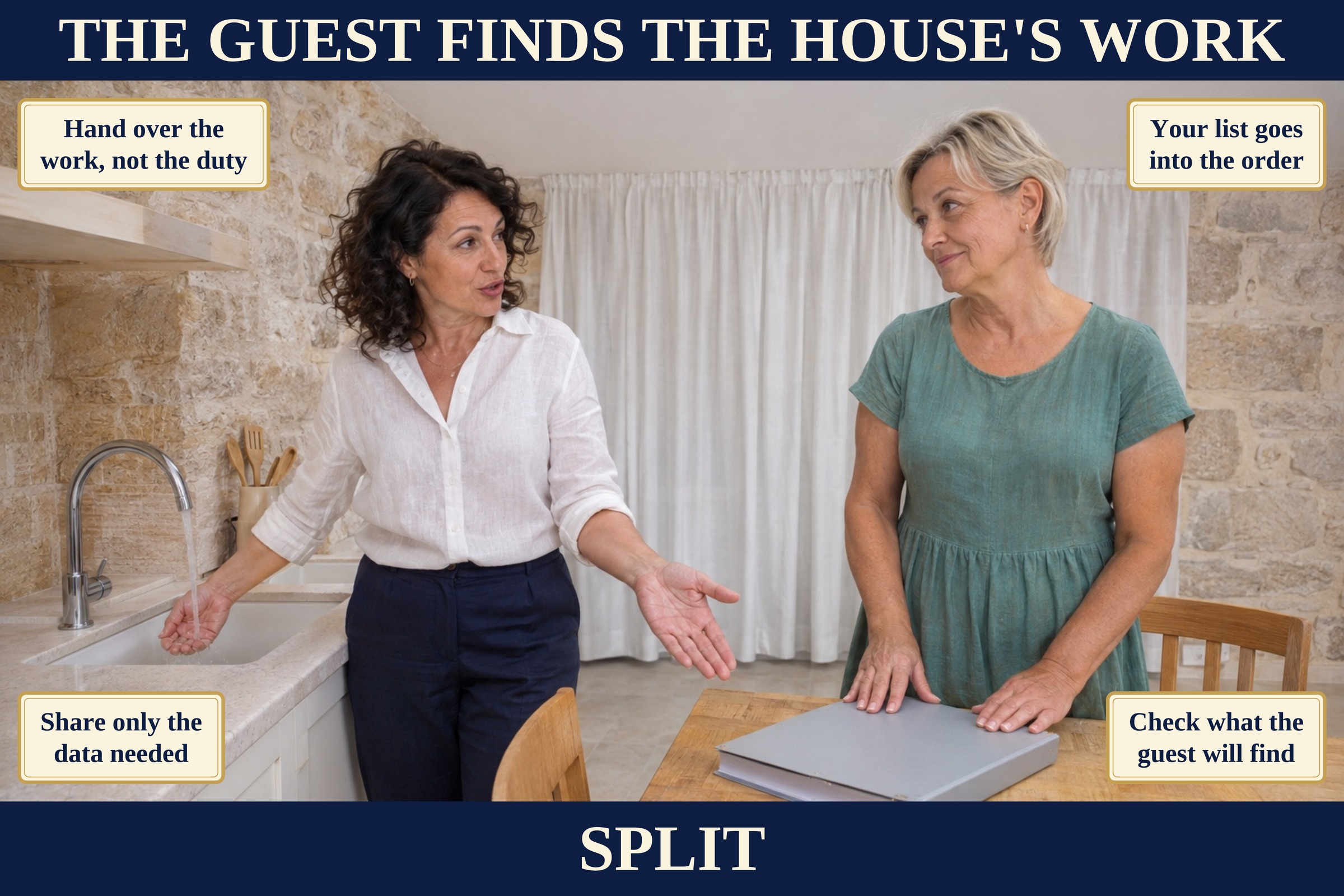
Concept Card 3.9 — The Guest Finds the House’s Work
Subchapter 3.9 · Split, Croatia
Setting: Split, Croatia
A freshly cleaned holiday apartment in an old stone house in Split, late on a May afternoon, in clear light behind drawn white curtains: pale stone walls, a small kitchenette, a wooden table. Mirela Jurić, the visiting auditor, in a white linen shirt, holds one hand under the running tap to feel the water warm and gestures with the other towards the table. There the owner, Ivana Matić, in a sea-green dress, rests both hands on a closed grey folder and listens, smiling a little ruefully.
The folder is the emergency folder every apartment should hold, and the water is the first thing a guest will test. Both stood on Ivana's handover list; neither stood on the cleaning company's. Mirela has entered apartment 4 as the next guest will, with the code from the message and no hints, and everything is in order. The composition puts the question elsewhere: the person telling the owner so is the auditor, not the company that cleaned.
The four plaques read as one argument. Hand over the work, not the duty, because what the guest finds remains the house's responsibility. Your list goes into the order, attached to the contract, since the words “to standard” are no criterion. Share only the data needed: the cleaners need rooms and times, not names, telephone numbers and the key-box code. And check what the guest will find, by entering as the guest enters.
The plate does not accuse the cleaning company, which worked fast and thoroughly to its own list and reported every defect it found; the first draft that called it careless was rewritten. It shows a house that had never made its own rules part of the work it handed over. The audit examines the house's control of what it outsources, not the supplier itself: what others do for the house stays in its audit.
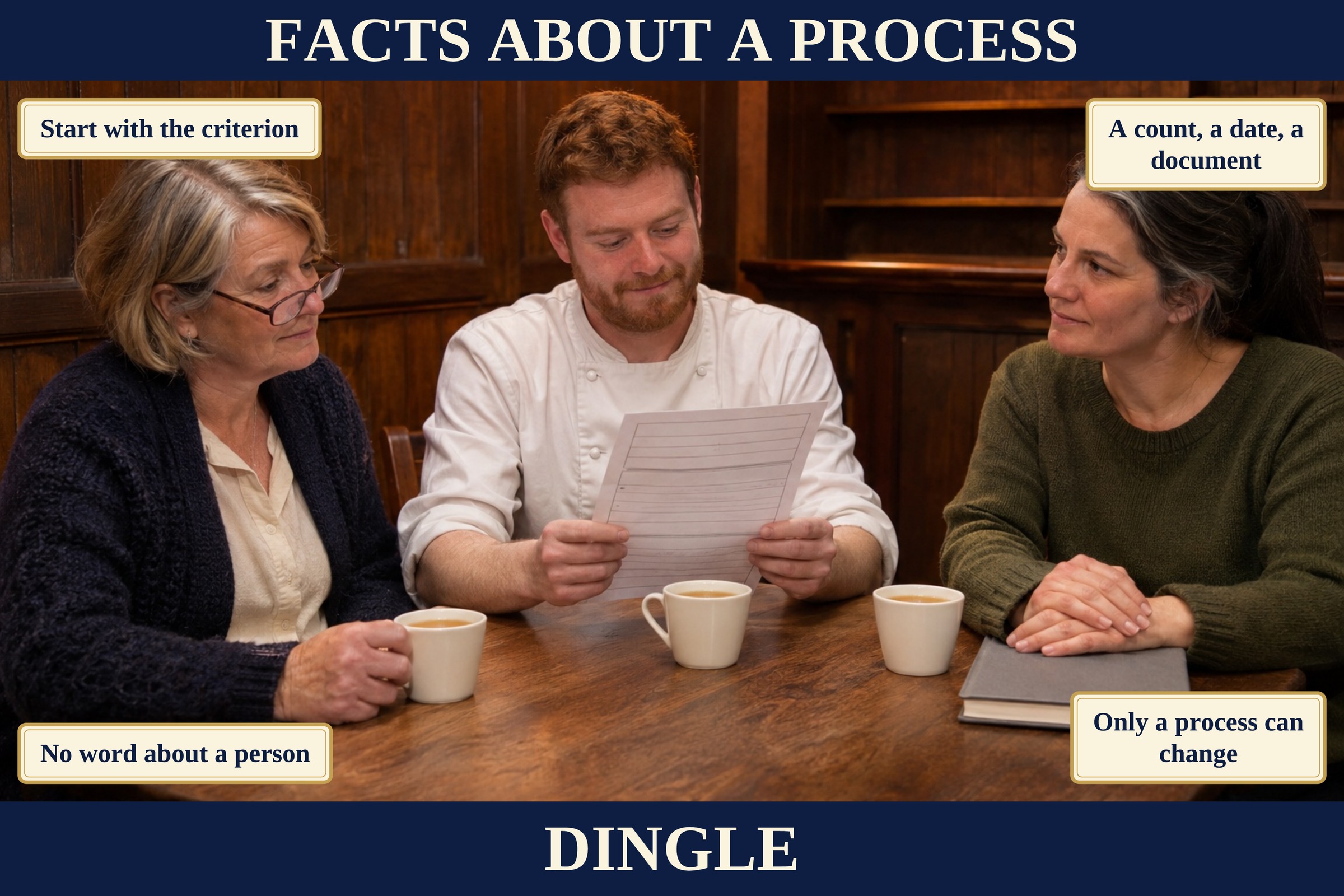
Concept Card 3.10 — Facts About a Process
Subchapter 3.10 · Dingle, Ireland
Setting: Dingle, Ireland
The corner table of the bar and dining room of a family inn in Dingle, on a March evening after the last guest, in warm low light: dark wooden panelling, empty shelves, three cups of tea. In the centre Cian, the son, in a white cook's jacket, reads a single sheet a second time, his face easing into reluctant agreement. His mother Bríd, the owner, watches him over her glasses, a hand on her cup. Áine Kennedy, the visiting auditor, waits with her hands folded on a closed notebook.
The sheet is the rewritten report. Three evenings earlier the same table heard seven sentences, among them that the allergen list was sloppy, and a disagreement about a list became an older one between mother and son. Now each finding stands in three parts, and the one Cian reads names a provision, a date and two missing dishes. Its subject is a process. The closed notebook beside Áine holds the times and figures she had all along.
The four plaques read as one argument. Start with the criterion, the provision of the house the finding is measured against. Then give a count, a date, a document, with place and time, so that another person could go there and see the same. Write no word about a person: care, will and character stay out of the sentence. Because only a process can change, and a son can read about two missing dishes without defending himself.
The plate does not accuse Áine, who had looked carefully, nor Bríd, who prints menus at night because the day has no room, nor Cian, who learned of changes too late. It shows how one word can turn an audit into a family quarrel and how a rewritten sentence can end it. Sloppy is a word about a person; two dishes, a date and three empty sheets are facts about a process the house can change.
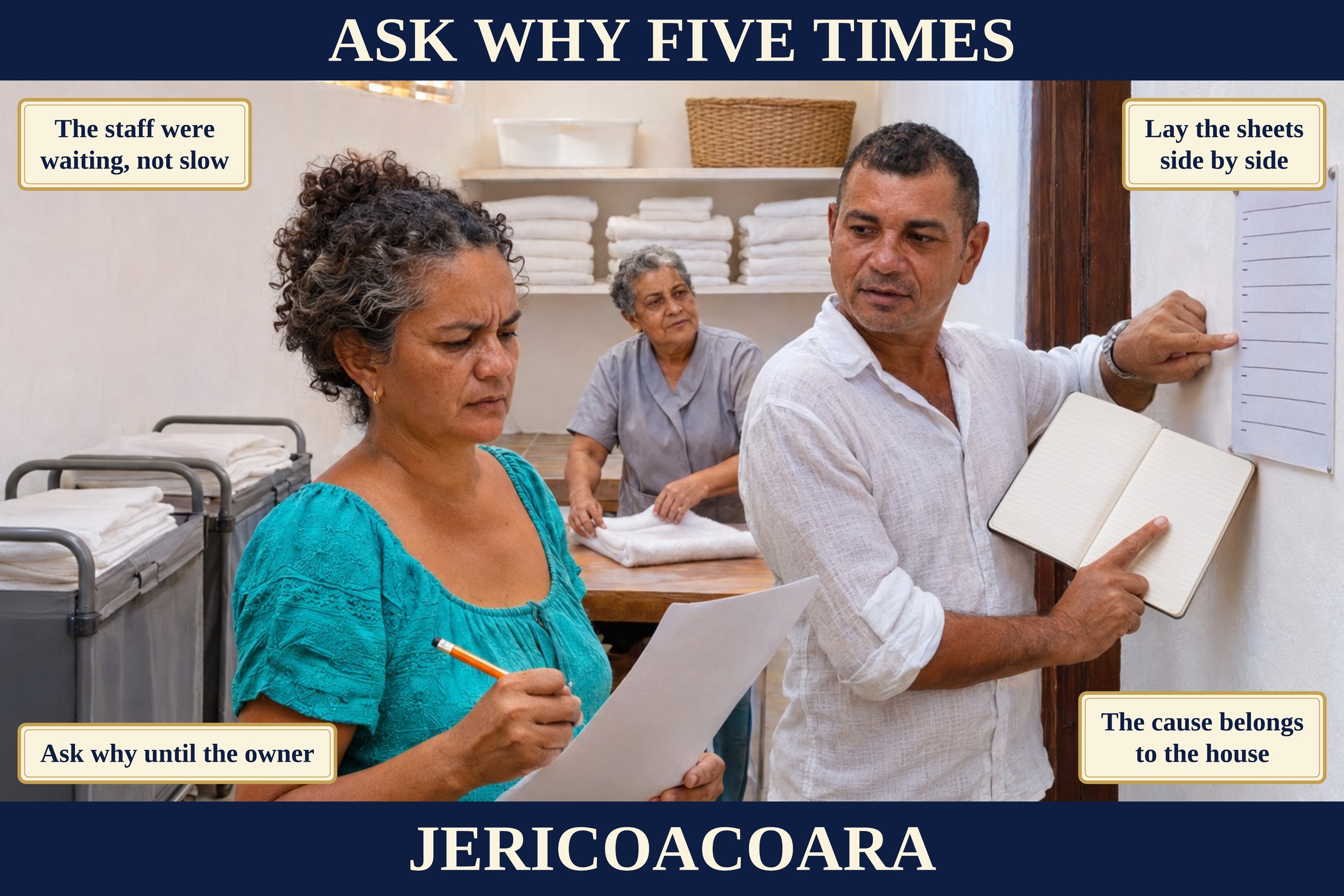
Concept Card 3.11 — Ask Why Five Times
Subchapter 3.11 · Jericoacoara, Brazil
Setting: Jericoacoara, Brazil
The small laundry room behind the kitchen of a whitewashed pousada in Jericoacoara, on a Saturday at the end of September, in bright light from a high vent: white walls, shelves of folded towels, two packed trolleys. Rafael Moura, the visiting auditor, in a white linen shirt, holds his open notebook against the wall, one finger on it and one on the routine sheet pinned beside it. Lúcia Bezerra, the owner, frowns over a sheet, pencil ready. Behind them the elder room attendant folds a towel and listens.
The pinned sheet is the house's routine; its third point says departure rooms are entered only after the owner releases them. The notebook beside it holds the morning in times: rooms released at five past eleven, three women waiting with their trolleys packed. Laid side by side, the two explain what three earlier action sheets had not. The blank back of the departure list in Lúcia's hand is where the chain of questions will be written, by the house.
The four plaques read as one argument. The staff were waiting, not slow: of a good seven hours worked that morning, much went on waiting for a release. Lay the sheets side by side, routine, notebook and the three old nonconformities, and a pattern appears that no single sheet shows. Ask why until the owner, because in a house without departments the chain often ends there. And the cause belongs to the house, which writes it down itself.
The plate does not accuse the room attendants, who obeyed a rule, nor Lúcia, whose rule had a good reason and prevented a second incident for three years, nor the helper hired in July. What it shows is that a trait of a person is not a cause anyone can work with. After two questions one reaches the room attendants; after five, the owner, and only there can the routine be changed.
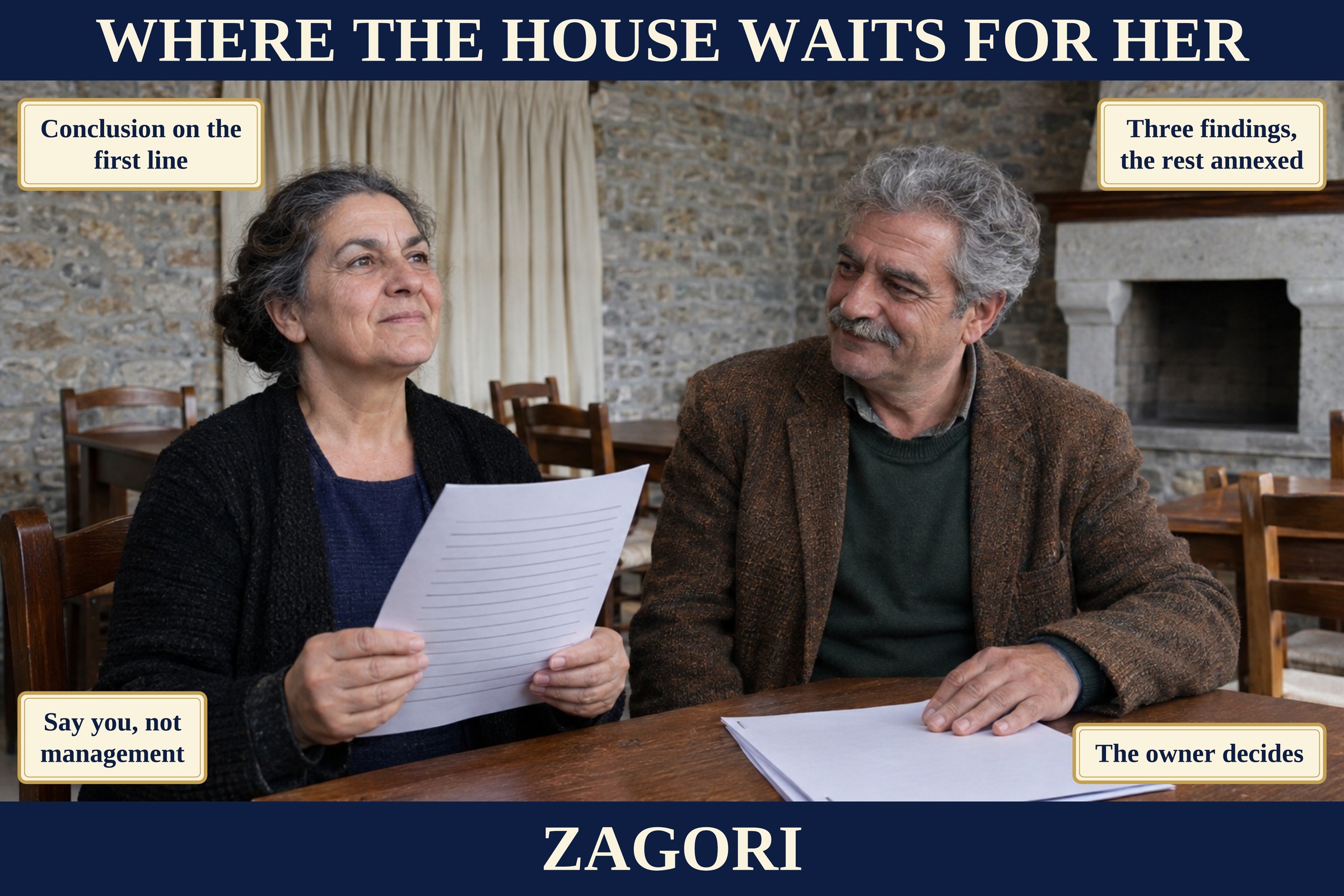
Concept Card 3.12 — Where the House Waits for Her
Subchapter 3.12 · Zagori, Greece
Setting: Zagori, Greece
The dining room of a closed stone guesthouse in Kipoi, one of the villages of Zagori, at eight on a November morning, in cool grey light behind heavy cream curtains: stone walls, dark tables, a cold stone fireplace. Eleni Tsoumani, the owner, in a black cardigan over dark blue, holds a single page in both hands, having read it twice, and looks up with the clear face of a decision taken. Beside her Kostas Ntinas, a neighbouring host and her auditor, rests a hand on three stapled pages and smiles.
Two reports share the table. The three stapled pages hold eleven accurate findings in the order of the auditor's walk, the most important at the back, softened into the conditional and addressed to management. The single page in Eleni's hands opens with a conclusion, gives three findings with their consequences, and ends with one question and a date. The thicker report is pushed aside; the thinner one is the one being acted on.
The four plaques read as one argument. Put the conclusion on the first line, so the owner knows what holds before she meets what does not. Three findings, the rest annexed, ordered by significance rather than by the walk. Say you, not management, where the owner's role is itself the step in the routine that waits. And the owner decides: the auditor writes the question, not the answer, because he is not a consultant.
The plate does not accuse Kostas, whose softness came from respect, nor Eleni, who read the first report exactly as it was written; all eleven findings were true. What it shows is that a report serves a decision, and that a reader who is both the one audited and the one who decides needs the facts first and the question last. By half past nine the seasonal cook had his answer.
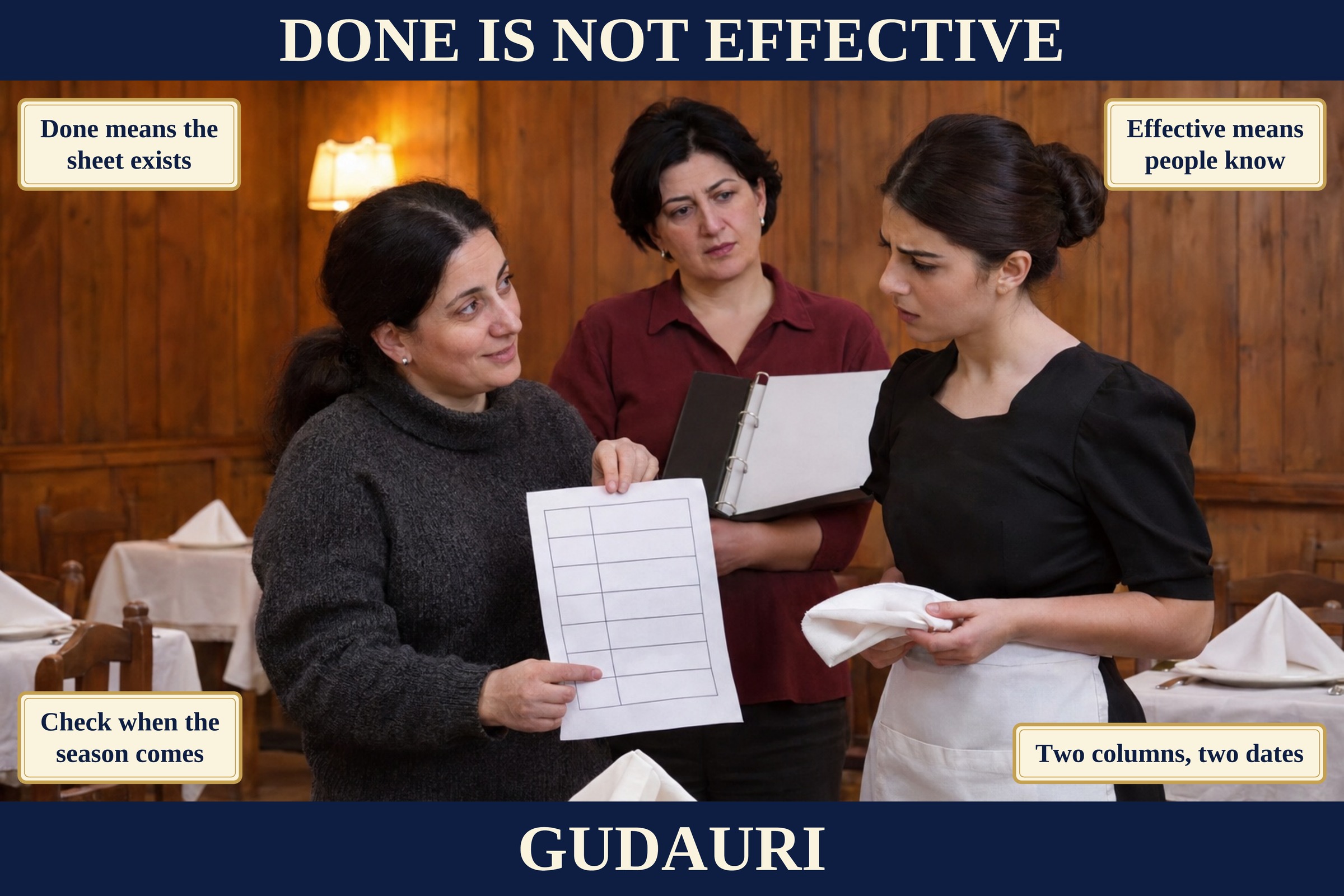
Concept Card 3.13 — Done Is Not Effective
Subchapter 3.13 · Gudauri, Georgia
Setting: Gudauri, Georgia
The panelled dining room of a small hotel in Gudauri at five on a December afternoon, before evening service, in warm lamplight: dark honey-coloured wood, tables laid with white cloths and folded napkins. Tamar Kapanadze, the visiting auditor, in a charcoal sweater, holds up a single ruled sheet and shows it kindly to a young waitress in black with a white apron, who holds a napkin and frowns at it as if for the first time. Behind them Nino Beridze, the co-owner, holds an open ring folder and listens.
The sheet is the induction sheet for new seasonal staff, written in May in three languages and marked done on the action list in Nino's folder. The waitress joined on 12 December, after the introduction day, and nobody gave it to her. The composition sets the paper between the auditor and the person it was written for, with the folder and its column of done just behind: the action exists, and it has not arrived.
The four plaques read as one argument. Done means the sheet exists, in the folder, punched and signed. Effective means people know: where the allergen list is, whom to call at night, where to assemble. Check when the season comes, because people arriving in December cannot be tested in May; the follow-up belongs in the first weeks of the season. And keep two columns, two dates, implemented and effective, each with a name.
The plate does not accuse Nino, whose sheet was good and worked for the room attendant who received it, nor the waitress, who missed nothing because nothing reached her. It shows that the cause lay not in the text but in its trigger, now changed: the sheet goes out with the contract and is handed over on each first working day. Done means the sheet exists; effective means the waitress knows by her third evening.
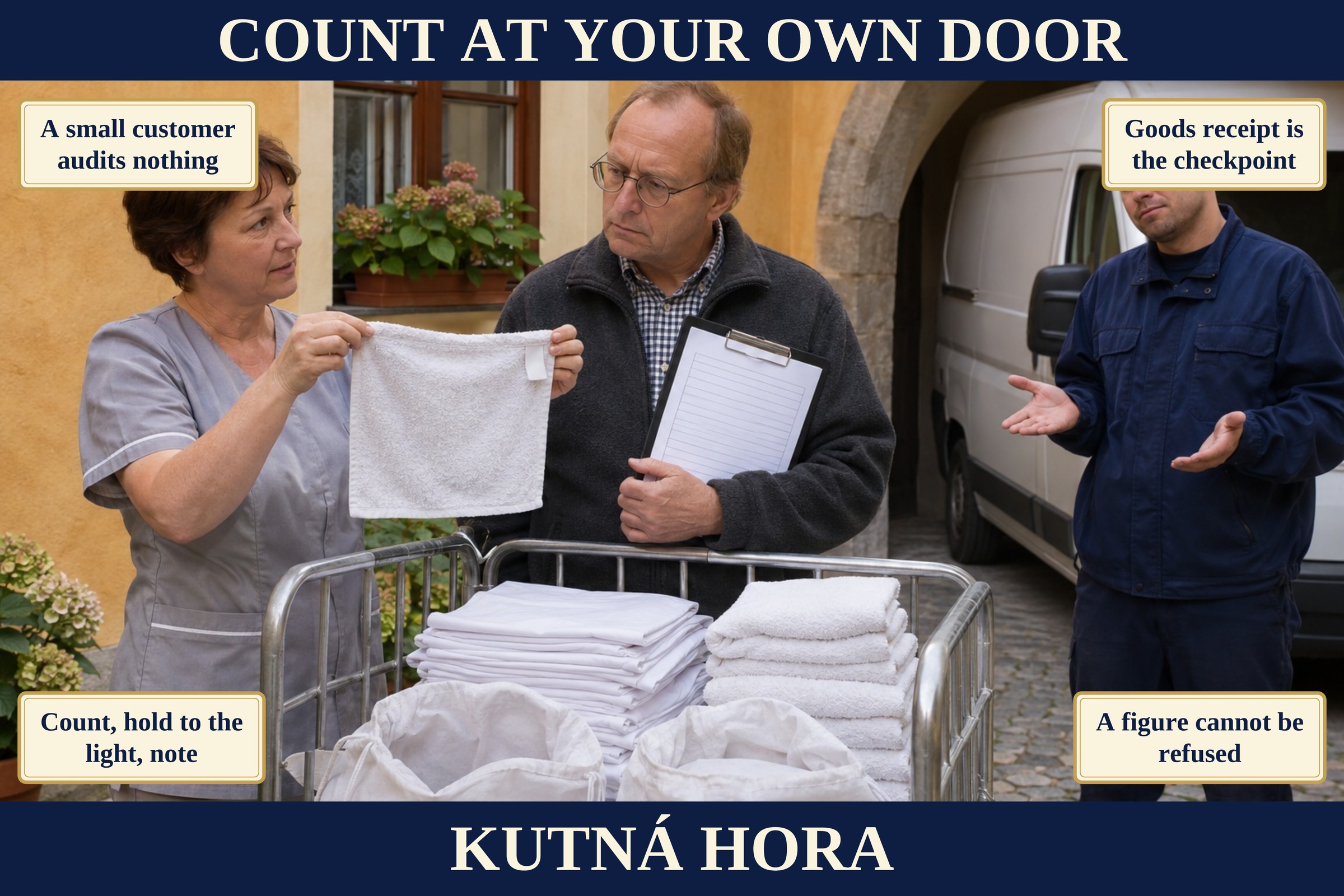
Concept Card 3.14 — Count at Your Own Door
Subchapter 3.14 · Kutná Hora, Czech Republic
Setting: Kutná Hora, Czech Republic
The small cobbled courtyard of a burgher house pension in Kutná Hora, shortly after seven on an October morning, in cool daylight: ochre walls, flowers at a window, a white van half inside the arched gateway. Beside a roll container of linen Jana Horáková, the housekeeper, in a grey tunic, holds up a small white face cloth with a sewn-in label. Tomáš Novák, the owner, clasps a clipboard to his chest and stares at it. By the van, the driver shrugs with open hands.
The face cloth is not the pension's; its label belongs to a care home elsewhere in the large laundry's round. On the clipboard lies the laundry's reply: audits on its premises are offered only above a certain volume. The composition sets the two things against each other. The letter says the small customer cannot look inside; the cloth, held up at his own gate, shows what he can see anyway, alongside four missing pillowcases and a stained sheet.
The four plaques read as one argument. A small customer audits nothing at a supplier with two hundred customers, and need not try. Goods receipt is the checkpoint, ten minutes per delivery, the only moment the house sees the service before the guest does. Count, hold to the light, note, one line per deviation in the folder. A figure cannot be refused: nine lines on the table are a language even a large laundry understands.
The plate does not accuse the laundry, whose reply was honest and offered documents Tomáš had not yet used, nor the driver, who carries linen and does not wash it, nor Tomáš, who followed a checklist written for large buyers. It shows that control without power is still control. A large supplier will not let a small customer audit it, but it cannot avoid a figure counted at the customer's own door.
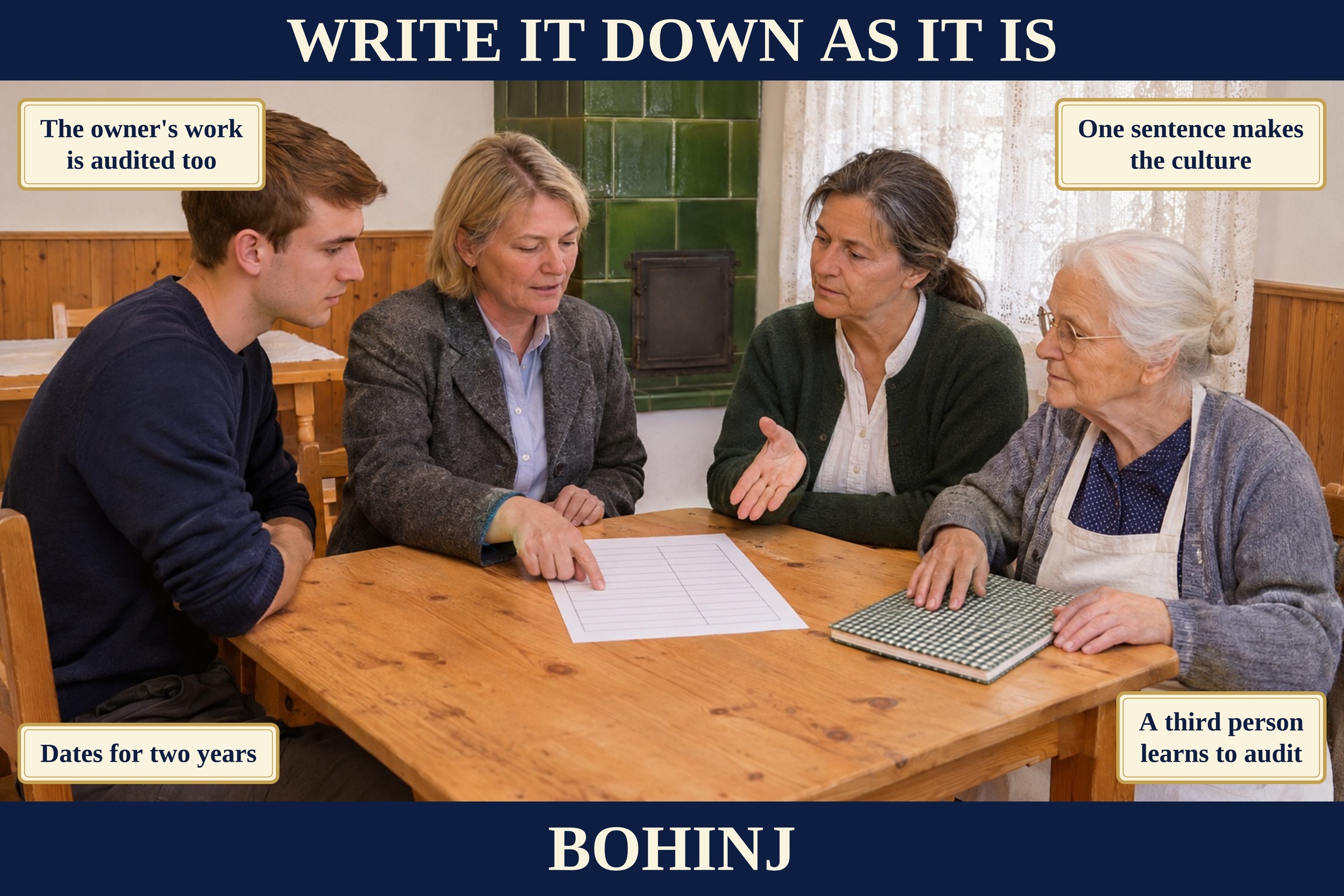
Concept Card 3.15 — Write It Down as It Is
Subchapter 3.15 · Bohinj, Slovenia
Setting: Bohinj, Slovenia
The breakfast room of the Kovač guesthouse in Ribčev Laz on a September afternoon, the family table in warm light before drawn lace curtains, the green tiled stove cold behind. Nevenka Rozman, the cross-auditor from Jezersko, in a grey wool jacket, rests a finger on a single ruled sheet and reads. Beside her Maja, the owner, looks at the sheet with one open hand raised, accepting. Ana sits with both hands on her checked notebook; Luka, on the other side, listens closely.
The single page at the centre is the report, and Nevenka has reached its third finding: the review of the list of legal duties, set for February with Maja's own name beside it, never took place. This finding concerns the owner. Ana's notebook lies on the table too; with it she ran reception in August, while the deputy sheet still named Luka. The open hand is the gesture the whole chapter has been working towards.
The four plaques read as one argument. The owner's work is audited too, and her review is a line like any other. One sentence makes the culture: when Maja says write it down as it is, son, mother and staff learn that a finding here is information, not an accusation. Dates for two years give auditing a fixed place in the calendar of both houses. And a third person learns to audit: Luka audits in Jezersko, never at home.
The plate does not accuse Maja, whose review was crowded out by the fullest weeks of winter, nor Nevenka, who hesitated over the finding out of courtesy to a colleague, nor Ana, whose memory carried the August days. It shows the habit two cross-audits have built around one kitchen table. Whether a small house has an audit culture is decided by one sentence: the one the owner says when the finding concerns her.
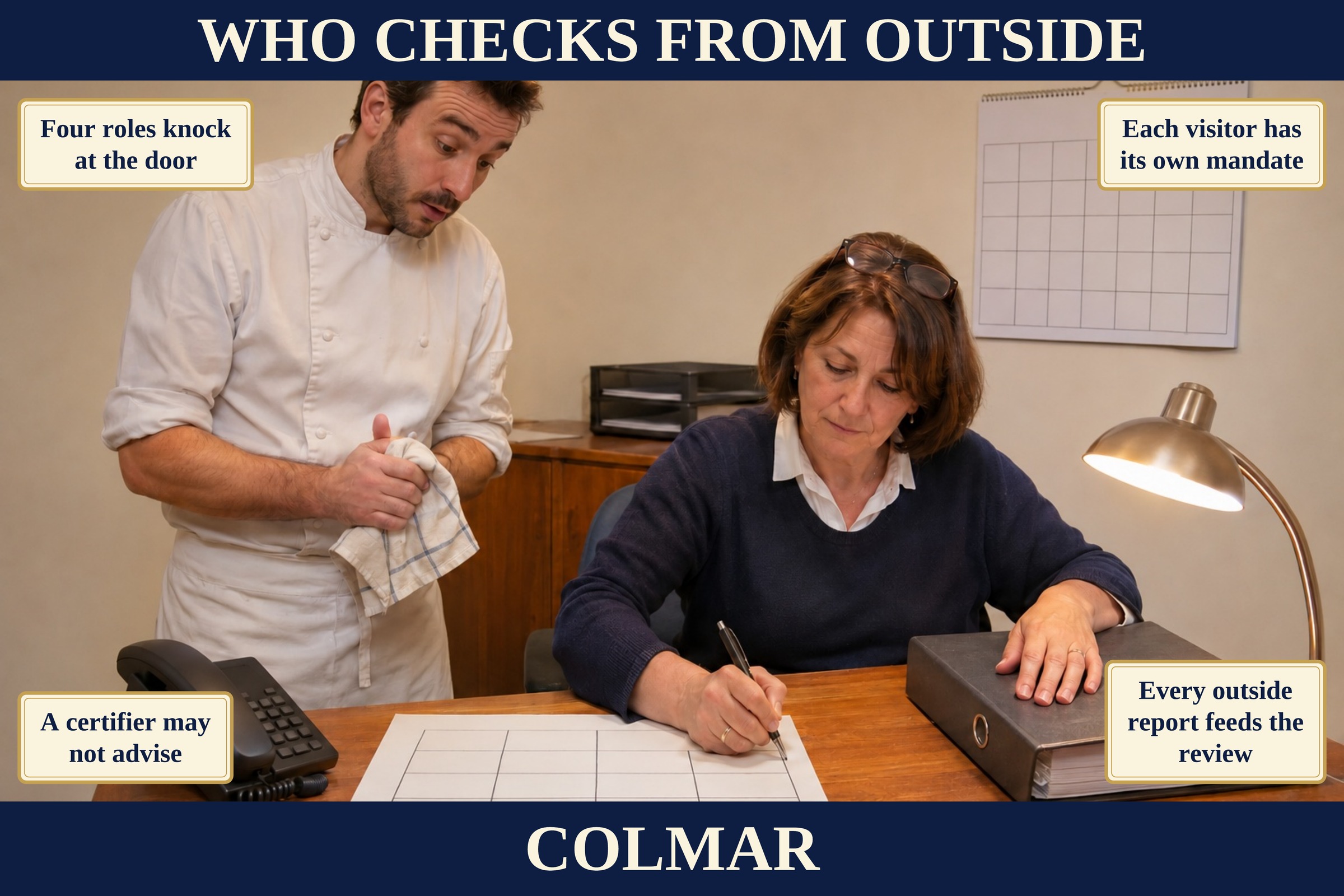
Concept Card 4.1 — Who Checks from Outside
Subchapter 4.1 · Colmar, France
Setting: Colmar, France
The small office behind reception of a family hotel on the edge of the old town of Colmar, on the last Monday in February, the day the restaurant is closed: cream walls, a desk lamp, a telephone and a wall calendar with empty squares. Hélène Marchal, the owner, glasses pushed up into her hair, draws the lines of a large grid in pen, her left hand flat on a thick grey binder. Julien, the chef, still in his apron, dries his hands and leans in, puzzled.
The composition sets two objects side by side. Under her left hand lies the single folder she had prepared for every visitor of the spring; under her pen grows the sheet that will replace it, four columns asking who comes, by what right, against which criteria and with what consequence. The empty calendar on the wall holds six appointments still to come. The chef's question stands at the centre of the scene: which of the six can actually tell the house what to do?
The four plaques read as one argument. Four roles knock at the door: the authority, the classifier, the label holder and the certifier. Each visitor has its own mandate, and a house that prepares for all of them with one folder prepares for none. A certifier may not advise, a rule that protects the house rather than obstructing it. And every outside report feeds the review, so that what an outsider saw returns into the system instead of resting in a binder nobody reads.
The plate does not accuse Hélène, who built a working system without help and offered one folder because she had nothing to hide; nor the chef, whose question is the right one. What the image shows is an owner discovering that six visitors are not one. The lesson of the subchapter is plain: a small house prepares for each outside examiner with what belongs to that mandate, and brings everything they find back into its own management review.
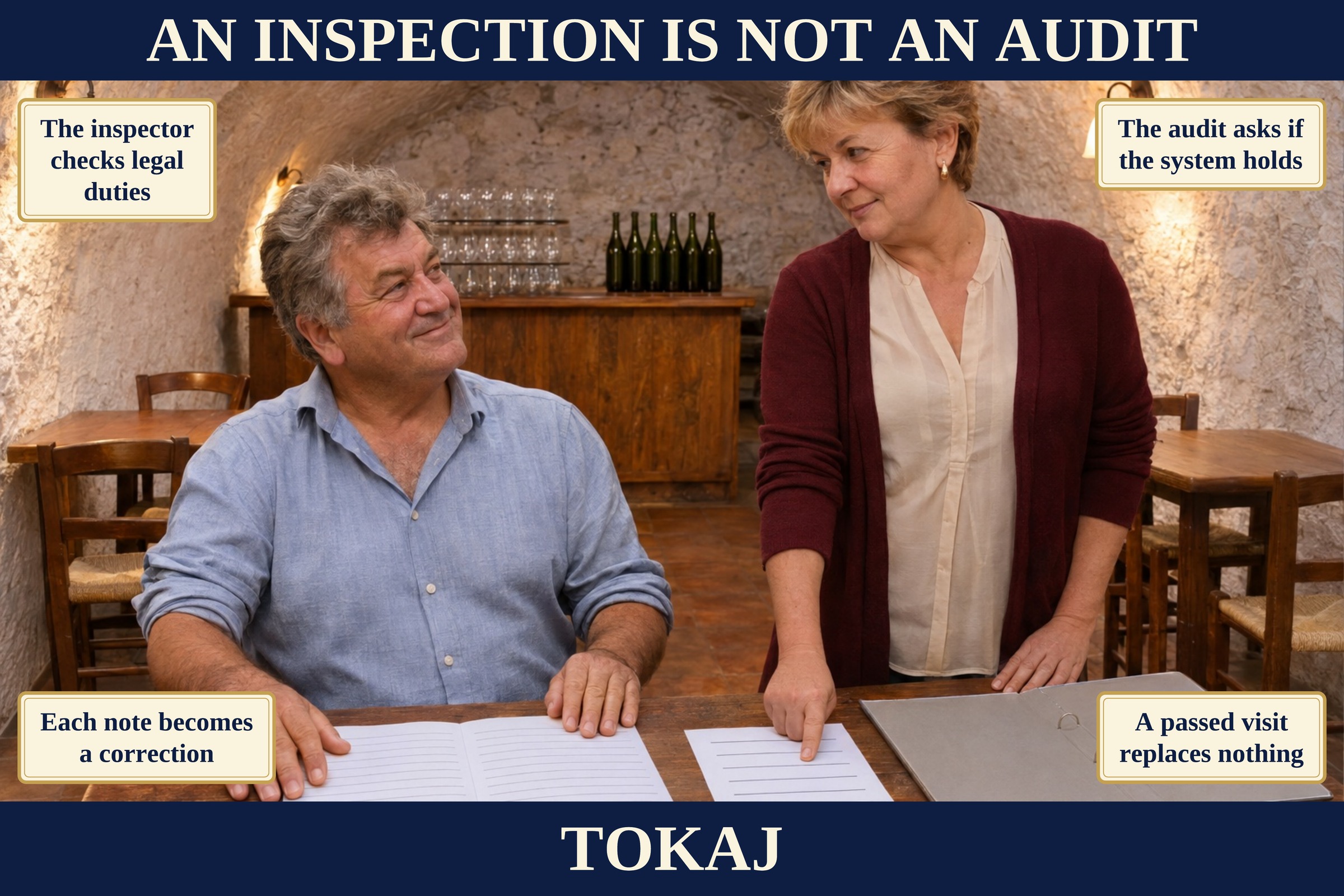
Concept Card 4.2 — An Inspection Is Not an Audit
Subchapter 4.2 · Tokaj, Hungary
Setting: Tokaj, Hungary
The small wine bar of the Szabó family guesthouse in Tokaj, at the end of a row of wine cellars cut into the hillside, on a June evening after closing: a vaulted ceiling of whitewashed stone, warm wall lamps, a wooden counter with stacked glasses and dark green unlabelled bottles. Gábor Szabó, the winemaker, sits with both hands on the inspector's two-page report and looks up, content. His wife Katalin stands beside him, a grey folder open at her elbow, and rests one finger on a short ruled sheet.
The two papers are the point of the composition. The report on the left is the food-safety inspector's: a good result for the kitchen on one morning. The sheet under Katalin's finger is the year's audit programme, eight lines, from breakfast and bar kitchen to the list of legal obligations. Her finger stops on the first line, the only one the inspector saw, and only half of it. Gábor's easy smile and her patient look carry the whole disagreement between them.
The four plaques read as one argument. The inspector checks legal duties: temperatures, dates on the spreads, allergen information, a notified change of room. The audit asks if the system holds, across the seven lines nobody from the authority looked at. Each note becomes a correction, with a cause and a record, and is written into the audit programme. And a passed visit replaces nothing: after a clean inspection the internal audit stays in the diary.
The plate does not accuse Gábor, who showed the inspector what the house does and arranged nothing for the visit; his sentence came from relief, not carelessness. Nor does it fault the inspector, who checked exactly what his mandate covers. What it shows is two examinations entering the same kitchen with different questions. The authority asks whether a house meets its duties; the audit asks whether its system holds, and the first answer never replaces the second.
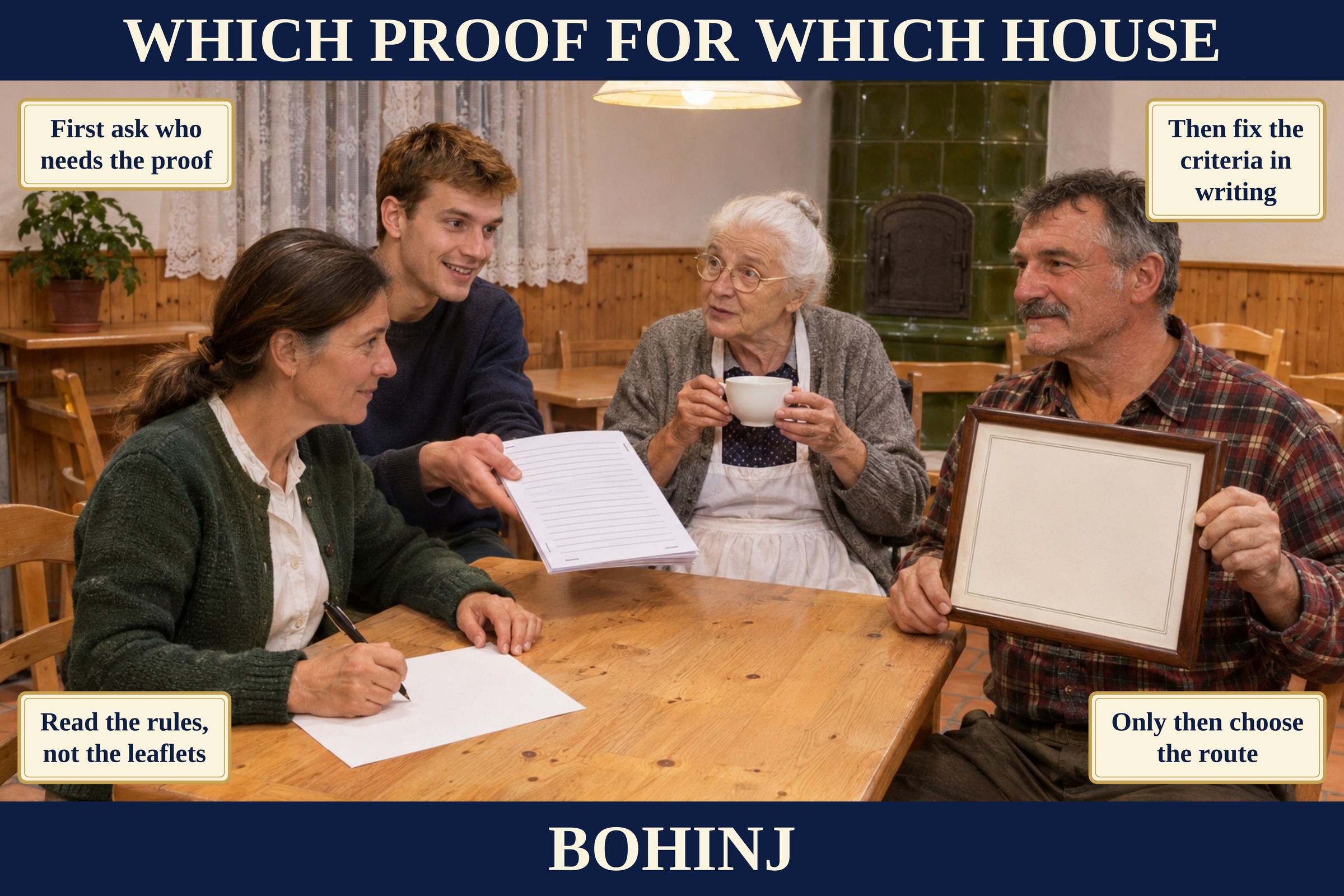
Concept Card 4.3 — Which Proof for Which House
Subchapter 4.3 · Bohinj, Slovenia
Setting: Bohinj, Slovenia
The breakfast room of the Kovač family guesthouse in Ribčev Laz, on a closed evening in November under a hanging lamp: white walls, pine panelling, lace curtains drawn, a green tiled stove cold in the corner. Four people sit at the family table. Maja holds a pen over a blank page; her son Luka holds out his stapled printed pages; her husband Tomaž raises the star classification certificate in its dark wooden frame; and Ana, the grandmother, holds her cup of tea with both hands and asks her question.
Each figure offers a route. Luka brings his pages on the GSTC route and wants a certificate everyone understands; Tomaž holds up the stars, checked on site by an assessor. Two more routes, the EU Ecolabel and an ISO 14001 certificate, had reached the table in the same weeks. At the centre, though, is the blank page under Maja's pen. On the back of the operator's letter she writes not a route but a question: who needs the proof, and for what?
The four plaques read as one argument, and as the order of the evening. First ask who needs the proof: the Dutch walking-tour operator, whose letter asks for proof from an independent body without naming one. Then fix the criteria in writing, five lines on the back of that letter. Read the rules, not the leaflets, because an underlined sentence about light audits was shorter than the rule behind it. Only then choose the route, and Maja set that decision for March.
The plate accuses nobody at the table. Luka's certificate is a good proof, Tomaž's stars were honestly earned, and the underlined sentence was not wrong, only incomplete. Ana's question, whether the guests notice, was the most precise of the evening, and Maja's answer held both halves: the guests notice the house, the operator notices the certificate. The lesson is the order itself: the question first, the criteria second, the route last.
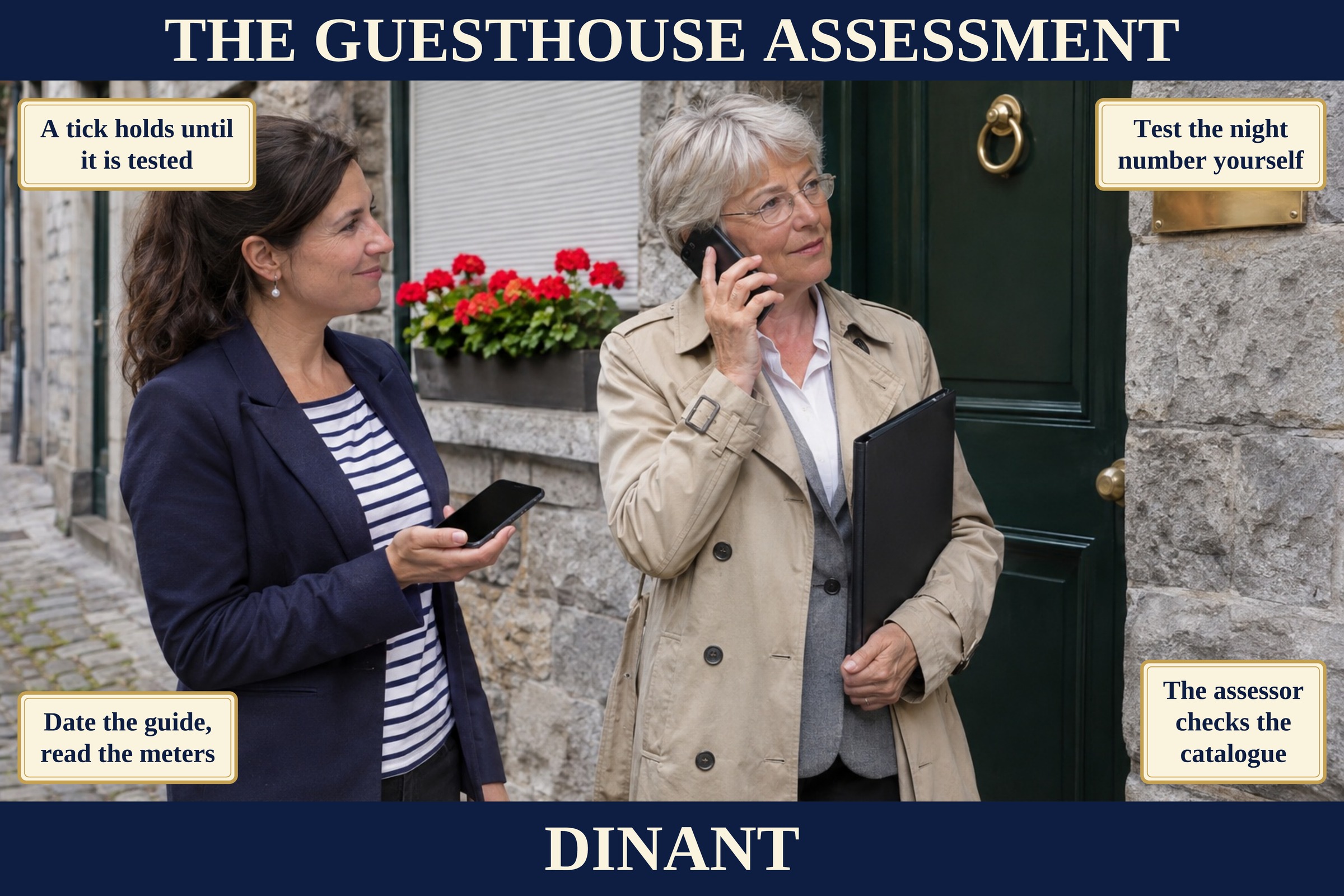
Concept Card 4.4 — The Guesthouse Assessment
Subchapter 4.4 · Dinant, Belgium
Setting: Dinant, Belgium
A cobbled lane in Dinant on a mild morning at the end of April, before a narrow grey stone house: a dark green door with a brass knocker, red geraniums, a closed blind, and on the stone beside the door a small brass plate. The classification assessor, in a beige trench coat with a dark folder under her arm, holds a mobile phone to her ear. Beside her Céline Dumont, the owner, holds her own phone in her open hand and smiles.
The composition joins the two phones by an invisible line. The assessor has dialled the number on the brass plate; inside, the desk telephone rings twice, and then the call arrives in Céline's hand, because the line now passes to her mobile. In February the same number had rung six times into an answering machine while she stood in this lane at eleven at night. Her quiet smile is not triumph but relief: the route she built has just been tested by someone else.
The four plaques read as one argument. A tick holds until it is tested: Céline's self-assessment said she was reachable, and the lane at night proved otherwise. Test the night number yourself, before the assessor and long before a guest. Date the guide, read the meters: the two other gaps were routines, not furniture, and no purchase closed them. And the assessor checks the catalogue, line by line, in a category where every classified guesthouse meets every line.
The plate does not accuse Céline of a false answer. She is reachable, she ticked from honest experience, and she was the one who walked out at eleven to test her own word. Nor does it present the assessment as an ordeal. It shows a host for whom the classification became an examination she had already passed in private. The lesson: a tick on a self-assessment is true only until someone tests it, and a small house tests it first.
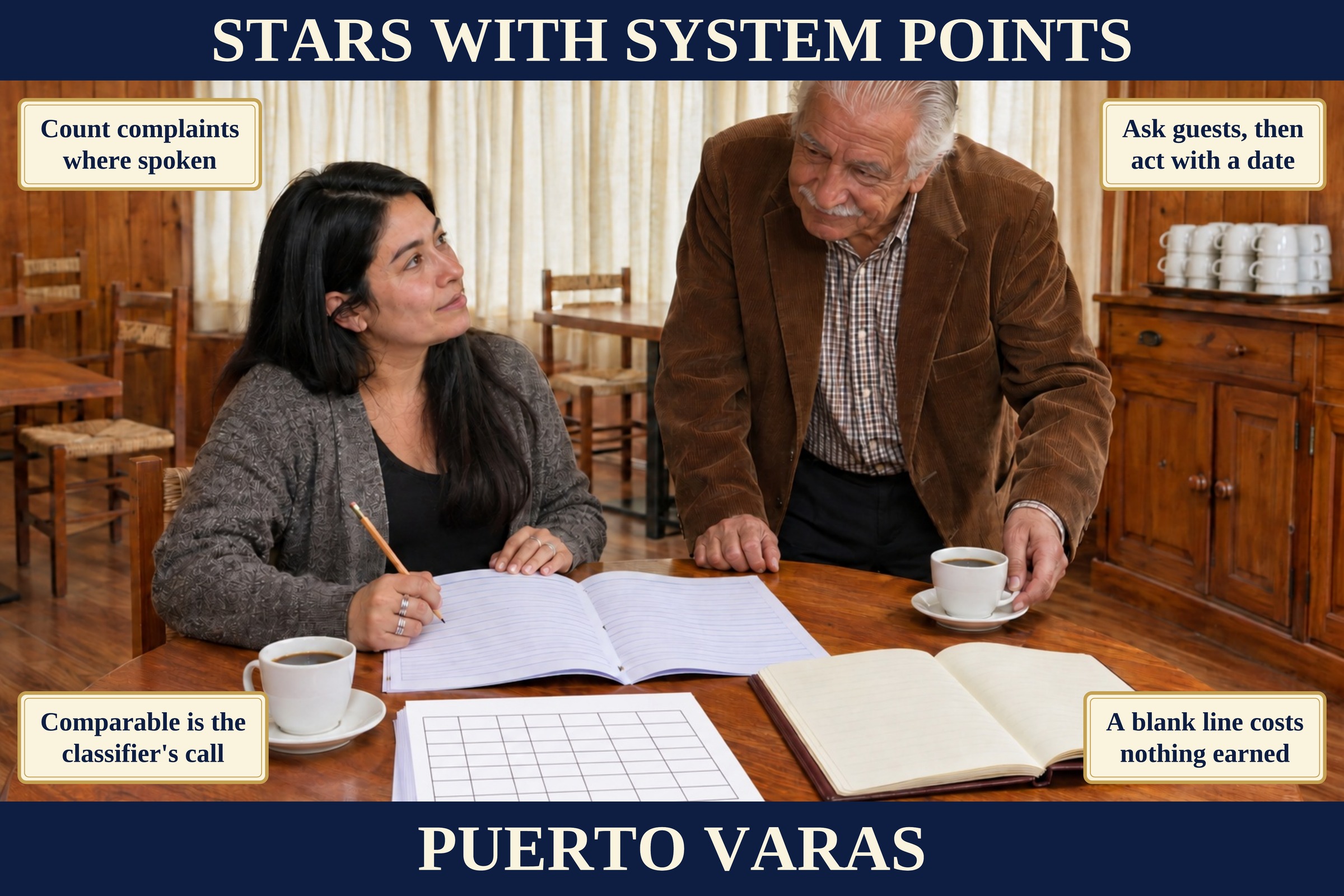
Concept Card 4.5 — Stars with System Points
Subchapter 4.5 · Puerto Varas, Chile
Setting: Puerto Varas, Chile
The breakfast room of a narrow timber guesthouse in Puerto Varas on a September morning after the last breakfast: honey-coloured board walls, cream curtains drawn over the window, cleared tables, a sideboard with stacked cups. Camila Soto, the owner, sits with a pencil over the open criteria catalogue of her star scheme, a stack of gridded monthly sheets and the bound complaints book beside it. Her father Hernán, back with the coffee, leans on the table and reads the margin with a knowing look.
Three papers lie in front of her, and they disagree. The complaints book holds four entries for a whole year; the fourteen monthly sheets hold fifty-seven complaints counted at breakfast and on the floors. The catalogue offers ten points for a quality management system or a comparable one, and in its margin Camila has pencilled a question. Her father's advice is the hinge of the scene: comparable is a stretchy word. Her reply turns it round: stretchy for whom?
The four plaques read as one argument. Count complaints where spoken, at the breakfast table and in the corridors, not only in a book at reception. Ask guests, then act with a date, so that every evaluation names a response. Comparable is the classifier's call, not the owner's, because a monthly sheet is good measurement but not yet a system with policy, objectives, internal audit and review. And a blank line costs nothing earned: an unclaimed item takes away nothing the house can prove.
The plate does not accuse Hernán, whose advice came from thirty years of classifications in which nobody asked what a system was, nor Camila, who had counted more than most small houses ever do. It shows the moment an owner chooses to claim only what she can prove. She left the quality item blank and kept her three stars, further above the minimum. A star catalogue counts elements; a system begins when someone looks at them together and decides.
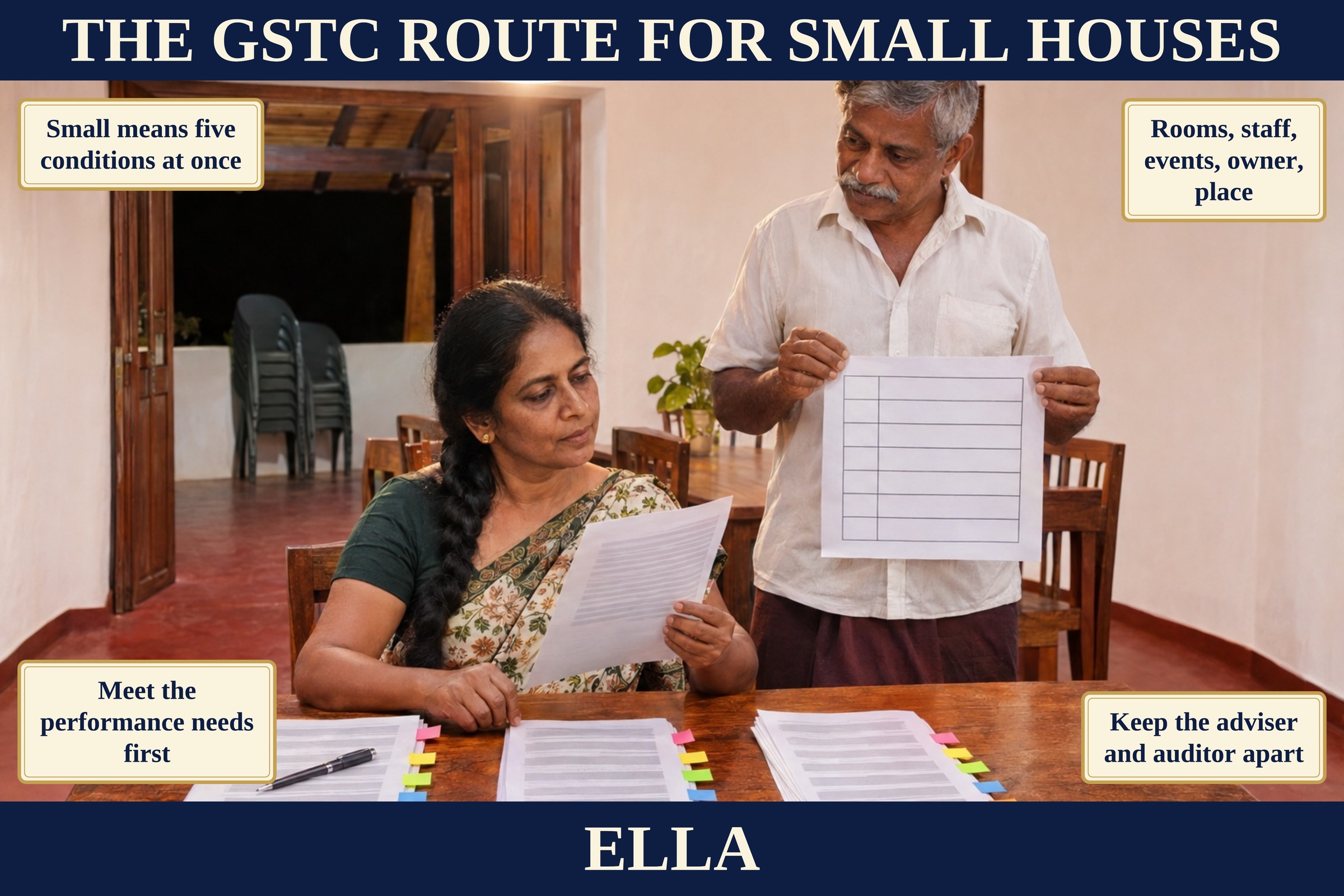
Concept Card 4.6 — The GSTC Route for Small Houses
Subchapter 4.6 · Ella, Sri Lanka
Setting: Ella, Sri Lanka
The dining room of a twelve-room guesthouse outside Ella, on an evening in late May under warm light: white walls, a red polished floor, wooden tables, and through an open door a covered terrace with plastic chairs stacked against a low wall. Nirmala Perera, the owner, in a green blouse and a printed sari, reads a single page taken from three stacks of documents marked with coloured slips, her pen laid on the table. Her husband stands beside her, holding up a ruled staff rota.
The composition places the decision between two objects. On the table lie the GSTC Hotel Standard, the Accreditation Manual and the list of accredited bodies, read over three evenings. In her husband's hands is the rota from the kitchen wall, with seven names for December; behind him, the stacked chairs of the terrace where families hold engagement parties several times a year. Neither is a fault. Both are facts that place the house outside the lightest risk category.
The four plaques read as one argument. Small means five conditions at once, as the annex of the Accreditation Manual sets out. Rooms, staff, events, owner, place: twenty rooms or fewer and five staff or fewer, no functions, local ownership outside any multi-site group, no sensitive location, and internet for remote audits. Meet the performance needs first, because the certifier audits the indicators. And keep the adviser and auditor apart, so that whoever helps the house never examines it.
The plate does not accuse the neighbour across the road, who described his own route correctly for four rooms, three people and no parties. Nor does it suggest that Nirmala's house is less deserving; her route is simply longer, with a day and a half on site while the house is full. The lesson of the subchapter is that the relief in the system is real, but it follows five facts about a house, not the feeling of being small.
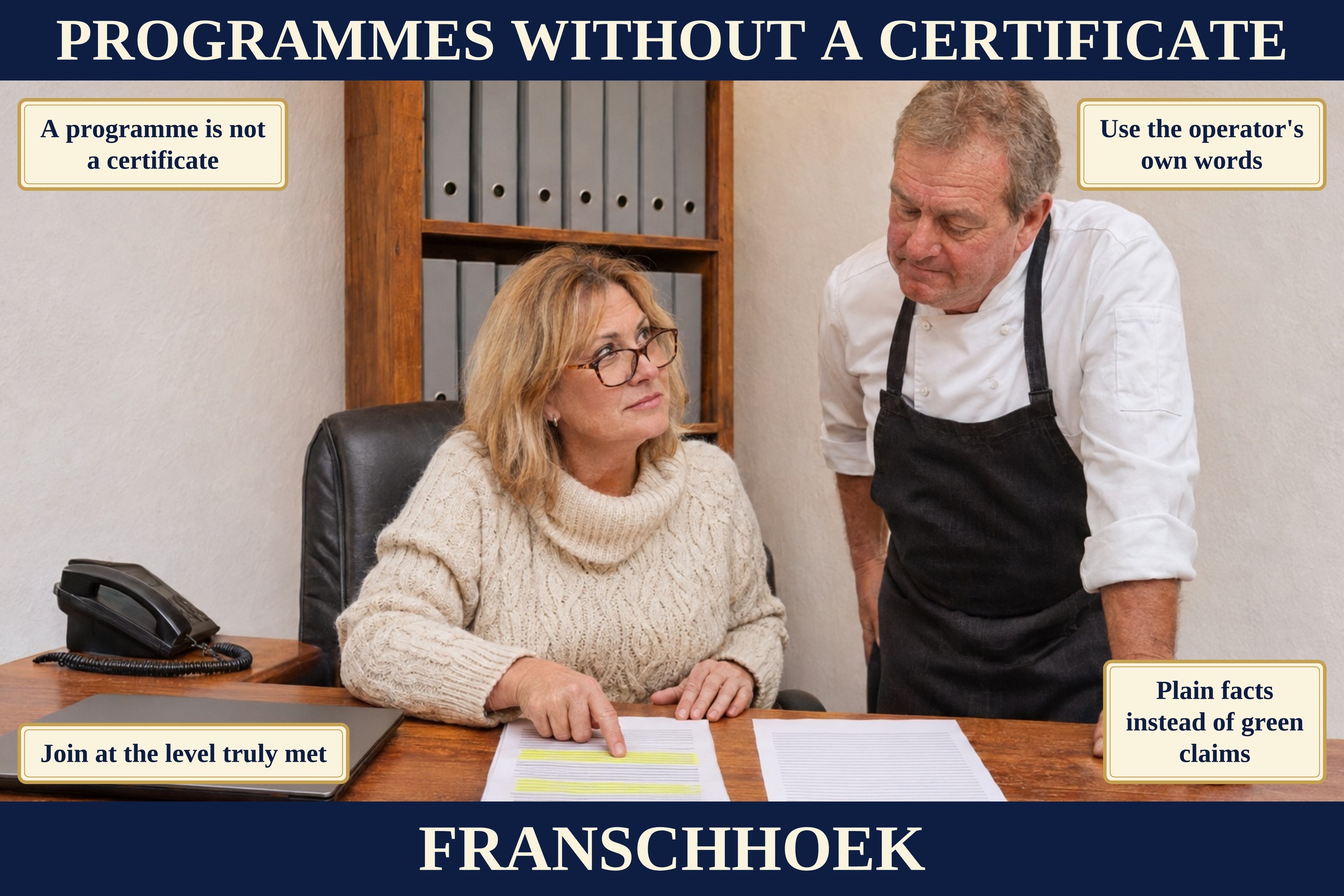
Concept Card 4.7 — Programmes Without a Certificate
Subchapter 4.7 · Franschhoek, South Africa
Setting: Franschhoek, South Africa
The office behind reception of a whitewashed country hotel in Franschhoek, on a cool June morning in winter: pale walls, a wooden shelf of grey binders, a closed laptop and a desk telephone. Marisa Fourie, in a cream cable-knit jumper and reading glasses, sits at the desk with her forefinger on a document marked with yellow highlighter, a plain printed sheet beside it. Her husband Riaan, the chef, in white jacket and dark apron, stands at her side and looks down at the papers.
Two papers lie side by side, and the distance between them is the subject. The plain sheet is Riaan's draft for a corporate client: certified at Level 2, a copy to follow. The highlighted pages are the programme's own rules, with three passages marked: what Level 2 requires, who checks, and the operator's statement that the programme is not a certification scheme. Marisa's sentence decides the morning: the house cannot write what the programme does not say about itself.
The four plaques read as one argument. A programme is not a certificate, and the word certified belongs only where a certification took place. Use the operator's own words when a client asks. Join at the level truly met, which for this house was Level 1, with Level 2 set as an objective with a date. And plain facts instead of green claims: electricity per month, produce from the valley, the solar water heating, with the evidence in the file.
The plate does not accuse Riaan, who used the word the buyer had used and wanted the client to see the work the house had genuinely done. Nor does it belittle the programme, which describes itself honestly. It shows a reply being corrected before it is sent; the buyer accepted a certificate field reading none, with the figures beneath it. A logo does not say who checked; the house must say it, in the words the operator itself uses.
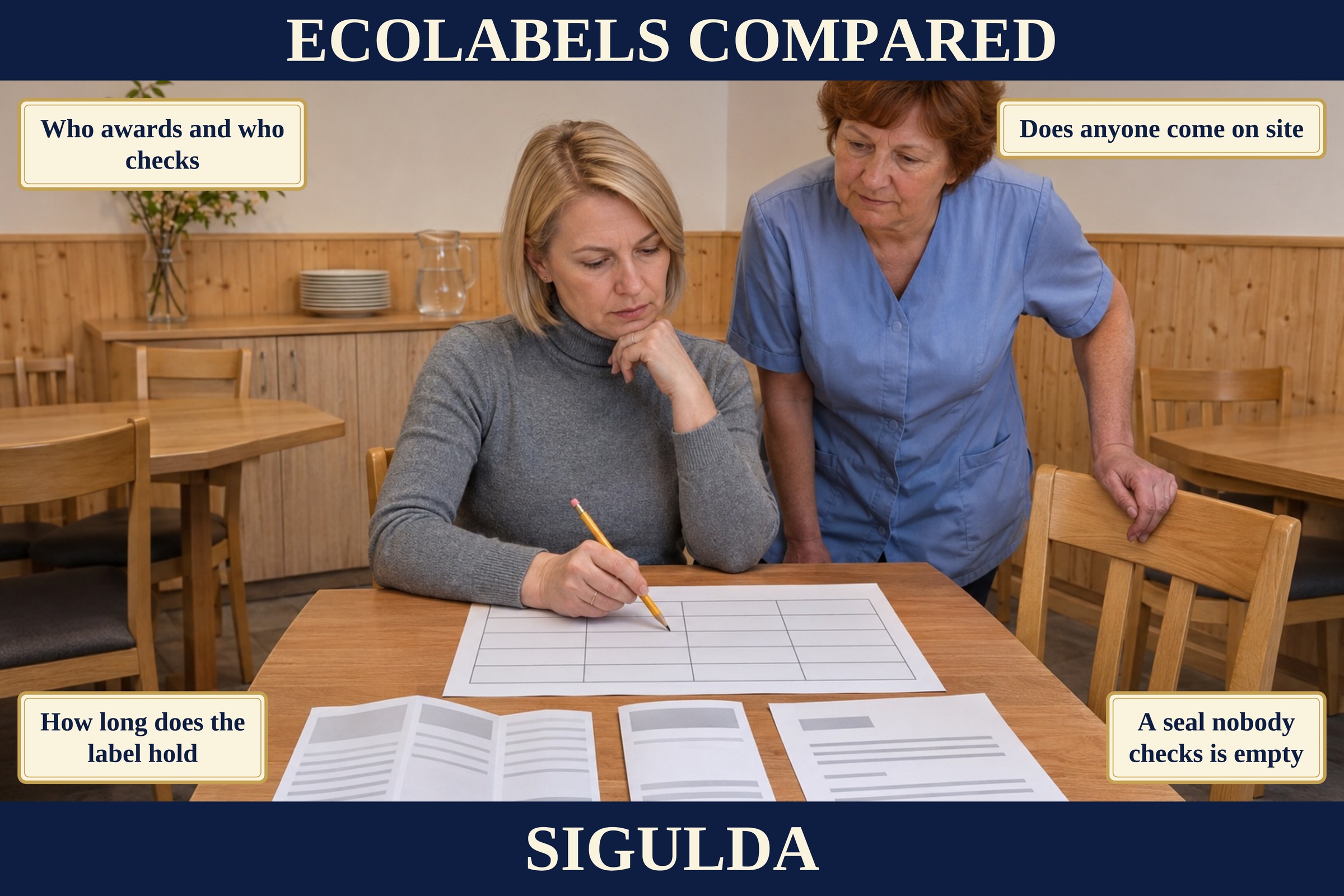
Concept Card 4.8 — Ecolabels Compared
Subchapter 4.8 · Sigulda, Latvia
Setting: Sigulda, Latvia
The breakfast room of an eighteen-room guesthouse on the edge of Sigulda, on a quiet afternoon in mid-April after the ski season: pine panelling, cleared pine tables, a sideboard with a stack of plates and a glass water jug, a few branches in a vase. Ilze Kalniņa, the owner, sits with her chin on her hand and a pencil over a large sheet ruled in four columns. Before it lie a leaflet, a slim brochure and a printed email. The housekeeper leans on a chair beside her and watches.
The three documents at the front are three offers that all use the same word. The leaflet describes the EU Ecolabel, with mandatory criteria and an on-site check by the competent body; the brochure describes an association label with an independent auditor; the email offers a seal from forty online questions, available at once. Above them, the sheet of four columns turns sales language into five questions. The pencil hovers over the column where, after the first answer, little remains to write.
The four plaques read as one argument, and are four of the questions on Ilze's sheet. Who awards and who checks: the word verified meant three different things in three documents. Does anyone come on site, or does an automatic check read answers the house gives about itself? How long does the label hold, and what happens when its criteria are revised? And a seal nobody checks is empty, however low its fee and however confident its subject line.
The plate does not accuse the provider of the online seal, which answered her question at once and truthfully, nor the tour operator, which asked for nothing it could not justify. It shows an owner who refuses to choose by price or by adjective and asks instead what each label rests on. The lesson of the subchapter: a label is worth exactly as much as its verification, and who comes, what they check and how long it holds are never printed on the seal.
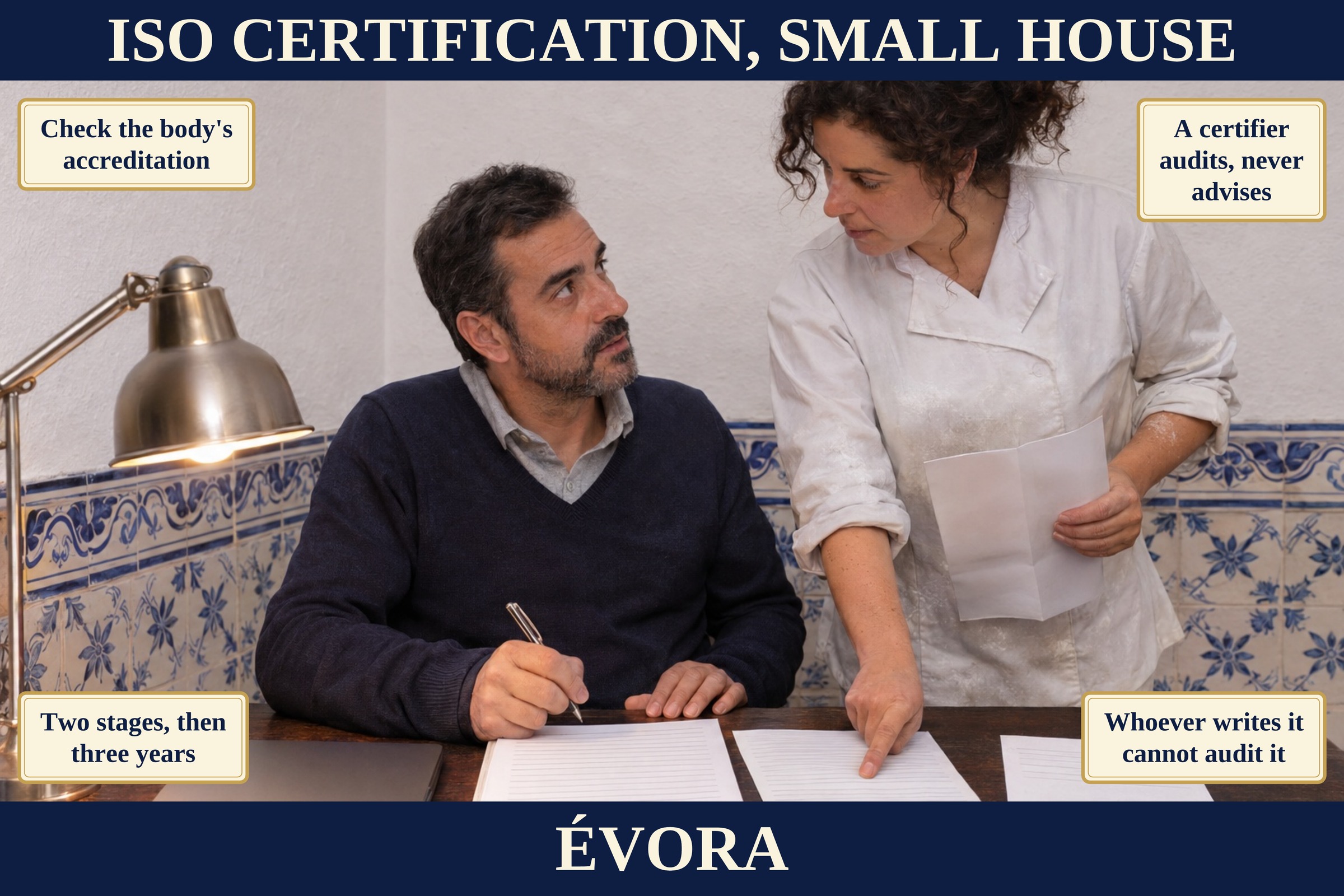
Concept Card 4.9 — ISO Certification, Small House
Subchapter 4.9 · Évora, Portugal
Setting: Évora, Portugal
The owner's office in an old townhouse hotel inside the walls of Évora, on a January morning: white walls above blue and white tiles, a desk lamp, a closed laptop. Nuno Carvalho, the owner, in a dark jumper, holds a pen above the papers on his desk and looks up, caught out. His sister Inês, who runs the family bakery next door, stands beside him in a white tunic dusted with flour, a folded invoice in one hand, her forefinger on one of the offers.
Two offers and a client's letter lie on the desk. The thin offer promises certification in ninety days and a preparation day on which the auditor will draw up the missing documents; the thicker one names its accreditation, two stages, two surveillance audits and a recertification, and no consultancy. Nuno's pen was close to the cheaper signature. Inês's finger rests on the decisive sentence, and her question carries the composition: who then audits what he wrote himself?
The four plaques read as one argument. Check the body's accreditation, its scope and the edition of the standard it certifies. A certifier audits, never advises: the rules that bind it forbid management-system consultancy. Two stages, then three years: certification is a contract with an initial audit, yearly surveillance and a recertification, and its fees and hours belong on three years, not one. Whoever writes it cannot audit it, because an auditor who builds the system examines only his own work.
The plate does not accuse the client, whose rule came down its own supply chain, nor the short offer, which sold openly what many small businesses want. Nor does it fault Nuno, who read two offers describing different things as if they were the same, with nobody to compare them for him until his sister came in with the bakery invoice. The lesson: a certificate is a three-year contract with someone who audits and never advises.
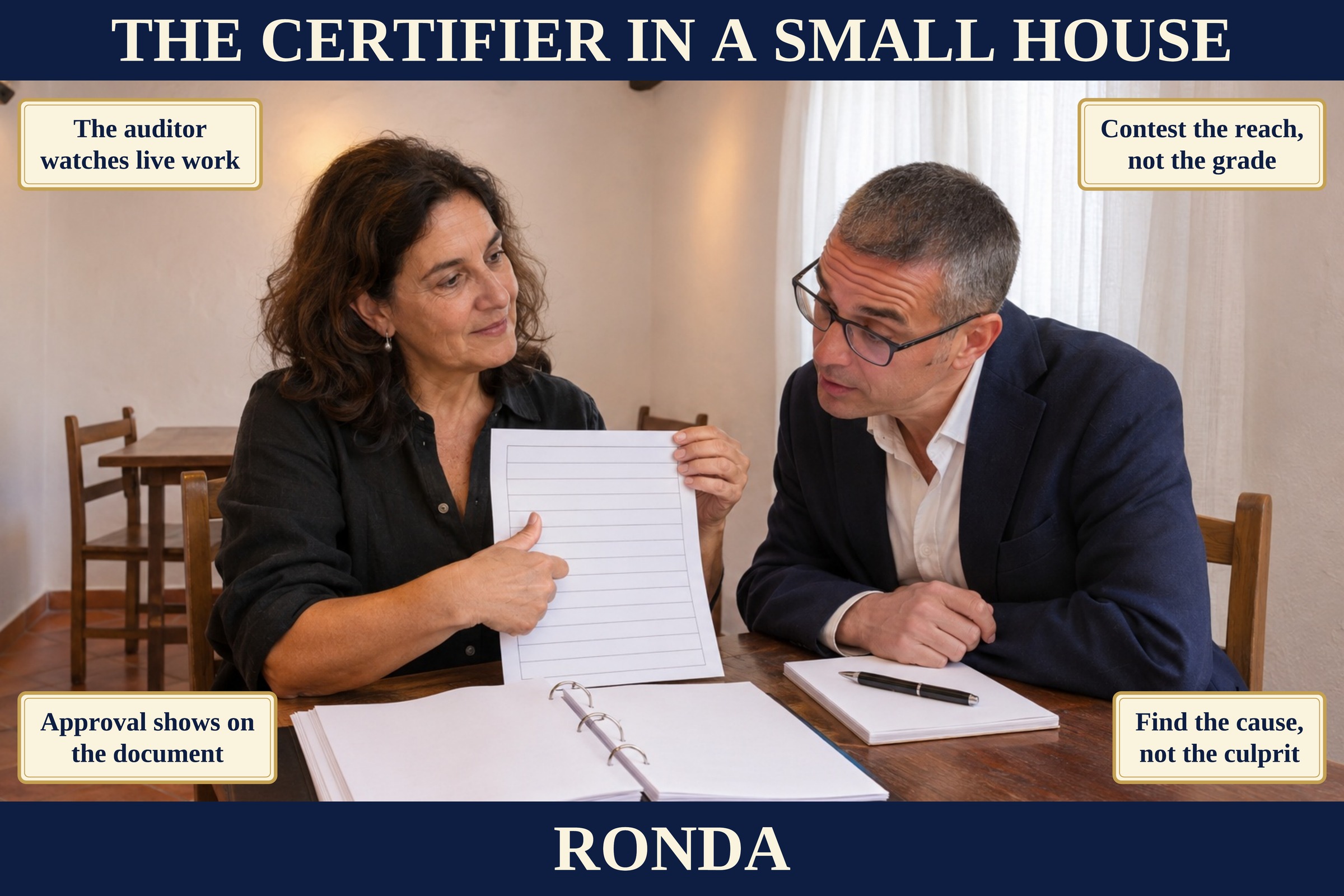
Concept Card 4.10 — The Certifier in a Small House
Subchapter 4.10 · Ronda, Spain
Setting: Ronda, Spain
The empty breakfast room on the first floor of a small hotel in Ronda, on a Thursday afternoon in mid-May: white walls, a white curtain drawn across the window, a terracotta floor. Pilar Márquez, the owner, holds up a ruled monthly sheet across the table and points to one line with her thumb. Beside her Tomás Aguilar, the certification body's auditor, in a navy blazer and glasses, leans in to read it, a notepad and pen before him and an open ring folder on the table.
The sheet in her hands is the March monthly sheet, and the line under her thumb records the review and approval of three new documents, with her initials and a date. The auditor had proposed a minor nonconformity for a missing approval procedure. Reading the line twice, he will change the wording but not the grading, and he will not decide it either: that falls to a person who took no part in the audit. The composition is a disagreement conducted with a document.
The four plaques read as one argument. The auditor watches live work: breakfast at a quarter to seven, a room attendant on the second floor, the laundry collection. Contest the reach, not the grade, with a fact rather than an opinion, and have the disagreement recorded. Approval shows on the document, where anyone at the shelf can see which version applies. And find the cause, not the culprit, as with the towel action marked done while the laundry invoices showed no change.
The plate does not accuse the auditor, whose first wording reached further than his evidence and who corrected it as soon as he saw why, nor Pilar, who answered most questions that day because she knew every answer. It shows the courtesy of a fair argument. The finding that stood came from a place where the owner was not standing. What an auditor needs to see in a small house is rarely in the folder; it is in the work itself.

Concept Card 4.11 — Certified Together
Subchapter 4.11 · Pinhão, Portugal
Setting: Pinhão, Portugal
The dining room of a quinta guesthouse above the river at Pinhão, on a misty February evening under pendant lamps: chestnut beams, a stone wall, a long table with glasses of water and closed brochures. Four hosts sit around it. Teresa Sampaio, the group's spokeswoman, in a dark red cardigan, holds a one-page letter, her other hand on a stapled document. Rui Cardoso, in a tweed jacket, gestures as he proposes a shortcut; a younger woman in a green jumper and a bearded man listen, unconvinced.
The letter in Teresa's hand is the certification body's reply: each house can be certified on its own, but one certificate for the group is not possible. The stapled document is the rule it cites for organisations with several sites. Rui's open hand offers the answer the chains use, an association as head office and the houses as its sites. Across the table sits the owner of the smallest house, who asks whether the association would then tell her how to wash her bed linen.
The four plaques read as one argument. One certificate needs one system, with a central function that answers for every site. Neighbours are not branch offices: six owners who share a brochure and a stand at travel fairs still decide alone, and an association created only for the certificate is the very grouping the rules exclude. Share templates, adviser and dates, a ring of cross-audits and an adviser who is not the certifier. But the proof belongs to each house.
The plate does not accuse Rui, who meant a shortcut, not a trick, of the kind that had served the group well with its brochure. It credits Teresa, who read the source, and the owner of the smallest house, whose question about bed linen marked the exact boundary. The lesson of the subchapter is not to dissolve the group after the refusal: a group can share the template, the adviser and the evening; the proof belongs to whoever decides in the house.

Concept Card 4.12 — Advertising with Proof
Subchapter 4.12 · Piran, Slovenia
Setting: Piran, Slovenia
The empty restaurant of a small inn in a lane of Piran, on a Tuesday morning at the end of October: plastered walls, wall lamps, tables laid only with folded white napkins. At the round regulars' table Boris Jakomin, the innkeeper, in a dark green knitted waistcoat, holds a stapled report open and presses a finger on a paragraph. His daughter Nina, who looks after the website, sits beside him behind an open laptop, a pencil above a single sheet, listening with growing doubt.
The report under Boris's finger is the assessment report of the publicly run ecolabel the inn received in spring; the licence contract had lain in the office folder since, read once. The laptop holds the website, where the label stands beside a green line promising climate-neutral holidays and a bought badge. Boris repeats the assessor's sentence from the boiler room: the label says you meet its criteria; it does not say you are climate-neutral, or sustainable in everything.
The four plaques read as one argument. Beside the label, only what it says, because a guest reads every neighbouring sentence as checked. Strike every vague green claim, and every neutrality claim resting on offsets, which the new rules in EU member states prohibit. Facts with evidence in the folder: olive oil from a family grove in Strunjan, figures the house has measured itself. And read the licence contract in full, since it states what the holder may and may not say.
The plate does not accuse Nina, who had read the label as permission, nor the inn, whose label was genuine and earned after months of work. Boris had signed the contract in good faith, as owners of small houses do with most contracts. The image shows father and daughter about to go through the pages sentence by sentence. The lesson: a label lends its credibility to whatever stands beside it, so only what the label itself says may stand there.
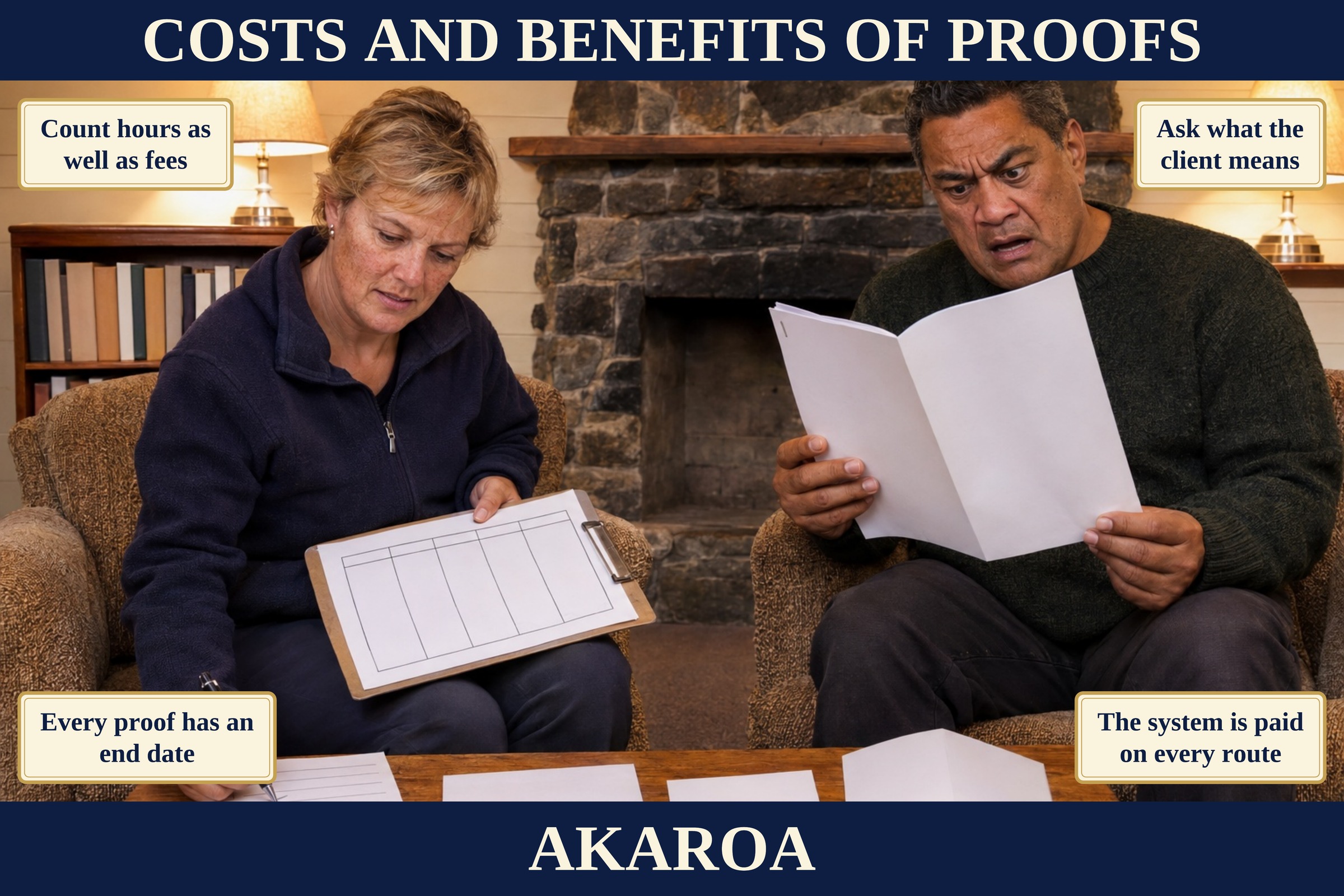
Concept Card 4.13 — Costs and Benefits of Proofs
Subchapter 4.13 · Akaroa, New Zealand
Setting: Akaroa, New Zealand
The guest lounge of a twenty-room family hotel at the upper edge of Akaroa, on an evening in early June at the start of winter: pale weatherboard walls, table lamps, a low bookcase and a stone fireplace, cold and empty. Kate Thompson sits in one armchair with a clipboard on her knee, a sheet ruled in five columns, and marks a paper on the low table. Her husband Rewi, in the other armchair, holds up the certification body's quotation and stares at it in alarm.
The quotation is the only paper in the room with a full sum on it, and that is why it frightens. The classification renewal, the destination's tiered programme and the label's brochure carry fees too, but nobody has counted the hours. Kate's five columns set out what Rewi's total cannot: hosts' hours, fees, validity, who asks for the proof, and what it improves. In the client's questionnaire she has underlined two words, equivalent and externally.
The four plaques read as one argument. Count hours as well as fees, because in a house of twenty rooms the hours belong to the two people who cook in the evening and stand at reception in the morning. Ask what the client means by its own words before pricing the most expensive reading. Every proof has an end date, so costs belong on a full cycle. And the system is paid on every route: the base work costs the same whichever proof the house chooses.
The plate does not accuse Rewi, who was right to be alarmed by the one total he could see at the end of a long season, nor the insurance client, whose question twelve was short and fair. It shows a decision being moved from the evening the quotation arrived to the management review, where it belongs. The lesson of the subchapter: a proof is worth what the party asking for it attaches to it; the work on the system is paid on every route.
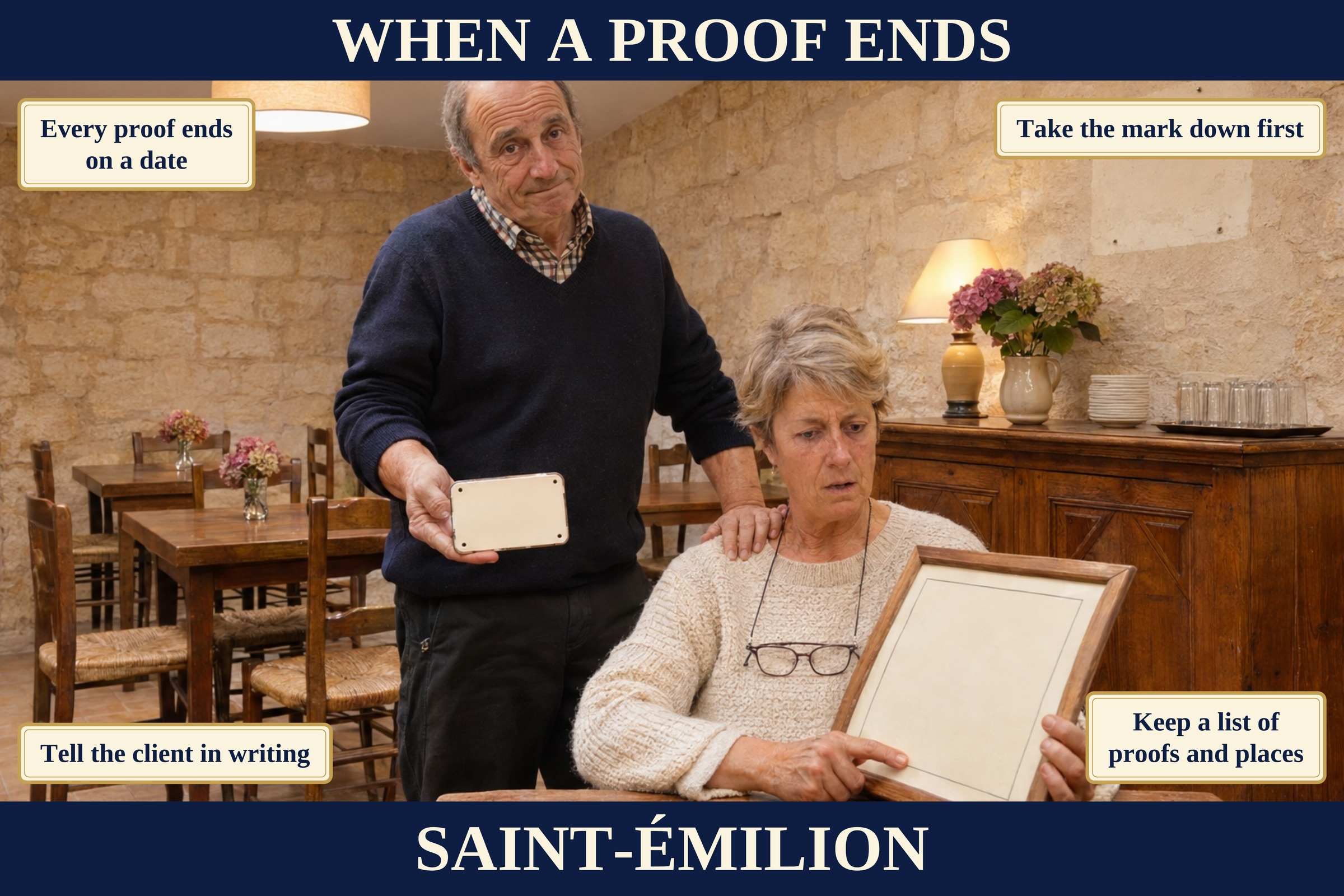
Concept Card 4.14 — When a Proof Ends
Subchapter 4.14 · Saint-Émilion, France
Setting: Saint-Émilion, France
The breakfast room of a narrow limestone guesthouse in Saint-Émilion, on a November evening after the season: pale stone walls, small wooden tables with hydrangeas, an oak buffet with a lamp, cups and glasses. Martine Dubreuil, reading glasses hanging on a cord, holds a wooden-framed certificate on her lap, one finger on its lower edge, her face startled. Her husband Alain stands behind her, a hand on her shoulder, holding out a small blank plaque with a rueful expression.
The frame is the three-star classification that hung for years beside the door to the breakfast room; its bottom line, read for the first time in a long while, shows a date seven months gone, and the scheme itself is no longer awarded. The plaque in Alain's hand is the award of an environmental check, taken from the wall beside the buffet: it carries no date, but its certificate in the folder does, two years past. Two proofs had ended, and nobody had seen them end.
The four plaques read as one argument. Every proof ends on a date, usually printed on the document where guests see it and nobody plans. Take the mark down first, from every place it appears: website, three platforms, brochures in the cellar, the sign by the door, an email signature. Tell the client in writing before its deadline, rather than send an old copy. And keep a list of proofs and places, with holder, validity and a six-month reminder.
The plate does not accuse the Dubreuils of deceit; nobody hid anything, and the closure of the scheme was not their doing. Alain is right that the house has not become worse, and wrong that this settles the matter, because a mark claims that an assessment still holds. The image shows two owners finding the problem themselves, on the first day. A proof ends on a date; whoever advertises with it afterwards says something no longer true.
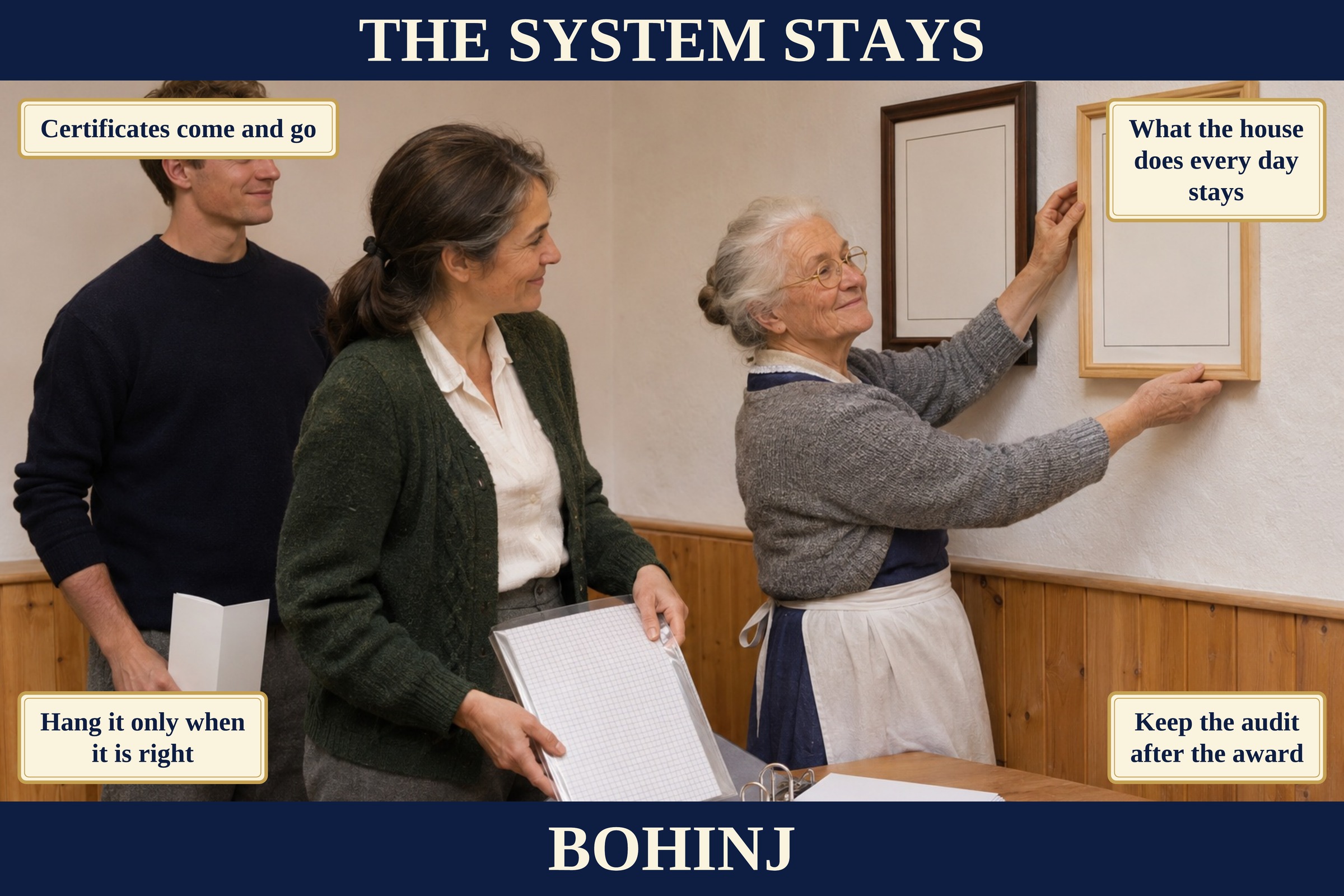
Concept Card 4.15 — The System Stays
Subchapter 4.15 · Bohinj, Slovenia
Setting: Bohinj, Slovenia
The office of the Kovač family guesthouse in Ribčev Laz, on a morning in early June: whitewashed walls, pine panelling to waist height, an open grey ring folder on the desk. On the wall hang two frames, the star classification certificate in dark wood and a new certificate in pale wood, which Ana, the grandmother, straightens with both hands. Maja stands beside the desk holding what remains of Ana's checked notebook, slid into a clear plastic sleeve. Luka watches from behind, a folded brochure at his side.
The pale frame holds the EU Ecolabel certificate, awarded after an assessor's day in the house in May. Ana had kept the empty frame in a drawer since April: only when it is right. Now she hangs it beside the stars and says nothing. Yet the centre of the composition is in Maja's hands. The notebook in which Ana once kept the house's daily record goes to the back of the folder, after the sheet of proofs, where it belongs.
The four plaques read as one argument. Certificates come and go: over fifty years various ones have hung on this wall, and none has remained. What the house does every day stays: breakfast at six, the suppliers, the meters, the phone at night. Hang it only when it is right, as Ana insisted, not when it is merely expected. And keep the audit after the award, because between the label's follow-ups lie years in which nobody from outside looks.
The plate neither celebrates the certificate nor dismisses it; the label was honestly earned, and the assessor herself said most of the work would have been done without her. It shows a family that files its proofs in one folder and has written a date a year before the term ends: decide again. With this page the volume and the series close. Certificates come and go; what stays is what a house does every day, even when nobody is looking.
L’AUTORE