
The Helm and the Lens · English
In attesa di approvazione / Pending approval
the Helm and the Lens
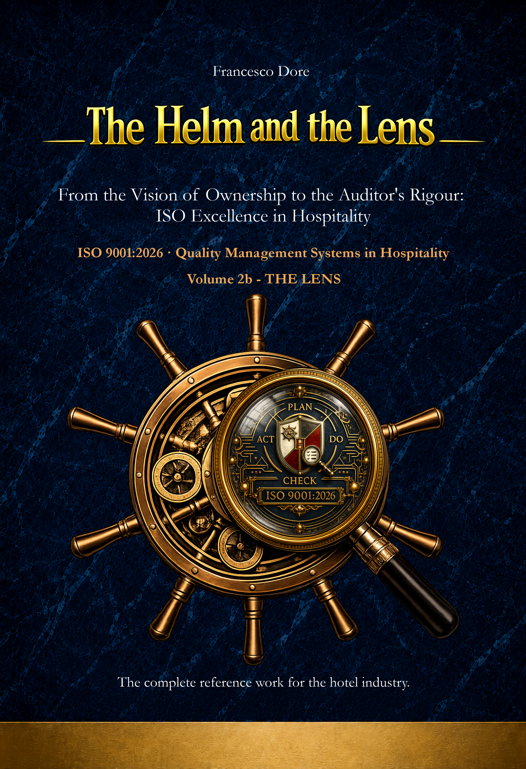
ISO 9001:2026 Quality Management Systems in Hospitality - Volume 2b – THE LENS
ISO 9001:2026 from the other side of the table: thirty hotels seen by the auditor who has to stay and by the stranger who decides — and what each of them can actually see.
The Helm and the Lens — Volume 2b: The Lens
Quality Management Systems in Hospitality · ISO 9001:2026
A hotel that holds a certificate is examined twice: from inside, by someone who works there and will meet the housekeeping manager at breakfast tomorrow, and from outside, by someone who arrives on a Tuesday, has two days, and leaves with a decision. This volume takes the same standard as its companion and turns it round, to the two people who look rather than to the people who are looked at.
The book is built in two parts. Chapter Three — The Auditor Who Has to Stay covers internal audit: the programme and why its timing is a determination rather than a habit, criteria and scope stated for each audit, evidence and what counts as it, sampling, competence, and how a finding is written so that it survives being contested by a colleague. Chapter Four — The Stranger Who Decides covers certification, from the scope on the application form and the arithmetic of audit time to the first two stages, surveillance, recertification, the transition to the new edition, the three requirements nobody has audited before, the nonconformity that threatens the certificate, suspension and transfer, multi-site schemes, what the certificate does not prove, and what the whole arrangement actually costs.
Thirty subchapters, each opening on a working situation in a named city — Bologna, Osaka, Stavanger, Gdańsk, Helsinki, Mendoza, Siem Reap, Kochi; Bath, Rotterdam, Nairobi, Malacca, Asunción, Lyon, Jeju, Christchurch and fourteen more. Each follows the same architecture as the companion volume: the case, the problem, the principle, what the standard says, a Verification Pact, what it means in practice, practical application, economic implications, common mistakes, and a synthesis that can be read on its own.
The Verification Pact governs this volume as it governs the series, and here it does something the first volume did not have to do: it separates three families of source. Some of what a hotel is asked for comes from the standard; some from the auditing guidelines; and a great deal of what properties believe the standard requires is required instead by the certification rules and the mandatory documents of the framework — the audit days, the surveillance interval, the sampling of sites, the suspension of a certificate. The book names which of the three carries each claim, every time, rather than letting them blur into a single authority.
Written for internal auditors and quality managers, for general managers and owners who host audits without knowing what the visitor is permitted to ask, and for certification auditors who want the account read back to them from the other chair. The thirty cases are composite constructions drawn from recurring patterns in two decades of international hospitality practice — a practitioner's case-based guide, not a peer-reviewed research contribution.
Volume 2b takes the perspective of those who examine the property. Its companion, Volume 2a — The Helm, takes the same standard from the position of those who run it.
EDIZIONI · FORMATI
Formati disponibili
Le edizioni fisiche e digitali associate a questa scheda.
NEL LIBRO
Contenuto / Contents
La struttura del volume così come presentata nell’edizione pubblicata.
Table of Contents
- Preface.
- 3.1 Auditing Without Criteria.
- 3.2 Objectives, Criteria and Scope, One Audit at a Time.
- 3.3 A Programme That Has to Cover the Whole Hotel
- 3.4 Independence Where There Is Only One Competent Person.
- 3.5 Competence for a Department You Have Never Worked In.
- 3.6 Auditing a Service While It Is Happening.
- 3.7 Evidence When the Output Has Already Left.
- 3.8 Sampling Across Seasons, Shifts and Segments.
- 3.9 The Departments Nobody Audits.
- 3.10 Auditing Quality Culture and Ethical Behaviour.
- 3.11 Auditing Actions Taken to Prevent Human Error.
- 3.12 Auditing What Was Done About an Opportunity.
- 3.13 Writing a Finding That Survives Being Contested.
- 3.14 Grading, and Following an Action to Its Result.
- 3.15 Reading Three Years of Your Own Programme.
- 4.1 What a Certification Body Verifies in a Quality System...
- 4.2 Choosing a Body, and the Arithmetic Behind the Days.
- 4.3 The Chain Behind the Certificate.
- 4.4 Stage 1: The Audit Whose Subject Is Time.
- 4.5 Stage 2: When the System Speaks Through People Who Did Not Build It
- 4.6 Where a Stranger Starts in a System With No Aspects Register.
- 4.7 Surveillance: The Audit of the Interval
- 4.8 Recertification: Reading a Cycle as One Document.
- 4.9 Transition to the 2026 Edition: What Actually Has to Change.
- 4.10 Being Audited Against Requirements Nobody Has Audited Before
- 4.11 When a Nonconformity Threatens the Certificate.
- 4.12 Suspension, Withdrawal, and the Door That Closes.
- 4.13 Multi-Site Certification and Scope Extensions.
- 4.14 What the Certificate Does Not Prove.
- 4.15 Certification as an Investment: Who Pays, Who Benefits, and When
- Afterword.
- Sources and Research Methodology — What This Book Verified, and How
- Glossary Terms as This Volume Uses Them...
- About the Author.
- Contact.
- The Series.
- The Online Platform...
- Acknowledgements.
- Analytical Index.
L’AUTORE