
The Helm and the Lens · English
Pronto per la pubblicazione / Ready for publication
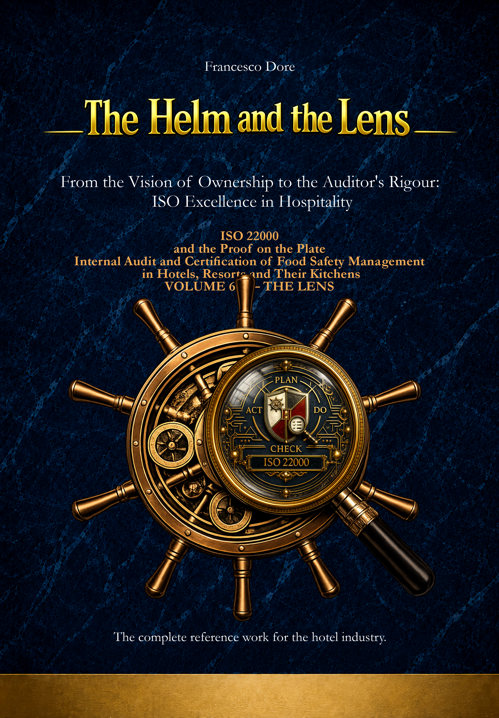
the Helm and the Lens – Vol. 6b
ISO 22000 and the Proof on the Plate Internal Audit and Certification of Food Safety Management in Hotels, Resorts and Their Kitchens
SO 22000 seen through the lens of the internal auditor and the certification body: how to audit a hotel’s food safety system where risk actually lives, and what a certificate really proves to guests, owners and buyers. Thirty cases, from Lyon to Auckland.
551
Pagine
The Helm and the Lens · Volume 6b
ISO 22000 and the Proof on the Plate
A food safety system can look perfect in its binders and still fail on a Saturday night, when the banquet doubles in size and the blast chiller stops. This volume is about proof. How do you find out, by looking, asking and sampling, whether the system a hotel has described is the system its kitchens actually run? And what does a certificate really say once it has been issued?
The book picks up where its companion volume, 6a · ISO 22000 and Trust at the Table, leaves off, and reads the same standard from the other side. Chapter 3, The Internal Auditor’s Lens, follows the internal auditor. It covers how to plan an audit programme around risk rather than the calendar, how to audit a kitchen during service and not only in the office, and how to follow an allergy from the booking to the plate. It also shows how to verify that CCPs and OPRPs are monitored as written, and how to write findings that management will act on. Chapter 4, The Certifier’s Lens, explains what happens when the certification body arrives. It covers stage 1 and stage 2, multi-site and seasonal properties, surveillance, nonconformities and their closure, and what an accredited certificate does and does not cover.
Every subchapter opens with a case set in a real city, built as a composite and clearly declared as fictional. Each one carries a Verification Pact, which checks common market claims against the standard and keeps three things apart: binding requirement, explanatory note and the author’s recommendation. Where the book refers to the rules certification bodies follow, it states what has been verified and what the reader should confirm at the source.
The volume closes with a practical tool for owners and sales teams: the questions corporate buyers and tour operators ask about food safety, with what the certificate answers and what the hotel can show on top of it.
The author is a Lead Auditor and has spent over twenty years in international luxury hospitality. He writes as an author and publisher, for those who run hotels and those who audit them.
Each subchapter ends with a concept card. Worksheets, audit checklists and the cards in high resolution are available on the online platform.
EDIZIONI · FORMATI
Formati disponibili
Le edizioni fisiche e digitali associate a questa scheda.
NEL LIBRO
Contenuto / Contents
La struttura del volume così come presentata nell’edizione pubblicata.
Contents
- Preface
- Chapter 3 The Internal Auditor’s Lens.
- 3.1 The Auditor Who Does Not Cook. 12
- 3.2 An Audit Programme That Follows the Service. 27
- 3.3 The Checklist from Another Edition. 41
- 3.4 Does the Brigade Act or Endure the Standard?. 55
- 3.5 The Supplier’s Kitchen: Auditing Second Party. 69
- 3.6 Observing Without Changing the Work. 83
- 3.7 What a Camera Can Prove: Remote Auditing. 97
- 3.8 The Plate That Did Not Leave: Near-Misses. 111
- 3.9 Why the Procedure Failed. 124
- 3.10 The Thermometer Under Audit 137
- 3.11 Auditing the Reasoning, Not the Records. 150
- 3.12 Following One Allergy from Booking to Plate. 164
- 3.13 The Report That Speaks to the Owner 178
- 3.14 Follow-Up: Proving the Crack Is Sealed. 191
- 3.15 Did the System Keep Its Promise?. 204
- The Certifier’s Lens. 219
- 4.1 The Chain Behind the Certificate. 221
- 4.2 Choosing the Certification Body. 234
- 4.3 Audit Days Are Calculated, Not Negotiated. 247
- 4.4 A Standard or a Scheme?. 260
- 4.5 Stage 1: Readiness Before Anyone Enters the Kitchen. 273
- 4.6 Stage 2: The Kitchen at Full Service. 286
- 4.7 Scrutinising Leadership. 299
- 4.8 Did the Numbers Move?. 312
- 4.9 Multi-Site, and the Outlets in Concession. 325
- 4.10 One Audit, Three Standards. 338
- 4.11 Findings: Major, Minor, and the Deadline. 351
- 4.12 Issued, Then Surveilled. 364
- 4.13 An Outbreak Under a Valid Certificate. 377
- 4.14 The Mark and the Menu. 390
- 4.15 Excellence as a Permanent State. 403
- Afterword. 415
- Appendices. 419
- Appendix A — Where Each Subject Is Treated. 420
- Appendix B — The Audit Programme and the Audit Plan. 425
- Appendix C — The Auditor’s Question Bank. 430
- Appendix D — Reading the Work. 440
- Appendix E — The Supplier File and the Visit 445
- Appendix F — The Catch Card and the Cause Sheet 449
- Appendix G — Instruments Under Verification. 454
- Appendix H — Auditing the Hazard Analysis. 458
- Appendix I — The Allergy Trace. 463
- Appendix J — The Report, the Follow-Up and the Verdict 467
- Appendix K — Before Certification. 473
- Appendix L — Stage 1 and Stage 2. 480
- Appendix M — Where Certification Audits Turn. 486
- Appendix N — Keeping the Certificate. 494
- Appendix O — Making an Internal Auditor 502
- Appendix P — The Year on One Calendar 507
- Appendix Q — Thirty Questions for the General Manager 511
- Sources and Research Methodology. 514
- Glossary. 521
- About the Author 528
- Contact 531
- The Series. 533
- The Online Platform.. 535
- Acknowledgements. 538
- Analytical Index. 540
PRIMA DELL’ACQUISTO
Estratti / Extracts
Passaggi selezionati dal libro disponibili per la consultazione.
01 Preface Apri / Open
Why a hotel with a food safety system needs someone to look at it
The companion to this volume was about the helm: the decisions an owner and a management team take to build a food safety management system and keep it true to the hotel. This volume is about the lens: the ways in which a hotel finds out whether those decisions were taken, whether they hold, and whether the system that resulted is doing what it was built to do. A system nobody looks at becomes a set of documents. A system that is looked at honestly, from inside and from outside, stays a system.
The lens has two parts, and this book has two chapters for them. The first is the hotel’s own: the internal audit, carried out by people who know the hotel and are asked to judge it fairly. The second is the certifier’s: the external audit, carried out by a body that does not know the hotel and is required to judge it impartially. Each sees things the other cannot. An internal auditor can be in the breakfast room at seven on a trade-fair morning; a certification auditor can say what nobody inside the hotel will say to the general manager. A hotel that uses both well has a clearer view of its own kitchens than any guest, inspector or buyer will ever have.
The first subchapter opens in Lyon, with an executive chef who offers to audit his own kitchen because he is the only person who understands it. He is right about the understanding and wrong about the audit, and the reason he is wrong runs through every page that follows: an audit is worth what its auditors can both see and say. Thirty cases later, the book closes in Auckland, with a buyer who reads a certificate and asks what she is entitled to believe. Between them lies everything a hotel needs to know about being looked at.
What this volume is
The Helm and the Lens treats each management system standard in two companion volumes. The first, The Helm, takes the side of the people who own and run the property. The second, The Lens, takes the side of the auditor, internal and external. This is the second of the two volumes on ISO 22000. Its companion is ISO 22000 and Trust at the Table. Each volume stands on its own, and a reader who has the first will find this one built on the same ground and looking at it from the other side.
Chapter 3, The Internal Auditor’s Lens, follows the hotel’s own audit from the choice of who audits, through the programme, the criteria, the evidence from people, suppliers, traces, instruments and reasoning, the near-misses and the causes, to the report, the follow-up and the auditor’s verdict on whether the system keeps the promises its policy makes. Chapter 4, The Certifier’s Lens, follows the certification of the system from the chain of accreditation behind a certificate, through the choice of a certification body, the calculation of audit days, the difference between a standard and a scheme, the two stages of initial certification, the audit of leadership and of performance, multi-site certification, combined audits, findings and their deadlines, surveillance, incidents under a valid certificate and the claims a hotel may make, to the reader of the certificate at the end.
What this volume rests on
Three kinds of text sit beneath this book, and they carry different weight. ISO 22000:2018 sets the requirements for the hotel’s system, including the requirement to audit it internally; every statement about what the standard requires has been checked against its text. ISO 19011:2026, published in May 2026, is the international guidance on auditing management systems; it is guidance, written in the language of what should be done, and this book treats it that way. And the certification of food safety management systems is governed by requirements that apply to certification bodies and by the documents of the international accreditation arrangement. Those are described in this book by their function, because they are the certification bodies’ obligations rather than the hotel’s, and they are named in the Sources at the end, with their status, for any reader who wants to consult them.
The distinction matters, because a great deal of what hotels believe about certification is wrong in one of two directions. Some believe the certification body will do things it is not allowed to do, such as help them prepare the system it will judge. Others believe they have no say in matters where the rules give them one, such as how their audit days are calculated or how a finding they disagree with can be challenged. Knowing whose rule is whose is the beginning of using the lens well.
How each subchapter is built
Every subchapter follows the same order as in the companion volume, so that a reader who knows one can find anything in any of them. A guiding question and a case open it, set in a real kind of hotel in a real city. The Problem names what went wrong and why. The Principle states what the subchapter holds to be true. What the Standard Says renders the relevant requirements and guidance in the book’s own words. The Verification Pact tests the commonest claims about the subject against the texts and says which are binding and which are not. What This Means in a Hotel turns the requirements into the hotel’s own terms, and What No Single Manual Will Tell You adds what experience teaches. Practical Application follows what the hotel did next, Economic Implications models what the failure and the correction cost, and Common Mistakes and Operative Synthesis reduce the subchapter to checks and questions that management can use. The Closing returns to the case and passes the reader to the next city.
The Verification Pact is the discipline that carries the series. In this volume it has an extra edge, because certification is a field in which confident claims circulate freely: that a certificate guarantees safe food, that audit days are a matter for negotiation, that an accredited body issues accredited certificates for anything it chooses, that a chef may audit his own kitchen because nobody else understands it. Each of those claims is tested in these pages, and each is found wanting in a particular and useful way.
The cities
Thirty cases are set in thirty cities, none of them repeated from the companion volume, across Europe, Asia, Africa, the Americas and Oceania. As in the companion, the city is part of the case. It brings a climate, a produce and a way of eating: oysters opened on the Tasmanian coast, street food on a lawn in Penang, a juice bar two thousand six hundred metres up in Bogotá, a pastilla with almonds in Fez, a feast cooked in the earth in Auckland. None of the hotels is real. Each is a composite of patterns that recur across four decades of hospitality, and in none of them does anyone act in bad faith. The internal auditors are receptionists, credit managers, revenue managers and security managers who were trained to audit and asked to look at kitchens they did not know; the certification auditors are professionals doing a difficult job within rules. Every failure in this book is produced by competent people on criteria that were legitimate at the time. That is not a courtesy. It is the argument. …
02 4.4 A Standard or a Scheme? Apri / Open
Answer the question the buyer asked, not the one you hoped for: Amsterdam
| Guiding Question
When a client asks for a “recognised food safety certification”, do you know whether your ISO 22000 certificate is what they mean, and what it would take if it is not? |
Opening
The Hotel Zevensluizen occupies five canal houses joined behind their facades on one of Amsterdam’s inner canals, with a modern wing at the back that houses its conference rooms and a production kitchen. It has a hundred and seventy rooms, a restaurant that serves Dutch and Indonesian dishes, the latter a legacy of the city’s colonial history, a bar known for its raw herring in early summer, and a breakfast for two hundred and fifty. Since the pandemic it has also had a second business. Its production kitchen prepares lunches and meeting catering every working day for the European headquarters of two companies in the city’s business district, delivered in insulated containers by the hotel’s own van.
The hotel had held an accredited ISO 22000 certificate for three years, covering both the hotel and the contract catering. In April, the larger of the two corporate clients, an international technology company, put its catering contract out to tender. The specification was long. Under the heading of food safety, it asked for “certification under a scheme recognised by the global food safety initiative”, and gave a link.
The hotel’s sales manager assumed the requirement was met, attached the ISO 22000 certificate and moved on to the menus. The quality manager, Femke de Jong, read the specification more slowly and followed the link. It led to the list of certification programmes recognised by the global initiative, an organisation set up by large retailers and food companies to benchmark food safety certification programmes against a common set of requirements. ISO 22000 was not on the list. Several programmes on the list included ISO 22000 within them, adding further requirements of their own.
She wrote to the client’s procurement officer, Laura Mendes, to make sure she had understood. The reply was clear. The company’s global procurement policy required its food suppliers, including contract caterers, to hold certification under a recognised programme. ISO 22000 on its own did not qualify. The company had no doubt that the hotel’s system was good; it simply could not accept the certificate under its policy. The tender would close in five months.
The general manager, Joost Visser, asked the obvious question. Was the hotel’s certificate worth less than the hotel had thought? Femke de Jong said it was worth exactly what it had always been worth. It was not what this client was asking for.
The Problem
The sales manager had read “food safety certification” and heard “ISO 22000”. The client had written something more specific. In the market for food safety certification there are standards, which set requirements, and there are certification schemes, which specify what an organisation must meet to be certified and how certification bodies must audit it. Some schemes are built on ISO 22000, and add to it the technical requirements for prerequisite programmes in the relevant sector, together with requirements of their own. A global initiative of retailers and manufacturers benchmarks such schemes and recognises those that meet its requirements. Buyers who follow that initiative ask for certification under a recognised scheme, and ISO 22000 on its own does not meet that request, because it leaves the detail of prerequisite programmes to the organisation.
The confusion is common and understandable. The schemes contain ISO 22000, use its language and are audited by the same certification bodies. A hotel whose certificate says ISO 22000 can easily believe it holds the thing a buyer is describing. It may hold most of it. It does not hold the certificate the buyer’s policy requires.
The client’s policy was not arbitrary. A technology company with offices in forty countries buys food from hundreds of caterers, canteens and suppliers. Its procurement team cannot assess each one, and it cannot compare a caterer’s self-designed prerequisite programmes in Amsterdam with another’s in Singapore. A recognised scheme gives it a single rule that applies everywhere: the same technical requirements for prerequisites, the same additional requirements, the same audit rules, benchmarked by an initiative its industry trusts. The hotel’s certificate might well describe a better system than some scheme-certified caterers had. The policy had no way of knowing that, and was not designed to find out.
The second problem was timing. The hotel discovered the gap when the tender was published, five months before it closed. Moving to a scheme is not a matter of exchanging certificates. It means meeting the scheme’s additional requirements, demonstrating them in an audit and receiving a new certificate, and five months is close to the minimum for that. A hotel that had asked its corporate clients about their requirements a year earlier would have had time to spare.
Table 1: A good certificate, and not the one asked for
| What the hotel had | What the client asked for | The gap |
| Accredited ISO 22000 certificate | Certification under a recognised scheme | ISO 22000 alone is not a recognised scheme |
| PRPs designed by the hotel | PRPs to a sector technical specification | Detailed technical requirements for catering |
| ISO 22000 requirements only | Scheme’s additional requirements | For example food defence, food fraud, unannounced audits |
| Five months to the tender | Certificate at award | Tight but possible |
The Principle
The principle of this subchapter is that the choice between a standard and a scheme is not a ladder of quality but a question of who the hotel serves and what they require. ISO 22000 sets out a complete food safety management system and is sufficient for most hotels, whose guests and clients rely on it directly or not at all. A scheme that incorporates ISO 22000 is needed when a buyer’s policy requires it, typically when the hotel supplies food under contract to a company that applies the same rules to all its food suppliers.
Because the schemes are built on the standard, moving from one to the other does not mean starting again. The management system, the hazard analysis, the hazard control plan and the internal audits all carry over. What changes is the detail of the prerequisite programmes, which must meet a sector technical specification, and the scheme’s own additional requirements and audit rules.
The practical rule follows. A hotel should know, for each client who buys food from it under contract, what certification that client requires, and should ask before the tender rather than after it.
What the Standard Says
Clause 8.2.3 of ISO 22000:2018 states that, when selecting and establishing prerequisite programmes, the organisation should consider the applicable part of the ISO/TS 22002 series and applicable standards, codes of practice and guidelines. The verb is “should”: the standard recommends that the sector technical specification be considered, but leaves the organisation to decide how. Clause 8.2.4 then lists the elements the organisation must consider, from the construction of buildings to cleaning, pest control, personnel hygiene and product information. The standard’s bibliography lists the ISO/TS 22002 series, which includes a part for catering. That part has since been replaced: ISO 22002-2:2025 is an International Standard for catering, used together with ISO 22002-100:2025, which sets the requirements common to every sector, and it leaves kitchens that produce meals for consumption elsewhere to the part for food manufacturing. In this subchapter the sector technical specification means whichever part a scheme names for the activity concerned. …
MATERIALI DI LAVORO
Materiali e download
Checklist, modelli, supplementi e file di lavoro collegati al volume.
35 materiali in 3 gruppi
Capitolo 317 materiali
FILES
1 · Worksheet 3.1: The Auditor Who Does Not Cook
Subchapter 3.1
Who audits your kitchen: someone who understands it, or someone who is free to say what they find? If the honest answer is only one of the two, what does your internal audit actually prove?
FILES
2 · Worksheet 3.2: An Audit Programme That Follows the Service
Subchapter 3.2
On the days when your kitchens are most at risk (the busiest breakfast, the largest banquet, the first week of a new menu) has an internal auditor ever been there to see them?
FILES
3 · Worksheet 3.3: The Checklist from Another Edition
Subchapter 3.3
Against what, exactly, does your internal auditor compare the evidence? Could you show the edition of the standard and the version of your own procedures that the checklist was written from?
FILES
4 · Worksheet 3.4: Does the Brigade Act or Endure the Standard?
Subchapter 3.4
If your auditor asked a cook not what the rule is, but why it exists and what to do when it cannot be followed, how many of your kitchen staff would answer, and how many would point to the sign on the wall?
FILES
5 · Worksheet 3.5: The Supplier’s Kitchen: Auditing Second Party
Subchapter 3.5
For the ingredient on which a whole control measure depends, what do you know about your supplier that the supplier did not tell you itself?
FILES
6 · Worksheet 3.6: Observing Without Changing the Work
Subchapter 3.6
When your auditor walks into the kitchen, what changes in the first five minutes, and how would you know what the kitchen looked like before?
FILES
7 · Worksheet 3.7: What a Camera Can Prove: Remote Auditing
Subchapter 3.7
If your next internal audit of a kitchen were carried out through a phone held by the kitchen’s own manager, which of your findings from the last on-site audit would it still have found?
FILES
8 · Worksheet 3.8: The Plate That Did Not Leave: Near-Misses
Subchapter 3.8
How many times last month did someone in your kitchen stop a plate, discard a tray or remake a dish because something was not right, and where is the record of any of it?
FILES
9 · Worksheet 3.9: Why the Procedure Failed
Subchapter 3.9
Look at the causes written in your last ten corrective actions. How many say, in one form or another, that a person made a mistake, and how many of those problems have come back?
FILES
10 · Worksheet 3.10: The Thermometer Under Audit
Subchapter 3.10
If one of your probe thermometers had been reading two degrees low for three months, how would you know, and what would you do about everything it measured in that time?
FILES
11 · Worksheet 3.11: Auditing the Reasoning, Not the Records
Subchapter 3.11
Your audits confirm that the hazard control plan is applied. Has anyone ever audited whether the plan is right, whether each hazard was scored, and each control measure classified, by a reasoning that someone else could follow and check?
FILES
12 · Worksheet 3.12: Following One Allergy from Booking to Plate
Subchapter 3.12
Every department in your hotel may follow its own procedure for allergies perfectly. Has anyone ever followed a single guest’s allergy through all of them, from the moment it was declared to the moment the plate was set down?
FILES
13 · Worksheet 3.13: The Report That Speaks to the Owner
Subchapter 3.13
If your owner read only the first page of your last internal audit report, would he know the one thing that most needed his decision?
FILES
14 · Worksheet 3.14: Follow-Up: Proving the Crack Is Sealed
Subchapter 3.14
Of the findings your last audit marked as closed, how many did someone go back to see: at the hour, on the shift and in the conditions where the problem had been found?
FILES
15 · Worksheet 3.15: Did the System Keep Its Promise?
Subchapter 3.15
Your food safety policy makes promises to your guests. When did an auditor last tell you, in one page, which of those promises the system is keeping, which it is not, and which nobody has checked?
XLSX
31 · Practical application: all thirty subchapters
Subchapters 3.1–4.15
121 steps from the book, with a summary by subchapter
FILES
35 · The thirty concept cards
Subchapters 3.1–4.15
Title, city, image and text of every card
Capitolo 415 materiali
FILES
16 · Worksheet 4.1: The Chain Behind the Certificate
Subchapter 4.1
Your hotel has a certificate on the wall. Could you show, in five minutes, who checked the body that issued it, for which standard, and whether that check covers the certificate you hold?
FILES
17 · Worksheet 4.2: Choosing the Certification Body
Subchapter 4.2
When you last chose a certification body, did you compare the people who would audit your kitchens, or only the prices on the quotations?
FILES
18 · Worksheet 4.3: Audit Days Are Calculated, Not Negotiated
Subchapter 4.3
The number of audit days in your certification contract came from figures your hotel supplied. Do you know which figures, and were they the figures of the hotel the auditor would actually visit?
FILES
19 · Worksheet 4.4: A Standard or a Scheme?
Subchapter 4.4
When a client asks for a “recognised food safety certification”, do you know whether your ISO 22000 certificate is what they mean, and what it would take if it is not?
FILES
20 · Worksheet 4.5: Stage 1: Readiness Before Anyone Enters the Kitchen
Subchapter 4.5
Is your hotel ready to be judged, or ready to be told what to do before it is judged? Stage 1 is designed for the first, and many hotels arrive expecting the second.
FILES
21 · Worksheet 4.6: Stage 2: The Kitchen at Full Service
Subchapter 4.6
If the certification auditor arrived at the busiest twenty minutes of your busiest day, would your records and your kitchen tell the same story?
FILES
22 · Worksheet 4.7: Scrutinising Leadership
Subchapter 4.7
If a certification auditor asked your general manager to show three decisions he took last year because of the food safety system, what would he bring?
FILES
23 · Worksheet 4.8: Did the Numbers Move?
Subchapter 4.8
Your food safety objectives were met last year. Were they met the year before, and the year before that, at the same level, and if so, what has the system learned in three years?
FILES
24 · Worksheet 4.9: Multi-Site, and the Outlets in Concession
Subchapter 4.9
If your group asked for one certificate covering all its hotels, could it show one system behind it, and could a guest tell which bars and restaurants on your property that certificate does not cover?
FILES
25 · Worksheet 4.10: One Audit, Three Standards
Subchapter 4.10
If your food safety, quality and environmental audits were combined into one, which part of your kitchens would receive less attention, and which conflicts between your three systems would finally become visible?
FILES
26 · Worksheet 4.11: Findings: Major, Minor, and the Deadline
Subchapter 4.11
If your certification auditor raised a major nonconformity three weeks before your busiest season, what would you send her, by when, and would it convince her, or only reassure you?
FILES
27 · Worksheet 4.12: Issued, Then Surveilled
Subchapter 4.12
Since your certificate was issued, what has changed in your hotel (outlets, people, suppliers, menus) and does your certified system, and your certification body, know about each change?
FILES
28 · Worksheet 4.13: An Outbreak Under a Valid Certificate
Subchapter 4.13
If guests fell ill after one of your events next month, what would the certificate on your wall have promised them, and what would your response prove about the system behind it?
FILES
29 · Worksheet 4.14: The Mark and the Menu
Subchapter 4.14
Look at your menus, your website, your brochures and anything you sell in a jar or a box. Does any of them say something about your certification that the certificate does not say?
FILES
30 · Worksheet 4.15: Excellence as a Permanent State
Subchapter 4.15
When a buyer, a guest or an owner reads your food safety certificate, what are they entitled to believe, and what would you show them if they asked for more?
Altri materiali3 materiali
XLSX
32 · Verification Pact
Verification Pact, all subchapters
150 common claims tested against ISO 22000:2018 and the certification rules, each marked binding or not
XLSX
33 · Common mistakes: a self-check
Common Mistakes, all subchapters
180 mistakes described in the book, with columns for the property
XLSX
34 · The thirty guiding questions
Guiding questions, all subchapters
One question per subchapter, with room for the answer
Immagini e tavole HD
Apri e proietta le foto direttamente dal sito, a schermo intero, oppure scarica gli originali.
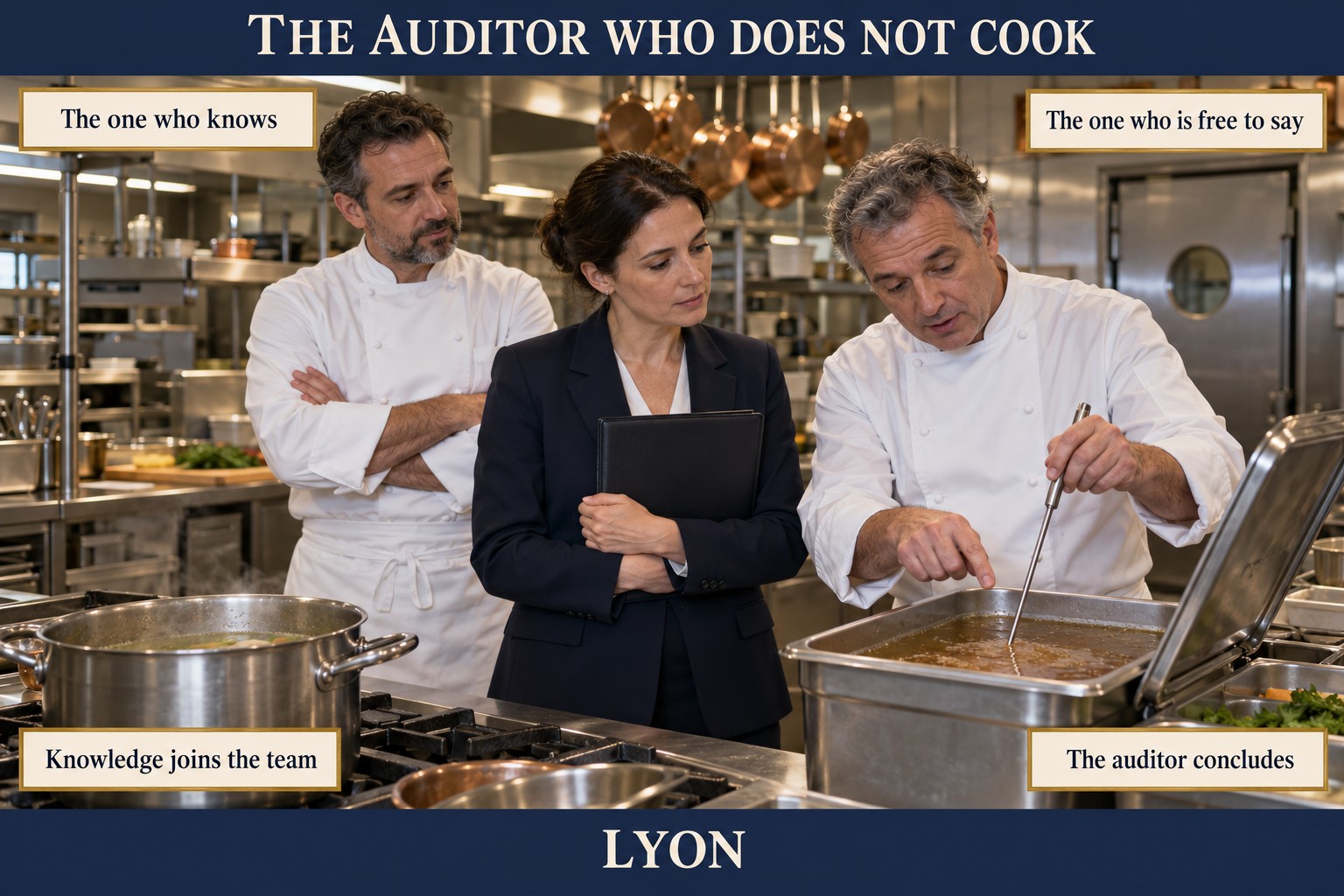
Concept Card 3.1 — The Auditor Who Does Not Cook
Subchapter 3.1 · Lyon, France
Setting: Lyon, France
A hotel kitchen during service, copper pans above the range. At the centre stands the internal auditor in a navy suit, a closed folder held against her. Beside her a visiting chef from another hotel of the group dips his own slim probe into a container of stock and points to the place she should watch. Behind them the hotel’s executive chef stands with his arms folded.
Three people, three positions. The executive chef knows this kitchen better than anyone and cannot be the one to judge it. The auditor is free to say what she finds and could not, alone, have known where to look. The visiting chef lends her his eyes.
The one who knows, and the one who is free to say: the upper plaques name two requirements the hotel had been treating as one. Knowledge joins the team is how they meet, through a technical expert who advises and does not decide. The auditor concludes says where the judgement stays.
The plate does not diminish the chef, whose offer to audit his own kitchen was generous. It shows why competence without distance proves little, why distance without competence sees only paper, and how a hotel can have both in the same room.
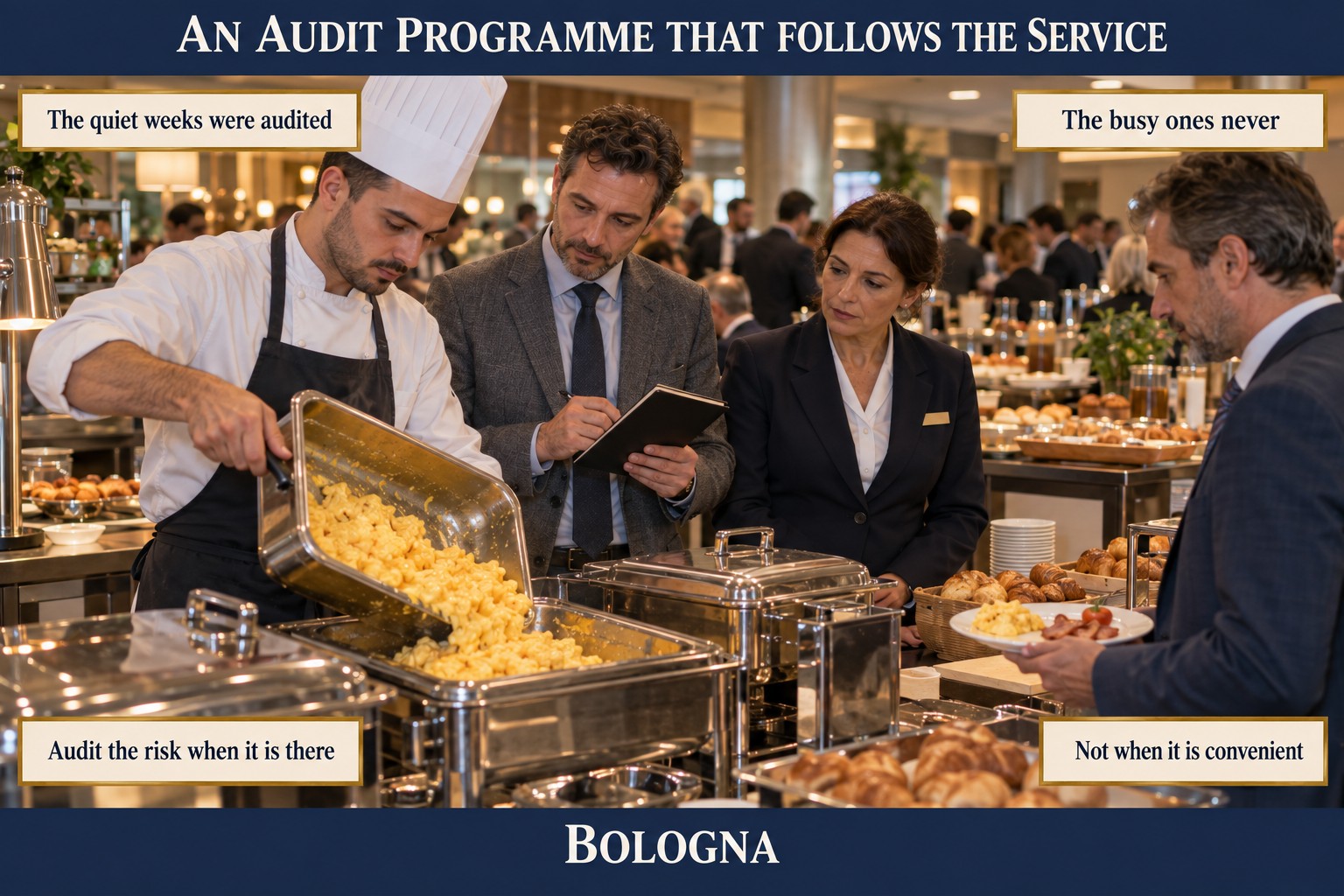
Concept Card 3.2 — An Audit Programme That Follows the Service
Subchapter 3.2 · Bologna, Italy
Setting: Bologna, Italy
A crowded breakfast room early in the morning of a trade fair. In the foreground a young cook tips a fresh tray of scrambled eggs into a chafing dish, on top of what was left of the old one. Beside him the internal auditor writes in a small notebook; the breakfast manager watches with him.
The gesture takes two seconds. For three years the hotel had audited breakfast at ten o’clock in November, when the room was being cleared. The composition places the auditor inside the crowd, at the hour when the eggs are actually replenished.
The quiet weeks were audited, the busy ones never: the upper plaques describe a programme built around the convenience of the hotel. Audit the risk when it is there, not when it is convenient: the lower plaques turn the calendar round, so that the dates follow the service.
The plate does not blame the cook, who is feeding a queue as fast as he can. It shows that an audit programme is a set of choices about when to look, and that a hotel which looks only when nothing is happening will go on finding that nothing happens.
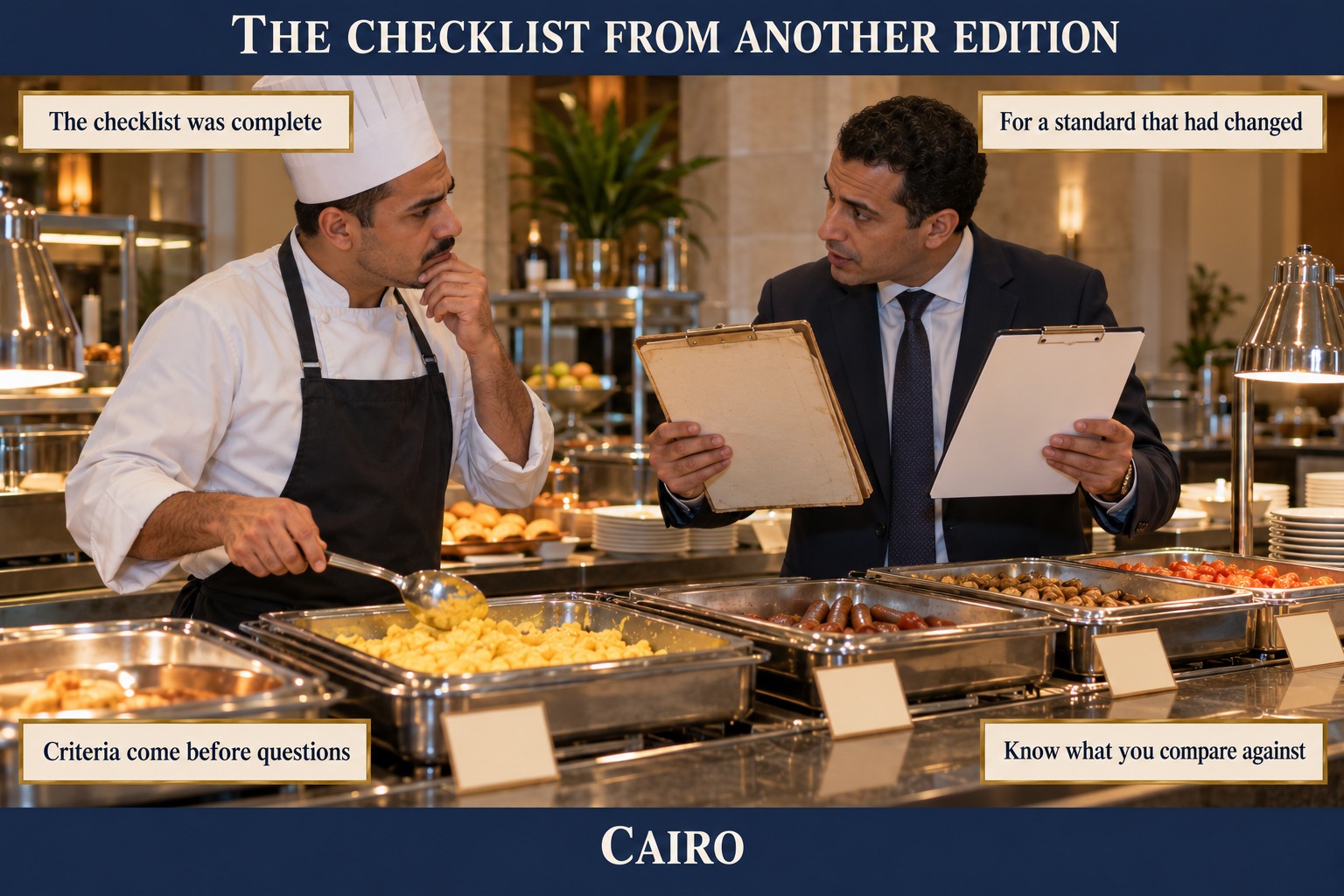
Concept Card 3.3 — The Checklist from Another Edition
Subchapter 3.3 · Cairo, Egypt
Setting: Cairo, Egypt
The hot counter of a large breakfast buffet, steel dishes of eggs and ful under warm lamps, a blank card in front of each. The internal auditor, in a dark suit, holds two clipboards: one yellowed with use, the other new and white. Facing him a cook in a tall hat pauses with a serving spoon in the eggs, his other hand at his chin.
The two clipboards are two editions of the same standard. The old checklist had eighteen pages, every one signed, and it had been used for years to audit a system that no longer existed. The composition holds old and new side by side, with the food and the cook in front of them.
The checklist was complete, for a standard that had changed: nothing in it was careless, and all of it was aimed at the wrong target. Criteria come before questions is the order an audit must follow. Know what you compare against is what turns a tick into a finding.
The plate does not accuse the auditors who filled in the old pages faithfully. It shows how easily diligence attaches itself to a form, and an auditor who now knows, before he asks the cook anything, what the answer will be measured against.
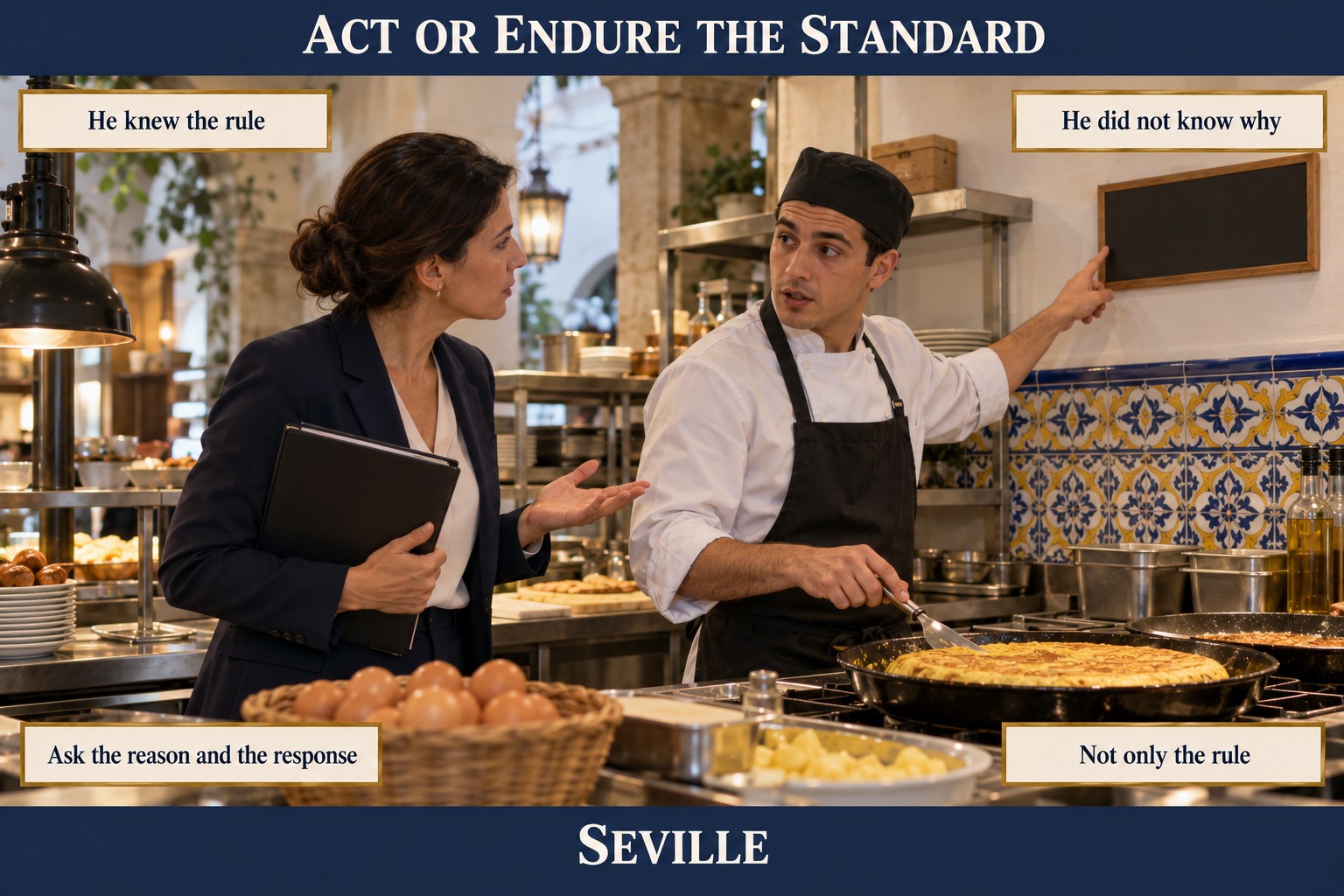
Concept Card 3.4 — Does the Brigade Act or Endure the Standard?
Subchapter 3.4 · Seville, Spain
Setting: Seville, Spain
A tapas kitchen in an old courtyard hotel, blue and yellow tiles along the wall, a thick tortilla in the pan and a basket of eggs in front. The internal auditor, a folder under her arm, asks a question with an open hand. The young cook turns from the stove and points up at the board above his station.
He is pointing at the rule. She had asked him why. He can recite what the sign says about eggs, and his test score confirms it. What he cannot say is what the rule is for, and so on the Sunday when the right egg ran out he solved the problem in the way that seemed sensible.
He knew the rule, he did not know why: the upper plaques separate two things a training record cannot tell apart. Ask the reason and the response, not only the rule: the lower plaques give the auditor her questions, and the last shows what a person will do when the rule runs out.
The plate does not belittle the cook, who is quick, careful and proud of his tortilla. It shows a brigade given rules to endure and not reasons to act on, and an auditor who has learned that training is audited at the stove.
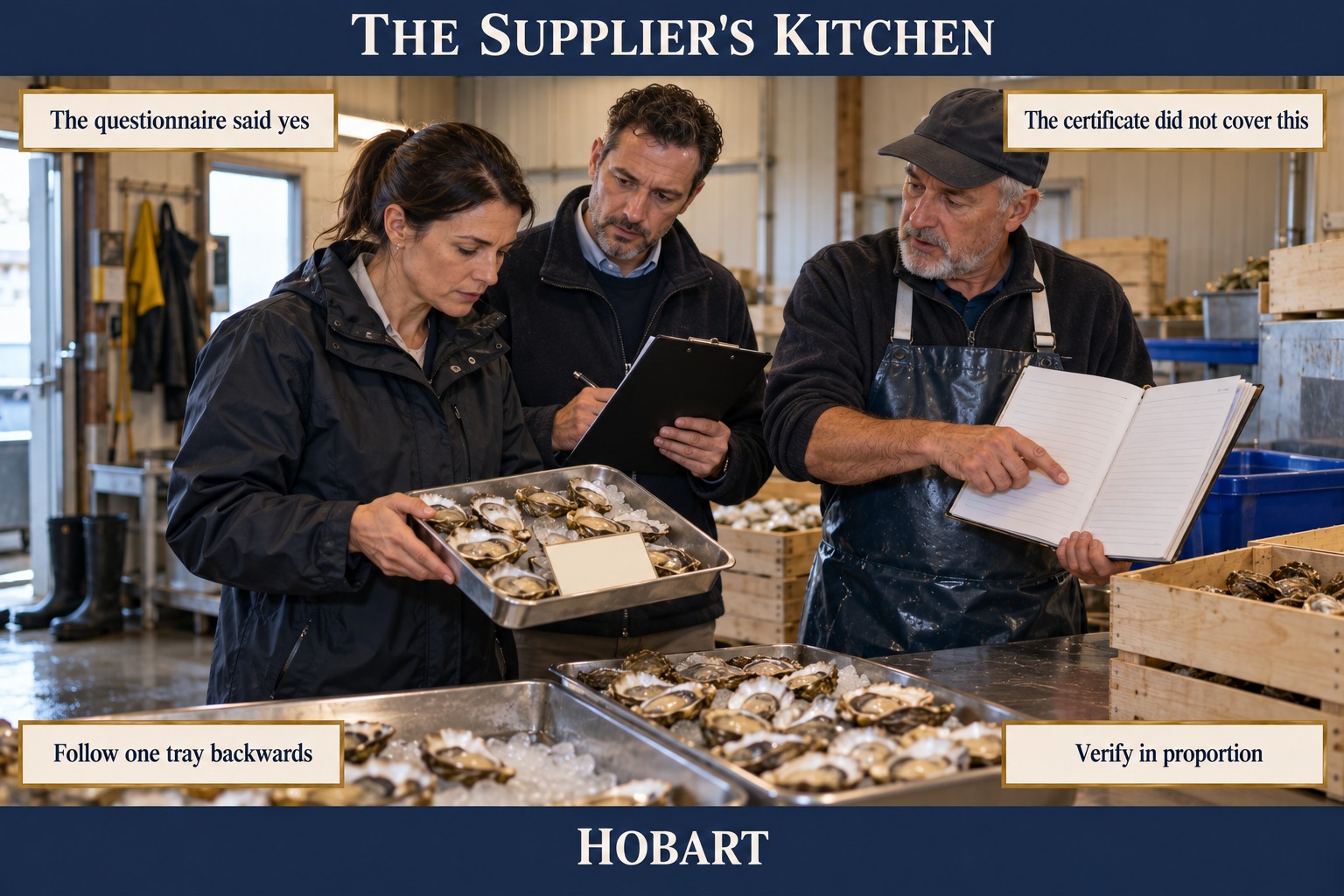
Concept Card 3.5 — The Supplier’s Kitchen: Auditing Second Party
Subchapter 3.5 · Hobart, Australia
Setting: Hobart, Australia
An oyster shed on the coast, wooden crates and wet boots by the door. The hotel’s food safety team leader holds a tray of opened oysters on ice and looks at its label. Behind her the purchasing manager writes on a clipboard. Facing them the grower, in a cap and a waterproof apron, holds open his harvest book and puts a finger on a line.
She has brought one tray and is asking where it came from. The label does not say. The book records harvests by lease and by day, not by the batches packed for customers. The hotel’s file on this supplier was in order, and none of it could answer the question on the morning it mattered.
The questionnaire said yes, and the certificate did not cover this: the upper plaques are the supplier file, read again after three days of rain. Follow one tray backwards is the method. Verify in proportion says how much of this a hotel should do, and for whom.
The plate does not accuse the grower, who has supplied the hotel for years without a problem. It shows two people who trust each other discovering that trust and evidence are different things.
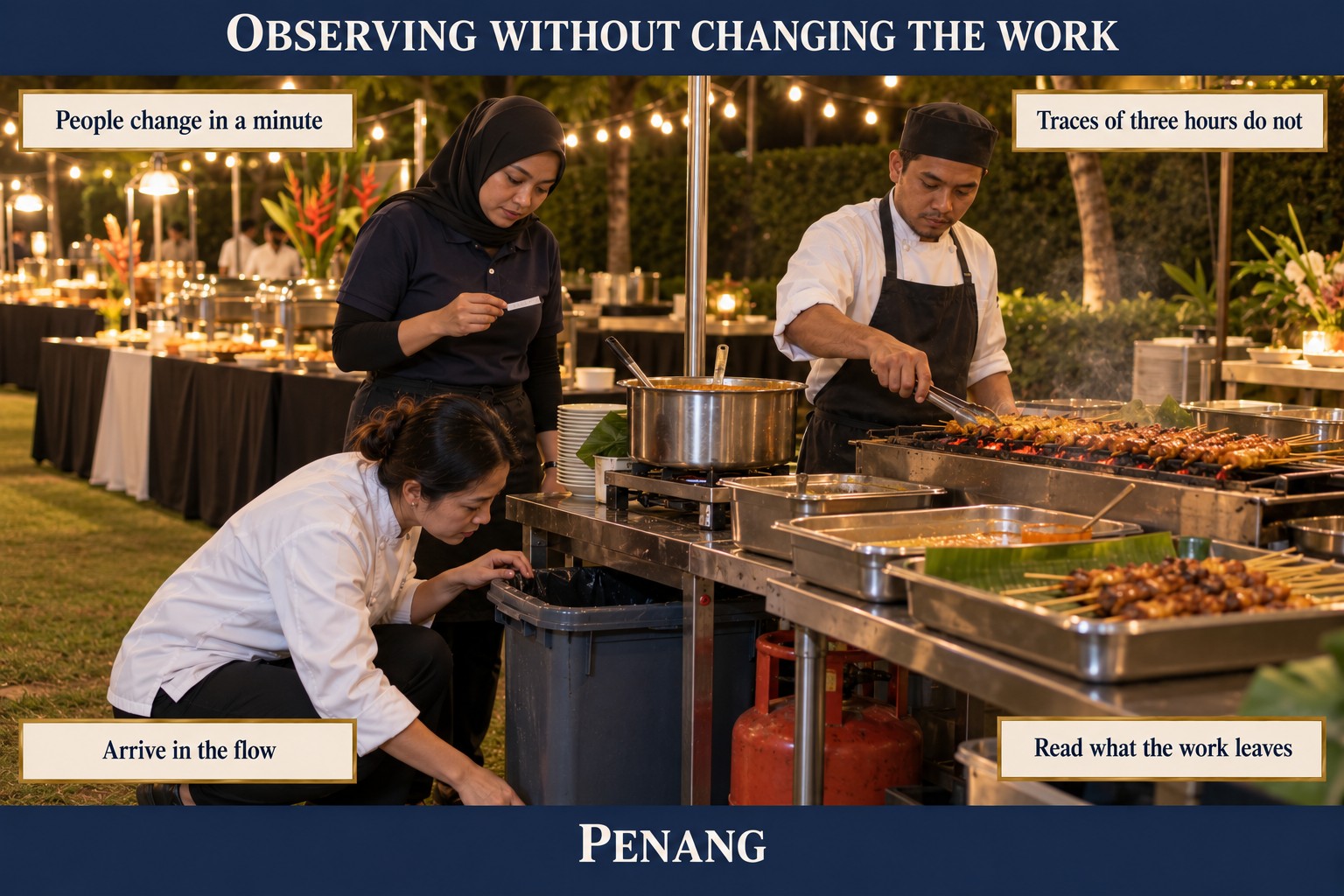
Concept Card 3.6 — Observing Without Changing the Work
Subchapter 3.6 · Penang, Malaysia
Setting: Penang, Malaysia
A hotel lawn at night under strings of warm bulbs, set with street-food stations. At the satay grill a cook turns skewers over charcoal and goes on working. Beside the station the internal auditor, in a plain chef’s jacket, crouches to look into the bin under the bench. Behind her the food safety team leader holds up a small test strip.
On her first visit she had arrived in office clothes with a tablet, and the whole lawn had changed within a minute. This time she looks at what cannot be rearranged when an auditor appears. The bin holds three hours of evidence. The strip measures a sanitiser made up at six.
People change in a minute, traces of three hours do not: the upper plaques are the lesson of the first audit. Arrive in the flow is how she comes now. Read what the work leaves is where she looks, at what the service has left behind without thinking about it.
The plate does not treat the cooks as people to be caught. They behaved as anyone behaves when watched. It shows an auditor who has stopped auditing her own arrival, and a cook so used to her that he does not look up.
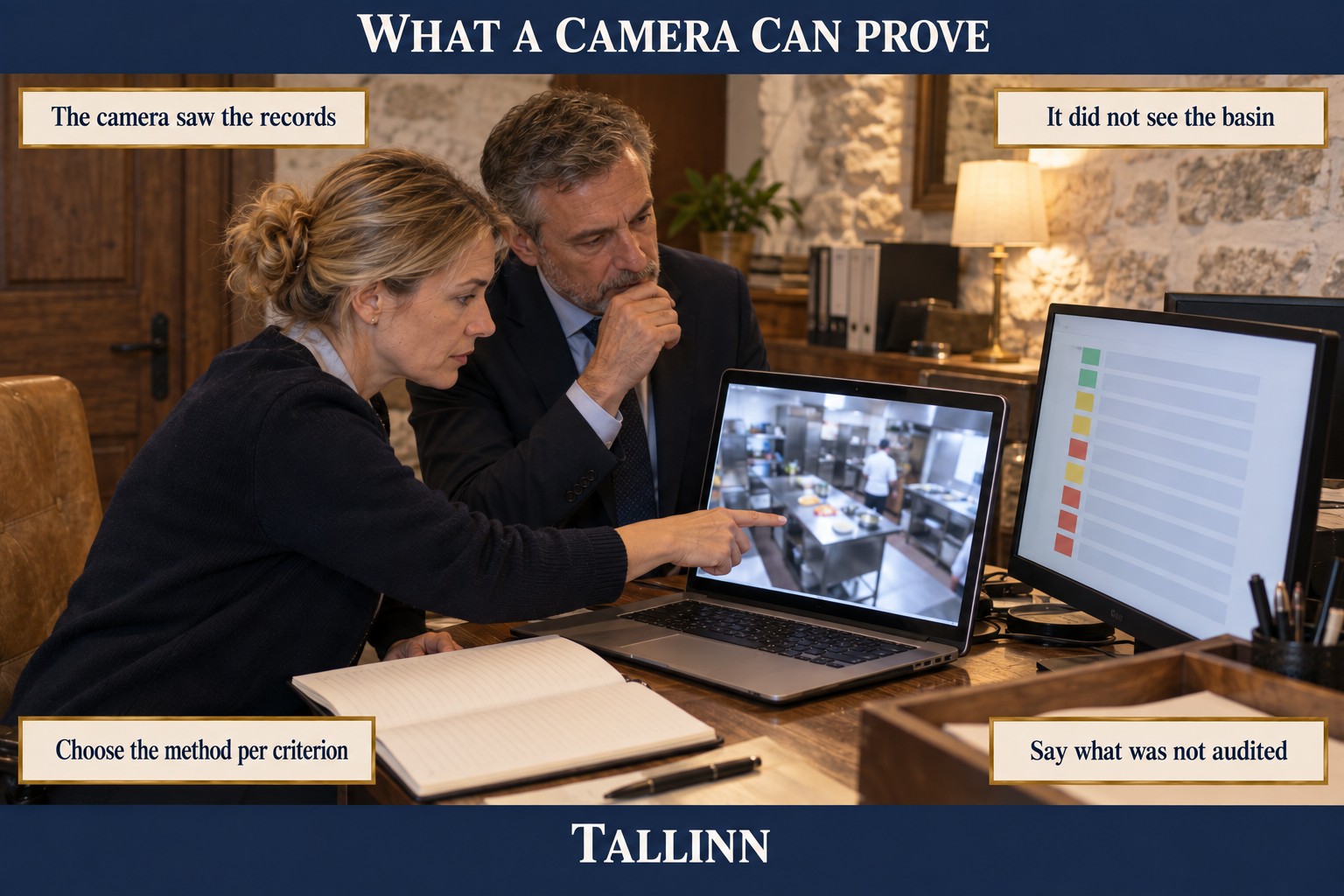
Concept Card 3.7 — What a Camera Can Prove: Remote Auditing
Subchapter 3.7 · Tallinn, Estonia
Setting: Tallinn, Estonia
A small office in an old-town hotel, limestone walls and lamplight. The group quality manager leans towards a laptop and points at the edge of a blurred video image of a steel kitchen. Beside her the operations director watches, a hand at his chin. On the second screen stands a plain column of coloured tiles.
The two screens are the two halves of a remote audit. The column of tiles is the alarm log, and through a screen she could read every line of it. The kitchen picture froze in the cold room, blurred under the pass, and never showed that a hand-wash basin stood blocked behind a trolley.
The camera saw the records, it did not see the basin: the upper plaques are the result of auditing the same kitchen twice. Choose the method per criterion replaces a decision made once for the whole audit. Say what was not audited is what a remote report owes its reader.
The plate does not reject the camera, which saved days of travel and read the documents well. It shows two people learning what a screen can prove, and where somebody still has to walk in.
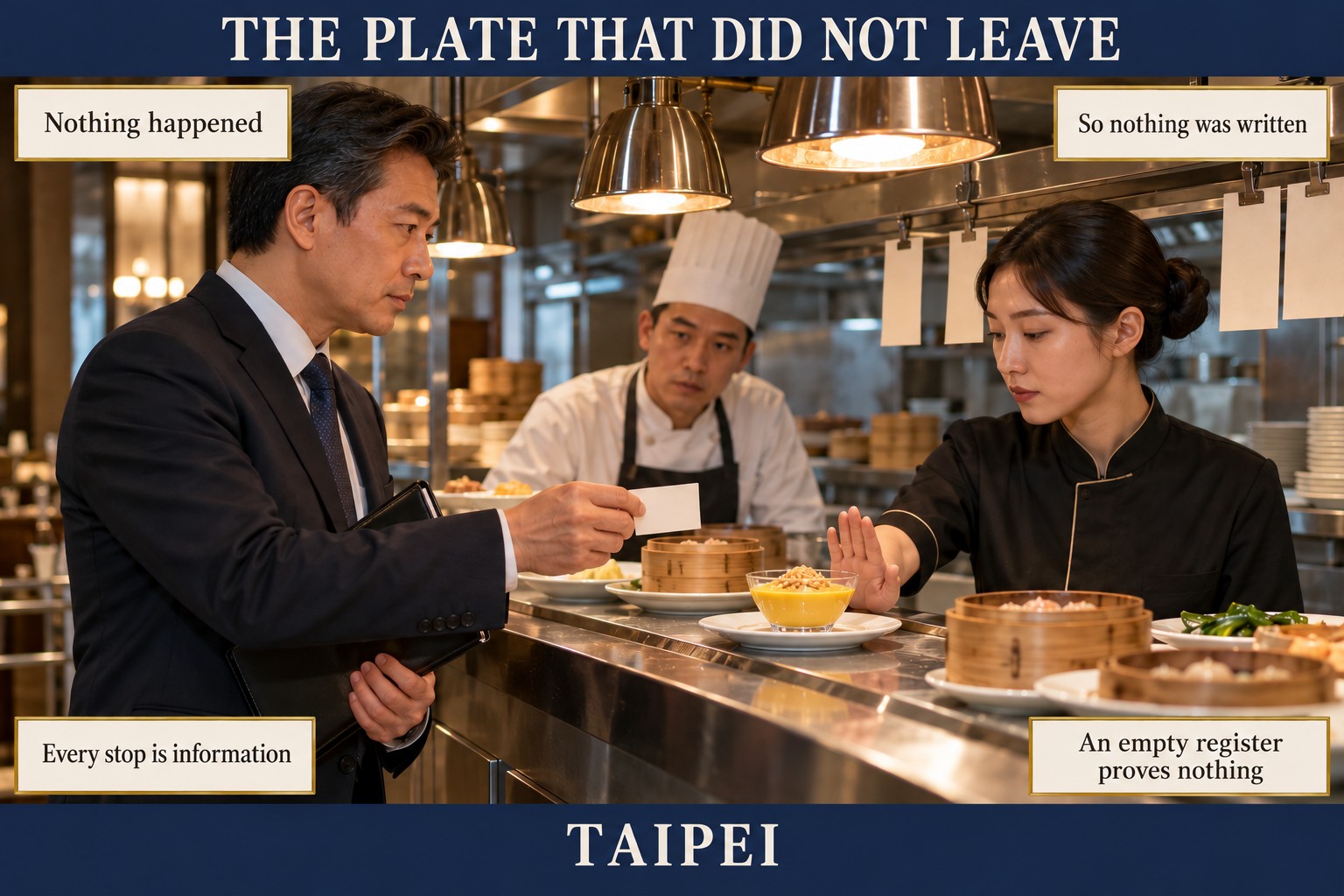
Concept Card 3.8 — The Plate That Did Not Leave: Near-Misses
Subchapter 3.8 · Taipei, Taiwan
Setting: Taipei, Taiwan
The pass of a Cantonese restaurant during service, bamboo steamers under the heat lamps. A waitress in a black uniform holds her hand flat beside a small glass bowl of mango pudding topped with crushed peanuts. Facing her the internal auditor holds out a small blank card. Behind the pass a cook looks up.
The pudding is not going anywhere. She remembered the guest’s allergy from the evening before; the ticket had not mentioned it. In the hotel’s register this moment did not exist, because the guest never ate the pudding. The card is the smallest possible record, a few lines filled in at the pass.
Nothing happened, so nothing was written: the upper plaques are the logic of every kitchen that keeps a clean register. Every stop is information says what was being thrown away each day. An empty register proves nothing is the auditor’s conclusion about two entries in a year.
The plate does not look for the person who left the allergy off the ticket. It honours the one who caught it, and shows a hotel discovering that its safest moments were its least recorded.
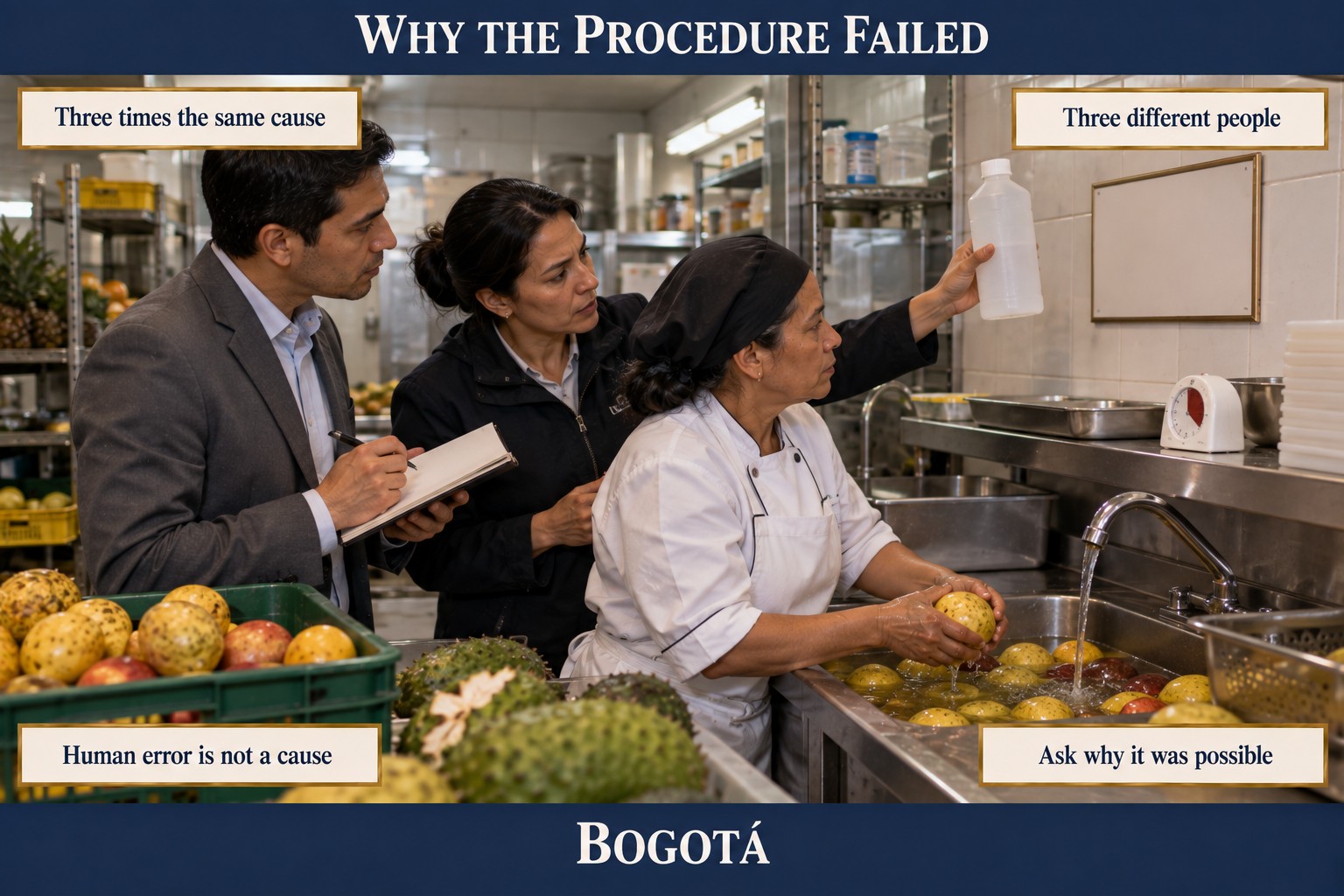
Concept Card 3.9 — Why the Procedure Failed
Subchapter 3.9 · Bogotá, Colombia
Setting: Bogotá, Colombia
A small preparation room behind a juice bar before dawn, crates of tropical fruit all around. At the sink a cook washes fruit in a basin of water. The food safety team leader holds a plastic bottle of disinfectant up beside the procedure on the tiled wall. Next to her the internal auditor writes in his notebook.
She is comparing what the wall asks for with what the room provides. The dose on the sign was written for a disinfectant the hotel no longer buys, and the bottle in her hand is half as strong. Three samples had failed in one year, and three investigations had each named a different person.
Three times the same cause, three different people: the upper plaques are the pattern nobody saw while the records were read one at a time. Human error is not a cause is the sentence that reopens them. Ask why it was possible moves the investigation from the person to the place.
The plate does not blame the woman at the sink, who is doing what the room allows. It shows an investigation that had stopped at the first plausible answer, and two people standing where the work is done to find the next one.
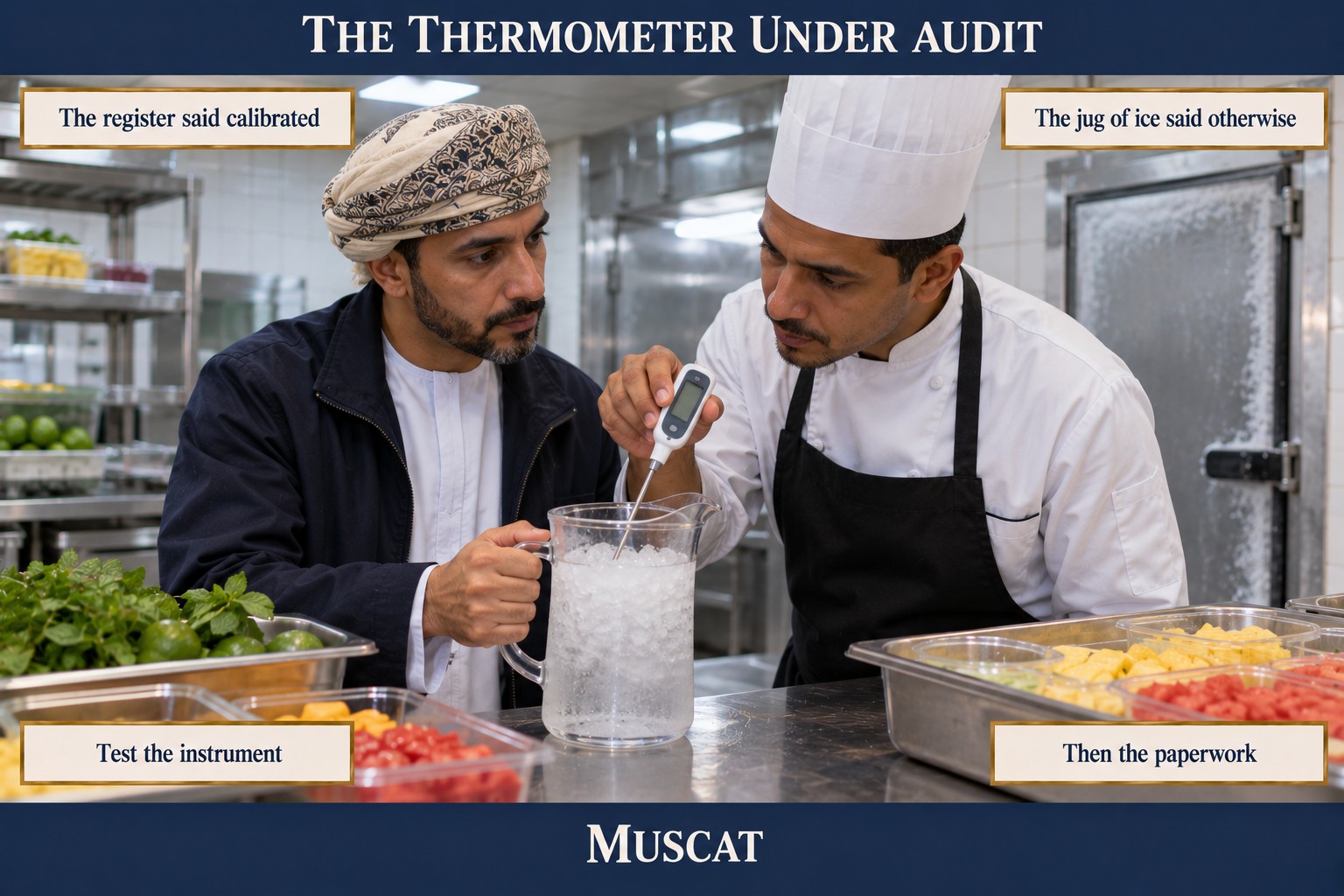
Concept Card 3.10 — The Thermometer Under Audit
Subchapter 3.10 · Muscat, Oman
Setting: Muscat, Oman
The cold kitchen of a seaside resort, white tiles and trays of cut fruit, frost on the cold room door behind. The internal auditor steadies a glass jug of crushed ice and water on the bench. Facing him a cook holds his own digital probe in the ice and watches its small display, waiting for the reading to settle.
The jug is the oldest reference there is: melting ice has one temperature, whatever any register says. The hotel’s register listed thirty-four probes as calibrated, with a tick for every month and not one reading. The auditor carried the jug round the kitchens and asked each cook to test his own probe.
The register said calibrated, the jug of ice said otherwise: the upper plaques set a document against a fact. Test the instrument, then the paperwork is the order the lower plaques give, the reverse of the usual one.
The plate does not accuse the cook, who uses the probe he was given and believes what it tells him. It shows that every temperature in a food safety system rests on an instrument, and that the check takes a jug, some ice and a minute.
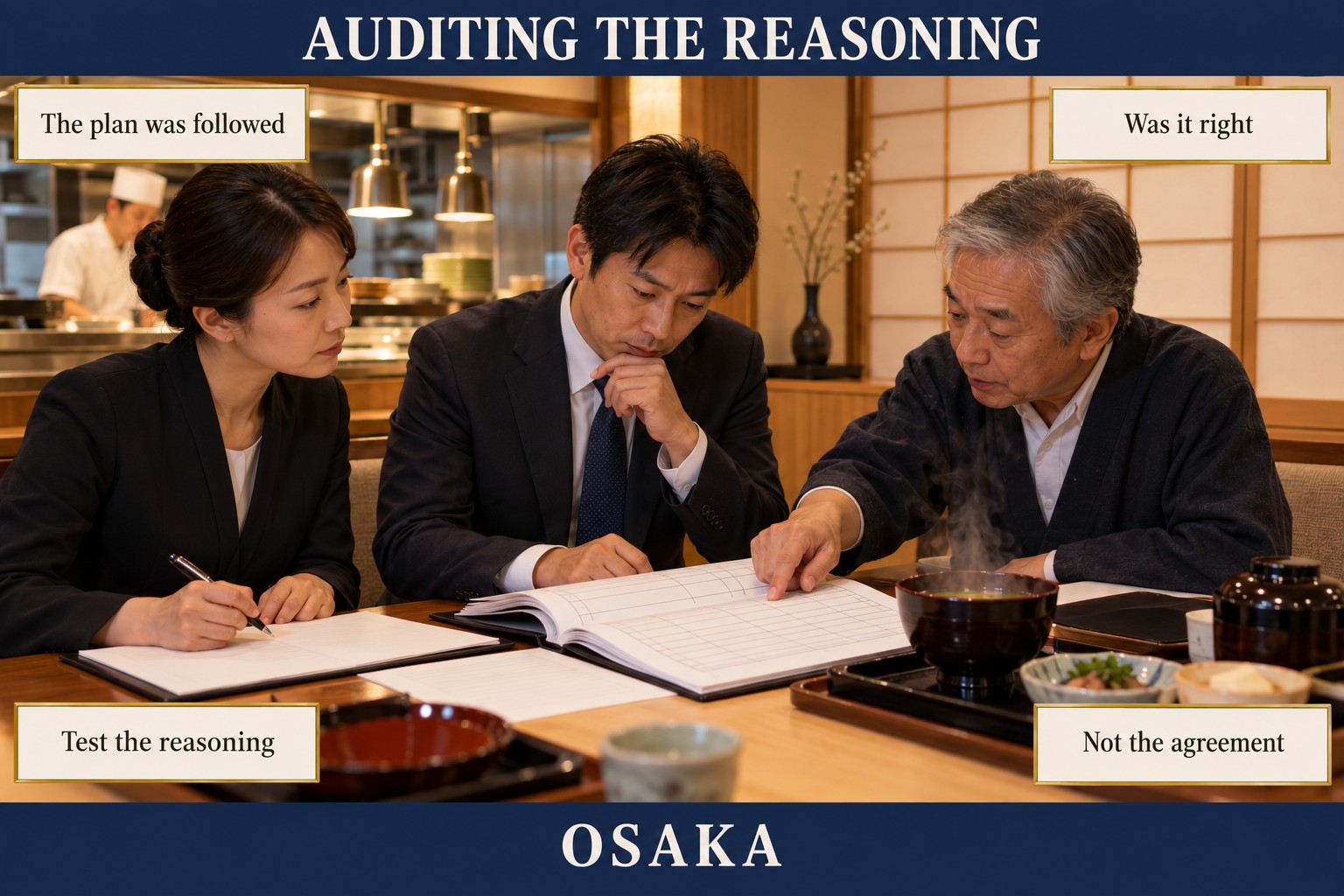
Concept Card 3.11 — Auditing the Reasoning, Not the Records
Subchapter 3.11 · Osaka, Japan
Setting: Osaka, Japan
A table beside a Japanese restaurant kitchen, pale wood and a paper screen. At the centre the internal auditor reads a thick hazard analysis open at a page of ruled grids, his chin on his hand. On his right a technical expert, grey-haired and in a cardigan, points to one cell. On his left the food safety team leader takes notes. A lacquer bowl of dashi steams on the table.
The cell he is pointing at is a score. The plan was followed in every detail, and two years of audits had confirmed it. Nobody had asked whether the scores behind the limits were right. The bowl on the table is one of them: the stock that underlies most of the hotel’s cooking, rated at the lowest likelihood with three words of justification.
The plan was followed, was it right: the upper plaques separate two questions an audit usually treats as one. Test the reasoning, not the agreement: the lower plaques say what the auditor and his expert are doing, following each judgement back to its grounds.
The plate does not accuse the team that wrote the analysis with great care. It shows that a hazard analysis is an argument, and that an argument can be examined.

Concept Card 3.12 — Following One Allergy from Booking to Plate
Subchapter 3.12 · Vancouver, Canada
Setting: Vancouver, Canada
The pass between a hotel kitchen and its restaurant during dinner, plates of salmon crusted with sesame under the lamps. The internal auditor holds up a kitchen ticket. A waiter in a black apron points to the place on it where something should be written. The chef leans in from the kitchen side to look.
Three people are looking at one small piece of paper, and each belongs to a department that had passed its audit. The allergy the guest declared at registration was lost between them, at a hand-off that no department owned. The ticket is where the loss becomes visible.
Every department did its part, the allergy fell between them: the upper plaques explain how clean reports and a wrong plate can exist together. Follow one case end to end is the method. Every hand-off is a question tells the auditor where to stop and ask.
The plate does not look for a guilty department, because there is none. It shows three competent people seeing, for the first time, the whole path of something each had only seen a part of.
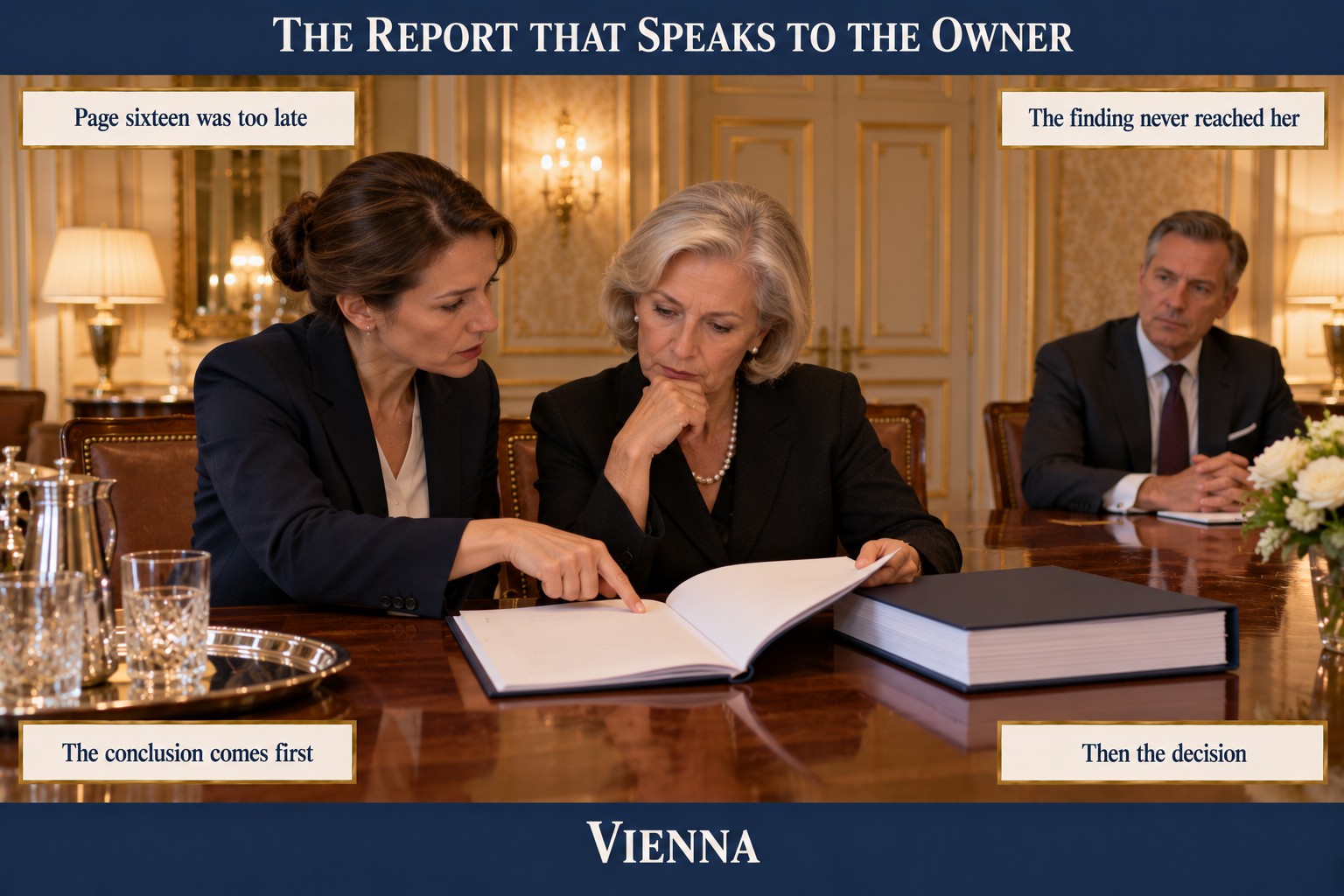
Concept Card 3.13 — The Report That Speaks to the Owner
Subchapter 3.13 · Vienna, Austria
Setting: Vienna, Austria
A boardroom in a palace hotel, gilded panelling and a long polished table. The owner’s representative reads a slim report opened at its first page, her chin on her hand. Beside her the internal auditor points to a line on that page. Next to them lies a thick report, closed. At the far end of the table the general manager waits.
The thick report is last year’s: forty findings in the order of the standard’s clauses, with the only serious one on page sixteen. The owner read the first pages carefully, as she always does. The slim report is the same audit written for her, with what she must decide on the page where she begins to read.
Page sixteen was too late, the finding never reached her: the upper plaques are the failure, and it was a failure of form. The conclusion comes first, then the decision: the lower plaques are the new order of the report.
The plate does not blame the owner for not reading to the end, nor the manager who summarised in good faith. It shows that an audit is finished only when the person who can act has understood it.
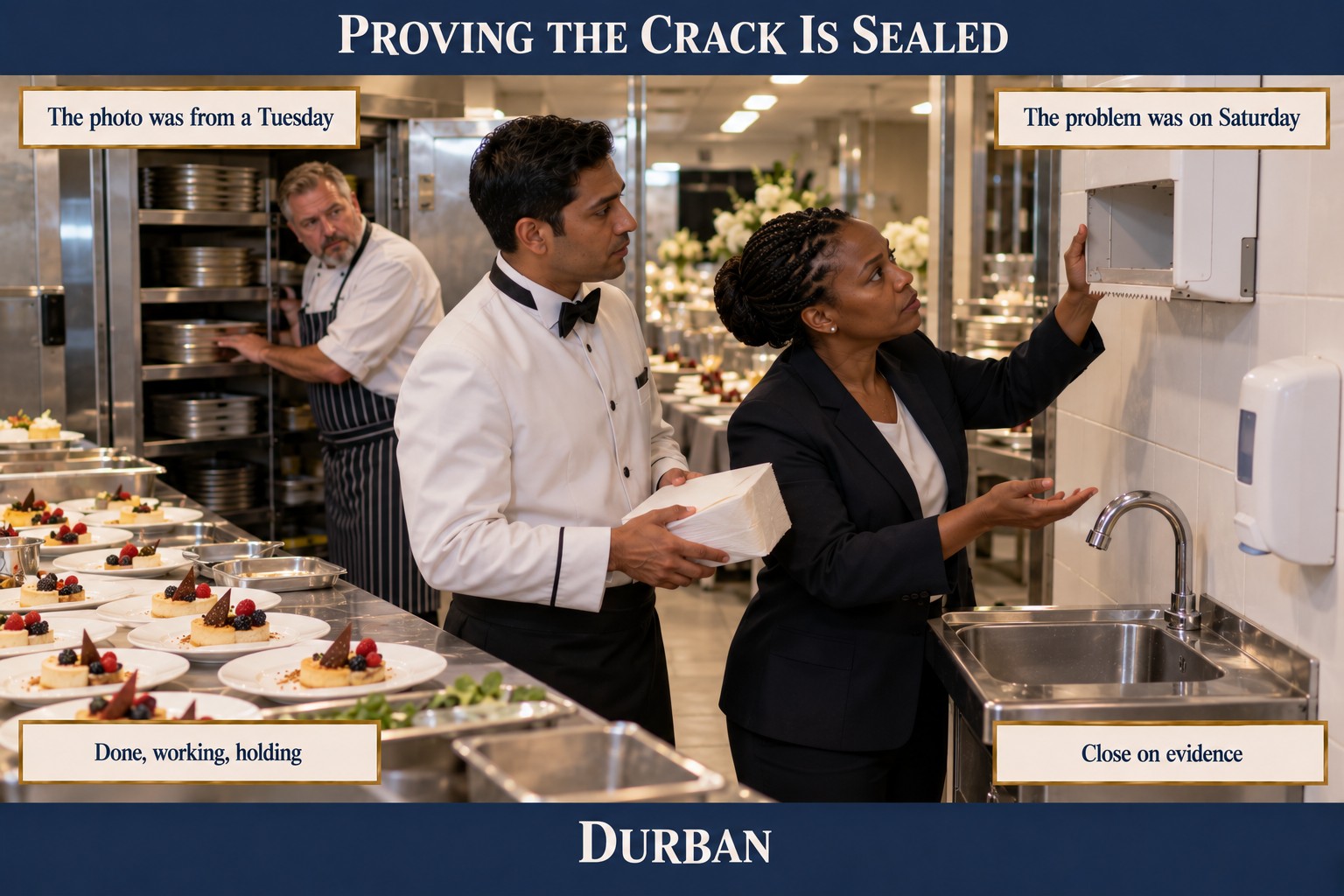
Concept Card 3.14 — Follow-Up: Proving the Crack Is Sealed
Subchapter 3.14 · Durban, South Africa
Setting: Durban, South Africa
A banqueting kitchen at night, the benches crowded with plated desserts. At the hand-wash basin the internal auditor has opened the paper towel dispenser and found it empty; her other hand is turned up. Beside her a banquet steward in a white jacket arrives with a pack of towels. Behind them the executive chef stands at a rack of trays.
The finding about this basin had been closed months earlier, with a photograph of a new dispenser fully stocked, taken on a quiet afternoon. She has come back at the hour and on the night when the problem was first found. The refill arrives a moment after the auditor.
The photo was from a Tuesday, the problem was on Saturday: the upper plaques say why a closure can be true and still prove nothing. Done, working, holding names three stages an action passes through. Close on evidence is the rule for what the word closed may mean.
The plate does not catch anyone lying. It shows the distance between an action taken and a problem solved, and an auditor willing to stand in it on a Saturday night.
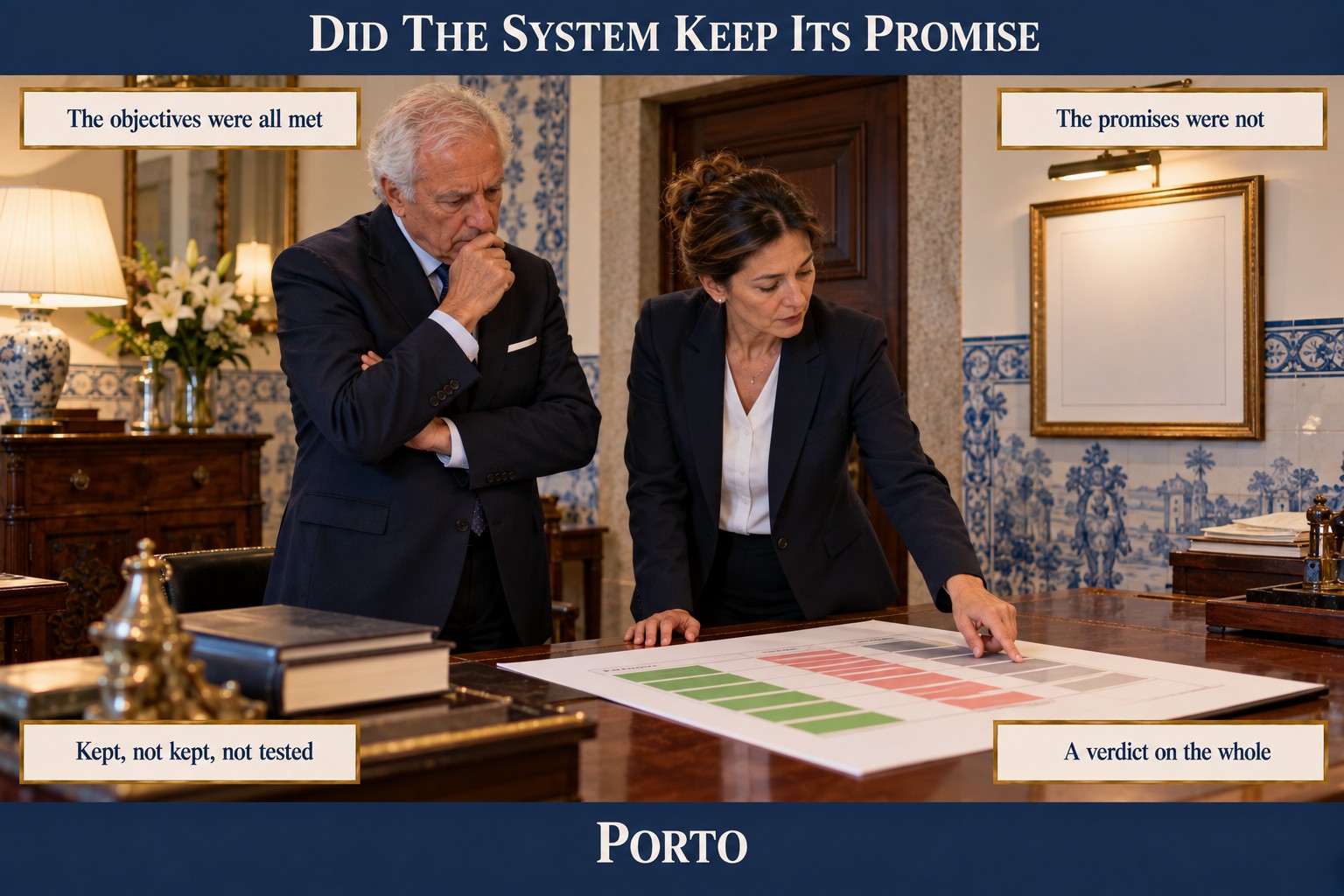
Concept Card 3.15 — Did the System Keep Its Promise?
Subchapter 3.15 · Porto, Portugal
Setting: Porto, Portugal
The owner’s office, blue and white tiles along the walls. On the desk lies a large sheet with three columns of coloured blocks: green, red and grey. The owner studies it with his hand at his chin. Beside him the internal audit lead rests one finger on a grey block. On the wall hangs a framed single page.
The framed page is the policy he wrote himself, three promises in plain words. The sheet is what a year of audits says about them. Green is a promise kept, red one not kept, and grey, where her finger rests, one nobody tested.
The objectives were all met, the promises were not: the upper plaques set what a hotel measures against what it has said. Kept, not kept, not tested gives the three honest answers. A verdict on the whole is what the internal audit owes at the end of its year.
The plate does not accuse the owner, whose promises were sincere. It shows him reading his own words as claims that can be checked.
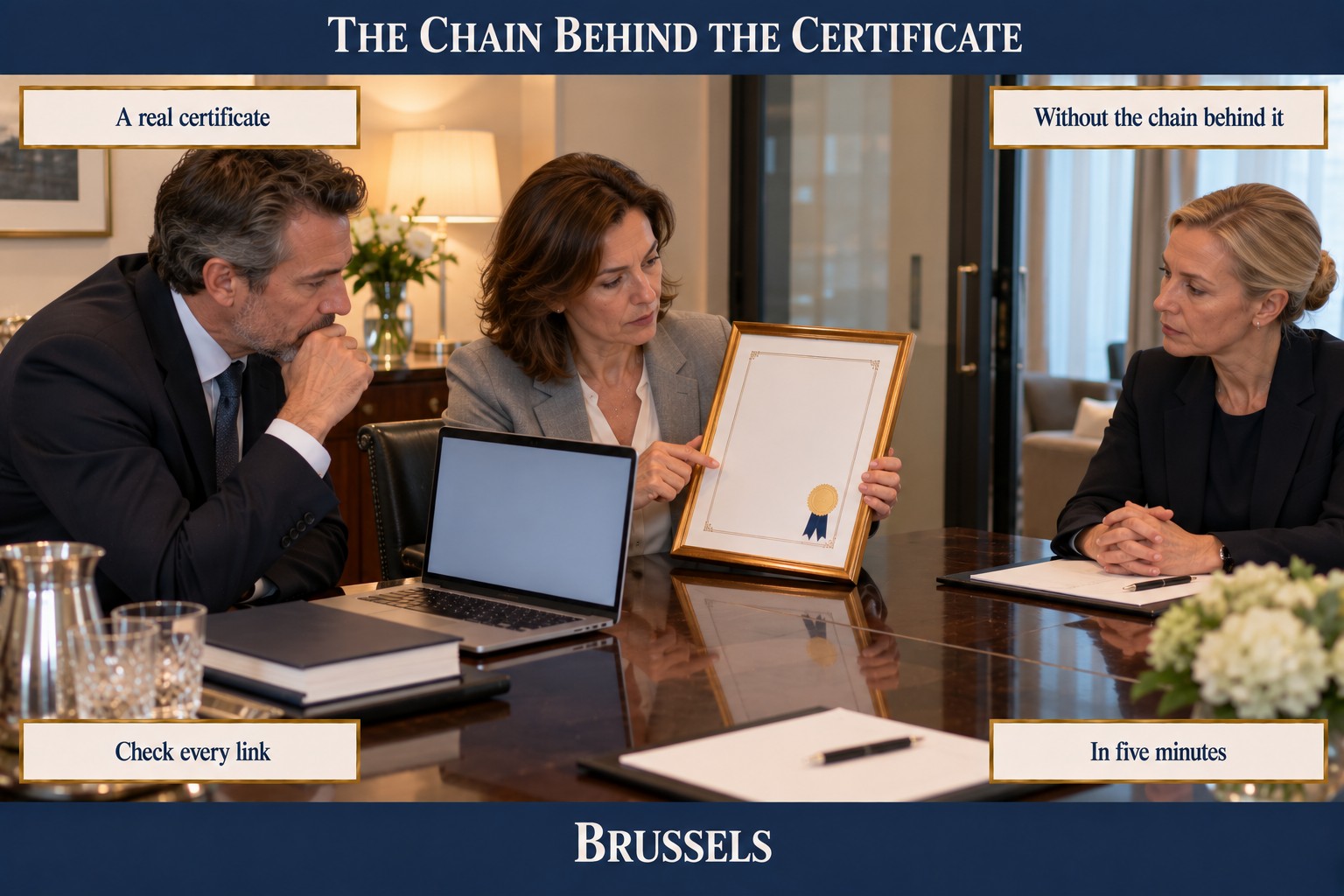
Concept Card 4.1 — The Chain Behind the Certificate
Subchapter 4.1 · Brussels, Belgium
Setting: Brussels, Belgium
A meeting room in a city hotel, lamplight and a long dark table. The quality manager holds the hotel’s framed certificate upright beside an open laptop and points to it. On her left the general manager leans in, his hand at his mouth. Across the table a procurement officer waits with her hands folded on her notes.
The certificate had hung in the lobby for four years and gone out with every tender. It is genuine. The procurement officer asked one question, by whom it was accredited, and the answer was that for food safety it was not. The composition sets the frame against the screen where the chain behind a certificate can be looked up.
A real certificate, without the chain behind it: the upper plaques say precisely what the hotel held. Check every link is the work, from the certificate to the body, from the body to its accreditation and its scope. In five minutes says how little that takes once someone knows the steps.
The plate does not accuse the hotel of deception; it had believed its own certificate. It shows a hotel learning to read the document it had only ever displayed.
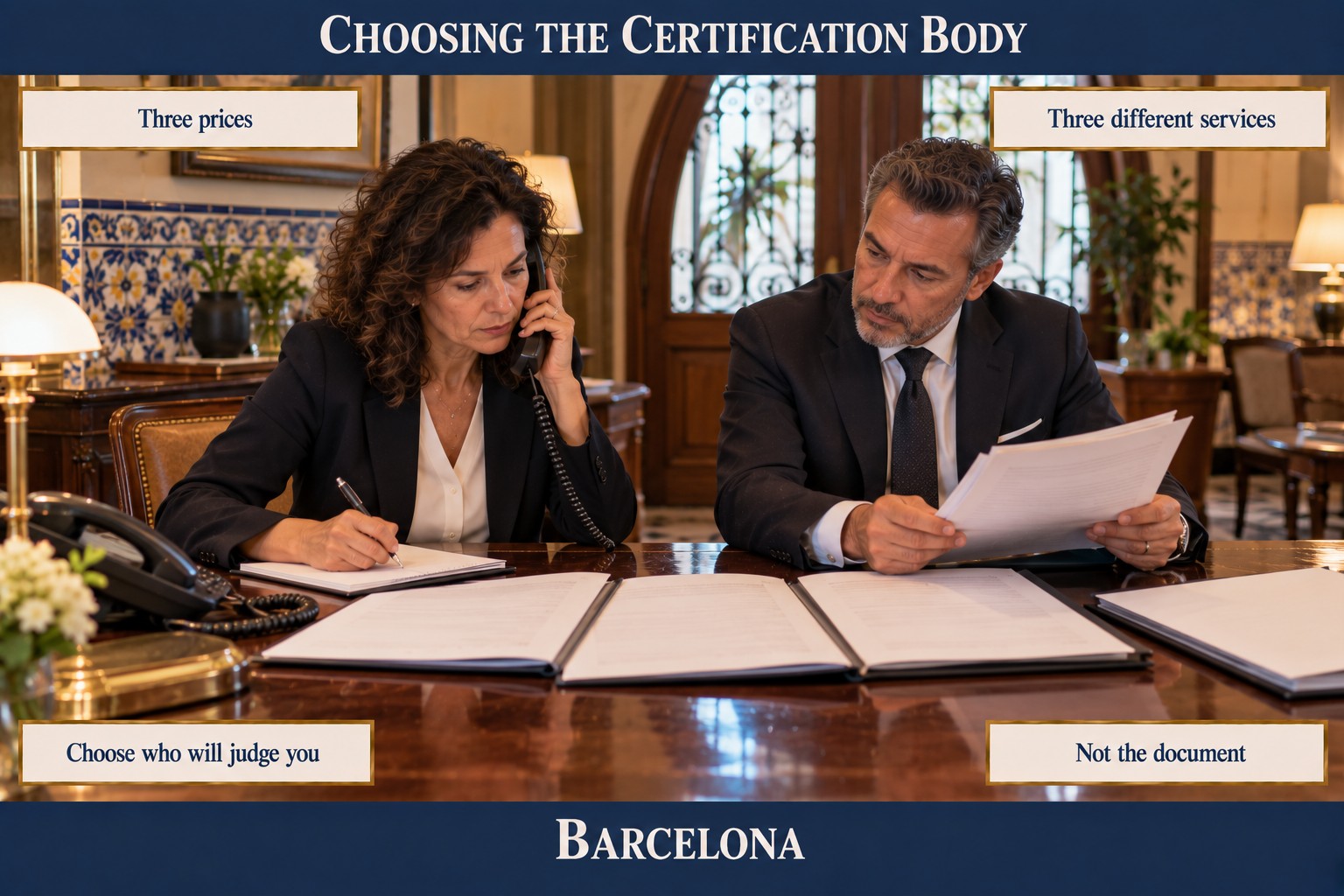
Concept Card 4.2 — Choosing the Certification Body
Subchapter 4.2 · Barcelona, Spain
Setting: Barcelona, Spain
An office in a modernist hotel, carved wood, ironwork and painted tiles. Three quotations lie open side by side on the desk. The quality manager speaks on the telephone and takes notes with her free hand. Beside her the general manager has picked up some of the pages and studies them closely.
Three bodies, all properly accredited, had sent three prices. She is on the telephone because the price was the only thing the quotations made easy to compare. Who would actually come? What had that auditor audited before? Was the help on offer independent of the judgement?
Three prices, three different services: the upper plaques undo the idea that the quotations describe the same thing. Choose who will judge you, not the document: the hotel is choosing a person who will stand in its kitchens for years, and a certificate is only what that person leaves behind.
The plate does not condemn the cheapest offer, or the manager drawn to the one that promised a smooth certification. It shows a week of questions that changed a purchase into a choice.
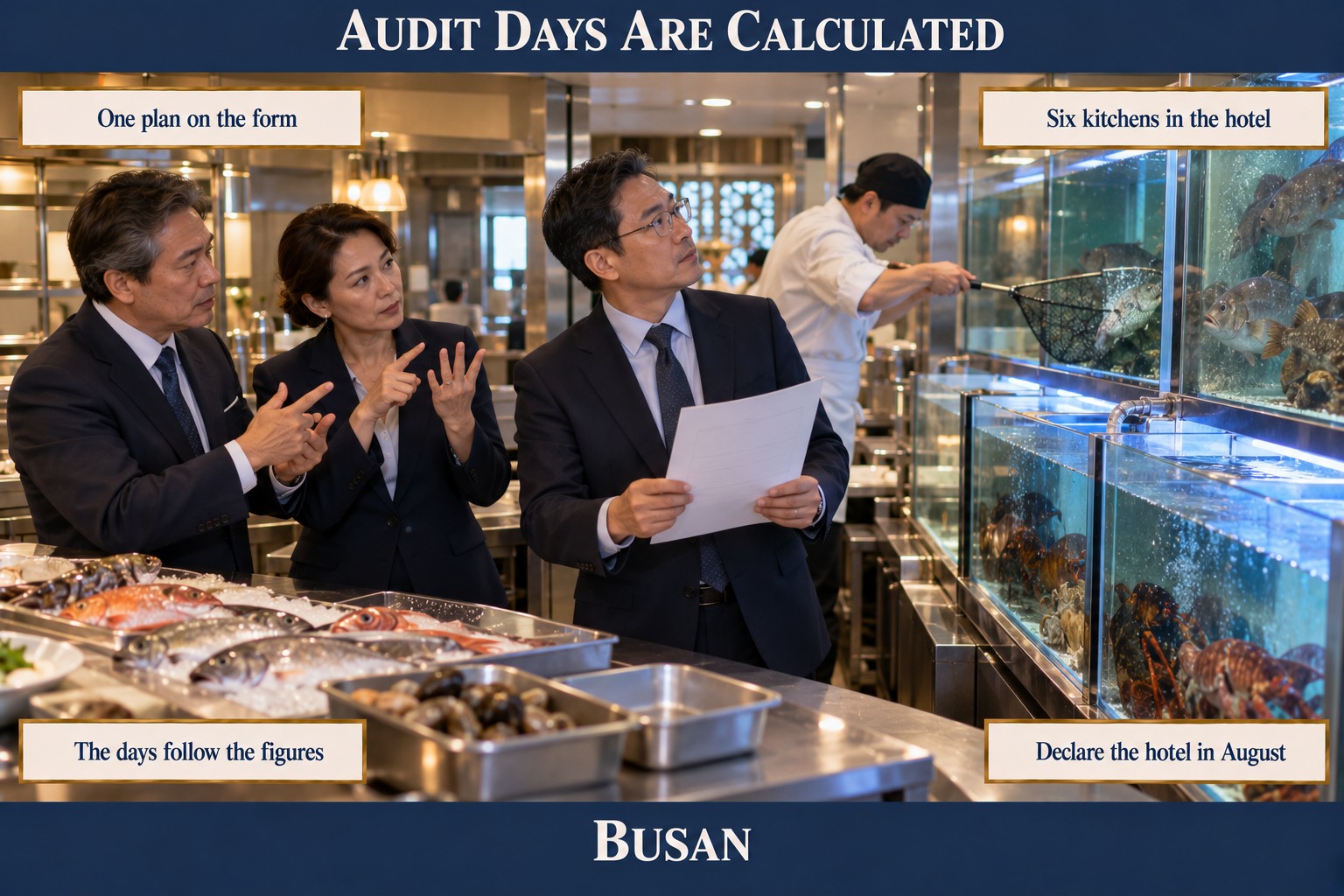
Concept Card 4.3 — Audit Days Are Calculated, Not Negotiated
Subchapter 4.3 · Busan, South Korea
Setting: Busan, South Korea
The raw fish restaurant of a beach hotel, glass tanks of live fish and shellfish along the wall. The certification auditor holds a single application form and looks up at the tanks. Beside him the quality manager and the general manager count on their fingers. Behind them a cook lifts a fish from a tank with a net.
The form in his hand says one hazard study and a hundred and forty employees. The room he is standing in is one of six operations with hazards of their own, and by August nearly three hundred people will work in the building. The manager had wanted to negotiate the audit days down; here he is counting instead.
One plan on the form, six kitchens in the hotel: the upper plaques are what the first morning revealed. The days follow the figures says that audit time is derived, by rules, from what the hotel declares. Declare the hotel in August tells it which version of itself to put on the form.
The plate does not accuse the quality manager, who answered each question as she understood it. It shows that an audit sized for a smaller hotel is not a saving.
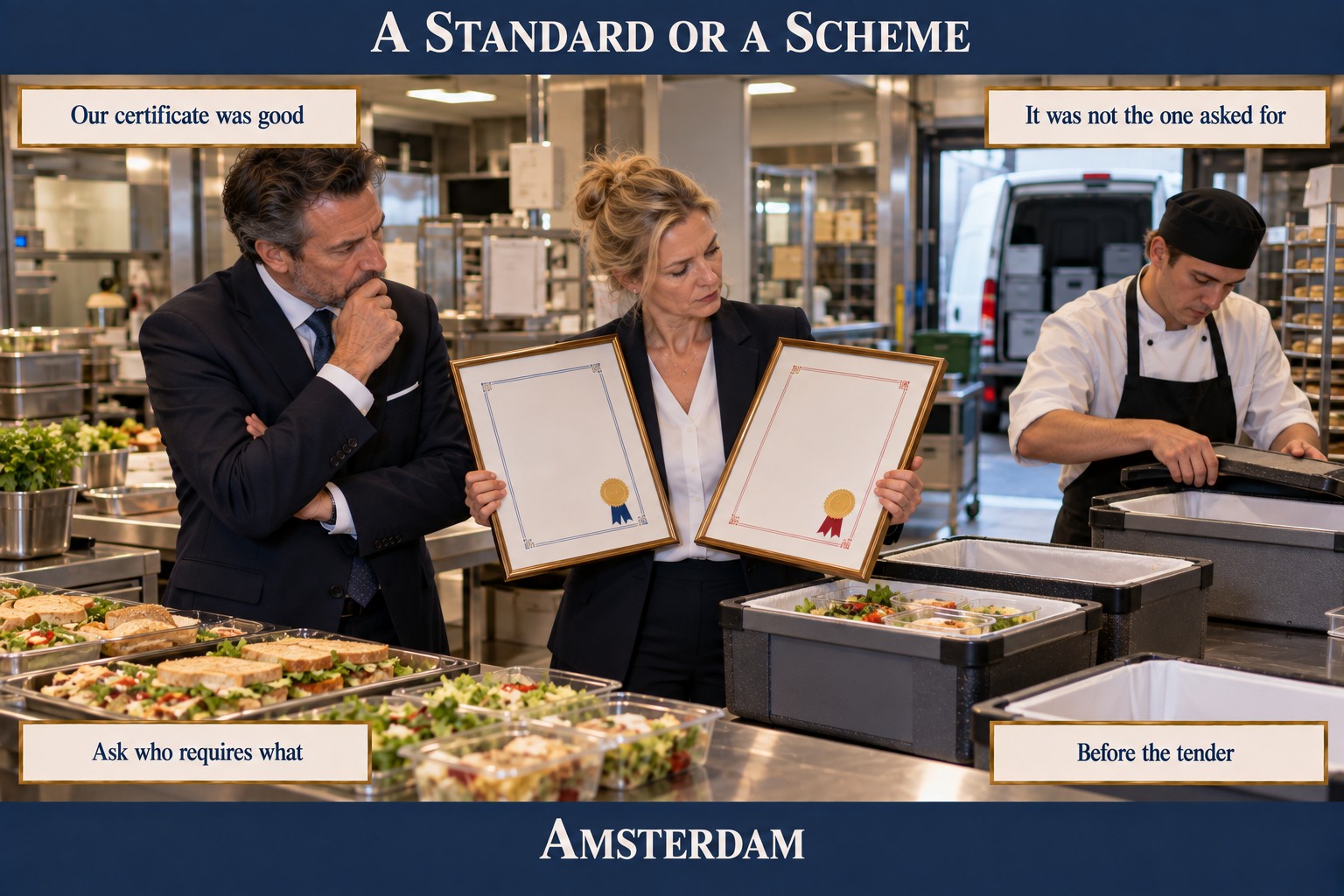
Concept Card 4.4 — A Standard or a Scheme?
Subchapter 4.4 · Amsterdam, the Netherlands
Setting: Amsterdam, the Netherlands
A production kitchen at the back of a canal-house hotel, sandwiches and salads lined up for packing. The quality manager holds two framed certificates, one in each hand, and looks from one to the other. Beside her the general manager studies them. At the bench a cook closes an insulated box. Through the loading door a van stands ready.
The two frames look almost alike, and that is the point. One is the certificate the hotel holds, sound and accredited. The other is what the client’s tender asked for, a scheme that contains the same standard and adds requirements of its own. The boxes and the van are the business that depends on the difference.
Our certificate was good, it was not the one asked for: the upper plaques separate quality from fit. Ask who requires what is the question to put to every buyer. Before the tender says when: five months is enough to extend a certification, and five days is not.
The plate does not say the hotel’s certificate was worth less than it thought. It shows a manager who read the specification slowly, and a hotel learning that a requirement belongs to the one who sets it.
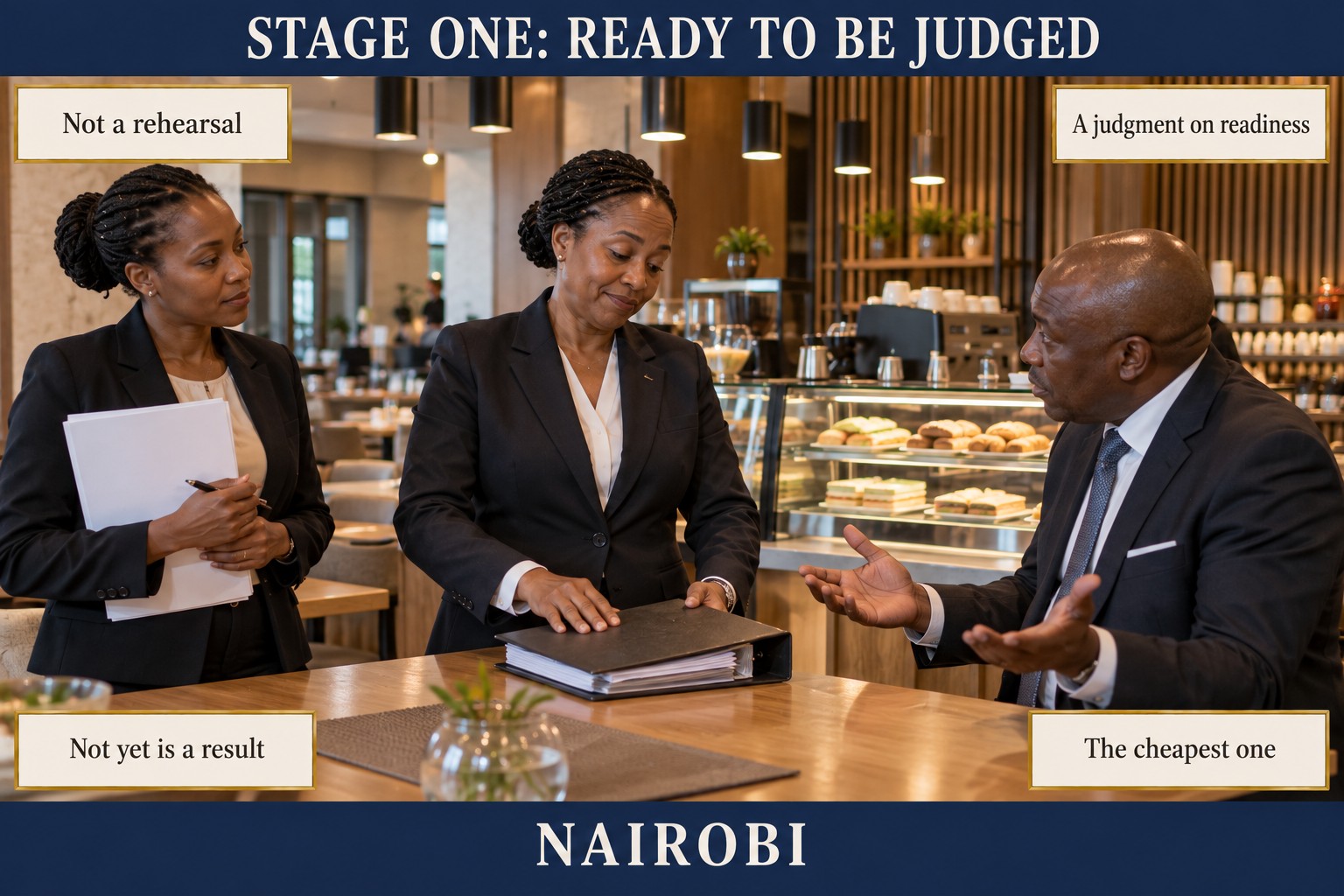
Concept Card 4.5 — Stage 1: Readiness Before Anyone Enters the Kitchen
Subchapter 4.5 · Nairobi, Kenya
Setting: Nairobi, Kenya
The new café of a hotel conference centre, a display case of sandwiches and pastries, and nobody yet behind the counter. At the centre the certification auditor closes a binder on the table with both hands and gives a small, kind shake of the head. Facing her the general manager spreads his hands. Beside her the quality manager holds her list.
The café opened in January and is not yet in the hazard analysis. The water treatment is not validated, and the management review has been postponed twice. The general manager had called the first stage a rehearsal. The closed binder is the auditor’s answer.
Not a rehearsal, a judgment on readiness: the upper plaques correct a common idea of what Stage 1 is for. Not yet is a result, the cheapest one: to hear not yet now costs a few weeks; to hear it at Stage 2 would have cost far more.
The plate does not show a failure. The quality manager had answered honestly when asked how ready they were, and the auditor is not unkind. It shows the moment a date gives way to a state of readiness.

Concept Card 4.6 — Stage 2: The Kitchen at Full Service
Subchapter 4.6 · Salvador, Brazil
Setting: Salvador, Brazil
A hotel pool deck at lunchtime in full sun. At a small stall a baiana in white lace and a head wrap fills fritters to order, a spoon of golden vatapá in her hand. The certification auditor, in a light jacket, looks down at the steel container on her counter. Beside him the quality manager holds her papers. Behind them guests wait in line.
On the first day the documents were complete: a time limit for the paste at ambient temperature, and a record signed at eleven every morning. He has come back at twenty to one, with the hotel full. The container stands in the sun, and the woman tells him without unease when the paste was made.
The record said eleven, the service said otherwise: the upper plaques put two days of the audit side by side. Conformity and effectiveness are the two things a Stage 2 audit must find. Seen at full service says where the second one is found.
The plate does not accuse the baiana, whose craft is older than the hotel. It shows a control that was written, signed and never made part of her work, and an auditor who knew at what hour to come.
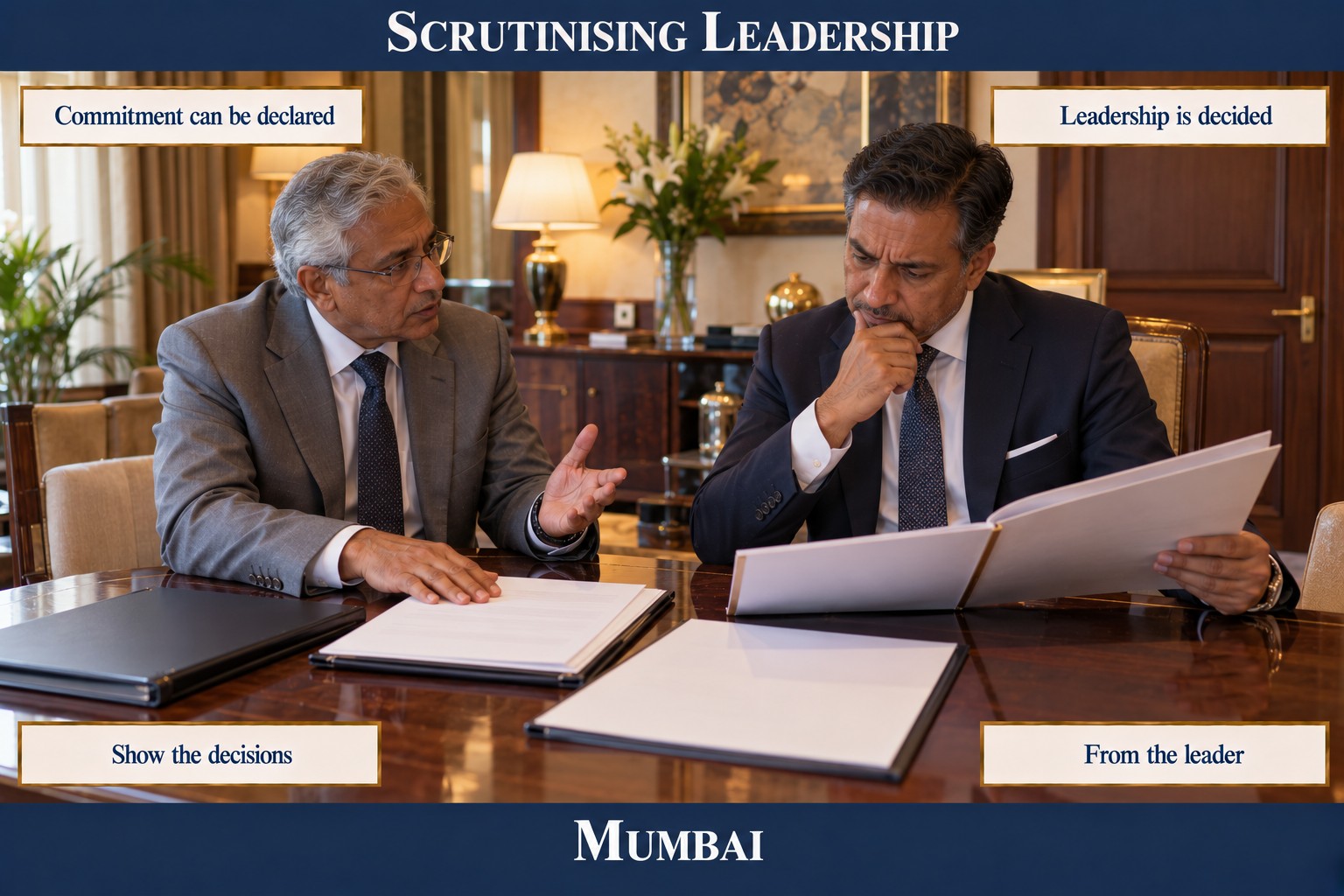
Concept Card 4.7 — Scrutinising Leadership
Subchapter 4.7 · Mumbai, India
Setting: Mumbai, India
The general manager’s office in a seafront hotel, dark wood and lamplight. The certification auditor, grey-haired and in a grey suit, rests one hand on the minutes of the management review and asks a question with the other. Facing him the general manager holds a wedding contract open and frowns at it. A slim presentation lies closed at the edge of the desk.
The presentation was what the general manager had brought: objectives, a signed policy, an organisation chart. The auditor set it aside after the first slide. The minutes record a blast chiller deferred and a second officer declined. The contract allows outside caterers into the hotel’s kitchen. Both carry a signature.
Commitment can be declared, leadership is decided: the upper plaques are the difference between the presentation and the minutes. Show the decisions, from the leader: nobody else in the hotel can give evidence of what its leader chose.
The plate does not portray a careless manager. He had a difficult year and trusted his chef. It shows a man reading his own decisions as an auditor reads them.
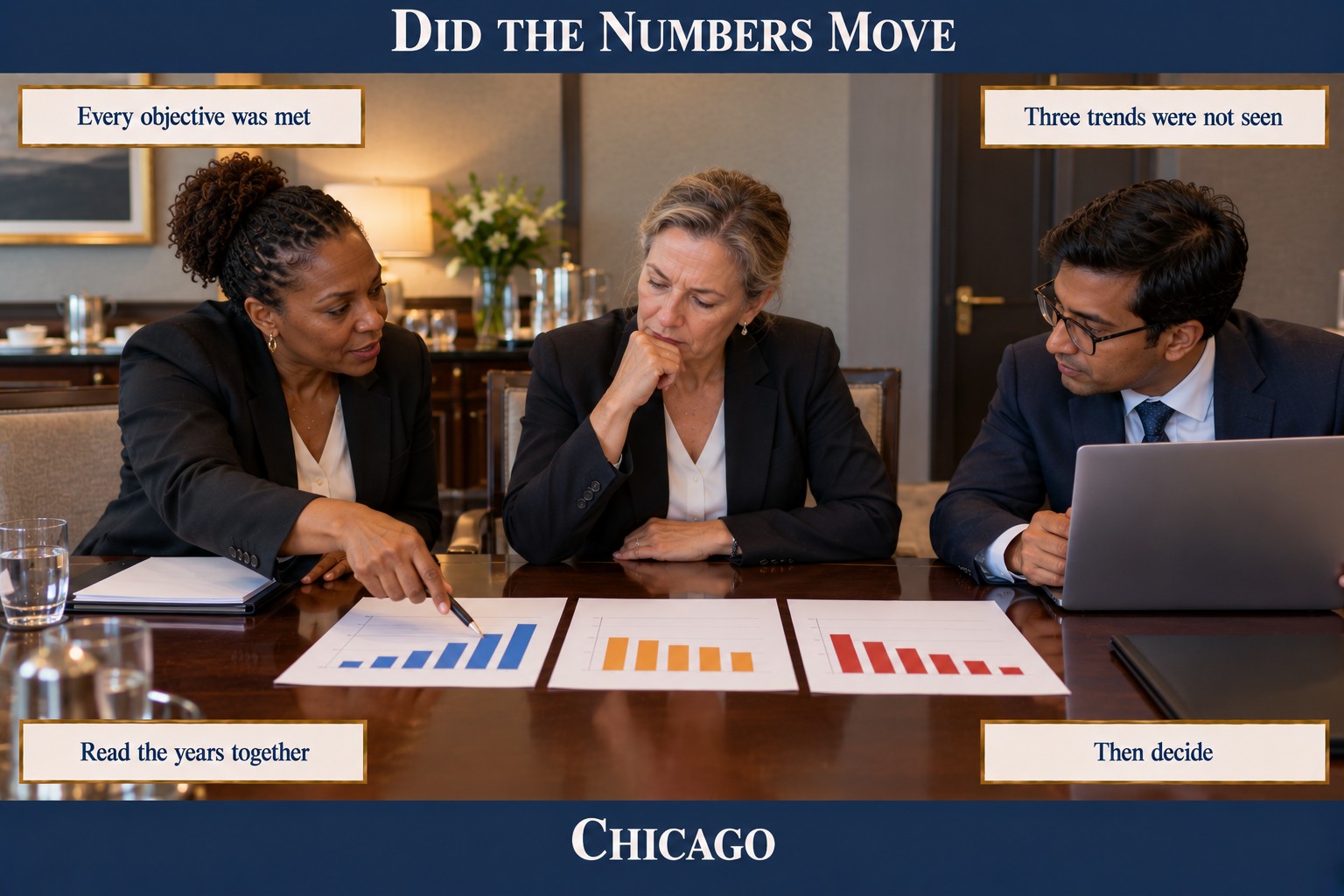
Concept Card 4.8 — Did the Numbers Move?
Subchapter 4.8 · Chicago, United States
Setting: Chicago, United States
A meeting room in a large downtown hotel, three sheets laid side by side on a dark table. Each carries a row of coloured bars: on one the bars climb, on the others they shorten. The certification auditor leans over them, her chin on her hand. On her left the food safety team leader points with a pen at the rising bars. On her right a revenue analyst sits at his laptop.
For three years the hotel had met all five of its objectives. The sheets are the same data read as series: complaints still under the limit while the share about allergens climbed, deviations steady in number and gathering in one kitchen. The analyst is there because nobody had ever put the years together.
Every objective was met, three trends were not seen: the upper plaques set a result against a direction. Read the years together is what an hour with the data achieved. Then decide gives the management review something to do beyond recording that targets were reached.
The plate does not question the numbers; every one was accurate. It shows an auditor who asked to see what lay underneath the results.

Concept Card 4.9 — Multi-Site, and the Outlets in Concession
Subchapter 4.9 · Punta Cana, Dominican Republic
Setting: Punta Cana, Dominican Republic
The edge of a beach club in an all-inclusive resort, a wooden bar under thatch, a grill, sun loungers among the palms. A rope on wooden posts marks the boundary, and on it stands a blank sign. The multi-site auditor rests a hand on the sign and asks a question. Beside him the group quality director holds her clipboard. Behind the bar the concession holder listens.
The guest with a wristband does not see the rope. The grill behind the bar belongs to another business, on the resort’s own sand. The company wanted one certificate for all its properties; the auditor found four separate systems and, at each resort, uncertainty about which outlets were inside.
Four systems, one logo is what he found behind the wish. Where does the certificate end is the question he put at every resort. One system, many sites is the condition for certifying a group together. Every outlet decided means in or out, on purpose.
The plate does not accuse the concession holder, who runs his club as his contract allows. It shows that a group certificate rests on a central system that really governs, and on an edge someone has drawn.
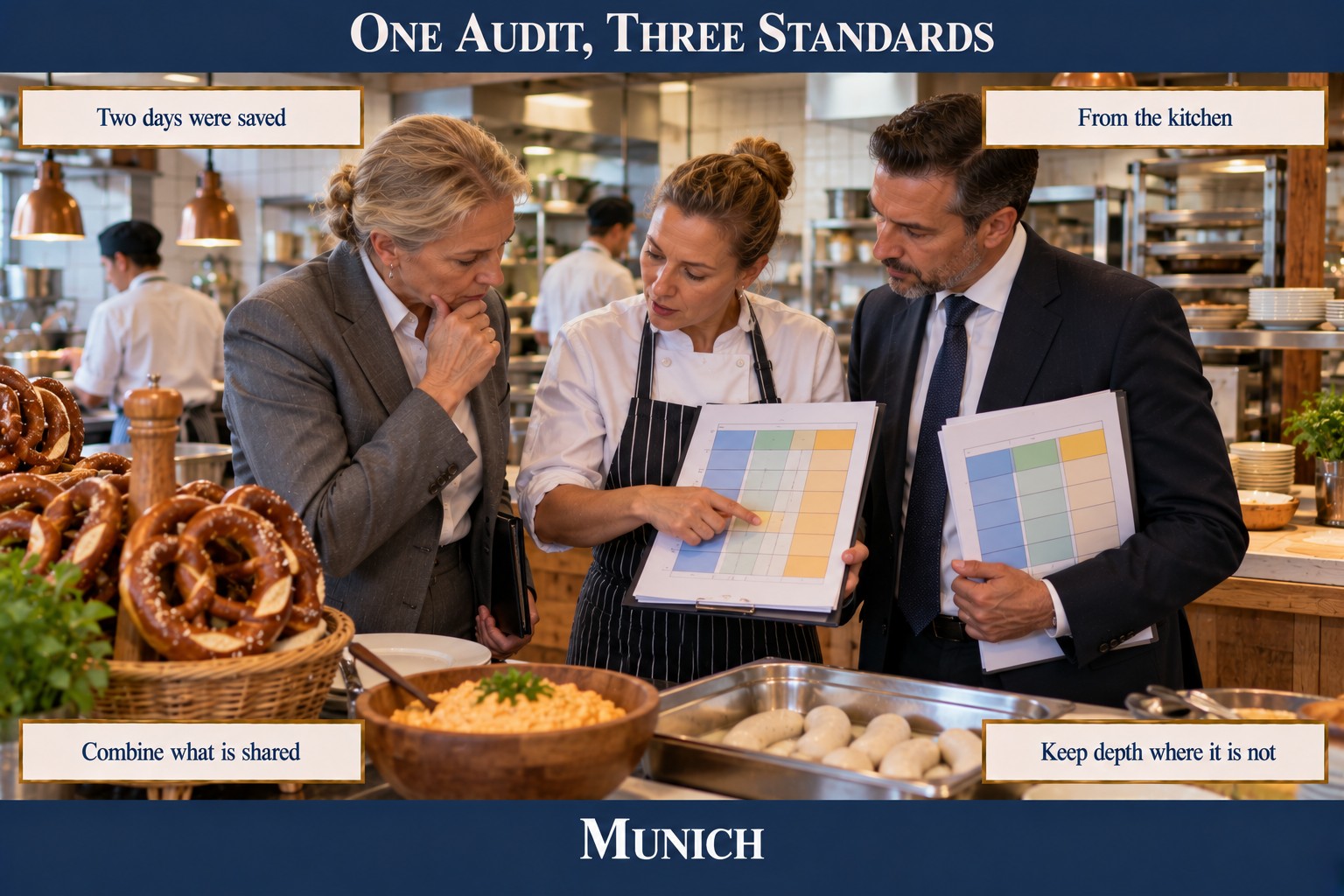
Concept Card 4.10 — One Audit, Three Standards
Subchapter 4.10 · Munich, Germany
Setting: Munich, Germany
A Bavarian hotel kitchen, pretzels piled in a basket, a wooden bowl of orange cheese spread, a tray of white sausages. The food safety team leader, in whites and a striped apron, holds an audit plan divided into three coloured columns and points to one small cell. The lead auditor studies it, her hand at her chin. Beside them the quality and environment manager holds a second copy.
The three columns are three standards audited together, by one team, in four days instead of six. The cell under her finger is the time given to the kitchens for food safety: three hours on a weekday morning. She is showing them where the two days came from.
Two days were saved, from the kitchen: the upper plaques are the arithmetic of the combined audit. Combine what is shared is the sound part of the idea. Keep depth where it is not protects what only a food safety auditor, in the kitchen at the right hour, can see.
The plate does not oppose the combined audit, and nobody here acted in bad faith. It shows a team leader who did not find a clean report reassuring, and who read the plan to find out why.

Concept Card 4.11 — Findings: Major, Minor, and the Deadline
Subchapter 4.11 · Fez, Morocco
Setting: Fez, Morocco
The courtyard of a riad, carved plaster arches, a tiled fountain and orange trees. At a low table set with mint tea and a pastilla dusted with sugar, the quality manager hands a thick bound file to the certification auditor. Beside them the general manager holds a single sheet and looks at the file.
The single sheet was the hotel’s first response to a major nonconformity on allergens: the labels reprinted, the waiters retrained, the matter closed. The thick file is the second. It holds the correction, the reason the buffet list had drifted from the recipes, the action taken on that cause, and proof of each.
One page was not enough, correction is not cause: the upper plaques explain why the first answer came back. Evidence, not promise is what the body must receive before it can close a finding. Within the deadline is the condition on which the certificate stays valid.
The plate does not show a hotel in disgrace. It shows the difference between fixing a label and understanding why it was wrong, and a response that can be weighed in the hands.
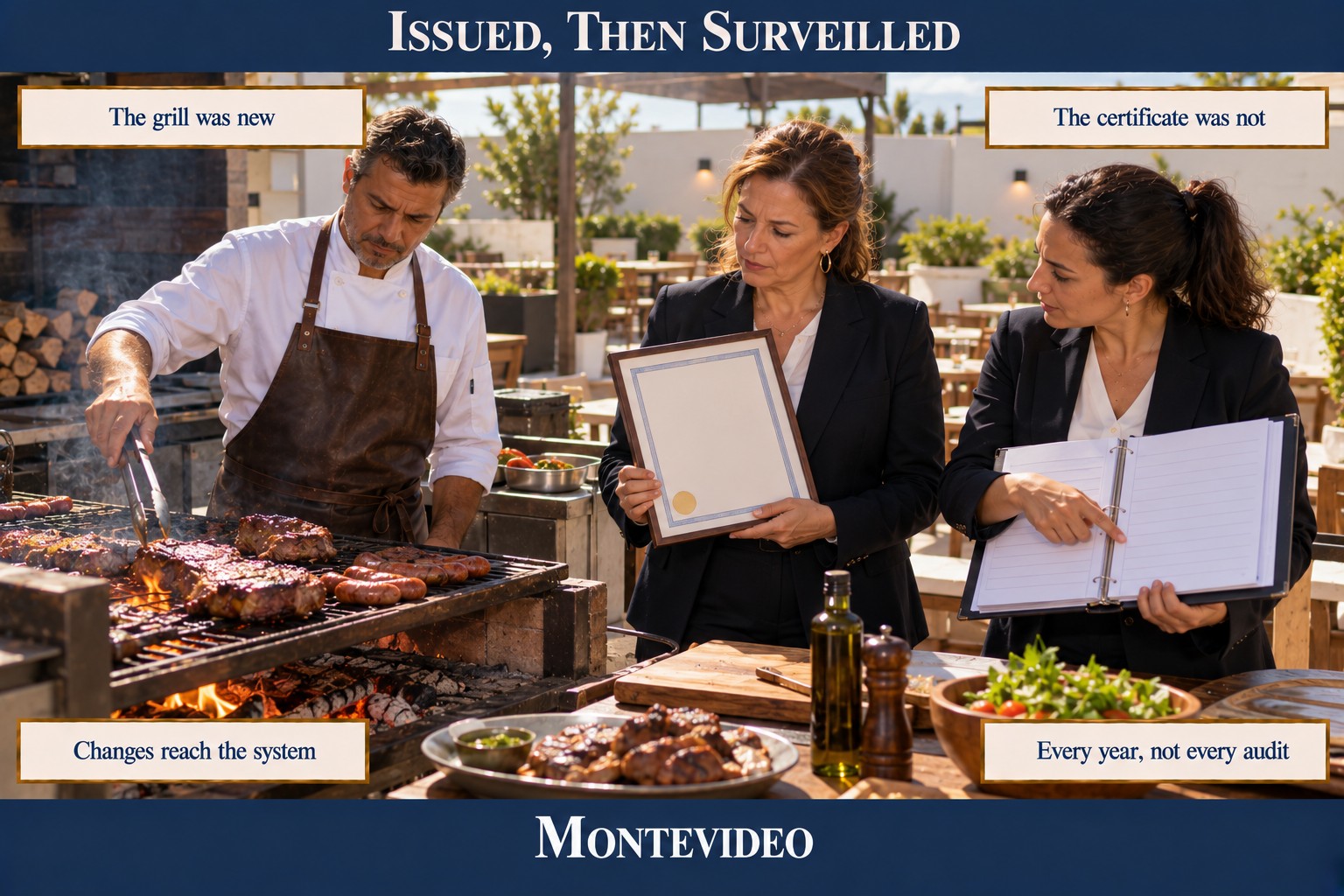
Concept Card 4.12 — Issued, Then Surveilled
Subchapter 4.12 · Montevideo, Uruguay
Setting: Montevideo, Uruguay
A hotel rooftop terrace with a wood-fired grill, beef and sausages over the embers. The grill cook, in a leather apron, turns the meat. Next to him the certification auditor holds the hotel’s framed certificate and looks from it to the grill. Beside her the quality manager holds open a register and points to a ruled page.
The certificate is two years old. The grill opened in the second of those years and became the hotel’s most profitable outlet. It is not in the scope, not in the hazard analysis, and its meat comes from a supplier nobody evaluated. The register is what the hotel keeps now: every change, written down when it happens.
The grill was new, the certificate was not: the upper plaques are what a surveillance visit found. Changes reach the system is the duty that had lapsed. Every year, not every audit says who keeps a certificate alive: the hotel, on the days when no auditor is there.
The plate does not blame the grill cook, who was never told he worked inside a certified system. It shows that a certificate describes a hotel on a date.
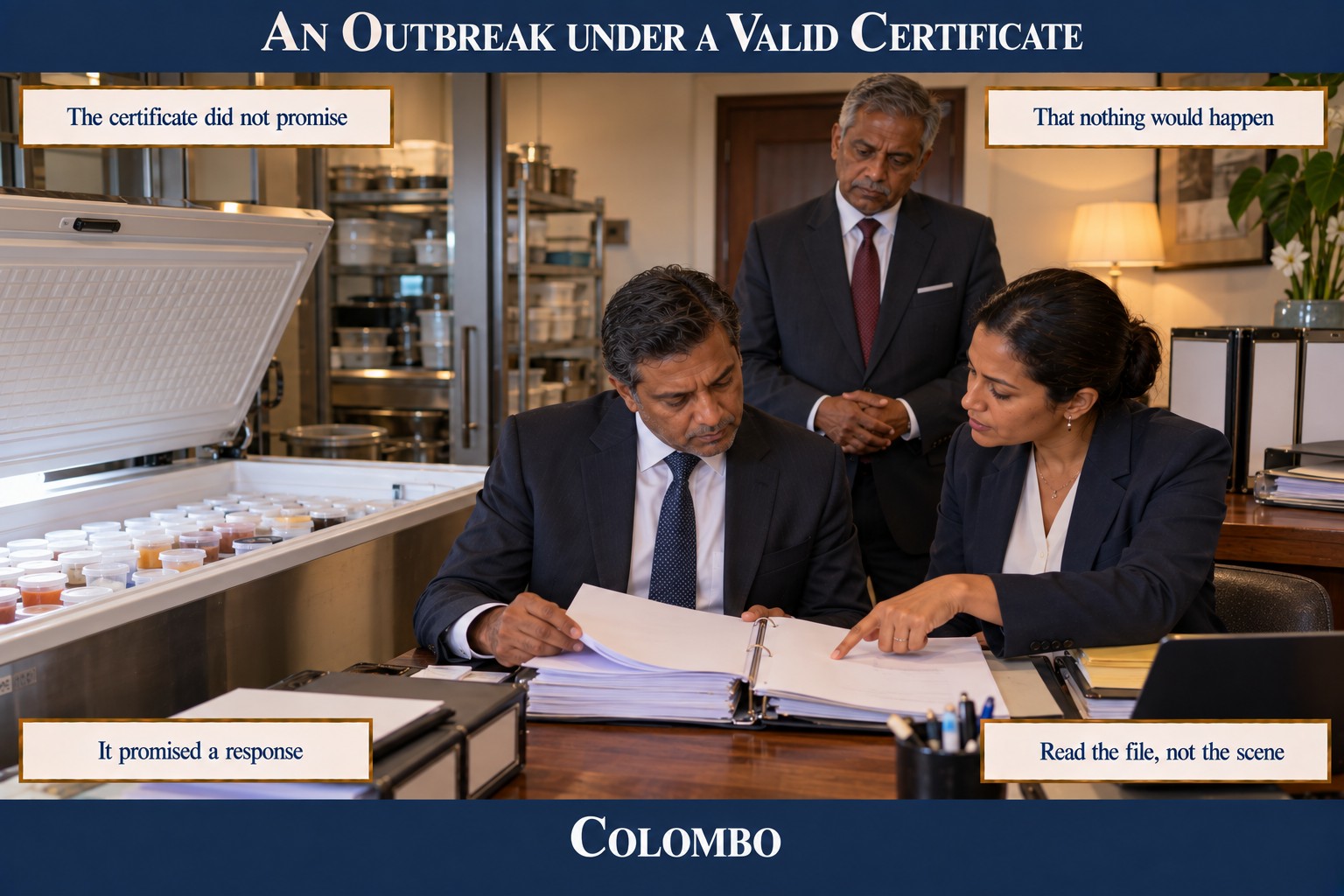
Concept Card 4.13 — An Outbreak Under a Valid Certificate
Subchapter 4.13 · Colombo, Sri Lanka
Setting: Colombo, Sri Lanka
A quiet back office in a large hotel. The certification auditor sits at a desk and reads a thick incident file. Beside him the food safety team leader points to a page. Behind them the general manager stands with his hands clasped. To one side a chest freezer stands open, showing rows of small sealed pots: the samples the hotel keeps from every banquet dish.
There is no guest in this picture and no dining room. The subchapter reads the file, and so does the plate. The pots are why the laboratory could name the station within days. The pages record what the hotel did hour by hour, and the gap it found: a rule on illness that never reached the agency cooks.
The certificate did not promise that nothing would happen: the upper plaques say what a certificate is not. It promised a response is what it is. Read the file, not the scene tells the auditor, and the reader, where the evidence of that system lies.
The plate does not look away from what happened, and it does not display it. It shows a hotel being judged on how it answered.
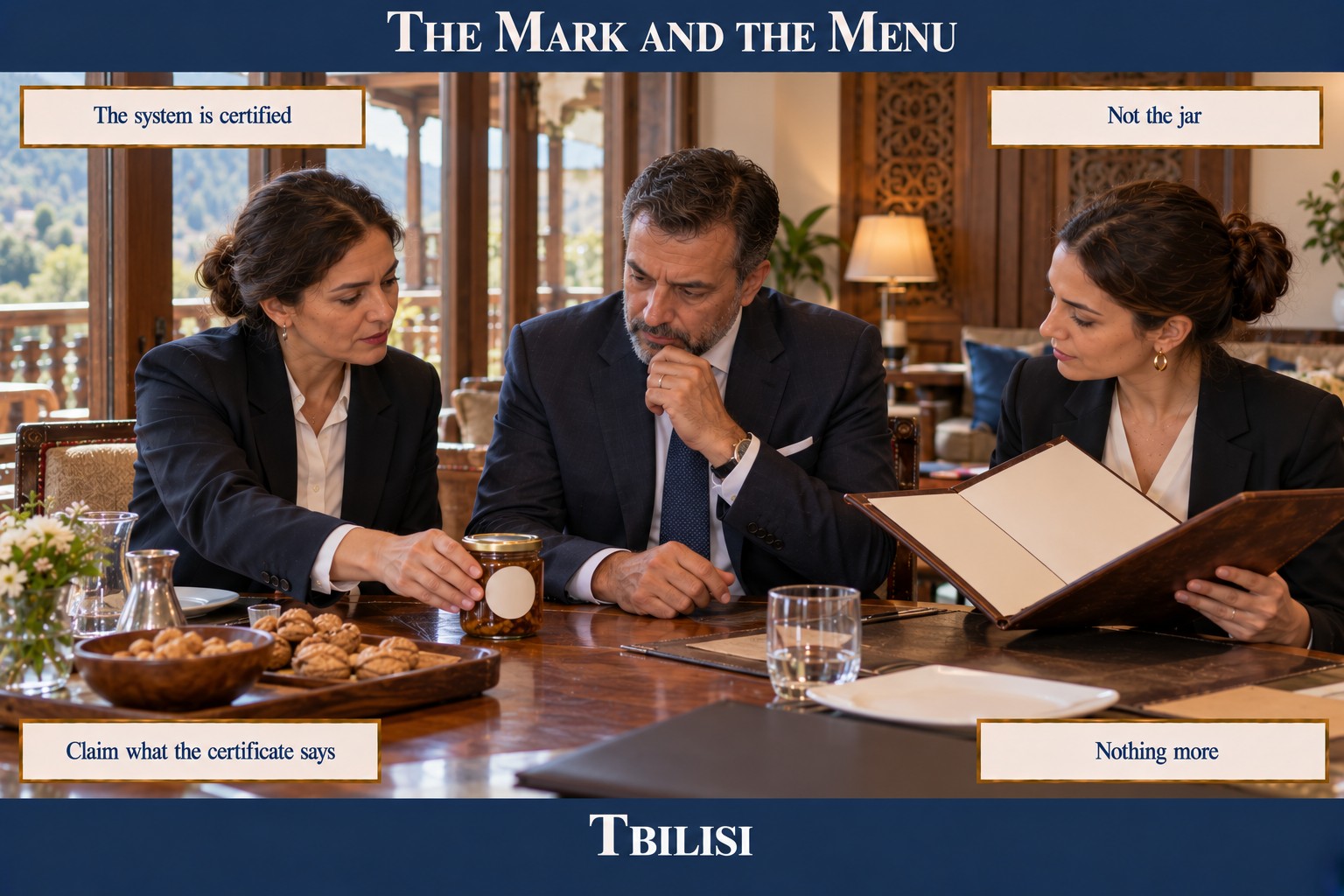
Concept Card 4.14 — The Mark and the Menu
Subchapter 4.14 · Tbilisi, Georgia
Setting: Tbilisi, Georgia
A meeting room in a hillside hotel, carved wood and a view of green slopes. The certification auditor reaches across the table and turns a small jar of walnut preserve so that its round sticker faces the general manager. He looks at it, his hand at his chin. Beside him the marketing manager holds a menu open.
She bought the jar in the lobby shop the evening before. The preserve is made by a family in a village, not by the hotel, and it is in no scope. The sticker told every guest who bought one that the product was certified. The menu carried the same claim in a gentler form.
The system is certified, not the jar: the upper plaques draw the line the marketing had crossed. Claim what the certificate says, nothing more: a certificate speaks about a management system and a scope, and its mark may say only that.
The plate does not mock the marketing manager, who was proud of the certificate and wanted guests to know. It shows how a true statement becomes a false one on the wrong object, and an auditor who made the point with a jar.

Concept Card 4.15 — Excellence as a Permanent State
Subchapter 4.15 · Auckland, New Zealand
Setting: Auckland, New Zealand
A hotel garden at dusk, steam rising from an earth oven behind. Wire baskets of lamb and root vegetables have just been lifted out. The food safety team leader pushes a long probe into a shoulder of lamb and writes on a sheet with her other hand. Beside her the head cook of the feast watches. Across the table a tour operator’s buyer looks on.
Nobody has stopped for this. The reading takes a few seconds and is part of the evening now. What the buyer came to see is in front of her: the system at work on an ordinary night, in the hands of the people who cook.
A certificate is where trust begins, the proof is on the plate: the upper plaques give the certificate its place, real and limited. Every day after is where excellence lives. The helm and the lens names the two instruments of the series, the one that steers and the one that looks.
The plate ends on a probe, a number written down and a cook who watches calmly, because the check has become his own. It shows what the thirty hotels of this volume were working towards: food that is safe when nobody has come to check.
L’AUTORE