
The Helm and the Lens · English
Disponibile / Available
the Helm and the Lens – Vol. 7b
GSTC Hotel Standard · Sustainable Tourism in Hospitality Volume 7b — The Lens
The GSTC Hotel Standard v4.0 through the eyes of the internal auditor and the certification body: how to test a hotel’s sustainability against the indicators, and what a GSTC-accredited certificate really proves. Thirty cases, from Puerto Ayora to Rarotonga.
565
Pagine
The Helm and the Lens · Volume 7b — The Lens
GSTC Hotel Standard · Sustainable Tourism in Hospitality
Auditing a property against criteria written for the whole of tourism
A sustainability report can be well written and still describe a hotel that does not exist. This volume is about the moment someone checks. That might be the hotel’s own internal auditor walking the property with the criteria in hand. It might be a certification body deciding whether a certificate can be issued, kept or withdrawn.
With version 4.0 of the GSTC criteria, published at the end of December 2025, audits are built on performance indicators rather than on the criteria alone. This changes what evidence counts. A written policy is no longer enough: the auditor looks for what the indicator says should be visible in the hotel’s records, in its staff and in its surroundings. This book shows how to do that work with rigour, without turning it into a box-ticking exercise.
Chapter 3, The Internal Auditor’s Lens, follows the internal auditor through the four sections of the Hotel Standard: management system, socio-economic impacts, cultural heritage and environment. It covers how to plan a programme around real risk, and how to interview staff and suppliers as well as managers. It shows how to verify claims made to guests, and how to approach sensitive areas such as the protection of children and the rights of local communities with the care they need. Chapter 4, The Certifier’s Lens, explains the rules certification bodies work under when they assess a hotel against a GSTC-recognised standard. It covers what an audit must include, how nonconformities are graded and closed, and how the transition from version 3 to version 4 affects existing certificates. It also shows how to read a certificate and its scope before trusting it.
Every subchapter opens with a case set in a real place, built as a composite and clearly declared as fictional. The story starts in Puerto Ayora, in the Galápagos, and returns there through the volume. Each one carries a Verification Pact, which keeps apart what the standard requires of a hotel, what is required of the certification body, and what is the author’s recommendation.
The author is a Lead Auditor and has spent over twenty years in international luxury hospitality. He writes as an author and publisher, for those who audit hotels and those whose hotels are audited. This is independent material, not affiliated with or endorsed by the GSTC: the standard’s own texts, published at www.gstc.org, always prevail.
Each subchapter ends with a concept card. Audit worksheets, evidence checklists and the cards in high resolution are available on the online platform. The companion volume, 7a — The Helm, reads the same criteria from the owner’s chair.
EDIZIONI · FORMATI
Formati disponibili
Le edizioni fisiche e digitali associate a questa scheda.
NEL LIBRO
Contenuto / Contents
La struttura del volume così come presentata nell’edizione pubblicata.
Table of Contents
- Preface.
- 3.1 Why Audit Against a Standard Written for Tourism..
- 3.2 An Audit Programme Proportional to the Property.
- 3.3 Who Audits a Thirty-Room Hotel? Independence and Competence.
- 3.4 Evidence That Holds: Documents, Observation, Interviews.
- 3.5 Auditing What the Hotel Says About Itself.
- 3.6 Auditing the Legal Register Without Being a Lawyer.
- 3.7 Interviewing Staff in Their Own Language.
- 3.8 Listening Beyond the Fence: Stakeholders and Community.
- 3.9 Auditing Suppliers and Purchasing.
- 3.10 Auditing the Sensitive Criteria: Safeguarding and Conduct.
- 3.11 Auditing Culture and Heritage Claims.
- 3.12 Auditing Environmental Data: Meters, Invoices and Spreadsheets.
- 3.13 Walking the Pathway: Waste, Wastewater and Chemicals.
- 3.14 Auditing Nature: Biodiversity, Animals and Tour Providers.
- 3.15 From Findings to Decisions: The Report That Gets Acted On.
- 4.1 Who Certifies the Certifier: Accreditation Explained.
- 4.2 Choosing a Certification Body, and the Two-Year Rule.
- 4.3 How a Certifier Sizes the Audit: Risk and Duration.
- 4.4 The Initial Audit on Site.
- 4.5 When the Certifier Talks to Your Neighbours.
- 4.6 Major, Minor and Ninety Days.
- 4.7 The Certification Decision and the Person Who Was Not There.
- 4.8 Certificates, Logos and the Claims That Follow..
- 4.9 Surveillance: Annual, Remote, Unannounced.
- 4.10 One Certificate, Many Hotels: Multi-Site Certification.
- 4.11 Group Certification for Small Properties.
- 4.12 Transfer, Suspension and Withdrawal
- 4.13 Supplier Due Diligence Through the Certifier’s Eyes.
- 4.14 The Transition Audit: From v3.0 to v4.0.
- 4.15 Recertification and the Three-Year Cycle.
- Afterword.
- Appendix A..
- Sources and Research Methodology — What This Book Verified, and How..
- Glossary.
- About the Author.
- Contact.
- The Series.
- The Online Platform..
PRIMA DELL’ACQUISTO
Estratti / Extracts
Passaggi selezionati dal libro disponibili per la consultazione.
01 Preface Apri / Open
This book exists because a hotel that has decided to be sustainable, and has built the evidence to show it, soon meets a second question that is rarely answered plainly: what happens when someone else is allowed to check the work? First a colleague with a checklist, then a stranger from a certification body: what does each of them look at, and why?
The companion volume, The Helm, read the GSTC Hotel Standard from the side of ownership: forty criteria, each with performance indicators beside it, representing, in the words of the preamble, “the minimum level of performance that any tourism business should aspire to achieve”. This volume reads the same standard from the other side of the table. Its first chapter takes the position of the internal auditor, who must ask a hotel to see itself as a stranger would. Its second takes the position of the certification body, which is that stranger.
The GSTC Hotel Standard, the one standard in this series that is not an ISO standard, contains no criterion called internal audit and says nothing about how a certification body must work. The first gap is filled by the indicators themselves, which cannot be met honestly without some disciplined way of checking the hotel against itself; the second by a separate document written for certification bodies. This book reads the two side by side.
The Helm and the Lens is built the same way here as everywhere else in the series. It asks what the texts themselves require and it tests that answer across thirty subchapters set in hospitality settings on six continents, from the Arctic to the Pacific, with a single twenty-eight-room hotel in Puerto Ayora, in the Galápagos Islands, opening the volume, closing its first chapter and closing the book. Where a matter turns on national law, it sends the reader to the legal register that criterion A2 requires. The series calls this discipline standard-pure: no single country’s law is allowed to stand in for the world.
A Series Built the Same Way Twice
This volume belongs to a wider undertaking, first built in German for the DACH hospitality market under the title Das Steuer und die Lupe, The Helm and the Lens, translated directly, and now built a second time, independently, for a global English-language readership. The two editions are not translations of each other, and here they do not even treat the same standard: the German edition turns to the EU’s Eco-Management and Audit Scheme, this one to the GSTC. What the two share is a method, not a text: the same architecture, the same tracing of every normative claim to its primary source, and the same refusal to let a market’s inflated claims about a standard stand unchallenged.
That discipline has a name inside this series. We call it the Verification Pact. Every significant claim this book makes about what the GSTC Hotel Standard requires is checked directly against the text of version 4.0, its performance indicators and its annex of guidelines. Every claim about what a certification body must do is checked against the GSTC Accreditation Manual for Certification Bodies for the tourism industry (hotels and accommodation, tour operators, MICE and attractions), version 5.0, approved on 1 March 2026. Where the market inflates a voluntary practice into a requirement, this book says so, in a dedicated table. Where the market has understated a genuine obligation, such as a minor nonconformity treated as a footnote, a remote audit treated as equal to a visit or a transfer treated as a way out of a finding, this book says that too. The Pact cuts in both directions, and it is not negotiable. Where a related document was named but not read directly, the section on Sources and Research Methodology says so.
Who Certifies the Certifier
Because this volume follows a hotel all the way to its certificate, it owes the reader a short account of the system around that certificate. The GSTC does not certify hotels. It recognises standards written by other organisations as equivalent to its criteria, which are then called GSTC-Recognized, and it accredits certification bodies as competent and impartial, which are then called GSTC-Accredited. A hotel is certified only when an accredited body audits it against the GSTC criteria or a recognised standard, within a scope that covers hotels and accommodation.
The Accreditation Manual requires certification bodies to comply with ISO/IEC 17065, the international standard for bodies that certify products, processes and services, and builds on it the requirements specific to sustainable tourism: audit plans based on ISO 19011, sampling, risk assessments that weigh the place as well as the size of a hotel, trained auditors, a three-year cycle with annual surveillance, nonconformities with fixed deadlines, a decision taken by someone who was not at the audit, and logos that never say more than the scope allows. In some countries, including those of the European Union, a GSTC-Endorsed National Accreditation Body accredits in the GSTC’s place. Either way, someone has always checked the certifier.
This book does not explain how to run a certification body. It explains to hotels what a certifier does and why, so that an owner can read an audit plan before approving it, a nonconformity before answering it and a certificate before framing it.
The Pact in Practice
A single example shows how the Pact works inside a chapter rather than as a stated principle alone. The first subchapter of Chapter 4 follows a thirty-six-room hotel on the edge of the Knysna lagoon, on the southern Cape coast of South Africa, whose main tour operator asks for certification by a GSTC-Accredited body. Within a week the owner receives an offer of “GSTC-aligned sustainability certification” at a third of the usual price, and signs. The certificate arrives on time, with a green leaf and the words “Certified Sustainable, GSTC-aligned”. The tour operator declines it. The issuer is not on the GSTC’s list of accredited bodies, its standard is not recognised, and the certificate carries no GSTC-Certified logo and no traceable code.
The subchapter’s Verification Pact table sets the market’s habits beside the texts. A certificate “aligned to the GSTC Criteria” is GSTC certification: no, because certification requires an accredited body auditing against the GSTC criteria or a recognised standard. Accreditation is a formality that adds nothing for small hotels: no, because it is the only independent check that the body is competent, impartial and covers all the criteria. And the Pact turns back on the hotel as well: criterion A5 requires promotional claims to be transparent and verifiable, so a certificate the hotel presented as GSTC certification was not only a commercial loss but a gap against the very standard it wanted to meet. The same table appears in every subchapter, from the thirty-eight unevidenced ticks of the first to the three-year calendar of the last.
Every criterion, indicator and clause cited is taken from the primary texts, in the versions this Preface names, not from a secondary summary. Where this volume offers its own extrapolation, such as an audit programme, a checklist or a modelled cost estimate, it says so.
Two Volumes: The Helm and the Lens
Each standard receives two volumes. The Helm, Volume 7a, the companion volume, takes the perspective of ownership and management: sustainable tourism as a decision of ownership, and what the criteria do and do not certify. The Lens, Volume 7b, the book you are holding, takes the position of those whose task is verification: auditing a property against criteria written for the whole of tourism, first from the inside and then from the outside.
The two volumes are companions, not a single book divided arbitrarily in half. Each stands on its own. Read together, they follow a property from deciding what its sustainability is, through building the evidence that shows it, to the moment someone else is allowed to check the work, and every year after.
Who This Book Is For …
02 3.13 Walking the Pathway: Waste, Wastewater and Chemicals Apri / Open
GUIDING QUESTION
A register of waste contracts, safety data sheets and discharge tests can be complete and still describe only part of a hotel. Criteria D5 to D8 ask where wastewater, waste and chemicals actually go. How does an internal auditor move from the binder to the pipe, and what does she do when the two disagree?
Opening
The hotel stands on the waterfront at Kralendijk, on Bonaire, a forty-room dive property whose guests spend most of their days below the surface of the marine park that protects the island’s coast. A short wooden jetty leads from the terrace to a ladder into the water, and the house reef begins a few metres beyond it. The beach bar on the terrace serves breakfast and sunset drinks; behind it, a small swimming pool is used mostly by families on rest days between dives.
The hotel’s environmental register is, by any standard, well kept. The chief engineer maintains a chemicals inventory with a safety data sheet for every product, filed by department. Solid waste is collected under contract by a licensed operator, with monthly weight tickets. The main building’s wastewater is connected to an approved treatment system, and the register holds the test results the hotel receives. A one-page plumbing drawing, prepared when the main building was renovated, shows every drain and where it leads.
In May, the hotel’s internal audit of D5 to D8 is carried out by the assistant general manager, trained for the purpose in the GSTC criteria and in the audit guidance of ISO 19011, who has no responsibility for engineering. She reviews the register in the morning and finds it in order. In the afternoon she does what her audit plan calls “walking the pathway”: she takes each stream, wastewater, solid waste and chemicals, and follows it on foot from where it is generated to where it leaves the hotel.
Before she sets out, she reads the guest feedback for the previous quarter, as the plan requires. One comment card, from a diver, mentions “foam on the water near the ladder some evenings”. Nobody had followed it up. Walking along the shoreline below the beach bar, the auditor finds a plastic pipe emerging between the rocks a few metres from the jetty. It is not on the plumbing drawing. The chief engineer, called down from the workshop, traces it within half an hour: the beach bar’s sink and glass-washer, added two years after the renovation, drain into a stormwater line that runs to the shore. The pool’s filter backwash is connected to the same line.
The walk produces two further findings. The used cooking oil from the kitchen is collected by a local man who says he makes fuel from it; there is no record of who he is or what happens to the oil. And the pool chemicals store, a locked room behind the pump house, holds no safety data sheets: they are all in the binder in the engineering office, on the other side of the building.
It is worth being fair to the chief engineer. His register is better than most, every document in it is genuine, and the treatment system for the main building performs as its tests show. The beach bar was installed by an outside contractor during a busy season, at the request of the food and beverage department, and the connection was never drawn. The register was accurate about everything it described. It simply did not describe everything.
The Problem
The Structural Failure
The structural failure was a register built from documents rather than from the site. The plumbing drawing reflected the hotel as it was at the last renovation; every change since then had been made by someone other than the person who kept the register. Contracts, tickets and test results confirmed the pathways the hotel knew about. Nothing in the system was designed to find the pathways it did not.
This is why an audit of D5 to D8 that stays at the desk is incomplete by design. A register shows that documented streams are managed. It cannot show that all streams are documented. Only a walk, from source to exit, tests that second question.
The Cultural Failure
The cultural failure was a division of attention. Engineering looked after the register; food and beverage looked after the bar; the dive centre looked after the guests in the water. The diver’s comment card reached guest relations, which filed it as a minor complaint about water quality, a matter for nature rather than for the hotel. Each department saw a fragment, and no one put the fragments together.
An internal auditor’s advantage is that she belongs to no department’s routine. Reading guest feedback before walking the site, and walking the site before signing off the register, is how she connects what three departments had each seen separately.
The Principle
For waste, wastewater and chemicals, the register describes the pathway and the site is the pathway. The internal auditor tests the first against the second.
| Stream | What the register shows | What the walk tests |
| Wastewater and greywater | Connection to an approved system; test results | Every drain, sink and outlet, including those added since the last drawing |
| Pool and spa water | Chemical dosing records | Where backwash and drained water actually go |
| Solid waste | Contract and weight tickets from the licensed collector | Streams handed to anyone else, such as oil, batteries or electronic waste |
| Hazardous waste | Disposal records for known products | Old stock, empty containers and where they are left |
| Chemicals in use | Inventory and safety data sheets | Whether data sheets are at or near the point of use, and storage conditions |
| Pollution sources | A list of identified sources under D8.1 | Light, noise, runoff and erosion observed on site |
The walk does not replace the register; it validates it. An audit that finds the register complete and the walk consistent with it can conclude that the pathways are known. An audit that finds a pipe the register does not mention has found something more important than any missing document.
What the Standard Says
Criteria D5 to D8 of the GSTC Hotel Standard, version 4.0, sit in the category “Reducing Pollution” together with D3 and D4. Read as a group, they ask the hotel to know its pathways, to document safe outcomes and to train the people who manage them.
| Criterion | Indicators an internal auditor tests | Points from the guidelines |
| D5 Wastewater | D5.1 compliance with applicable law; D5.2 documented evidence of safe discharge; D5.3 reuse where feasible; D5.4 technical staff training | Municipal, government-approved or compliant on-site systems; periodically tested, performance documented and reported |
| D6 Solid Waste | D6.2 plan by the Waste Hierarchy; D6.3 waste by type per guest night or occupied room; D6.7 legally authorised or recognised pathways; D6.8 training records | Minimum categories: recyclables, food waste, landfill or incineration; specialised handlers for electronic waste, batteries, used cooking oil and hazardous materials |
| D7 Harmful Substances | D7.1 updated inventory and safety data sheets; D7.2 usage monitored; D7.4 storage, handling and disposal compliant; D7.5 staff training | Safety data sheets accessible at or near points of use, including pool maintenance and landscaping chemicals |
| D8 Minimize Pollution | D8.1 sources identified by location and context; D8.2 measures for sources under direct control; D8.3 regular monitoring and review | Sources include noise, light, stormwater runoff, soil erosion and ozone-depleting substances; reviews incorporate guest and stakeholder feedback |
The criterion statement of D5 sets the test the Kralendijk outlet failed. Wastewater, “including greywater”, is effectively managed and treated and is only reused or discharged when it meets safe, best-practice quality standards “to ensure no harm to the local population and ecosystems”. Indicator D5.2 asks for documented evidence of safe discharge. For a line that nobody knew existed, there could be no such evidence. …
MATERIALI DI LAVORO
Materiali e download
Checklist, modelli, supplementi e file di lavoro collegati al volume.
FILES
1 · Working material 3.1 — Why Audit Against a Standard Written for Tourism
GSTC Hotel Standard v4.0 · 7b · 3.1
Editable Word worksheet: Verification Pact, mistakes self-check, checklist and evidence questions
FILES
3 · Working material 3.2 — An Audit Programme Proportional to the Property
GSTC Hotel Standard v4.0 · 7b · 3.2
Editable Word worksheet: Verification Pact, mistakes self-check, checklist and evidence questions
FILES
5 · Working material 3.3 — Who Audits a Thirty-Room Hotel? Independence and Competence
GSTC Hotel Standard v4.0 · 7b · 3.3
Editable Word worksheet: Verification Pact, mistakes self-check, checklist and evidence questions
FILES
7 · Working material 3.4 — Evidence That Holds: Documents, Observation, Interviews
GSTC Hotel Standard v4.0 · 7b · 3.4
Editable Word worksheet: Verification Pact, mistakes self-check, checklist and evidence questions
FILES
9 · Working material 3.5 — Auditing What the Hotel Says About Itself
GSTC Hotel Standard v4.0 · 7b · 3.5
Editable Word worksheet: Verification Pact, mistakes self-check, checklist and evidence questions
FILES
11 · Working material 3.6 — Auditing the Legal Register Without Being a Lawyer
GSTC Hotel Standard v4.0 · 7b · 3.6
Editable Word worksheet: Verification Pact, mistakes self-check, checklist and evidence questions
FILES
13 · Working material 3.7 — Interviewing Staff in Their Own Language
GSTC Hotel Standard v4.0 · 7b · 3.7
Editable Word worksheet: Verification Pact, mistakes self-check, checklist and evidence questions
FILES
15 · Working material 3.8 — Listening Beyond the Fence: Stakeholders and Community
GSTC Hotel Standard v4.0 · 7b · 3.8
Editable Word worksheet: Verification Pact, mistakes self-check, checklist and evidence questions
FILES
17 · Working material 3.9 — Auditing Suppliers and Purchasing
GSTC Hotel Standard v4.0 · 7b · 3.9
Editable Word worksheet: Verification Pact, mistakes self-check, checklist and evidence questions
FILES
19 · Working material 3.10 — Auditing the Sensitive Criteria: Safeguarding and Conduct
GSTC Hotel Standard v4.0 · 7b · 3.10
Editable Word worksheet: Verification Pact, mistakes self-check, checklist and evidence questions
FILES
21 · Working material 3.11 — Auditing Culture and Heritage Claims
GSTC Hotel Standard v4.0 · 7b · 3.11
Editable Word worksheet: Verification Pact, mistakes self-check, checklist and evidence questions
FILES
23 · Working material 3.12 — Auditing Environmental Data: Meters, Invoices and Spreadsheets
GSTC Hotel Standard v4.0 · 7b · 3.12
Editable Word worksheet: Verification Pact, mistakes self-check, checklist and evidence questions
FILES
25 · Working material 3.13 — Walking the Pathway: Waste, Wastewater and Chemicals
GSTC Hotel Standard v4.0 · 7b · 3.13
Editable Word worksheet: Verification Pact, mistakes self-check, checklist and evidence questions
FILES
27 · Working material 3.14 — Auditing Nature: Biodiversity, Animals and Tour Providers
GSTC Hotel Standard v4.0 · 7b · 3.14
Editable Word worksheet: Verification Pact, mistakes self-check, checklist and evidence questions
FILES
29 · Working material 3.15 — From Findings to Decisions: The Report That Gets Acted On
GSTC Hotel Standard v4.0 · 7b · 3.15
Editable Word worksheet: Verification Pact, mistakes self-check, checklist and evidence questions
FILES
31 · Working material 4.1 — Who Certifies the Certifier: Accreditation Explained
GSTC Accreditation Manual v4.1 · 7b · 4.1
Editable Word worksheet: Verification Pact, mistakes self-check, checklist and evidence questions
FILES
33 · Working material 4.2 — Choosing a Certification Body, and the Two-Year Rule
GSTC Accreditation Manual v4.1 · 7b · 4.2
Editable Word worksheet: Verification Pact, mistakes self-check, checklist and evidence questions
FILES
35 · Working material 4.3 — How a Certifier Sizes the Audit: Risk and Duration
GSTC Accreditation Manual v4.1 · 7b · 4.3
Editable Word worksheet: Verification Pact, mistakes self-check, checklist and evidence questions
FILES
37 · Working material 4.4 — The Initial Audit on Site
GSTC Accreditation Manual v4.1 · 7b · 4.4
Editable Word worksheet: Verification Pact, mistakes self-check, checklist and evidence questions
FILES
39 · Working material 4.5 — When the Certifier Talks to Your Neighbours
GSTC Accreditation Manual v4.1 · 7b · 4.5
Editable Word worksheet: Verification Pact, mistakes self-check, checklist and evidence questions
FILES
41 · Working material 4.6 — Major, Minor and Ninety Days
GSTC Accreditation Manual v4.1 · 7b · 4.6
Editable Word worksheet: Verification Pact, mistakes self-check, checklist and evidence questions
FILES
43 · Working material 4.7 — The Certification Decision and the Person Who Was Not There
GSTC Accreditation Manual v4.1 · 7b · 4.7
Editable Word worksheet: Verification Pact, mistakes self-check, checklist and evidence questions
FILES
45 · Working material 4.8 — Certificates, Logos and the Claims That Follow
GSTC Accreditation Manual v4.1 · 7b · 4.8
Editable Word worksheet: Verification Pact, mistakes self-check, checklist and evidence questions
FILES
47 · Working material 4.9 — Surveillance: Annual, Remote, Unannounced
GSTC Accreditation Manual v4.1 · 7b · 4.9
Editable Word worksheet: Verification Pact, mistakes self-check, checklist and evidence questions
FILES
49 · Working material 4.10 — One Certificate, Many Hotels: Multi-Site Certification
GSTC Accreditation Manual v4.1 · 7b · 4.10
Editable Word worksheet: Verification Pact, mistakes self-check, checklist and evidence questions
FILES
51 · Working material 4.11 — Group Certification for Small Properties
GSTC Accreditation Manual v4.1 · 7b · 4.11
Editable Word worksheet: Verification Pact, mistakes self-check, checklist and evidence questions
FILES
53 · Working material 4.12 — Transfer, Suspension and Withdrawal
GSTC Accreditation Manual v4.1 · 7b · 4.12
Editable Word worksheet: Verification Pact, mistakes self-check, checklist and evidence questions
FILES
55 · Working material 4.13 — Supplier Due Diligence Through the Certifier’s Eyes
GSTC Accreditation Manual v4.1 · 7b · 4.13
Editable Word worksheet: Verification Pact, mistakes self-check, checklist and evidence questions
FILES
57 · Working material 4.14 — The Transition Audit: From v3.0 to v4.0
GSTC Accreditation Manual v4.1 · 7b · 4.14
Editable Word worksheet: Verification Pact, mistakes self-check, checklist and evidence questions
FILES
59 · Working material 4.15 — Recertification and the Three-Year Cycle
GSTC Accreditation Manual v4.1 · 7b · 4.15
Editable Word worksheet: Verification Pact, mistakes self-check, checklist and evidence questions
FILES
61 · The internal audit checklist of Appendix A, indicator by indicator
GSTC Hotel Standard v4.0 · 7b · Appendix A
Editable Word worksheet: 205 indicators, evidence examined, form of evidence, result, reason if not applicable
FILES
64 · The internal audit programme planner over a three-year cycle
GSTC Hotel Standard v4.0 · 7b · 3.2 / GSTC Accreditation Manual v4.1 · 7b · 4.15
Editable Word grid: forty criteria by year, risk level, exclusions, certifier audit dates
FILES
67 · The interview record template
GSTC Hotel Standard v4.0 · 7b · 3.4 · 3.7 · 3.8
Editable Word form: department, shift, contract, language, interpreter, questions, indicators
FILES
70 · The finding and corrective-action log
GSTC Hotel Standard v4.0 · 7b · 3.15 / GSTC Accreditation Manual v4.1 · 7b · 4.6
Editable Word guide and finding cards: cause, action, owner, verification, certifier class
FILES
73 · The certification-readiness checklist
GSTC Accreditation Manual v4.1 · 7b · 4.1–4.4 · 4.8
Editable Word checklist: the five questions to answer before signing with a certifier
XLSX
76 · Verification Pact register
GSTC Hotel Standard v4.0 · 7b · 3.1–3.15 / GSTC Accreditation Manual v4.1 · 7b · 4.1–4.15
Every Verification Pact row of the thirty subchapters (181), filterable, with counts by answer
XLSX
77 · Common Mistakes register
GSTC Hotel Standard v4.0 · 7b · 3.1–3.15 / GSTC Accreditation Manual v4.1 · 7b · 4.1–4.15
All 240 common mistakes with a Yes/Partly/No/N.A. column and counts by subchapter
Immagini e tavole HD
Apri e proietta le foto direttamente dal sito, a schermo intero, oppure scarica gli originali.
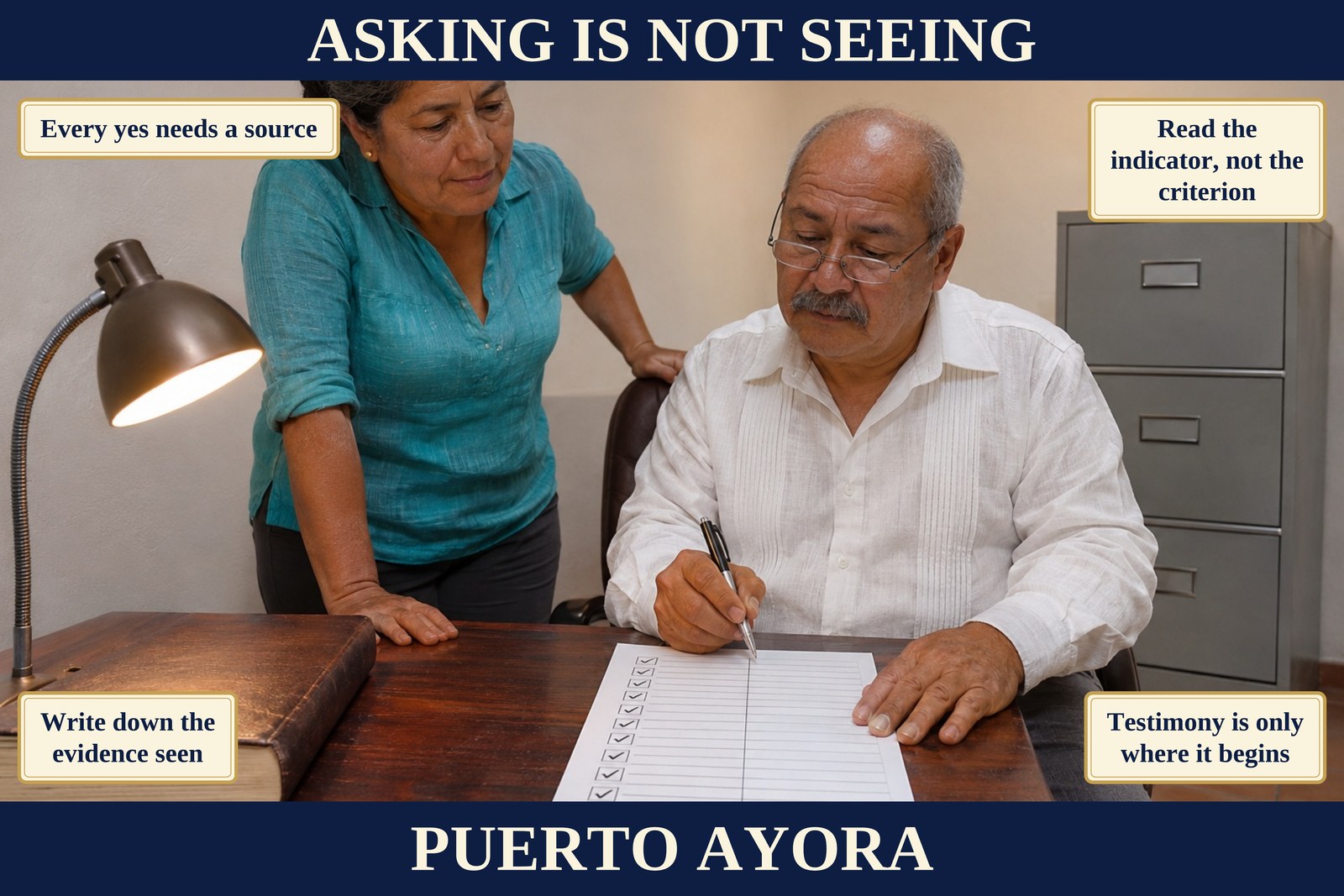
Concept Card 3.1 — Why Audit Against a Standard Written for Tourism
Setting: Puerto Ayora (Galápagos), Ecuador
The card shows the fourth evening of the first internal audit at a family hotel in Puerto Ayora. In three days the accountant, who has kept its books for eleven years, has interviewed seven people and ticked thirty-eight criteria as conforming. Sitting down to write, he opens the column he had left empty, "evidence seen", and cannot fill it: no written policy, water invoices never totalled, training unrecorded. He rewrites the first line of his report: thirty-eight criteria confirmed verbally, no indicator supported by evidence.
The plaques at the top give the event: «Thirty-eight ticks in three days» and «No voucher behind a single tick». The lower pair names the lesson: «Testimony is where an audit begins» and «No finding without evidence»: conformity is read at the level of the indicators, and citing the evidence seen for every finding is the book's method.
The card does not say that the staff misled the accountant: the practices they described are real. Nor does it fault him: his was the audit most first-time auditors conduct, and nobody had told him that indicators, not criteria, are where conformity is read.
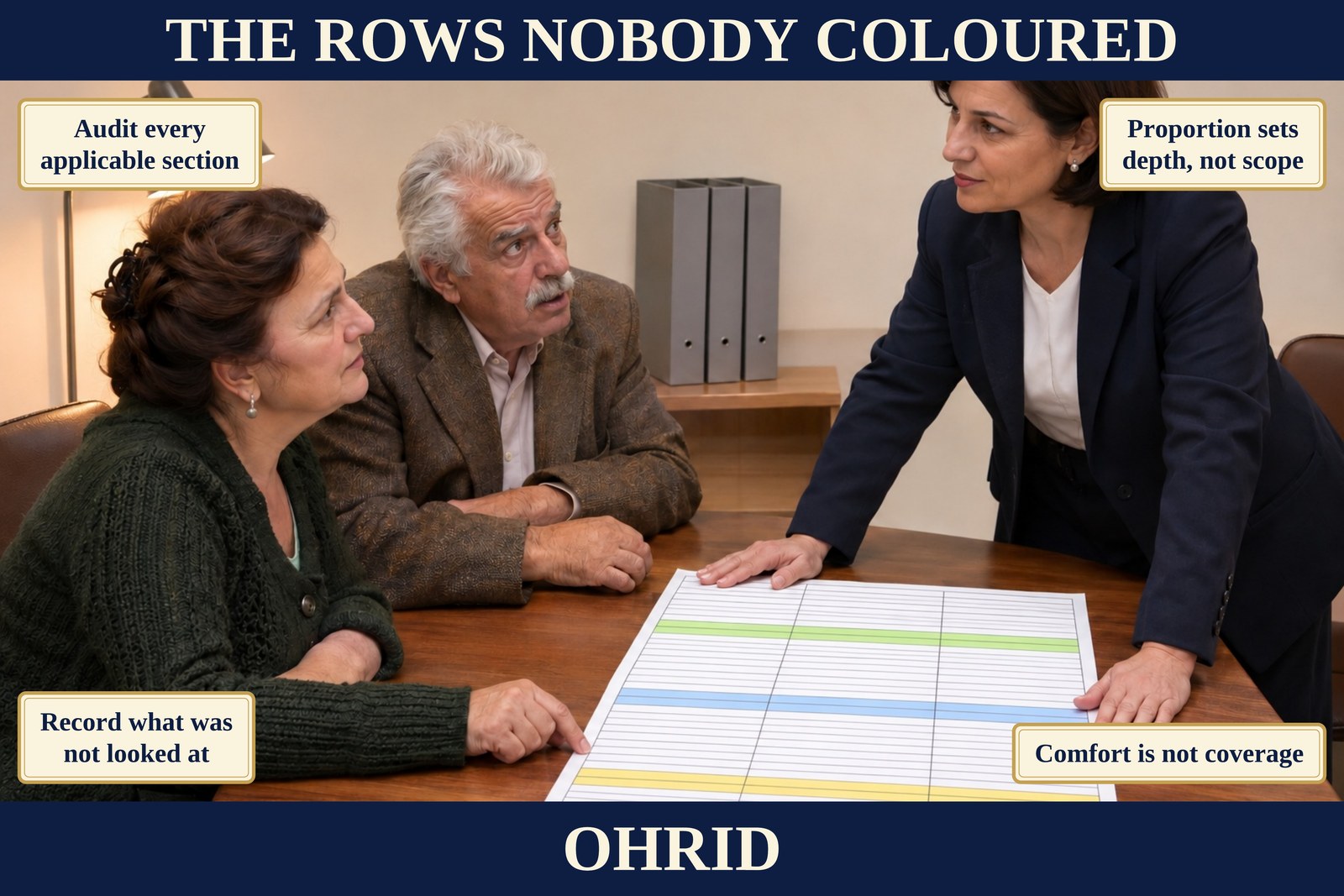
Concept Card 3.2 — An Audit Programme Proportional to the Property
Setting: Ohrid, North Macedonia
The card shows the owners' monthly visit to a forty-four-room hotel below the old town of Ohrid, where the general manager who joined in January lays three internal audit reports beside a grid drawn by hand. Each report is dated, signed and clean, and each audits the same six items: energy, water, kitchen waste, chemicals, fire equipment and permits. Thirty-four of the forty criteria were never visited, including all of sections B and C, in a hotel inside a World Heritage property.
The plaques at the top give the event: «Three audits, the same six items» and «No audit of community or culture». The lower pair names the lesson: «Proportion sets depth, not scope» and «Coverage before frequency»: A1 asks for a system proportional to the hotel, not one with sections missing; a full cycle of coverage is the book's rule.
The card does not say that the former quality coordinator was lazy or dishonest: every report was accurate about what it covered. Nor does it say that a small hotel must audit all forty criteria every year.
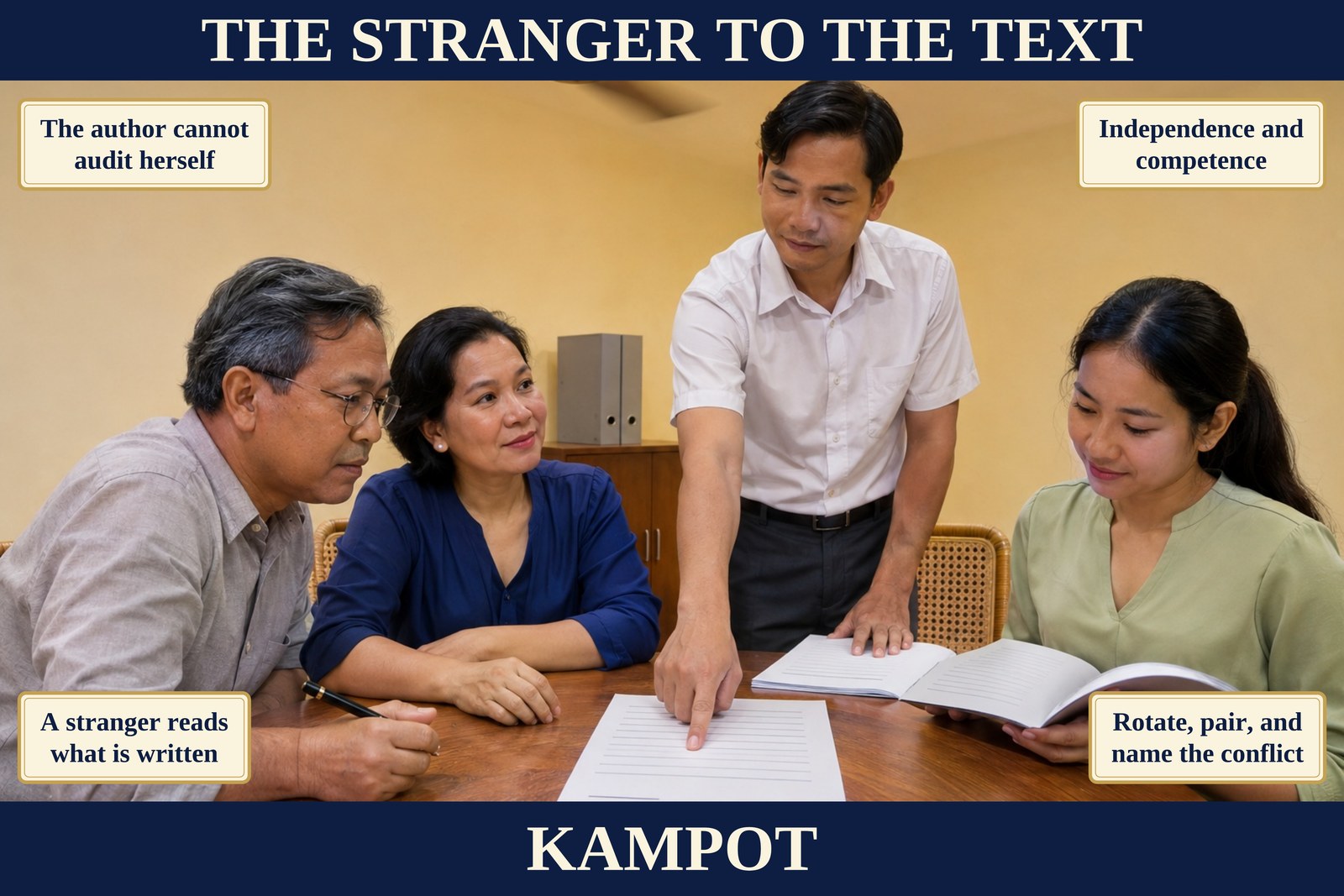
Concept Card 3.3 — Who Audits a Thirty-Room Hotel? Independence and Competence
Setting: Kampot, Cambodia
The card shows the back office of a riverside hotel in Kampot, where the sustainability manager, back from leave, reads a follow-up audit by the front office manager. She wrote nearly every document of the system and had audited it herself, finding it conforming throughout. In two days he found four gaps: a policy marked "approved" but never signed by the owners, Phnom Penh distributors counted as local suppliers, guest information only in English, and a feedback link to a page that no longer exists.
The plaques at the top give the event: «Approved, but never signed» and «Four gaps a stranger found in two days». The lower pair names the lesson: «Nobody audits their own work» and «Independence is arranged in advance»: the standard says nothing on who audits internally; these rules come from audit practice, applied by the book.
The card does not say that the sustainability manager was careless: each gap sat where her own knowledge filled in what the document did not say. Nor does it say the front office manager was the better auditor; he was a stranger to the text.

Concept Card 3.4 — Evidence That Holds: Documents, Observation, Interviews
Setting: Paraty, Brazil
The card shows the second day of the first internal audit at a pousada in Paraty, when the assistant manager leaves the impressive binder upstairs and goes down to the kitchen. Six cooks and stewards signed the attendance list for the March session on emergency response; asked where they would gather if the alarm sounded, none can name the assembly point, and they point to different doors. The extinguisher on the plan stands behind three crates of empty bottles, and no evacuation plan hangs in the kitchen.
The plaques at the top give the event: «Six signatures, no assembly point» and «An extinguisher behind the crates». The lower pair names the lesson: «Begin downstairs, end at the binder» and «A contradiction is a finding»: in the book's method, a record contradicted by interviews and observation is not evidence of conformity.
The card does not say that the binder is false or that the kitchen staff lied: the March session did take place. Nor does it fault the general manager; the twenty-minute session was recorded exactly as it happened, and nobody tested what it taught.

Concept Card 3.5 — Auditing What the Hotel Says About Itself
Setting: Byron Bay, Australia
The card shows a focused internal audit of claims at a thirty-room boutique hotel in Byron Bay, before its website is redesigned. The auditor, a former environmental officer, lays the printed page "Our Promise to the Coast", twelve icons and twelve confident sentences, beside the sustainability report. Over two days she asks for the evidence behind each claim and finds it for five. The renewable electricity contract lapsed two years ago; the page still says carbon neutral, plastic-free and zero waste to landfill.
The plaques at the top give the event: «Twelve promises, five with proof» and «A renewable contract lapsed unseen». The lower pair names the lesson: «A claim is audited word by word» and «Absolute words break on one exception»: the standard asks for claims backed by verifiable evidence; auditing their exact wording is the book's method.
The card does not say that the marketing manager invented the promises: most were true, or nearly true, when she wrote them three years ago. Nor does it say that the hotel's practice is poor; the hotel changed, and the page did not.
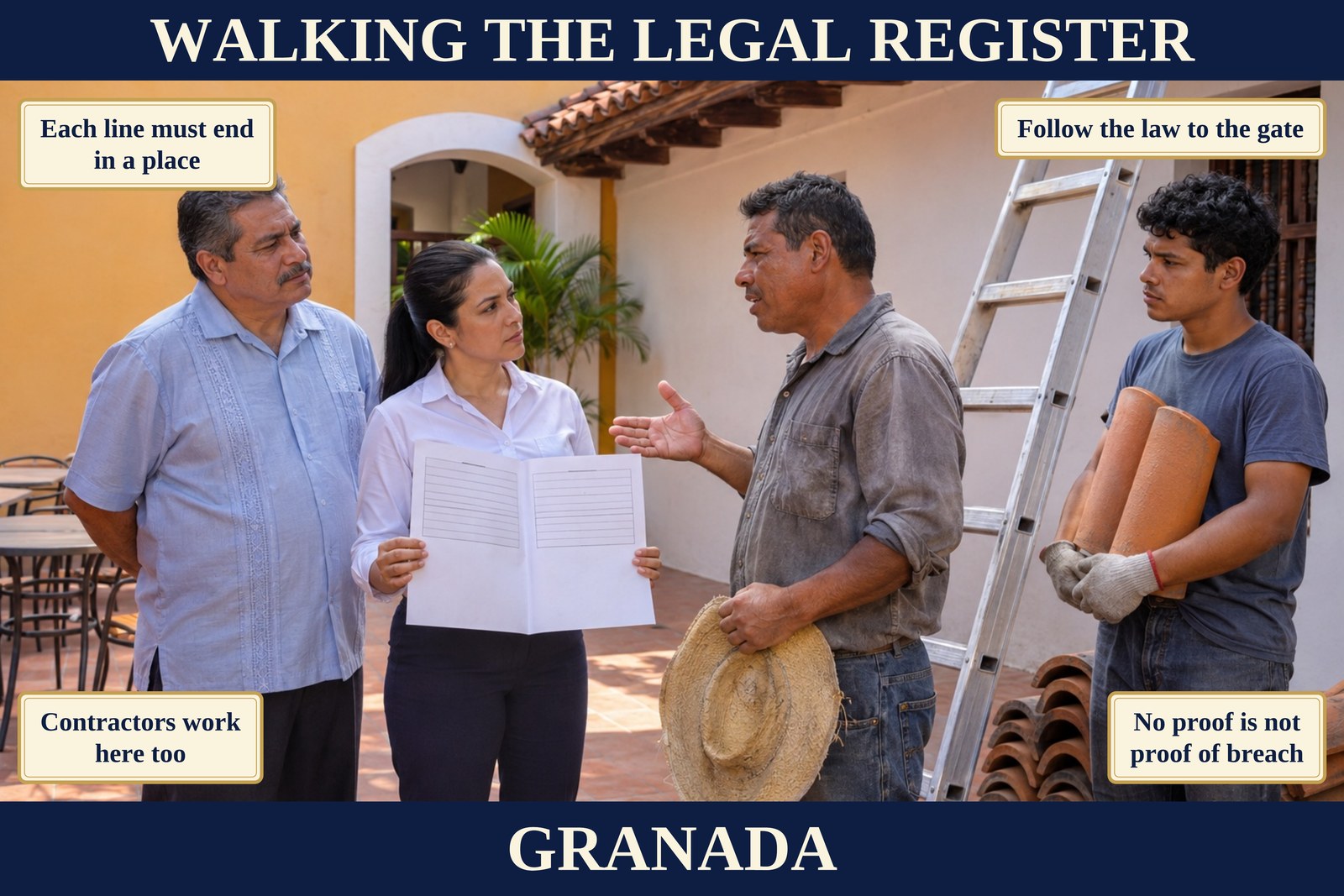
Concept Card 3.6 — Auditing the Legal Register Without Being a Lawyer
Setting: Granada, Nicaragua
The card shows the morning in Granada when the administration manager, auditing a legal register of sixty-three entries reviewed each quarter by a labour lawyer, follows one entry, on minimum working age, from the screen into the courtyard. The files of the thirty-one employees answer well. But four men from a roofing contractor are carrying tiles up a ladder, and the hotel holds no list of them and no check of their ages or conditions. The two-page contract says nothing about who works on site.
The plaques at the top give the event: «Sixty-three entries, no crew list» and «Four men on the ladder, no papers». The lower pair names the lesson: «Follow each entry to the gate» and «Absence of proof is still a finding»: A2 asks the hotel to show the law applied; walking an entry to its application is the book's method.
The card does not say that any worker was under age: the auditor found no evidence of non-compliance, only an absence of evidence of compliance. Nor does it fault the lawyer, who did exactly what he was engaged to do.
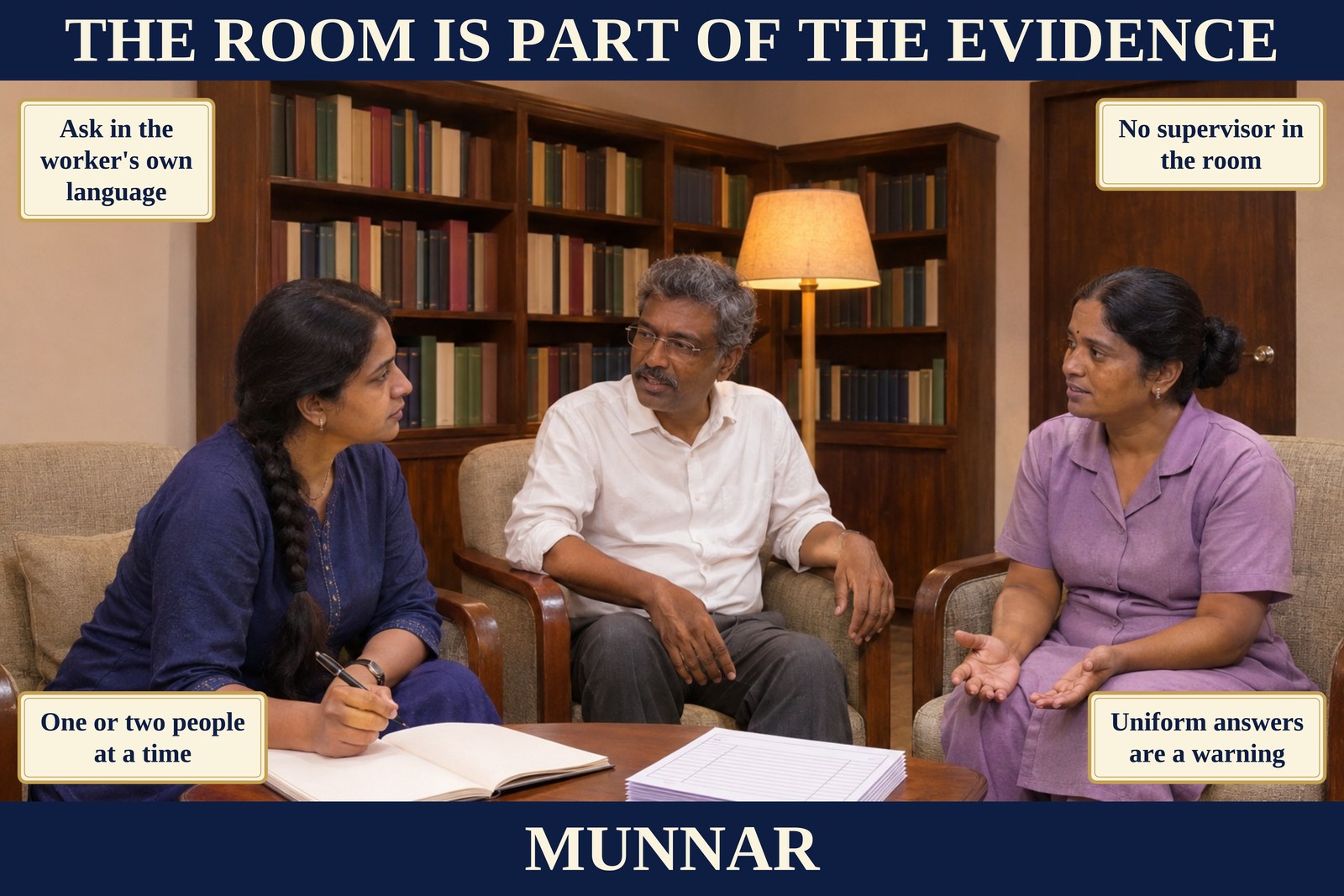
Concept Card 3.7 — Interviewing Staff in Their Own Language
Setting: Munnar, India
The card shows a resort above the tea estates of Munnar, where the internal auditor, short of time, asked department heads to interview their own teams. Twenty-four forms came back with the same answers: everyone knows the policy, everyone was trained, nobody has a suggestion. The housekeeper read the questions in English to nine attendants in the canteen; the agency's security supervisor signed one form for all his guards. Repeating eighteen interviews in private, in Malayalam and Tamil, the auditor hears another picture.
The plaques at the top give the event: «Twenty-four forms, the same answers» and «One form signed for all the guards». The lower pair names the lesson: «Ask in the language people think in» and «No supervisor in the room»: these are the book's conditions for a valid interview, since an answer is evidence only if another answer was possible.
The card does not say that the department heads were dishonest or that the staff lied: the uniform answers were the only ones the setting allowed. Nor does it fault the housekeeper, who did what she was asked, conscientiously and quickly.

Concept Card 3.8 — Listening Beyond the Fence: Stakeholders and Community
Setting: Diani, Kenya
The card shows the internal audit of a sixty-four-room beach resort at Diani, conducted by the quality manager of a sister property. The stakeholder file is impeccable: the county tourism office, a hoteliers' association, a turtle conservation group, a school thanking the resort for twenty desks. Walking the boundary, she finds a village footpath ending at the new rendered wall, which now sends fishers a quarter of an hour round with their gear. They complained at the gate; nothing was recorded, and the village has no entry.
The plaques at the top give the event: «A path that ends at the render» and «Complaints that stopped at the gate». The lower pair names the lesson: «Audit from the impact, not the file» and «Stakeholders without letterheads»: the book's method starts from who is affected, then checks engagement, consultation and a channel for concerns.
The card does not say that the wall was built carelessly: guests had been robbed, the insurer advised it and the county approved the plans. Nor does it call the resort indifferent; it had defined stakeholders as organisations with letterheads.
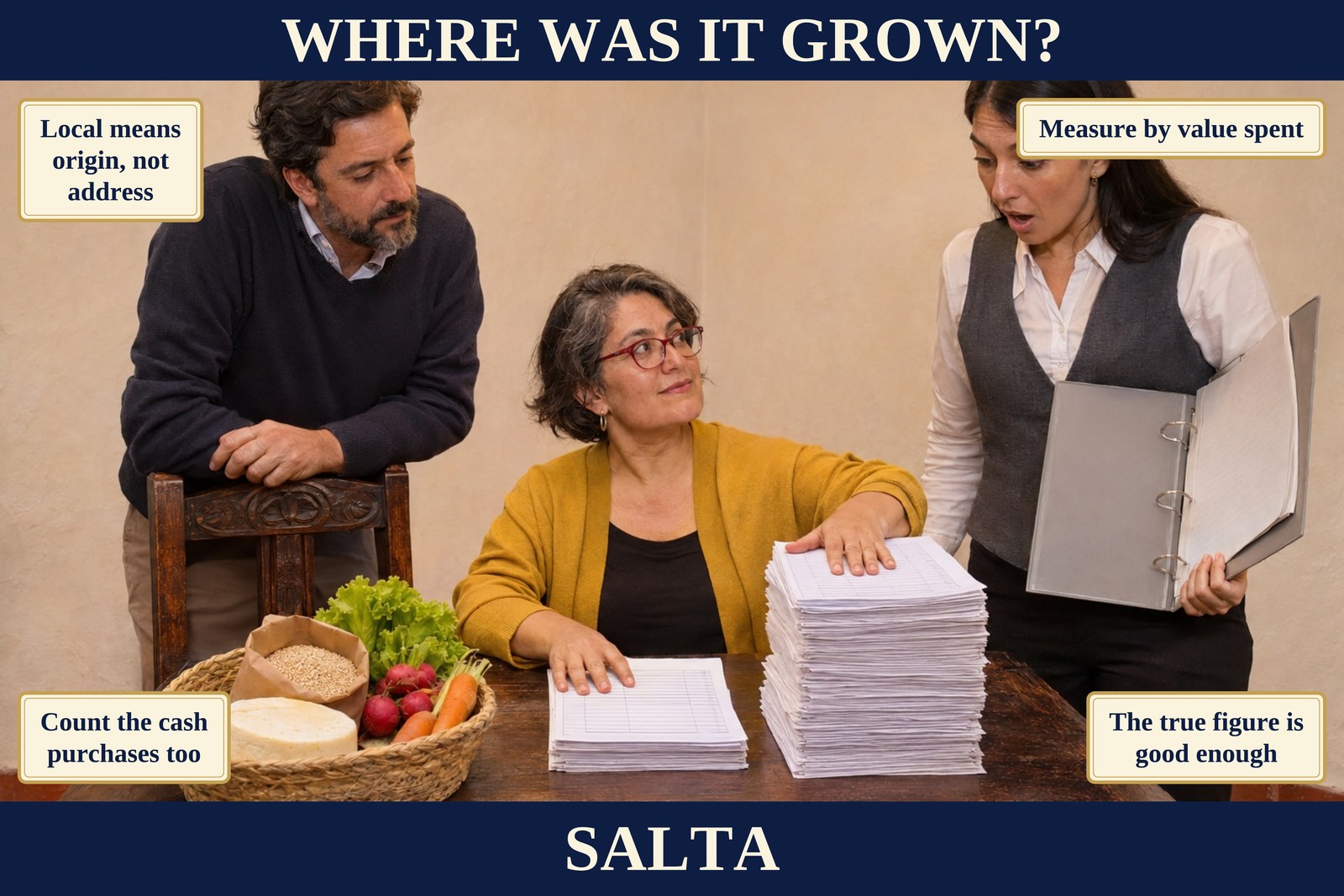
Concept Card 3.9 — Auditing Suppliers and Purchasing
Setting: Salta, Argentina
The card shows the purchasing office of a thirty-six-room hotel in Salta, whose report, website and menu folder state that sixty-two per cent of fresh food comes from local suppliers. A freelance auditor from Tucumán samples forty invoices from the "local" folder and asks where each product was grown or made. The largest supplier, a Salta distributor of goods from other provinces and abroad, accounts for more than half the folder. Recalculated by origin and by spending on fresh goods, the local share is thirty-one per cent.
The plaques at the top give the event: «Sixty-two per cent by address» and «Half the folder from one reseller». The lower pair names the lesson: «Local means where it was grown» and «Measure fresh goods by spending»: the guidelines to A13 exclude resellers of goods from outside the destination and measure the local share of fresh goods by expenditure.
The card does not say that the distributor is not a local business: it is owned in Salta and employs people from the city. Nor does it fault the coordinator, whose method of counting by address is the one most hotels begin with.
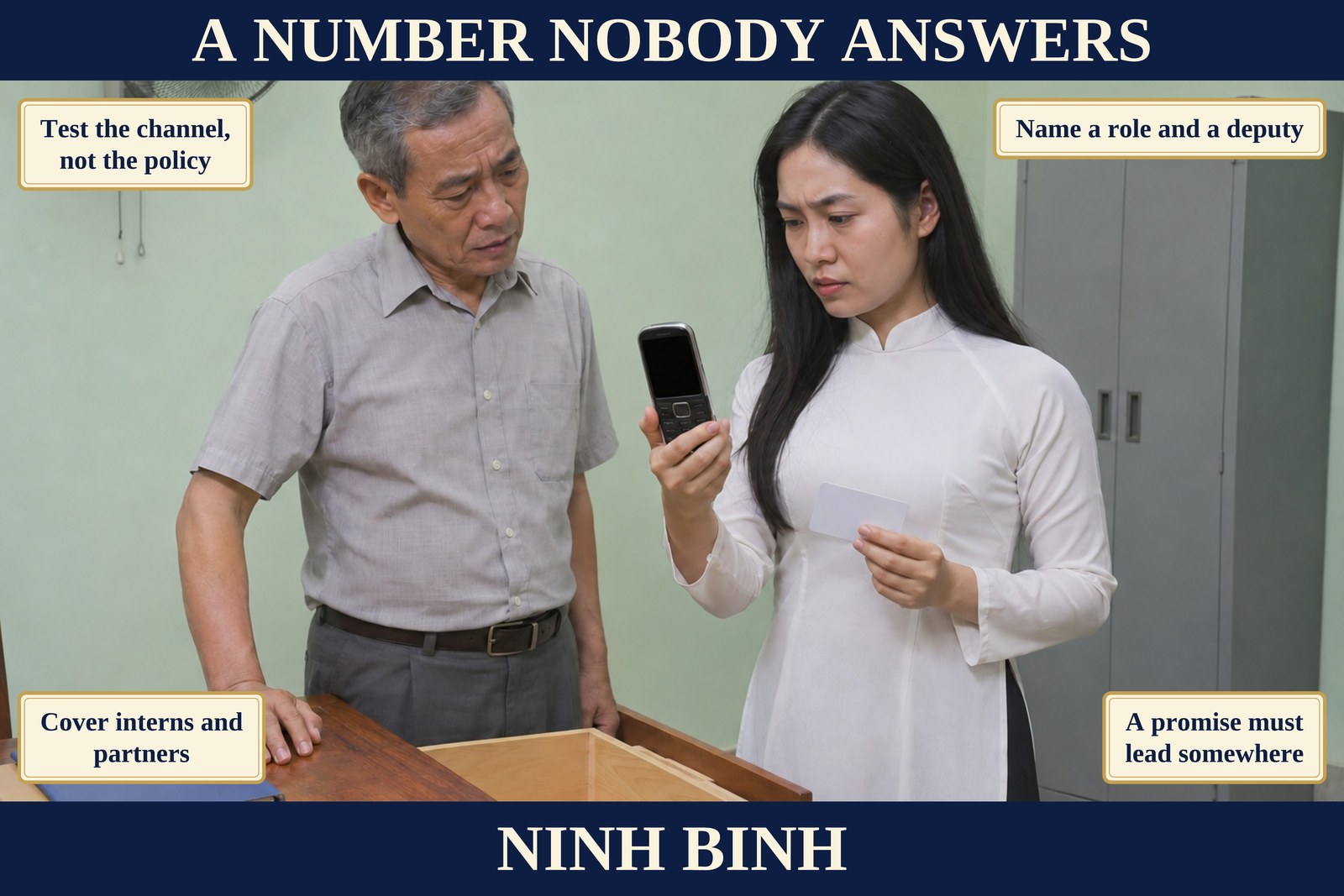
Concept Card 3.10 — Auditing the Sensitive Criteria: Safeguarding and Conduct
Setting: Tam Coc (Ninh Binh), Vietnam
The card shows a hotel among the karsts near Tam Coc, whose code of conduct and safeguarding policy are careful, complete and signed by every employee. Interviewing fourteen people privately in Vietnamese, interns and boat operators among them, the guest relations manager asks one question: if something worried you about a child or a colleague, whom would you tell? The answers name six routes; nobody names the designated officer. She left eight months ago, nobody replaced her, and her number reaches a phone switched off in a drawer.
The plaques at the top give the event: «Fourteen staff, six different routes» and «A switched-off phone in a drawer». The lower pair names the lesson: «A role needs a deputy, not a name» and «Whom would you tell?»: the book audits safeguarding as a system of policy, people, channels and records, tested by what staff can actually answer.
The card does not say that any child or colleague came to harm: the audit found no incident and investigated none. Nor does it fault the owner, whose policy was written in good faith and worked while its officer was there.
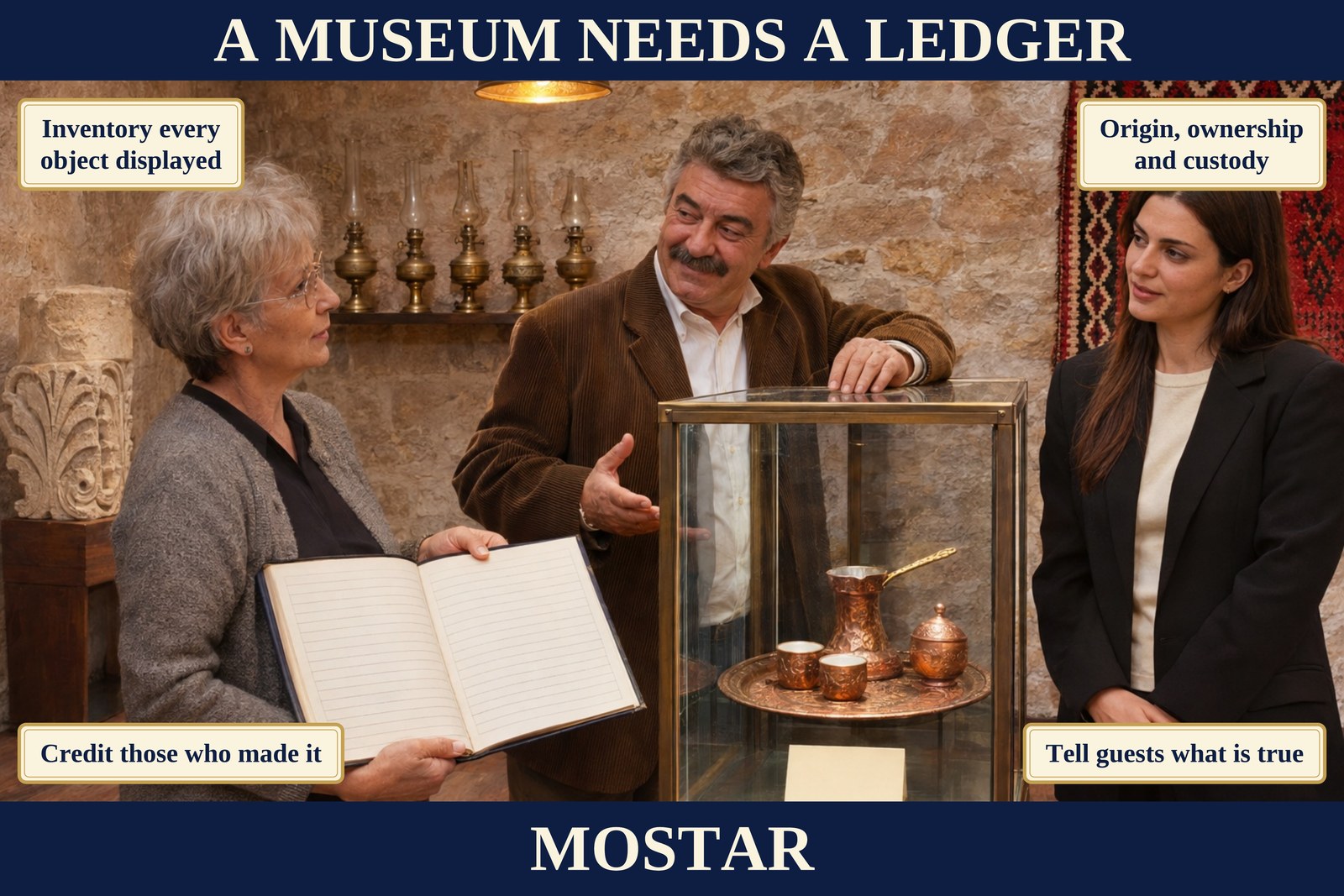
Concept Card 3.11 — Auditing Culture and Heritage Claims
Setting: Mostar, Bosnia and Herzegovina
The card shows an October morning in the lobby of a stone house in Mostar that calls itself a little museum. The auditor asks for the inventory of artifacts that C4.2 requires; there is none, only the late father's handwritten cards. The night receptionist tells guests that the large copper coffee set is four hundred years old; the owner says it was made in the old bazaar in the 1980s. A woven rug credits no maker, and a carved stone was simply kept after being found in the courtyard.
The plaques at the top give the event: «A coffee set called four centuries» and «A stone kept from the courtyard». The lower pair names the lesson: «Record what is not documented» and «A display case is a claim»: section C asks for an inventory of origin and custody, credit to local makers and accurate information from guest-facing staff.
The card does not say that the father's collection was dishonest: he never sold a piece and hid nothing. Nor does it decide whether the stone may be kept; that question goes to the legal register, for local expertise.
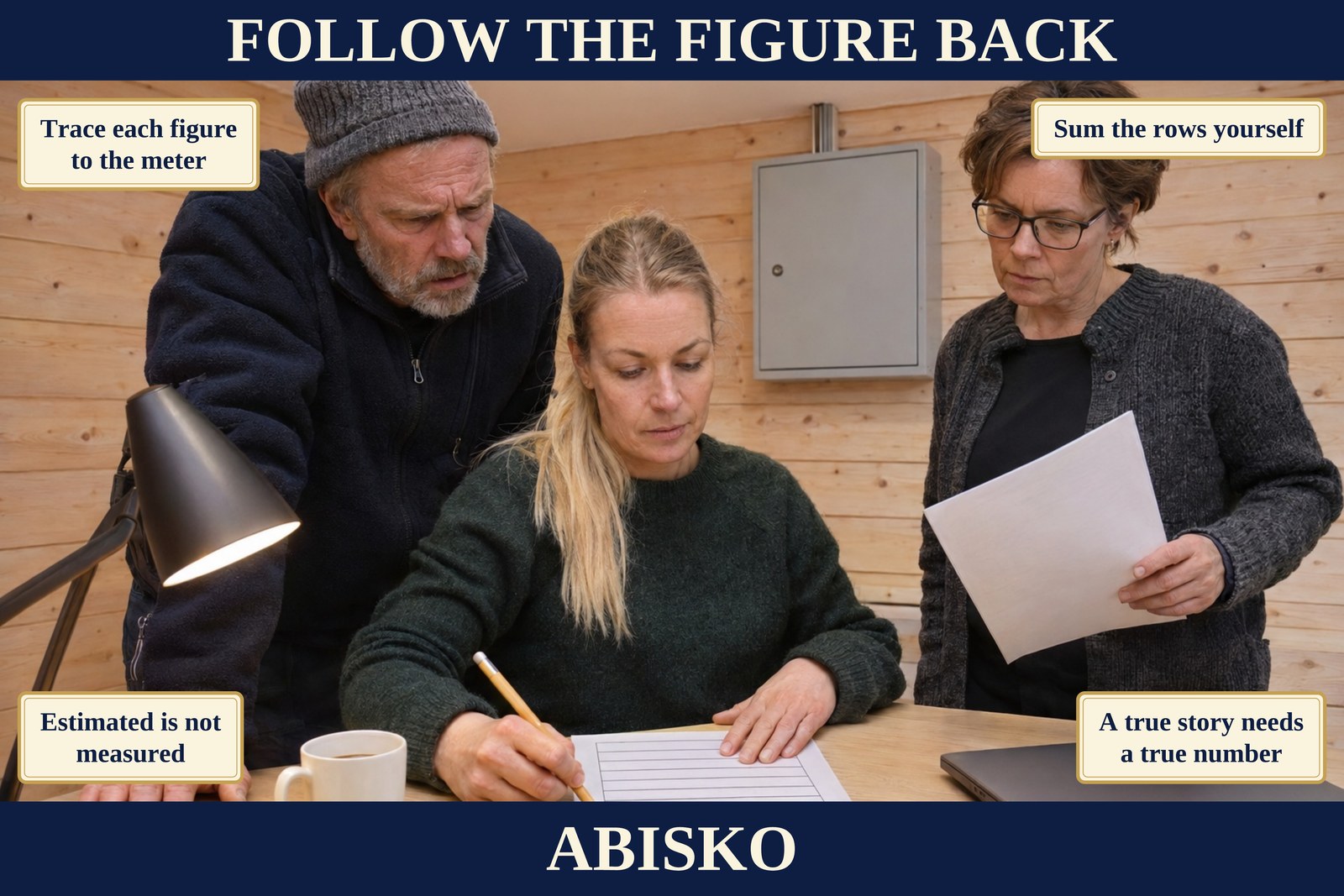
Concept Card 3.12 — Auditing Environmental Data: Meters, Invoices and Spreadsheets
Setting: Abisko, Sweden
The card shows an April afternoon at a mountain lodge in Abisko, whose report headlines an eighteen per cent fall in energy per guest night. The revenue manager, auditing section D, follows the figure back towards the meter. Adding the monthly rows by hand, she finds that the annual total covers January to September: October to December, the darkest and costliest months, sit outside the formula, while guest nights cover twelve months. The real fall is about four per cent, and the Scope 2 figure is wrong too.
The plaques at the top give the event: «Eighteen per cent from nine months» and «Three dark months outside the sum». The lower pair names the lesson: «Test the good news first» and «Add the months by hand»: the book traces each published figure back through spreadsheet and invoice to the meter.
The card does not say that the technician was careless or that the savings were invented: his monthly entries are correct, and the four per cent fall is real. The lodge had published a true story attached to a wrong number.
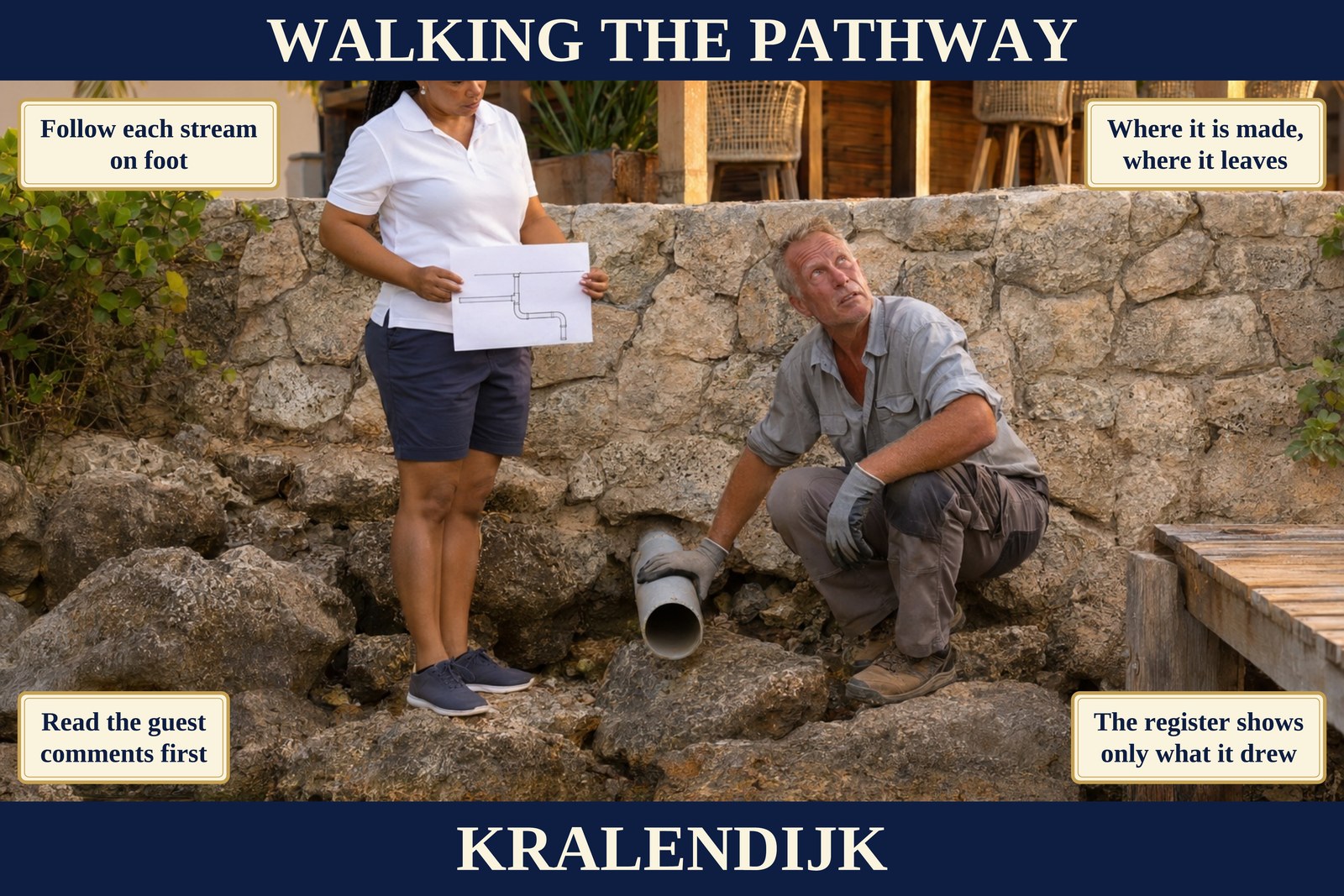
Concept Card 3.13 — Walking the Pathway: Waste, Wastewater and Chemicals
Setting: Kralendijk (Bonaire), Caribbean Netherlands
The card shows a May afternoon at a dive hotel on the waterfront at Kralendijk, where the assistant general manager, having found the environmental register in order, walks each stream from source to exit. A diver's comment card mentioned foam near the ladder some evenings. Below the beach bar she finds a plastic pipe between the rocks that is not on the plumbing drawing: the bar's sink and glass-washer, and the pool backwash, drain into a stormwater line to the shore. Used cooking oil goes to an unrecorded collector.
The plaques at the top give the event: «Foam near the ladder some evenings» and «A drain missing from the drawing». The lower pair names the lesson: «Walk each stream from source to exit» and «Read the feedback before the walk»: D5 to D8 ask where wastewater, waste and chemicals actually go; the walk is the book's test.
The card does not say that the chief engineer kept a false register: every document in it is genuine, and the main treatment system performs. The beach bar was connected by an outside contractor, and the connection was never drawn.

Concept Card 3.14 — Auditing Nature: Biodiversity, Animals and Tour Providers
Setting: Kasane, Botswana
The card shows the reception of a hotel on the Chobe River at Kasane, where three outside companies run the boat cruises, game drives and village visits the receptionists book every day. The internal auditor asks how the operators were evaluated: beyond licences and commission agreements, they were not. Two guest comments describe the boat pressing close to elephants crossing the river, and she sees it happen when she books the cruise as an ordinary guest. Meanwhile, staff put out fruit so guests can photograph birds.
The plaques at the top give the event: «Three operators, never evaluated» and «Fruit on the wall for the photos». The lower pair names the lesson: «A licence is not responsible practice» and «Answer for what you sell»: D11 asks the hotel to ensure tour providers follow responsible practices, and forbids feeding wild animals on its grounds.
The card does not say that the operators were chosen carelessly: they were licensed, reliable and popular. Nor does it fault reception, which nobody had told that selling an activity was a sustainability decision; the fruit began as a small kindness.
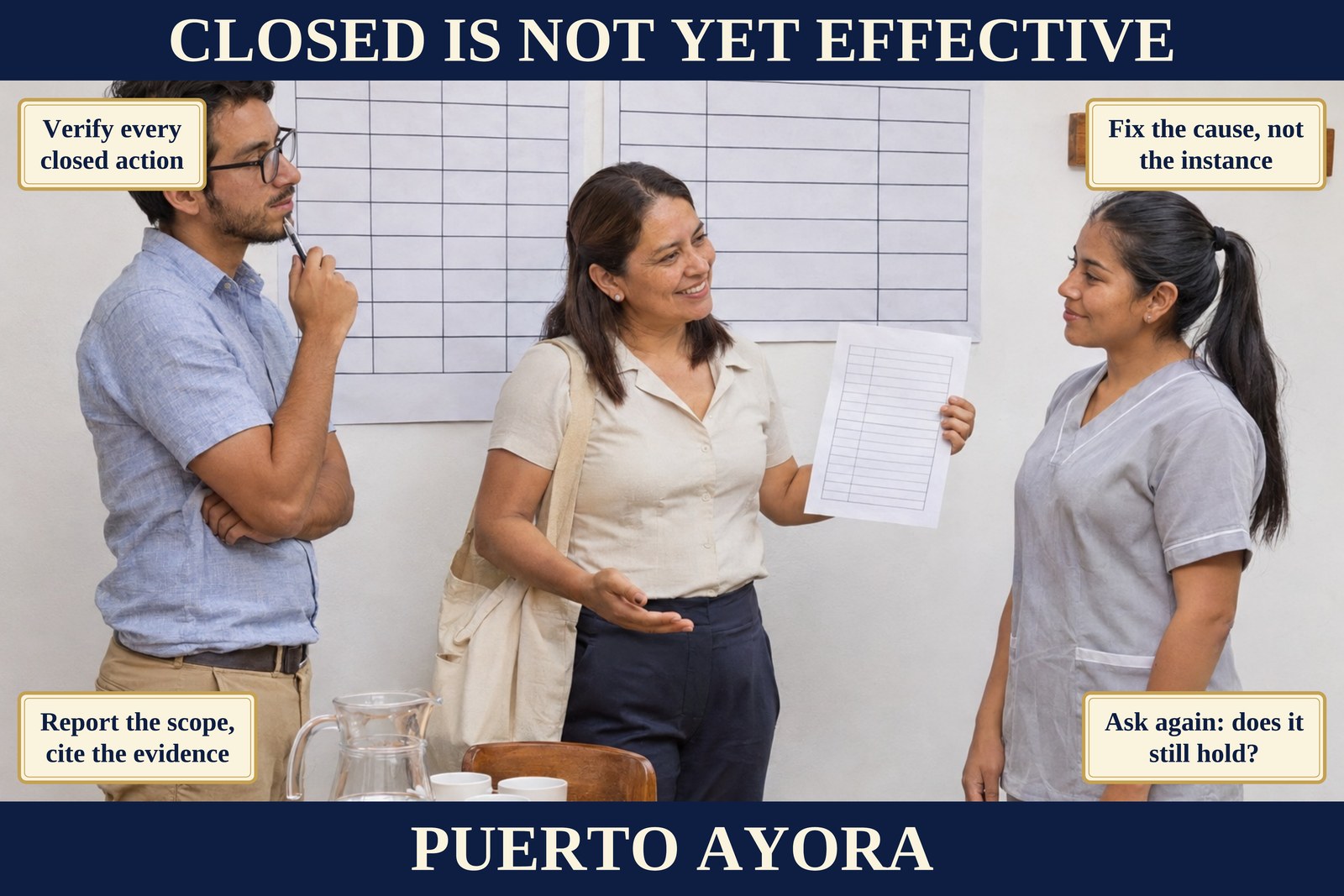
Concept Card 3.15 — From Findings to Decisions: The Report That Gets Acted On
Setting: Puerto Ayora (Galápagos), Ecuador
The card shows the third afternoon of the second internal audit in Puerto Ayora, conducted this time by a peer: the general manager of a twenty-room hotel on San Cristóbal, under a reciprocal arrangement. She has begun with the action plan, not the hotel. Twenty-seven of twenty-nine closed actions hold. Two do not: everyone signed for the code of conduct training in June, but a room attendant hired in September was never trained, and no guest was told about the new refill station.
The plaques at the top give the event: «Twenty-seven of twenty-nine hold» and «Trained in June, hired in September». The lower pair names the lesson: «Completed is not yet effective» and «Fix the cause, not the instance»: the book's report verifies each closed action and asks why the gap arose, so induction closes it.
The card does not say that Andrés closed the action carelessly: the training was real, and the attendance list was the evidence the indicator names. Nor does it say the hotel failed; none of its six open indicators lacked the practice.

Concept Card 4.1 — Who Certifies the Certifier: Accreditation Explained
Setting: Knysna, South Africa
The card shows an evening at a lagoon hotel in Knysna, weeks after a one-day "audit" by a company offering "GSTC-aligned" certification at a third of the usual price within six weeks. A pleasant young auditor photographed the solar panels and left before lunch; a green-leaf certificate followed. The German tour operator that fills a quarter of the rooms rejects it: the company is not on the GSTC's list of accredited bodies, its standard is not GSTC-Recognized, and the certificate carries no traceable code.
The plaques at the top give the event: «A certificate bought in six weeks» and «Not on the list of accredited bodies». The lower pair names the lesson: «Aligned is not accredited» and «Check the certifier before the price»: in the GSTC system a certificate borrows its credibility from an accredited body and a recognised standard.
The card does not say that the owner was careless: the email used the vocabulary of the field fluently, and the visit looked like an audit. Nor does it make accreditation a requirement of the Hotel Standard; it belongs to the system that checks certifiers.
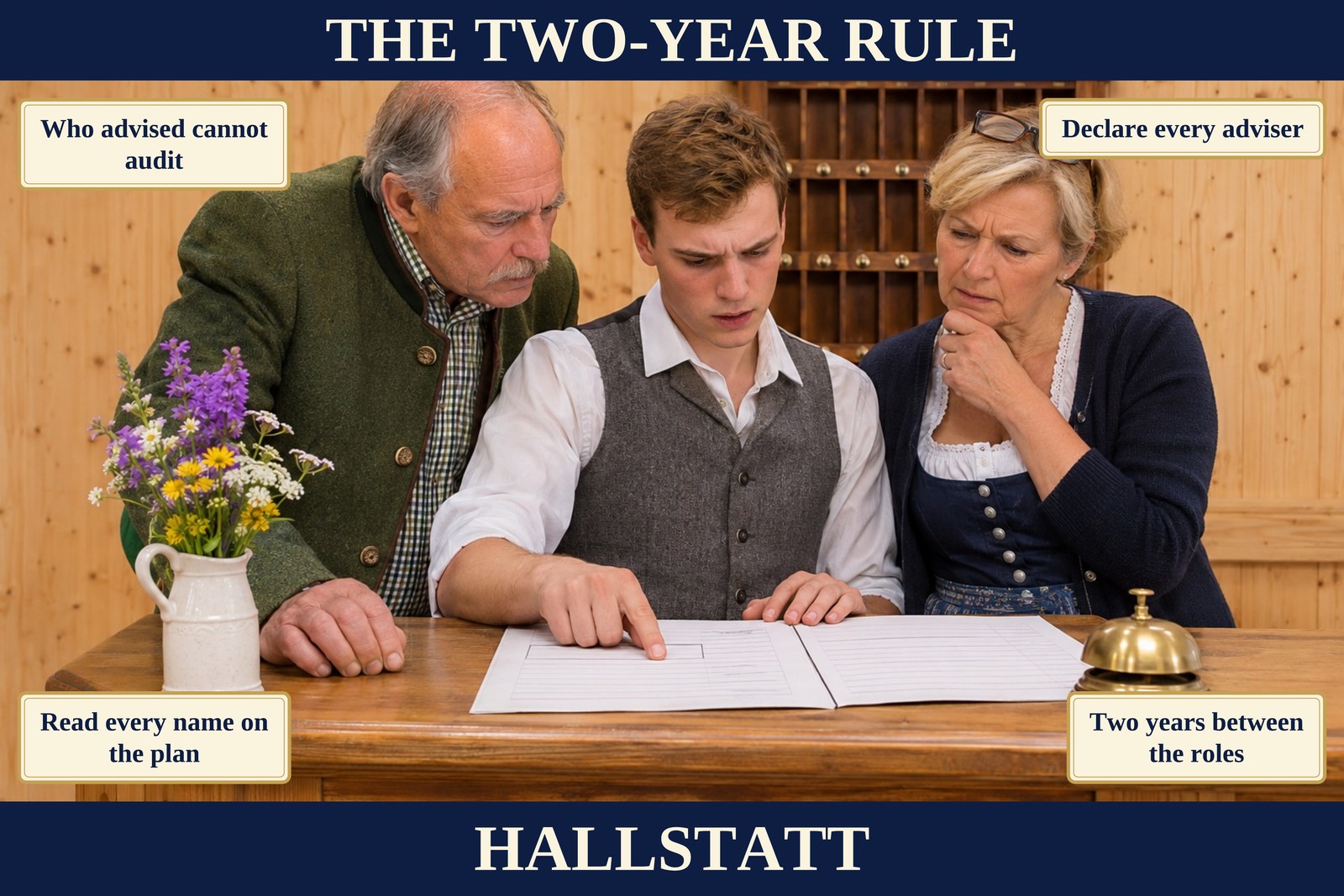
Concept Card 4.2 — Choosing a Certification Body, and the Two-Year Rule
Setting: Hallstatt, Austria
The card shows a quiet May afternoon at the reception of a family hotel on the Hallstätter See. For fourteen months a consultant from Linz prepared the hotel well: gap analysis, policy, records, training and the first internal audit. She also audits freelance for the accredited certification body she recommended. Reading the audit plan, the owner's son finds her named as lead auditor. His first reaction is relief; his second, an hour later, is doubt. That evening he writes to the body.
The plaques at the top give the event: «The consultant named as lead auditor» and «Relief first, then doubt». The lower pair names the lesson: «Who advised us must not audit us» and «Declare every adviser in writing»: the Accreditation Manual bars advisers of the last two years from auditing; listing them is the book's advice.
The card does not say that the consultant or the body acted in bad faith: everyone believed her knowledge would help. Nor does it say that the Hotel Standard forbids consultants; the two-year rule binds the certification body.

Concept Card 4.3 — How a Certifier Sizes the Audit: Risk and Duration
Setting: Rarotonga, Cook Islands
The card shows the shared kitchen of an eight-room guesthouse of timber bungalows on the lagoon side of Rarotonga, run by a couple with a few helpers. The owner expected a short audit, perhaps partly by video; the certification body proposes two days on site, with on-site surveillance too. She asks whether there has been a mistake, since an eighty-room hotel across the island needed a day and a half. The reply names three factors: a protected lagoon, beach weddings and a relative's snorkelling boat.
The plaques at the top give the event: «Two days on site for eight rooms» and «A lagoon, weddings and a boat». The lower pair names the lesson: «Risk follows place, not room count» and «Small is not the same as low risk»: under the Accreditation Manual, sensitive areas and functions exclude extremely low risk, whatever the size.
The card does not say that the owner's expectation was unreasonable: size does matter, and the smallest properties may be audited more lightly. Nor does it say that the Hotel Standard sets audit duration; that is the certifier's risk assessment.
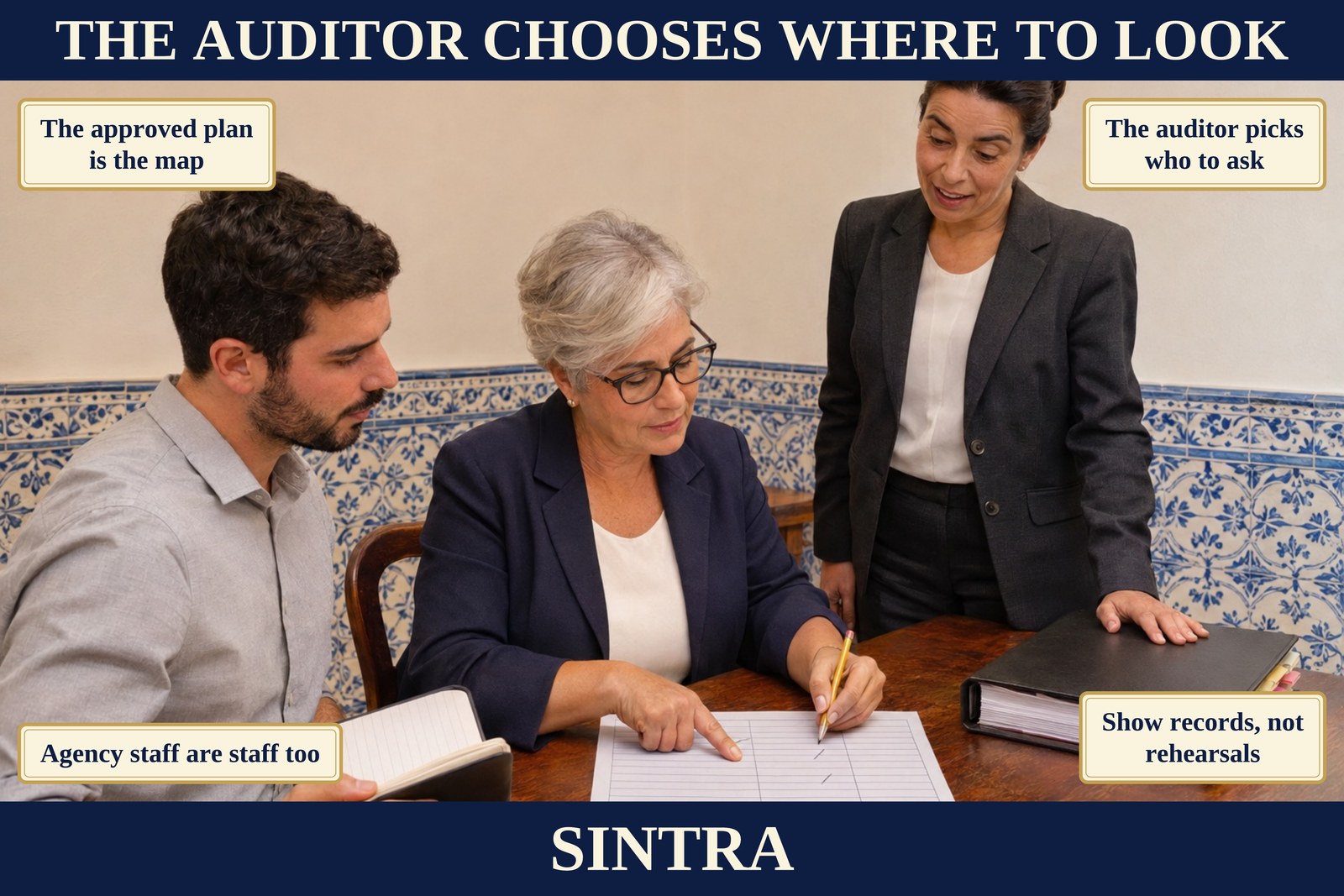
Concept Card 4.4 — The Initial Audit on Site
Setting: Sintra, Portugal
The card shows noon on the first day of the initial audit at a restored quinta below the Serra de Sintra. The general manager prepared for three months: a binder of two hundred pages, forty slides, six rehearsed staff. The lead auditor sets the presentation aside, walks to the chemical store and the meters, then asks for the full staff list, agency workers included, and picks four names; only one was rehearsed. The approved plan listed the laundry and landscaping contractors, and nobody had read it.
The plaques at the top give the event: «Six staff rehearsed, four sampled» and «The plan approved, never read». The lower pair names the lesson: «The auditor chooses whom to ask» and «Prepare evidence, not a performance»: under the Accreditation Manual the certifier samples staff and outsourced activities; findable evidence is the book's advice.
The card does not say that the general manager prepared badly: her binder held most of what the auditors needed, and her six staff knew the policy. She prepared for an examination of what the hotel knew, not what it could show.

Concept Card 4.5 — When the Certifier Talks to Your Neighbours
Setting: Siwa, Egypt
The card shows the end of the first audit day at a kershef lodge in the Siwa oasis, whose report says it shares the income from every guest visit to the salt pools with the harvesting families. The file holds an old letter, salt invoices and a list of visits, but no payment since the first year, and a cooperative member's public post says the share stopped. The auditor tells the owner in writing that she will interview the cooperative. He objects; she records his objection and keeps the interview.
The plaques at the top give the event: «A share promised, then stopped» and «The interview will take place». The lower pair names the lesson: «Informed in writing, not asked» and «Let the partners confirm the claim»: under the Accreditation Manual doubt makes the interview required, with written notice to the hotel; documented partnerships remove the doubt.
The card does not say that the owner hid a wrong he knew of: he believed the arrangement had lapsed by agreement and feared a family dispute. Nor does it say the complaint was proved; that was the interview's purpose.
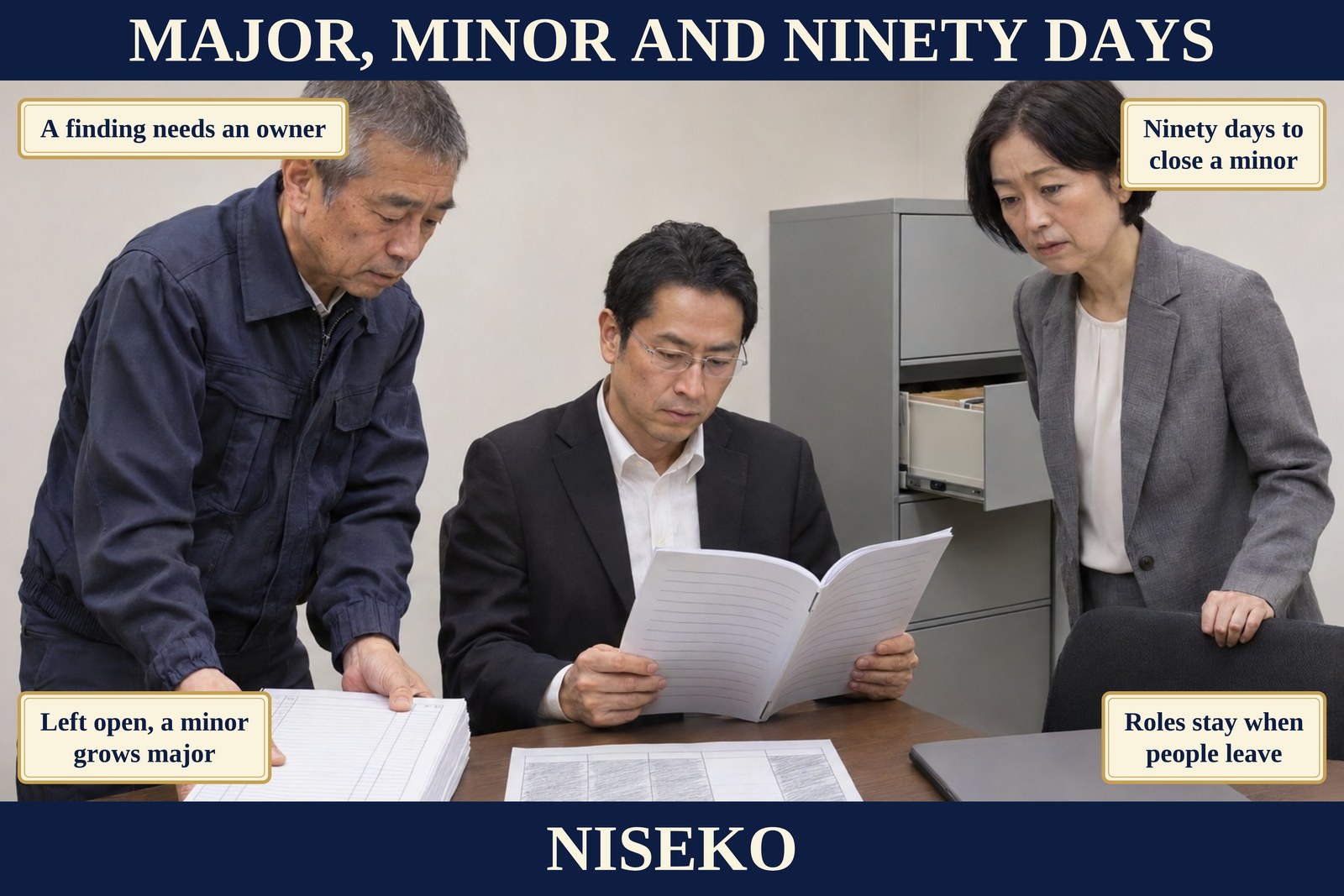
Concept Card 4.6 — Major, Minor and Ninety Days
Setting: Niseko (Hokkaido), Japan
The card shows the back office of a forty-four-room hotel outside Niseko at the end of ninety days. The initial audit in March raised two minor nonconformities; one concerned energy, because the kerosene for the boilers and snow-melting is invoiced to head office in Sapporo and never measured. The general manager's plan was accepted, the certificate issued in April, and he left at the end of the month. The reminder went to his former address. On day ninety, the minor becomes a major.
The plaques at the top give the event: «A minor left in a departed inbox» and «Day ninety, and nothing sent». The lower pair names the lesson: «Minor means smaller, not optional» and «A finding belongs to a role»: the Accreditation Manual gives minors ninety days and upgrades them if unclosed; a named owner is the book's answer.
The card does not say that the hotel's energy practice was dishonest or dangerous: the kerosene was bought, paid for and burned as before, and the invoices were accurate. What failed was the ownership of a finding.
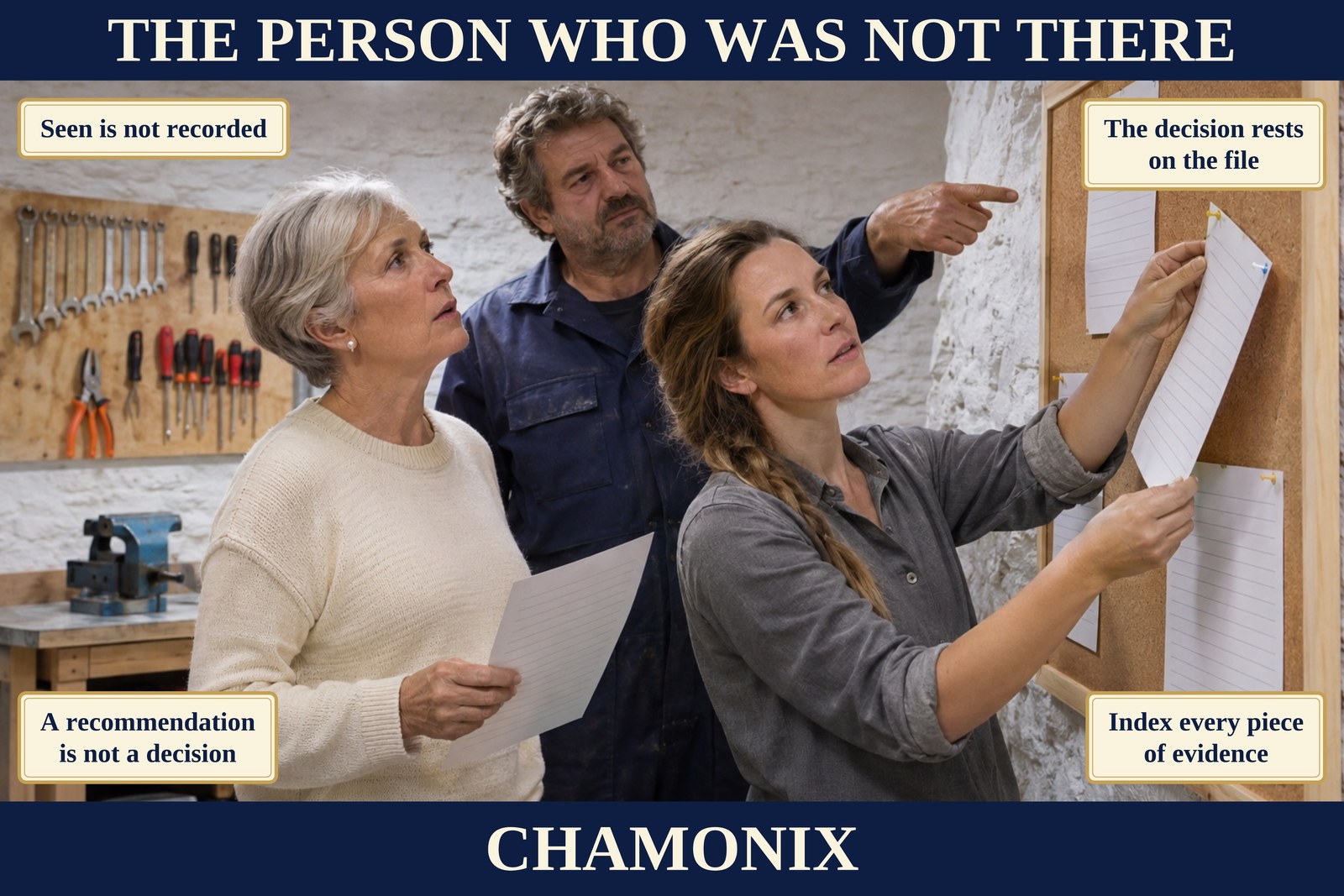
Concept Card 4.7 — The Certification Decision and the Person Who Was Not There
Setting: Chamonix, France
The card shows a June morning at a family hotel in the Chamonix valley, three weeks after an initial audit that ended warmly with two minors and a recommendation for certification. The certificate had been promised to the summer brochure. Instead a letter arrives from the person responsible for the technical review and decision: the file shows neither the document on safe wastewater discharge nor the list of protected areas and species. The lead auditor saw both on site; in his notes, both lines say "seen".
The plaques at the top give the event: «Seen on site, missing from the file» and «A letter, not yet a certificate». The lower pair names the lesson: «The one who decides was not there» and «Every judgement points to evidence»: the Accreditation Manual keeps the decision from the auditor; the book's evidence index serves the decision-maker.
The card does not say that the hotel failed or hid anything: everything asked for was shown. Nor does it say the auditor was wrong to judge the evidence adequate; he did not record it, and the decision is taken on the file.

Concept Card 4.8 — Certificates, Logos and the Claims That Follow
Setting: South Goa, India
The card shows a February afternoon at a fifty-two-room resort in South Goa, certified in October for accommodation, the main restaurant, the spa and the events lawn. The marketing manager put the logo everywhere and, to share the news, sent the logo file to the independently run beach restaurant on the resort's land. Its new menu says "Certified sustainable beach dining". A guest from a European tour operator checks the public database and finds the restaurant outside the scope. The certification body asks for the menus' withdrawal.
The plaques at the top give the event: «A logo on the beach menus» and «A guest checked the public list». The lower pair names the lesson: «Claim no more than the scope» and «Logo files are not gifts»: the certification agreement and logo terms of use forbid implying certification beyond the scope.
The card does not say that the marketing manager meant to mislead: her intention was generous, and guests treat the restaurant as part of the resort. Nor does it call the restaurant's food unsustainable; it has never been evaluated.

Concept Card 4.9 — Surveillance: Annual, Remote, Unannounced
Setting: Moorea, French Polynesia
The card shows an April morning at the reception of a thirty-room hotel on the north coast of Moorea. Its first surveillance, at its own request, was remote and well organised, with records on a shared screen and a tablet walk through the kitchen and plant room. The camera never visited the lagoon, where a new pontoon and a new "ray and shark" excursion attract animals with food. After a conservation association sends photographs, an auditor arrives unannounced and asks to walk to the end of the jetty.
The plaques at the top give the event: «The camera never saw the pontoon» and «Unannounced, at the reception desk». The lower pair names the lesson: «Tell the certifier what has changed» and «A screen sees only where it points»: the Accreditation Manual lets the body choose the mode by risk; a change note is the book's advice.
The card does not say that the remote audit was faulty or that the general manager hid anything: he honestly showed every document asked for. Nor does it say remote audits are wrong; they suit operations whose risks lie mostly in records.
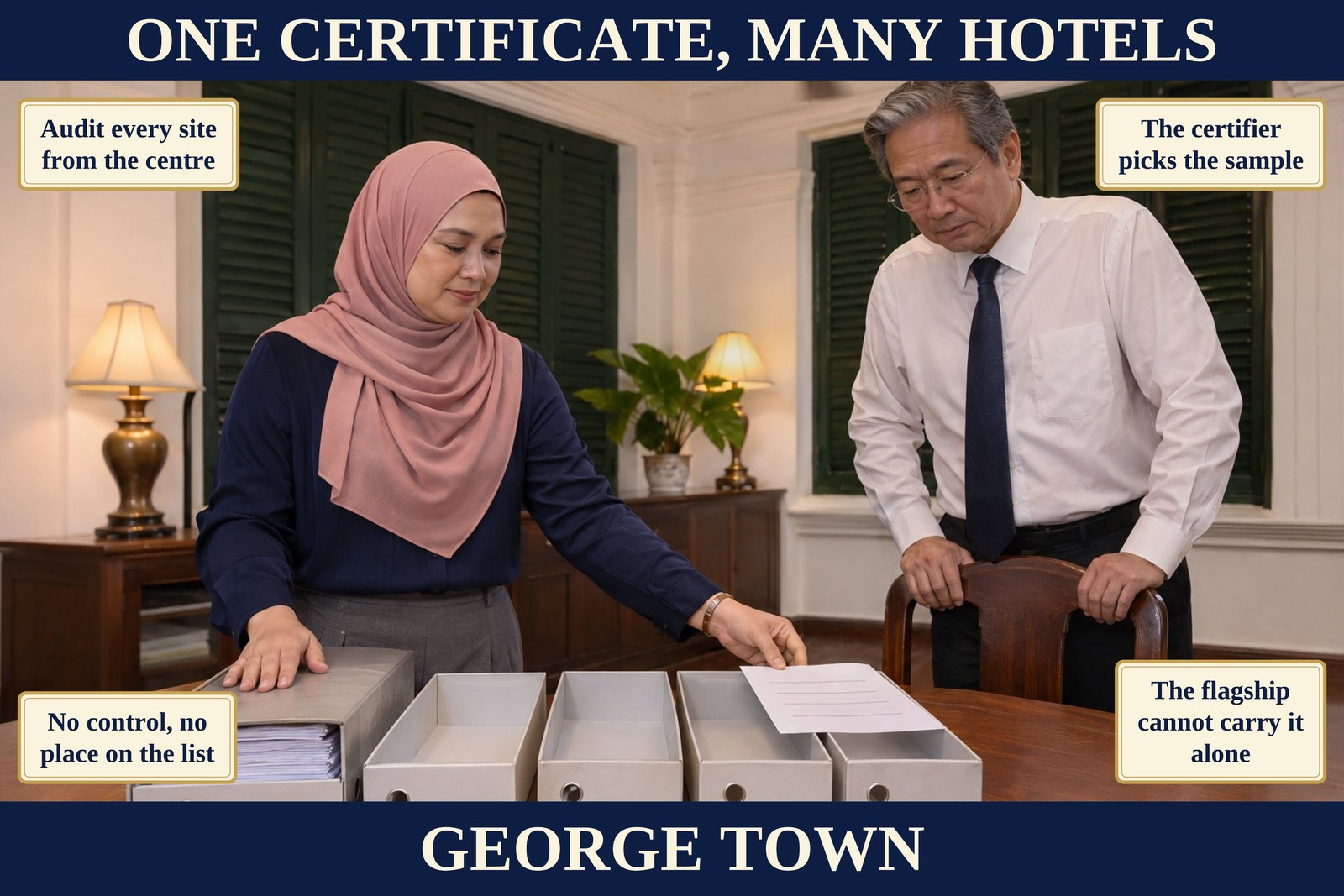
Concept Card 4.10 — One Certificate, Many Hotels: Multi-Site Certification
Setting: George Town (Penang), Malaysia
The card shows the meeting room of a group's flagship in George Town, Penang, which has applied for one multi-site certificate covering five hotels. The flagship has a policy, a plan, monthly data and a spring internal audit; the other four are described as "aligned with the group system". One, in the hills, belongs to another family and is linked only by a sales agreement. The certification body asks for internal audits of every site and the centre's authority over each, and says it will choose the sample.
The plaques at the top give the event: «Five sites, one internal audit» and «Aligned with the group system». The lower pair names the lesson: «The certifier picks the sample» and «One failing site reaches them all»: under the multi-site rules of the Accreditation Manual, sampling rests on the centre having audited every site.
The card does not say that the idea of multi-site certification was wrong: a group of hotels under one system is what it exists for, and the flagship's work was real. What the chief executive misunderstood was the bargain.
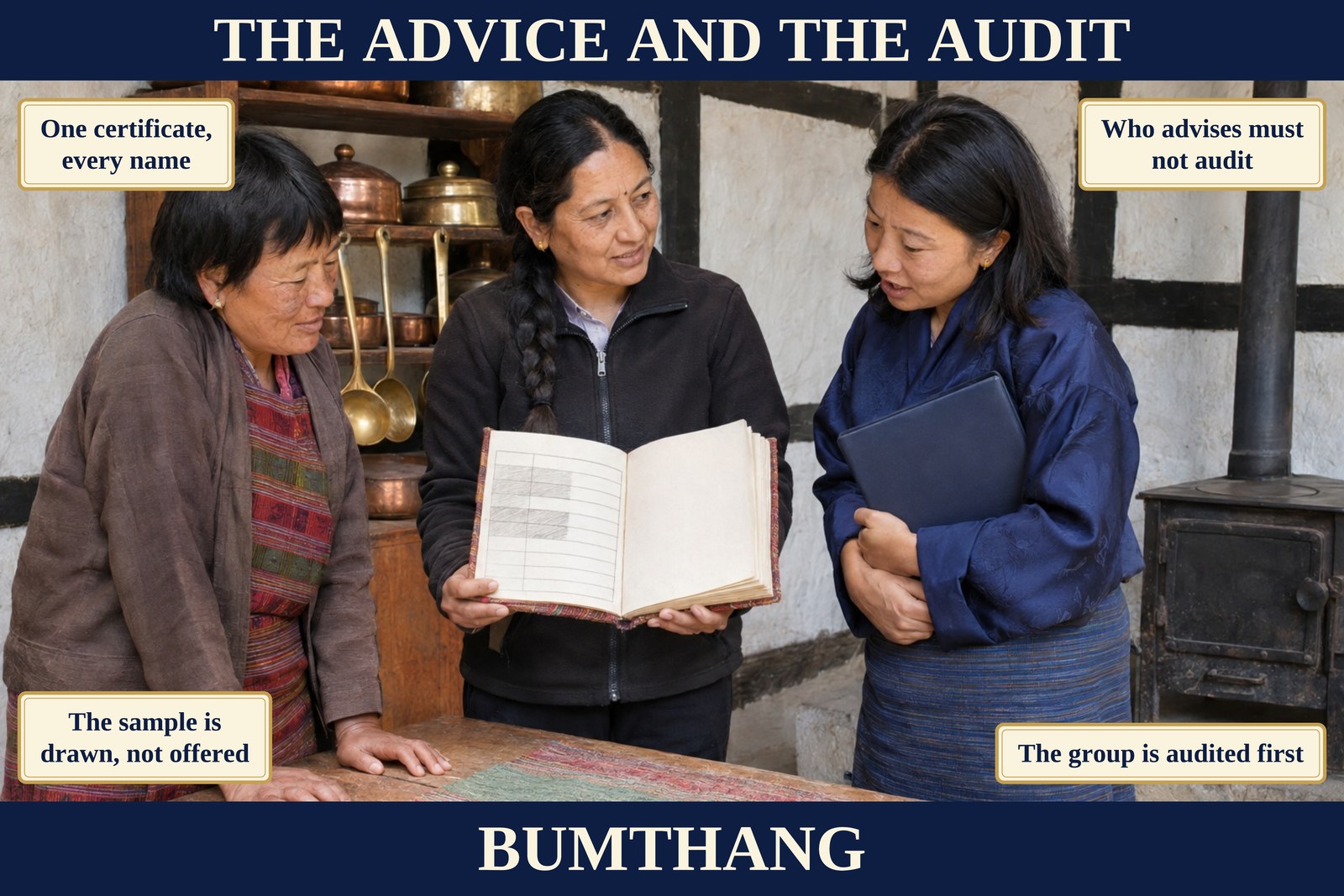
Concept Card 4.11 — Group Certification for Small Properties
Setting: Bumthang, Bhutan
The card shows a crisp October morning in the kitchen of a seven-room farmhouse in the Bumthang valley, one of twelve guesthouses seeking certification together through their association. The coordinator helped every family write its plan and then audited each one herself, always finding conformity. The certifier's auditor, sampling four members, finds this meter book with entries for March and April and nothing after. Who helped write the plan? The coordinator. Who audited it? The coordinator again. The president had already ordered twelve frames.
The plaques at the top give the event: «Two months in the meter book» and «The adviser was also the auditor». The lower pair names the lesson: «Never audit the member you advised» and «One sheet carries every name»: under the Accreditation Manual's group rules, nobody audits a member they advised, and one certificate lists all members.
The card does not say that the coordinator was careless: she was the only trained person in the valley and did two jobs well enough that nobody noticed. Nor does it say the family hid anything; they explained without embarrassment.
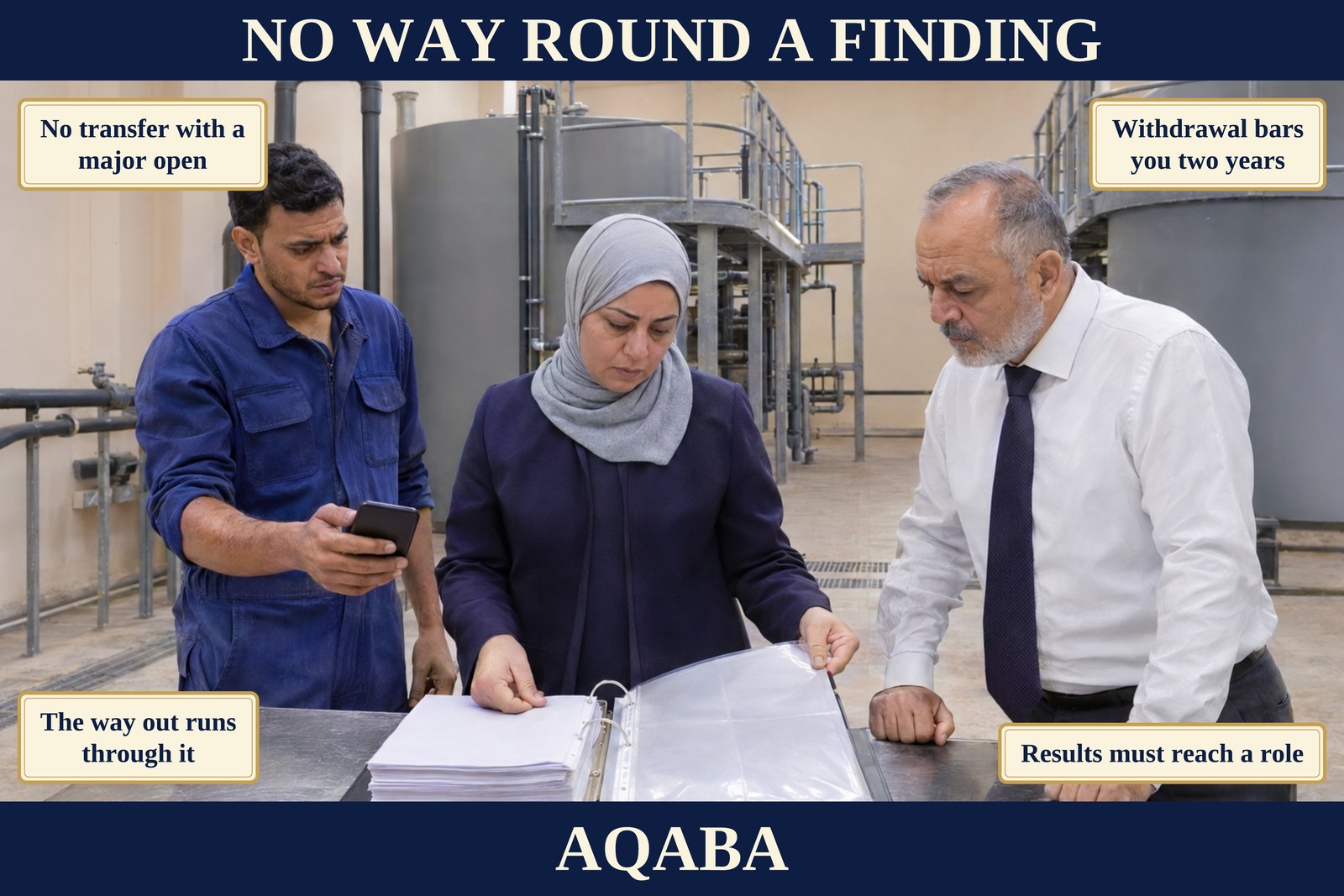
Concept Card 4.12 — Transfer, Suspension and Withdrawal
Setting: Aqaba, Jordan
The card shows a management meeting at a resort south of Aqaba, two weeks after a surveillance audit raised a major nonconformity on wastewater. The contractor running the treatment plant held five months of test results the hotel never received after its engineer left; two exceeded the limit in the resort's own legal register. The new commercial director proposes moving the certificate to a cheaper accredited body and leaving the finding behind. The other body's answer is short: no transfer while a major is open.
The plaques at the top give the event: «Five months of results unread» and «Move the certificate, he said». The lower pair names the lesson: «No transfer while a major is open» and «The way out runs through the finding»: the Accreditation Manual blocks transfer with a major open, and withdrawal, without remedial action, bars certification for two years.
The card does not say that the commercial director meant to deceive: in his former company, changing a supplier after a dispute was ordinary procurement. Nor does it say that a hotel may never change certification body; it can, once nothing is open.
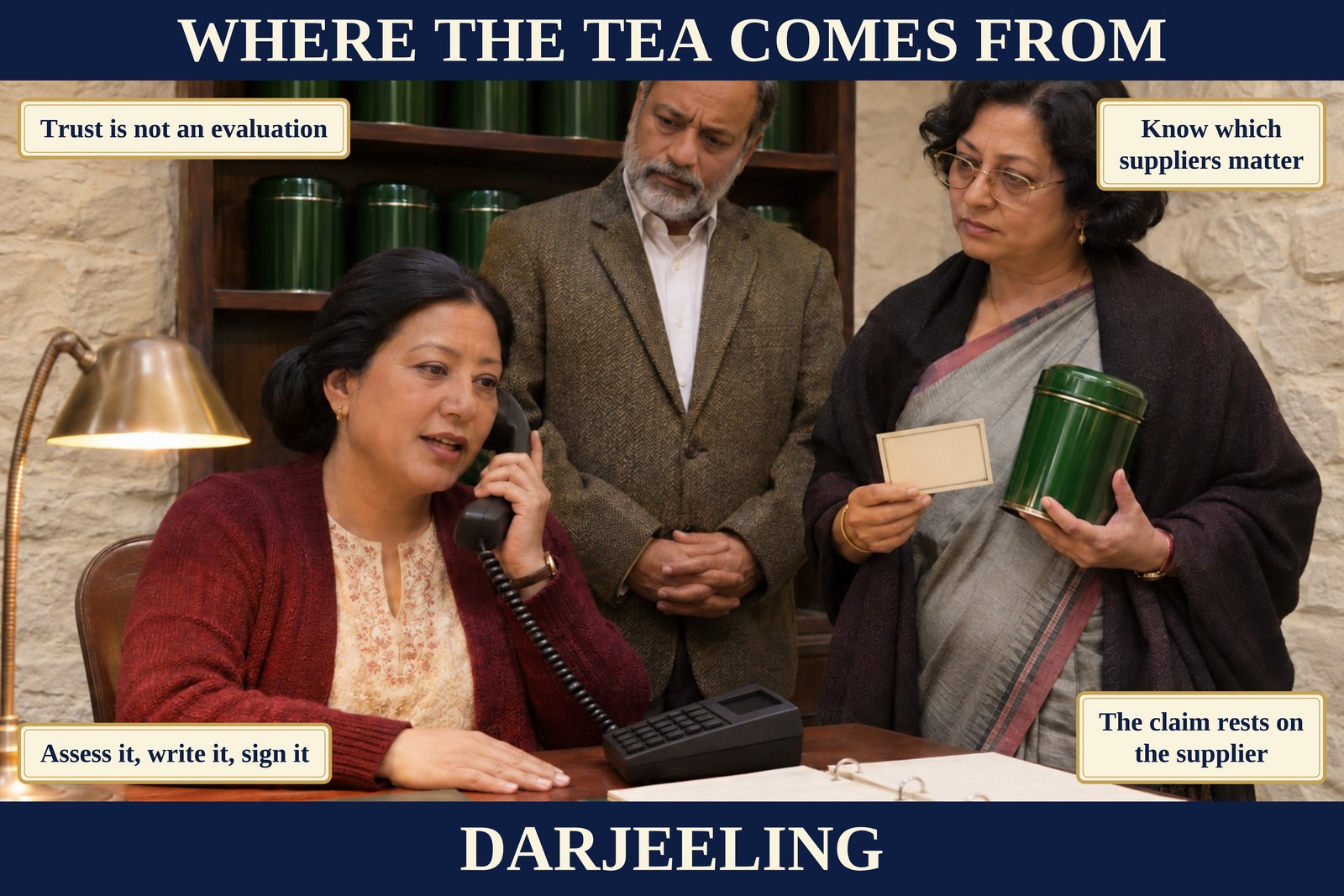
Concept Card 4.13 — Supplier Due Diligence Through the Certifier’s Eyes
Setting: Darjeeling, India
The card shows the second morning of the initial audit at a century-old hotel above Darjeeling, whose room cards promise "sustainable estate tea from the gardens of our hills". The auditor asks for the evaluation of the tea supplier: there is none. The merchant, who has supplied the hotel for thirty years, admits by telephone that the tea is a blend, partly from estates outside the district. The laundry contractor and the jeep company were never evaluated either; the file holds only invoices and a supplier list.
The plaques at the top give the event: «Thirty years of trust, no record» and «The tea turned out to be a blend». The lower pair names the lesson: «Rank, tell, assess, record» and «Evaluate whoever stands behind a claim»: the Accreditation Manual has the certifier check these steps; A13 and A5 ask for reviewed suppliers and evidenced claims.
The card does not say that the merchant deceived anyone or that his tea is poor: he answered frankly and never sent a bad consignment. Nor does it say that the hotel must inspect all ninety suppliers.
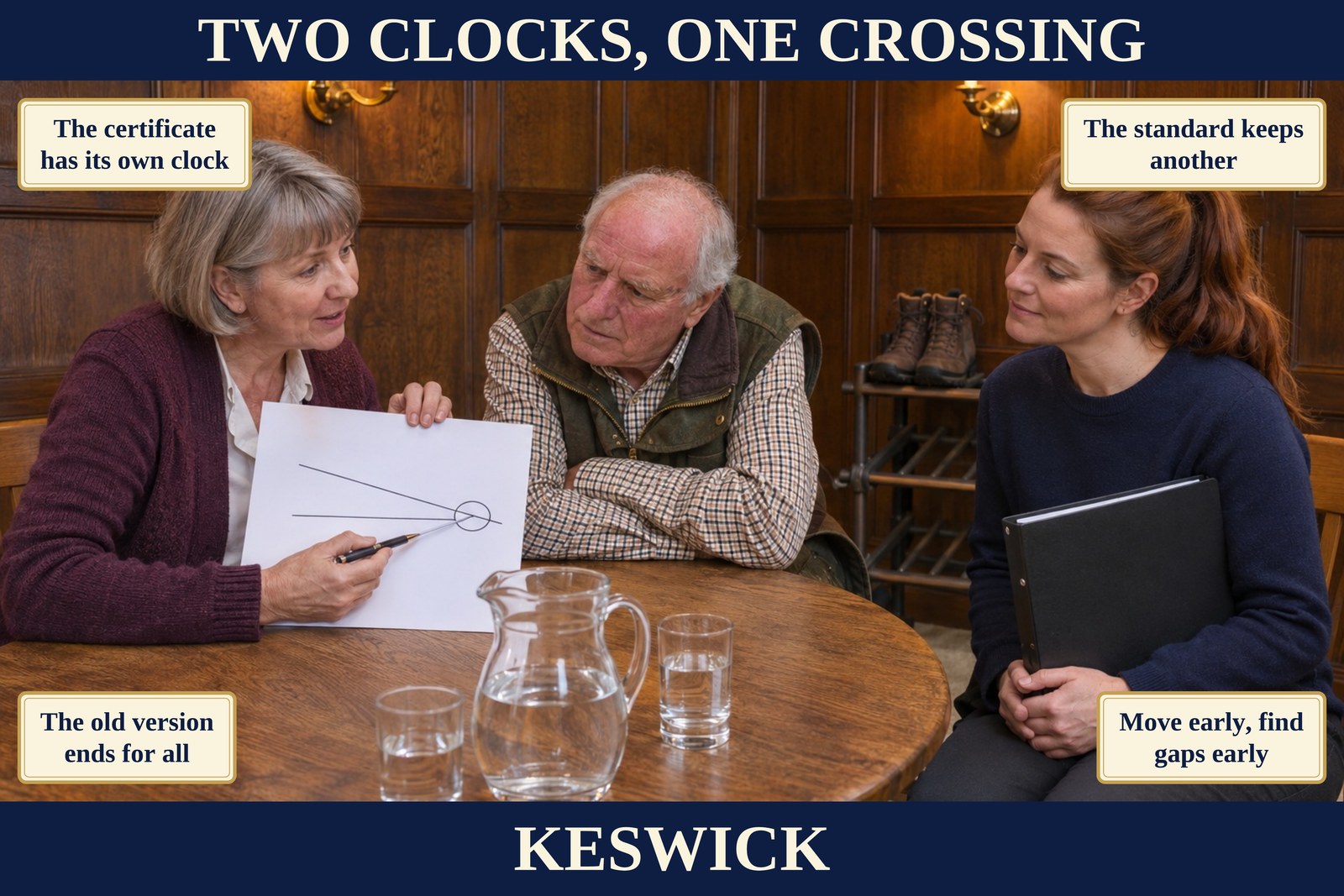
Concept Card 4.14 — The Transition Audit: From v3.0 to v4.0
Setting: Keswick, England
The card shows the opening meeting of the first surveillance audit, in May 2026, at a Victorian house hotel above Derwentwater near Keswick. Certified under version 3.0 in June 2025, the owner plans to renew under 3.0 in spring 2028 and forget version 4.0 until 2031. The auditor confirms that renewals may still use 3.0, then draws two lines on the back of the audit plan: version 3.0 certifications are no longer valid after 30 December 2028. Renewing under 3.0 would buy seven months.
The plaques at the top give the event: «A renewal that buys only months» and «Two lines drawn on the audit plan». The lower pair names the lesson: «Read both clocks, act on the first» and «A new version is not new labels»: the certification cycle and the GSTC transition are two separate dates, and the earlier one decides.
The card does not say that the owner read carelessly: the guidance does allow renewal under version 3.0. Nor does it say that every hotel must move early; an earlier first audit against version 4.0 is agreed with the certification body.

Concept Card 4.15 — Recertification and the Three-Year Cycle
Setting: Puerto Ayora (Galápagos), Ecuador
The card shows the first morning of the recertification audit at the Puerto Ayora hotel, three years after its certification decision. The owner spent the evening listing railings to repaint. Andrés lays out the sheet from beside the staff rota: internal audits every March, annual reviews, reports, two surveillances, every box dated. The auditor reads the cycle, not the week, and finds two things: a new boat operator for an islet trip, never evaluated, and a water target met in the first year and unchanged since.
The plaques at the top give the event: «The calendar beside the staff rota» and «A new boat operator, unevaluated». The lower pair names the lesson: «Recertification reads the whole cycle» and «Targets must move when they are met»: the Accreditation Manual covers all requirements within the cycle; A1.5 asks targets to be reviewed yearly and updated as necessary.
The card does not say that the owner's instinct was foolish: the late nights before the initial audit had worked. Nor does it say the hotel was unprepared; the sheet beside the rota had prepared it every month for three years.
L’AUTORE