
The Helm and the Lens · English
Pronto per la pubblicazione / Ready for publication
the Helm and the Lens – Vol. 8a
ISO 20121 · Event Sustainability Management Systems in Hospitality Volume 8a — The Helm
ISO 20121:2024 for hotels that host weddings, conferences and festivals: how owners and managers build an event sustainability management system that governs what every celebration leaves behind. Thirty cases, opening and closing in Annecy.
534
Pagine
The Helm and the Lens · Volume 8a — The Helm
ISO 20121:2024 · Event Sustainability Management Systems in Hospitality
What the Celebration Leaves Behind
A wedding lasts one day and a conference three. What they leave behind lasts much longer: food that was never eaten, set-ups thrown away after a single use, traffic on a village road, noise on a summer night, staff working double shifts, and a supplier chain no one looked at. For a hotel, events are rarely a side business. They fill the ballroom, the terrace and the calendar, and they are where sustainability promises are tested in front of hundreds of guests at once.
ISO 20121 is the international standard for event sustainability management systems. In its second edition, published in 2024, it asks organisations involved in events to manage their environmental, social and economic impacts as a system, not as a list of good intentions. This book reads the standard from the side of the hotel, which plays two roles at once. It is the venue that hosts the event, and the supplier that delivers rooms, food, staff and technical services. Each role brings different responsibilities, and the book keeps them apart.
The volume has two chapters of fifteen subchapters each. The Vision of Ownership covers the decisions that belong to whoever holds the helm: context and interested parties, the scope of the system, leadership and the sustainable development policy, governance principles, issue identification, risks and opportunities, objectives and the business case. The Operational Perspective follows the standard into the life of an event, from first enquiry to the last delivery van. It covers planning and briefing, purchasing and the supply chain, food and waste, energy and transport, people and communities, communication with organisers and guests, monitoring, and what the hotel learns afterwards. An appendix maps the changes from the 2012 edition to the 2024 edition for hotels already on the path.
Every subchapter opens with a case set in a real place, built as a composite and clearly declared as fictional. A lakeside hotel in Annecy opens the story and comes back to frame it. Each subchapter carries a Verification Pact, which checks common market claims against what the standard actually requires and keeps three things apart: binding requirement, explanatory note and the author’s recommendation. Economic figures are presented as model estimates, not as sector data.
The author is a Lead Auditor and has spent over twenty years in international luxury hospitality. He writes as an author and publisher, for the people who run hotels and their event teams. This is independent material, not affiliated with ISO or any certification body.
Each subchapter ends with a concept card. Worksheets, checklists and the cards in high resolution are available on the online platform. The companion volume, 8b — The Lens, reads the same standard through the eyes of the internal auditor and the certification body.

EDIZIONI · FORMATI
Formati disponibili
Le edizioni fisiche e digitali associate a questa scheda.
NEL LIBRO
Contenuto / Contents
La struttura del volume così come presentata nell’edizione pubblicata.
Table of Contents
- Preface.
- 1.1 The Green Label: What a Sustainability Claim Must Carry.
- 1.2 The Event as a System: Roles, Cycle and Interfaces.
- 1.3 ISO 20121:2024: What the Second Edition Changes.
- 1.4 Sustainability and Value Creation in the Events Business.
- 1.5 Interested Parties and the Legitimacy of the Hotel
- 1.6 Reputational Risk: When the Event Goes Public.
- 1.7 Governance: The Four Guiding Principles and Who Decides.
- 1.8 Investment Decisions: Resources, Technology and What Remains. 1
- 1.9 Assessing Environmental, Social and Economic Impacts.
- 1.10 Transparency as an Asset: Reporting What Was Measured.
- 1.11 Brand, Attraction and Legacy.
- 1.12 Legal and Other Requirements Without a Single Jurisdiction.
- 1.13 The Cost of Improvisation: Planning and Controlling Change.
- 1.14 From Project to System: Scope and Structure.
- 1.15 Human and Children’s Rights at Events.
- 2.1 Analysing the Context.
- 2.2 Identifying and Engaging Interested Parties.
- 2.3 Purpose, Values and Policy.
- 2.4 Planning Objectives.
- 2.5 Identifying and Evaluating Issues.
- 2.6 Risks and Opportunities.
- 2.7 Planning the Event Operationally.
- 2.8 Managing the Supply Chain.
- 2.9 Internal and External Communication.
- 2.10 Managing Change.
- 2.11 Monitoring and Measurement.
- 2.12 Nonconformity and Corrective Action.
- 2.13 Documented Information.
- 2.14 Competence and Awareness.
- 2.15 Continual Improvement.
- Afterword.
- Appendix A..
- Sources and Research Methodology — What This Book Verified, and How..
- Glossary.
- About the Author.
- Contact.
- The Series.
- The Online Platform..
PRIMA DELL’ACQUISTO
Estratti / Extracts
Passaggi selezionati dal libro disponibili per la consultazione.
01 2.2 Identifying and Engaging Interested Parties Apri / Open
GUIDING QUESTION
If a client asked you to attach the result of your last engagement with interested parties, could you say whom you spoke to, what you changed as a result and what those people heard back from you? Or would you attach an average?
Opening
In the first week of March, Mark Vella received an email that he read twice before forwarding it to his general manager. Vella runs events at a congress hotel on the edge of Valletta, above Marsamxett Harbour. The hotel has 160 rooms, a divisible congress hall for 500, seven meeting rooms and a terrace over the water, and hosts about ninety events a year. In the autumn the general manager, Rebecca Zammit, had decided to organise the events business to ISO 20121.
The email came from Dr Hanne Visser, head of congress organisation at a European medical society based in Brussels. For five years the society had held its annual congress at the hotel: three days in October, about 450 participants, a contract worth about EUR 185,000. This year it had put the congress out to tender. Question 17 read: “Describe how your hotel engages interested parties, and attach the result of your most recent engagement.”
Vella had found the question easy. In January he had sent a survey of twelve questions on the hotel’s sustainability to all 640 addresses in the sales department’s customer database: clients, agencies and suppliers. Thirty-eight had replied, with an average score of 4.2 out of 5. Vella attached the bar chart and added that the hotel surveyed its stakeholders regularly.
Dr Visser’s reply was short and asked three questions. Who replied? What did your hotel change because of the answers? What did the respondents hear back? Then came a paragraph Vella had not expected: after the last congress two residents had complained to the society, not to the hotel. The coaches taking participants to partner hotels in Sliema each evening had waited in the narrow street below the bastions with their engines running, and the signs behind the windscreens carried the society’s name. Did the hotel talk to its neighbours?
Rebecca Zammit asked to see the customer database. The residents of the street below were not in it. The local council was not in it, and the coach company appeared only as a supplier for invoices. The agency that sends up to thirty service staff for large congresses was listed with its owner’s address; the staff themselves appeared nowhere. Nobody knew who the thirty-eight respondents were, because the survey had been anonymous to encourage replies.
It is worth being fair to Mark Vella. He had asked, which many hotels never do, and he had used the list he was given. The coach drivers were following the timetable they had received, and the residents had complained to the name they could read. Nobody had acted in bad faith. The survey simply measured how satisfied thirty-eight unknown people were with a hotel whose coaches they had probably never heard, while the two people who had heard them had never been asked.
The tender closed at the end of April. Zammit wrote to Dr Visser that the hotel would answer question 17 again, with the groups it had spoken to, the results and what would change.
The Problem
The Structural Failure
The first structural failure is the survey used as a substitute. A survey is one way of collecting opinions. Engagement is a process at the end of which something is different, and the people involved know it. Vella had collected, but decided nothing and answered no one. An average of 4.2 is not the result of engagement; it is a number without a sender.
The second is the distribution list. The survey went to the addresses the hotel had, not to the parties its events affect. A customer database holds those who book and those who supply. Residents, the council, the agency’s staff and the coach drivers book nothing, yet they bear consequences of what the hotel does or do part of the work themselves.
The third is the absence of decision. Among the thirty-eight replies were requests for charging points, vegan lunches and paperless invoices, and nobody had decided which the hotel would take up, which it would not, and why. Collecting wishes without deciding raises expectations that are then disappointed.
Beneath all of these lies a structural fact. A hotel talks constantly with the world around it, sales with clients, reception with drivers, the general manager with the council, but every conversation belongs to a department and none to the house. So the hotel knows a great deal and can show very little. A survey seems to solve this because it produces a document, but the wrong one: an opinion without a name instead of a decision with a reason.
The Cultural Failure
Vella had learned a seminar grid that sorts parties by influence and interest, and those with little influence are merely “monitored”. Residents and agency staff almost always land there. A hotel committed to inclusivity does not leave uninformed precisely those with the least power, and the residents turned out to have more influence than the grid allowed: they had written to the client.
The second cultural habit is one channel for all, and once only. An online questionnaire reaches a procurement officer. It hardly reaches a retired resident, an agency worker who reads little English, or a council officer. And in a house with ninety events a year, who is affected changes with every type of event: coaches and agency staff at a congress, neighbours at a terrace wedding. Engagement treated as a project, sent, analysed and closed, misses all of that.
The Principle
Engagement is a process with five parts, and each leaves a trace. It starts with a register: who is affected or has influence, in which role, with which requirements. From the register comes a plan: with whom the hotel speaks, about what, how often and through which channel. Then the conversation, with a short record. Then the decision on what the hotel takes up and what it does not. Finally the feedback to those who spoke. If one part is missing, what remains is a survey or a courtesy (1.5).
The register is ordered by role, not by power. For each party it states what the party does or bears at an event: it commissions, plans, supplies, contributes, attends, permits or bears consequences. The hotel appears in it too, with its own roles: venue and supplier at the society’s congress, organiser at its own summer party, and buyer of the coaches to the partner hotels. The role determines what the hotel must discuss with each party.
| Part of the process | What it produces | What is missing without it |
| Register | Every party with its role and requirements, each with a source | Those who book nothing are invisible |
| Plan | Who speaks with whom, about what, through which channel and when | Conversations happen by chance or not at all |
| Conversation and record | One page per conversation: concerns, commitments, deadlines | What was said lives in one person’s memory |
| Decision | Each requirement taken up, with how, or not, with why | Wishes pile up and expectations sour |
| Feedback | Each party hears what became of its concern, in its own language | The next complaint goes to the client, not the hotel |
Every requirement in the register has a source and a decision. A requirement the hotel does not take up does not disappear; it is answered. The record of each conversation is one page: who, when, concerns, commitments and a date for the reply. Names of private individuals appear only with their consent, and what the hotel passes to a client is a summary without names.
The process should catch an issue before it becomes a complaint. In Valletta there had been warning signs: the coach dispatcher’s remark in the autumn that residents were approaching her drivers, and an agency worker asking whether there was still a bus home to the south of the island after midnight. Both were emerging issues, lost because there was nowhere for such sentences to arrive. The register is that place. A remark on the telephone is not yet a record, but it is worth a line.
What the Standard Says
This section rests mainly on clauses 4.2 and 7.4 of ISO 20121:2024 and on Table A.1 of its annex A. What follows is what the standard requires, in this book’s own words; where only the informative annex speaks, it is called guidance.
Clause 4.2 requires the organisation to determine three things: the relevant interested parties, their relevant requirements, and which of those requirements will be addressed through the management system. The third is the one missing in Valletta. The standard does not require every requirement to be met; it requires a decision about each. A note adds that interested parties can have requirements related to climate change. Clause 4.2 lists under a) to i) who comes into question, from the client through the workforce and suppliers, expressly including the venue, to authorities and communities, including local residents (1.2, 1.5).
The same clause requires a process to identify and engage interested parties on current and emerging sustainable development issues, related to their role in the event’s value chain. That is the yardstick by which the register above is ordered. Where appropriate, the organisation documents the results of this engagement, and the standard points to 7.3, 7.4 and 8.3 for this. …
02 Preface Apri / Open
A proposal is a promise that someone else passes on. The first hotel this volume enters learns that on a Thursday in September. A lakeside hotel in Annecy has offered a professional association from Paris a two-day congress for about three hundred participants. The proposal comes back not from the congress office but from the association’s counsel, who has struck two lines in red, “Your carbon-neutral congress: CO2 offset” and “green meeting on Lake Annecy”, and written three questions beneath them. Which system stands behind your statements? Against which standard do you work? Who has checked it?
The owner lays three documents side by side. The proposal promises a carbon-neutral congress. The certificate from the hotel’s offset provider covers the estimated energy of two rooms over two days. And the night log records what the night porter found after the last large congress: “2:40 a.m., courtyard: general waste full, lid open, four bags beside it.” None of the three documents answers any of the three questions. The hotel has no system. It has a text, and the text is three years old.
This book is about ISO 20121:2024, the international standard for event sustainability management systems. It describes how an organisation plans, runs and reviews its events so that what it says about their sustainability is carried by a system. The thirty subchapters that follow test that idea in hotels on five continents, and the lakeside hotel in Annecy, France, opens the volume, closes its first chapter, opens its second and closes the book.
Why This Standard, and Why Hotels
Every other pair of volumes in this series treats a standard that a hotel applies to itself as a whole. ISO 20121 is different in kind. Its subject is the event, and the event is rarely the hotel’s own. An association books the congress; a couple and their planner own the wedding; a company organises its gala. The hotel provides the ballroom, the kitchen, the service, the technology and the rooms. In the standard’s language it is usually venue and supplier, sometimes organiser of its own formats, and only occasionally event owner.
That is precisely why the standard belongs in a series about hospitality. The hotel is the only party present from the first enquiry to the empty container in the courtyard. It is the interface whether it wants to be or not, and what an event leaves behind, in the yard at three in the morning, in the lane where the coaches wait, in the dish room after eleven, in the hours of the people who work after the last guest has gone, is left behind at the hotel. In Udaipur, after a three-day wedding, the function sheet, the planner’s run sheet and the night log each give a different account of the same night. Each was correct on its own. Together they described an event that nobody had planned as a whole.
The standard does not require an event to be carbon-neutral, and it gives no hotel a word with which to claim it. It requires a framework that decides, before the event, what the hotel stands for, and processes that make sure that, afterwards, it knows what remained. Which claims the hotel makes, which staffing agency it books at which hourly rate, whether the poor figure appears in the report to the client: these are decisions of ownership. That is why this book begins at the owner’s table. It does not argue that every hotel needs a system. For a hotel without one, the standard is a way of thinking; for a hotel that builds one, it is the yardstick against which it will be measured. The book is written for both.
Where the Standard Comes From, and What 2024 Changed
The forerunner of ISO 20121 was the British standard BS 8901, begun in 2006 with the London 2012 Olympic Games in view. From January 2010 an ISO working group developed an international standard, with the British and Brazilian national standards bodies as secretariat, and the first edition appeared in June 2012. The second edition appeared in April 2024 and replaces it. Its foreword calls it a technical revision following the harmonised structure of ISO management system standards, with more emphasis on environmental, social and governance matters, an aim to reduce negative impacts and enhance positive ones, and more accessible language.
Most of the weight shifts in four clauses. Under 4.5 the four guiding principles of sustainable development, stewardship, inclusion, integrity and transparency, are bound into an overarching statement that frames policy, objectives and operational plans. Under 6.3 changes to the system are made in a planned manner. Under 8.2 processes are adapted when circumstances change, consistent with that statement and the policy, and the lessons reach the management review. Under 9.3.4 performance is evaluated against purpose, values and the guiding principles. Only 6.3 has no predecessor; the other three rewrite or move what the 2012 edition already contained. Subchapter 1.3 shows why these clauses arrive at the board, and Appendix A maps the transition for hotels that worked to the first edition.
A Series Built the Same Way Twice …
MATERIALI DI LAVORO
Materiali e download
Checklist, modelli, supplementi e file di lavoro collegati al volume.
35 materiali in 3 gruppi
Capitolo 117 materiali
FILES
1 · Worksheet 1.1: A Claim and the System Behind It
Subchapter 1.1
If a client struck every word about sustainability from your event proposal tomorrow and asked which system stands behind them, what would you put on the table? And what would that client find in your courtyard at three in the morning after your last congress?
FILES
2 · Worksheet 1.2: Who the Hotel Is at an Event
Subchapter 1.2
When a wedding is celebrated in your hotel, do you know in how many roles your house takes part, and since when the celebration has really been running? And who is responsible for the hour in which the music stops and the coaches stand at the gate?
FILES
3 · Worksheet 1.3: A New Edition, a Board Question
Subchapter 1.3
If your hotel works to the first edition of the standard, do you treat the new edition as a documentation task or as a question for your board? And who in your hotel has read it before its cost is decided?
FILES
4 · Worksheet 1.4: The Figure That Was Never Made
Subchapter 1.4
If your largest conference client asked tomorrow how much food was left after its last annual meeting, would the figure exist in your hotel, or would someone first have to estimate it? And do you know what the answer would cost you, and what the missing answer costs?
FILES
5 · Worksheet 1.5: The People Outside the Room
Subchapter 1.5
Apart from your client, who decides whether your hotel will still be hosting celebrations next year? And when did you last ask those people anything before the party started, rather than after it had ended?
FILES
6 · Worksheet 1.6: When the Back Yard Goes Public
Subchapter 1.6
What would a stranger see who filmed through the gate of your service yard at three in the morning after a celebration in your ballroom? And would it match what your website says?
FILES
7 · Worksheet 1.7: Who Decides by Which Sentence
Subchapter 1.7
If tomorrow a proposal lands on the table that brings in a great deal of money and does not fit what your hotel says about itself, who in your hotel says no, and on the basis of which sentence? And does your board hear about it before it reads about it in the press?
FILES
8 · Worksheet 1.8: What Remains After the Payback
Subchapter 1.8
If your management puts three investment requests for the events business on your desk and the money covers one or two, by what do you choose? And what will still stand in your house in ten years, long after the events you bought it for are over?
FILES
9 · Worksheet 1.9: Impacts Beyond the Hotel’s Walls
Subchapter 1.9
When an event is larger than your house, which of its effects do you count as your own? And by which criteria do you decide which of them are significant, and who besides you knows those criteria?
FILES
10 · Worksheet 1.10: Reporting What Was Measured
Subchapter 1.10
When the figures after an event turn out worse than announced, who in your house decides whether the client gets to see them? And what is a commitment worth that is honoured only in good years?
FILES
11 · Worksheet 1.11: What Remains of a Celebration
Subchapter 1.11
What should remain of a celebration in your house once the guests have left and the stage has been taken down? And could you prove today what your advertising promises about it?
FILES
12 · Worksheet 1.12: From Checklist to Register
Subchapter 1.12
If an inspector asked tomorrow, in the middle of an event in your house, who is responsible for safety, would the answer be on a sheet that someone in the house knows? And who in your house would learn if that answer changed next year?
FILES
13 · Worksheet 1.13: The Cost of Improvisation
Subchapter 1.13
How often last season did your house re-plan an event the day before, and who paid for what it cost? Could you say what remained of your principles when the delivery arrived at eleven at night?
FILES
14 · Worksheet 1.14: From One Evening to a System
Subchapter 1.14
If a client asked you tomorrow which of your events your sustainability statements actually cover, could you draw the line without hesitating? And does your house keep, on an ordinary Tuesday, the standard it showed at its best celebration?
FILES
15 · Worksheet 1.15: Whom the Hotel Answers For
Subchapter 1.15
If children sing at your next celebration and half the service team comes through an agency, do you know who answers for these people while they are in your house? And what would you do if you learned that one of them was being wronged?
XLSX
31 · Practical application: all thirty subchapters
Subchapters 1.1–2.15
120 steps from the book, with a summary by subchapter
FILES
35 · The thirty concept cards
Subchapters 1.1–2.15
Title, city, image and text of every card
Capitolo 215 materiali
FILES
16 · Worksheet 2.1: Analysing the Context
Subchapter 2.1
If you wrote down today what is happening around your events business and within it, which decision would you take differently from yesterday? And who in your house already knows what your paper leaves out?
FILES
17 · Worksheet 2.2: Engaging Interested Parties
Subchapter 2.2
If a client asked you to attach the result of your last engagement with interested parties, could you say whom you spoke to, what you changed as a result and what those people heard back from you? Or would you attach an average?
FILES
18 · Worksheet 2.3: Purpose, Values and Policy
Subchapter 2.3
If you laid your hotel’s sustainability policy next to a competitor’s, how would a client tell which one belongs to you? And who in your hotel could say tomorrow which sentence in it applies to their own work?
FILES
19 · Worksheet 2.4: Planning Objectives
Subchapter 2.4
If you had to say today what your hotel intends to achieve with its events by year end, would you name an intention or a number below which you would admit defeat? And who in your hotel would notice if that number stopped holding in July?
FILES
20 · Worksheet 2.5: Identifying and Evaluating Issues
Subchapter 2.5
If someone put your list of significant issues in front of you and pointed to one line, could you say who rated it, by which rule and on the strength of which feedback? And who apart from you has ever seen that list?
FILES
21 · Worksheet 2.6: Risks and Opportunities
Subchapter 2.6
If you had to write down the risks of your events business today, would they come from a template or from what happened in your house after the last gala? And how would you know next year whether your actions had worked?
FILES
22 · Worksheet 2.7: Planning the Event Operationally
Subchapter 2.7
If your hotel ticked “yes” on every line of a sustainability checklist for the next congress, could anyone point to the place and the hour in your running order where each “yes” is delivered? And who would notice if it were not?
FILES
23 · Worksheet 2.8: Managing the Supply Chain
Subchapter 2.8
When your hotel selects its suppliers for sustainability, are you measuring what those businesses do, or how well they fill in questionnaires? And who checks the gifts that a client’s sponsor wants placed in your guest rooms?
FILES
24 · Worksheet 2.9: One Answer at the Buffet
Subchapter 2.9
When a guest at your buffet asks what happens to the leftovers, does your temporary waiter give the same answer as your website? And who in your hotel approved the sentence on the website before it went online?
FILES
25 · Worksheet 2.10: Managing Change
Subchapter 2.10
When a client doubles the number of guests three days before the event, who in your hotel says yes, and against what does that person measure the answer? And where is it written afterwards what was decided and why?
FILES
26 · Worksheet 2.11: Monitoring and Measurement
Subchapter 2.11
If the figures from your last twenty events were on the table today, could you say for each one how it was produced, with which instrument, at what time and by whom? And which of them has ever changed a decision in your house?
FILES
27 · Worksheet 2.12: Nonconformity, Corrective Action
Subchapter 2.12
When something at an event in your house goes differently from what was decided, does the first question ask who it was, or why it could happen? And how would you know, three months later, that it will not happen again?
FILES
28 · Worksheet 2.13: Documented Information
Subchapter 2.13
If a client asked tomorrow for six pieces of evidence from your system, would you hand over six sheets, or three binders in which the client must search? And do you know which participant lists from last autumn are still in your house, with whom, and for what purpose?
FILES
29 · Worksheet 2.14: Competence and Awareness
Subchapter 2.14
If, at midnight at your next gala, more of the people serving in the ballroom are not on your payroll than are, do they know what your hotel promised the client? And could you show that they know?
FILES
30 · Worksheet 2.15: Continual Improvement
Subchapter 2.15
When you sit at a table after a year with your system, do the figures in front of you tell you what to change, or that all is well? And who in your hotel decides what forty events mean for the forty-first?
Altri materiali3 materiali
XLSX
32 · Verification Pact
Verification Pact, all subchapters
188 common claims tested against ISO 20121:2024, each marked binding or not
XLSX
33 · Common mistakes: a self-check
Common Mistakes, all subchapters
240 mistakes described in the book, with columns for the property
XLSX
34 · The thirty guiding questions
Guiding questions, all subchapters
One question per subchapter, with room for the answer
Immagini e tavole HD
Apri e proietta le foto direttamente dal sito, a schermo intero, oppure scarica gli originali.
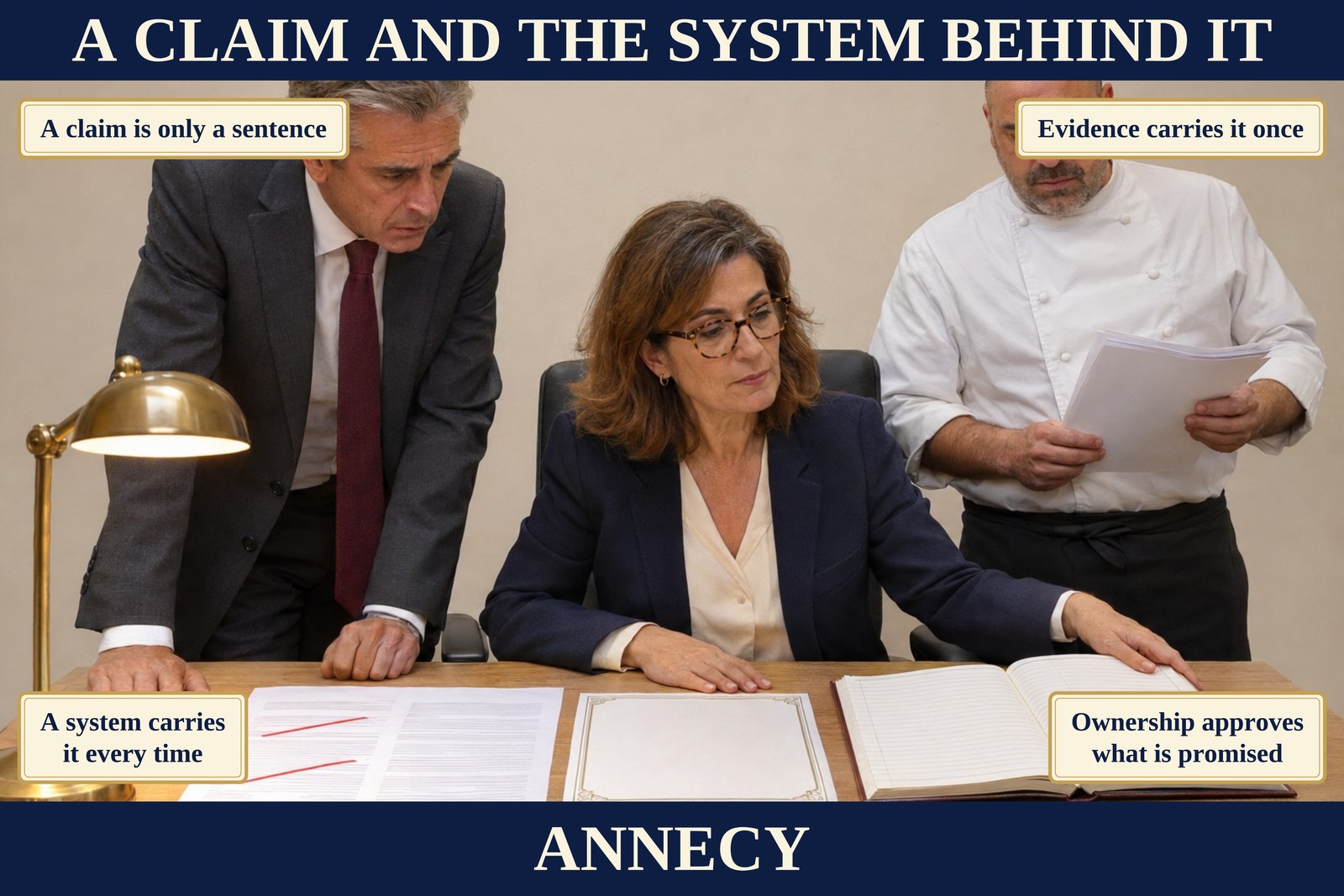
Concept Card 1.1 — A Claim and the System Behind It
Subchapter 1.1 · Annecy, France
Setting: Annecy, France
The owner’s office of the lakeside hotel in Annecy on a Friday morning in late September, under a brass desk lamp against a plain plaster wall. Claire Duval, the owner, sits at the light oak desk in a navy blazer and tortoiseshell glasses, one hand flat beside a certificate, the other on an open log book. Marc Lenoir, the general manager, leans over the desk from her right; Julien Favre, the chef, stands to her left holding a sheaf of delivery notes and frowning.
Three documents lie side by side and carry the whole argument. On the left, the congress proposal with two lines struck through in red by the client’s counsel. In the middle, the offset certificate, its decorative border framing an empty centre: credits bought for the estimated energy of two rooms over two days. On the right, the night log with the porter’s account of the courtyard after the last congress. Each document is true; none answers the three questions from Paris.
The four plaques read as one argument. A claim is only a sentence, and the proposal held two of them, now struck in red. Evidence carries it once, as the certificate covered one estimate for one congress and nothing more. A system carries it every time, connecting the kitchen’s delivery notes and the night round to what the hotel says. Ownership approves what is promised, because the sentences came from a three-year-old sales template that nobody above sales had ever approved.
The plate does not accuse the events manager, who wrote the proposal in good faith from the house template, nor the offset provider, which delivered exactly what it sold, nor the chef, whose sourcing is real. The night porter recorded faithfully what he saw. What the image shows is honest facts with no connection to the sentences that promised them, and an owner deciding to answer herself. A sustainability claim is worth exactly as much as the system behind it.
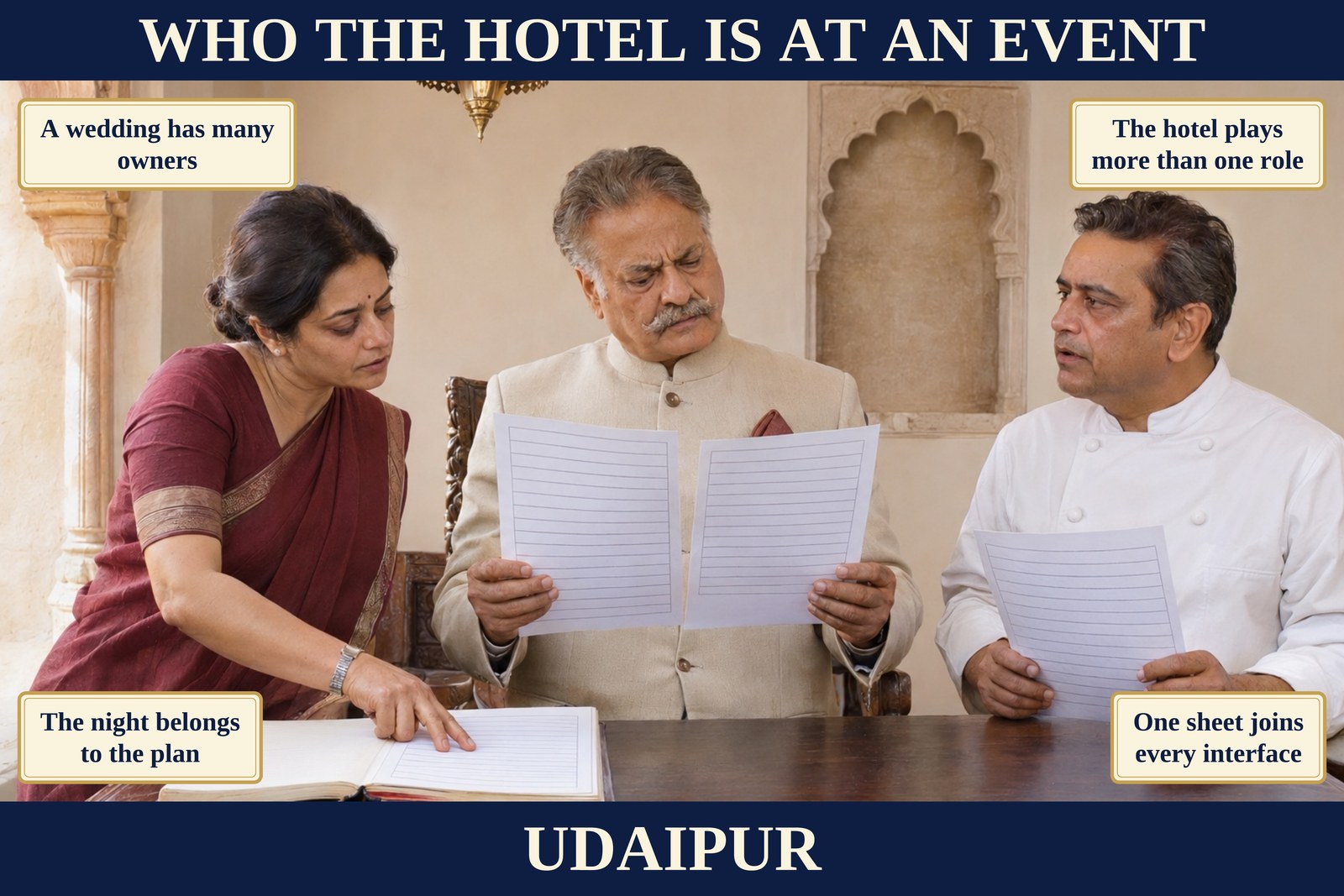
Concept Card 1.2 — Who the Hotel Is at an Event
Subchapter 1.2 · Udaipur, India
Setting: Udaipur, India
The owner’s office of a palace hotel on the edge of the old city of Udaipur, on a February morning: cream lime plaster, a carved sandstone column, an empty niche and a hanging brass lamp. Vikram Singh Shekhawat, the owner, in a cream bandhgala, holds two ruled sheets side by side and frowns from one to the other. Meera Joshi, the banquet manager, in a maroon sari, points at an open log book on the table; Rakesh Sharma, the chef, holds a third sheet and speaks.
The two sheets in the owner’s hands are the hotel’s function sheet and the wedding planner’s run sheet, each correct on its own and each ending the night at a different hour. The log book holds the night porter’s page: two coaches with engines running in the lane, the DJ’s van blocking the gate, floral foam in the general waste. The chef’s sheet carries the special meals that did not match. The owner stands in the middle because only the hotel saw every paper.
The plaques move from diagnosis to remedy. A wedding has many owners: two families, a planner from Mumbai, a DJ, a decorator. The hotel plays more than one role, as venue and supplier, as organiser of the heritage walk and the brunch, and as client of the coach company, and it answers for something different in each. The night belongs to the plan, not to whoever happens to be awake. One sheet joins every interface, reconciled weeks before the first guest arrives.
The plate does not blame the planner, whose run sheet was accurate for the plan she had been given, nor the families, who had every right to extend their own celebration by an hour. Joshi kept the morning brunch running with the only staff she had, and the night porter recorded faithfully what he saw. Each paper was correct; together they described a celebration nobody had planned as a whole. The hotel is the interface whether it wants to be or not.
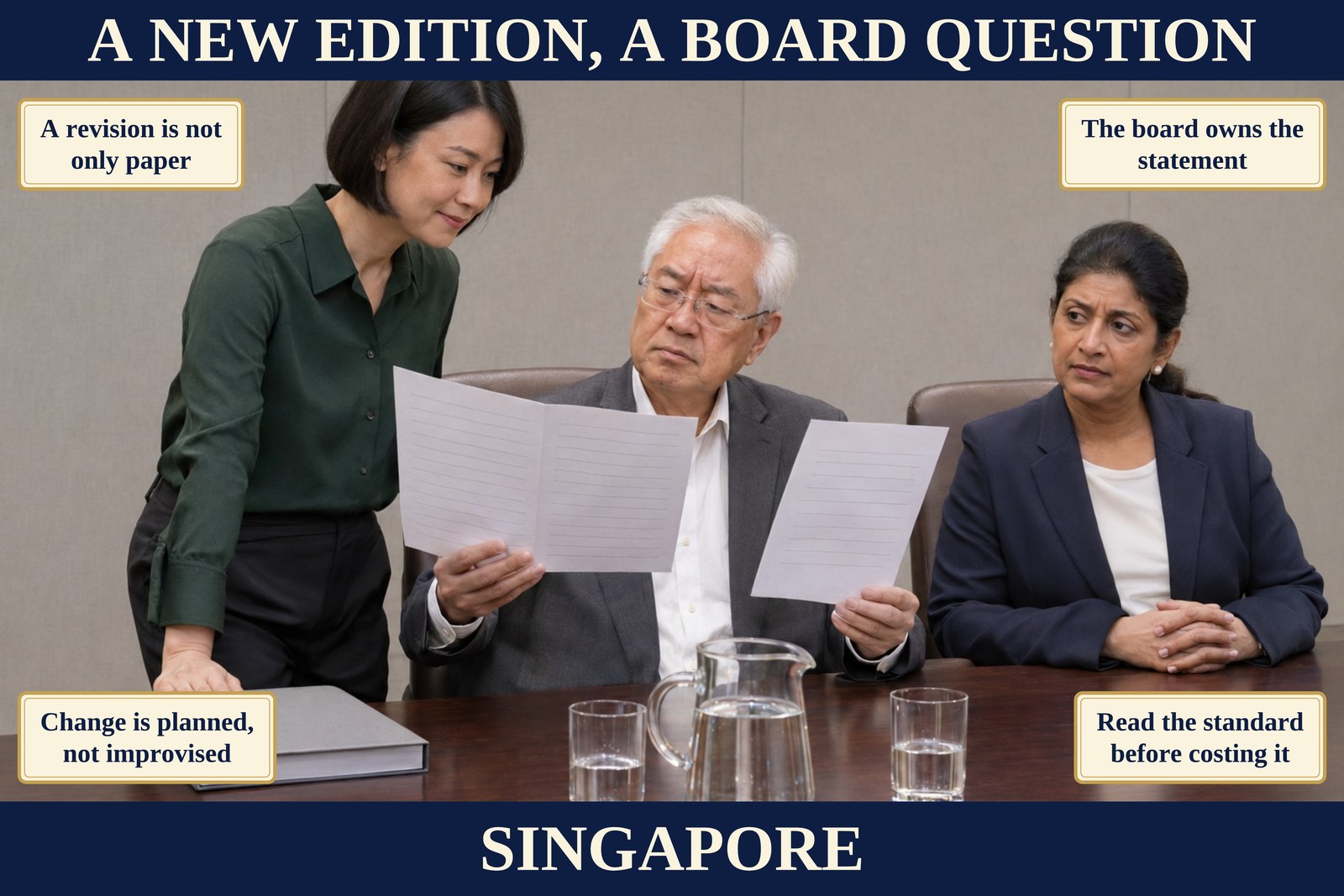
Concept Card 1.3 — A New Edition, a Board Question
Subchapter 1.3 · Singapore
Setting: Singapore
The boardroom of a large convention hotel in Singapore on a March afternoon, under even light, against walls of pale grey fabric. Raymond Tan, the chairman, seated in a dark grey suit and rimless glasses, holds a folded two-page document in one hand and a single sheet in the other, weighing them with a sceptical look. Ong Wei Ling, the sustainability manager, stands beside him in a dark green blouse, one hand on a closed grey volume. Priya Menon, the general manager, sits with her hands folded, watching him.
The single sheet is Menon’s paper: three lines, a documentation task, SGD 18,000, no operational impact. The two pages are Ong’s reading of the second edition: four clauses new or rewritten, two of them landing with the board. The chairman weighs paper against work, as he does at every revision. The closed grey volume under Ong’s hand is the standard itself, and her hand on it says what nobody else at the table could say: she had read it.
The four plaques read as one argument. A revision is not only paper, because the weight of the 2024 edition lies in a few clauses, not in the new numbering. The board owns the statement: the guiding principles, bound into one overarching statement, must frame policy, objectives and operational plans. Change is planned, not improvised, and its lessons reach the management review. Read the standard before costing it, since an estimate of SGD 18,000 and one of 68,000 begin from different readings.
The plate does not mock the general manager; what is commonly said about revisions is true for many of them, and Ong herself overstated one point. Neither was defending territory. What the image shows is a board discovering that a letter addressed to whoever maintains the documents was in fact addressed to it. The second edition moves weight from procedure to purpose, and purpose belongs to those who decide what the hotel stands for.
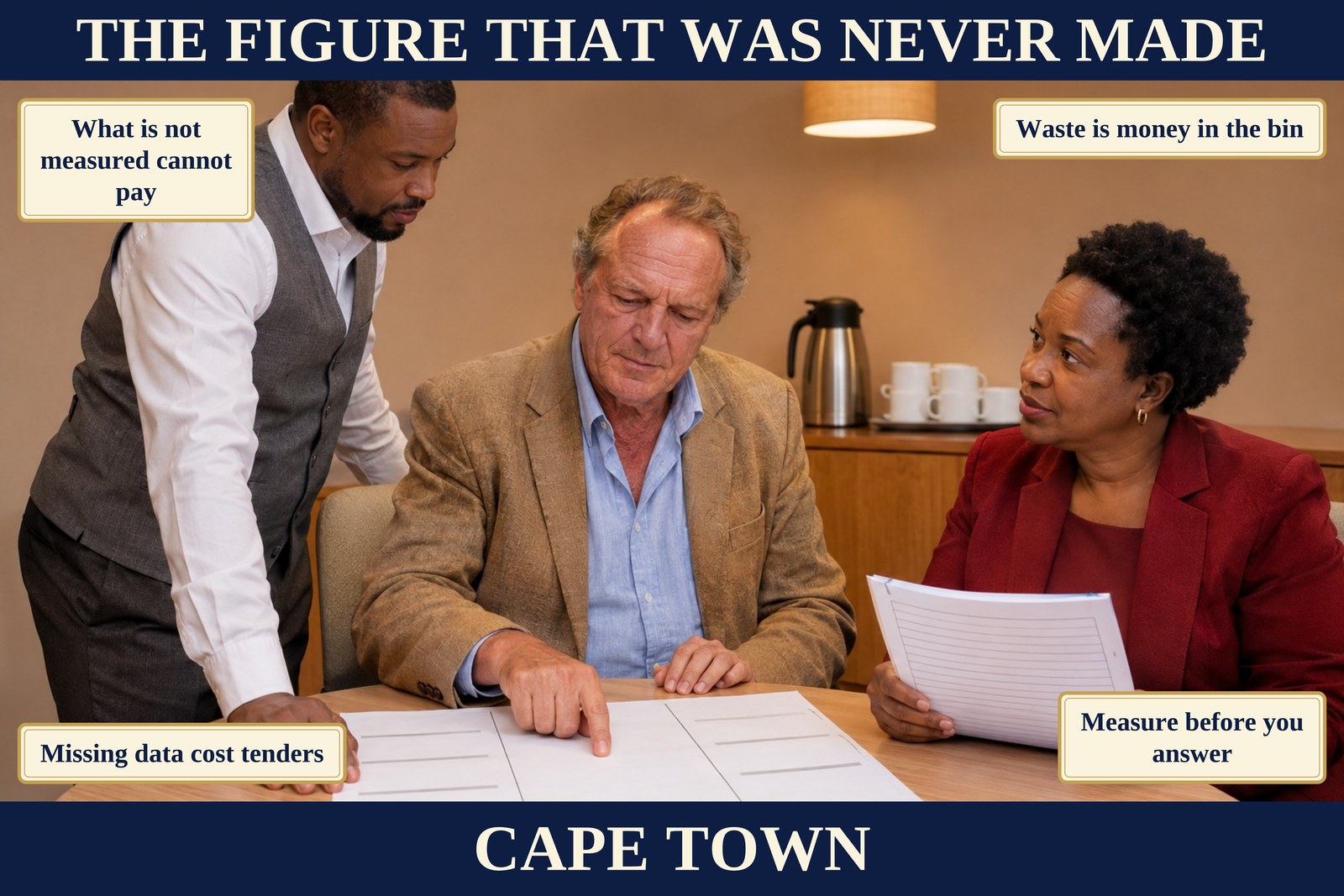
Concept Card 1.4 — The Figure That Was Never Made
Subchapter 1.4 · Cape Town, South Africa
Setting: Cape Town, South Africa
The first-floor meeting room of a conference hotel in Cape Town on a late October afternoon, under a warm pendant lamp, coffee cups waiting on the sideboard. Pieter van der Merwe, founder and shareholder, seated in a tan jacket and open blue shirt, rests his forefinger in the middle column of a large three-column sheet. Sipho Ndlovu, the financial controller, in a grey waistcoat, leans in with a hand on the table. Naledi Dlamini, the general manager, in a red jacket, holds the questionnaire.
The sheet’s three columns are what the hotel can lose, save and win. The finger rests on the middle one, the column without a figure: how much of eighteen million rand of banquet food cost ends in the bin. The questionnaire in Dlamini’s hands asks for food waste in kilograms, energy, step-free access and the standard the hotel works to. The empty column is the centre of the image because it holds the answer nobody in the house could give.
The plaques read as one sentence. What is not measured cannot pay, because a safety margin never weighed already sits in the accounts, unseen. Waste is money in the bin, and the generous buffet is part of food cost. Missing data cost tenders, as two the hotel set aside the previous autumn showed. Measure before you answer, so that the reply to the client names a person, a date and the first weighing at the next large event.
The plate does not accuse the kitchen, which planned buffets generously because an empty buffet at half past twelve is worse than a full one at two, nor sales, which set the tenders aside because it could not answer them. Dlamini’s “not available” was honest. Nobody had hidden a figure; it had simply never been made. Sustainability run beside the operation costs money; sustainability written into the function sheet produces figures.
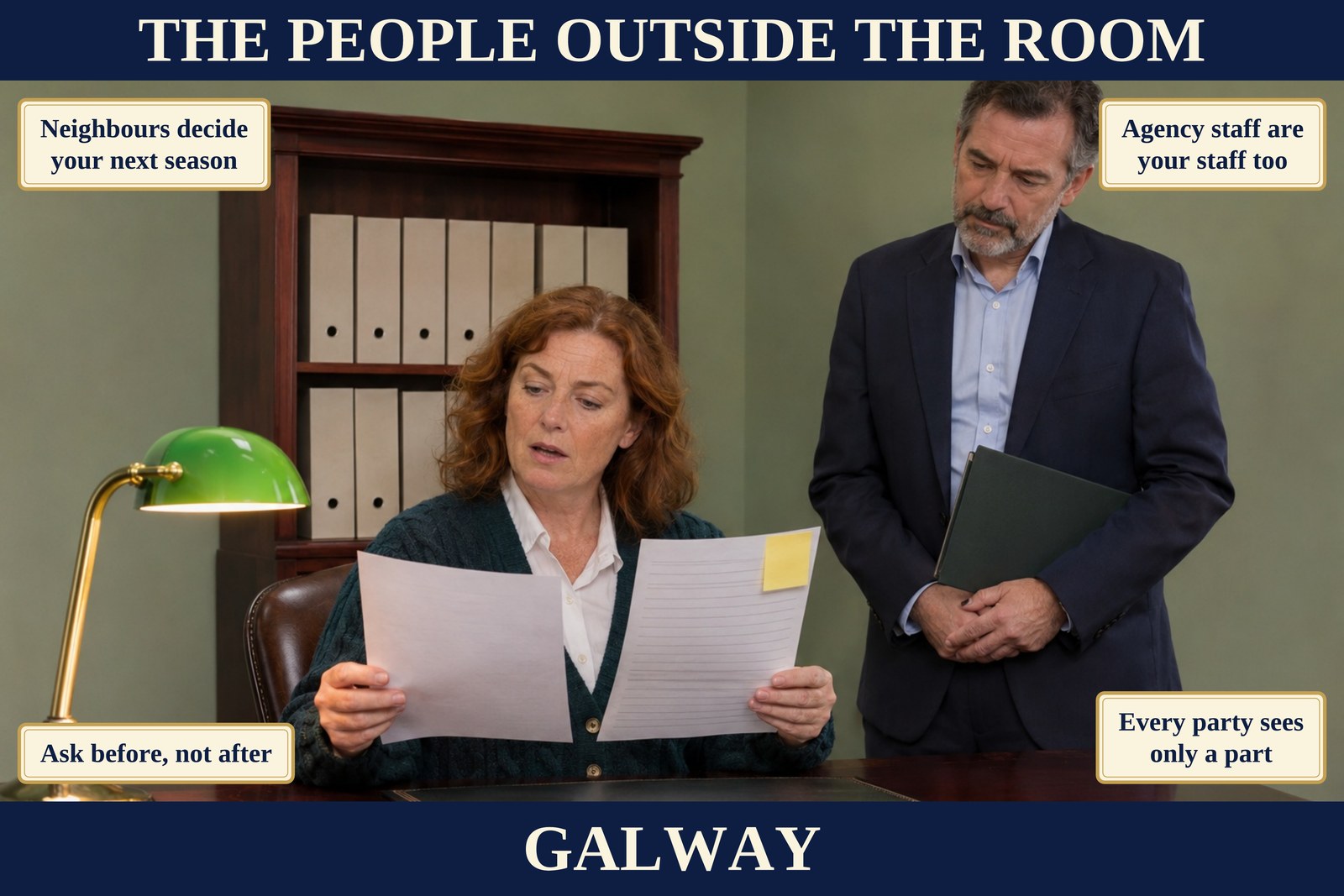
Concept Card 1.5 — The People Outside the Room
Subchapter 1.5 · Galway, Ireland
Setting: Galway, Ireland
The owner’s office of a city hotel in Galway on a grey February afternoon: sage-green walls, a mahogany bookcase of plain box files and a green-shaded brass lamp. Siobhán Keane, the owner, seated in a dark teal cardigan, holds a sheet in each hand and reads with dawning recognition; on the ruled letter a small yellow note is stuck at the corner. Declan Moran, the general manager, in a navy suit without a tie, stands beside the desk holding a dark green folder and watches her, concerned.
In one hand is the letter signed by thirty-eight residents across the side street, with Moran’s yellow note on it: they had nothing against parties, only against nobody telling them beforehand and nobody listening afterwards. In the other is a single sheet, the message from an agency server who changed in the drinks store, had no break and walked home at three. Moran saw two problems. The composition places both papers in the owner’s hands at once, because they have one cause.
The plaques read as one argument. Neighbours decide your next season, through their patience and through the council they write to. Agency staff are your staff too while they work in the hotel’s rooms on the hotel’s evening. Ask before, not after: every earlier complaint had been answered politely, but only once the party was over. Every party sees only a part, and the hotel is the one place where the parts can be put together before the evening begins.
The plate does not accuse the general manager, who had answered every complaint personally, nor the client, who booked coaches so that nobody would drive home. The hotel held every permit it needed. Nobody acted in bad faith; each did his own part of the evening well, and nobody saw the whole. A hotel’s licence says what it may do; its legitimacy depends on whether those who live with its events were asked before and heard afterwards.
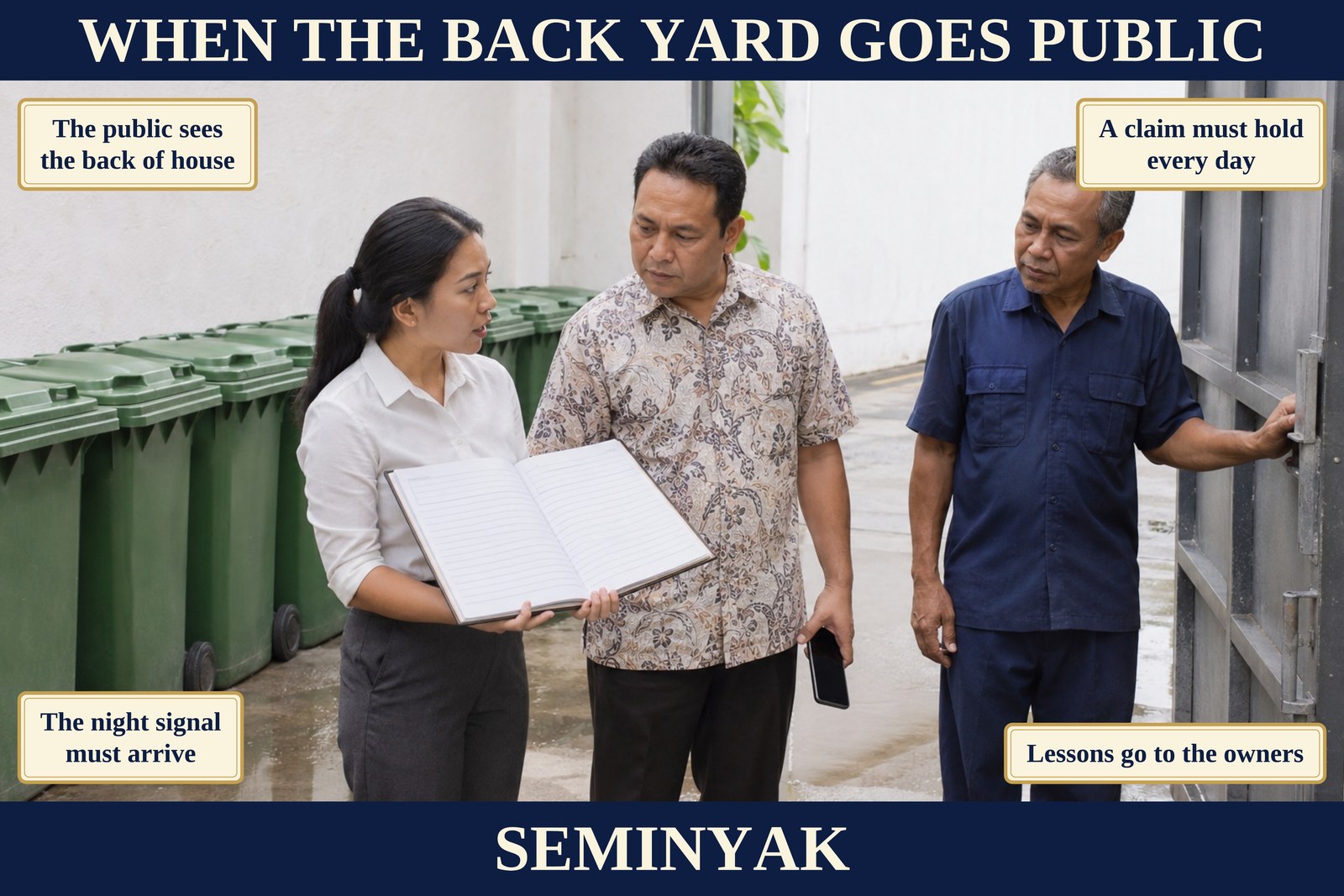
Concept Card 1.6 — When the Back Yard Goes Public
Subchapter 1.6 · Seminyak, Indonesia
Setting: Seminyak, Indonesia
The service yard behind a beach resort in Seminyak, early on a Monday morning, the concrete still wet and a row of green organic-waste bins along a white wall. Putu Ayu Lestari, the events manager, holds the night log open towards Made Wirawan, the general manager, and speaks urgently; he listens in a batik shirt, a dark phone in his hand. The night porter, in a navy uniform shirt at the end of his shift, stands by the steel gate, one hand on it, looking at the log.
Bins, gate and log are the three elements of a forty-one-second video, filmed through the open gate at 3:04 a.m. and watched by hundreds of thousands. The log holds the line written ninety minutes earlier: nine bins full of food, lids open, gate open. The open book sits at the centre because the hotel had known first. The entry had been initialled by the early shift and read by nobody who could act on it.
The plaques read as one sentence. The public sees the back of house, and a phone at a gate makes the yard as visible as the ballroom. A claim must hold every day, Saturdays included, when the charity did not collect and the website sentence quietly stopped being true. The night signal must arrive, routed to someone who can answer it. Lessons go to the owners, with cause and change, so that the question of what could have been known beforehand has an answer next time.
The plate does not accuse the kitchen, which cleared the cold rooms for a brunch it was obliged to serve, nor the client, which reduced its numbers for a reason nobody could fault. The night porter saw and recorded exactly what the public saw later, and the website sentence was not a lie on weekdays. The video caused nothing; it showed what had been true for months, and the only defence is a back of house that matches the front.
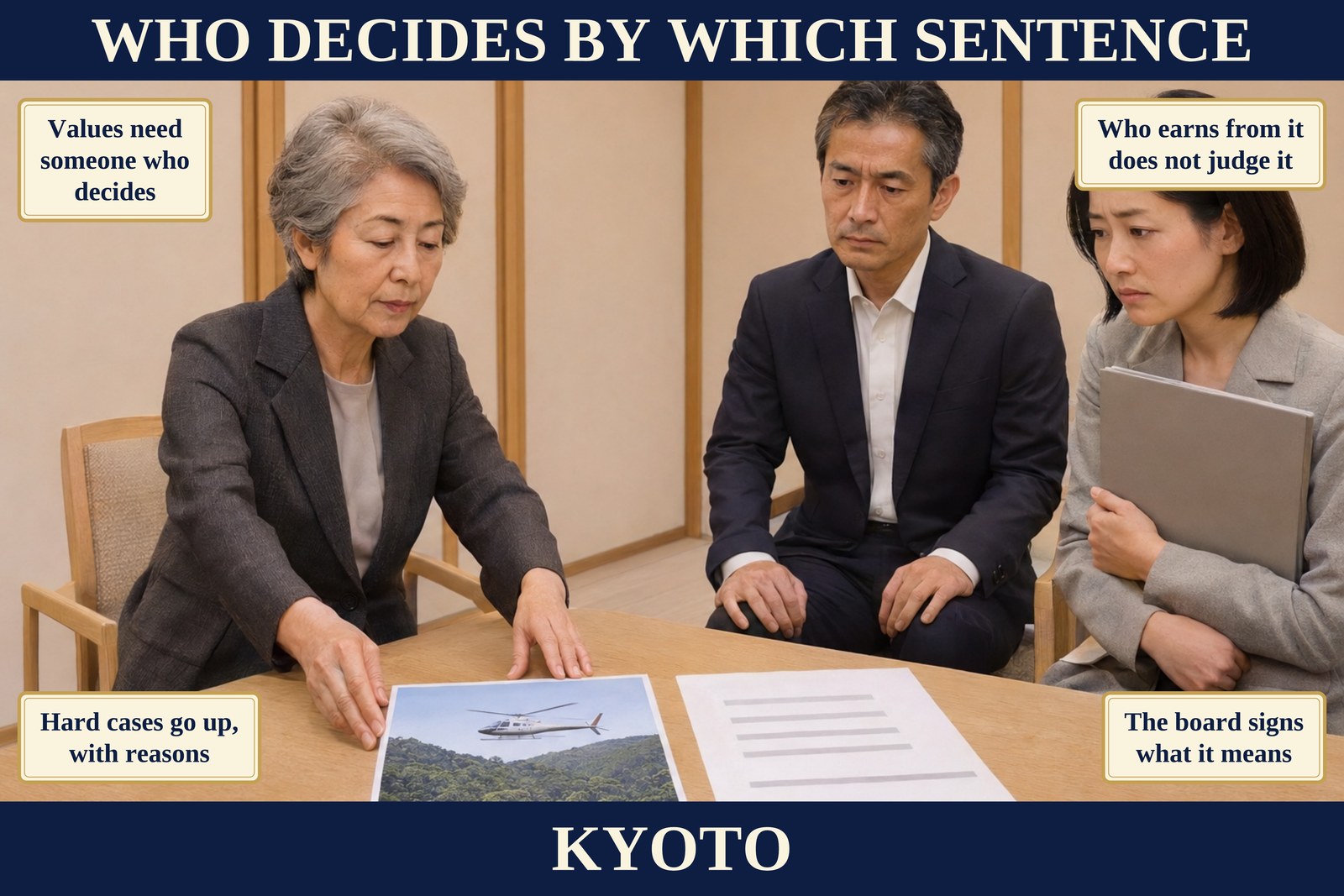
Concept Card 1.7 — Who Decides by Which Sentence
Subchapter 1.7 · Kyoto, Japan
Setting: Kyoto, Japan
A small meeting room beside the conference hall of a hotel in Kyoto, early on a Friday morning, with washi panels in cedar frames. Yoshiko Mori, chair of the board, in a charcoal suit, lays a printed invitation draft precisely with both hands, a helicopter above wooded hills; beside it lies a single page of short grey lines. Kenji Ishida, the general manager, sits upright with his hands on his knees. Haruka Sato, the director of sales, clutches a grey folder and looks at the picture, uneasy.
The invitation is the client’s draft for a gala worth about JPY 35 million, with a sponsor’s helicopters landing on a lawn that borders a residential street and a climate claim set beneath the hotel’s name. The page beside it is the statement the hotel published in March. The chair places the two edge to edge because the question is no longer the price, but which sentence of that statement decides, and who in the hotel reads it.
The four plaques read as one argument. Values need someone who decides, or a statement only hangs in the foyer. Who earns from it does not judge it alone, and a sales director measured on her budget is the wrong person to weigh a booking against principles. Hard cases go up, with reasons, in writing and before the option expires. The board signs what it means, rather than noting the statement between the quarterly accounts and the lift maintenance contract.
The plate does not accuse the sales director, who checked date, capacity, price and creditworthiness correctly, nor the general manager, who sensed a problem the rules had no place for and raised it instead of letting the option run. The gala went ahead without the sponsor’s lounge or the climate claim, and the hotel gave up JPY 2.3 million. A statement by which nothing has been decided is only a claim; the first reasoned refusal turns it into a frame.
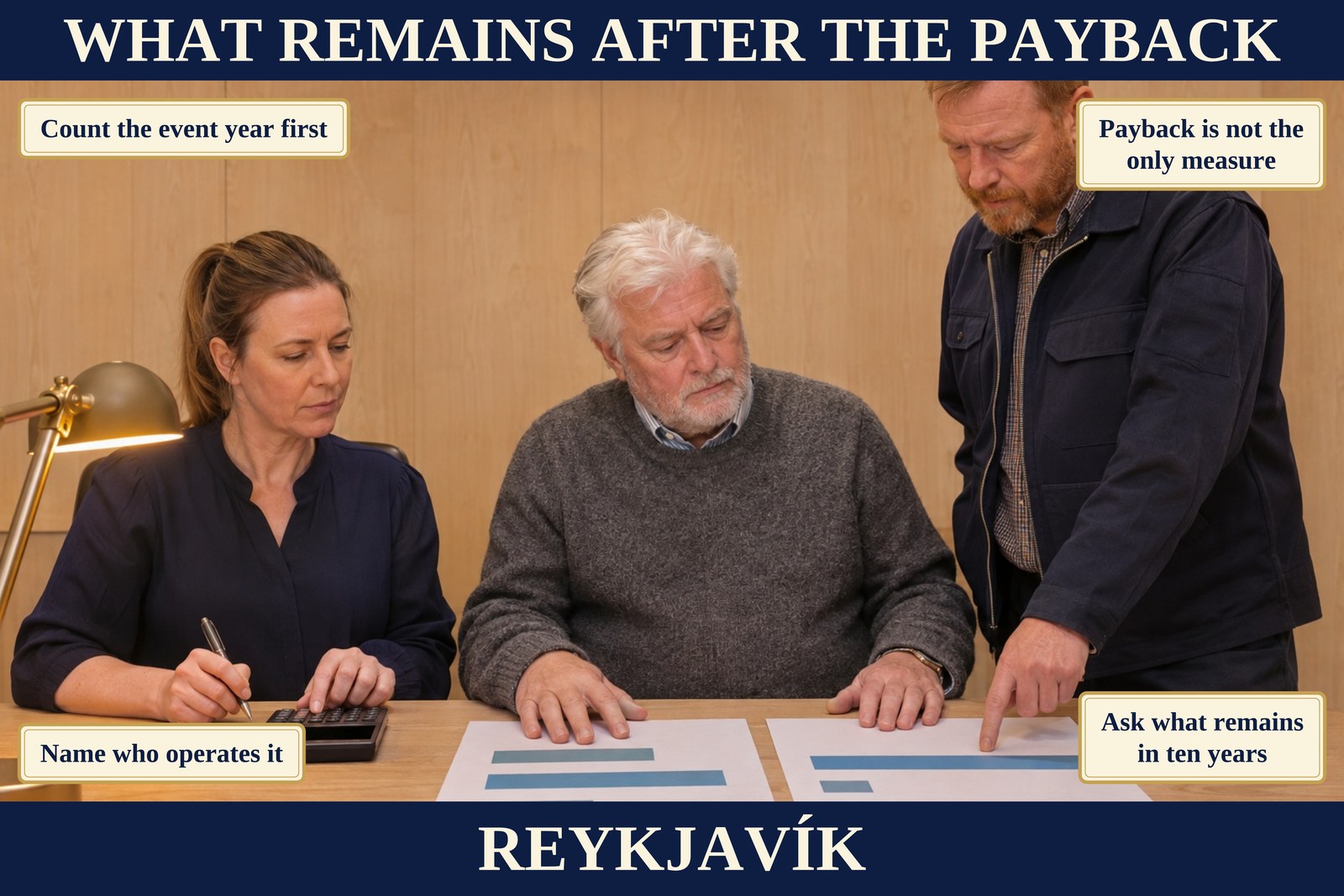
Concept Card 1.8 — What Remains After the Payback
Subchapter 1.8 · Reykjavík, Iceland
Setting: Reykjavík, Iceland
The owner’s office of a congress and city hotel in Reykjavík on a dark November afternoon, birch panelling behind and a desk lamp to one side. Gunnar Sigurðsson, the owner, white-haired in a grey jumper, rests a hand on each of two bar charts laid side by side. Helga Jónsdóttir, the financial controller, works a desk calculator, pen in hand, concentrated. Einar Magnússon, the head of engineering, in a navy work jacket over a checked shirt, stands at the end of the desk and points to the long bar.
The left sheet is the ranking by payback: hybrid equipment first, tableware second, the induction kitchen out. The right sheet is the event year drawn from the booking system, in which the seminars run almost across the page and the other events are short bars. The owner’s two hands hold the decision between them: how quickly money comes back, and what the house actually hosts. The calculator is working the cameras again at eight events instead of twenty-five.
The plaques read as one sentence. Count the event year first, because an investment is measured against the events the house actually holds, not against an enquiry. Payback is not the only measure; it says nothing about an asset that lasts five years against one that lasts fifteen. Name who operates it, since no request said who would run the cameras. Ask what remains in ten years: a dishwasher still in service, or equipment already in a skip.
The plate does not dismiss the controller, whose arithmetic was correct and whose figure is legitimate, nor sales, which passed on what two large clients had asked for. Magnússon argued against nobody; he pulled a list from the booking system. Each answered the question put to them. An event lasts a night; what a house buys for it stays fifteen years, or ends in a skip after five, unless someone asked how often it would be used.
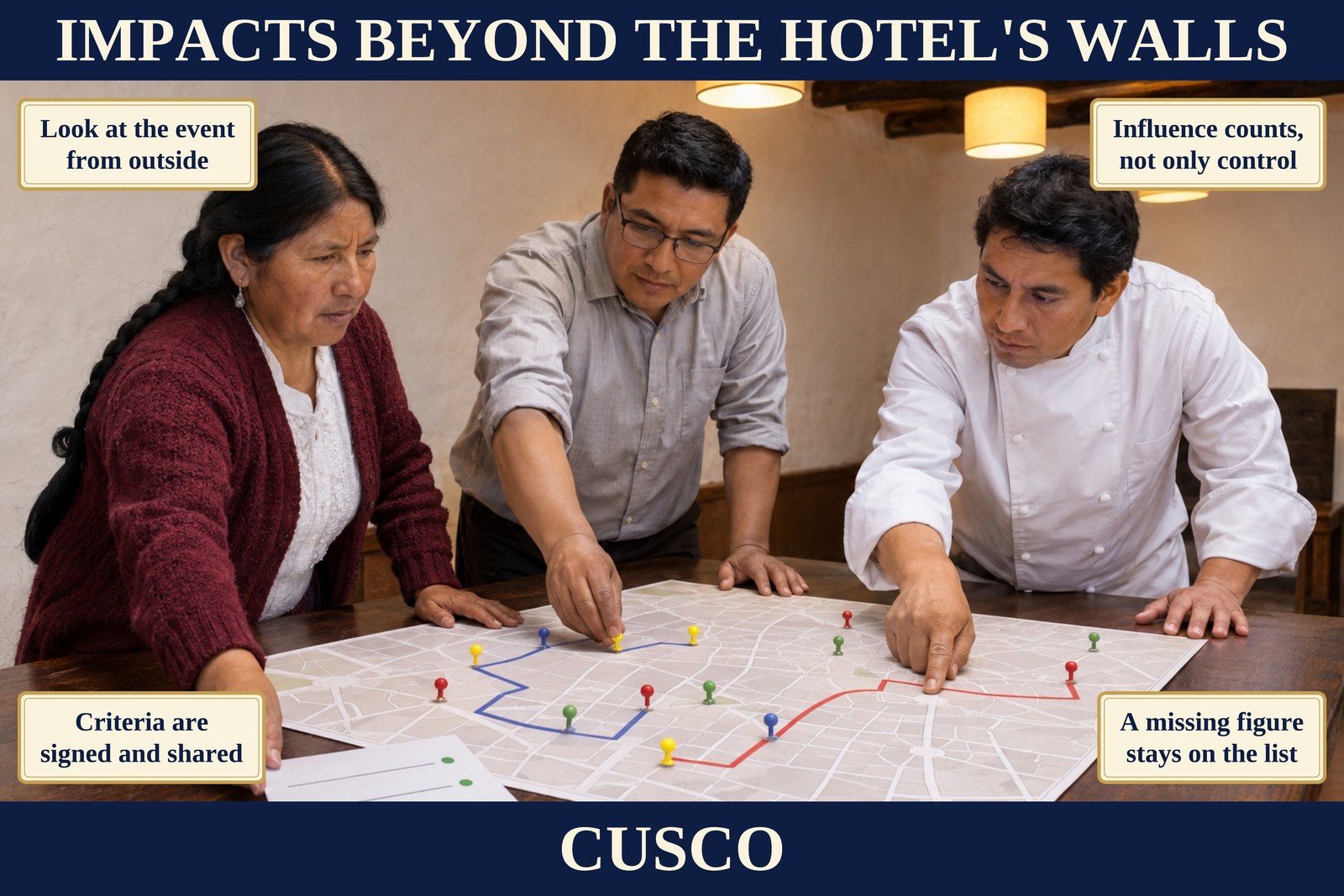
Concept Card 1.9 — Impacts Beyond the Hotel’s Walls
Subchapter 1.9 · Cusco, Peru
Setting: Cusco, Peru
A meeting room in a hotel of three connected colonial houses in Cusco, on a December morning, lamps hanging from dark beams. Across a heavy wooden table lies a large street plan without names, set with coloured pins and two routes drawn in blue and red. Rosa Huamán, the owner, in a dark red cardigan, her hair in a long braid, rests a hand on a sheet at the table’s edge. Andrés Villanueva, the general manager, presses a yellow pin; the chef traces the red route with a finger.
The sheet at the edge, with its row of green dots, is the first answer to the congress agency: four issues, energy, water, waste and local food, all rated green. The plan is the second answer: partner hotels, bus routes, the delivery street. The owner has moved the page aside without discarding it. At the centre now is the congress as it really happens, largely outside the hotel’s walls, in nine other hotels, six buses and narrow cobbled streets.
The four plaques read as one method. Look at the event from outside, since a congress of six hundred in a house of one hundred and ten rooms happens mostly elsewhere. Influence counts, not only control: the hotel chooses suppliers, coordinates beds and supplies the lunches. Criteria are signed and shared, dated by the owner before anything is rated. A missing figure stays on the list, marked as missing, as the caterer’s leftovers and the temporary staff’s conditions were.
The plate does not accuse Villanueva and his team, who listed what they could prove, every line of it true. The question was new to them, and the residents’ letter had been filed, not forgotten. What was missing was not effort but a view from outside the walls. Significant is not what a house can measure; it is what matters by criteria written down in advance, even when it happens in someone else’s street.
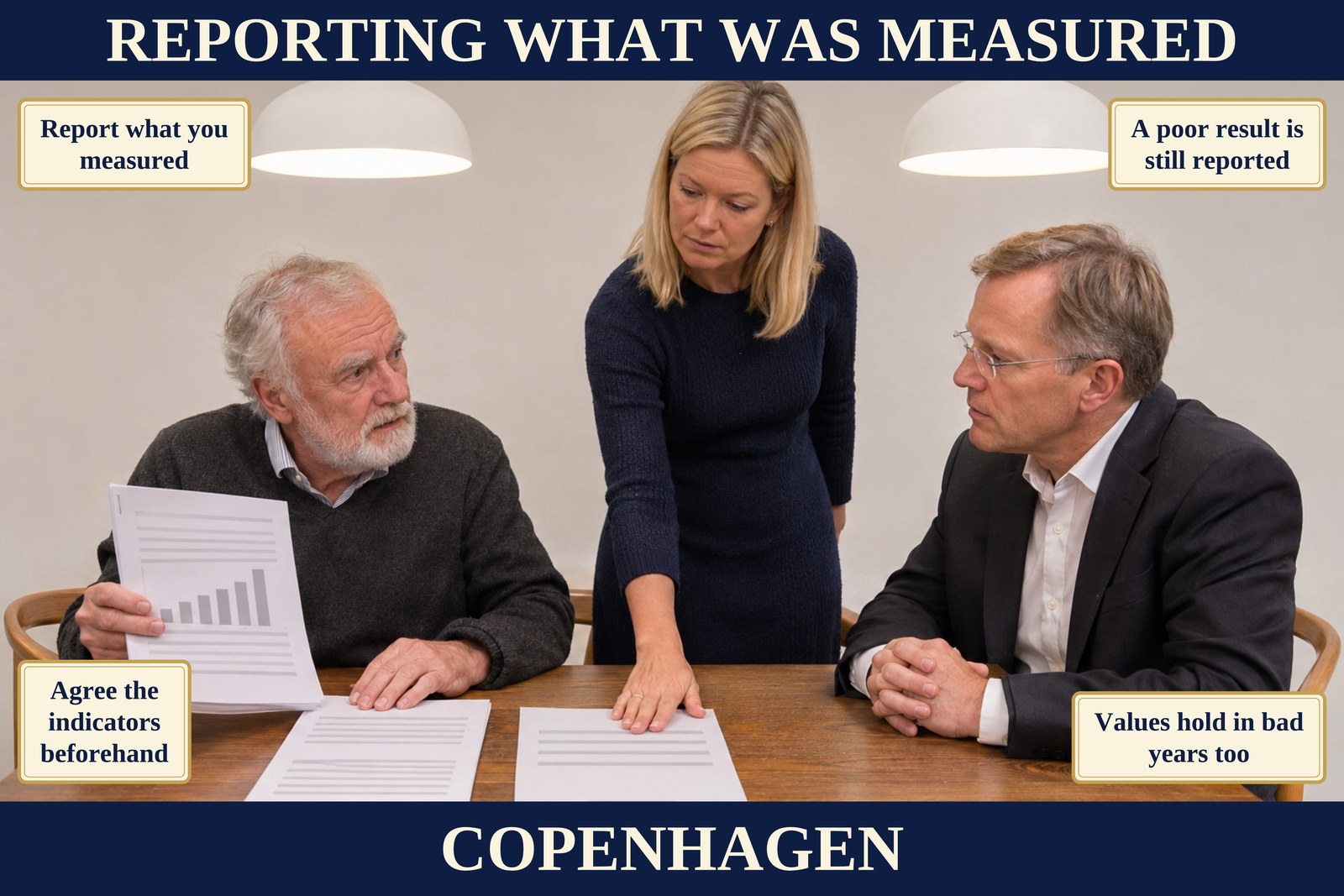
Concept Card 1.10 — Reporting What Was Measured
Subchapter 1.10 · Copenhagen, Denmark
Setting: Copenhagen, Denmark
The boardroom of a congress hotel in Copenhagen on a grey November Monday, white pendant lamps above an oiled oak table and plain white walls. Poul Rasmussen, the board member, in a dark jumper, lifts a thick report with a bar chart in one hand and keeps the other on a thinner one, looking across the table. Ida Kjær, the sustainability manager, stands between them in a navy knitted dress and lays her hand on a single page. Henrik Holm, the general manager, sits with his hands clasped, listening.
The thick report is Kjær’s six pages: vegetarian courses and travel by public transport or bicycle, but also waste per participant-day up by almost a third, a broken wrist in the dish room and a wheelchair user taken through the kitchen. The thin one is Holm’s two pages, with the good figures and none of the bad. The single page under Kjær’s hand is the statement of values the board signed in March, and it decides between the other two.
The plaques read as one argument. Report what you measured, with the method behind each figure. A poor result is still reported, because one can mislead with nothing but true sentences. Agree the indicators beforehand, in the proposal, so that the client knows what will come back and the house cannot choose afterwards. Values hold in bad years too: the sentence under transparency promised to say what was measured even when the hotel did not like it.
The plate does not accuse the general manager, who wrote nothing false, reported the accident as required and apologised sincerely; he had simply not connected the statement to this report. The association’s board read the page on the incidents first, printed the report in full and booked again. A bad figure in a report makes the good ones believable; a report without one is no longer read by the third year.

Concept Card 1.11 — What Remains of a Celebration
Subchapter 1.11 · Edinburgh, United Kingdom
Setting: Edinburgh, United Kingdom
The ballroom of a country-house hotel on the edge of Edinburgh on a January afternoon: duck-egg blue walls, a crystal chandelier and a low larch stage behind. On a display board hang three pictures, a modular stage, beech trees in autumn and a couple in backlight, with two ruled pages pinned beneath. Margaret Kerr, the owner, in a tweed jacket, holds a page and turns to her son Callum, who watches in a green jumper. Fiona Baird, the sales manager, holds a folder and studies the board.
The three pictures are the London agency’s poster drafts, shown without their slogans: celebrations that last, a green wedding house, carbon-neutral weddings in the park. The two pages are Callum’s list, headed What remains. The owner holds them beside the posters as if testing each picture against them. For the couple in backlight there is nothing on either page; for the larch stage, used at a hundred and forty celebrations, there is almost everything.
The plaques read as one order of work. Write down what remains: a stage built by a local joinery, apprentices who qualified, couples who came back for a christening. Every line needs its evidence, or it becomes one more slogan. Advertising follows the register, never the reverse, so that no agency describes a house it does not know. The successor owns the vision of the next ten years, and ownership signs it, so that it binds the house and not only him.
The plate does not ridicule the agency, which wrote what couples want to hear and wrote it well, nor the sales manager, who was answering real questions from real clients. Callum commissioned the campaign out of ambition for the house. What was missing was an order: nobody had written down what the house stood for before someone wrote about it. A brand may promise only what the house can show it has left behind.
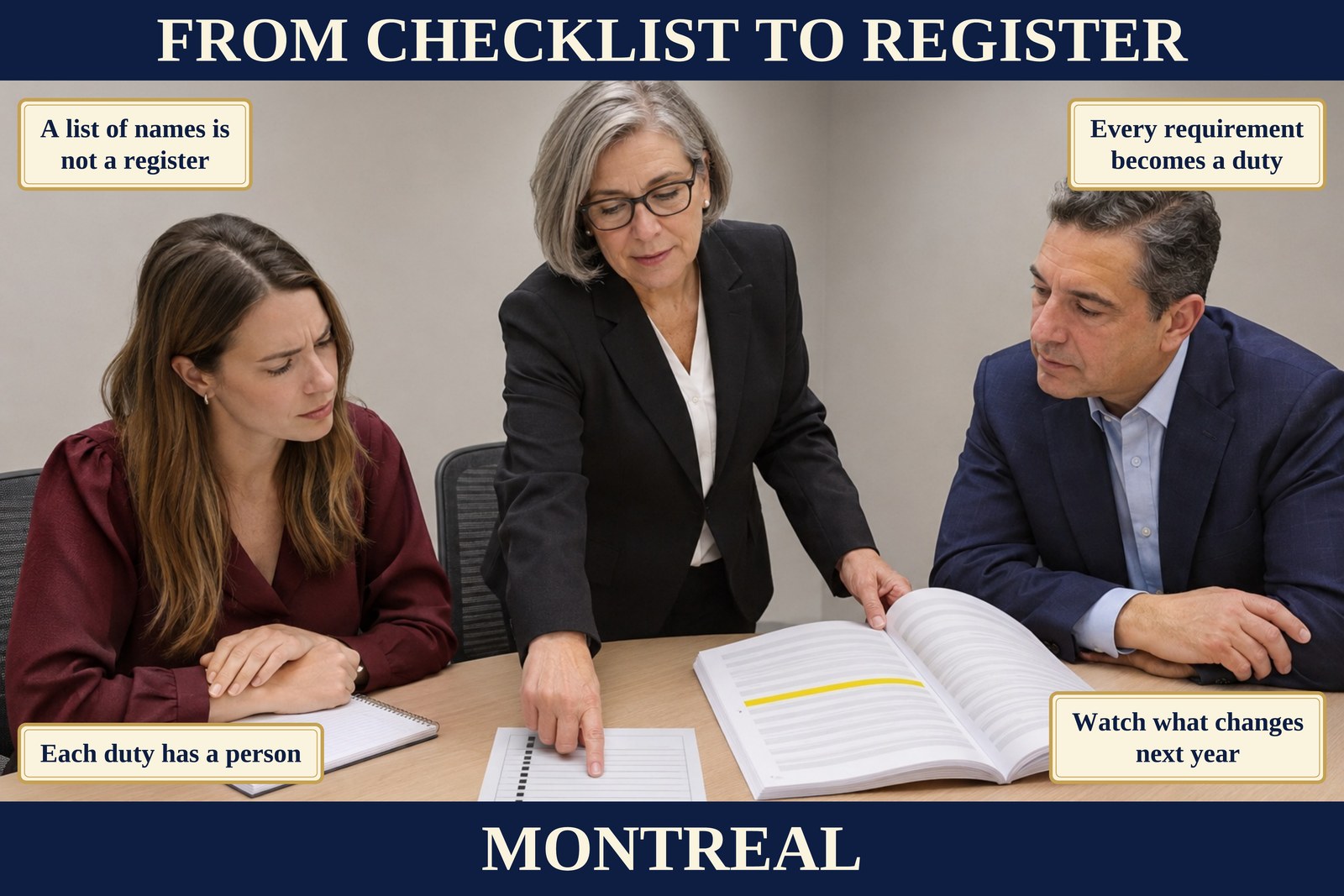
Concept Card 1.12 — From Checklist to Register
Subchapter 1.12 · Montreal, Canada
Setting: Montreal, Canada
The management meeting room of a large congress hotel in Montreal on a February morning, pale grey walls under bright light. Me Catherine Roy, the group’s legal counsel, stands in a black suit and dark-framed glasses, holding open a thick draft contract across which runs one yellow band, and laying a fingertip on a ruled checklist beside it. Chloé Bouchard, the events manager, frowns at the page over her notepad. Étienne Lavoie, the general manager, leans forward on his forearms, listening.
The checklist is the one the hotel has used since 2019: eighteen lines, each named and ticked, and nothing saying who in the house fulfils which duty. The yellow band marks the clause by which the organiser would assume the venue operator’s safety obligations for the event. Roy’s finger rests where the names of people should stand. The composition sets the clause that claims to move a duty beside the list that never assigned one.
The four plaques read as one procedure. A list of names is not a register; ticking a rule is not knowing it. Every requirement becomes a duty: at what capacity, whether the operator must be present, when operation must stop. Each duty has a person, and evidence that it was fulfilled. Watch what changes next year, because only a register with a column for emerging requirements tells the house that an answer has moved.
The plate does not accuse the events manager, who did what the house asked of her and sent the contract for review, nor the agency, which drafted in good faith from its own template. Clauses like these are common, and the checklist was a sensible start in 2019. A group can share one procedure but never one register, because the law of an event is always the law of the place where it happens.
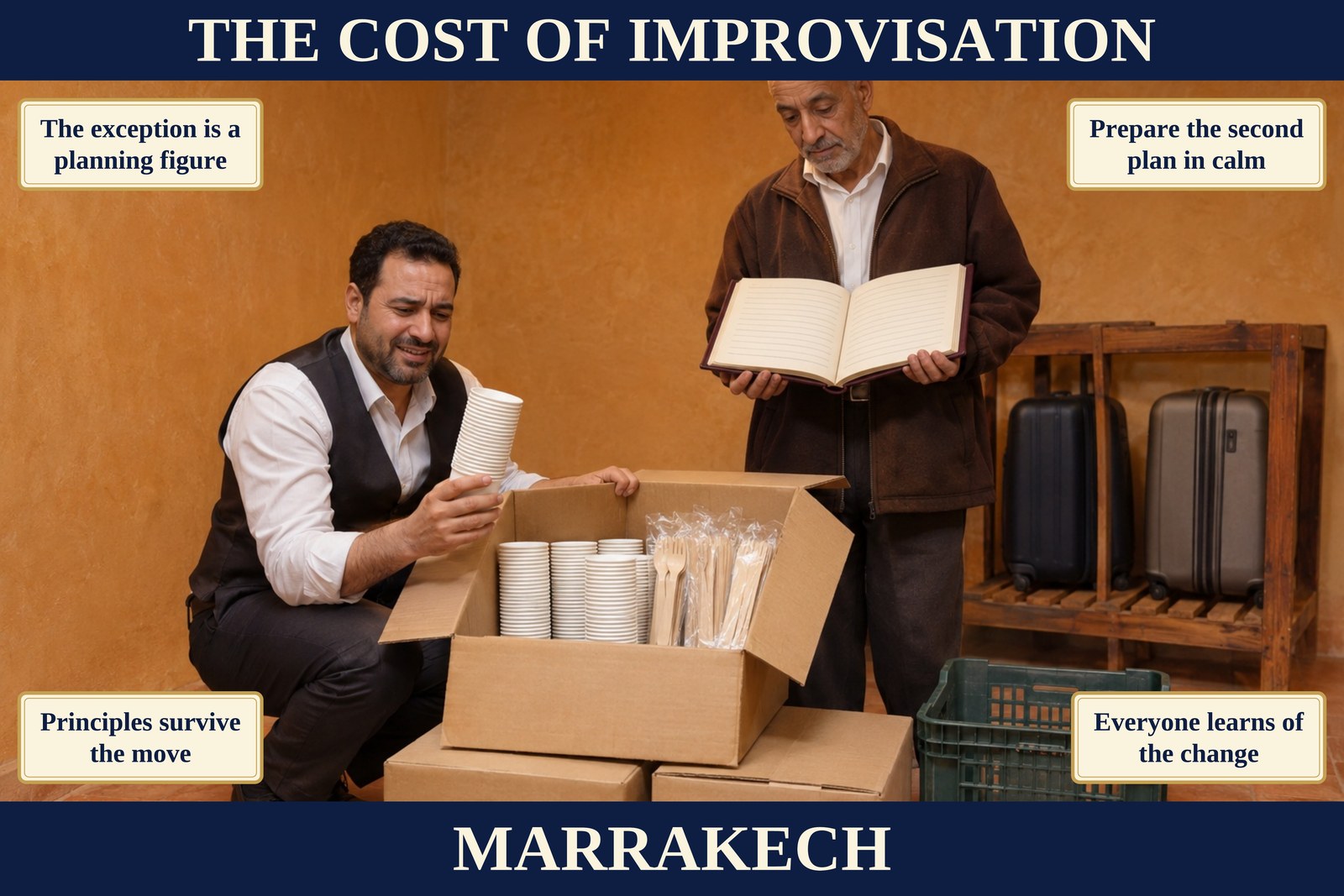
Concept Card 1.13 — The Cost of Improvisation
Subchapter 1.13 · Marrakech, Morocco
Setting: Marrakech, Morocco
The luggage room of a hotel on the edge of the Marrakech medina, early on a Friday morning: smooth ochre plaster under warm light and suitcases on a wooden rack. Youssef Amrani, the banquet manager, in a white shirt and dark waistcoat, crouches by an open cardboard box and lifts a stack of paper cups, his face caught between relief and dismay; inside lie more cups and wrapped wooden cutlery. The night porter, in a brown jacket, holds the night log open towards him.
The boxes and the crate are the wholesaler’s second delivery, accepted at five past eleven by a night porter whom nobody had told. He stored it, signed for it and wrote the entry the log now shows; Amrani found the boxes only after half an hour of searching. The paper cups sit at the centre because they are the cost the contract never priced: a dinner promised as local and free of throwaway tableware, photographed with disposables.
The plaques read as one sentence. The exception is a planning figure, because an outdoor event moves a few times every season. Prepare the second plan in calm, months before, when power, tableware, routes and staff can still be chosen rather than found. Principles survive the move when ownership has signed the non-negotiables in advance. Everyone learns of the change, the night porter included, so that a late delivery arrives expected.
The plate does not accuse Amrani, who made sound decisions under pressure and ran an evening the guests praised, nor the night porter, who accepted, stored and recorded exactly as he should. Cardboard was a defensible choice that night. What the image shows is a contract sentence that settled the location and left everything attached to it open. A change one can see coming is not a disruption but the part of the plan not yet written.
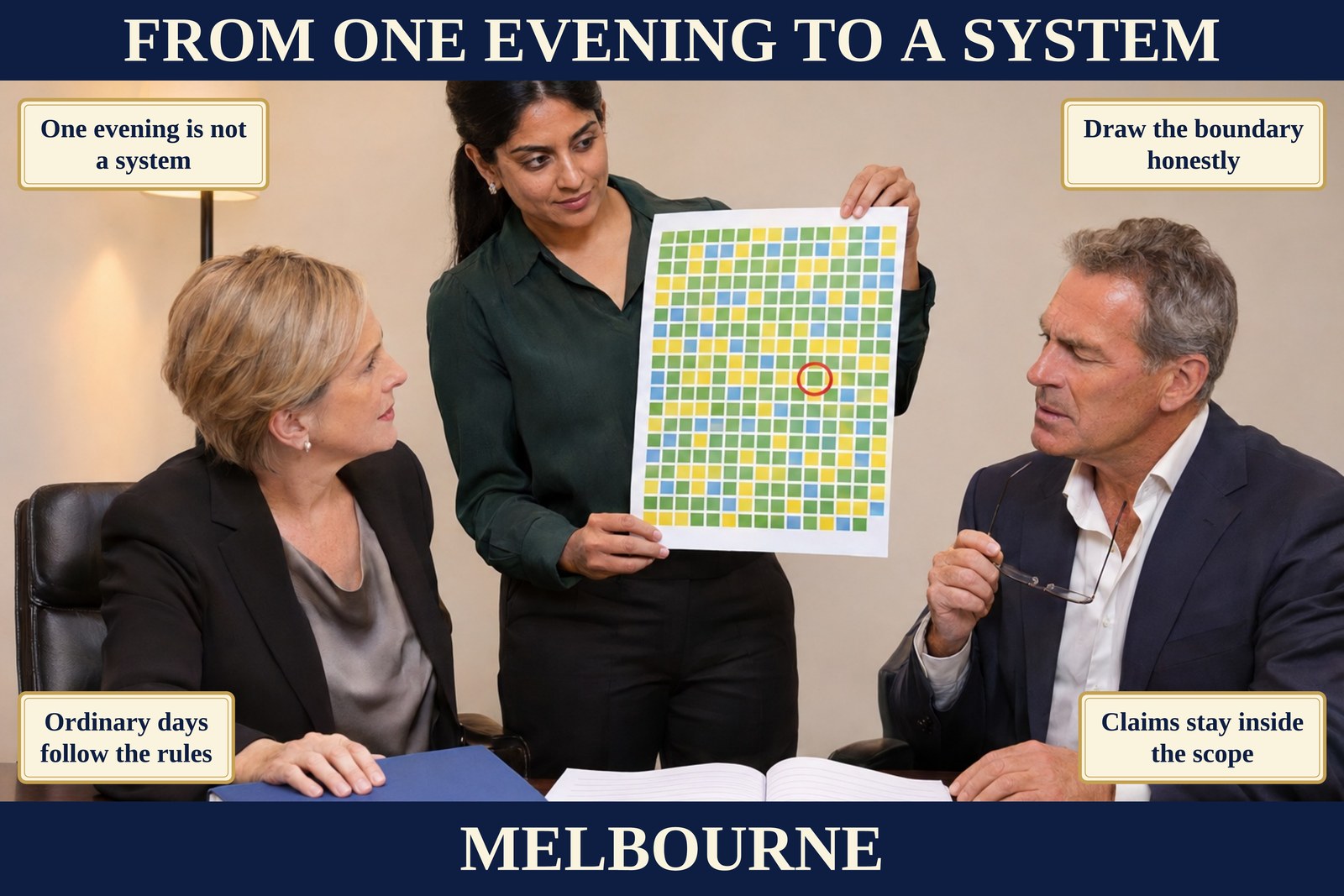
Concept Card 1.14 — From One Evening to a System
Subchapter 1.14 · Melbourne, Australia
Setting: Melbourne, Australia
The managing director’s office in a hotel on the Yarra in Melbourne on a late October afternoon. Helen Marsh, the managing director, seated in a black jacket, rests her hand on a bound report with a blue cover and looks up. Priya Nair, the director of events, holds up a sheet of hundreds of small squares in green, yellow and blue, one ringed in red. Daniel Whitford, the general manager, holds his reading glasses and frowns at the ringed square. An open tender lies on the desk.
The blue report records the reception of March 2024: well run, honestly measured, rewarded with an award. The sheet is Nair’s count of the past year, about six hundred events of three kinds, and the red ring marks that single evening among them. The tender beside it asks the hotel to state the scope of its system and how conformity is shown. The composition makes the proportion visible: one square accounted for, and all the others unanswered.
The plaques read as one argument. One evening is not a system; a project ends when its lead and its consultant leave. Draw the boundary honestly, by type of event and role, on one dated page with reasons for what is left out. Ordinary days follow the rules, so that a Tuesday seminar runs by the same system as the gala. Claims stay inside the scope, and an award is dated to the evening for which it was given.
The plate does not diminish the 2024 reception, which was well run and honestly reported, nor the award, earned for that evening, nor the consultant, who delivered what was commissioned. The hotel had proved it could deliver one sustainable celebration and had never asked whether an ordinary Tuesday followed the same rules. An award proves that one evening was good; a scope drawn honestly is what lets an ordinary Tuesday prove the same.
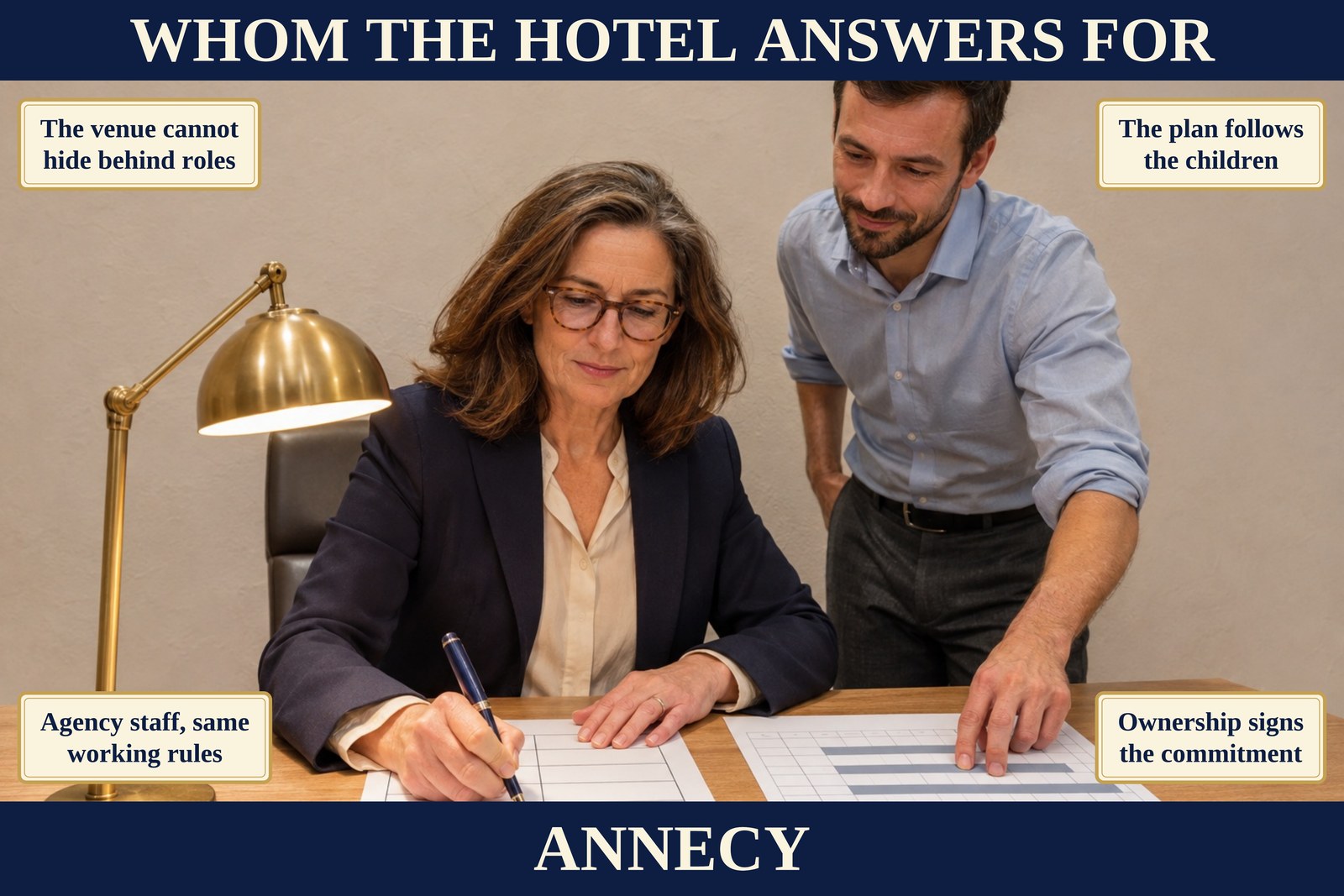
Concept Card 1.15 — Whom the Hotel Answers For
Subchapter 1.15 · Annecy, France
Setting: Annecy, France
The owner’s office of the lakeside hotel in Annecy on a December evening, a brass desk lamp lit against pale plaster. Claire Duval, the owner, seated in her navy blazer and tortoiseshell glasses, writes with a fountain pen at the foot of a banquet form of empty ruled boxes, her other hand holding it flat. Thomas Berthier, the events manager, in a light blue shirt with rolled sleeves, leans in beside her, two fingers resting on a staff rota where long bars cross almost the whole sheet.
The form is the hotel’s banquet form, with fields for menu, allergens, seating, technology and billing, and none for children taking part or for the conditions of agency staff; the owner is adding them. The rota under Berthier’s fingers is the hotel’s own for the November congress, with agency waiters scheduled from seven in the morning until half past nine at night on two consecutive days. The pen sits at the centre because the missing fields are the owner’s to add.
The four plaques read as one commitment. The venue cannot hide behind roles: the children rehearse and sing in the hotel’s rooms, and the agency waiters work to its rota. The plan follows the children, so the timetable is built around their age and their school day, not around the main course. Agency staff, same working rules: hours, breaks, housing and their own documents. Ownership signs the commitment, so that it binds every booking that follows.
The plate does not accuse the client, who booked the choir as a warm gesture to its staff, nor the music school, proud to be asked, nor the staffing agency, whose practices were not yet known. The waiter who spoke had done the hardest thing. On the night the children sang early and were on their coach before half past nine. The people a hotel answers for at an event include those who are not on its payroll, and those who are only nine years old.
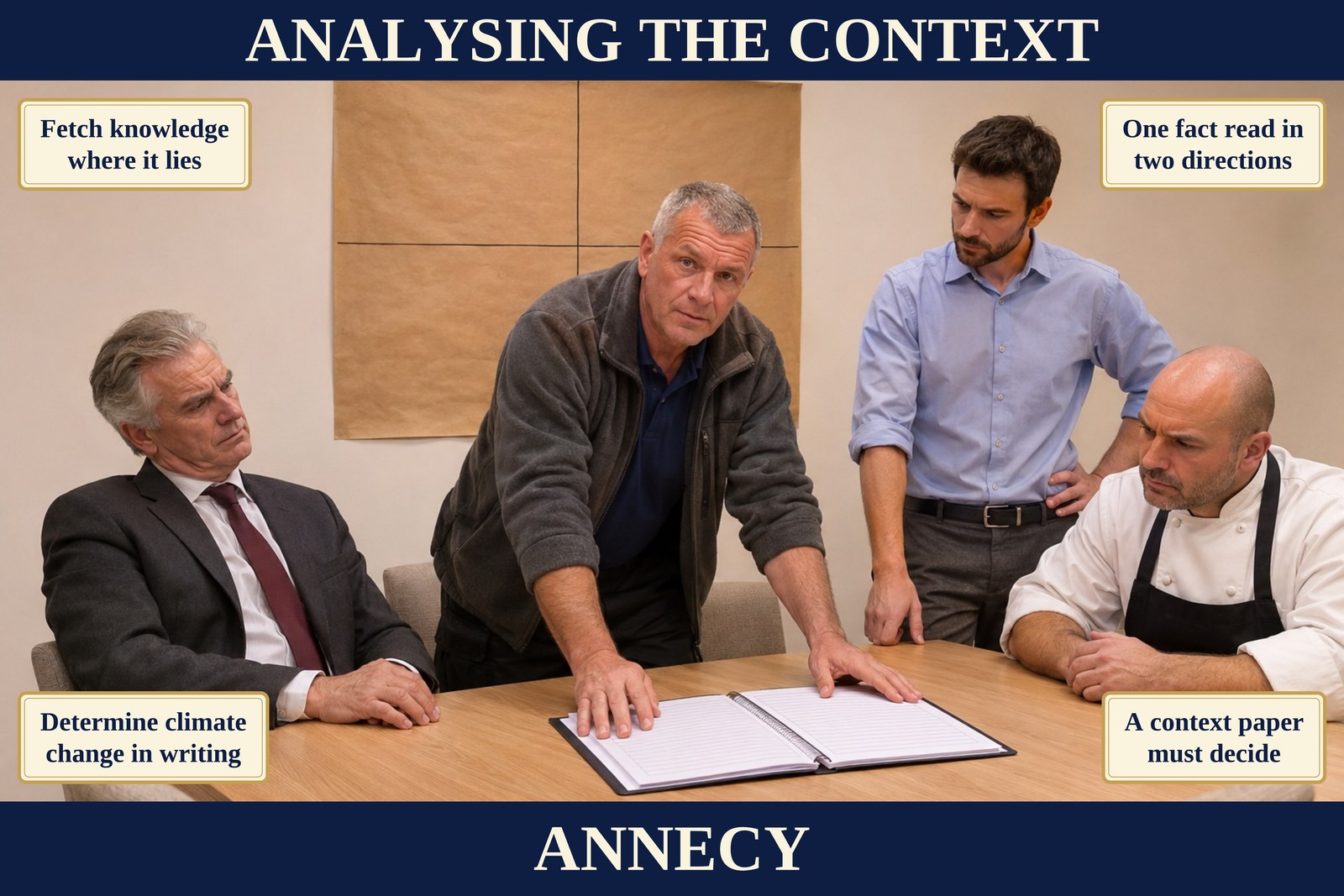
Concept Card 2.1 — Analysing the Context
Subchapter 2.1 · Annecy, France
Setting: Annecy, France
The smallest meeting room of the lakeside hotel in Annecy, on a January afternoon under warm ceiling light: plain white walls, a light oak table, and on the wall a sheet of brown paper divided by two marker lines into four empty fields. Antoine Perrin, the new maintenance manager, in a dark grey fleece, leans over an open folder of ruled forms. Thomas Berthier, the events manager, stands beside the sheet; Marc Lenoir, the general manager, sits back, sceptical; Julien Favre, the chef, frowns at the folder.
The composition sets two papers against each other. Above hang the four fields that a seminar template fills in forty minutes, and that would fit any hotel on the lake. Below, at the centre of the table, lies the folder the night porter handed over that morning: eleven forms, one for every large event since October, recording dishwashing after half past one, cups in the courtyard, water in the delivery bay. The knowledge was already in the house; nobody had carried it into this room.
The four plaques read as one argument. Fetch knowledge where it lies: in the night forms, the kitchen's weighing list and the client's evaluation, not in a seminar grid. One fact read in two directions: the lakeside location is an asset and a flood risk, and what the hotel itself causes, its cups and coaches, belongs on the paper too. Determine climate change in writing, neither dismissing it nor seeing it everywhere. And a context paper must decide, or it remains a stock-take.
The plate does not accuse Berthier, whose four fields were an honest first attempt with a tool taught in many seminars, nor Lenoir, who was right that a stock-take has its place. Nobody hid anything; the figures were scattered across departments, and it took a newcomer to bring them to one table. The lesson is the subchapter's own: a context paper is worth what it decides, and every line must say what the hotel will do differently because it now knows.
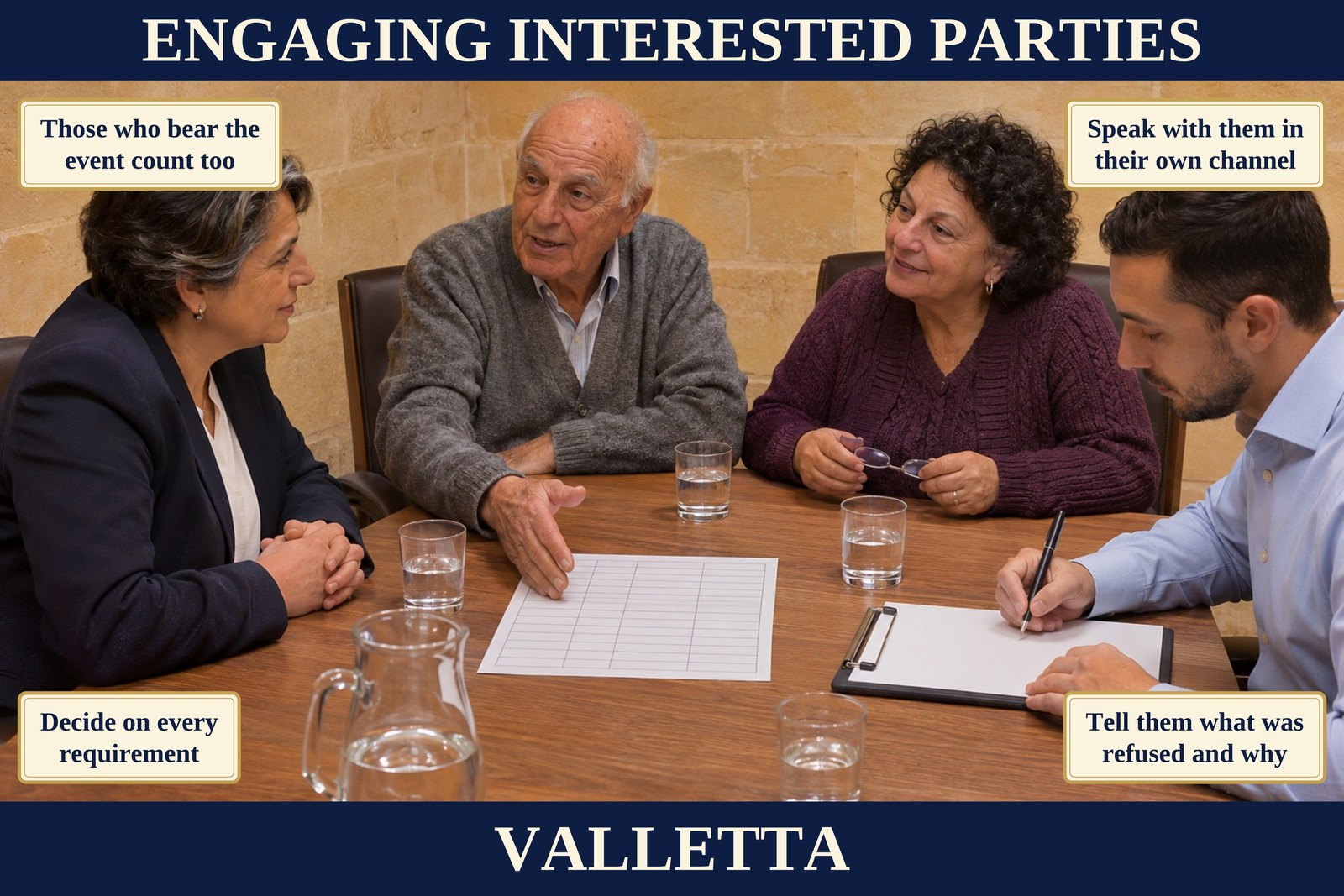
Concept Card 2.2 — Engaging Interested Parties
Subchapter 2.2 · Valletta, Malta
Setting: Valletta, Malta
A small meeting room in a congress hotel on the edge of Valletta, on an evening at the end of March: honey-coloured limestone walls, a wooden table with water glasses and a jug, warm light. Rebecca Zammit, the general manager, in a navy jacket, leans forward with her hands folded, listening. Opposite her an elderly resident in a grey cardigan speaks, one hand reaching towards a ruled sheet; a resident in a plum jumper holds her reading glasses and smiles. Mark Vella, the events manager, writes on a clipboard.
At the centre of the table lies the register of interested parties, ruled into rows and columns by role, not copied from the customer database. Beside it, on Vella's clipboard, the one-page record is being written while the neighbour is still speaking. The two sheets carry the subchapter between them: those who bear the hotel's events are listed, and what they say is written down where they can watch it happen. The anonymous average of 4.2 is nowhere on the table.
The four plaques read as one argument. Those who bear the event count too: the residents below the bastions, who heard the coaches idling, matter as much as the clients in the database. Speak with them in their own channel, an evening in the hotel rather than an online survey. Decide on every requirement, taken up or not, with the reason written beside it. Then tell them what was refused and why, because a party who hears nothing back has not been engaged.
The plate does not accuse Vella, who had asked when many hotels never do, nor the coach drivers, who kept the timetable they were given. Nobody acted in bad faith; the survey simply measured thirty-eight unknown people while the two who had heard the coaches were never asked. The lesson is short and demanding: engagement is finished only when those who spoke have heard what the hotel took up, what it did not, and why.
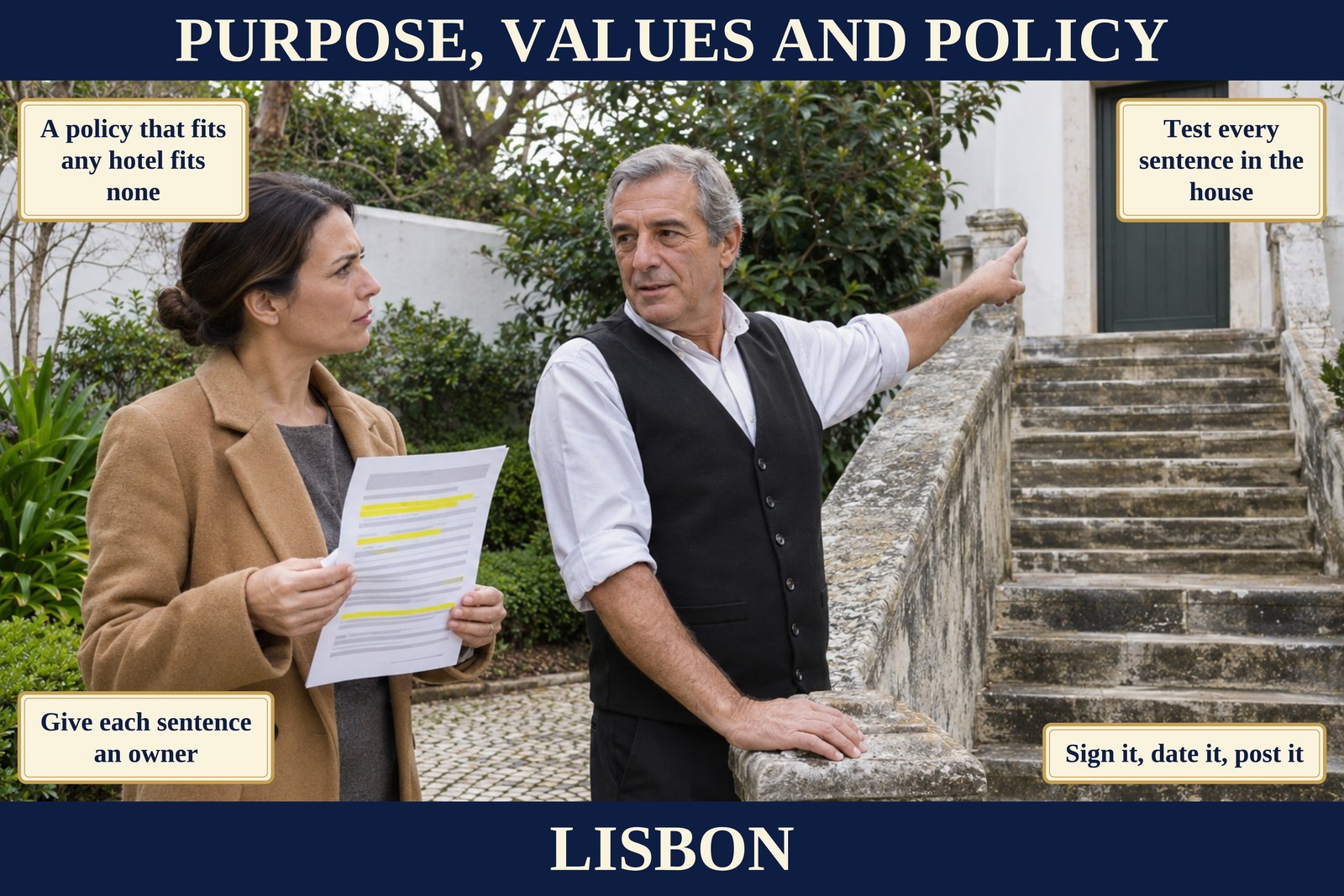
Concept Card 2.3 — Purpose, Values and Policy
Subchapter 2.3 · Lisbon, Portugal
Setting: Lisbon, Portugal
The garden of a hotel on the hill of Graça in Lisbon, in soft winter light at the end of January: a cobbled path, dense shrubs, a whitewashed wall, and a steep flight of worn limestone steps rising to the dark green door of the pavilion. Inês Carvalho, the events manager, in a camel coat, holds a printed page on which several lines are marked in yellow highlighter, her expression questioning. Rui Teixeira, the pavilion manager, in a black waistcoat, points up the steps, one hand on the balustrade.
The composition joins a sentence to a staircase. The page in Carvalho's hand is the policy an agency wrote for the website, and the yellow strokes mark what a client found it shared, almost word for word, with another hotel's. Teixeira's raised arm answers one of those sentences without a word: every guest is welcome here, and eleven steps lead to the only door. Between the paper and the stone lies the gap that the subchapter sets out to close.
The four plaques read as one argument. A policy that fits any hotel fits none: seven sentences out of nine were shared with a resort in the Algarve. Test every sentence in the house, at the pavilion steps and in the kitchen, rather than in the agency's office. Give each sentence an owner who will act on it tomorrow. Then sign it, date it, post it: mission statement and policy carry the signatures of top management and hang where staff work, not only on the website.
The plate does not accuse the agency, which delivered a well-written text of the kind it was asked for, nor the owners, who ordered it in good faith, nor the sales team, who wanted to say yes in December and could not find the way. What was missing was any connection between the sentences and the people who must live by them. A policy is finished when every sentence has an owner who acts on it tomorrow; until then it is only a well-written text.

Concept Card 2.4 — Planning Objectives
Subchapter 2.4 · Vancouver, Canada
Setting: Vancouver, Canada
The dish room of a conference hotel in Vancouver late in the evening after a banquet, under bright white light: stainless steel counters, racks of clean white plates, a tiled wall. Mateo Ruiz, the chef, in whites and a dark apron, bends to lower a grey bin of mixed leftovers beside a floor scale whose display stays dark. Laura Chen, the banqueting manager, holds a clipboard and pen, ready to write. Daniel Price, the general manager, stands behind them with arms folded, watching closely.
The bin is the centre of the picture because it is where the subchapter begins. A brochure sentence was to promise that the hotel would halve its food leftovers, and nobody had ever weighed what remained after a banquet. Halve from what was Chen's question; the scale is the answer. The dark display is honest: no figure exists yet. A target can come only after six weeks of weighing have produced a baseline, which turned out to be 160 grams per cover.
The four plaques read as one argument. Weigh before you set a target, or the number has nothing to stand on. Few objectives, each with one name: eleven lines marked all became four, each with a measure, a baseline, a date and one person responsible. Decide conflicts in writing, as between a local fisher's twenty kilograms of fillet a week and a congress dinner that needs forty. And objectives are not results: announce them only once the plan exists.
The plate does not accuse the heads of department, whose eleven lines named real concerns, nor Price, who wanted to answer what clients were asking, nor Ruiz, who wanted a menu that honoured the coast and its fishers. Nobody meant to promise what the hotel could not keep. The lesson is the subchapter's own: an objective is the number below which a hotel admits defeat; whoever does not name it cannot lose, and cannot steer.
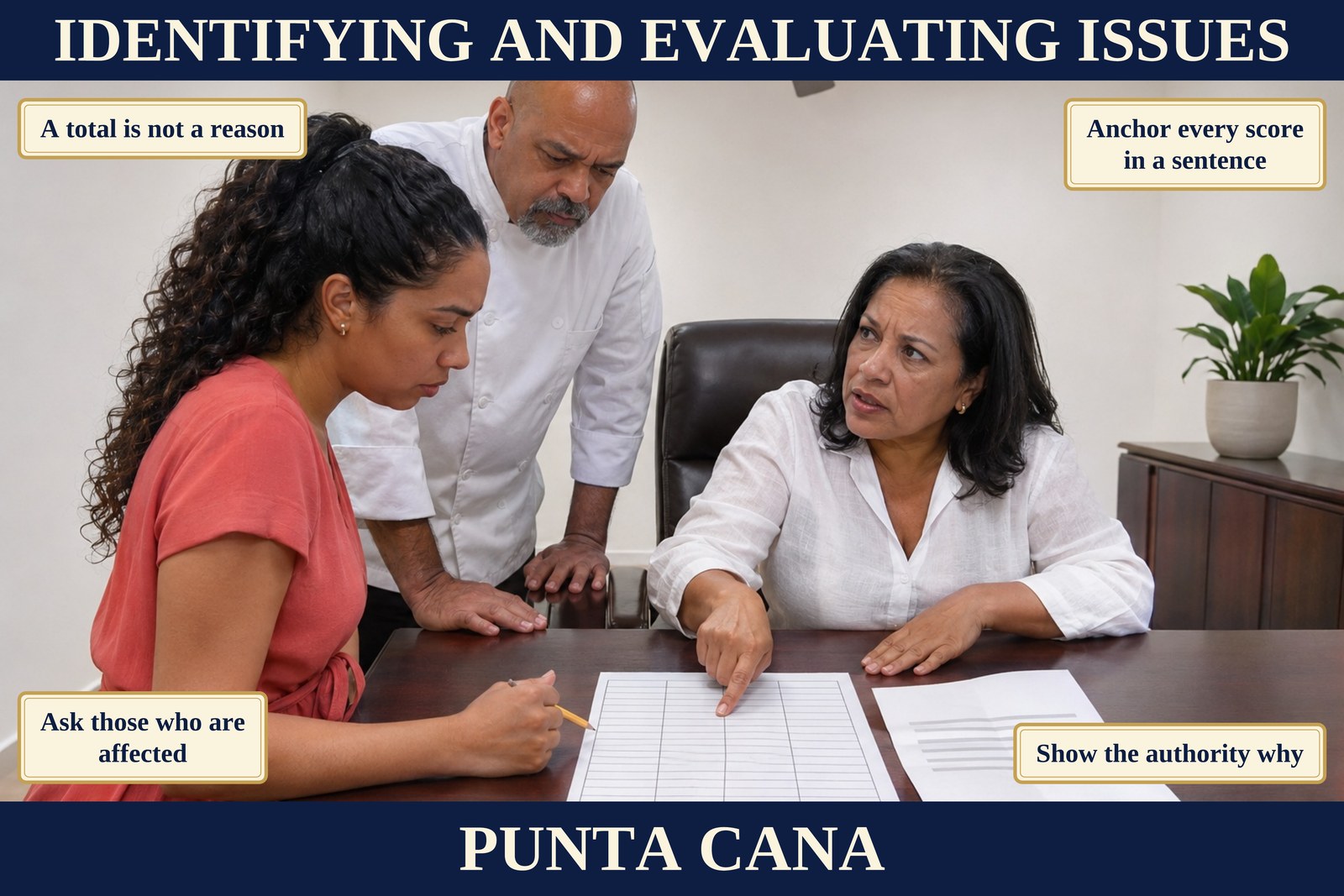
Concept Card 2.5 — Identifying and Evaluating Issues
Subchapter 2.5 · Punta Cana, Dominican Republic
Setting: Punta Cana, Dominican Republic
The owner's office of a beachfront hotel near Punta Cana on a bright March morning: white walls and a dark wooden desk. Isabel Marte, the owner, in a white linen blouse, rests a finger on one row of a long ruled printout and looks up with a direct question. Carolina Peña, the wedding planner, in a coral dress, holds a pencil over the same row, uncertain. Rafael Almonte, the chef, in whites, leans on the desk and frowns at it. Beside the printout lies a letter.
The two papers on the desk carry the whole case. The printout is the issues register for weddings, fifty-two lines scored in four columns and added up. The letter comes from the local authority, reporting residents' complaints about late fireworks and casings left in the dunes. In the register the fireworks scored ten points and counted as not significant. Marte's finger rests on the gap between the two: a total the hotel could not explain to the officer who wrote the letter.
The four plaques read as one argument. A total is not a reason: adding points let rare fireworks hide behind their low frequency. Anchor every score in a sentence, so that the chef's two and the planner's four for the same buffet become a rating both can check. Ask those who are affected, the florist and the couples, not only the people around the table. And show the authority why: a rating with its source beside it can be read by someone outside the house.
The plate does not accuse Peña, who brought back the template her course had taught, nor the team that spent a serious afternoon on it; the spreadsheet added correctly, and chef and planner both described the same buffet honestly. What was missing was not care but a method that let their care be read and checked. A number without a sentence cannot be checked; the sentence beside each rating is what turns a ranking into a register.

Concept Card 2.6 — Risks and Opportunities
Subchapter 2.6 · Da Nang, Vietnam
Setting: Da Nang, Vietnam
The general manager's office of a beachfront grand hotel in Da Nang on a March morning, warm light on cream walls and a polished teak desk with a closed laptop. Nguyễn Thu Hà, the events manager, in a pale blue blouse, lays a small sheet of a few lines beside a thick list with coloured squares in its margin. Richard Hale, the general manager, seated, looks down at the two papers. By the door the night porter, in a dark jacket, stands with his hands clasped and a modest smile.
The two papers on the desk are the subchapter. The thick one is the template of forty risks Hale brought from a previous hotel, coloured by likelihood and impact and headed by terrorist attack and pandemic. The small one is the porter's sheet, written unasked: eleven nights, the dishwashing contractor's van late seven times and absent twice. None of the forty lines concerned it. The quiet figure by the door is the source the template never consulted.
The four plaques read as one argument. Your risks are in your own house: they come from the issues and parties registers, not from another hotel's list. Listen to the one who sees the night, whose warnings had been heard for years as complaints rather than data. Every risk needs a sign and a name: an action placed in a contract, order or briefing, with a person responsible and a sign that it worked. And write the opportunities down too, such as shared airport transfers.
The plate does not accuse Hale, whose template was sound for the hotel it was written for, nor the contractor, who did exactly what had been agreed when nothing about timing had been. What was missing was a route from what the house knew to the list it kept. The lesson is the subchapter's own: an action with no place does not happen on the hot day, and an action with no sign counts as done even while it sits in the basement.
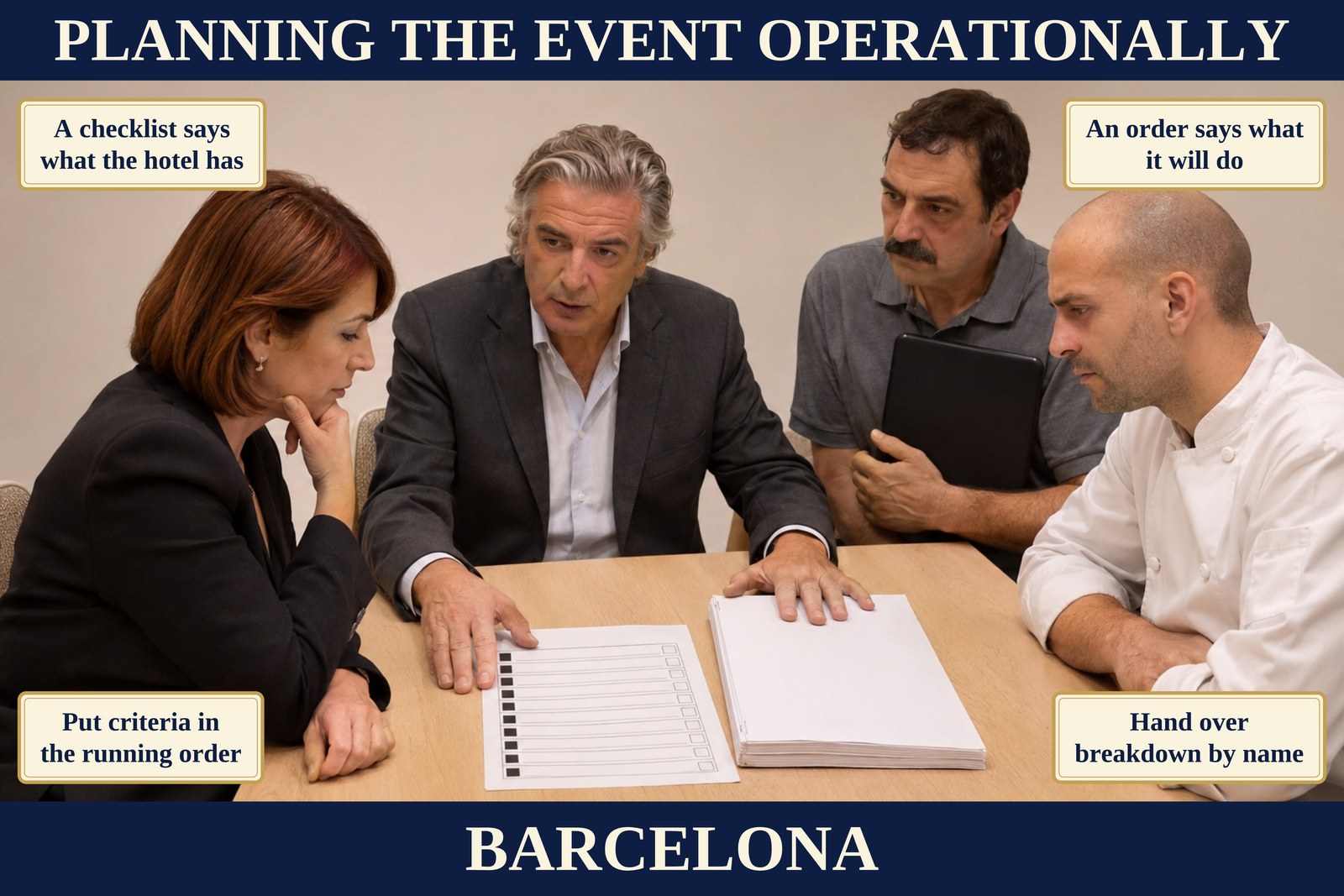
Concept Card 2.7 — Planning the Event Operationally
Subchapter 2.7 · Barcelona, Spain
Setting: Barcelona, Spain
A small meeting room behind the front office of a congress hotel in Barcelona at the end of January, under even light on warm white walls. At a pale wooden table Jordi Puig, the general manager, in a charcoal suit, rests one hand on a checklist with every box filled and the other on a thick stapled banqueting order. Marta Soler, the banqueting manager, touches her chin; Xavier Roca, the maintenance manager, holds a closed tablet to his chest; Sergi Vidal, the chef, listens with a frown.
Puig's two hands bridge two documents that had never met. The checklist is the agency's form of sixty-two lines, truthfully ticked yes: the hotel has separation bins, a building management system, a careful kitchen. The banqueting order of fourteen pages governs what happens on the day, and says nothing of ventilation, departure-day quantities or the breakdown. Between what the hotel has and what it will do each hour there was no link, and the photograph puts that gap at its centre.
The four plaques read as one argument. A checklist says what the hotel has; an order says what it will do. Put criteria in the running order: the hall's ventilation set back on empty nights, the Friday buffet sized for those who stay to lunch, written into the papers staff already use. And hand over breakdown by name, so that the cardboard and carpet offcuts in the corridor belong to someone before the exhibitors leave.
The plate does not accuse Soler, who completed the checklist truthfully, nor Roca, who programmed the system correctly from the information he had, nor Vidal, whose kitchen cooked exactly what the contract said. Each part worked; the gaps lay between them. The lesson is the subchapter's own: a checklist describes what a hotel has; a criterion says what must happen at which hour, and who will check that it did.

Concept Card 2.8 — Managing the Supply Chain
Subchapter 2.8 · Nairobi, Kenya
Setting: Nairobi, Kenya
A small florist's studio in Kilimani, Nairobi, on a March morning: whitewashed walls, a scrubbed wooden worktable, buckets of roses along the wall and a shelf of returned cream ceramic vessels. Grace Njeri, the florist, in a dark green apron, turns a vessel of roses and greenery towards her visitors, smiling. David Otieno, the hotel's purchasing manager, in a grey shirt, holds a clipboard and leans in to look. Achieng Odhiambo, the banqueting manager, in a navy blouse, rests a hand on the table and smiles.
The vessel at the centre is the evidence the questionnaire never asked for. The stems stand in a loose ball of reused chicken wire and clean water, with no floral foam; the pot is one of those Njeri takes back after every event, like the row on the shelf behind her. On paper she had scored eleven points out of forty-eight. In her studio, one morning's visit shows a way of working that nine pages of questions had missed entirely.
The four plaques read as one argument. A questionnaire measures form filling: the large supplier with a certificate scored forty-one, the small studio working without foam scored eleven. Criteria fitted to each category ask the florist, the staffing agency and the laundry different things. Go and see the small supplier, because for a three-person business a visit is proportionate evidence. And write the evidence into the contract, with a right to verify and a payment term the hotel will keep.
The plate does not accuse Otieno, who used a template many buyers use, in good faith and under time pressure, nor the large florist, whose certificate was genuine and whose answers were honest. What the ranking measured was the skill of filling in forms. The lesson is the subchapter's own: a supplier questionnaire measures who can fill in forms; a supply chain is steered by criteria, evidence, contracts and the patience to look again.
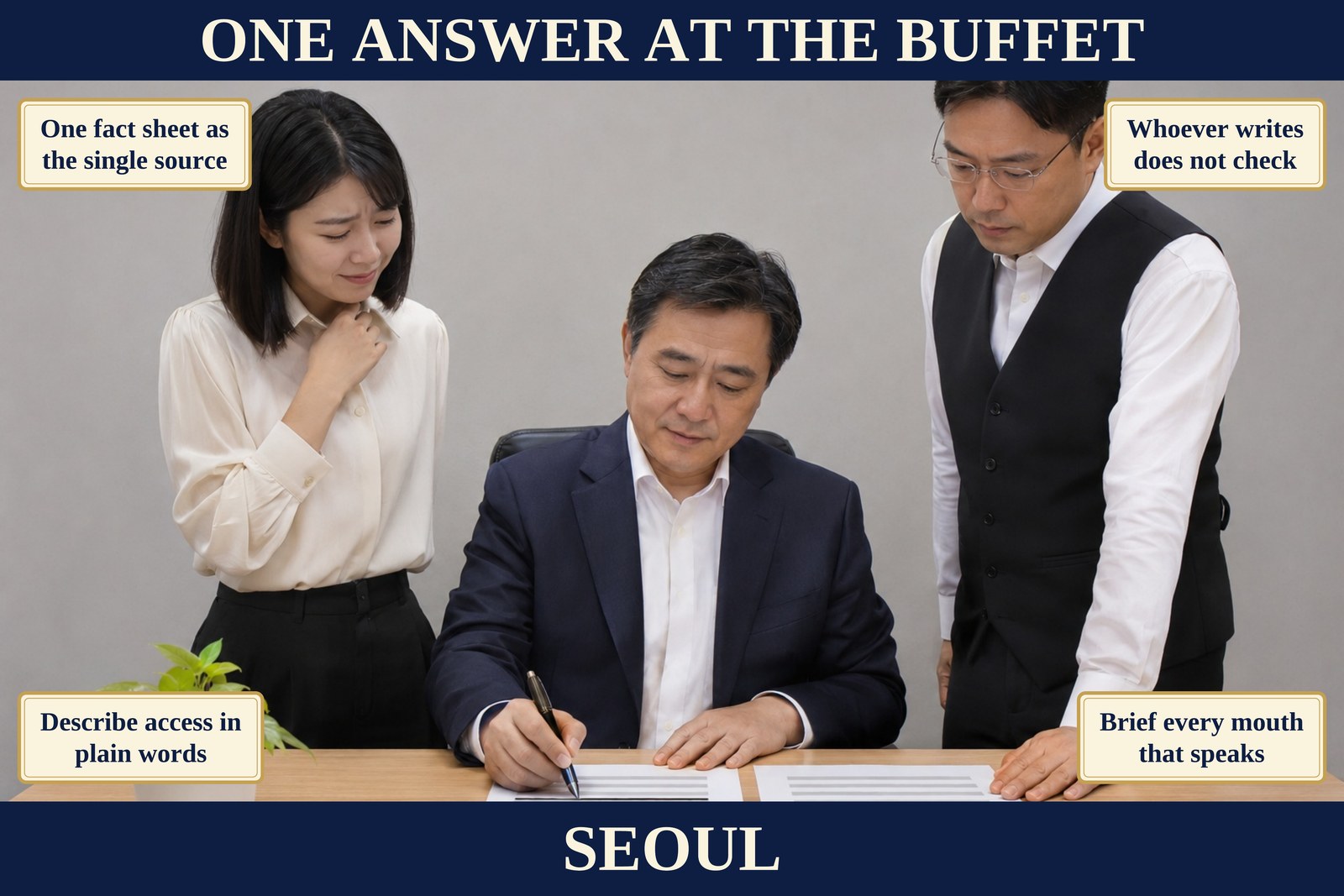
Concept Card 2.9 — One Answer at the Buffet
Subchapter 2.9 · Seoul, South Korea
Setting: Seoul, South Korea
The general manager's office of a city hotel in Seoul on an afternoon in late March, under cool light against pale grey walls. Park Ji-hoon, the general manager, in a navy suit, sits at a light wooden desk and holds his pen on the first block of a printed page. Kim Seo-yeon, the marketing manager, in a cream blouse, stands at his side with a hand at her collar, embarrassed but understanding. Lee Min-jun, the banqueting manager, in a black waistcoat, rests his hand on a second page.
The page under Park's pen is the draft of a new web page, and its first paragraph is the one being struck: carbon-neutral meetings, renewable energy, guests arriving free of emissions, a hotel working to ISO 20121. None of it could be shown. The second page is the email from an association whose members had believed the word barrier-free. The pen at the centre marks the act of approval that, until that afternoon, nobody but the writer had performed.
The four plaques read as one argument. One fact sheet as the single source, so that the website, the proposal and the waiter draw on the same checked sentences. Whoever writes does not check: a second person approves every claim before it goes out. Describe access in plain words, the step-free route through the courtyard instead of a label. And brief every mouth that speaks, the temporary waiter included, who had told a guest that all leftovers were thrown away.
The plate does not accuse Kim, who wrote the text the way other hotels write theirs and whom nobody had asked to do otherwise, nor the waiter, who answered what she believed. The donation of untouched food was a good decision that had simply not reached everyone who speaks for the hotel. To a guest, the sentence on the website and the answer at the buffet are the same voice; a hotel communicates well only when both have been checked.
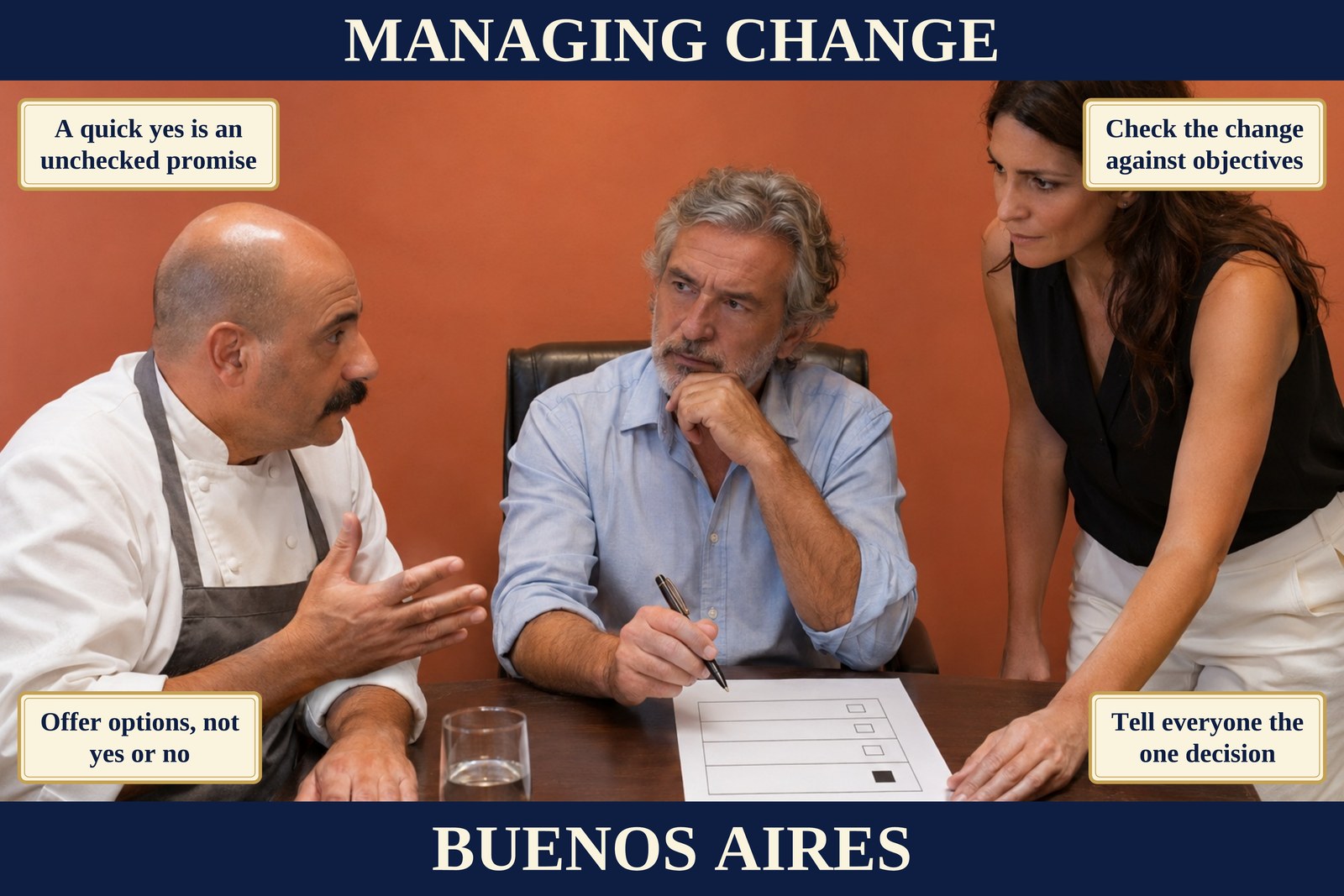
Concept Card 2.10 — Managing Change
Subchapter 2.10 · Buenos Aires, Argentina
Setting: Buenos Aires, Argentina
The general manager's office of a hotel in Palermo, Buenos Aires, late on a December morning: terracotta walls, a dark wooden desk, a glass of water. Martín Acosta, the general manager, in a light blue shirt, holds a pen over a one-page form, his other hand at his chin, weighing the decision. Valentina Sosa, the events manager, in a black sleeveless blouse, leans in with a hand beside the form. Diego Romero, the chef, in whites and a grey apron, makes his point with an open hand.
The form at the centre is the change sheet, a few rows with small boxes, and one box on the last row is filled in. It answers the fourth question: does the change affect an objective or a principle? Sosa ticked yes. A client's call had doubled the guests from 85 to 170 and asked for an outdoor grill and a later finish. Romero's cooperative could supply only sixty more steaks, and the lower terrace is reachable only by steps.
The four plaques read as one argument. A quick yes is an unchecked promise: we can manage that, said on the phone, had committed the hotel before anyone looked. Check the change against objectives, here traceable beef, food leftovers and reusable cups. Offer options, not yes or no, so that the client chooses between versions the hotel can keep. Then tell everyone the one decision, kitchen, service and client alike, so that it is not decided again by whoever answers next.
The plate does not accuse the client, whose request was reasonable and made in good faith, nor Sosa, whose quick yes came from years in which speed was what clients valued and the hotel rewarded, nor the wholesaler, who was offering a solution. The lesson is the subchapter's own: a change that is merely passed on has still been decided; the only question is whether anyone knew what was being decided, and against what.
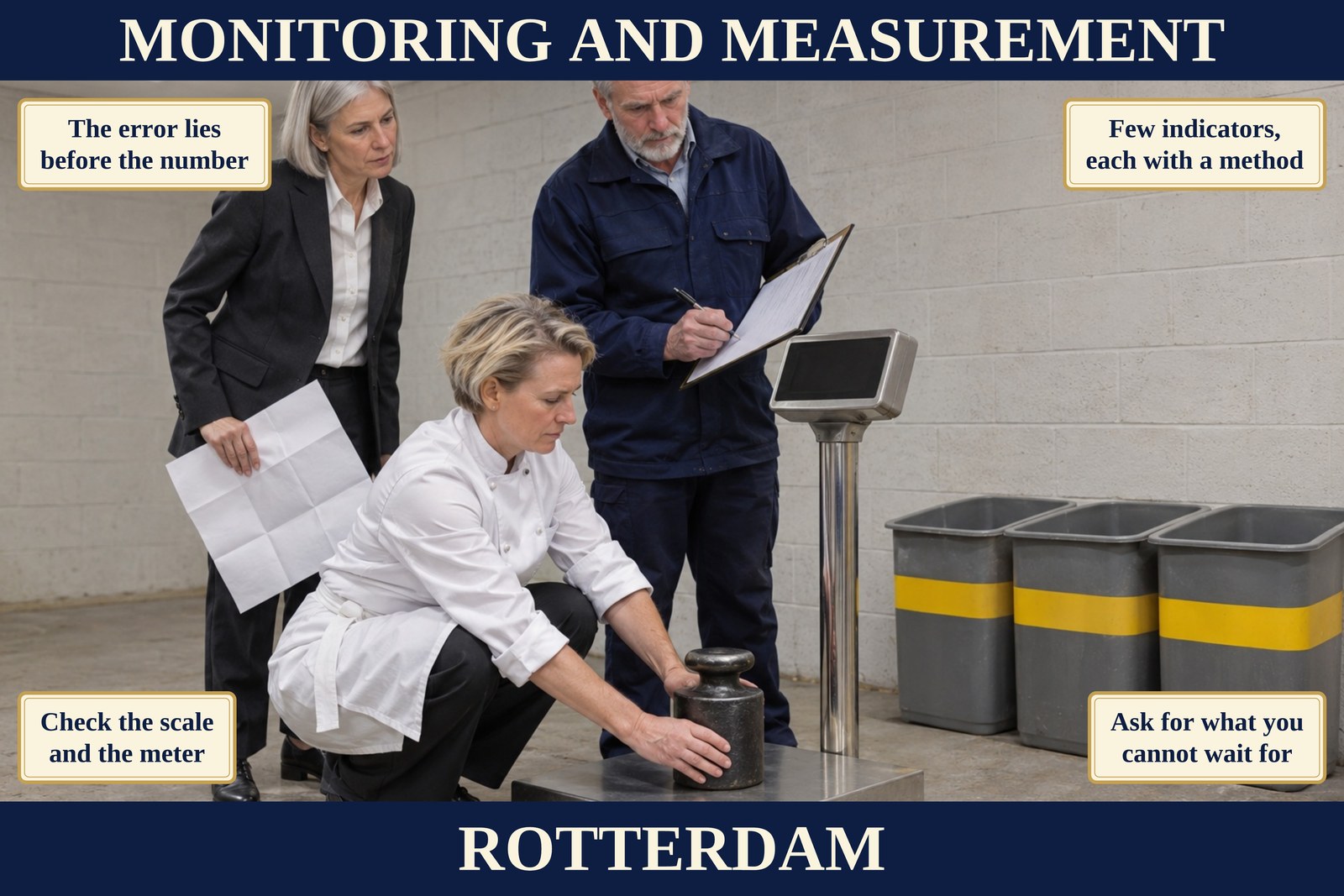
Concept Card 2.11 — Monitoring and Measurement
Subchapter 2.11 · Rotterdam, Netherlands
Setting: Rotterdam, Netherlands
The goods receiving area of a city hotel in Rotterdam on a Monday morning in April, under bright light on grey blockwork. Sanne Bakker, the head chef, crouches to set a polished cast-iron test weight on the platform of a steel scale whose display stays dark. Pieter Jansen, the maintenance technician, in a dark blue work jacket, writes on a clipboard. Anouk de Vries, the general manager, in a charcoal blazer, holds a folded printout and looks on. Three empty grey bins with yellow bands stand by the wall.
The test weight is the centre of the picture because the error lay before the number. In the first quarter, leftovers had been weighed with their bins, on different scales, or not at all, and a seminar had been charged with a whole weekend of foyer ventilation wired to the hall's sub-meter. The printout in de Vries's hand holds eleven columns of such figures. Before any of them can carry a decision, the scale must prove its accuracy and every bin must carry its tare.
The four plaques read as one argument. The error lies before the number: transcription was correct, but the method was missing. Few indicators, each with a method that fixes instrument, time and person in advance. Check the scale and the meter, as the night porter's note of a meter still turning at ten past three had shown. And ask for what you cannot wait for: a blocked ramp will never appear in a column that counts complaints and records zero.
The plate does not accuse de Vries, who chose eleven indicators out of thoroughness, nor the kitchen, which weighed whenever it had time and a scale, nor the electrician, who fitted the meter exactly as asked. The night porter wrote down what he saw, and every figure was transcribed correctly. A figure is worth exactly as much as the method decided before it; a figure that changes no decision need not be collected at all.
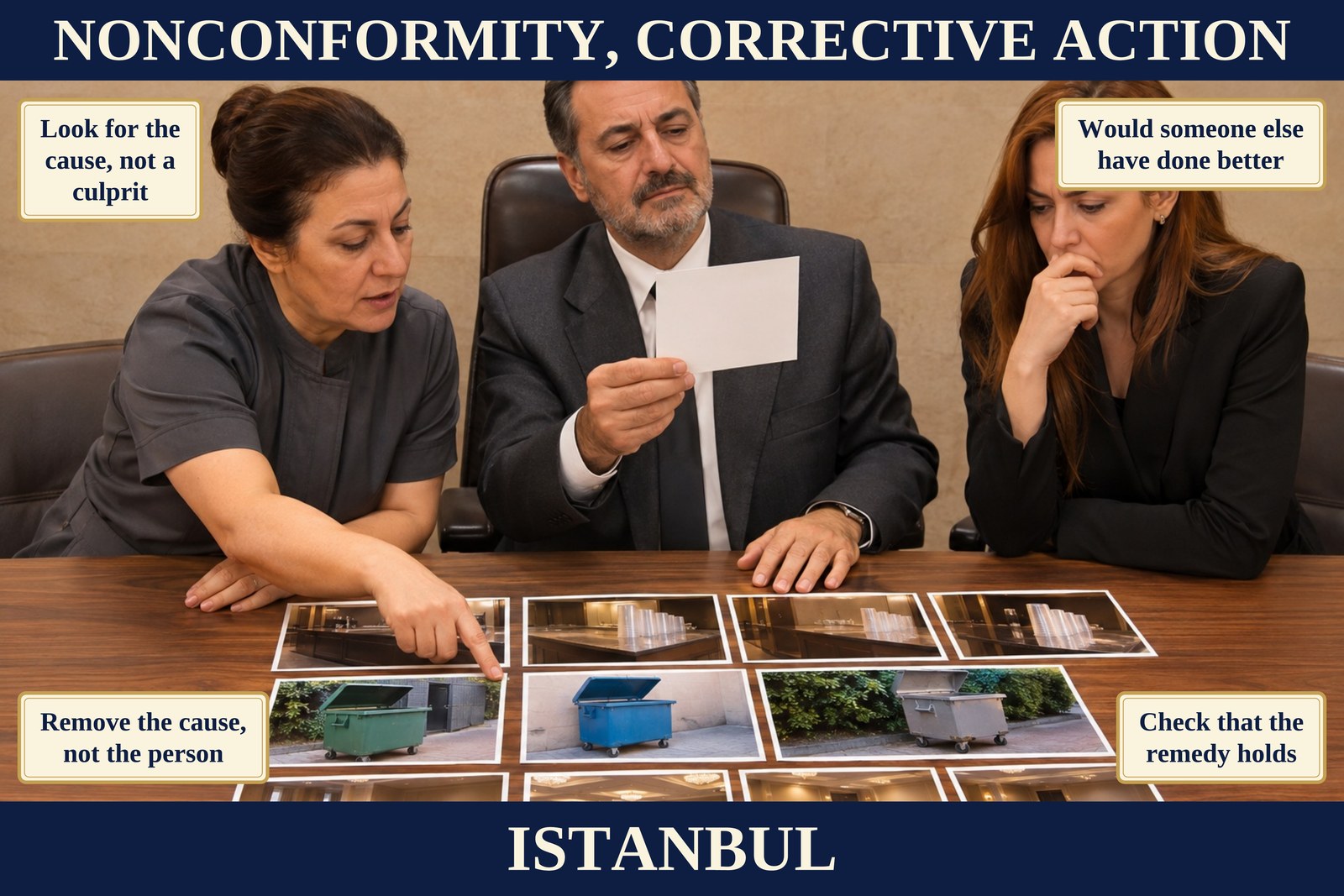
Concept Card 2.12 — Nonconformity, Corrective Action
Subchapter 2.12 · Istanbul, Turkey
Setting: Istanbul, Turkey
The general manager's office of a hotel a few streets from the Galata Tower in Istanbul, on a Monday afternoon in May, warm light on stone-coloured walls. On a walnut desk lie rows of printed photographs: bar counters with stacks of clear plastic cups, open waste containers in a yard. Kerem Yalçın, the general manager, holds up a blank card. Elif Demir, the executive housekeeper, in a grey tunic, points at one photograph; Selin Aydın, the banqueting manager, presses a hand to her lips, troubled.
The photographs are the night porter's, taken on his round after the season's first large wedding: single-use cups at the midnight bar, an organic bin filled with everything, agency staff clearing into the same sacks. No faces appear in them, and that is the point of the composition. The card in Yalçın's hand stands for his question to each finding: would someone else, in the same place, have acted differently? It turns the search for a culprit into a search for a cause.
The four plaques read as one argument. Look for the cause, not a culprit: a bartender with a full courtyard and only plastic in the store is a finding about stock, not character. Would someone else have done better is the test that separates the two. Remove the cause, not the person: clear the old cups, induct every agency worker, add late additions to every plan. And check that the remedy holds, over several events, before the case is closed.
The plate does not accuse Aydın, whose instinct to act quickly is that of a good banquet manager, nor the bartender, nor the agency workers, who did what they saw others do; the porter recorded what he found without naming anyone. The case stayed open six weeks, until every action had proved effective. A culprit is found after three photographs and a cause rarely is; whoever replaces only the culprit sends the next person to the same place.

Concept Card 2.13 — Documented Information
Subchapter 2.13 · Tallinn, Estonia
Setting: Tallinn, Estonia
A small quality office in a business hotel in Tallinn on a February afternoon, cool light on white walls and an empty grey shelf. Martin Kask, responsible for quality and sustainability, in a grey jumper, carries three thick blue ring binders together in his arms, half rueful, half relieved. Kadri Tamm, the general manager, in a dark green dress and black cardigan, gestures towards the door with an open hand. Liis Saar, the banquet manager, in a black blouse, holds up a single sheet ruled into a grid, quietly confident.
The composition weighs three binders against one sheet. The binders are a purchased template package: 212 pages, nineteen procedures and forty-seven forms with the hotel's name in every header, hardly any of them used. The sheet stands for the record Saar kept herself, food leftovers weighed after every banquet since November. A client's purchasing department had asked for the documents the hotel actually uses, not templates. Tamm's gesture settles which of the two will face the audit.
The four plaques read as one argument. Keep what the house actually uses, and strike the forms nobody fills in. Evidence lives where it arises, in the kitchen's weighing and the banquet's running order, and belongs in a shared, labelled place rather than on one person's computer. One policy, signed and dated, instead of three versions in binder, website and brochure. And personal data with an end date: participant lists with allergies do not belong on a pinboard for years.
The plate does not accuse Kask, who did what many hotels do with a package built on the pattern of older standards that did require a manual, nor Saar, who kept the best figure in the house without being asked. The binders leave without reproach; they were simply never the system. Instructions can be bought; evidence arises only in operations, on the day something happens, and stays only as long as it is needed.

Concept Card 2.14 — Competence and Awareness
Subchapter 2.14 · Muscat, Oman
Setting: Muscat, Oman
The ballroom on the mezzanine of a hotel in Muscat in the early evening before a gala, under warm chandeliers: sand-coloured panelling, round tables in white cloth and glassware. Arjun Menon, the banquet manager, in a black suit, holds a small briefing card and points at a glass carafe of water beside a white china cup. An agency waitress in a black waistcoat listens, hands on a chair back. Maria Santos, the human resources manager, in a dark red blazer, marks a list. Faisal Al-Rawahi, the general manager, watches approvingly.
The carafe and the china cup are the proposal made visible. At the season's first gala the client had been promised no single-use plastic and a step-free route by the service lift; the late karak was served in paper cups, and an elderly engineer climbed twenty-one steps. After eleven, eighteen of those in the ballroom were not employed by the hotel, and nobody had told them. The card in Menon's hand now carries the commitments to every person on the floor.
The four plaques read as one argument. The proposal must reach the floor, or the client's commitments stay in the sales office. One role sheet for whoever takes it, whether permanent, trainee, agency or casual. Brief everyone, in their language, and keep a list of who was briefed, as Santos does here. And ask three questions during service, about the lift, the refill station and the china, because a wrong answer at half past eleven can still be put right that night.
The plate does not accuse the agency workers, who served well and did what they had been told, nor Menon, whose briefing covered everything he thought was at risk, nor Santos, whose matrix was accurate for the people it listed. What was missing was a route by which the proposal reached those who had to keep it. For the guest, whoever stands in the ballroom is the hotel; what that person has not been told, the hotel does not know that night.
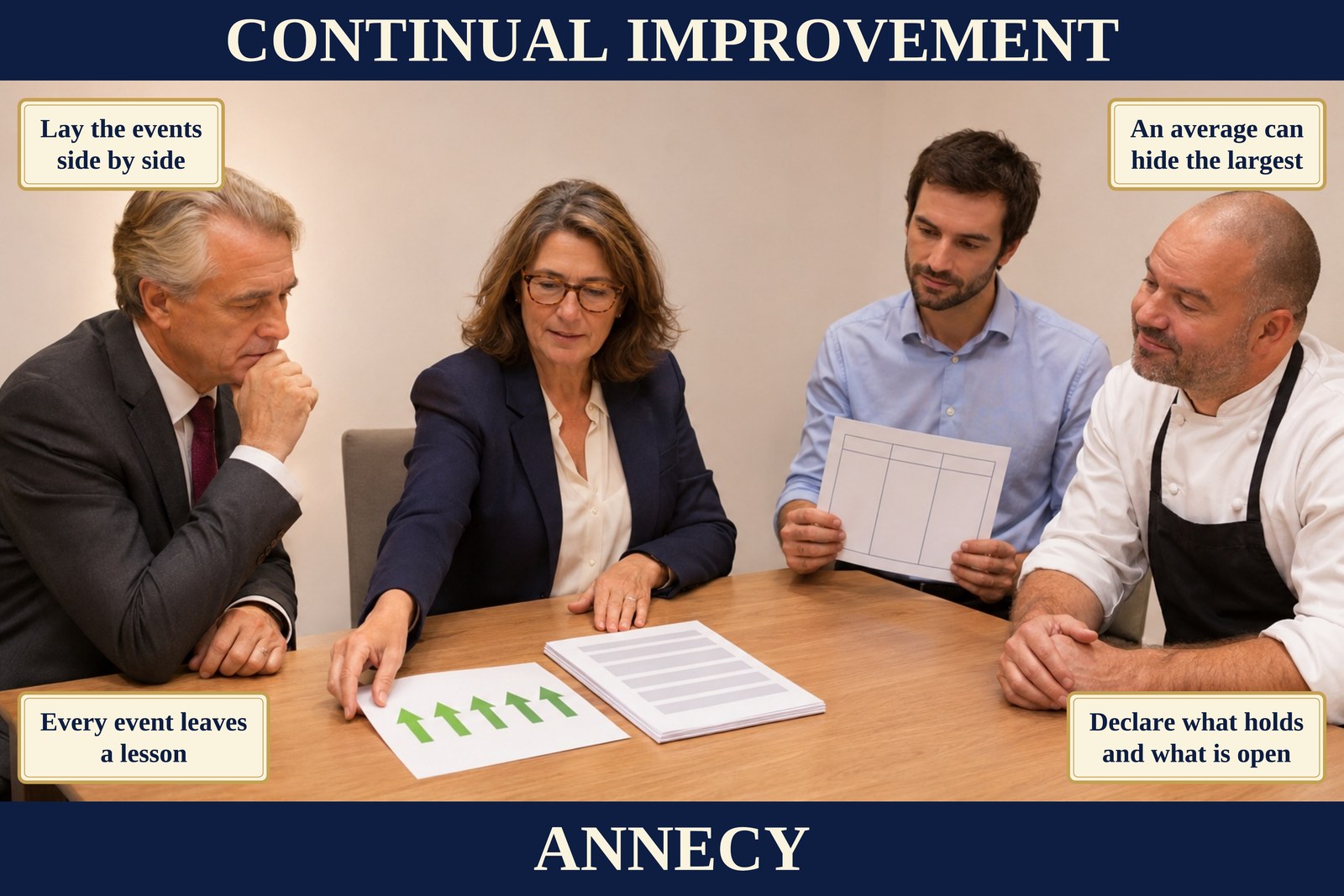
Concept Card 2.15 — Continual Improvement
Subchapter 2.15 · Annecy, France
Setting: Annecy, France
The smallest meeting room of the lakeside hotel in Annecy on a late October afternoon, under warm light; the same oak table where the work began in January. Claire Duval, the owner, in a navy blazer and tortoiseshell glasses, lays a page of five green arrows beside a stapled report. Marc Lenoir, the general manager, hand at his chin, studies the arrows, a little uneasy. Thomas Berthier, the events manager, holds up a grid of three columns; Julien Favre, the chef, leans on the table, nodding slowly.
Two papers lie side by side at the centre. The arrows are Lenoir's summary of the first year: leftovers down, disposable cups almost gone, a second dishwasher after eleven, all accurate. The report is the outside auditor's: nine events without a lessons note, six never weighed. Berthier's grid is the maturity matrix from the standard's annex, filled in by each of the four alone, with marks far apart. Duval places the arrows next to the audit, and the average loses its comfort.
The four plaques read as one argument. Lay the events side by side, all forty of them, rather than reading a year through a summary. An average can hide the largest: the six events nobody weighed were the biggest of the year, and absent from the best arrow. Every event leaves a lesson, including the agency-staffed weekends where none was written. And declare what holds and what is open: the self-declaration Duval signs names three open nonconformities and carries no seal.
The plate does not accuse Lenoir, whose arrows were right, nor Berthier, whose twenty-three pages were complete and honest. What the year lacked was a moment of decision. The hotel is not certified; it declares, within its scope and with a date, what its system holds and what is still open, and leaves certification to a later review. A hotel grows more experienced with every event; its system improves only when leadership lays the events side by side and decides.
L’AUTORE