
The Helm and the Lens · English
Disponibile / Available
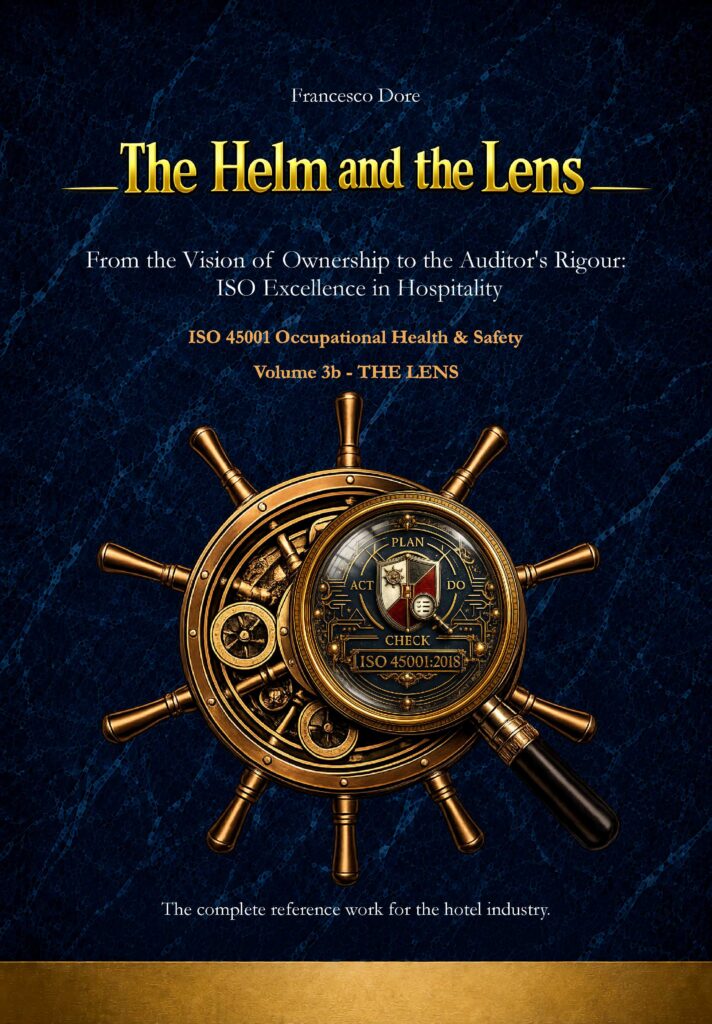
The Helm and the Lens – volume 3b
ISO 45001 Occupational Health & Safety Volume 3b — The Lens
Auditing and certifying a hotel’s occupational health and safety system — from the internal auditor who keeps coming back to the certification body that arrives for a few days and signs.
564
Pagine
A system can be conforming in every requirement and audited clean every year. It can still be a system nobody has watched while it was running.
What this volume is
Volume 3a built the occupational health and safety system from the position of the people who own a hotel and run it. This volume examines the same system from the two positions that have to be convinced it works: the internal auditor, who keeps coming back and lives with what he wrote, and the certification body, which arrives for a few days and signs. Neither of them builds anything. Both decide whether what was built is real.
The internal auditor’s lens
Fifteen subchapters on verifying your own system. An audit programme built on the hours a hotel works rather than on the months of a calendar. Criteria nobody has questioned. Competence and independence you may not have, because in a small property the person auditing the system is usually the person who wrote it. Hazard identification, the hierarchy of controls, fatigue and workload. Evidence in an occupied building. Sampling across shifts, seasons, departments and contractors. Emergency preparedness while the house is full. Findings, grading, and the one that cannot wait until Monday.
The certifier’s lens
Fifteen subchapters on the machinery almost nobody explains to a hotel. How audit days are calculated and why the number is not negotiable. What the first stage is actually assessing. What effectiveness evidence looks like, as distinct from the evidence that a control exists. The worker interview, and what it is evidence of. Root cause, and the response a certification body will accept. Who actually takes the decision — and it is not the auditor you met. Surveillance, recertification, suspension and withdrawal. An injury while the certificate is valid. And, last, what the certificate proves about a hotel and what it has never claimed.
How it is built
Thirty composite hotels in thirty cities, one to each subchapter, each closing with a concept card that carries the argument in a single image. No property is real; the cases are assembled from patterns that recur across four decades of work in international hospitality. Every financial figure is a modelled estimate, declared as such wherever it appears, never an industry benchmark — the sector does not publish them. Every subchapter ends with the case that runs the other way: the obvious correction that produces the opposite failure, because over-application is how much of the failure in this book was built in the first place.
On sources
The second chapter rests almost entirely on sources other than the standard, and says so at the opening of every subchapter, because the standard says almost nothing about certification. That machinery lives in the requirements applied to certification bodies and in the mandatory documents of the international arrangement. This book describes them by what they do rather than by what they are called, because designations change — and keeps the perishable part on this platform, where it can be corrected without reprinting a book.
Who it is for
The coordinator who inherited a safety system from somebody who left. The chief engineer told to audit a discipline nobody asked whether he was trained to audit. The general manager who will sit across from the certification auditor. And the owner who decides whether the certificate is a line worth keeping.
It states what ISO 45001:2018 requires today and separates requirement from method on the page rather than in a footnote. It invents no obligations.
A book for the people who have to find out whether it is true.
EDIZIONI · FORMATI
Formati disponibili
Le edizioni fisiche e digitali associate a questa scheda.
NEL LIBRO
Contenuto / Contents
La struttura del volume così come presentata nell’edizione pubblicata.
Table of Contents
- Preface.
- 3.1 Why Internal Audit Fails Differently When the Subject Is Harm...
- 3.2 An Audit Programme Built on Shifts, Not on Months.
- 3.3 Criteria, and the Obligations Nobody Has Questioned.
- 3.4 The Auditor: Competence and Independence You May Not Have.
- 3.5 Consultation and Participation Inside the Audit Programme.
- 3.6 Auditing Hazard Identification and Risk Assessment.
- 3.7 Auditing the Hierarchy of Controls.
- 3.8 Auditing Fatigue, Workload and Psychological Health.
- 3.9 An Audit Is Not a Safety Walk: Evidence in an Occupied Building.
- 3.10 Sampling Across Shifts, Seasons, Departments and Contractors
- 3.11 Auditing Work Done by People Who Are Not Your Employees.
- 3.12 Auditing Emergency Preparedness While the Building Is Full
- 3.13 Findings, Grading, and the One That Cannot Wait Until Monday.
- 3.14 The Quality of an Incident Investigation, and What Audit Does With It
- 3.15 Reporting Upward, and the Programme That Survives the Season
- 4.1 What a Certification Body Actually Verifies About Safety.
- 4.2 Choosing a Body, and the Auditor Who Actually Comes.
- 4.3 Accreditation: The Chain Behind the Signature.
- 4.4 Audit Days, and Why the Number Is Not Negotiable.
- 4.5 Stage 1: The Assessment That Happens Before Anyone Arrives.
- 4.6 Stage 2, and Evidence of Effectiveness.
- 4.7 The Worker Interview, and What It Is Evidence Of.
- 4.8 Nonconformities, Root Cause and the Response the Body Accepts
- 4.9 The Decision, and Who Actually Makes It.
- 4.10 Surveillance, Recertification and the Three-Year Cycle.
- 4.11 An Injury While the Certificate Is Valid.
- 4.12 Suspension, Withdrawal and the Certificate You Cannot Keep.
- 4.13 Transfer, Multi-Site and the Group Certificate.
- 4.14 What the Auditor Cannot Tell You, and Why.
- 4.15 What the Certificate Proves, and What It Does Not.
- Afterword.
- Sources and Research Methodology.
- Glossary.
- About the Author.
- Contact.
- The Online Platform...
- Acknowledgements.
- Analytical Index.
L’AUTORE