
The Helm and the Lens · English
Disponibile / Available
the Helm and the Lens – Vol. 4a
iso 50001
Volume 4a of The Helm and the Lens examines ISO 50001 from the perspective of hotel ownership and management. Thirty cases show how decisions about energy use become measurable improvements that can be sustained.
585
Pagine
Who decides when a hotel wakes up, which equipment it buys and what happens when consumption rises without an obvious fault? Energy performance depends on decisions made throughout the building, many of them far from the meter.
ISO 50001 and Sovereignty over the kWh — Volume 4a: The Helm examines how hotel ownership and management can build an energy management system around those decisions. It moves from energy policy, indicators and baselines to significant energy uses, investment, operational control, purchasing, maintenance and measurement. It also asks what management can honestly claim when the figures change.
Through thirty composite cases set in thirty cities, Francesco Dore connects the requirements of ISO 50001 to the daily operation of a hotel. Each case brings a practical question into focus: who has the authority to act, what evidence should be collected, and how will the property know whether an improvement has lasted?
Written for owners, general managers, energy managers and hospitality professionals, The Helm is the management companion to Volume 4b, The Lens, which examines the same standard from the auditor’s perspective.

EDIZIONI · FORMATI
Formati disponibili
Le edizioni fisiche e digitali associate a questa scheda.
NEL LIBRO
Contenuto / Contents
La struttura del volume così come presentata nell’edizione pubblicata.
Table of Contents
- Preface.
- 1.1 The Line That Is Not a Cost.
- 1.2 The Context You Did Not Choose.
- 1.3 Who Has an Interest in Your Consumption.
- 1.4 Leadership, and the Decision That Precedes the Meter.
- 1.5 A Policy That Can Be Refused.
- 1.6 Indicators That Cannot Be Achieved by Doing Nothing.
- 1.7 The Baseline, and the Year You Chose. 1
- 1.8 Significant Energy Uses, and the One Nobody Named.
- 1.9 The Energy Review as an Act of Discovery.
- 1.10 Risk in a Flow That Never Stops.
- 1.11 The Objective That Survives the Budget.
- 1.12 Competence Where the Decisions Are Actually Made.
- 1.13 Resources, and the Investment That Was Never Refused.
- 1.14 The Management Review That Reads a Curve.
- 1.15 What a Hotel Can Honestly Claim...
- 2.1 Operational Control on the Uses That Matter.
- 2.2 The Measurement Plan, and the Data You Chose Not to Collect.
- 2.3 Metering Is a Management Decision.
- 2.4 Design: the Requirement Only This Standard Has.
- 2.5 Buying Energy.
- 2.6 Buying Equipment, and the Specification Nobody Wrote.
- 2.7 Maintenance, and the Slow Return of Consumption.
- 2.8 Who Decides When the Building Wakes Up.
- 2.9 The Concession That Consumes and Does Not Pay.
- 2.10 Awareness on a Floor Where Nobody Sees a Bill
- 2.11 Communication, Inside and Out.
- 2.12 Documented Information Where the Work Is.
- 2.13 When Consumption Rises and Nothing Broke.
- 2.14 The Obligations You Have to Check.
- 2.15 Improvement, and the Result You Have to Hold.
- Afterword.
- Sources and Research Methodology.
- Glossary.
- About the Author.
- Contact.
- The Series.
- The Online Platform...
- Acknowledgements.
- Analytical Index.
PRIMA DELL’ACQUISTO
Estratti / Extracts
Passaggi selezionati dal libro disponibili per la consultazione.
01 Preface Apri / Open
Three of the standards in this series ask an organisation to manage something. This one asks it to move a number.
That difference is not a matter of emphasis. A quality system can be conforming while the product stays exactly as good as it was. An environmental system can be conforming while the impacts remain where they were, provided they are controlled and the commitments are met. This standard requires the organisation to demonstrate continual improvement of its energy performance — and a system in which nothing has improved is not a system that has been badly implemented. It is a system that does not conform.
Everything in this book follows from that sentence. It is why the baseline matters more here than in any other discipline, why an indicator that can be achieved by doing nothing is a defect rather than an imperfection, and why so much of what follows is about measurement in a building that was never designed to be measured.
There is a second difference and it belongs to the subject rather than to the standard. Energy is the only thing a hotel pays for every single day and decides once every fifteen or twenty years. The bill arrives monthly and is negotiated annually; the consumption behind it was settled when somebody chose a machine, specified a fitting, signed a concession or wrote a schedule — often years earlier, often in four days, often by somebody who was solving a different problem and did not know that this was also a decision.
That asymmetry is the reason an energy management system in a hotel so often produces effort without result. The effort goes where attention naturally goes, which is the recurring cost. The result was determined somewhere else entirely, by a process that nobody has connected to any of it.
This volume builds the system from the position of the people who own the property and run it. The first chapter is what ownership decides: the context that cannot be chosen, the parties whose needs shape what has to be demonstrated, the policy, the indicators, the baseline, the significant uses, the review from which everything else derives, the risks, the objectives, the competence, the resources, the management review, and the last question an owner faces — what may honestly be said in public about any of it. The second chapter is what management does with those decisions: the operating criteria, the measurement plan, the design and procurement moments, the maintenance, the hours, the concessions, the people, the documents, the deviations, the obligations and, finally, the holding of what has been gained.
The companion volume examines the same system from the two positions that have to be convinced it works. Everything in this book is what a property does. Whether any of it is true is a different question, asked by different people, and it is not the subject here.
Who this book is for
The owner or asset manager who approves an equipment purchase without being told it is an energy decision. The general manager who receives an indicator every month and has never been shown what would move it. The chief engineer who is competent and holds authority over none of the three decisions that set the number. The purchasing officer who negotiates a unit price with great skill while somebody else writes the other half of the invoice. The head of department who is asked to take responsibility for a consumption nobody can measure at the boundary of their department. And the person — there is usually one — who runs the energy management system alongside another job, in whatever hours are left.
Three facts about hotels govern everything in this book. The first is that a hotel consumes when it sells nothing. Roughly half of what a building draws does not depend on whether a single room is occupied, which means that the indicator the whole industry uses — consumption per occupied room night — improves whenever the commercial team succeeds, and tells an owner almost nothing about how the building is being run.
The second is that the building never closes, and therefore is never observed from scratch. A factory stops, a school empties, an office has a weekend. A hotel runs continuously, every day resembles the one before it, and the only comparison anybody makes is with yesterday — which is precisely the comparison that a slow deterioration survives indefinitely.
The third is that the decisions which determine consumption are taken by people who never see an invoice. A designer specifying a bathroom fitting, a chef switching on at a quarter to six, a concessionaire extending his opening hours, an engineer lowering a set point for a guest who asked — each of them acting correctly, on criteria that are legitimate, in a document or a moment that nobody has connected to energy.
To these the standard adds a fourth, and it is what separates this discipline from the others in the series. Performance improvement is not an outcome the system hopes for; it is a requirement the system must demonstrate. That obligation falls on a property whose consumption is largely fixed by decisions already taken and whose remaining room for manoeuvre lies in hours, schedules, settings and habits — which are cheap to change, invisible to measure, and held by people whose job is something else entirely.
What this book is, and what it is not
It is a practitioner’s guide to building and running an energy management system in a hotel. It is not consultancy, it does not sell a template, and it will not tell you whether your property is compliant — nobody who has not read your own consumption data can tell you that. It is also not an engineering manual. There is nothing here about sizing a chiller or selecting a heat recovery unit, because those are questions for a different profession and because the decisions that actually govern a hotel’s consumption are almost never technical ones.
Where the book states what is required, it states it as a requirement. Where it recommends a method, it says that it is a method and that other methods will do. The distinction is kept visible on the page rather than in a footnote, because the amount of documentation produced in this industry against obligations that do not exist is the single largest waste this book can help a reader avoid.
Every case in it is composite. Thirty properties in thirty cities, none of them a report of any real hotel’s history, each assembled from patterns that recur across four decades of work in international hospitality. Every financial figure is a modelled estimate and is declared as one wherever it appears; none of them is a sector benchmark, because the sector does not publish them and figures that are presented as benchmarks in this field are almost always something else.
The climate in each case is not decoration. Energy performance is the one discipline in this series where the location changes the problem rather than the setting — a building in Reykjavík, one in Muscat and one on the plateau at Nairobi have different largest uses, and a method built for one of them will mislead in the others. Where a case turns on a climate, the book says so.
The fixed elements of a subchapter
Every subchapter carries the same four. A Guiding Question opens it, and is the question the subchapter exists to answer; each one can be applied to your own property today, and each carries a time or a count, because a question that cannot be attempted in an afternoon will not be attempted at all.
What the Standard Says sets out the applicable requirement in the book’s own words, never in the standard’s. This volume rests on the standard throughout — unlike the second chapter of some others in this series, every requirement discussed here is one that binds the organisation itself, and the edition it is written against is stated in the Sources.
The Verification Pact runs a claim commonly made in the market against what actually holds. It is the discipline the whole series is built on, and it is deliberately the shortest thing on the page: six lines, no argument, no qualification.
Two tables then close the practical section. The first sets each requirement against what would demonstrate it in a hotel — which document, which record, which figure, which conversation — and, in a third column, against what is not being asked for at all. That third column is the one to read twice. The second table is the instrument of the subchapter: the thing a reader can take to their own property and use on Monday. Neither is a checklist. Several of them are deliberately left with a column empty, because the emptiness is the finding.
A fifth element is not a heading and appears throughout. Every subchapter closes its practical section with the case that runs the other way — the obvious correction that produces the opposite failure. The property that abandons ratios and can no longer tell growth from waste. The one that meters everything and answers no more questions than before. The one that writes forty operating criteria for a workforce that turns over every April. The one that refuses a viable solar installation because it would not improve the indicator. These are not rhetorical balance. Over-application is how a good part of the failure described in this book was built in the first place, and a reader who takes the argument without its inversion will build some more.
A note on words
This standard distinguishes several things that the industry routinely merges, and four of those distinctions decide whole subchapters of this book.
Energy performance is a measurable result relating to energy efficiency, energy use and energy consumption. Efficiency is a ratio between a result and the energy put in. Use is how the energy is employed — ventilation, lighting, heating, cooling. Consumption is the quantity used. A property can improve its efficiency while its consumption rises, and both statements can be true at once; keeping the four terms apart is what makes such a sentence readable rather than suspicious.
An indicator is a measure of energy performance, and a baseline is the quantitative reference against which it is compared. The first tells you where you are and the second decides what that means, which is why a book about improvement spends an entire subchapter on how a reference period is chosen and who chooses it.
A relevant variable is a quantifiable factor that significantly affects energy performance and changes routinely — the weather, the occupancy, the covers served. A static factor affects performance and does not change routinely — floor area, room count, installed plant. The first is what you normalise against. The second is what tells you when a comparison has stopped being valid, and confusing them is the most common way a property comes to believe something about itself that is not the case.
And two distinctions belong to the standard’s own vocabulary rather than to the subject, and both are easy to read past. To consider something means it must be thought about and may then be excluded; to take it into account means it may not be excluded. And continual improvement is not continuous improvement: the first implies occurrence over a period of time with intervals of interruption, and the expectation is that improvements occur periodically rather than without pause. Two subchapters of this book turn on those two sentences, and both of them are in the standard’s own guidance, where almost nobody looks.
02 2.9 The Concession That Consumes and Does Not Pay Apri / Open
| GUIDING QUESTION Identify every part of your building operated by somebody your property does not employ — a spa, a restaurant, a shop, a fitness operation. Then answer two questions about each. Is its energy inside your utility bill? And does your agreement with that operator contain a single line about energy? Where the answers are yes and no, you are carrying a consumption you cannot influence and have not contracted for. |
Opening
The highest consumption per square metre in the building belonged to an operation the hotel could not instruct, could not measure and paid for in full.
The property is a hundred and fifty rooms in Baden-Baden, and its spa — pool, saunas, steam rooms and treatment cabins — had been operated under concession for eight years by a specialist company that ran three such facilities in the region and ran them well. The arrangement suited everybody. The operator paid a fixed fee plus a share of revenue, brought a clientele the hotel did not have, and relieved the property of a business it had never been good at. The hotel provided the space and the utilities, which the agreement described in four words: utilities included in the concession.
Annegret Vogel had been running the energy management system for three years and had never had a figure for the spa, because there was no meter on it. Its heat came off the main circuit, its electricity from a board that also served part of the back of house, and its water was on the property’s supply. Preparing the energy review update, she calculated the spa’s consumption by subtraction: total consumption, less everything metered, less everything reasonably estimable. The residual was larger than anybody in the building had supposed. It came to about twenty-two per cent of the property’s total energy.
Two things had happened over the eight years, both entirely proper. The operator had extended the opening hours twice, first by an evening and later by two hours on weekdays, in response to demand and to the competitive position of the facility — which is what a concession is for, and which increased the hotel’s revenue share both times. And the pool temperature had been raised by one degree in the fourth year, after guest feedback, by a manager exercising exactly the judgement his own business required of him.
Neither change was notified to the hotel, because nothing obliged notification and nothing suggested that either was the hotel’s concern. Neither was costed by the operator, because the operator does not pay for energy. And neither appeared in the hotel’s energy review, because there was no meter and no line of communication through which such a thing would travel.
When Annegret raised it internally the general manager’s first instinct was that the operator should have said something. Her own view, which she had to argue for, was that he had behaved exactly as the contract invited him to. A concessionaire who does not pay for energy and whose revenue rises with opening hours is being asked, by the agreement he signed, to maximise service and disregard consumption — and he had done so competently for eight years.
What she wrote for the owners is the whole of this subchapter. The spa is inside our building, inside our scope, on our bill and outside our authority, and the standard does not permit those four things to be true at once.
The Problem
The first failure is contractual and it is the origin of everything else. Four words — utilities included in the concession — transferred an unlimited quantity of energy to a party with no reason to limit it. The agreement was negotiated on the commercial terms that mattered at the time, by people thinking about revenue share and about who cleans what, and the energy clause was an afterthought that happened to be a blank cheque.
The second failure is that the incentives point the wrong way and point that way permanently. The operator’s revenue rises with opening hours and with guest satisfaction, and his costs do not rise with either. Nothing in that arrangement requires bad faith to produce growing consumption; it produces growing consumption when everybody behaves well, which is the characteristic of a badly aligned contract and the reason no amount of goodwill fixes one.
The third failure is that the hotel had placed the spa inside the scope of its energy management system, as it had to, without holding the authority to control it. The standard requires the organisation to ensure it has the authority to control its energy efficiency, use and consumption within the scope and boundaries. A significant use inside the boundary that the property cannot instruct is not a difficulty to be managed; it is a defect in the scope that has to be repaired either by acquiring the authority or by changing the arrangement.
The fourth failure is that nothing could be excluded to make the problem disappear. The standard says the organisation shall not exclude any energy type within the scope and boundaries, which closes the escape route most properties reach for — declaring the spa out of scope while continuing to pay its bill and operate the plant that serves it. The energy is in the building and therefore in the system.
The fifth failure is that there was no measurement, which made the whole thing invisible for eight years. A concession whose consumption is known can be discussed; one that is calculated by subtraction cannot even be raised, because the operator will reasonably dispute a residual and the hotel has nothing better to offer. Every conversation this subchapter recommends begins with a meter.
The sixth failure is that outsourcing had been understood as a transfer of responsibility rather than of activity. The definition in the standard is precise: although the external organisation is outside the scope of the management system, the outsourced function or process falls within it. The operator is outside. The spa is inside. Eight years of arrangements had proceeded on the assumption that both were outside, and nothing in the commercial documentation ever said otherwise because nobody had asked the question.
The seventh failure is that the shared plant belonged to nobody in particular. The heat serving the spa came off the property’s main circuit, which the hotel maintains, operates and pays for, and which the operator uses without instructing. When a circulation pump ran continuously through a winter nobody investigated it, because the hotel assumed it served the spa and the spa assumed the hotel was managing its own plant. A boundary drawn on a commercial document rarely coincides with a boundary drawn in pipework, and the gap between the two is where equipment runs for years without an owner.
Underneath all seven sits a proposition that a general manager will recognise from every other part of the business. A party that does not pay for something does not manage it, and no contractual obligation substitutes for an incentive. The remedy is not to police the operator; it is to change what the operator is optimising — which requires a meter first and a negotiation second.
The Principle
The standard defines outsourcing with unusual precision and the definition settles this subchapter. To outsource is to make an arrangement where an external organisation performs part of an organisation’s function or process. The note attached is the operative part: although the external organisation is outside the scope of the management system, the outsourced function or process is within that scope. The company is outside; the activity is inside.
That is reinforced from two directions. The organisation must ensure that outsourced significant energy uses, or the processes related to them, are controlled. And when determining the scope and boundaries, the organisation must ensure it has the authority to control its energy efficiency, energy use and energy consumption within them — which means authority is not optional, and a boundary drawn around something the property cannot instruct has been drawn wrongly.
The escape route is closed explicitly. The organisation shall not exclude any energy type within the scope and boundaries. A property cannot declare the spa outside its system while the spa sits inside its building, draws off its circuits and appears on its invoice. If the energy is inside the boundary, it is inside the system, and the system has to be able to reach it. …
MATERIALI DI LAVORO
Materiali e download
Checklist, modelli, supplementi e file di lavoro collegati al volume.
33 materiali in 2 gruppi
Capitolo 118 materiali
FILES
1 · Worksheet 1.1: The Line That Is Not a Cost
1.1
Verification Pact, what the standard requires and what demonstrates it, the instrument table, common mistakes self-check and action plan for your property
FILES
2 · Worksheet 1.2: The Context You Did Not Choose
1.2
Verification Pact, what the standard requires and what demonstrates it, the instrument table, common mistakes self-check and action plan for your property
FILES
3 · Worksheet 1.3: Who Has an Interest in Your Consumption
1.3
Verification Pact, what the standard requires and what demonstrates it, the instrument table, common mistakes self-check and action plan for your property
FILES
4 · Worksheet 1.4: Leadership, and the Decision That Precedes the Meter
1.4
Verification Pact, what the standard requires and what demonstrates it, the instrument table, common mistakes self-check and action plan for your property
FILES
5 · Worksheet 1.5: A Policy That Can Be Refused
1.5
Verification Pact, what the standard requires and what demonstrates it, the instrument table, common mistakes self-check and action plan for your property
FILES
6 · Worksheet 1.6: Indicators That Cannot Be Achieved by Doing Nothing
1.6
Verification Pact, what the standard requires and what demonstrates it, the instrument table, common mistakes self-check and action plan for your property
FILES
7 · Worksheet 1.7: The Baseline, and the Year You Chose
1.7
Verification Pact, what the standard requires and what demonstrates it, the instrument table, common mistakes self-check and action plan for your property
FILES
8 · Worksheet 1.8: Significant Energy Uses, and the One Nobody Named
1.8
Verification Pact, what the standard requires and what demonstrates it, the instrument table, common mistakes self-check and action plan for your property
FILES
9 · Worksheet 1.9: The Energy Review as an Act of Discovery
1.9
Verification Pact, what the standard requires and what demonstrates it, the instrument table, common mistakes self-check and action plan for your property
FILES
10 · Worksheet 1.10: Risk in a Flow That Never Stops
1.10
Verification Pact, what the standard requires and what demonstrates it, the instrument table, common mistakes self-check and action plan for your property
FILES
11 · Worksheet 1.11: The Objective That Survives the Budget
1.11
Verification Pact, what the standard requires and what demonstrates it, the instrument table, common mistakes self-check and action plan for your property
FILES
12 · Worksheet 1.12: Competence Where the Decisions Are Actually Made
1.12
Verification Pact, what the standard requires and what demonstrates it, the instrument table, common mistakes self-check and action plan for your property
FILES
13 · Worksheet 1.13: Resources, and the Investment That Was Never Refused
1.13
Verification Pact, what the standard requires and what demonstrates it, the instrument table, common mistakes self-check and action plan for your property
FILES
14 · Worksheet 1.14: The Management Review That Reads a Curve
1.14
Verification Pact, what the standard requires and what demonstrates it, the instrument table, common mistakes self-check and action plan for your property
FILES
15 · Worksheet 1.15: What a Hotel Can Honestly Claim
1.15
Verification Pact, what the standard requires and what demonstrates it, the instrument table, common mistakes self-check and action plan for your property
XLSX
41 · Verification Pact Register
1.1 to 2.15
All 180 Verification Pact claims of the volume, with a column for your property, a status for each claim and a count by status and by subchapter
XLSX
42 · The Ten Instruments, as a workbook
1.1 to 2.13
The ten instruments on fillable sheets, one per instrument, with the calculations each one needs
FILES
43 · Concept Cards
1.1 to 2.15
The thirty concept cards of the volume, one per page
Capitolo 215 materiali
FILES
16 · Worksheet 2.1: Operational Control on the Uses That Matter
2.1
Verification Pact, what the standard requires and what demonstrates it, the instrument table, common mistakes self-check and action plan for your property
FILES
17 · Worksheet 2.2: The Measurement Plan, and the Data You Chose Not to Collect
2.2
Verification Pact, what the standard requires and what demonstrates it, the instrument table, common mistakes self-check and action plan for your property
FILES
18 · Worksheet 2.3: Metering Is a Management Decision
2.3
Verification Pact, what the standard requires and what demonstrates it, the instrument table, common mistakes self-check and action plan for your property
FILES
19 · Worksheet 2.4: Design: the Requirement Only This Standard Has
2.4
Verification Pact, what the standard requires and what demonstrates it, the instrument table, common mistakes self-check and action plan for your property
FILES
20 · Worksheet 2.5: Buying Energy
2.5
Verification Pact, what the standard requires and what demonstrates it, the instrument table, common mistakes self-check and action plan for your property
FILES
21 · Worksheet 2.6: Buying Equipment, and the Specification Nobody Wrote
2.6
Verification Pact, what the standard requires and what demonstrates it, the instrument table, common mistakes self-check and action plan for your property
FILES
22 · Worksheet 2.7: Maintenance, and the Slow Return of Consumption
2.7
Verification Pact, what the standard requires and what demonstrates it, the instrument table, common mistakes self-check and action plan for your property
FILES
23 · Worksheet 2.8: Who Decides When the Building Wakes Up
2.8
Verification Pact, what the standard requires and what demonstrates it, the instrument table, common mistakes self-check and action plan for your property
FILES
24 · Worksheet 2.9: The Concession That Consumes and Does Not Pay
2.9
Verification Pact, what the standard requires and what demonstrates it, the instrument table, common mistakes self-check and action plan for your property
FILES
25 · Worksheet 2.10: Awareness on a Floor Where Nobody Sees a Bill
2.10
Verification Pact, what the standard requires and what demonstrates it, the instrument table, common mistakes self-check and action plan for your property
FILES
26 · Worksheet 2.11: Communication, Inside and Out
2.11
Verification Pact, what the standard requires and what demonstrates it, the instrument table, common mistakes self-check and action plan for your property
FILES
27 · Worksheet 2.12: Documented Information Where the Work Is
2.12
Verification Pact, what the standard requires and what demonstrates it, the instrument table, common mistakes self-check and action plan for your property
FILES
28 · Worksheet 2.13: When Consumption Rises and Nothing Broke
2.13
Verification Pact, what the standard requires and what demonstrates it, the instrument table, common mistakes self-check and action plan for your property
FILES
29 · Worksheet 2.14: The Obligations You Have to Check
2.14
Verification Pact, what the standard requires and what demonstrates it, the instrument table, common mistakes self-check and action plan for your property
FILES
30 · Worksheet 2.15: Improvement, and the Result You Have to Hold
2.15
Verification Pact, what the standard requires and what demonstrates it, the instrument table, common mistakes self-check and action plan for your property
Immagini e tavole HD
Apri e proietta le foto direttamente dal sito, a schermo intero, oppure scarica gli originali.
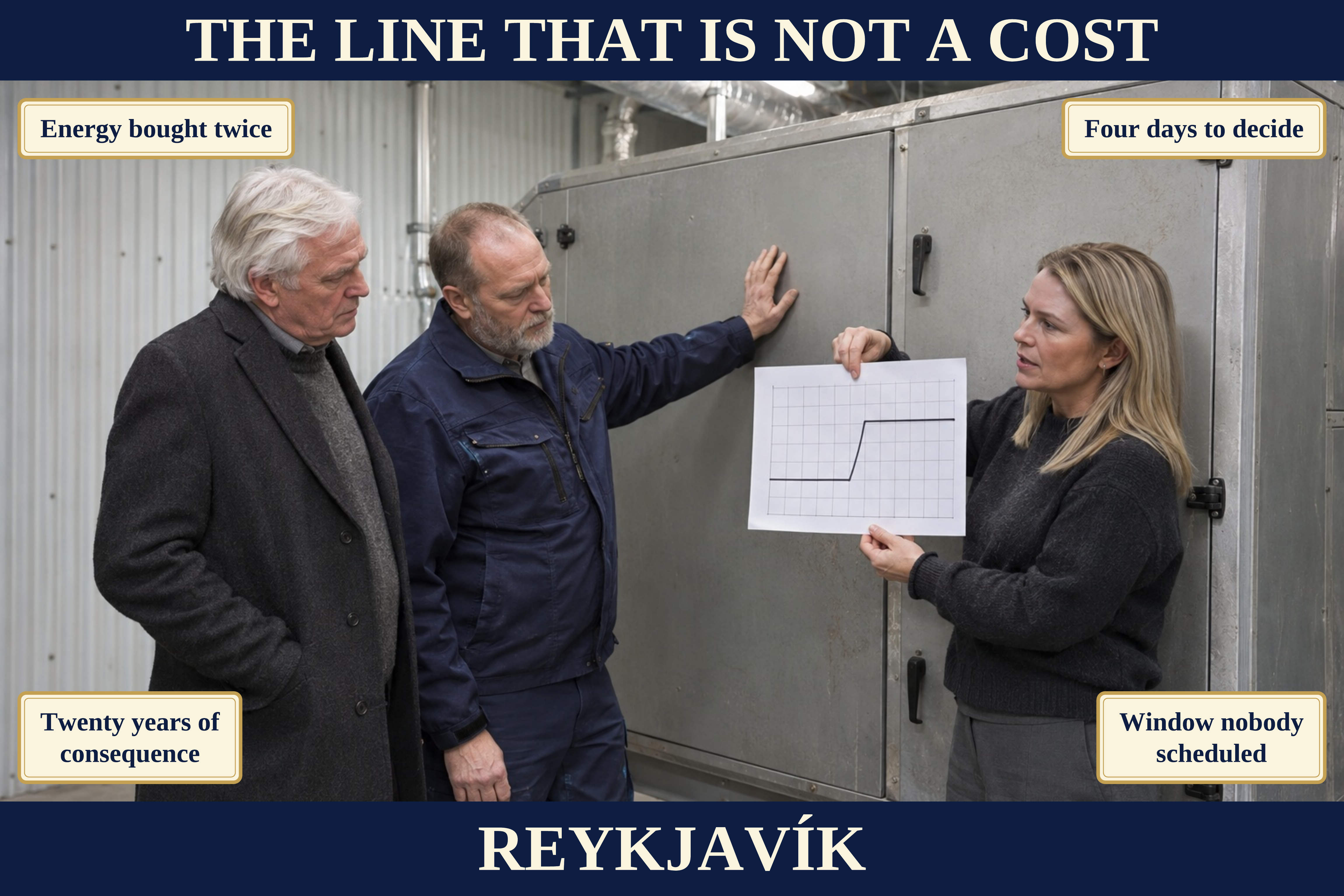
Concept Card 1.1 — The Line That Is Not a Cost
Subchapter 1.1 · Reykjavík
Setting: Reykjavík
A plant room behind the conference floor of a converted fish processing plant, under cold white tubes and insulated ducts. In the centre stands a grey air handling unit, dulled by years of work. Halla, the asset manager, holds a sheet beside its casing: a grid with one line that runs flat, steps sharply up and stays high. The chief of maintenance rests his open palm on the machine and studies the line. A member of the owning family, in a dark overcoat, looks from the sheet to the unit.
The card places the record beside its cause. The step on the sheet is not a fault and not a tariff; it is this machine, installed in four days eleven years ago and running ever since at a level nobody chose deliberately. A hotel buys energy twice: once a year as a commodity, and once every twenty years as equipment. The second purchase is far larger than the first, and it is rarely recognised as an energy decision at all.
The plaques set the two timescales against each other. ‘Energy bought twice’ names the double purchase. ‘Four days to decide’ is the weekend in February when the unit failed with the house full. ‘Twenty years of consequence’ is what that weekend committed the property to. ‘Window nobody scheduled’ names the real omission: the replacement was foreseeable a decade ahead, and a date on a page would have moved the decision into a meeting with figures.
The card is not saying that the replacement was wrong. The general manager who approved it by telephone and the contractor who installed it acted correctly, and the chief of maintenance has kept the machine running for eleven years. The failure belongs to the ownership, which never kept a list of when its major assets would fall due, and so let its largest energy decision arrive as an emergency.

Concept Card 1.2 — The Context You Did Not Choose
Subchapter 1.2 · Seville
Setting: Seville
A walled service yard on the roof at midday in July, under a near vertical sun, with a row of grey condenser units on a concrete plinth against an ochre wall. In the strip of shade beneath a metal canopy Amparo, the operations director, holds two sheets side by side, each a grid with a single line that rises and falls in the same shape. The owner leans in to compare them, his brow furrowed. His daughter, one hand shading her eyes, reads the second sheet with sudden understanding.
The card shows the one variable in this volume that nobody chooses and everybody is judged on. The two lines are two summers over the same unchanged plant, and they look alike because the work behind them was alike. What separated the years was heat, and nobody had recorded it. The standard expects a property to understand the external conditions that affect its energy performance; a result not separated from its weather does not yet describe what the property did.
The plaques describe the symmetry of the error. ‘Weather credited’ is the mild summer, in which a seven per cent fall was praised although the work explained only part of it. ‘Weather charged’ is the hot one, in which a nine per cent rise was punished in what was in fact the best operating year. ‘Same building’ and ‘Nothing was done’ complete the line: the programme was intact both times, and only the summer had changed.
The card is not saying that the family judged carelessly. They read the figures in front of them and drew the conclusion those figures supported, and Amparo's programme was sound throughout. The failure lies in a reporting system that delivered totals without the temperature series beside them, so that the owners rewarded the wrong year, cut the budget in the right one and discontinued measures that were still working.

Concept Card 1.3 — Who Has an Interest in Your Consumption
Subchapter 1.3 · Tallinn
Setting: Tallinn
A sales office in an old limestone and timber building on a winter evening, lit by a brass desk lamp, with whitewashed walls under dark beams. Maarja, the energy manager, sits at the desk with her own bound report raised in one hand and the other resting on a thick tender document open at an empty table; the ruled columns of the two documents do not correspond. Standing beside her, the director of sales holds the telephone handset lifted from its cradle, not yet dialled, with a rueful expression.
The card shows the moment at which a property discovers who its interested parties actually are. Maarja's register listed fourteen of them, carefully assessed, and the party that decided the contract was not there in any useful form. The client did not want efficiency in general; it wanted one figure, in one denominator, in one structure. The standard asks a property to determine the needs of the parties relevant to its energy performance, and that determination is made by asking, not by inference.
The plaques follow the loss. ‘Efficiency not asked for’: the client was assembling a consolidated report, not comparing buildings. ‘Denominator decides’: this house was better per room night and reported per square metre. ‘Format decides’: a competitor with worse figures could supply them from a standing report. ‘Nobody asked them’ names the cause, and the undialled telephone in the photograph is the method that would have prevented it.
The card is not saying that the energy manager did poor work. Her indicators were the right ones for managing a building, her data were complete, and she refused to sign a retrospective series without qualifying it. The failure lies in a stakeholder analysis compiled at a desk and never tested in conversation with the largest account, by the commercial side of the property that held the relationship.
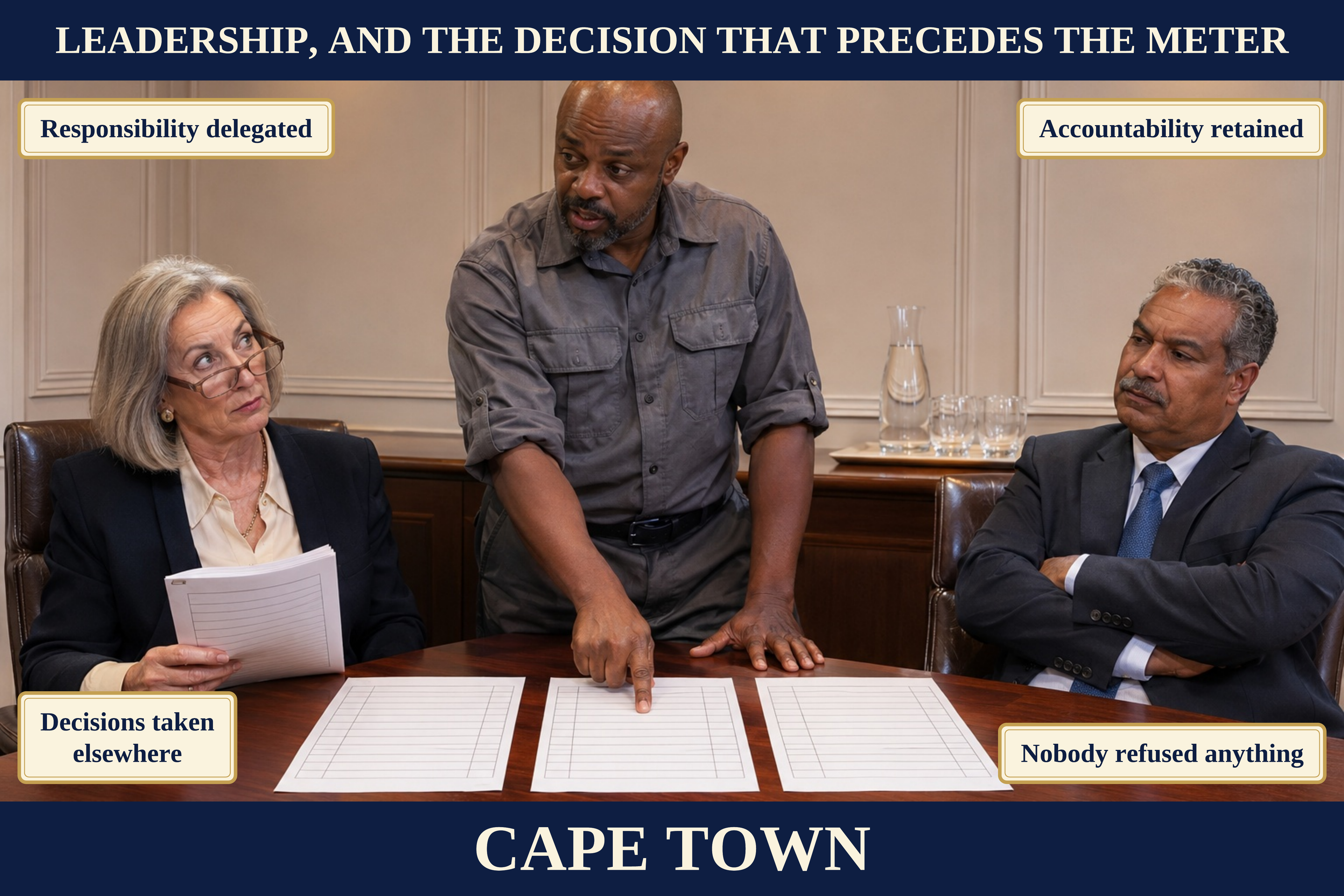
Concept Card 1.4 — Leadership, and the Decision That Precedes the Meter
Subchapter 1.4 · Cape Town
Setting: Cape Town
A boardroom late on a December afternoon, under warm ceiling lights, with pale panelled walls, leather chairs and a carafe and glasses on the sideboard. Sipho, the chief engineer, stands at the polished table in a grey work shirt with rolled sleeves; he has laid three documents in a row and presses his finger on the middle one, his other hand flat on the wood. The owner holds his report lowered and looks at him over her reading glasses, unconvinced. The general manager sits back with his arms folded.
The card puts the whole problem on one table. The three sheets stand for the three decisions of a single year: the spa hours extended, the laundry machines replaced, the closed wing reopened. Each was taken correctly by somebody else, in another room, and each moved the number Sipho had been made responsible for. Leadership under this standard is more than appointing a competent person; it includes deciding which decisions must pass the energy desk before they are taken.
The plaques take the arrangement apart. ‘Responsibility delegated’: properly, in writing, to a named person. ‘Accountability retained’: equally properly, by the ownership. ‘Decisions taken elsewhere’: three of them, in three offices, none routed through the person answerable for the result. ‘Nobody refused anything’ explains why the gap stayed invisible, since there was no conflict, no request turned down and nothing anybody could appeal.
The card is not saying that the owner or the general manager behaved improperly. Each decision was commercially sound, and the board read the report it was given. The chief engineer named the causes honestly. The failure lies in a delegation that transferred a number without transferring any of the means of moving it, and that belongs to the leadership, not to the man at the table.

Concept Card 1.5 — A Policy That Can Be Refused
Subchapter 1.5 · Salzburg
Setting: Salzburg
The main kitchen of a town house hotel on a February morning between services, among white tiles and stainless steel. Behind the group stand two new combi ovens, their doors closed. Theresa, the operations manager who runs the energy system, holds the framed policy taken down from the corridor wall in one hand and, in the other, a clipboard with three ruled columns, bringing the two together for the first time. The purchasing assistant opens one palm in a sincere question. The head chef leans in, eyebrows raised.
The card brings into one place two documents that had been kept eleven metres apart. The framed page commits the property to considering energy performance when it buys and when it designs. The clipboard is the quotation comparison on which the ovens were chosen, by price, delivery and service cover, with no column for consumption. A policy does its work only where a decision is taken, and in this building it had never been placed inside one.
The plaques measure the gap. ‘Signed and posted’ is everything the property had done, and done properly. ‘Never consulted’ is what no communication requirement detects. ‘Decision elsewhere’ is the clipboard, the requisition and the approval route, none of which asked the policy's question. ‘Distance of eleven metres’ is the length of the corridor: close enough that nobody could call the policy hidden, far enough that it never changed an answer.
The card is not saying that the assistant or the chef ignored the policy. She had read it, signed for it and, asked afterwards, wondered only where she would have seen it during the purchase. The chef compared three quotations as the procedure required. The failure lies in a system that framed its commitments and left its purchasing forms unchanged, a choice that belonged to the owners.

Concept Card 1.6 — Indicators That Cannot Be Achieved by Doing Nothing
Subchapter 1.6 · Bilbao
Setting: Bilbao
An empty conference room on an autumn afternoon with every ceiling light left on: stacked chairs along the wall, a rolled projection screen, folded linen on a trolley. Nerea, the energy manager, bends over a single sheet on the long table, her pen at its lower edge, below two lines that start together and diverge, one climbing and one falling. The owner sits opposite with his hands clasped, studying the sheet, sobered. His son stands at his shoulder, one hand on the back of the chair, staring in surprise.
The card puts the whole argument on one sheet. The falling line is kilowatt-hours per occupied room night, the indicator that went to the owners for three years as evidence of progress. The rising line is total consumption, which grew twelve per cent while occupancy rose. Nerea is adding the line that explains both: what the building consumes when it is empty. An indicator must represent energy performance, and this one had been measuring occupancy.
The plaques explain how two true lines can point in opposite directions. ‘Indicator falling’ and ‘Consumption rising’ describe the same months in the same building. ‘Base load unchanged’ is the line under her pen: nearly half the consumption ran whether the rooms were full or not, and nobody had touched it. ‘Denominator grew’ completes the reasoning, because the ratio improved when the divisor did, which is an improvement achieved by doing nothing.
The card is not saying that intensity indicators are dishonest or that Nerea presented her figures carelessly. She reported accurately and believed the numbers, and the commercial team that filled the house did good work. The failure lies in steering by a single ratio that growth in trade could move unaided, and in reviews at which nobody asked what the number would do if occupancy rose and nothing else changed.

Concept Card 1.7 — The Baseline, and the Year You Chose
Subchapter 1.7 · Gothenburg
Setting: Gothenburg
A guest room in a renovated wing on a grey spring morning, under the room's warm lights, the bed made and the bathroom door open on pale new tiles and a glass shower screen. Karin, the energy manager, holds an open binder with a floor plan on which one long wing is hatched in grey, and raises her free hand to decline a sheet the consultant is offering her with an encouraging half smile. Between them the owner, in a camel coat, looks down at the hatched wing, reconsidering.
The card sets two remedies in front of the owner. The consultant's sheet is the convenient one: move the baseline to a later year and the series will show improvement. Karin's plan is the honest one: the reference year contained a wing closed for five months, so it never represented the building's normal range. A baseline is a decision taken by the organisation, with stated conditions, and it may be revised only for stated reasons, recorded with the change.
The plaques take the error in order. ‘Year chosen for convenience’: the last complete year, because the data were there. ‘Wing closed five months’: the bathroom works, known to everybody and absent from the energy file. ‘Comparison invalid’: every later result measured the difference between two configurations of the building. ‘Data were complete’ names why nobody questioned it, since every figure in that baseline was accurate.
The card is not saying that the consultant was acting in bad faith. His proposal would have produced a better chart. Karin applied the test most hotels apply. The failure lies in a system that stored the baseline as a figure without its conditions, and in an ownership that nearly accepted a revision because the result was unfavourable rather than because the building had changed.

Concept Card 1.8 — Significant Energy Uses, and the One Nobody Named
Subchapter 1.8 · Muscat
Setting: Muscat
The pool plant room of a coastal resort late on a summer night, under hard fluorescent tubes, with grey pipework, a filter vessel and two blue water chillers. Amal, the energy manager, points at a small new sub-meter fitted to the electrical panel, its coloured cables bright and its display dark, a folder held at her side. The pool supervisor rests two fingers on the round dial of the chiller controller, showing how far it has been turned. The chief engineer watches with his hands clasped.
The card sets the instrument against the setting it will expose. The pool chillers were left off the list of significant energy uses on an estimate of four per cent; the first month of metering put them above nine. The dial explains the difference: the set point had been lowered over three seasons, one degree at a time, in answer to guest comments. Because the use was not on the list, nobody had identified the people whose work affected it, and the supervisor never knew the number mattered.
The plaques describe a circle that closes itself. ‘Estimated not measured’: rated power multiplied by believed hours. ‘Below the threshold’: under a ten per cent criterion that had never been written down. ‘Never metered’, because a use below the threshold did not seem worth an instrument. ‘Still too small’ is the answer the estimate went on giving, year after year, since nothing outside it could contradict it.
The card is not saying that the supervisor acted wrongly. Each adjustment was within his authority and answered a genuine complaint. Amal's review was competent and her threshold reasonable. The failure lies in an unwritten criterion applied to an unmeasured estimate, which removed the use from the system together with the means of discovering the mistake; the meter arrived only because the owners wanted a figure for a third pool.

Concept Card 1.9 — The Energy Review as an Act of Discovery
Subchapter 1.9 · Chiang Mai
Setting: Chiang Mai
The domestic hot water plant room at half past four in the morning, under a single overhead fitting, with five tall insulated storage vessels along a whitewashed wall and a faint wisp of vapour at one valve. Nattaya, the energy manager, holds up a sheet: a low, nearly flat line with one narrow peak standing above everything else. The night technician, torch in hand, has opened the grey timer box on the wall and reaches for its dial. The chief of maintenance, glasses pushed up, studies the timer.
The card photographs an event rather than a place. The peak on the sheet comes from the supplier's half-hourly data, recorded for years and never requested; the timer is its cause, releasing every vessel from its night set-back at the same minute. A forty-page review built on billing and rated power could not contain this. An energy review is meant to analyse use and consumption on the basis of measurement, and that means going to look at the hour the thing happens.
The plaques say what each source can and cannot show. ‘Bill shows how much’: thirty-six months of totals, reconciled and correct. ‘Shape shows when’: only the profile revealed the morning spike. ‘Simultaneity at dawn’ names the mechanism, five vessels reheating together and setting a demand that is paid for all year. ‘Nine years unseen’ is how long it had run, through every invoice correctly paid.
The card is not saying that the earlier review was dishonest. The consultants used the only method available from outside, and the timer was doing exactly what it had been set to do. The failure lies with a property that commissioned an expensive document instead of asking its supplier for data it already owned, and that treated reading its bills as reviewing its energy.

Concept Card 1.10 — Risk in a Flow That Never Stops
Subchapter 1.10 · Vancouver
Setting: Vancouver
The basement plant room of a city hotel closed for partial refurbishment, on a wet autumn afternoon, under steady tubes: a clean floor, blue pumps on plinths, insulated pipework, and through the doorway behind a corridor of furniture under dust sheets. The technician draws a filter panel from the open air handling unit and holds it up, heavily greyed with dust. Erin, the energy manager, holds a binder open on five neat rows and looks from the page to the filter. The chief engineer rubs his chin.
The card sets the register against the drift it could not hold. The five rows are the risks Erin identified properly: supply, tariff, chiller failure, spares and access to the controls. None occurred in five years. The filter is one of the losses that did occur, its replacement interval slipping from three months to five as a contract was renegotiated. Planning for energy risks has to include slow movement, because the building at rest had grown twenty-two per cent heavier without a single event.
The plaques name the blind spot. ‘Register of events’: a good one, owned and reviewed. ‘Nothing failed’, which is true and is why the register looked successful. ‘Drift without alarm’: annual rises below a five per cent threshold, each explained by occupancy or weather. ‘Eighteen hundred ordinary days’ is the time it took, every one of them defensible and none unusual enough to report.
The card is not saying that the property was careless about risk. The register was competent and the maintenance contract was followed as written. The failure lies in a system designed to detect events and a threshold set too wide to see a movement of two per cent a year, a design accepted at management level that only an empty building and five years of interval data finally exposed.
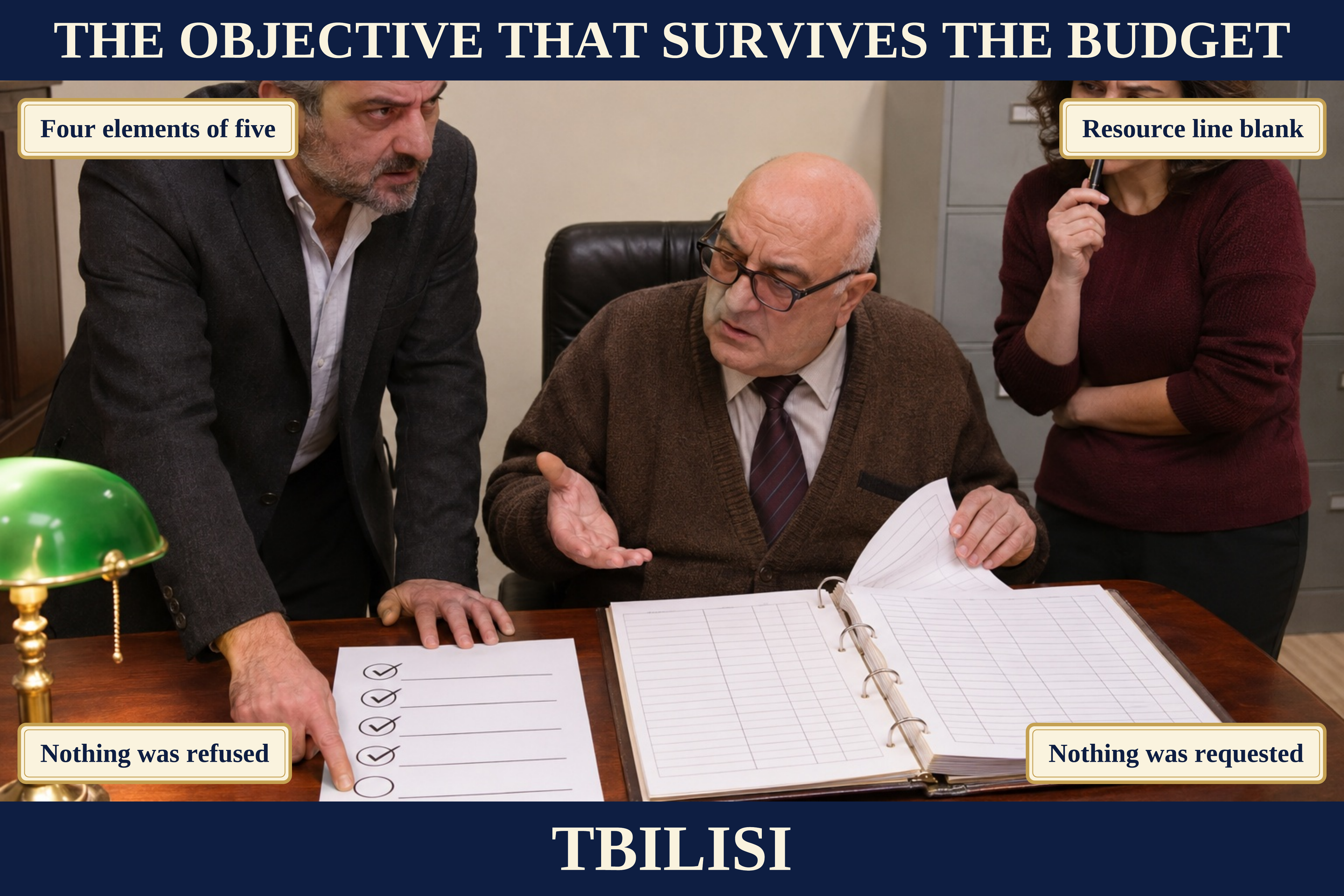
Concept Card 1.11 — The Objective That Survives the Budget
Subchapter 1.11 · Tbilisi
Setting: Tbilisi
The finance office of a converted nineteen-seventies building on a winter morning, lit by a ceiling light and a green-shaded desk lamp, with grey filing cabinets behind. The new general manager leans over the desk and presses his finger on the fifth of five rows on a single sheet: four circles carry a tick, the fifth is empty. Behind the desk the finance director turns a page of the open budget binder, one palm opening. Nino, the energy manager, stands to one side with a pen against her lips.
The card places the action plan beside the budget it never reached. Nino's objective was sound, and her plan named what would be done, by whom, by when and how the results would be evaluated. The line for resources was left to be completed when the quotations arrived, and it never was. An action plan under this standard must state the resources it requires, and that is the only element that has to leave the room and meet a budget.
The plaques follow what the absence did. ‘Four elements of five’: the ticks on the sheet. ‘Resource line blank’: the empty circle under the general manager's finger. ‘Nothing was refused’, because a refusal would have been a decision, recorded and capable of being raised again. ‘Nothing was requested’, so the finance director built the budget from the documents he had, and the objective lapsed without anybody deciding that it should.
The card is not saying that the finance director cut the work or that Nino planned carelessly. He never saw a request, and she left a figure open to avoid delaying approval. The failure lies in an approval process that accepted a plan with no resources attached, and in three management reviews that recorded the objective as in progress without asking whether any money had been allocated to it.
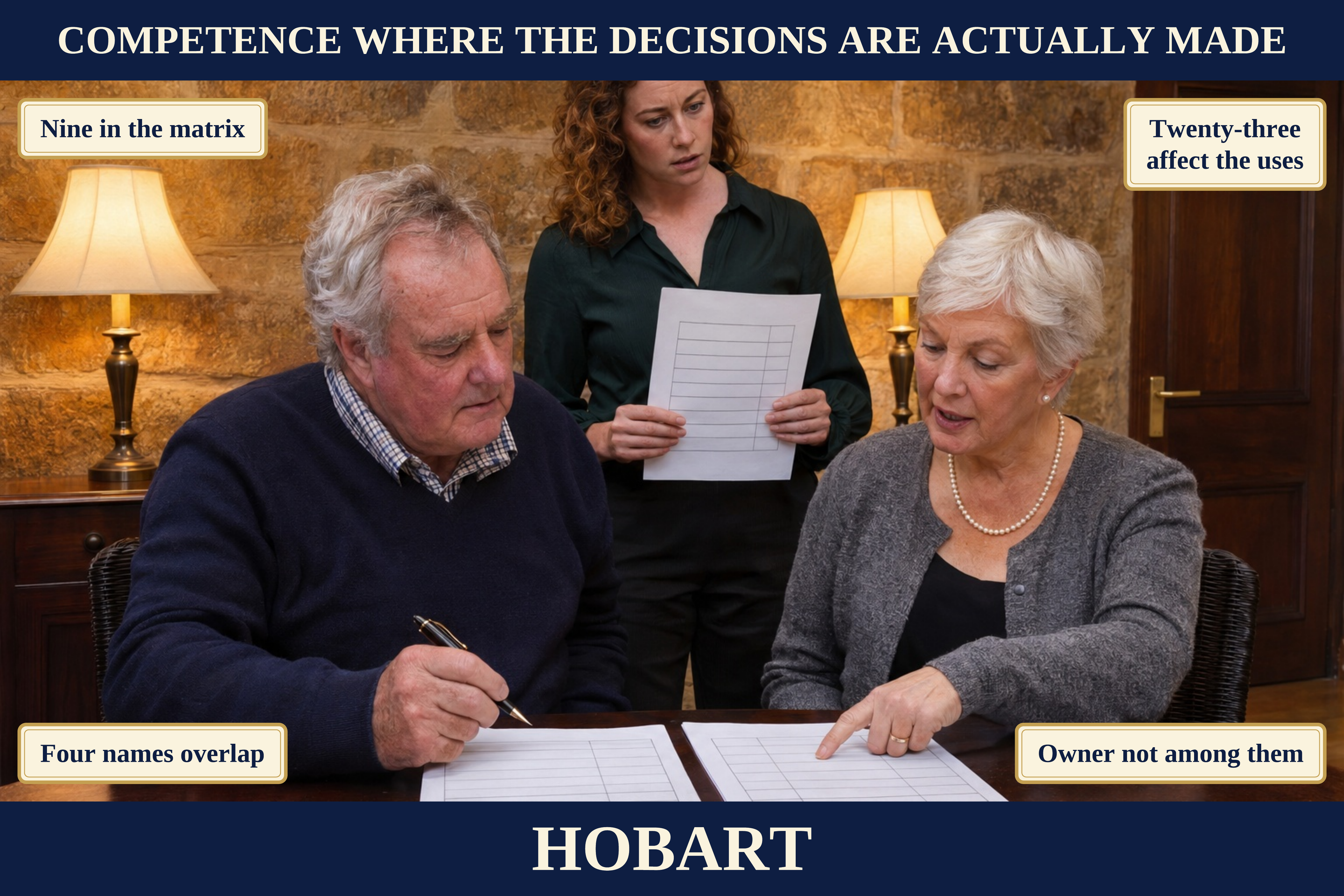
Concept Card 1.12 — Competence Where the Decisions Are Actually Made
Subchapter 1.12 · Hobart
Setting: Hobart
The owners' private sitting room in an old sandstone warehouse on a June afternoon in the southern winter, lit by two table lamps against the exposed stone, a dark door closed on the corridor. The owner, pen in hand, leans over two stapled proposals laid side by side, ready to sign. His wife and co-owner points with confidence to a line on the second. Standing behind them, Tessa, the energy manager, holds a sheet of nine ruled rows and looks from it to the owners with slow unease.
The card places the competence matrix behind the decision it never reached. Tessa's sheet holds nine names, each with evidence on file. The two people at the table are choosing the main heating plant on a payback calculated for standard operating hours, in a property that closes a floor for four months, and nobody in the chain was equipped to ask what hours the figure assumed. The standard asks for competence in every person whose work affects energy performance, and owners are among them.
The plaques count what was there. ‘Nine in the matrix’: the technical roles, properly documented. ‘Twenty-three affect the uses’: the list Tessa's own energy review had produced, housekeepers and cooks included. ‘Four names overlap’ measures the distance between the two documents. ‘Owner not among them’ names the gap that mattered most, since the costliest decision of the year was taken by people the system had never considered.
The card is not saying that the owners are unqualified or that the supplier concealed anything. They chose correctly on the figures in front of them, and he supplied the payback he was asked for. The failure lies in starting from technical roles rather than from the uses, which left the room where the decisions are actually made outside the reach of the system.

Concept Card 1.13 — Resources, and the Investment That Was Never Refused
Subchapter 1.13 · Montevideo
Setting: Montevideo
The pump room of a hotel on the rambla on a winter evening after seven, under bright new tubes: a freshly painted floor, new circulation pumps with grey casings, insulated pipework and drive cabinets with dark displays. Valeria, the deputy manager, rests her open hand on an empty galvanised mounting plate on the wall, a conduit ending beneath it, and looks at the owner, tired and candid. The owner, in tweed and a woollen scarf, opens both hands in a genuine question. His daughter frowns at the empty plate.
The card puts a large investment and a small omission within reach of one another. The family approved four proposals in four years, and the pump drives in the photograph are one of them. The meter that would have shown what any of them achieved was never requested, because every proposal was tested on payback and a meter produces knowledge rather than savings. Resources for an energy system include instruments and time, and here only the machines had been funded.
The plaques follow the money. ‘Capital granted’: generously, sometimes for more than was asked. ‘Time never asked for’: about two hours a week, mostly after seven, and none in high season. ‘No instrument bought’, because no instrument could pass the test applied to everything else. ‘Result not knowable’ answers the owner's question: the saving from the hot water plant cannot be separated from a mild winter, the new lighting and a shift in occupancy.
The card is not saying that the investments were wasted or that the family was careless. They said yes to sensible proposals, and their question is the right one. Valeria worked within the hours she had. The failure lies in an approval criterion applied to every proposal, which could never fund the means of verifying the others, and in an ownership that granted capital without ever being asked for time.
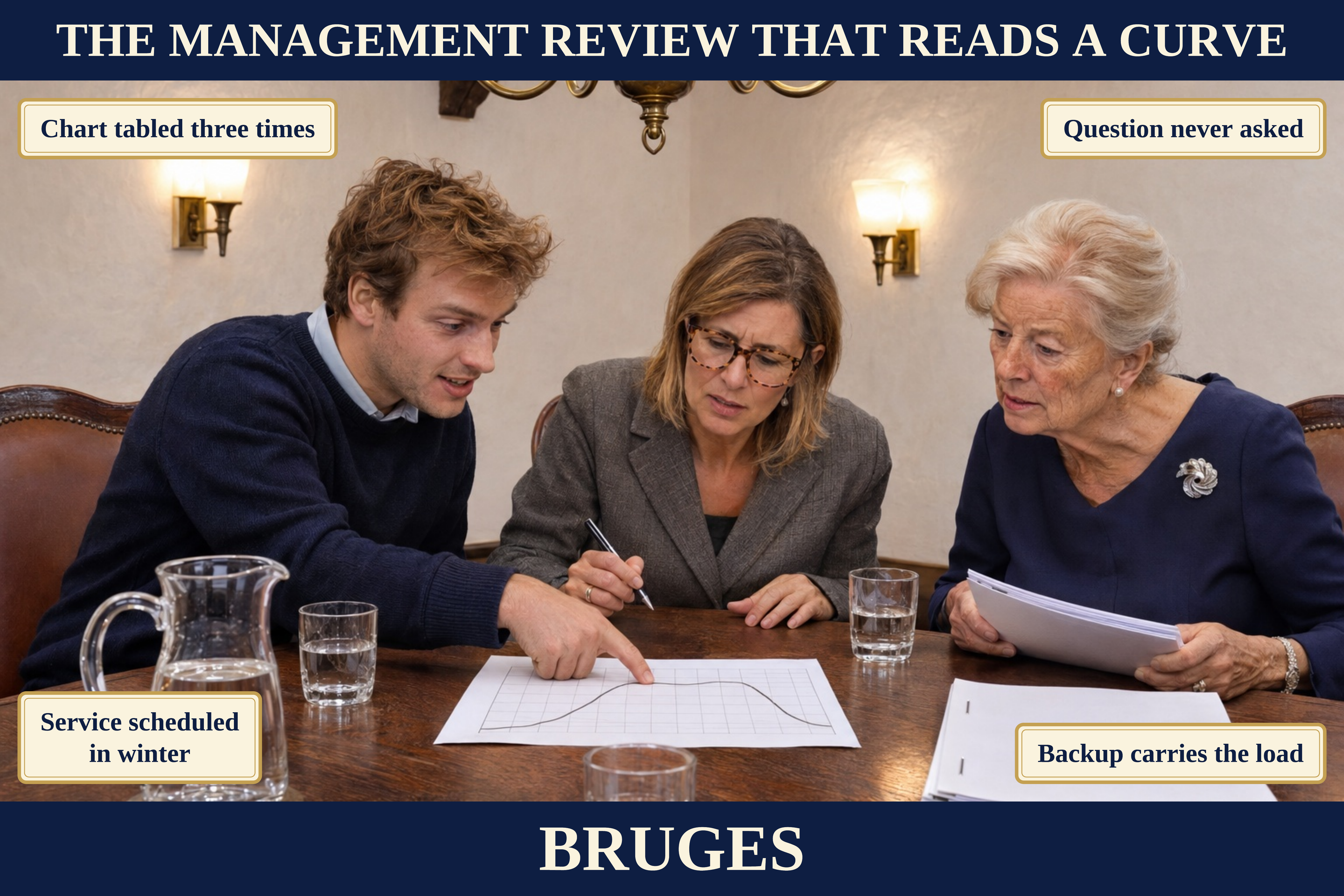
Concept Card 1.14 — The Management Review That Reads a Curve
Subchapter 1.14 · Bruges
Setting: Bruges
The meeting room of a small hotel in a listed house on a February afternoon, under a brass chandelier, around an oak table with a water jug, glasses and stacks of stapled minutes. A young member of the owning family, attending for the first time, places his finger on the hump of the line on a single chart. Griet, the operations manager, bends toward it with her pen stopped above the paper, caught out. The matriarch of the family lowers her minutes and peers at the curve.
The card shows a management review at the moment it begins to work. The chart had been tabled at three consecutive reviews as evidence that monitoring took place, and each year February and March stood above every other month. The cause was in the maintenance contract: the principal heat generator was serviced in those weeks, and the older backup carried the building. A review is expected to consider energy performance and its trend, and that means asking about the shape.
The plaques describe a review that worked exactly as designed. ‘Chart tabled three times’, with signed minutes to prove it. ‘Question never asked’, because a chart filed as an input reads as background. ‘Service scheduled in winter’, when the contractor was available and the house was quiet. ‘Backup carries the load’, at an efficiency and a cost nobody had calculated, for eight weeks of the heating season every year.
The card is not saying that Griet ran the review as a formality. Every input the standard lists was present, the minutes were signed and the right document reached the right table. The failure lies in a review conducted as presentation rather than interrogation, by an owning family who read the chart for reassurance; the question took a newcomer, and it could have been asked by anybody at the table.

Concept Card 1.15 — What a Hotel Can Honestly Claim
Subchapter 1.15 · Copenhagen
Setting: Copenhagen
The flat roof of a city hotel on an overcast spring morning, with rows of dark photovoltaic panels on low frames and a tall parapet hiding the city. Signe, the energy manager, holds up a sheet with one line climbing steadily from left to right and looks at the owner, calm and serious. The owner, in a dark coat, has one hand on a green brochure and looks toward her, his confidence fading. Beside him the marketing manager holds the brochure open and glances uncertainly at the sheet.
The card puts the claim and the building on the same roof. The panels and the renewable supply contract are real, and the brochure speaks of them. Signe's line is gross consumption, which rose six per cent over two years while the energy drawn from the grid fell. Generation on site reduces what crosses the boundary; it does not by itself improve the energy performance of the building, which is what the standard asks a property to demonstrate.
The plaques are all true statements, which is the point of the subchapter. ‘Panels generate’, and the generation is metered. ‘Contract is genuine’, with certificates properly issued. ‘Gross consumption rose’, and that is the line on the sheet. ‘Building not improved’ closes the reasoning: no fabric measure, no control change and no change in operating hours, so the reported improvement belonged to the roof and the contract, not to the house.
The card is not saying that the property lied or that the marketing manager wrote carelessly. Every sentence in the brochure would survive an audit. The failure lies in a system that reported net consumption as performance and in an ownership that stopped pressing once the number went the right way; the defence is to publish, beside every claim, how much energy the building used this year against last.

Concept Card 2.1 — Operational Control on the Uses That Matter
Subchapter 2.1 · Dubrovnik
Setting: Dubrovnik
A basement hot water plant room in Dubrovnik on a grey February afternoon. Along the wall runs a lagged header with eight identical valves dropping from it, each with a red handwheel. Ivana, the operations manager, holds a telephone to her ear, listening hard, and points along the row with her free hand. Beside her the deputy maintenance supervisor has a gloved hand on the last handwheel and turns towards her, understanding as she does. On a steel shelf lies a ruled sheet, still blank.
The card shows a control at the moment it passes from a voice into a building. The man on the other end of the line closed this property for eleven years, and the eight valves look exactly as they did when he left; nothing in the room records which of them he shut. The standard asks for operating criteria on the significant uses and for control of changes, and a retirement is a change. Here the criterion is dictated after the winter it should have governed.
The plaques read as a short inventory of the loss. ‘Thirty acts’ made up the closure, performed over two weeks by several people. ‘Nothing written’ held any of them. ‘Four never watched’ were the acts that happen out of sight in a plant room, and those were the four that did not pass to the people who had watched the rest. ‘Winter of fourteen per cent’ is what the omission cost, with no single fault to point at.
The card is not saying that the deputy failed. He performed every act he had seen performed, carefully, and the gloved hand on the handwheel belongs to somebody learning willingly. Nor did the former supervisor withhold anything; he answered in eleven minutes. The failure belongs to a management that let five months of consumption depend on one person and never asked for it on a page.
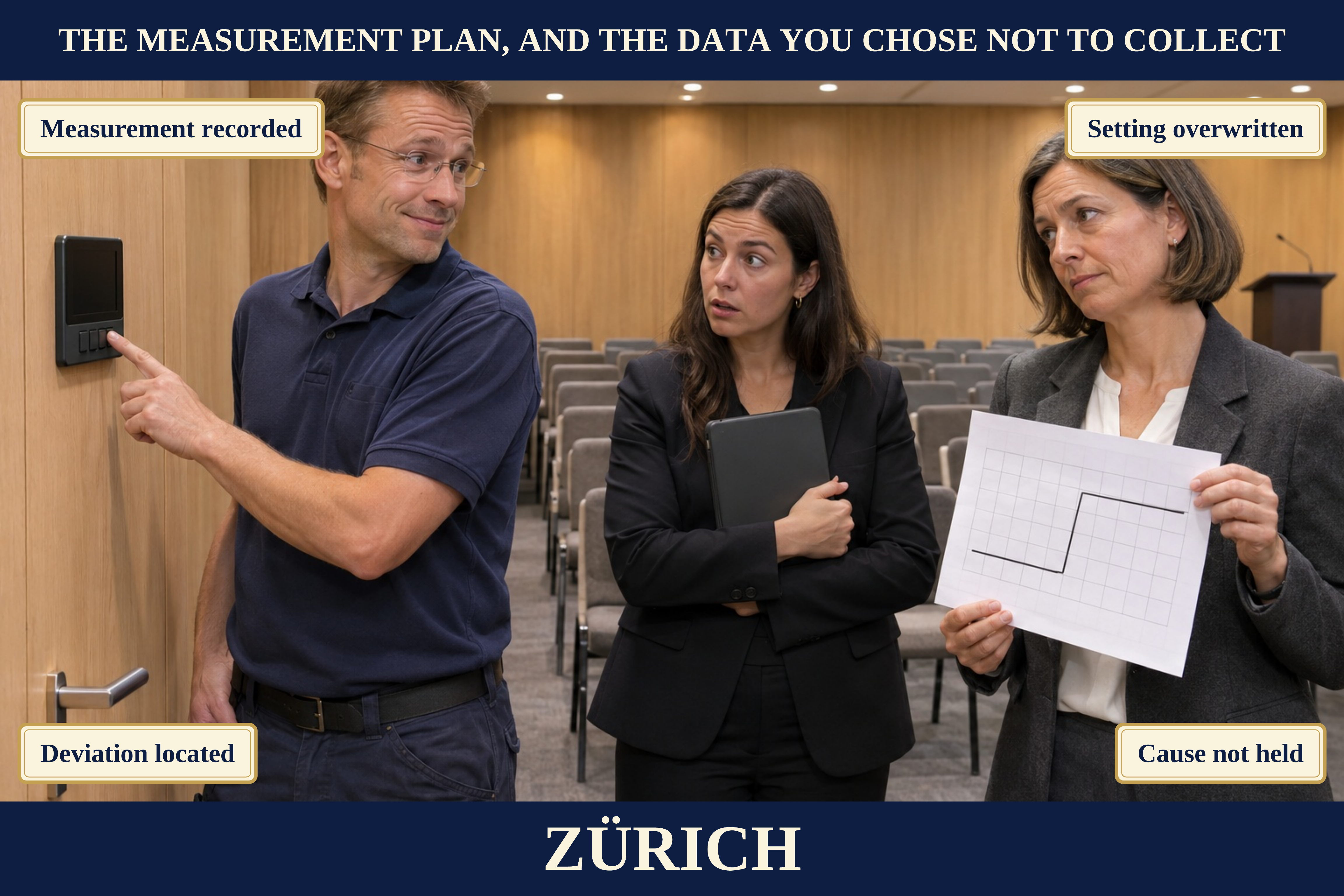
Concept Card 2.2 — The Measurement Plan, and the Data You Chose Not to Collect
Subchapter 2.2 · Zürich
Setting: Zürich
The largest room of a conference floor in Zürich on a December evening: oak panelling, empty chairs, a lectern pushed aside. By the door the duty engineer rests his finger on the small room control panel and turns to the others with a sheepish half smile. Nadine, the technical and energy manager, holds up a printed sheet on which a single line steps abruptly upwards across a grid. Between them the events manager holds a closed tablet to her chest and listens, surprised.
The composition puts the two halves of a measurement plan on opposite sides of the frame. The sheet is the half the property collected: consumption on the conference floor, located to the circuit and the hour, with the step plainly visible. The panel is the half it never collected: a set point lowered for a production company and not restored. Of the categories of data the standard asks a property to plan for, the operating criteria of its significant uses were the one left out, and that cost five weeks.
The plaques follow the step from its cause to the search for it. ‘Measurement recorded’: the meters saw everything, twenty-two per cent above the previous November. ‘Setting overwritten’: the control system showed only the current value, and each new value replaced the last without trace. ‘Deviation located’ to the floor and the week. ‘Cause not held’, because the only record of two degrees was the memory of the man now pointing at the panel.
The card is not saying that the engineer was wrong to lower the temperature. A client asked reasonably, and adjusting a room for an event is his work; his half smile is that of someone asked for the first time. The failure lies in a plan that chose, without discussion, to keep no history of settings, and in a building where nobody was ever asked to put a setting back.
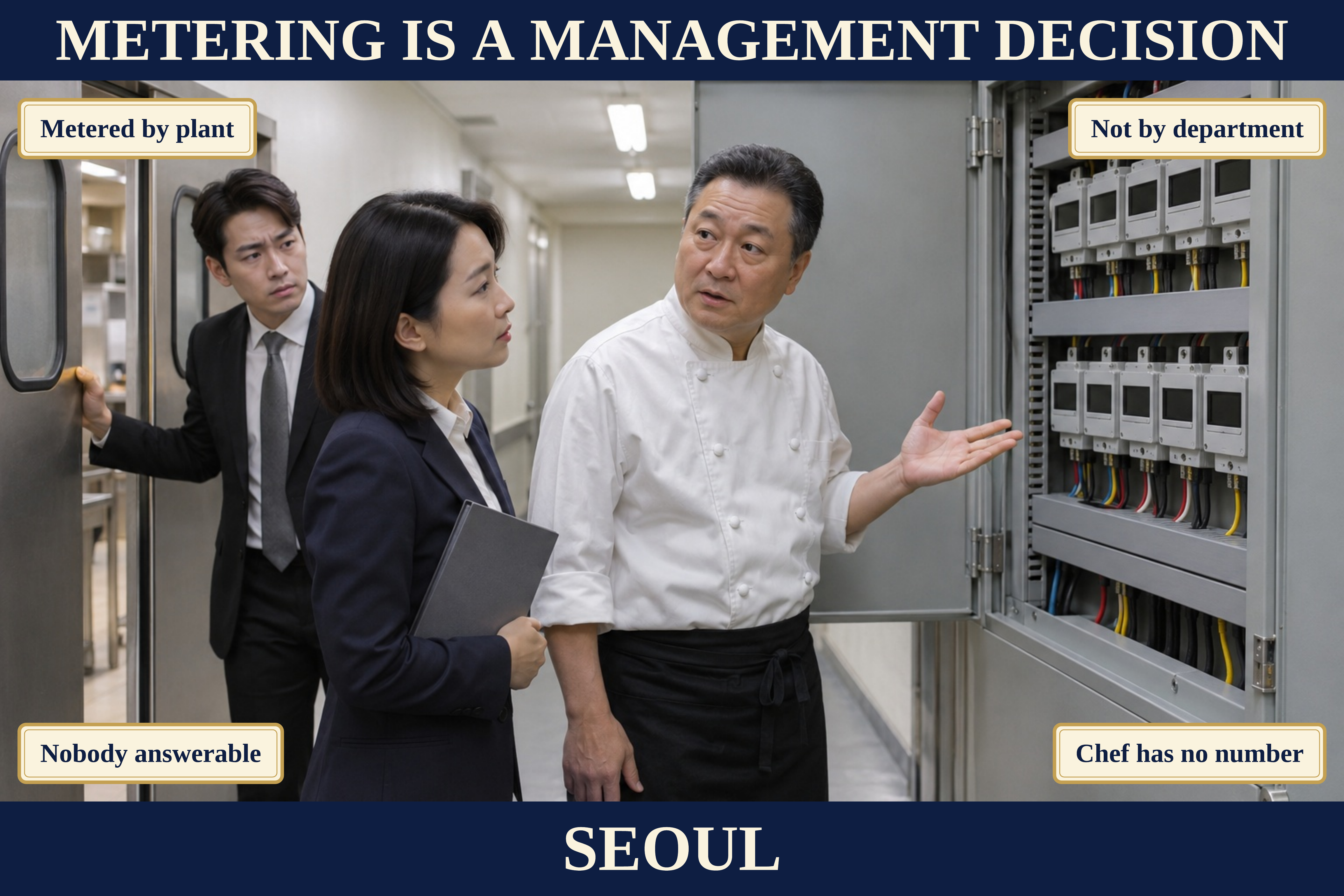
Concept Card 2.3 — Metering Is a Management Decision
Subchapter 2.3 · Seoul
Setting: Seoul
A service corridor between the kitchen and the banqueting floor of a tower hotel in Seoul, mid-morning. A tall grey distribution board stands open, two ranks of identical sub-meters inside, the wiring dressed with care. The executive chef holds an open hand towards it and asks a question, calmly. Seo-yeon, the director of engineering, holds a thin folder and looks at him without an answer. Behind them the banqueting manager pauses with a hand on the kitchen's swing door, watching the board, faintly uneasy.
The board is the argument. Twenty-two metering points were installed to answer the questions of the engineer who chose them: which chiller is degrading, what the pumps draw. They answer them perfectly. When management asked each head of department to own a consumption figure, the scheme offered no boundary that matched a department, and the kitchen shares this board with a banqueting floor whose activity varies by an order of magnitude. Deciding where a meter goes is deciding whom the property will be able to hold to a number.
The plaques move from design to consequence. ‘Metered by plant’, which suits troubleshooting. ‘Not by department’, which is the axis accountability needs. ‘Nobody answerable’, because a reduction objective given to someone who cannot see his own consumption is a request, not a responsibility. ‘Chef has no number’: the man who decides how one of the largest uses in the building is run cannot be told whether a change will show.
The card is not saying that the metering was poorly designed; it is excellent for the brief it was given, and the director of engineering inherited it in good order. The chef's question is the right one. The lesson sits with the decision taken at refurbishment, when three or four further points would have cost almost nothing and nobody asked what management would need to see.

Concept Card 2.4 — Design: the Requirement Only This Standard Has
Subchapter 2.4 · Nairobi
Setting: Nairobi
A newly refurbished guest bathroom in Nairobi: pale stone tiles, a glass enclosure with its door open, a wide square rain head mounted overhead. Inside, Wanjiru, the energy manager, raises the small hand shower on its hose beside the wide head and turns to the others with a rueful, open gesture. Outside the glass the general manager looks up at the two fittings, hand on his chin, taken aback. The maintenance manager frowns into a thick schedule of fittings, its rows ruled and empty.
The card sets two pieces of chrome side by side and lets their size do the arithmetic. The wide head above her was chosen by an interior practice for a category of guest, for the finish and the feel, and its flow is far higher than the fitting it replaced. Hot water is the largest single use in this building, and the energy review said so every year. The requirement on design, which this standard alone carries, exists for exactly this page of a specification.
The plaques trace how a finish became a decade. ‘Chosen as a finish’, in a schedule of several hundred items between the basin taps and the towel rails. ‘Decided for a decade’, because a fitting sets consumption for as long as it stays on the wall. ‘Nobody saw the schedule’ among those who knew what hot water costs here. ‘Irreversible without works’: undoing it now needs a contractor, closed floors and rooms out of sale.
The card is not saying that the designer was careless, or that the general manager approved something he should have caught. The designer met the brief, and the general manager had no reason to read a fittings schedule for hydraulics. The maintenance manager is reading it now. The gap is administrative: no route existed between the energy review and the documents in which consumption is decided.

Concept Card 2.5 — Buying Energy
Subchapter 2.5 · Strasbourg
Setting: Strasbourg
A small purchasing office in Strasbourg on a January evening, a desk lamp lit, box files behind. Camille, the energy manager, sits at the desk and presses her finger on a printed sheet where a single line rises to one sharp early peak. The purchasing officer, seated beside her, leans over it with his reading glasses in his hand, surprised. The head of laundry stands at the end of the desk, looking down at the peak. Supplier offers lie along the front edge.
The card brings into one room the two halves of an electricity bill that had always been written in two places. The offers settled the unit price, competently, each year. The peak on the sheet is where the capacity charge was settled, by a laundry moved an hour earlier, a second kitchen line and an earlier heating start. Buying energy, in the sense the standard intends, means buying against the way the building actually draws power, which no tender had ever been asked to consider.
The plaques add the bill up. ‘Unit price negotiated’, and negotiated well, four years running. ‘Peak written elsewhere’, in the laundry, the kitchen and the heating schedule, where nobody had seen an invoice. ‘Two halves, two people’, who until this evening had never stood at the same desk. ‘Bill rose anyway’, because the capacity charge grew faster than the price fell, and a fourth offer on a different capacity basis was set aside.
The card is not saying that the purchasing officer did his job badly; he compared what he was asked to compare, and accurately. The laundry moved its hour for a sound operational reason. Neither was told that the other existed in the invoice. The lesson belongs to management, which defined the purchase as a price and never connected the people who write each half of the bill.

Concept Card 2.6 — Buying Equipment, and the Specification Nobody Wrote
Subchapter 2.6 · Lyon
Setting: Lyon
The goods receiving bay of a hotel kitchen in Lyon, a steel roller door closed behind. A new combination oven stands on its pallet, the protective film half peeled away. The long-standing equipment supplier holds a thick catalogue open across his forearm and points to a page showing a similar oven above a block of empty ruled lines. Margaux, responsible for purchasing and energy, leans in with raised eyebrows. On the far side the executive chef rests his arm on the oven and studies the page.
The photograph places the machine just bought and the machine that could have been bought within an arm's length of each other. The supplier carried the more efficient model for six of the eight years in which he won most of this kitchen's orders, and named it the first time somebody asked about consumption. The standard expects energy performance over the expected operating life to count when significant uses are procured, and only the customer can write that criterion into a request for quotation.
The plaques describe a purchase run correctly against an incomplete question. ‘Three quotations compared’, on capacity, dimensions, finish, delivery and price. ‘Energy never asked’, across eleven machines and eight years of requests, although the specification block was always there to be filled. ‘Alternative never offered’, because proposing a costlier model against a brief that does not mention energy reads as upselling. ‘He answered the brief’, accurately and every time.
The card is not saying that the supplier hid anything. He answered within a minute when asked and turned to the page himself, which is what the photograph records. The chef asked for the capacity his kitchen needs. The omission lies in the property's own requests for quotation, which for eight years never told anybody that energy would count, and so ensured that it would not.
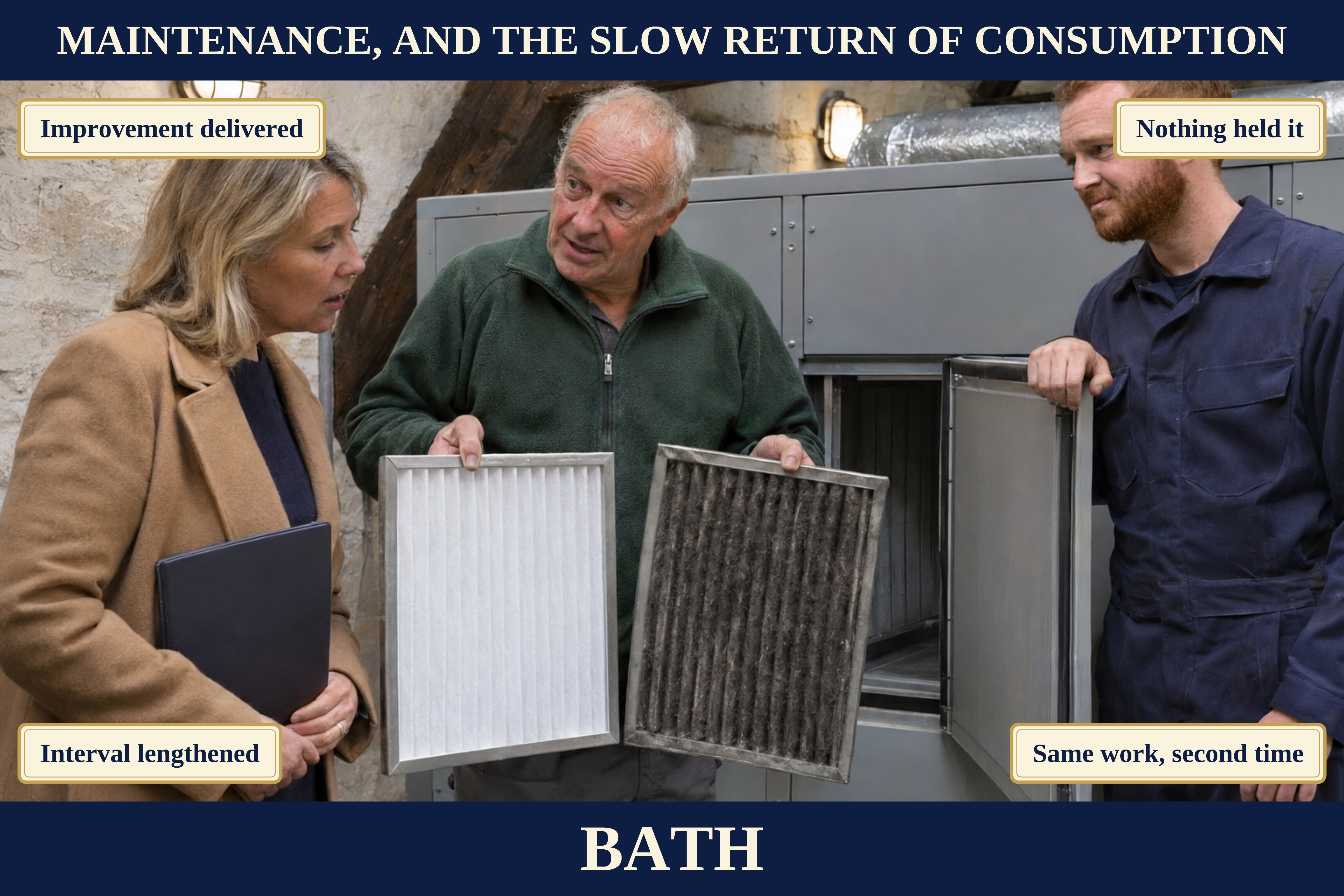
Concept Card 2.7 — Maintenance, and the Slow Return of Consumption
Subchapter 2.7 · Bath
Setting: Bath
The roof-space plant room of a Georgian townhouse hotel in Bath on an overcast October morning, old beams above, limewashed stone behind, the access door of a grey air handling unit standing open. The contractor's foreman holds up two filter panels side by side, one new and white, the other clogged dark grey, and asks a plain question. Harriet, the operations manager, holds a dark folder and listens as the point arrives. The duty engineer rests a hand on the open door, a little uncomfortable.
The two filters carry four years of the building's history in one gesture. A rebalancing, a review of set points and an exchanger clean had cut heating consumption by eleven per cent, measured against degree days. Then a clean invoiced as a project and never scheduled, valves moved during late complaints, an interval drifting from three months to five and set points never returned walked the figure back. The standard recognises that slowing such decline through maintenance is itself improvement; this property had never organised maintenance to hold the gain.
The plaques compress the cycle. ‘Improvement delivered’, real and reported to the owners. ‘Nothing held it’: no schedule, no record of settings, nobody owning the result. ‘Interval lengthened’ across two cost-driven contract renewals, for reasons that looked prudent at the time. ‘Same work, second time’, quoted by the same contractor for a system nobody had altered, which is the question the foreman is asking.
The card is not saying that maintenance was neglected; the plant is clean and the people around it are competent. The foreman's question is a service. Each change that eroded the result was reasonable when it was made. The failure is that the improvement was treated as a finished project rather than a condition to be maintained, and that nobody was given the job of holding it.

Concept Card 2.8 — Who Decides When the Building Wakes Up
Subchapter 2.8 · Palermo
Setting: Palermo
The main kitchen of a hotel in Palermo at six on a May morning, before breakfast, under bright white light. Rosalia, the deputy manager, in a borrowed apron, holds a probe thermometer inside the open door of an oven that has just been switched on, concentrating. Beside her the second chef who asked the question watches the reading closely. The head chef stands behind with his arms folded, half amused. Further back the young commis waits beside a grey panel of eight identical switches.
The card shows the cheapest piece of evidence in the volume being gathered: how long an oven really takes to reach working temperature. The kitchen came on at a quarter to six for a seven o'clock service, a habit handed from commis to commis and set for ovens that needed ninety minutes. Their replacements need under twenty. The hour at which a building starts consuming is an operating criterion for a significant use, and nobody with the authority to set it had ever done so.
The plaques read back through the inheritance. ‘Switched on at once’, in one pass, because that is how one person readies a kitchen alone. ‘Time nobody set’, learned by watching a predecessor who had learned it the same way. ‘Machines since replaced’, piece by piece over the years, without the schedule following them. ‘Seventy-five minutes early’, every day, for equipment that no longer needs the time.
The card is not saying that the commis wastes energy; he does what he was shown, and being ready is his job. The head chef inherited the practice and was never asked about it; the second chef asked because he was new. The lesson lies with management, which had never written a start time, and which needed only a thermometer, a watch and two mornings to write one.
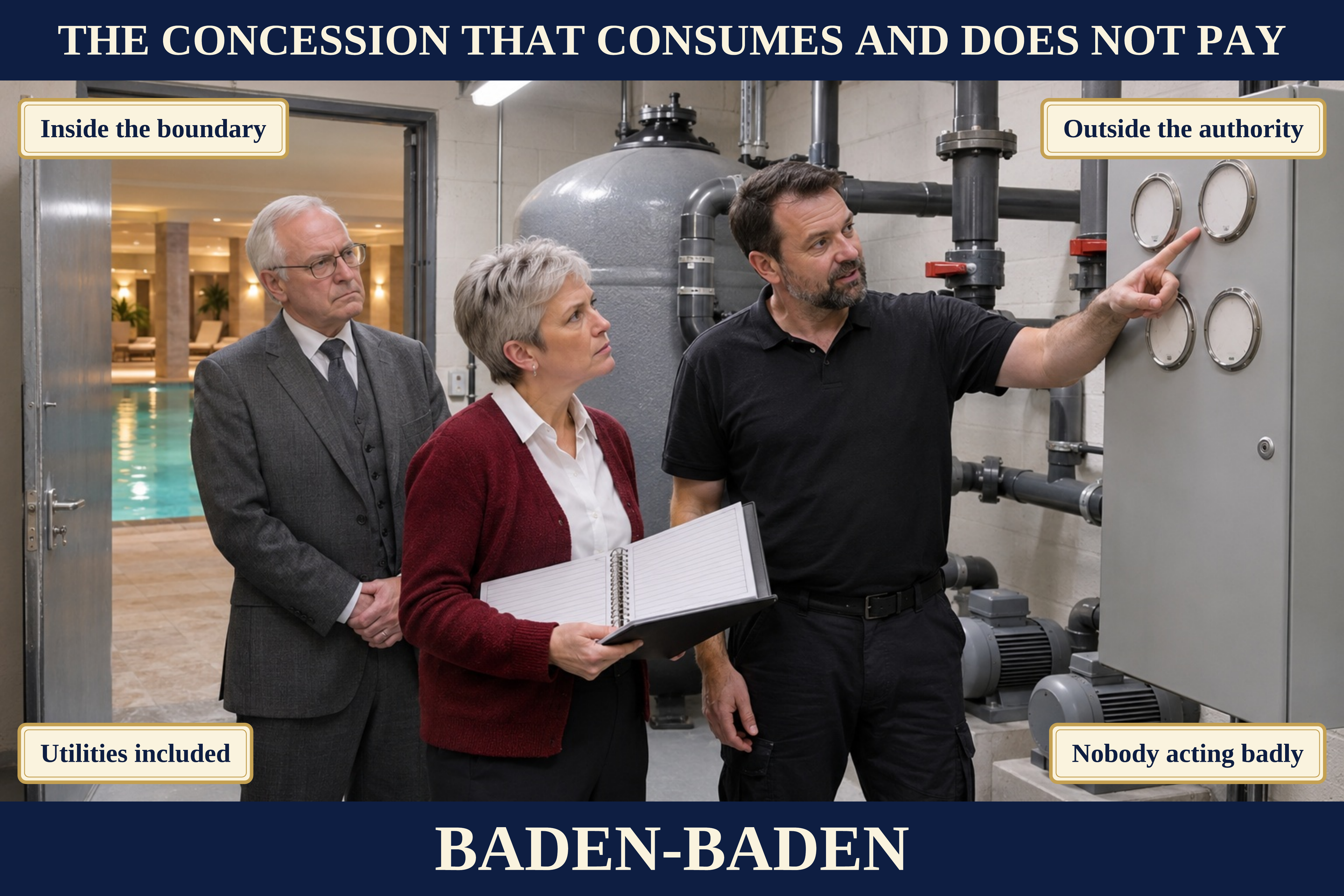
Concept Card 2.9 — The Concession That Consumes and Does Not Pay
Subchapter 2.9 · Baden-Baden
Setting: Baden-Baden
The spa plant room of a hotel in Baden-Baden before opening on a winter morning: pumps, a grey filter vessel, pipework against painted blockwork. A wide door stands open on the still, warmly lit pool hall. The spa operator's manager points at a dial on the control cabinet, explaining openly and without defensiveness. Annegret, the hotel's energy manager, holds the concession agreement open and looks up at the dial, sobered. In the doorway the general manager stands with his hands folded, frowning in thought.
The card is built across the threshold of that door. The pool, the plant and the energy they use all lie within the hotel's energy boundary and on its invoice; the hours, the water temperature and the availability are decided by a company the hotel does not employ. The spa had no meter, and its consumption, found by subtraction, came to about twenty-two per cent of the building. The standard requires outsourced significant uses to be controlled, and a contract silent on energy controls nothing.
The plaques set out a gap no single party opened. ‘Inside the boundary’, as the plan of the building shows. ‘Outside the authority’, as the agreement shows. ‘Utilities included’, four words that were a fair commercial term when signed and have since become an open instruction. ‘Nobody acting badly’: two extensions of opening hours and one degree on the pool, each a sound decision for the operator's business.
The card is not saying that the operator should have behaved otherwise; he extended his hours in response to demand, raising the hotel's revenue share each time, and he is explaining his settings freely. The fault lies in the agreement the hotel signed, which drew boundary and authority on different lines, and in a property that left one of its largest uses unmeasured for eight years.
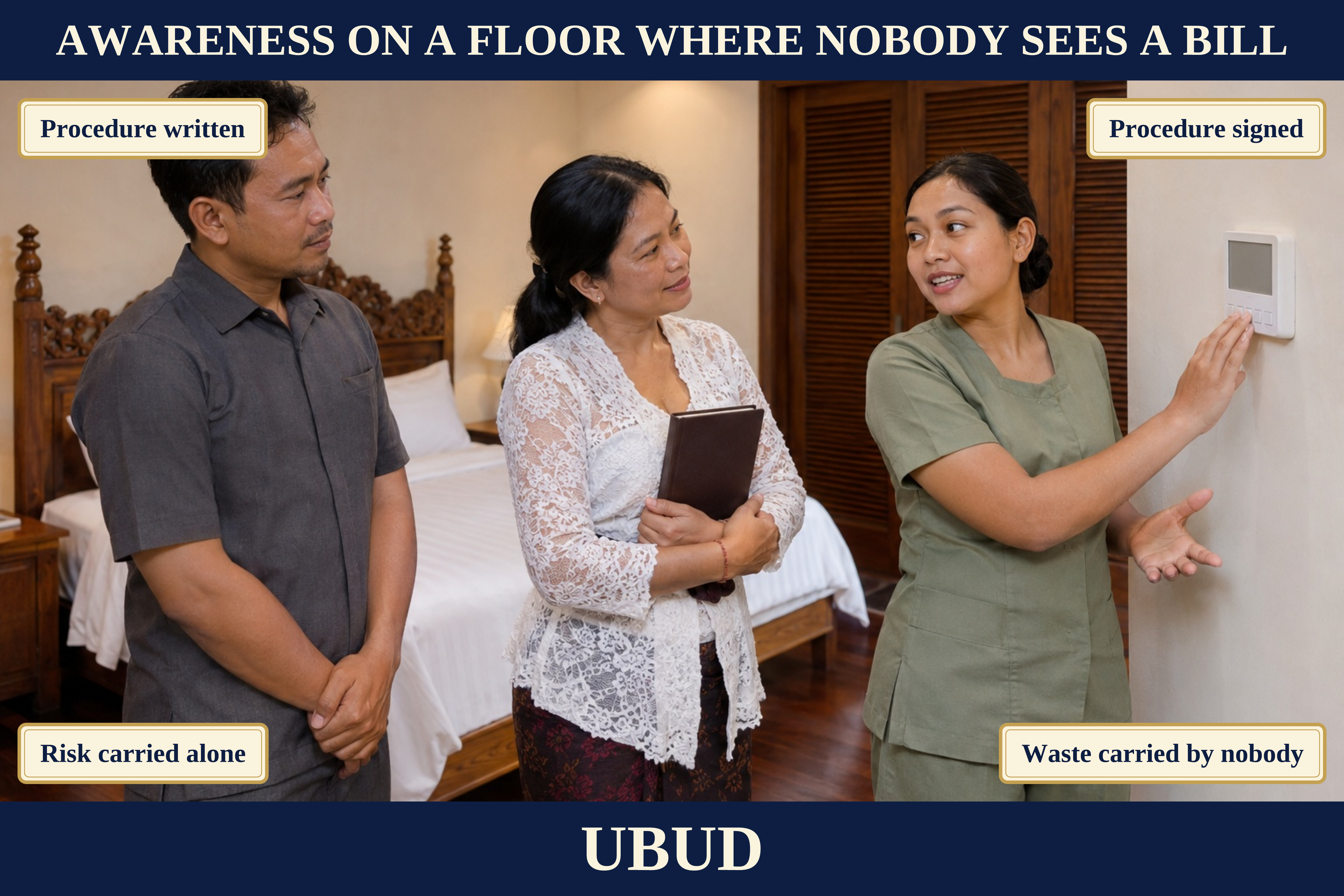
Concept Card 2.10 — Awareness on a Floor Where Nobody Sees a Bill
Subchapter 2.10 · Ubud
Setting: Ubud
The bedroom of a private villa in Ubud on a humid afternoon, prepared for an arrival: a carved teak bed in fresh white linen, closed louvred doors, soft light. The room attendant rests her fingers on the air conditioning control on the wall and turns to explain, frank and unhurried. Ketut, the energy manager, holds a closed notebook to her chest and listens closely, her expression shifting towards recognition. Near the bed the housekeeping supervisor stands with his hands clasped, a little uncomfortable.
The card records the moment a property hears why its procedure is not followed. Switching on forty minutes before arrival was written, timed, posted and signed; in practice units came on two to three hours early, everywhere. The reason is not ignorance. A late start puts the attendant's name on a guest complaint; an early one puts nobody's name on anything. Awareness, as the standard understands it, includes what one's own action contributes, and no campaign can teach that while the risk is arranged this way.
The plaques state the asymmetry plainly. ‘Procedure written’, carefully and realistically. ‘Procedure signed’, by everybody at induction, including the woman at the control. ‘Risk carried alone’: a warm villa at check-in becomes her complaint. ‘Waste carried by nobody’: the cost of three early hours appears weeks later in a total she never sees, in a currency with no name attached to it.
The card is not saying that the attendant does not care; she is answering the only signal the building sends her, and saying so without complaint. The supervisor has enforced the procedure as written. The failure lies with management, which ran three years of campaigns without asking anybody a question, and which can remove the personal exposure from the careful choice in an afternoon.

Concept Card 2.11 — Communication, Inside and Out
Subchapter 2.11 · Adelaide
Setting: Adelaide
A back-of-house corridor beside the kitchen of a conference hotel in Adelaide on a hot January afternoon. Behind a steel door standing ajar the housing of a large extract fan is visible. On the bare wall hangs a new wooden box with a slot, the first of its kind. The maintenance technician, toolbox in hand, posts a folded slip into it with a wry smile. Danielle, the energy and sustainability manager, watches with quiet expectation; the maintenance supervisor looks on, a little abashed.
The card shows the third direction of communication being opened. The property spoke outward with care and inward very little; until this box appeared there was nowhere for anybody working in the building to tell it anything about energy. The standard asks a property to decide what it communicates and also to give the people working under its control a way to comment and suggest improvements. The fan behind the door ran around the clock for two years after a time clock failed, and its technician knew.
The plaques trace what became of that knowledge. ‘Told somebody once’, in passing, in this corridor. ‘Nowhere to record it’: no form, no box, no item on any agenda. ‘Silence read as nothing’, which a reasonable man takes as an answer and does not raise again. ‘Two years running’ is the fan's account of the delay. The slip now entering the box was the fourth item received.
The card is not saying that the technician should have insisted, or that the colleague he told was negligent; a remark in a corridor has nowhere to go. The failure lies in the arrangement management had built, which spoke outwards and provided no route inwards. The box costs nothing. Whether it works will depend on whether every slip receives a reply with a name on it.

Concept Card 2.12 — Documented Information Where the Work Is
Subchapter 2.12 · Riga
Setting: Riga
The basement boiler room of a hotel in Riga before five on a January morning, lit by a work lamp: dark boilers, lagged pipes, a wet floor. The visiting service engineer holds a torch and points down at the lever of a bypass valve on a pipe in the foreground. The hotel's plant technician, in a heavy coat and knitted cap, holds a phone in a thick glove, its screen dark. Ilze, the energy and quality manager, hooded, hands in her pockets, stands between them, sobered.
The card sets a correct document against the place where it would have to be used. The start-up procedure was written with the installing contractor, approved, reviewed and filed with backups. It was in English, on a server, behind two passwords, and the man who starts this plant works in Latvian and Russian with gloves on. After a repair the bypass the procedure requires to be closed was left open, and a circuit ran for three weeks. Documented information has to be available where and when it is needed.
The plaques move from the document to the hand. ‘Correct and approved’: nothing in its content is wrong. ‘Held on a server’, reachable from a desk and not from a boiler room. ‘Wrong language’ for the man who performs the sequence. ‘Never once opened’, because the only moment it would have mattered was a restart after a repair, under pressure, which is the moment with the least time in it.
The card is not saying that the technician was careless. He starts this plant competently on most winter mornings, and the restart after a repair was a configuration he had met once. The engineer is simply showing what he found. The failure lies in a document system designed to satisfy an auditor at a desk, which never asked where its reader would be standing.

Concept Card 2.13 — When Consumption Rises and Nothing Broke
Subchapter 2.13 · San Juan
Setting: San Juan
The chiller plant room of a seaside hotel in San Juan on a February morning, two large grey chillers running, condensate on the pipework. Between them stands a grey sequencing panel with a single rotary selector. The contractor's service technician rests his finger on it and turns to the others, mildly surprised. Mariela, the energy manager, holds up a sheet on which two lines cross a grid with a widening gap between them, and reacts with sudden understanding. The young maintenance technician rubs the back of his neck.
The card shows a year of deviation reduced to a quarter turn of a switch. The sequencing logic was put into manual for the annual service and never returned, and both machines ran in parallel for eleven months. Each month the excess over expected consumption was reported and explained, and each explanation was true. The standard requires significant deviations in energy performance to be investigated and responded to, and that needs a threshold, set in advance, at which explaining stops and investigating begins.
The plaques record eleven months of good faith. ‘Eleven explanations’: a warm March, a large group, longer spa hours, record occupancy, a three-night function, a late turn in the weather. ‘Each one true’, and each reported accurately. ‘None sufficient’, because weather and occupancy do not persist for eleven months and a plant left in manual does. ‘Nothing broke’, so no alarm ever sounded.
The card is not saying that anyone in the photograph erred. Putting the logic in manual for a service is correct practice; the young technician did not know it was a state that needed returning; the energy manager reported honestly every month. The failure lies in a system with no rule for persistence, under which three consecutive periods of excess would have opened an investigation by May.

Concept Card 2.14 — The Obligations You Have to Check
Subchapter 2.14 · Porto
Setting: Porto
The records room of a nineteenth-century hotel in Porto on a grey spring afternoon, granite walls, wooden shelving filled with grey box files. At a heavy oak table Matilde, the energy and compliance manager, holds the old lease open and presses her finger on a block of clauses, turning to her colleague with startled certainty. The chief engineer leans in with both hands on the table and reads where she points, astonished. A thick ring binder lies closed beside the lease.
The card places the problem inside the property's own archive. The register of legal and other requirements had nineteen entries and was competent work, and at four management reviews compliance was recorded in good faith. Nobody had gone back to the documents themselves. This lease, signed and filed here, obliges the property to notify plant replacements, and two had taken place. The standard asks a property to evaluate its compliance at planned intervals, which recording the absence of bad news does not do.
The plaques take four years in four steps. ‘Register compiled’, with advisers, at the outset. ‘Compliance declared’, once at every review, in good faith and on the basis of silence. ‘Never evaluated’: the minutes recorded a belief, not a check. ‘Standards changed twice’, as the brand reissued its standards, the second time with a reporting basis the property never adopted. Commercial obligations change on commercial cycles, and nobody announces them.
The card is not saying that the chief engineer acted improperly. He managed two plant replacements competently and had never been told the lease said anything about them. Matilde wrote each compliance line honestly. The failure lies in treating a register as a set of answers rather than a list of questions, and in nobody being assigned to read the property's own contracts again.
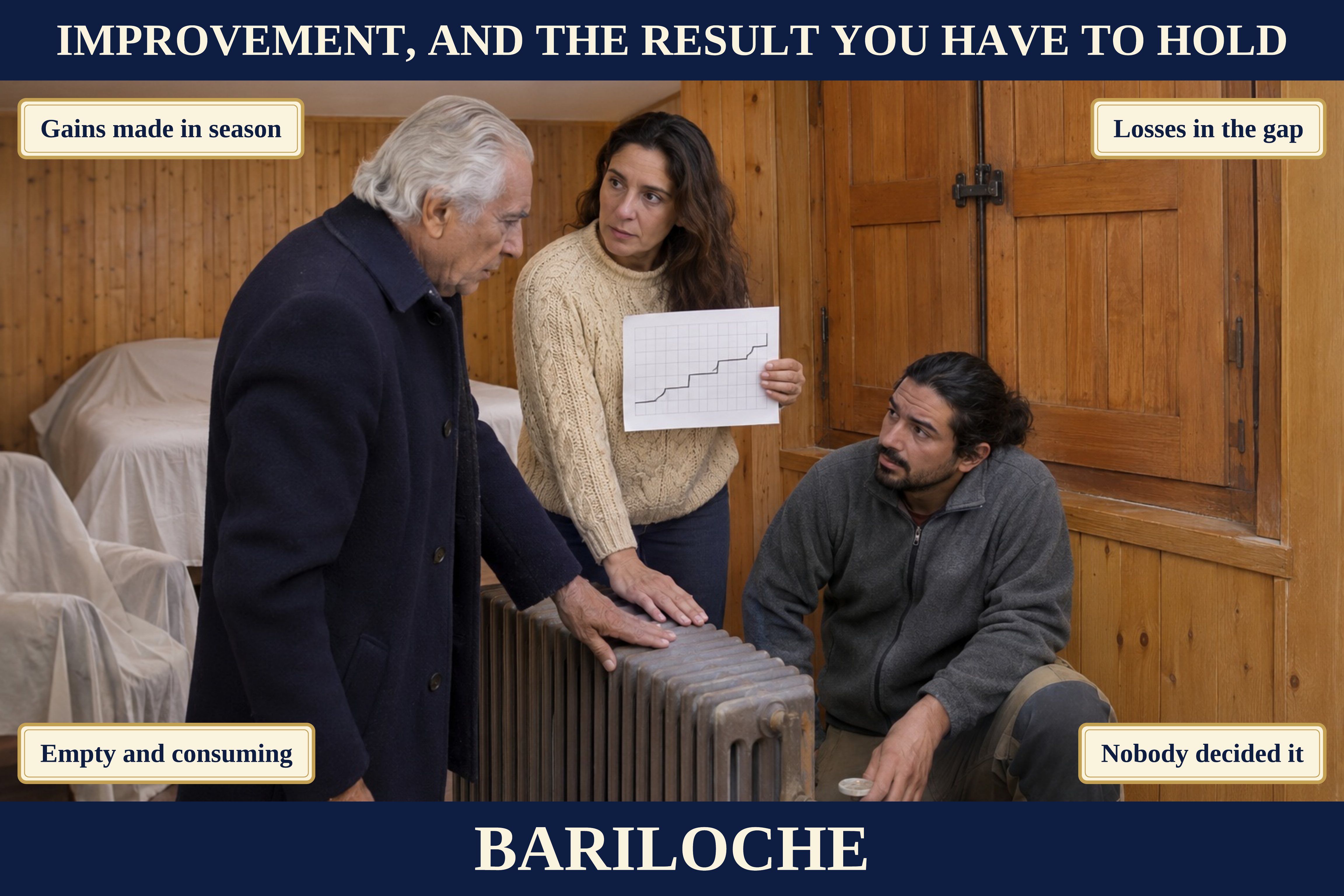
Concept Card 2.15 — Improvement, and the Result You Have to Hold
Subchapter 2.15 · Bariloche
Setting: Bariloche
A guest room in the closed wing of a mountain hotel at Bariloche, between seasons in April: pine panelling, wooden shutters closed, the bed and armchairs under white dust sheets. Paula, the energy manager, rests her palm on a cast-iron radiator that should be cold and holds up a sheet on which one line climbs in steps. The owner, in a dark overcoat, has laid his own hand on the radiator beside hers and stares at it. The maintenance technician kneels at its foot, looking up, rueful.
The card places a warm radiator in an empty room and lets that be the finding. Five improvements over four years were each measured in the season they were made, and each worked; yet normalised annual consumption rose a little every year, and the owners began to see a cost. The rise lived in the dead weeks: a zone valve left open, circuits isolated one year and not the next, schedules overridden. Improvement means little unless it is held through them.
The plaques account for four years. ‘Gains made in season’, when people were present to make and measure them. ‘Losses in the gap’, when the property ran on a skeleton staff and much of it was closed. ‘Empty and consuming’: a building doing nothing drew thirty per cent of a full house. ‘Nobody decided it’; no meeting had ever chosen the regime for the weeks between seasons.
The card is not saying that the improvements were illusory or that the technician was careless. The valve was left open after a legitimate repair, and every gain Paula reported was real. The failure lies with ownership and management together, which measured each improvement in its season and never defined, or assigned to anyone, the state the building should be in when nobody is there.
L’AUTORE