
The Helm and the Lens · English
Disponibile / Available
the Helm and the Lens – Vol. 4b
iso 50001
Volume 4b of The Helm and the Lens brings ISO 50001 into hotel auditing: from energy data and evidence of improvement to certification. Thirty cases show how to verify what is actually happening in the building.
579
Pagine
An energy management system may conform on paper. But do the data show that the hotel has improved its energy performance? And does that improvement last?
ISO 50001 and Sovereignty over the kWh — Volume 4b: The Lens approaches these questions from the perspective of internal and external auditors. It follows the audit from planning and staff interviews into the plant room, through meter reliability, performance deviations and the findings presented to management. It then examines certification, the evidence needed to demonstrate improvement, surveillance and the results that must be sustained.
Through thirty composite cases set in thirty cities, Francesco Dore separates requirements from common practice and tests the conclusions an auditor can reasonably draw from the evidence. At the heart of the book is a demanding principle: a claimed improvement must be traceable and verifiable by someone who has never worked in the building.
This volume of The Helm and the Lens is written for auditors, energy managers, hotel leaders and certification professionals who need to understand both the figures and the building behind them.

EDIZIONI · FORMATI
Formati disponibili
Le edizioni fisiche e digitali associate a questa scheda.
NEL LIBRO
Contenuto / Contents
La struttura del volume così come presentata nell’edizione pubblicata.
Table of Contents
- Preface.
- 3.1 Auditing a Standard That Measures.
- 3.2 Planning an Audit Around Hours, Not Departments.
- 3.3 The Checklist That Goes to the Plant Room...
- 3.4 Auditing the Process That Finds the Obligations.
- 3.5 The Energy Near-Miss.
- 3.6 Interviewing for Awareness.
- 3.7 Second-Party Audit: Suppliers, Contracts and Guarantees of Origin
- 3.8 The Gap Between the Baseline and the Building.
- 3.9 Root Cause, and the Answer That Is Not a Component.
- 3.10 Calibration, and Whether a Meter Can Be Trusted.
- 3.11 Who Is Allowed to Change a Set Point.
- 3.12 The Energy Performance Test.
- 3.13 The Report That Ownership Will Actually Read.
- 3.14 Follow-up, and the Correction That Was an Engineering Job.
- 3.15 What the Internal Audit Owes the Management Review..
- 4.1 The Chain That Makes a Certificate Mean Something.
- 4.2 Choosing a Certification Body That Has Seen a Hotel
- 4.3 Stage 1: Readiness, and the Data That Does Not Yet Exist.
- 4.4 Stage 2: Conformity, and the Question Only This Standard Asks.
- 4.5 The Audit Team, and Competence in a Performance Standard.
- 4.6 Objective Evidence of Improvement.
- 4.7 Findings, and the Correction That Has to Change a Number.
- 4.8 The Certificate, and What It Actually Certifies.
- 4.9 Surveillance, and the Year Performance Fell
- 4.10 The Mark, and What a Certified Hotel May Claim...
- 4.11 Integration with the Environmental Standard.
- 4.12 Ratings, Lenders and the Cost of Capital
- 4.13 Multi-Site Certification Across Climates.
- 4.14 Change During the Cycle: Boundary, Baseline and Major Works.
- 4.15 Recertification, and the Result That Had to Be Held.
- Afterword.
- Sources and Research Methodology.
- Glossary.
- About the Author.
- Contact.
- The Series.
- The Online Platform...
- Acknowledgements.
- Analytical Index.
PRIMA DELL’ACQUISTO
Estratti / Extracts
Passaggi selezionati dal libro disponibili per la consultazione.
01 Preface Apri / Open
The companion volume described what a property does. This one asks whether any of it is true.
In every other standard of this series, that question has a familiar shape. An auditor establishes whether the system conforms to its requirements and whether it is effectively implemented and maintained, and a system can pass both tests while the thing it manages stays exactly where it was. This standard adds a third test and it changes the profession. The organisation must demonstrate continual improvement of its energy performance, which means that the auditor — internal or external — must establish not only that the system works but that a number moved, and that the movement was real.
The second half of that sentence is where the difficulty lives. A hotel’s energy figure moves for reasons that have nothing to do with management: a milder winter, a fuller house, a service that left the building, a baseline that was quietly rebuilt. Every one of them produces a genuine improvement in the reported figure and none of them is an improvement in energy performance. The volume opens on exactly that — a nine per cent gain in Helsinki that turned out to be four things happening in the same year, and less than one point of management inside it — and almost everything that follows is a method for telling the two apart.
There is a second difficulty and it belongs to the building rather than to the standard. The evidence an auditor needs was never built to be audited. Meters were installed to bill, control systems to keep guests comfortable, maintenance records to show that a visit took place. None of them was designed to support a conclusion about performance, and a great deal of auditing in this discipline consists of establishing whether a number can bear the weight that is about to be placed on it.
The third chapter takes the position of the internal auditor: the programme built around the hours at which a hotel actually consumes rather than around its departments, the checklist that goes to the plant room, the near-miss nobody recorded, the interview, the supplier, the gap between the baseline and the building, root cause, calibration, access to the set points, the report that ownership will read, the follow-up, and what the audit owes the management review. At its centre is the energy performance test — how an improvement is demonstrated rather than asserted.
The fourth chapter takes the position of the certifier: the chain that makes a certificate mean something, the choice of a body, the two stages of initial certification, the competence of the team, the findings and what closes them, what a certificate actually says, the surveillance visit in the year performance fell, the mark and the claim, the combined audit, the lender who reads the certificate, the group certified across four climates, change inside the cycle, and recertification. At its centre is objective evidence of improvement — what a person who has never met anybody in the building will accept.
Those two central subchapters are the spine of the volume, and the other twenty-eight lean on them.
Who this book is for
The quality manager who has audited two other standards competently for years and is given two days for this one. The coordinator who holds the energy management system alongside another job and has to prepare for a stage two visit. The general manager who signs the management review and reads the first page of every audit report. The owner or asset manager deciding whether a certificate is worth what it costs and what may honestly be said about it. The certification auditor who learned this standard in industry, where a production line has a measurable output and a stable load, and now finds a hotel in the audit programme. And the person — there is usually one — who is asked, the week before a visit, whether the figure in the pack is actually true.
Three facts about auditing energy in a hotel govern everything in this book. The first is that the number can be entirely accurate and mean nothing. Weather, occupancy, boundary and baseline all move it, and a figure that is arithmetically correct can be the sum of four things none of which was done by anybody. Accuracy is the beginning of an auditor’s work in this discipline and not its conclusion.
The second is that the evidence was built for another purpose. The meter answers the supplier’s question, the control system answers the guest’s and the maintenance record answers the contractor’s. An auditor who takes any of them at face value is auditing the purpose they were built for, and the first question in almost every subchapter of this book is what a given record can support and what it cannot.
The third is that the auditor is never in the building when the consumption happens. Audits are conducted on weekdays in daylight. A hotel’s energy is decided at two in the morning, on changeover Saturdays and in the shoulder weeks of a season — by schedules that nobody reviews, set points changed for a guest who asked, and plant left in the position a technician found convenient. The audit that does not go looking for those hours will certify the building the day shift sees.
To these the discipline adds a fourth, and it is the rule on which the whole of the fourth chapter rests. The property demonstrates; the auditor does not disprove. An audit team that finds no evidence of an improvement is not required to establish that it did not occur, and should say precisely that — not that the measure failed, but that nothing exists by which anybody could establish that it worked. Unsupported is not untrue, and the difference is not a courtesy. It is the finding.
What this book is, and what it is not
It is a practitioner’s guide to auditing an energy management system in a hotel, from inside and from outside. It is not a certification scheme, it is not an auditor training course, and it does not replace the texts that actually bind anybody. It will not tell you whether a given property would pass. Nobody who has not seen that property’s data can tell you that, and a book that pretends to is selling something.
Where the book states what is required, it states it as a requirement, and it says whose requirement it is. That distinction matters more here than in the companion volume, because in the fourth chapter the requirements come in two families: those the energy standard places on the property, and those the framework governing certification places on the body that certifies it. Several of the most consequential obligations in this volume — the use of the mark, the duty to notify change, what a surveillance visit must cover — sit in the second family, or in the certification agreement a property signs, and appear nowhere in the standard itself. A reader who looks for them there will not find them.
Bodies, schemes and the documents of the certification framework are described throughout by what they do and never by name. This is deliberate. The names change, merge and are reissued on their own timetables, and a book that depends on them ages by the year; the functions they perform have been stable for a long time. Where a reader needs the binding text, the Sources identify which document carries which obligation.
Every case is composite. Thirty properties in thirty cities, none of them repeated from the companion volume, none of them a report of any real hotel’s history, each assembled from patterns that recur across four decades of work in international hospitality. The distribution of climates is deliberate — five cold, five hot or arid, the rest temperate — because in this standard the location changes the problem rather than the setting. Every financial figure is a modelled estimate and is declared as one wherever it appears; none of them is a sector benchmark.
One subchapter stands apart and says so. What lenders, valuers and rating analysts ask of a certified property is commercial and regulatory practice rather than a normative text, and it changes faster than any standard. The subchapter that deals with it describes the shape of the questions, which has been stable, and declines to describe any particular institution’s rules, which have not.
The fixed elements of a subchapter
Every subchapter carries the same elements. A Guiding Question opens it and is the question the subchapter exists to answer. Each one can be put to your own property or your own audit programme today, and each carries a time or a count, because a question that cannot be attempted in an afternoon will not be attempted at all.
What the Standard Says sets out the applicable requirements in the book’s own words, never in the standard’s, and in the fourth chapter it says which family each requirement belongs to. Where a subchapter’s subject has little or no normative basis, the section says that too, rather than inventing one.
The Verification Pact runs a belief commonly held in the market against what actually holds. It is the discipline the whole series is built on, and it is deliberately the shortest thing on the page: a handful of lines, no argument, no qualification.
Two tables then close the practical section. The first separates what is actually required from what is method or custom — in the third chapter, what is required against what demonstrates it and what is merely one way of doing it; in the fourth, what binds against what a property can settle for itself and what is only habit. The third column is the one to read twice, because the documentation produced in this industry against obligations that do not exist is the largest avoidable waste an auditor sees. The second table is the instrument of the subchapter: the thing a reader can take into a plant room, an audit or a meeting and use on Monday.
Every subchapter also closes its practical section with the case that runs the other way — the obvious correction that produces the opposite failure. The auditor so wary of normalisation that nothing can ever be demonstrated. The property so frightened of over-claiming that it says nothing true about a certificate it earned. The group that responds to a sampling problem by abandoning the one advantage of certifying as a group. The building locked down so tightly that it loses everything at once through a workaround. These are not rhetorical balance. Over-correction built a good part of what this book describes, and a reader who takes the argument without its inversion will build some more.
A note on words
Auditing borrows a vocabulary that the industry uses loosely, and five of its distinctions decide whole subchapters of this book.
Conformity is the fulfilment of a requirement. Performance is a measurable result. In every other standard of this series an auditor reaches a conclusion about the first and may say nothing about the second. In this one both conclusions are required, and the second cannot be inferred from the first: a system can conform in every clause and still fail to demonstrate that anything improved.
Objective evidence is data supporting the existence or truth of something, which can be verified. The last three words carry the whole of it. An improvement is demonstrated when a person who has never met anybody in the building can reach the same conclusion by the same route from what is written down, and not otherwise — whatever the seniority or the confidence of whoever is explaining it.
02 4.9 Surveillance, and the Year Performance Fell Apri / Open
| GUIDING QUESTION Open the folder you intend to hand the auditor at your next surveillance visit and find the month in which your energy performance last moved the wrong way. Then find the record of what you did about it. If the second document does not exist, the auditor will not be told that performance fell. He will establish it himself, in an afternoon, from your own figures, and he will establish the second thing in the same afternoon. Only one of the two is a finding, and it is not the one you are afraid of. |
Opening
The surveillance visit was booked for the second week of March, and by the end of January Nuria Sempere knew what the auditor would find, because she had found it first.
The property is two hundred and forty rooms on the Costa Blanca at Alicante: four guest floors in two wings, two pools of which one is heated, a spa, and a laundry serving the hotel and a sister property nine kilometres up the coast. It had always run a season, from the last week of April to the last week of October. Nuria had been maintenance manager for eleven years and had carried the energy coordination since the system was established.
The certificate was twenty-six months old and the first surveillance visit had been clean. The figure taken to it was a normalised improvement of seven point four per cent against the baseline, won on a chiller sequencing change and a new domestic hot water plant, and it had gone into the owning company’s annual report, onto the website, and into a tender the sales office won that February. The figure for the year just closed was four point two per cent better than the baseline and three and a half per cent worse than the year before it. It was the first fall since anybody in the building had been measuring.
Nobody had panicked, and there was a respectable reason not to. During the year ownership had extended the season, opening six weeks earlier and closing three weeks later: forty-seven additional operating days at an average occupancy of thirty-eight per cent, against a main-season average of eighty-six. The plant that runs because a building is open rather than because it is full barely notices how many rooms are sold: spread across thirty-eight per cent occupancy it produces an intensity per occupied room-night roughly two and a half times the main-season figure. Forty-seven days of that, inside a two-hundred-day year, will turn a modest gain into a modest loss on its own.
The normalisation should have handled part of it and Nuria could not say how much. The model had been fitted on three seasons of main-season data, at occupancies between seventy and ninety-five per cent, in the weather of May to October. It was now being asked about days in March at a third full, at temperatures the fitting data did not contain. The consultant who built it said it would still work; he did not say on what basis, and when she plotted the fitted points and the new points on one chart, the new ones sat in a region where there was nothing at all.
He had a second proposal, and that was the one that worried her. Revise the baseline. The argument was not frivolous: the operating calendar of a property is a static factor, an extension of nine weeks is a material change to it, and the standard provides for revision where static factors change materially. He had a draft ready, and restated against the new calendar the year showed an improvement of one point one per cent rather than a fall. She did not sign it. The method had not existed before the result; it had been built to meet it. It restated a whole year rather than the part that had changed. And it would replace one series with another, leaving nothing by which the auditor, her successor or ownership could see what the figure had been before the arithmetic improved it.
So she spent three weeks separating the fall instead. Degree days for both periods. Occupancy by day rather than by month, which is where shoulder weeks stop hiding. The boundary record and the service contracts, to establish that nothing had moved in or out. The revision register, which was empty, as it should have been.
Three things came out of it that belonged to the property rather than to the weather. The heat recovery exchanger on the laundry failed in the second week of July; the laundry’s own indicator rose nineteen per cent and was flagged in week three; the work order went out the same day and the part took eleven weeks to arrive. The chillers ran the summer schedule for six weeks into the shoulder, because the schedule had been written for a season that ended in October and nobody had been asked to write another; that was found in the fourth month and corrected. And the corridor air handling on the guest floors had been running one and a half degrees colder since the second week of August, after a complaint from a tour group, and was still running colder in February when Nuria found the entry in the change log of the building management system. Nobody had opened that log since the previous audit. Seven months of it took forty minutes to read.
Her arithmetic put about one and three-tenths of the three and a half points on the property, the corridor set point the largest of the three; the rest divided between the extended shoulder and a summer the normalisation had absorbed to an extent she could not state with confidence, and she wrote that sentence in exactly those words. What she took to the visit was eleven pages: the fall on the first of them with both figures, the separation with its four documents, the three defects with dates and costs and what had been done, the change log now read monthly, and a proposal to revise the baseline forward from the coming season, by a method written out in a paragraph and dated before any result it would touch, with the unrevised series retained beside the new one for the rest of the cycle.
The visit took two days and this took two hours of them. One minor nonconformity: a deviation in guest-floor consumption that the property’s own monitoring had recorded and nobody had investigated, over seven months. One opportunity for improvement, on the validity range of the normalisation. The forward revision accepted on the terms proposed, and written down as accepted. The certificate maintained without qualification.
The auditor said one thing on the way out that Nuria has repeated to three other coordinators since. A performance standard does not require you to have a good year; it requires you to know what kind of year you had. The fall was never the finding. The seven months were.
The Problem
The first failure is believing that a fall in performance is itself a nonconformity. It is not, and the belief is expensive because of what it causes. A property convinced that a bad year costs the certificate will manage the number rather than the building: the presentation gets adjusted, the awkward months get aggregated away, the baseline acquires a revision it was not owed. All of those are findings. The fall was not.
The second failure is the mirror of the first and is commoner in well-run properties. The fall is accepted as weather and trade, described in one sentence at the management review, and nothing is separated and nothing is done. This is also a finding, and a more serious one, because the system has stopped doing the only thing that distinguishes it from a filing cabinet.
The third failure is the baseline revised after the result. Revision is provided for and is sometimes obligatory, but it has stated triggers and a method that must exist before the figure it is applied to. A revision drafted in the month before a surveillance visit, on a year that disappointed, restating a whole period rather than the part that changed, is not a technical correction. It is the audit’s principal finding wearing a spreadsheet.
The fourth failure is the significant deviation that was recorded and not investigated. This is the requirement written for precisely this situation, and it is the one most often unmet, because investigating a deviation takes a person and half a day and the number will probably come back on its own. In Alicante the number did not come back on its own for seven months.
The fifth failure is the normalisation applied outside the conditions it was built on. A regression fitted on a full-occupancy summer will produce a number for a third-full March, the number will look exactly like all the others, and nobody will know the model has never seen anything resembling that day. The failure is invisible in every direction but one: plot the fitted points and the applied points on the same chart, and it is obvious in four seconds.
The sixth failure is holding one indicator and no others. A property with a single headline figure has a verdict and no diagnosis. It knows that performance fell and cannot say whether the standing load grew, whether a circuit failed, whether a schedule drifted or whether the denominator changed shape, because it has not kept the three or four cheap supporting series by which those are told apart.
MATERIALI DI LAVORO
Materiali e download
Checklist, modelli, supplementi e file di lavoro collegati al volume.
35 materiali in 3 gruppi
Capitolo 317 materiali
FILES
1 · Worksheet 3.1: Auditing a Standard That Measures
Subchapter 3.1
Take the last energy performance figure your property reported and write it at the top of a page. Underneath it write four lines: the weather, the boundary, the denominator, the baseline. Beside each, write what changed in the same period the figure covers. If you cannot complete all four lines from records that already exist, you do not yet know whether that figure is a result or an accident, and neither does anybody who has signed it.
FILES
2 · Worksheet 3.2: Planning an Audit Around Hours, Not Departments
Subchapter 3.2
Take your internal audit programme for last year and write beside each entry two things: the month the audit took place and the hour of the day the auditor was actually in the building. If every line says a working morning in a quiet month, your programme has never once seen the property at the moment it consumes most, and every finding it has ever produced was made in the easiest conditions the year had to offer.
FILES
3 · Worksheet 3.3: The Checklist That Goes to the Plant Room
Subchapter 3.3
Take the checklist your last internal energy audit was conducted with and count two things. How many of its questions can be answered without leaving a desk, and how many require somebody to open a panel, read a value aloud and say when it was last changed and why. If the second number is zero, the audit has never been to the place where this property's energy is actually decided, and no amount of rigour applied to the first number will take it there.
FILES
4 · Worksheet 3.4: Auditing the Process That Finds the Obligations
Subchapter 3.4
Take your register of legal and other requirements and write, beside each entry, the condition that makes it apply to this property: the consumption, the floor area, the number of employees, the ownership structure, the contract it sits inside. Then write the date that condition was last checked. If most of those dates are blank, what you have is not a register of your obligations. It is a list of the obligations that were yours on the day somebody wrote it.
FILES
5 · Worksheet 3.5: The Energy Near-Miss
Subchapter 3.5
Ask whoever operates your building management system for two lists covering the last twelve months: every occasion on which a control was placed in manual, and the moment each one was returned to automatic. Then read your twelve monthly energy reports and count how many of those occasions appear in them. The difference between the two numbers is the quantity of information your property generated, paid nothing for, and threw away.
FILES
6 · Worksheet 3.6: Interviewing for Awareness
Subchapter 3.6
Choose one person whose work touches a significant energy use and ask them a single question: what happens if you leave that machine on through the afternoon. Not whether it is allowed, not what the rule says: what happens. If the answer cannot be given in any unit at all, not money, not time, not quantity, then your training records are evidence of attendance and of nothing else, however many signatures they carry.
FILES
7 · Worksheet 3.7: Second-Party Audit: Suppliers, Contracts and Guarantees of Origin
Subchapter 3.7
Take your three largest energy-related supply contracts and look in each one for the clause that entitles you to ask the supplier a question and be answered. Not the clause about service levels, and not the one about termination: the one that gives you a right to information. If there is no such clause in any of the three, then everything you currently receive from those suppliers you receive as a courtesy, and a courtesy is not audit evidence.
FILES
8 · Worksheet 3.8: The Gap Between the Baseline and the Building
Subchapter 3.8
Write down, in one column, what your property actually was in the baseline year: rooms in service, floor area conditioned, which significant uses sat inside the boundary, who operated each of them, the occupancy band, the length-of-stay mix. In a second column write the same facts for last year. If the two columns differ in more than one line, part of your reported improvement is a comparison between two different buildings, and no amount of normalisation will separate it out.
FILES
9 · Worksheet 3.9: Root Cause, and the Answer That Is Not a Component
Subchapter 3.9
Take your last unexplained rise and, before asking anybody why, plot the daily consumption and decide which of three shapes it is. A step, which happened on a date. A slope, which has been happening for months. Or a level that was always there and that nobody ever questioned because it never changed. If you cannot say which of the three you are looking at, every explanation you are about to be offered will fit, and you will accept the first one that does.
FILES
10 · Worksheet 3.10: Calibration, and Whether a Meter Can Be Trusted
Subchapter 3.10
Take the energy performance figure your property reported last year and follow it backwards to the instruments it came from: through the spreadsheet, through the sub-meters, to whatever physically measured something. Beside each instrument in that chain, write the date it was last checked against anything at all. If the chain ends at a device nobody has ever verified, your figure has the accuracy of that device, and nobody in the property knows what that is.
FILES
11 · Worksheet 3.11: Who Is Allowed to Change a Set Point
Subchapter 3.11
Ask your building management system three questions about the chilled water set point: what it is now, what it was before, and who changed it. Most systems will answer the first. A good many can answer the second. If yours cannot answer the third, then the operating criteria of your property are held in a document with no author, no date and no approval, and it is the only copy of them that governs anything.
FILES
12 · Worksheet 3.12: The Energy Performance Test
Subchapter 3.12
Take the last saving your property claimed for a specific measure (the lighting, the drives, the control change) and ask one question about it. How would you have known if it had not worked? If the only answer available is that the property's total went down, then the measure was never verified. The total was verified, and the total contains every other thing that happened in the same twelve months.
FILES
13 · Worksheet 3.13: The Report That Ownership Will Actually Read
Subchapter 3.13
Take your last internal audit report and time yourself reading only the part an owner would read: the summary, and the first page. Then close it and ask three questions. What decision is required. By when. By whom. If you cannot answer all three after four minutes, the remaining pages are an annex to nothing, however accurate every one of them is.
FILES
14 · Worksheet 3.14: Follow-up, and the Correction That Was an Engineering Job
Subchapter 3.14
Take three findings your property closed last year and, for each one, write down what physically happened on the day it was marked closed. If the answer is that an approval was given, a work order was raised or a paper was signed, then what was closed was a record. Now go and look at the number the finding was about, for the four months after that date, and see whether it stayed where it was put.
FILES
15 · Worksheet 3.15: What the Internal Audit Owes the Management Review
Subchapter 3.15
Read the minutes of your last three management reviews and find the sentence about the internal audit. If it is the same sentence three times with the year changed, then the audit has been an agenda item and not an input, and the difference between the two is that an input changes an output. Now read the outputs of those same three reviews and see whether any of them came from the audit.
XLSX
31 · Practical application: all thirty subchapters
Subchapters 3.1–4.15
259 steps from the book, with a summary by subchapter
FILES
35 · The thirty concept cards
Subchapters 3.1–4.15
Title, city, image and text of every card
Capitolo 415 materiali
FILES
16 · Worksheet 4.1: The Chain That Makes a Certificate Mean Something
Subchapter 4.1
Take your certificate off the wall and answer three questions without telephoning anybody. Is it accredited. By whom. And in what scope. Then find that scope on the public register the accreditation body is obliged to maintain, and read it to see whether it covers what your property actually does. The whole exercise takes about twenty minutes, and most hotels have never done it once in the life of the certificate.
FILES
17 · Worksheet 4.2: Choosing a Certification Body That Has Seen a Hotel
Subchapter 4.2
Before the next visit, ask your certification body one question in writing: how many of your auditors have audited an energy management system in accommodation, and will one of them be on my team. The question is proper, the answer is not confidential, and a body operating under accreditation is obliged to be able to give it. What comes back (including how long it takes to come back) will tell you more about the next three years than any part of the quotation.
FILES
18 · Worksheet 4.3: Stage 1: Readiness, and the Data That Does Not Yet Exist
Subchapter 4.3
Count the months of measured data standing behind your energy baseline, and then check whether those months contain one complete cycle of your property's year: your fullest month and your emptiest, your heating season and your cooling season, the weeks when everything coincides and the weeks when nothing does. If they do not, no quantity of documentation will let you demonstrate improvement, because you do not yet have anything to improve against.
FILES
19 · Worksheet 4.4: Stage 2: Conformity, and the Question Only This Standard Asks
Subchapter 4.4
Before your stage two, take the improvement you intend to present and write beside it two other figures for the same period: the change in your occupancy and the change in your base load. If the improvement and the occupancy moved together while the base load did not move at all, you are about to present growth as performance to somebody whose whole task that week is to tell the two apart.
FILES
20 · Worksheet 4.5: The Audit Team, and Competence in a Performance Standard
Subchapter 4.5
Open your last two audit reports and look for the paragraph in which the auditor tested your normalisation, not the sentence confirming that you have one, and not the note that a method is documented, but the passage in which somebody from outside your property examined whether the method works. If there is no such passage in either report, the single component your entire reported performance rests on has never been looked at by anybody who did not build it.
FILES
21 · Worksheet 4.6: Objective Evidence of Improvement
Subchapter 4.6
Take the largest saving your property claims and ask one question of it. If everybody who worked on it left tomorrow, could a stranger reach the same conclusion from what is written down? Not a stranger who trusts you: one who does not know you, reading the file. If the answer depends on what somebody would explain to them, then what the property holds is a belief, and a belief is not what this standard asks a certification body to find.
FILES
22 · Worksheet 4.7: Findings, and the Correction That Has to Change a Number
Subchapter 4.7
Take the last nonconformity your property closed and ask what the closure consisted of. If it consisted of a revised procedure, a briefing and an attendance sheet, ask a second question: what in the building is different today because of it, and who outside the property could see the difference. Where the honest answer is nothing and nobody, the finding was not closed. It was answered.
FILES
23 · Worksheet 4.8: The Certificate, and What It Actually Certifies
Subchapter 4.8
Take your certificate off the wall and read the whole of it, including the line in small type at the bottom. Then write down four things: which legal entity is named, which sites, which activities, and what figure appears anywhere on it. The fourth answer is none, in every certificate ever issued against this standard. If your website says otherwise, the website is making a claim the certificate does not support, and somebody will eventually check.
FILES
24 · Worksheet 4.9: Surveillance, and the Year Performance Fell
Subchapter 4.9
Open the folder you intend to hand the auditor at your next surveillance visit and find the month in which your energy performance last moved the wrong way. Then find the record of what you did about it. If the second document does not exist, the auditor will not be told that performance fell. He will establish it himself, in an afternoon, from your own figures, and he will establish the second thing in the same afternoon. Only one of the two is a finding, and it is not the one you are afraid of.
FILES
25 · Worksheet 4.10: The Mark, and What a Certified Hotel May Claim
Subchapter 4.10
Write down every place your certification appears: the website, the listings, the tender library, the email signatures, the lift poster, the door, the wine list, the posts your regional director writes on a Sunday evening. Now mark the ones where the certification mark sits within eye-line of a number, a product or the name of a hotel that does not hold a certificate. Those are the ones somebody will photograph and send to your certification body, and the body will not be able to ignore them.
FILES
26 · Worksheet 4.11: Integration with the Environmental Standard
Subchapter 4.11
Find your internal audit programme and read it with one question in mind: has anybody ever audited the energy review, the significant energy uses and their relevant variables, the baseline, the data collection plan and the method by which improvement is verified? In a property that reached the energy standard through an environmental system already in place, the answer is almost always no, and the programme will still say energy in its title.
FILES
27 · Worksheet 4.12: Ratings, Lenders and the Cost of Capital
Subchapter 4.12
Ask your finance director for the loan documents on your building and read the definitions. If there is a performance obligation in them (an intensity that must fall, a figure that must be reported by a date, a margin that moves against a target) then your management system has acquired a requirement that the energy standard expects you to determine, among the other requirements related to energy use and consumption, and that will reach the system only if that process looks inside the finance files; the person responsible for meeting it has probably never been shown the sentence.
FILES
28 · Worksheet 4.13: Multi-Site Certification Across Climates
Subchapter 4.13
Take your group's reported improvement and break it into one line per property. Now find the site that went backwards, and then find out when an auditor last stood in it. If the answer to the second question is never, you have nine certified hotels and eight audited ones, and the ninth has been travelling on the others' evidence.
FILES
29 · Worksheet 4.14: Change During the Cycle: Boundary, Baseline and Major Works
Subchapter 4.14
List everything that changed in your property since your last audit: plant replaced, a wing closed, a service outsourced, an area let, an owner changed, a key person gone. Beside each, write the date you told your certification body. Where that column is empty, the certificate on your wall describes a building you no longer have, and the body has lost every option it had for dealing with it cheaply.
FILES
30 · Worksheet 4.15: Recertification, and the Result That Had to Be Held
Subchapter 4.15
Take the action plan from your first year of certification, the one whose measures are all marked complete, and walk the building with it tonight. Not the records: the building. Check the damper, read the set point, look at the schedule, put your hand on the cover. Whatever you find is what your certificate is about to be judged on, because at recertification the question is not only what you achieved but what you still have.
Altri materiali3 materiali
XLSX
32 · Verification Pact
Verification Pact, all subchapters
201 common beliefs tested against ISO 50001:2018 and the certification rules
XLSX
33 · Common mistakes: a self-check
Common Mistakes, all subchapters
259 mistakes described in the book, with columns for the property
XLSX
34 · The thirty guiding questions
Guiding questions, all subchapters
One question per subchapter, with room for the answer
Immagini e tavole HD
Apri e proietta le foto direttamente dal sito, a schermo intero, oppure scarica gli originali.
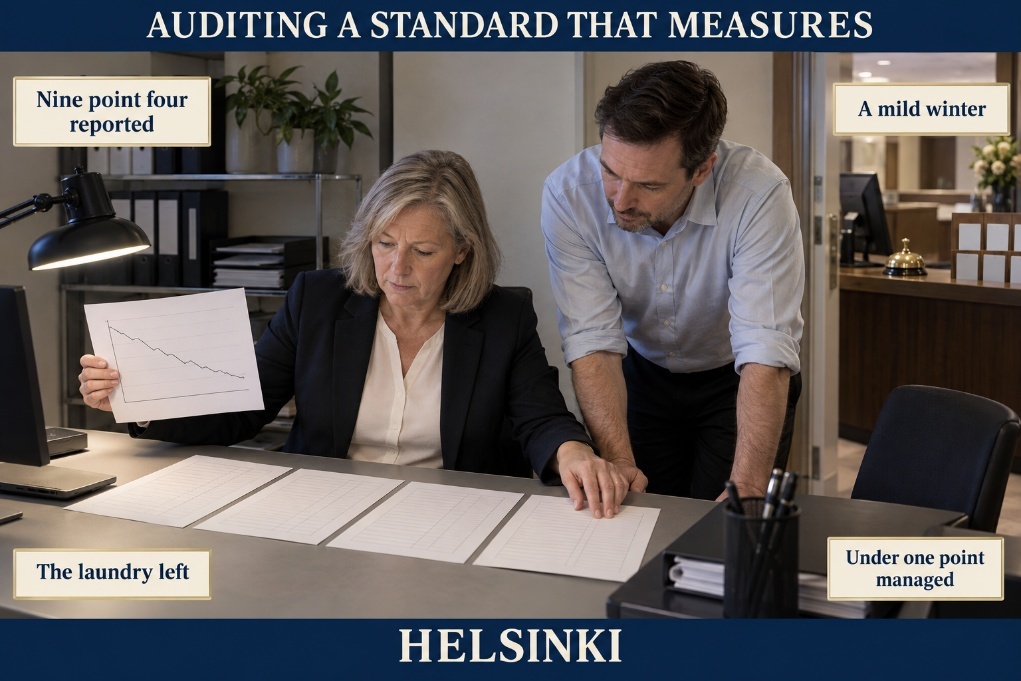
Concept Card 3.1 — Auditing a Standard That Measures
Subchapter 3.1 · Helsinki, Finland
Setting: Helsinki, Finland
An internal auditor at a desk holds up a single chart: a line falling steadily from left to right, the kind of figure a management review is glad to receive. The coordinator who calculated it leans over the table beside her, and between them lie four ruled sheets, laid out side by side. The chart is the claim and the four sheets are the question, and the card is built on the distance between them.
The first label gives the figure as it was reported: nine point four per cent, checked by the financial controller, presented to the review and repeated in a letter to the owners. The next two name what else happened in the same twelve months. A mild winter, with heating degree days eleven per cent below the mean in a building that takes more than half its energy from the district network. A laundry that left, taking its consumption out of the building and into a service invoice. Occupancy growth and an old baseline adjustment fill the remaining sheets. The fourth label is what was left once all of it had been taken out: under one point managed, inside the uncertainty of the instruments.
Nobody in the picture has done anything wrong, and the card is careful not to suggest it. The arithmetic was correct and the data came from meters that existed. What was missing was not honesty but a method, and specifically the one this standard asks for and no other in the series does: a way of telling the property’s own work apart from what simply happened to it.
The cost of that absence is the part the figure hides. In the same year the chief engineer had rescheduled the conference air handling, relamped six floors and won an argument with the heat supplier over the heating curve. That work was real, and the property’s own reporting could not tell it whether the work had worked.
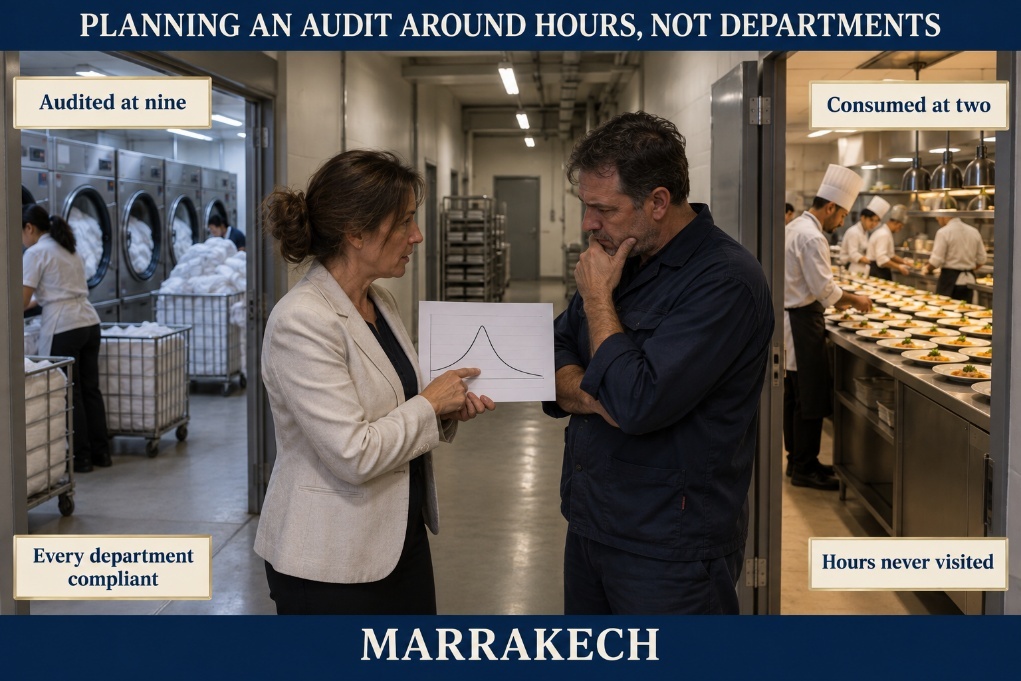
Concept Card 3.2 — Planning an Audit Around Hours, Not Departments
Subchapter 3.2 · Marrakech, Morocco
Setting: Marrakech, Morocco
The auditor stands in a service corridor between two open doors. On the left the laundry is loading its machines; on the right the kitchen is plating for a banquet, a long pass of identical plates under the heat lamps. She holds a single curve with one sharp peak, and the chief engineer beside her studies it as though he had never seen it drawn, which is true: nobody had ever drawn it.
The two doors are the argument. Each department behind them had been audited within the year and found compliant, correctly: the laundry in May with two of its four machines running, the kitchen in January serving eighty covers. What no audit had ever seen was the forty-three minutes on a July Saturday afternoon when both doors were open at once, with both chillers at full load, the spa cooling a booked-out treatment room, the pool on high flow and the irrigation pumps starting on a timer set by a gardener who had left in 2019.
Read in pairs, the labels state the whole problem. Audited at nine; consumed at two. Every department compliant; hours never visited. None of the four describes a fault. The first pair is a scheduling habit and the second is its consequence, and together they describe a programme that was sound in every line and blind in exactly one dimension, which was time.
The card does not argue for abandoning departmental audits. Competence, records and responsibilities belong to departments and are audited there. It argues that a hotel’s consumption is organised by the clock, and that the audit which finally found the peak had a single criterion belonging to no department at all: what is running now, and who decided that it would be running now.
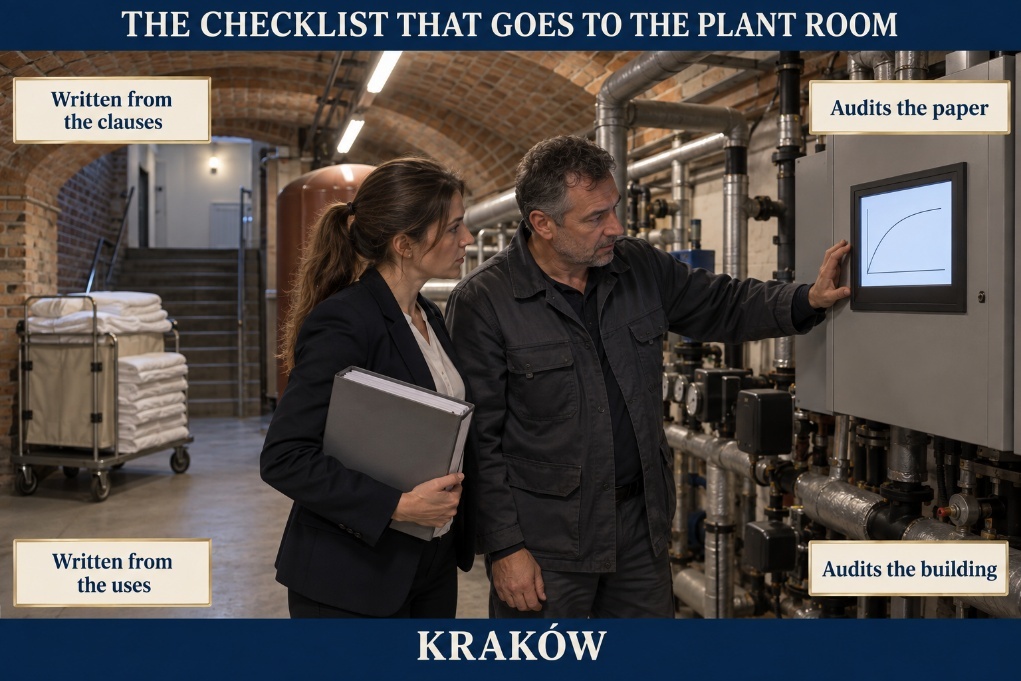
Concept Card 3.3 — The Checklist That Goes to the Plant Room
Subchapter 3.3 · Kraków, Poland
Setting: Kraków, Poland
Two people stand before a controller in a vaulted brick cellar. The auditor holds a thick grey binder against her chest; the maintenance supervisor, nineteen years in the building, has his hand on the panel and is showing her the screen, where a single compensation curve is drawn. The binder is the sixty-two page checklist. The screen is the building.
The labels are arranged as two opposing pairs, and the card reads across rather than down. On the left, written from the clauses; on the right, audits the paper. Below, written from the uses; audits the building. A checklist built in the order of the standard sends the auditor to the filing cabinet, because that is where the evidence for each clause is kept. A checklist built around the significant energy uses sends him to the equipment, because the answer to its questions exists nowhere else.
What the screen shows is the gap between the two. The documented criterion said that the flow temperature follows the manufacturer’s curve, and it had been ticked that morning. The curve in the controller had been lifted in the winter of 2017 to cure eleven cold rooms under a protected roof that cannot be insulated, and it had carried the whole building at that temperature through nine winters. The file was accurate. It described a curve that had not been in the controller since 2017.
The linen trolley at the foot of the stairs keeps the scene in a hotel, and it matters that it does: the change was made for guests, for good reasons, by a competent man who told his general manager at the time. Nothing was hidden. It simply lived in a place no clause-by-clause checklist would ever visit, and the new checklist, nine pages long, begins by opening the panel.
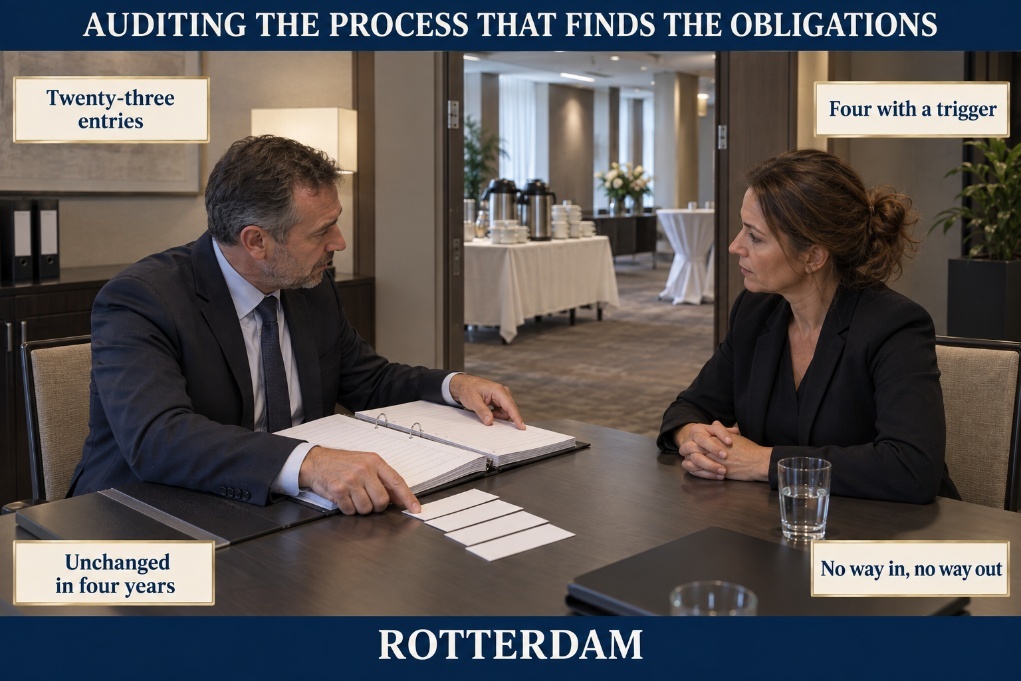
Concept Card 3.4 — Auditing the Process That Finds the Obligations
Subchapter 3.4 · Rotterdam, Netherlands
Setting: Rotterdam, Netherlands
Across a table in a waterfront conference hotel, the internal auditor has the register of legal and other requirements open in front of him and has laid four blank cards beside it. The coordinator opposite waits for the question. Behind her, through the glass, a function room is set for coffee: the conference business whose recovery, together with a row of charging points in the car park, quietly moved this property into a different legal regime.
The four cards are the four entries out of twenty-three that recorded a trigger, the condition that makes an obligation apply to this property rather than to some other. The first two labels make the count: twenty-three entries, four with a trigger. The third gives the register’s history, unchanged in four years, which had been presented as evidence of control. The fourth names the defect underneath all of them: no way in, no way out.
A register that lists what is required, and not why it applies, can be reviewed faithfully every year and never find anything, because the reviewer is looking for changes in the obligation and the obligation has not changed. What changed was the property. It crossed a consumption threshold and spent two reporting cycles in a regime nobody in the building had heard of. It signed a client contract with a disclosure clause the energy coordinator never saw. And it evaluated its compliance each year by asking the contractors who were complying.
The auditor in the picture is not reading the law, and he is not qualified to. His report contained no legal opinion of any kind. It was about process: how an obligation enters the register, how it leaves or changes inside it, and who, other than the party complying, ever evaluates whether it has been met.

Concept Card 3.5 — The Energy Near-Miss
Subchapter 3.5 · Busan, South Korea
Setting: Busan, South Korea
In the engineering office the auditor has turned from her screen to listen. On the monitors behind her are the plant schematics of the building management system; on the screen in front of her, a long log. The duty engineer at her shoulder is explaining one line of it with an open hand. Through the window, the service corridor is lined with linen trolleys: the ordinary night traffic of a large hotel that had recorded no significant deviation in two years.
The labels tell the story of a single entry and then multiply it. Left open: a chilled water set point lowered for a full ballroom on a hot night, correctly. Closed by chance: returned at two in the morning because the man who changed it happened to remember. Never recorded: nothing in the energy management system knew it had happened. And the multiplier, forty-seven times in twelve months, of which forty-one were reversed within three days and two were never reversed at all.
The two that stayed had already surfaced as rises in the monthly figures and had been explained, by a warm month and a fuller house, both of which were true. The forty-one are the card’s subject. Each contained the same cause as the two, and each was cancelled by chance before it could cost anything, which is precisely what the disciplines that learned long ago to collect such events call a near-miss.
The engineer’s gesture is the part of the image to hold on to. He had asked whether the forty-one would get him into trouble. The answer that closes the card is that they were the reason there had only been two, and that a register which is ever used against a person will, within a month, have the same overrides and no log.

Concept Card 3.6 — Interviewing for Awareness
Subchapter 3.6 · Antigua Guatemala, Guatemala
Setting: Antigua Guatemala, Guatemala
In the laundry of a restored colonial house, beside a flatwork ironer, a laundry attendant answers the auditor’s question with a gesture while the auditor writes. The training file for this property is exemplary: annual sessions, full attendance for four years, a written quiz with the scores retained. The card is set at the machine rather than in the training room because the question that finally mattered could only be asked here.
The first two labels concern the file and what it actually proves. Eleven same answers: ten people out of eleven, two of them word for word, saying that the hotel wants to save energy and that they should switch off what is not being used. A sentence learned. Concordance of that kind looks like a system, and it is evidence only that everybody was shown the same sentence.
The third label is the question the programme had never asked: what happens if this machine runs through the afternoon break? Not whether it is allowed. What happens, in any unit at all. Nobody could say, except the laundry supervisor, who answered at once in quetzales per hour for three machines, because he had once run a tortillería and paid its electricity bill himself. The property’s one genuinely aware employee had acquired his awareness somewhere else.
The fourth label belongs to the night porter and is the most honest line on the card. Nothing would change: he knew roughly what the boiler cost to keep hot overnight and kept it hot anyway, because a cold shower at one in the morning produces a complaint with his name on it and the gas carries nobody’s. That is not an awareness problem, and no course will touch it. What the audit proposed was a number on the laundry wall, in the currency the people in that room actually use.

Concept Card 3.7 — Second-Party Audit: Suppliers, Contracts and Guarantees of Origin
Subchapter 3.7 · Leipzig, Germany
Setting: Leipzig, Germany
The auditor stands in the plant room with the supply file open in her hands, while the engineer beside her checks something on a clipboard against the plant around them. Stacked banqueting chairs wait along the corridor behind: the furniture of a trade-fair hotel that fills in bursts. Everything in the file is genuine. The card is about what it is genuine evidence of.
The labels run as a short syllogism. Every certificate genuine: the renewable attribute certificates existed, matched the property’s volumes and had been properly retired. The supply changed. The building did not. And then the conclusion the property had drawn from those premises, which does not follow from them: reported as improvement.
The category error is the whole subchapter, and the card makes it visible by carrying the documents into the plant room. An attribute product makes a statement about how a quantity of electricity was generated somewhere on a network. It does not reduce the quantity the building draws, and it does not change how efficiently the building turns that quantity into rooms sold. Over the same period consumption had risen by six per cent on comparable occupancy, and the two facts sat three pages apart in one report without ever meeting in a sentence.
Behind the certificates lie the audit’s other findings, and they share a shape. The supplier documented a genuine product. The maintenance contractor delivered exactly the availability his contract measured, and in eleven years of service reports never recorded a set point. The laundry moved off-site and its energy moved outside the property’s sight, still reported as a gain. In none of the three contracts was there a clause giving the property the right to ask a question. Everything it had received, promptly, it had received as a courtesy.
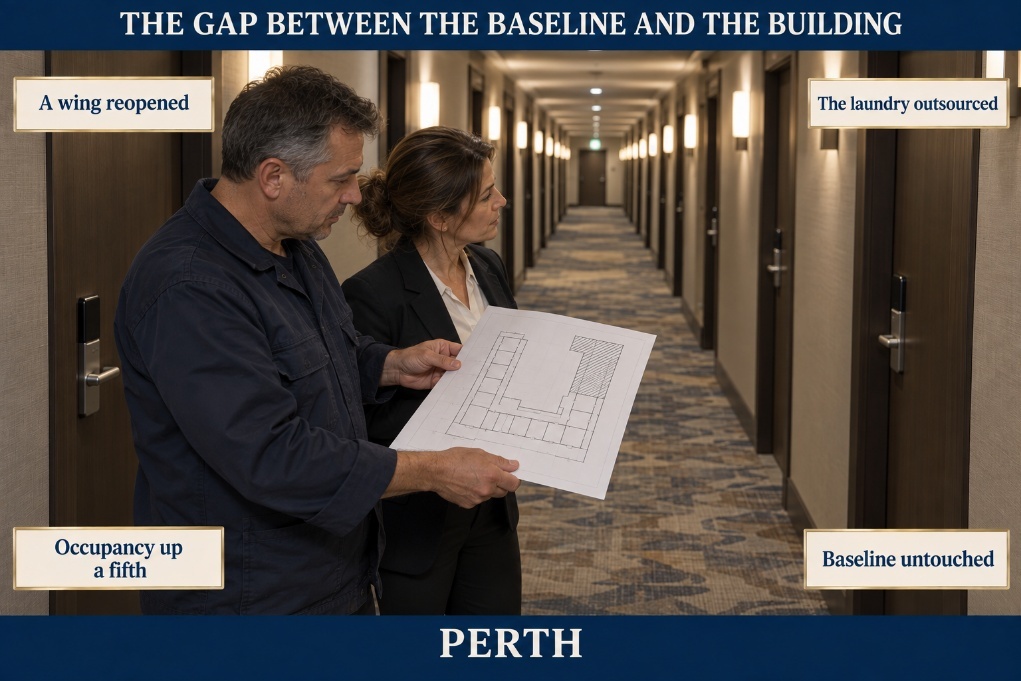
Concept Card 3.8 — The Gap Between the Baseline and the Building
Subchapter 3.8 · Perth, Australia
Setting: Perth, Australia
In a guest corridor that runs away to a vanishing point, the chief engineer holds up a floor plan and the auditor studies it with him. One wing on the plan is hatched. The corridor is the building as it is now and the plan is the building in the baseline year, and the card asks the reader to notice that they are not the same building.
Each of the four labels names a change that, taken alone, was defensible as not major. A wing reopened: twenty-four rooms closed for refurbishment in the baseline year were back in service. The laundry outsourced: a significant energy use gone from the boundary. Occupancy up a fifth: from seventy-one per cent to eighty-four, with thirty rooms now let continuously as long-stay apartments, which had changed what occupancy means rather than merely how much of it there was. And the fourth label, which is the finding: baseline untouched.
The reported improvement was eleven per cent, normalised by a method that predated its results and correctly applied in every year. Each reason given for leaving the baseline alone was reasonable on its own terms. The procedure said the baseline would be revised in the event of major changes; it did not define major, and a rule keyed to a single large event cannot respond to four small ones. So it never fired.
The auditor did not say the eleven per cent was wrong. She said nobody could say what it was, because nobody had ever written down the distance between the building on the plan and the building in the corridor. That distance is the gap in the title, and it is the one thing an internal auditor can establish without redoing anybody’s arithmetic.

Concept Card 3.9 — Root Cause, and the Answer That Is Not a Component
Subchapter 3.9 · Thessaloniki, Greece
Setting: Thessaloniki, Greece
The auditor holds a chart of daily consumption with one clear feature: a step, a single rise on a single date, after which the line stays level at its new height. The engineer beside her has his hand inside an open control panel for the conference floor’s air handling. Through the door behind them lies the refurbished conference room, chairs stacked, which reopened on the Monday of the week the step appears.
Three of the labels are the explanation the management review had accepted. The machine is old: the chillers are fifteen years old. The summer was hot: cooling degree days were up. The house was full: occupancy had risen four points. The auditor checked all three and confirmed them, because an auditor who dismisses accurate information has lost the room. They are conditions (facts about the world the property operates in) and none of them is a cause.
The shape of the line is what separates them. Ageing plant produces a slope; a hot summer produces a curve weighted towards July; neither continues through the winter months when the chillers are off. A step belongs to a date, and a date belongs to a decision. Here it was a project closed in April with the new air handling drives left in fixed mode, awaiting a part that arrived in June for a commissioning engineer who no longer had a contract.
The fourth label names the kind of answer the method is looking for: the schedule had no owner. The same investigation found two more of the species: a service interval lengthened on one set of figures and never checked against the other, and a kitchen extraction running eighteen hours a day on a schedule inherited from a restaurant that used to close at ten. Three causes, and each was a decision that somebody could have taken differently.
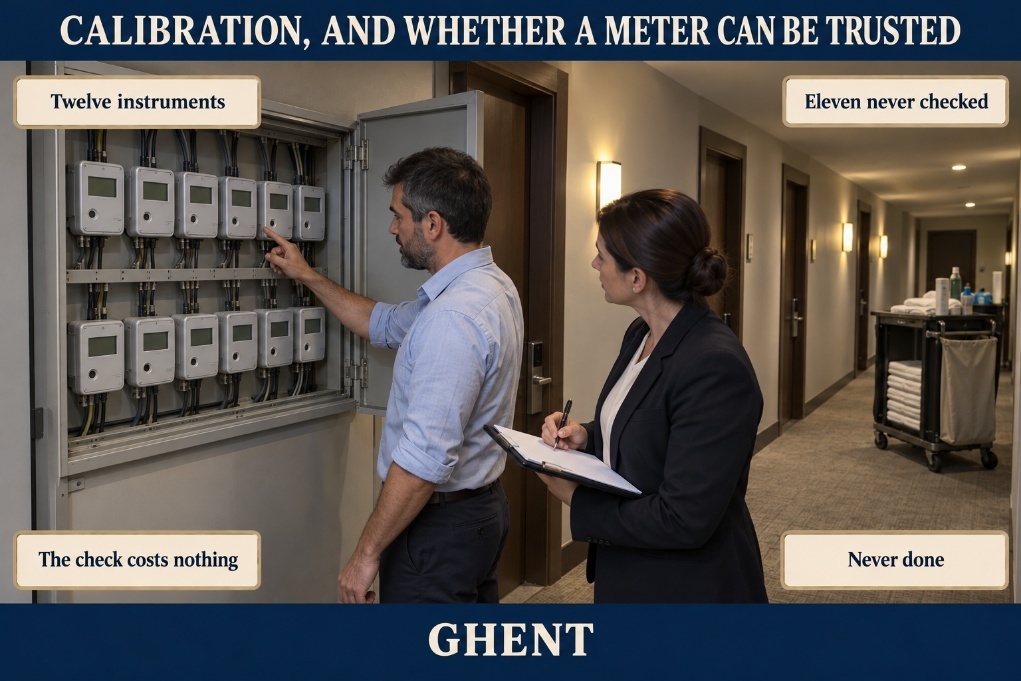
Concept Card 3.10 — Calibration, and Whether a Meter Can Be Trusted
Subchapter 3.10 · Ghent, Belgium
Setting: Ghent, Belgium
A metering cabinet stands open in a guest corridor: two ranks of sub-meters with blank displays. The engineer points to one of them and the auditor beside him writes. A housekeeping trolley waits further down the corridor, because this is where the instruments actually are, not in a laboratory, but on a board behind a panel that guests walk past every day.
The labels give the case in four short lines. Twelve instruments: the sub-meters fitted when the combined heat and power unit arrived, so that the property could report by department. Eleven never checked: only the two supplier meters at the interface had ever been verified, and they belong to the suppliers. The check costs nothing. Never done.
What the auditor did instead of ordering a calibration programme is the heart of the card. She summed the sub-meters month by month for three years and set the total against the supplier’s meter. For two years they accounted for ninety-three per cent of it; in the last eight months, eighty-one. The residual itself was expected. The change in it was the only signal in the building, and within an afternoon it led to a current transformer refitted on the wrong conductor, and to a kitchen that had been praised in a management review for an improvement that was a wiring error.
The card is honest about what that reconciliation cannot find. A meter that has been wrong since the day it was installed produces a stable, plausible number for ever, and the laundry sub-meter had been reading a third of its load since commissioning. Against that only a commissioning record protects a property, or an open statement that a figure is unverified. Against almost everything else, an hour of arithmetic a year is enough.
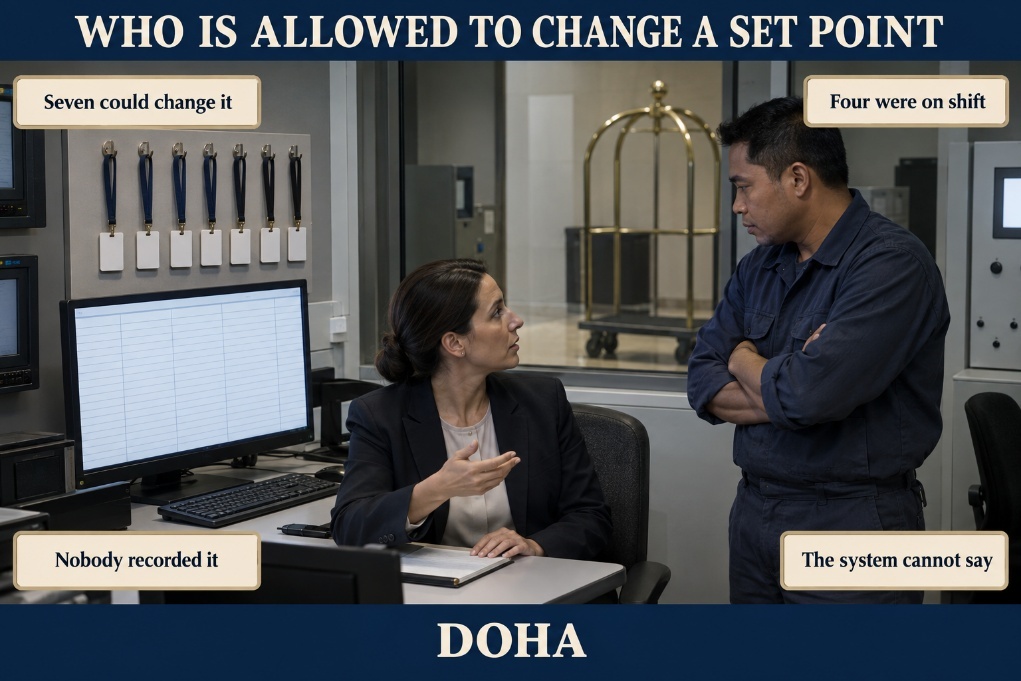
Concept Card 3.11 — Who Is Allowed to Change a Set Point
Subchapter 3.11 · Doha, Qatar
Setting: Doha, Qatar
In the engineering office the auditor, seated at the terminal of the building management system, has turned to the chief engineer, who stands with his arms folded. On the wall behind them hang seven identical lanyards on seven hooks, each with a blank tag. Through the glass, a brass luggage cart stands in the back corridor of a twenty-one floor hotel.
The lanyards are the account structure, and the image makes it literal: seven duty engineers shared a single login called engineer. The first two labels do the arithmetic of the case. Seven could change it; four were on shift in the week the secondary chilled water set point was lowered and two bypasses were opened on the upper floors. All four said it was not them, and there was no reason to disbelieve any of them.
The lower labels state what the property had arranged without intending to. Nobody recorded it: the change log had been enabled since 2013, attributed every one of sixty-one changes to the same account, and forgot everything after ninety days. The system cannot say who made the change, so it cannot say why, so nobody can decide whether it should still be in place. Three weeks later it still was, narrowing the temperature difference returned to the district network and buying the same cooling at a worse rate under a contract term two basements below.
The change was correct when it was made; there had been real complaints on a night that never dropped below thirty-eight degrees. The card is not about who made it, and the auditor rightly did not pursue that. It is about the two copies of the property’s operating criteria: one in a document with an author, an approver and a date, which governs nothing, and one in a controller with no author and a ninety-day memory, which governs the building.

Concept Card 3.12 — The Energy Performance Test
Subchapter 3.12 · Turin, Italy
Setting: Turin, Italy
In a plant room the coordinator is explaining and the auditor is taking notes beside a control panel. Around them stand the things the owner paid for over two years: variable speed pump sets, a heat interface running a new control strategy, the panels of a revised air handling schedule. Stacked banqueting chairs in the background carry the conference season that moves this property’s figures from one year to the next.
The first two labels state the claim and its method. Four measures claimed: a lighting replacement, a heat interface control, pump drives and a night setback, each with an expected saving, together about six per cent. One number for all four: the property’s normalised total had fallen, and all four had been credited from it.
The third label is why that number cannot bear the weight: noise larger than effect. In each of the four previous years this property’s normalised total had moved by more than six per cent for reasons unrelated to any measure: the conference calendar, a banqueting season that moves, a degree-day correction that is itself approximate. A method that cannot resolve the effect it is looking for will still produce a result every time, and the result is an artefact whichever way it falls.
The fourth label is the one that stings: the cheap test never run. The lighting sat on its own sub-meter with a near-constant load, and four comparable weeks before and after would have settled it. The pump drives and the control change were commissioned in the same fortnight on the same circuit and can now never be separated. The night setback was overridden before almost every event and worked on perhaps a third of the nights it was designed for. The remedy fits on a page: design the test, and date it, before the work is ordered.

Concept Card 3.13 — The Report That Ownership Will Actually Read
Subchapter 3.13 · Luxembourg, Luxembourg
Setting: Luxembourg, Luxembourg
Across a boardroom table the internal auditor hands a single sheet to the asset manager, who holds a thick bound report in his other hand. Through the glass behind them, a coffee break is laid for the conference suite that pays for much of the building. The bound report and the single sheet contain the same findings. Only one of them was read.
The top labels describe the first report. Accurate in every line: twenty-six pages, fourteen findings, each correctly referenced, and every sentence still defensible today. Changed nothing: two quarters later three findings had been closed, all of them the ones that cost nothing and belonged to the coordinator. The asset manager, with eleven properties and a quarterly meeting, had read the summary paragraph, learned that the system conformed with no major nonconformity, and drawn the conclusion any reasonable reader would draw.
On page nineteen, under a clause heading about resources, finding eleven recorded that the property had no schedule for renewing its significant energy-using equipment. Behind that sentence was a window that would not open again for a decade: two chillers approaching the end of their working lives, and a conference refurbishment the following year with the plant rooms accessible and a contractor on site for four months. Nobody had ever put the two dates on the same page.
The lower labels describe the second report. Fourteen became one: nothing was removed, and the only change was a single page at the front listing what decision was required, by when, by whom, and roughly what it was worth. One page was read, in about four minutes, and a paper on the chillers was requested for the next meeting. The card does not say detail is worthless. It says a report is finished only when the person it is addressed to knows what he is being asked to do.
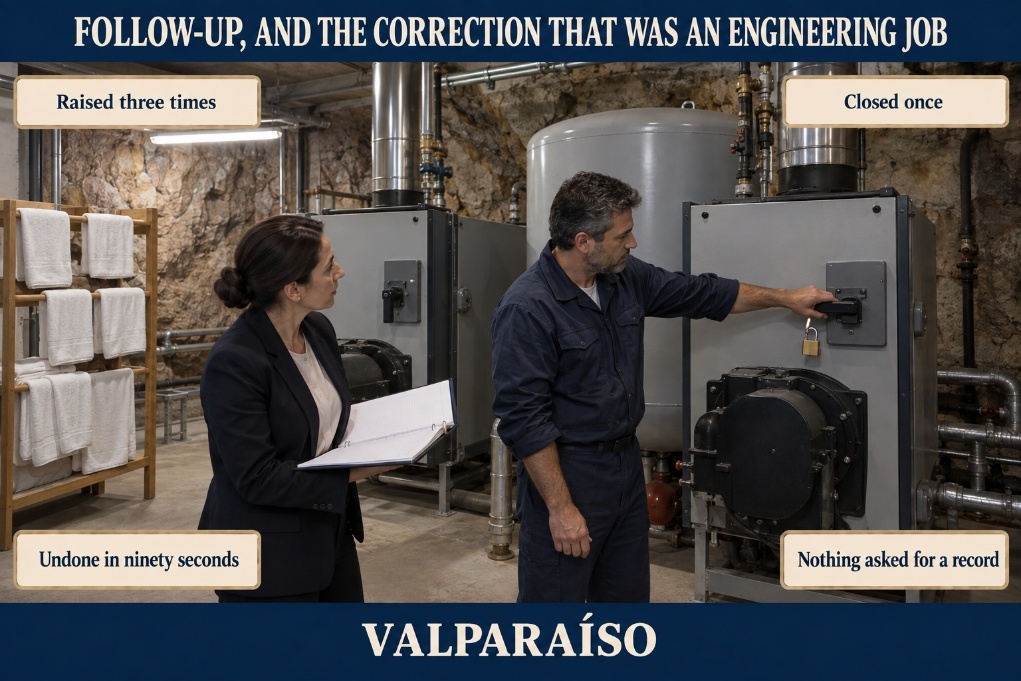
Concept Card 3.14 — Follow-up, and the Correction That Was an Engineering Job
Subchapter 3.14 · Valparaíso, Chile
Setting: Valparaíso, Chile
In a plant room cut into the hillside rock, the engineer has his hand on the lockout of one of two boilers, a padlock hanging from the switch. The auditor watches with the register of findings open. On the rack beside her hang the towels whose hot water this plant exists to deliver, and whose shortage, one full winter morning, is the reason the lock did not hold.
The labels are a history in four lines. Raised three times: the same finding, an oversized plant cycling through the night, in three consecutive years. Closed once: in the first year the chief engineer locked one boiler out of the sequence, consumption fell within a fortnight, and the closure was recorded with its date and a month of confirming data, which is better practice than most properties manage. Undone in ninety seconds: on a full Saturday in June, with the upper floor short of hot water at half past six, the duty engineer unlocked it. He was right to.
Nothing asked for a record, and so the reversal left no trace except in trend data nobody read. The circuit was back where it had started a hundred and seventeen days after the correction, less than the interval between audits, and each later audit found the condition and recorded it as new. Meanwhile the real answer, a smaller boiler with a buffer, lost the capital plan twice: once to a heritage façade, once to a street consent the scaffolding had already used.
What nobody proposed in three years was the answer that costs nothing: lock the second boiler out for the low season only, with a date on which it comes back. The card is about the life of a correction. A finding is closed when the number it concerns stays where it was put, and a follow-up that never looks at the number again has closed only a record.

Concept Card 3.15 — What the Internal Audit Owes the Management Review
Subchapter 3.15 · Quebec City, Canada
Setting: Quebec City, Canada
The management review is in session. The general manager chairs from the head of the table, the coordinator presents, and the internal auditor sits to one side with her chin in her hand. On the table in front of them lies the audit report, closed. It had been circulated in December and presented in March, as item eight of ten, in four minutes.
The first label is what the review decided: baseline confirmed. The second is what the audit had known since its visit: evidence since November. The auditor’s working papers held a condition statement listing four changes to the building: the older wing out of service for eleven weeks, the restaurant let to an operator, thirty rooms sold on a long-stay contract through the quiet months, the heat pumps extended to another floor. The minute that noted the audit also recorded that no major changes had occurred, in the same words, for the third year running.
The third label names what the audit had been contributing: findings, not decisions. A review with ten items and a fixed length does not go looking inside an attached report for a sentence that bears on a different agenda item. The fourth label is the image of it: the door stayed closed. Nothing was concealed. The information was in the building, in a document, in a form that required somebody to go and fetch it.
The remedy took an afternoon. Instead of a report, the auditor brought three papers, each shaped as a decision the review was obliged to take, one of them containing the condition statement and nothing else. The following year the energy item took forty minutes and produced three dated decisions. The general manager, chairing for the sixth year, said it was the first time he had understood what an internal audit was for.

Concept Card 4.1 — The Chain That Makes a Certificate Mean Something
Subchapter 4.1 · Geneva, Switzerland
Setting: Geneva, Switzerland
A quality manager sits at a desk in a lakeside conference hotel with her framed certificate in one hand and, on the laptop in front of her, a public register with a single row highlighted. Behind her, on a table set for a delegation, hang rows of blank name badges. The guests this property sells to are booked by procurement departments, and procurement departments ask for documents.
The top two labels are both true, and the card needs the reader to accept them before going on. The certificate is genuine: an audit took place, over three days, led by an auditor she still considers better than the one who came after him. The body exists: a real company, and an accredited one. The lower labels are the questions that turned out to matter (accredited by whom, and for what) and the answer to both was waiting in the register.
The body’s accreditation covered energy supply and several categories of manufacturing. It did not cover services, and nothing in it touched the operation of a hotel. What the client asked for, in the fourth label, was accredited certification in a scope covering accommodation, and that is what the certificate could not show. Nothing unlawful had occurred; an unaccredited certificate is a legitimate commercial product. It was simply unconstrained, and the absence of constraint explained two things the property had never questioned: why the offer had proposed fewer days, and why the same firm had been free to advise before it judged.
The card’s instrument is the one on the screen. Three questions (is it accredited, by whom, and in what scope) and a public register anybody can read. Twenty minutes, and in most certified properties it has never been done once in the life of the certificate.

Concept Card 4.2 — Choosing a Certification Body That Has Seen a Hotel
Subchapter 4.2 · Milan, Italy
Setting: Milan, Italy
In a plant room, a certification auditor with a clipboard studies a drawing that the group’s quality manager holds out to him. It is a floor plan, because that is what a hotel has; he had asked for a process flow diagram. Through the open door behind them the kitchen line is at work, steam rising from the stoves. In three days he did not go through that door once.
Three of the labels are compliments, and they are sincere. Competent: eleven energy management systems audited in food processing, two in logistics, and precise questions. Courteous. Thorough: two days in the plant room and the document room, with boilers, chillers, maintenance records and meter calibration all properly examined. The fourth label says what all of that competence was pointed at: looking for a factory.
A factory has a process, an output and a specific consumption per unit. A hotel has a guest night, which in a fair week means a full house, two banquets and the air handling on all day, and in the second week of January (when the audit took place) means almost nothing. The auditor never asked who sets the kitchen’s switch-on time, and never asked about the laundry, because it had left the building and nothing in his method prompted the question.
Fourteen months later a client’s auditor asked all three questions in half a day, and the property could answer none of them. The card’s lesson sits in the tender file. The rejected offer, nine days and more than twice the price of the offer chosen, had counted the July staffing, proposed part of the visit inside a fair week and explained why in a covering letter. It had read the hotel correctly and lost on price to people who had never been told what they were comparing.
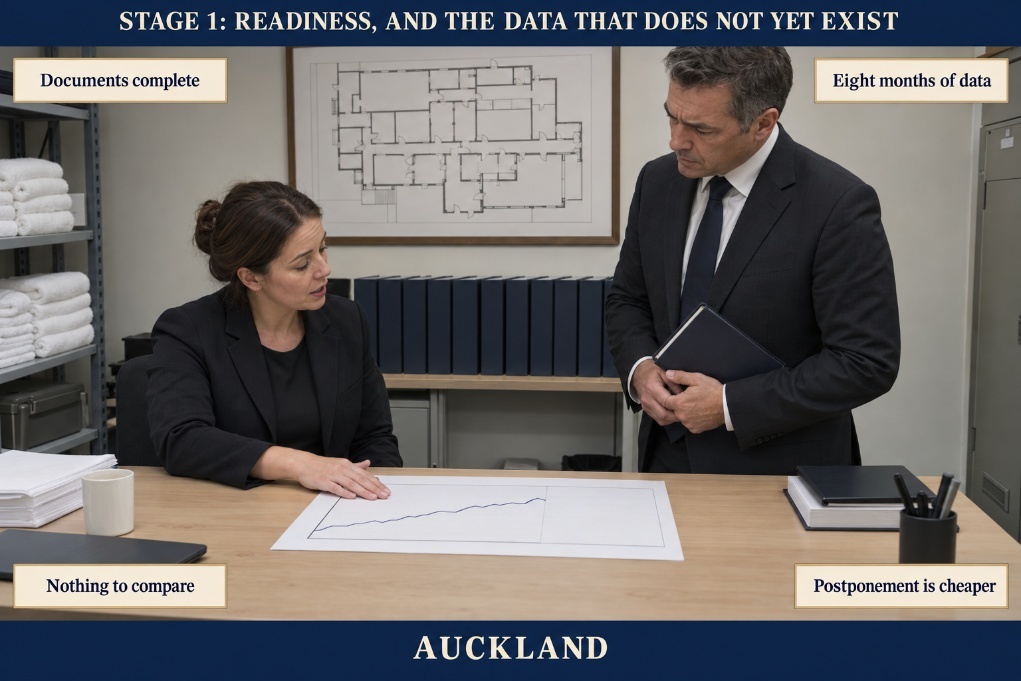
Concept Card 4.3 — Stage 1: Readiness, and the Data That Does Not Yet Exist
Subchapter 4.3 · Auckland, New Zealand
Setting: Auckland, New Zealand
At a desk in a back office the stage one auditor has her hand flat on a single chart: a line of measured consumption that runs across part of the sheet and stops, leaving the rest of the grid empty. The general manager stands opposite, folder closed. On the shelves behind them, rows of identical binders; on the wall, the plan of the building. Everything that can be written down is here.
The first label is the compliment, and it was deserved: documents complete. The energy review was thorough, relevant variables and static factors were properly distinguished, and operating criteria were stated as values. The second label is the problem, and it is on the chart: eight months of data, June to January. One winter, one spring and the first two months of summer. Not February, this property’s heaviest week, and not one complete cruise season.
The third label follows: nothing to compare. A standard that asks a property to demonstrate improvement in energy performance first asks it to have something to improve against, and a baseline describing two-thirds of a year will compare every future year with a building that does not exist. Two of the three indicators rested on sub-meters with three months of readings, and the internal audit had been carried out by the consultant who built the system.
The fourth label is the advice the general manager did not want to hear: postponement is cheaper. Going ahead in March would probably have produced two major nonconformities, a follow-up and a delay that would still have had to be explained to the client. Deferring used a year that was running anyway. The property certified in September, cleanly, with a full cycle in its baseline, because in this standard the calendar is a prerequisite and not a constraint.
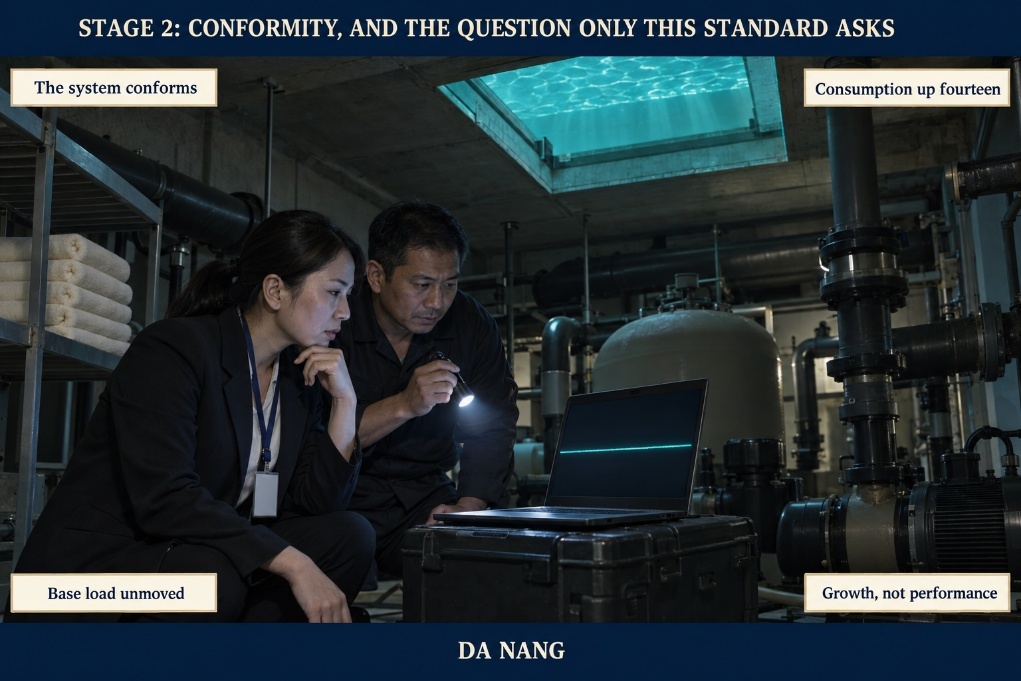
Concept Card 4.4 — Stage 2: Conformity, and the Question Only This Standard Asks
Subchapter 4.4 · Da Nang, Vietnam
Setting: Da Nang, Vietnam
The plant room lies beneath the pool, and the water glows through a skylight overhead. It is the middle of the night. The lead auditor is crouched beside a laptop set on an equipment case while a technician holds a torch; on the screen, a single flat trace. Folded towels on a rack keep the scene in a hotel. The hour is the method: this is what the building consumes when nobody is using it.
The top labels are the two statements that were going to share one report. The system conforms: documentation sound, criteria matching the controllers, internal audit independent, management review decisive. Consumption up fourteen: gross energy purchase fourteen per cent above the baseline year, in a young resort whose occupancy had climbed from fifty-four per cent to seventy-one. The coordinator had presented the indicator per guest night, down nine per cent, as the demonstration of improvement.
The flat trace on the laptop is the third label: base load unmoved. Between three and five in the morning on a quiet night, three years of growth had changed what the building consumed by nothing the instruments could see. That single fact reframes the nine per cent. A ratio improves automatically when its denominator grows faster than its numerator, and it will go on improving exactly as long as the hotel keeps filling. The fourth label names it plainly: growth, not performance.
The finding was minor and not major, and the card rests on why. The property had verified one measure properly: a chiller sequencing change on a sub-metered circuit, tested over comparable weeks by a method written down in advance. It could separate its own work from its circumstances; it had simply never applied that capability to its headline figure. The certificate was recommended, and the gap was closed with a second indicator that occupancy barely moves.

Concept Card 4.5 — The Audit Team, and Competence in a Performance Standard
Subchapter 4.5 · Bergen, Norway
Setting: Bergen, Norway
In a meeting room built into an old harbour warehouse, two auditors sit side by side before a laptop. The younger has his hand on the keyboard and his brow furrowed; the lead auditor beside him leans in with her chin on her hand. Behind them a third person stands with a closed notebook, watching the two of them rather than the screen. Through the doorway, a room-service trolley under a silver cloche waits in the corridor.
The first two labels are the team’s honest record. Two good auditors: one with nine years on this standard, one from hotel engineering, covering between them the standard and the sector, which is more than many properties get. Documents examined: they confirmed that normalisation was carried out, that the method was documented, that it predated its results and had been applied consistently. All of it was true, and all of it was checked properly.
What is on the screen is the third label: the regression unread. Almost everything the property reported rested on one model, fitted against heating degree days and occupancy. In this building those two variables are not independent (the cruise season is the summer, and the summer is when the degree days are fewest) so the model could not tell which of them was doing the work. Neither auditor could interrogate it, and neither pretended to. A client’s procurement auditor did, fourteen months later, in twenty minutes.
The fourth label is a finding about the team rather than the property: no expert on the team. The framework asks for competence held collectively, and provides a technical expert for exactly this case; it is almost never used. The standing figure is the card’s other half. An accreditation assessor watching the audit team, not the hotel, at the one visit in three years when somebody independent checks the auditors, and the coordinator spent the first hour of it being defensive at the wrong person.
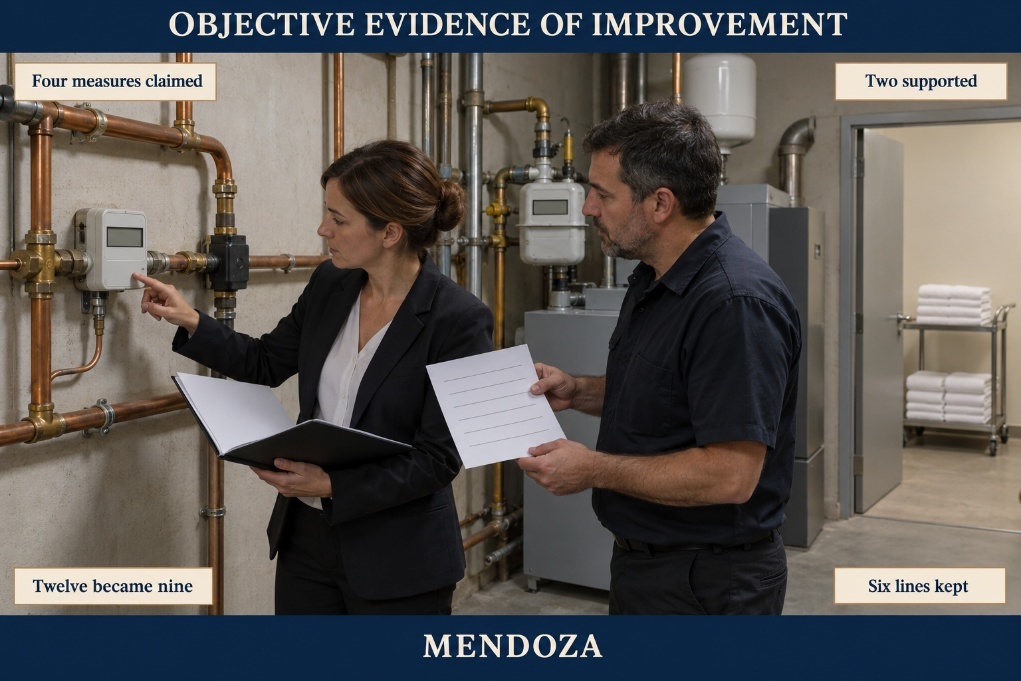
Concept Card 4.6 — Objective Evidence of Improvement
Subchapter 4.6 · Mendoza, Argentina
Setting: Mendoza, Argentina
The auditor has her finger on a meter in a plant room, a notebook open in her other hand; the maintenance manager beside her holds out a sheet with six ruled lines on it. Through the open door, a linen trolley stands in the corridor of a vineyard hotel whose climate swings twenty degrees between an afternoon and a night. The card begins at the meter because the question she was asking was what a stranger could verify.
The first two labels are that question put to four claims. Four measures claimed: solar preheating for the spa and laundry, a lighting replacement, a revised irrigation schedule, and improved staff awareness credited with three points. Two supported: the solar loop, confirmed by two independent instruments on either side of the same energy flow, and the lighting, accepted not on the manufacturer’s calculation but on a step in the sub-meter’s daily data in the week of installation.
The other two were not rejected as false. The irrigation probably worked, but its evidence was a water bill and its pumps had no meter; the awareness points had been attributed because the remainder was otherwise unexplained. Unsupported is not untrue, and the card holds that distinction carefully. The third label then tests the headline figure itself: twelve became nine, once a properly recorded baseline revision was set aside to see what it had contributed.
The fourth label is the part of the audit the coordinator kept: six lines kept. He had expected to be told his twelve per cent was wrong. He was given instead a paragraph of six lines stating exactly what had been accepted and why, and it has been the template for how the property reports ever since. The improvement was demonstrated, it was smaller than the claim, and the certificate was recommended.
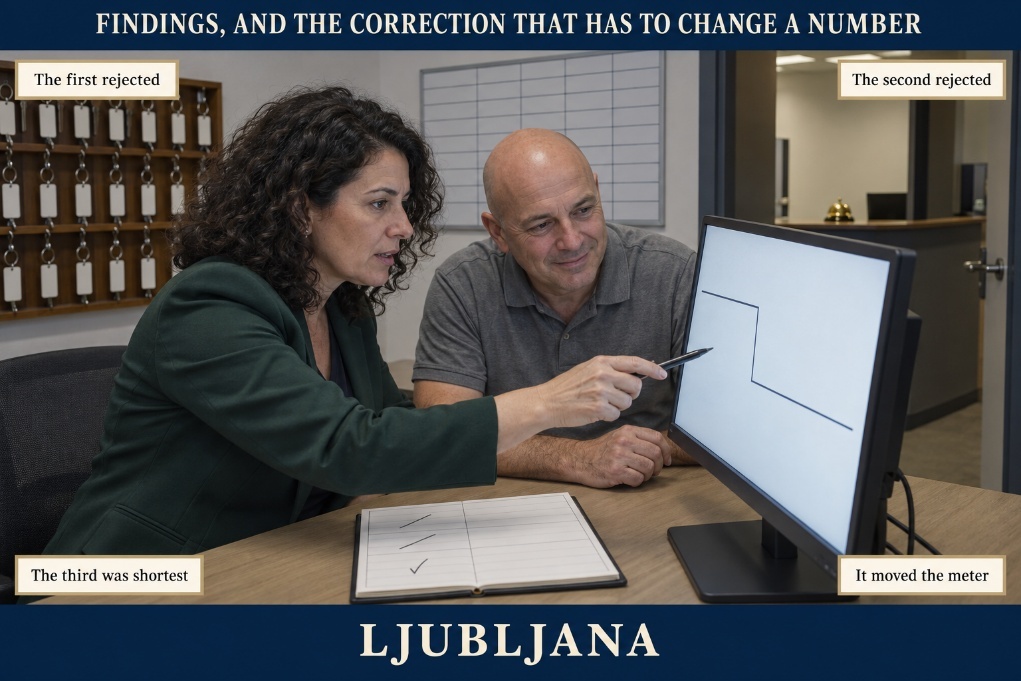
Concept Card 4.7 — Findings, and the Correction That Has to Change a Number
Subchapter 4.7 · Ljubljana, Slovenia
Setting: Ljubljana, Slovenia
In the back office behind reception, beneath the board of room keys, the lead auditor points with a pen at a monitor. On it is a single line that runs flat, drops in one clear step and stays low. The hotel’s maintenance manager leans in beside her with the restrained half-smile of a man who has finally been told yes. On the desk lies a register with three entries: two struck through, one ticked.
The labels are that register read aloud. The first rejected: nineteen days after a major nonconformity on a heating controller left in manual for two seasons, the property sent a toolbox talk, an attendance sheet and a memo. The second rejected: at seven weeks, a revised procedure and a monthly verification form, and a screenshot of the new form showing, in its corner, the controller still in manual. Both responses were true and documented, and neither said anything about what the plant was doing.
The third was shortest. At ten weeks the property sent four headed parts: the curve restored on a named day, with settings exported before and after; a cause in five lines without a euphemism in them (the winter morning peak the criteria had never provided for); criteria rewritten with a storage recharge at five o’clock and a route for requesting a deviation; and six weeks of plant gas against the same weeks of the year before.
It moved the meter, and that is why it was accepted. The step on the screen is the evidence of effectiveness, and somebody who was never in the building can see it. The card’s argument is the sentence the auditor left with the coordinator: whatever you send us, ask who could see the difference, and with what. The third response was not more thorough than the second. It was aimed at something different.

Concept Card 4.8 — The Certificate, and What It Actually Certifies
Subchapter 4.8 · Vilnius, Lithuania
Setting: Vilnius, Lithuania
In the lobby, beside a brass luggage cart, a man holds a framed certificate in both hands and presses one finger on a small ruled box near its foot. The woman facing him sweeps an open hand towards the building behind her, as if to say that it covers everything. On the wall behind them, a paler rectangle marks where the frame hung by the lift for four years, until somebody took it down and read the whole of it.
The first two labels are what the certificate actually says. An entity named: the operating company of this one hotel, not the group, and not its three other properties, none of which had ever been audited. A scope limited: accommodation, food and beverage and conference services at a single address. The spa was not in it, because a company the hotel does not control operates it under lease, and neither were the two shops at street level, although all three sit inside the same walls.
The third label settles the website’s claim: no figure anywhere. No percentage, rating or band appears on any certificate issued against this standard, and none may. The group’s site said its hotels were certified with a verified fourteen per cent improvement. The fourteen per cent was real, demonstrated and accepted at recertification; it had simply been attached to the wrong sentence. The fourth label names the assumption that carried it there: four hotels assumed.
The correction was two statements instead of one. The first says what the certificate says, with its number and the public register where anybody can check it in forty seconds. The second says, on the property’s own authority, what the property has demonstrated and where the evidence is. The corporate account accepted it without a further question. The scope sentence, the line almost everybody treats as a formality, decides what may be claimed.

Concept Card 4.9 — Surveillance, and the Year Performance Fell
Subchapter 4.9 · Alicante, Spain
Setting: Alicante, Spain
In the restaurant after service, chairs up on the tables, the surveillance auditor reads a chart on which the line has turned down. The maintenance manager who carries the energy coordination sits across from him and explains, one hand open. She had found the fall before he arrived. The closed laptop beside her stands for the change log that nobody had opened for seven months.
The top labels are the two figures of the year. Three and a half down: after a first surveillance visit taken on a seven point four per cent improvement, the year just closed was three and a half per cent worse than the one before it, the first fall since measuring began. Four point two held: against the baseline the property was still better by that much. Much of the fall belonged to a season extended by forty-seven days at thirty-eight per cent occupancy, on a normalisation fitted to main-season data that had never seen a March.
The consultant proposed revising the baseline, and restated that way the year showed a gain. She did not sign it, because the method had been built to meet the result. She separated the fall instead and found three defects that belonged to the property. The third label is the largest: one and a half degrees, the guest-floor corridors running colder since a tour group’s complaint in August. The fourth is how long it had lasted: seven months unread, in a log that took forty minutes to read.
The visit produced one minor nonconformity (for a deviation recorded and never investigated) and the certificate was maintained without qualification. The auditor’s parting sentence is the card’s argument: a performance standard does not require you to have a good year; it requires you to know what kind of year you had. The fall was never the finding. The seven months were.

Concept Card 4.10 — The Mark, and What a Certified Hotel May Claim
Subchapter 4.10 · Edinburgh, United Kingdom
Setting: Edinburgh, United Kingdom
At the street door of a Georgian townhouse hotel, the operations manager photographs a decal on the glass before it comes off. Beside him a colleague holds the inventory on a clipboard and a scraper in her other hand. The reception desk is a few paces away, with its bell and its leather folders: the door is a surface of the service being sold, which is why the group decided the mark should not be on it.
The first two labels hold the central distinction of the subchapter. True in every part: the electricity really was supplied under guarantees of origin, the twenty-three per cent really had been calculated from real meter data, three of the group’s six hotels really were certified. Misleading assembled: set beside the certification body’s mark, those true sentences told a reader that the body had verified the electricity, a carbon position, a percentage and six hotels. It had examined none of those things.
The lower labels are the inventory the complaint forced. Forty-one surfaces: two days, three people, every website, listing, tender answer, signature, room card, poster, decal, wine list and regional director’s post going back eighteen months. Fourteen came off, including both door decals, the head of the wine list, and a post claiming certification across the group that had been shared eleven times.
What replaced them was three sentences and a rule. One says what is certified, with the certificate number and the register reference. One says, in its own paragraph, what the property has demonstrated and by what method. One describes the electricity supply without the word certification anywhere near it. And the rule needs no judgement from anybody: the mark never appears within eye-line of a number, a product or a hotel that does not hold a certificate.
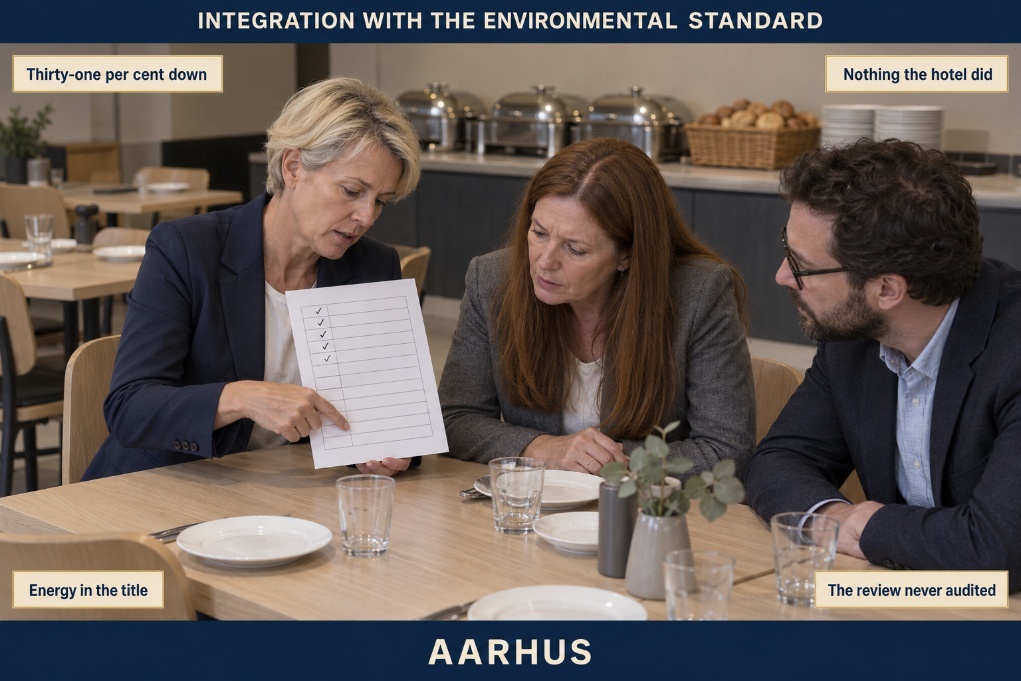
Concept Card 4.11 — Integration with the Environmental Standard
Subchapter 4.11 · Aarhus, Denmark
Setting: Aarhus, Denmark
The breakfast service is over, the cloches on the buffet are closed and the tables are half reset. At one of them the environmental auditor holds up the property’s internal audit programme and puts her finger on the lower half of the sheet. The rows above are ticked; the rows under her finger are empty. The energy coordinator leans in to look, and the second auditor, who holds the energy qualification, turns towards the page. Two auditors, one visit, two standards: the card is about what the arrangement can hide.
The first two labels are the headline the property had printed in its sustainability report, and its honest footnote. Thirty-one per cent down: carbon dioxide from heat and power, against an objective of twenty-five. Nothing the hotel did: the district heating utility had spent four years moving off coal, and the emissions factor of every unit of heat on the network had fallen by about forty per cent. Over the same year the building’s own energy use per occupied room-night had risen. Emissions describe what a unit of energy cost the atmosphere; energy performance describes how many units the building used. A supplier can change the first and cannot touch the second.
That distinction was not the finding. The finding is on the sheet. Energy in the title: when the energy system was built, the environmental audit programme was extended by adding one word to its heading and two topics to its plan, both about awareness and policy. The review never audited: fourteen months into certification, nobody inside the organisation had examined the energy review, the significant energy uses and their variables, the baseline, the indicators, or the method by which improvement is verified, the parts of the system that the environmental standard does not contain.
This is the characteristic failure of an integrated system. The shared clauses are satisfied in the shape of whichever standard came first, and the requirements the second standard adds inside those clauses stay invisible, because the clause number already has a tick beside it. It took an auditor working on the other standard to see it. The programme was rebuilt from the energy requirements upward, and its first audit found the conference ventilation running seven days a week for a four-day booking pattern, where it had been running since before the energy system existed.

Concept Card 4.12 — Ratings, Lenders and the Cost of Capital
Subchapter 4.12 · Frankfurt, Germany
Setting: Frankfurt, Germany
In a conference hotel’s meeting room, banqueting chairs stacked in the corridor beyond the door, the technical director makes her case across the table to the bank’s sustainability analyst, who keeps a hand on the documents in front of him. On the floor against the wall, a framed certificate leans where it was put down. It was the reason she had been invited, for twenty minutes. She stayed four hours.
The first label is her own summary afterwards: the certificate opened the door. The refinancing carried a margin that moves with sustainability performance, and the company had expected the certificate to settle the matter. The analyst’s questions showed why it could not. The second label is the first of them: the asset, not the group. The reported nine per cent was a portfolio figure across three hotels, and the loan is secured on one building.
The third label is the question she thought about on the train home: persistence is priced. The improvement had been won in eighteen months, mostly through one plant replacement, and the following two years had given about a fifth of it back. A covenant runs for the term of the facility, so what a lender prices is not the result that was achieved but the result that will still be there at maturity.
The fourth label is what the signed agreement turned on: the definitions decide. On which boundary performance is measured: the operational one of the management system, or the title boundary including a let restaurant and a leased fitness floor she cannot enter. Whether the normalisation is written into a schedule of the agreement or merely referenced. Whose trajectory the margin moves against. A certified system produces none of this; she built it as a file over six weeks. A covenant is a requirement the standard expects to be determined, and it reaches the energy team only if somebody opens the loan file.

Concept Card 4.13 — Multi-Site Certification Across Climates
Subchapter 4.13 · Split, Croatia
Setting: Split, Croatia
In a bare, hot plant room, an auditor crouches at the pump of a reverse osmosis unit with a clamp meter on its cable, reading the current it draws. A colleague stands alongside with the group’s energy review template on a tablet. Against the far wall, beach loungers and furled parasols are stacked for the season. The room is on the island of Vis, in the smallest of nine hotels run from Split, and until that week no auditor had ever stood in it.
The top labels set out the certification. Nine hotels, one figure: a group improvement of four point one per cent, correctly built and weighted by consumption, across coast, interior, mountains and island. Eight sites visited: a sampling rotation across the three-year cycle that had worked exactly as designed, and a better record than most groups manage. The ninth had joined the scope by extension, on the strength of documents.
The lower labels are what the site-by-site decomposition revealed: eleven seconds to ask for, four days to produce. The ninth never seen: Vis, down fourteen point two per cent, invisible in an aggregate it moved by a tenth of a point. Its energy review listed the same three uses in the same order as a coastal hotel on the mainland, because it had been made from the group template, and the template could not know that from May to October the island’s mains pressure fails and the hotel makes its own water.
The fourth label is what the clamp meter showed: a third of its power, in season, going into a unit billed internally as water and absent from every line of the review. The major nonconformity went to the central function rather than to the island, because the method had no step at which a template is tested against the building it describes. The unit now runs against the cistern level on the night tariff, which is what anybody would have done the first time a competent person looked at it.

Concept Card 4.14 — Change During the Cycle: Boundary, Baseline and Major Works
Subchapter 4.14 · Belfast, United Kingdom
Setting: Belfast, United Kingdom
In a guest corridor whose doors are still wrapped in protective film, the auditor turns the pages of a refurbishment specification laid on a folding table. The quality and compliance manager stands opposite, a single sheet in her hand, explaining. At the end of the corridor, through an open door, the new heat pump plant stands in its wrapping. The works are finished, the wing has reopened, and everything in the scene is new.
The first label is the compliment, and it was earned: four changes made well. A wing closed and reopened with new plant, the laundry contracted out, the spa let on a ten-year lease, a floor closed for one winter: each handled correctly, including the judgement most properties get wrong, that a floor closed for a season is a relevant variable and not a reason to revise the baseline. The second label is the other half of the same fact: told eleven months late. The certification body heard about all four at the opening meeting.
Told late, a body loses every option it had while a change was in progress and can only verify afterwards. Here it could, because the records were unusually good, and the auditor said so. The certificate was reissued with the laundry and the spa removed from a scope that had been naming them to clients, an insurer and one tender for eleven months.
The lower labels are the finding worth the price of the subchapter. A hundred and forty pages: comfort, acoustic and lighting criteria, a budget and a programme. No energy criterion: not one line, and the energy management system never consulted. A higher-efficiency option had existed, thirty-one thousand pounds dearer and paying for itself in a little over four years, and nobody at the table had been asked to put it there. The duty to notify can be met late. The duty to consider energy performance in design loses most of its value on the day the specification is issued.
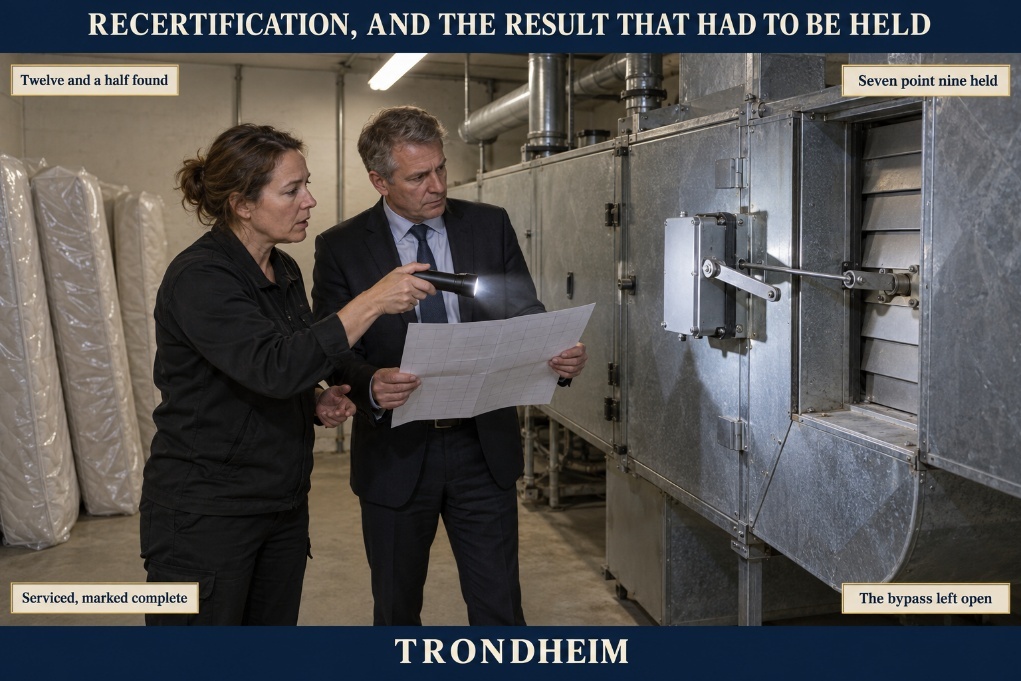
Concept Card 4.15 — Recertification, and the Result That Had to Be Held
Subchapter 4.15 · Trondheim, Norway
Setting: Trondheim, Norway
In the ventilation plant, the technical manager shines a torch at the heat recovery section of the largest air handling unit while the lead auditor follows on the schematic. What the torch lights is a bypass damper standing open. Mattresses wrapped in plastic lean against the wall behind them, the stores of a hotel in which, in that climate, heat recovery is not an efficiency measure but the reason the building is affordable at all.
The top labels are the arithmetic of the cycle. Twelve and a half found: across three years the property had found and implemented measures worth about twelve and a half points against its baseline. Seven point nine held: the figure at recertification. Four and a half points had been given back, and the technical manager had found them one at a time, by walking the building.
The lower labels are the most instructive of them. Serviced, marked complete: fourteen months earlier a technician opened the bypass to work on the wheel, as he was supposed to, and did not close it, as he was supposed to. The unit still stood in the register of significant energy uses with its performance figure beside it and a green mark in the maintenance system, because it had been serviced. The bypass left open. Around it, three ventilation zones reset to factory defaults by a firmware update, and a hot water temperature raised one degree at a time in answer to real complaints.
The pattern the card leaves with the reader is the one she could not unsee. Everything physical and irreversible had held. Everything that lived in a setting, a schedule, a position or a habit had decayed, quietly, inside a system that had marked every measure complete. The auditor’s sentence is now written inside the cover of the system manual: anybody can find a saving in a building nobody has looked at; in the second cycle, holding what you have is the whole of the work.
L’AUTORE