
The Helm and the Lens · English
Pronto per la pubblicazione / Ready for publication
the Helm and the Lens – Vol. 7a
GSTC Hotel Standard · Sustainable Tourism in Hospitality
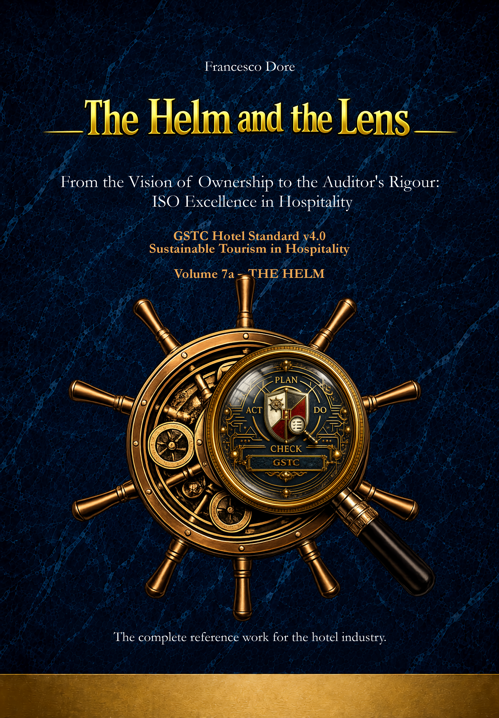
The GSTC Hotel Standard v4.0 read from the owner’s chair: what the 40 criteria ask of a hotel, what they do not, and how sustainable tourism becomes a decision of ownership rather than a label. Thirty cases, from Monteverde to Mahé.
570
Pagine
The Helm and the Lens · Volume 7a — The Helm
GSTC Hotel Standard · Sustainable Tourism in Hospitality
Sustainable tourism as a decision of ownership, and what the criteria do and do not certify
Almost every hotel now calls itself sustainable. Few can show what that means on the ground: for the people they employ, the communities around them, the heritage they stand on and the water, energy and waste that pass through them every day. This volume is about the difference between the word and the proof. Its starting point is the reference most widely used worldwide for sustainable tourism.
At the end of December 2025 the Global Sustainable Tourism Council published version 4.0 of its criteria. For the first time it set out a dedicated Hotel Standard: 40 criteria in four sections, covering sustainable management, socio-economic impacts, cultural heritage and the environment, each with its own performance indicators. The book reads the new standard as an owner or general manager meets it. It explains what each section asks and why, how the move from version 3 to version 4 changes the work of a hotel already on the path, and the transition period during which certificates issued under the old criteria remain valid.
The book also clears up a confusion the market keeps alive. The GSTC does not certify hotels. It recognises standards and accredits certification bodies. A hotel is certified by an accredited body against a recognised standard. Knowing who does what protects owners from logos that promise more than they prove.
The volume has two chapters of fifteen subchapters. The Vision of Ownership covers the decisions that belong to whoever holds the helm: the management system, purpose, local communities, fair employment, heritage, claims and communication. The Operational Perspective follows the criteria into daily operations: purchasing, staff, guests, water, energy, waste, biodiversity and the place itself. Every subchapter opens with a case set in a real place, built as a composite and clearly declared as fictional. The story begins in Monteverde, Costa Rica, and returns there to close each chapter. Each case includes a Verification Pact, which checks common market claims against what the standard actually requires.
The author is a Lead Auditor and has spent over twenty years in international luxury hospitality. He writes as an author and publisher, for those who run hotels and for those who will run them next. This is independent material, not affiliated with or endorsed by the GSTC: the standard’s own text, published at www.gstc.org, always prevails.
Each subchapter ends with a concept card. Worksheets, checklists and the cards in high resolution are available on the online platform. The companion volume, 7b — The Lens, reads the same criteria through the eyes of the internal auditor and the certification body.
EDIZIONI · FORMATI
Formati disponibili
Le edizioni fisiche e digitali associate a questa scheda.
NEL LIBRO
Contenuto / Contents
La struttura del volume così come presentata nell’edizione pubblicata.
Table of Contents
- Preface.
- 1.1 Why a Hotel Standard, and Why Now..
- 1.2 A Management System Proportional to the Property.
- 1.3 The Register Nobody Reads: Legal Compliance Beyond Permits.
- 1.4 Guest and Staff Welfare: A Name, Not a Department.
- 1.5 The Annual Sustainability Report.
- 1.6 Accurate Promotion and the Price of a Green Word.
- 1.7 Information Sharing: Telling Guests How to Behave Well
- 1.8 Staff Engagement in Every Language Spoken Back of House.
- 1.9 Guest Experience: From Feedback to Corrective Action.
- 1.10 Collaboration with the Destination.
- 1.11 Land, Water and the Rights of Those Who Were There First.
- 1.12 Site, Buildings and the Weight of a Renovation.
- 1.13 Responsible Procurement Beyond the Cheapest Quote.
- 1.14 Food and Beverages: What Reaches the Plate.
- 1.15 From Vision to System: What Chapter 2 Will Ask.
- 2.1 Community Support That Does Not Drain the Community.
- 2.2 Local Employment and Local Entrepreneurs.
- 2.3 Access for All
- 2.4 A Code of Conduct and Zero Tolerance for Exploitation.
- 2.5 Inclusion, Equality and Decent Work in a Seasonal Trade.
- 2.6 Cultural Interactions and the Protection of Heritage.
- 2.7 Presenting Culture Honestly, and the Artifact in the Lobby.
- 2.8 Energy Conservation You Can Measure.
- 2.9 Water in a Place That Has Too Little.
- 2.10 Greenhouse Gas Emissions and How Guests Arrive.
- 2.11 Wastewater, Harmful Substances and Pollution.
- 2.12 Solid Waste, Food Waste and the Island Without a Landfill
- 2.13 Biodiversity and the Invasive Plant in the Garden.
- 2.14 Animals: Interaction, Welfare and Trade.
- 2.15 From Criteria to Proof: Continual Improvement and the Road to Certification
- Afterword.
- Appendix A..
- Sources and Research Methodology — What This Book Verified, and How
- Glossary.
- About the Author.
- Contact.
- The Series.
- The Online Platform...
PRIMA DELL’ACQUISTO
Estratti / Extracts
Passaggi selezionati dal libro disponibili per la consultazione.
01 Preface Apri / Open
This book exists because a hotel that wants to show it is sustainable has, for a long time, been offered almost everything except a clear answer to a simple question: what does a published sustainability standard actually ask of a hotel, once the awards, the booking-platform badges, the consultants’ proposals and every national law are set aside, leaving only the standard’s own text and its own indicators?
Every other pair of volumes in this series takes an ISO management system standard and asks that question of it. This one does not. The GSTC Hotel Standard is the one standard in the series that is not an ISO standard, and it is worth explaining at the outset why it belongs here at all. It is not built on the harmonised clause structure of the ISO family. It is a set of forty criteria, each with performance indicators beside it, written by a council whose remit is sustainable tourism as a whole, and whose standards, in the words of their own preamble, represent “the minimum level of performance that any tourism business should aspire to achieve”. Its starting point is not the organisation but the place: the community beside the hotel, the culture around it, the water beneath it, the animals guests come to see.
That is precisely why it belongs in a series about hospitality. The ISO standards ask how a hotel manages itself. The GSTC Hotel Standard asks what a hotel does to the destination it lives from, and it asks in a form an owner can read, a guest can understand and a certification body can audit. Its first criterion still requires a documented management system, so the discipline of the earlier volumes carries over intact. What changes is the reach of the questions. A system that answered ISO 14001 well can still have nothing to say about a closed path to the beach, a locked gate on a chapel track, a seal pup touched for a photograph or a supervisory post never advertised in the town.
The Helm and the Lens is built the same way here as everywhere else in the series. It asks what the GSTC Hotel Standard itself requires and it tests that answer across thirty subchapters set in hospitality settings on five continents, from the Arctic to the Indian Ocean, with a single lodge in Monteverde, Costa Rica, opening the volume, closing its first chapter and closing the book. Where a matter turns on national law, this book says so and sends the reader to the legal register that criterion A2 already requires. This series calls that discipline standard-pure: the standard’s own text is the reference, and no single country’s law is allowed to stand in for the world.
A Series Built the Same Way Twice
This volume belongs to a wider undertaking, first built in German for the DACH hospitality market under the title Das Steuer und die Lupe (The Helm and the Lens, translated directly), and now built a second time, independently, for a global English-language readership. The two editions are not translations of each other, and at this point in the series they do not even treat the same standard: the German edition, written for a European market, turns here to the EU’s Eco-Management and Audit Scheme, while this edition, written for a readership spread across every tourism market, turns to the GSTC. The choice of standard follows the reader. What the two editions share is a method, not a text: the same architecture, the same discipline of tracing every normative claim to its primary source, and the same refusal to let a market’s own inflated claims about a standard stand unchallenged.
That discipline has a name inside this series. We call it the Verification Pact. Every significant claim this book makes about what the GSTC Hotel Standard requires is checked directly against the text of version 4.0, its performance indicators and its annex of guidelines, not against what a label vendor or a well-meaning colleague believes it says. Where the market has inflated a voluntary practice into a supposed requirement, this book says so, in a dedicated table. Where the market has understated a genuine obligation (a register that lists permits but omits child protection, a code of ethics that names no channel for a report), this book says that too. The Pact cuts in both directions, and it is not negotiable.
The Pact in Practice
A single example shows how the Pact works inside a chapter rather than as a stated principle alone. This volume’s sixth subchapter follows a twenty-two-cabin hotel on the beach road south of Tulum whose website still opens with the sentence its founders wrote ten years earlier: zero plastic, one hundred per cent off-grid, powered by the sun. The sentence had been true for a twelve-room hotel with ceiling fans. It was no longer true for a twenty-two-room hotel with air conditioning in every cabin, a diesel generator behind a bamboo screen that started on most nights after eleven, and bottled water in plastic placed in every room since the filtration unit failed. A guest found the generator at one in the morning and wrote about it.
The subchapter’s Verification Pact table sets the market’s habits beside the standard’s text. A claim that was true at opening remains acceptable: no, because criterion A5 requires claims based on actual practices, and its guideline excludes actions no longer actively implemented. Solar panels on site justify “off-grid”: no, because the energy indicators of D1 require energy by type and the proportion of renewables, and the claim must match them. Buying offsets justifies “carbon neutral”: only partially true, because D3 places offsets after reduction. The same table appears in every subchapter, from the trophy wall of awards in the first to the transition rules in the last.
Every criterion and indicator this book cites is quoted or paraphrased from the standard’s current text, not from a secondary summary or a training slide inherited from an earlier version. Where this volume offers its own extrapolation (a proposed table, a checklist, a modelled cost estimate), it says so, distinguishing its own judgement from the standard’s text.
Two Volumes: The Helm and the Lens
Each standard this series treats receives two volumes, and the title names both halves of the same instrument. The Helm (Volume 7a, the book you are holding) takes the perspective of ownership and management: sustainable tourism as a decision of ownership, and what the criteria do and do not certify. The Lens (Volume 7b, the companion volume) turns the same standard around and views it from the position of those whose task is verification: the internal auditor testing whether the system this volume describes genuinely holds, and the certification body auditing a property against criteria written for the whole of tourism.
The two volumes are companions, not a single book divided arbitrarily in half. Each stands on its own. Read together, they follow a property from deciding what its sustainability is, through building the evidence that shows it, to the moment someone else is allowed to check the work.
Who This Book Is For
Three readers will find direct use in the chapters that follow, and this book tries to serve all three without asking any one of them to wade through material meant for the other two.
| Reader | What this volume offers directly |
| Owners, general managers and hospitality leadership | A clear account of what the forty criteria require of ownership: not frames on a reception wall, but decisions, targets, named responsibilities and an annual review the thirty cases show leadership either making or avoiding |
| Sustainability coordinators, department heads and internal audit staff | A working method for reading a property at the level of the performance indicators, where version 4.0 is now assessed, and for finding where practice and evidence have drifted apart |
| Students and faculty at hospitality management institutions | A case-based introduction to sustainable tourism standards grounded in real operational tension rather than abstract summary, written in the hope that it earns a place on a reading list |
That third readership carries a specific ambition this preface will state plainly. The standard’s own preamble names education and training by universities and hospitality schools among its uses. This series exists in part to reach institutions with genuine international standing in hospitality education (the École hôtelière de Lausanne named specifically among them), as a work judged fit to teach from, not merely a work fit to sell. Whether it earns that place is a judgement this book cannot make about itself. It can only be written as though that judgement mattered from the first page.
The Wider Series
The Helm and the Lens follows one international standard per pair of volumes, in its own numbering: Volume 1, environmental management under ISO 14001:2026; Volume 2, quality management under ISO 9001:2026; Volume 3, occupational health and safety under ISO 45001:2018; Volume 4, energy management under ISO 50001:2018; Volume 5, information security under ISO/IEC 27001:2022; Volume 6, food safety under ISO 22000:2018; Volume 7, sustainable tourism under the GSTC Hotel Standard; Volume 8, event sustainability under ISO 20121:2024; and Volume 9, The Small Property, addressing the small, independently owned property whose scale changes what proportionate management looks like without changing what the standards themselves require. Readers of the earlier volumes will recognise much of section A of the GSTC Hotel Standard: a policy, a plan, targets, a legal register, an annual review. …
02 2.5 Inclusion, Equality and Decent Work in a Seasonal Trade Apri / Open
GUIDING QUESTION
A seasonal hotel lives on people who arrive in spring and leave in autumn, and many of them come back year after year. Criteria B8 and B9 do not distinguish between the permanent and the temporary: they ask for equal opportunity, a fair wage, training, a voice and a safe way to complain for all staff. What does an owner discover when the people who come back are counted as if they had never been there before?
Opening
In a fishing village on the outer Lofoten Islands, where the mountains drop straight into the sea and the drying racks for cod stand empty in summer, a family company runs forty-eight converted fishermen’s cabins and a main house with a restaurant on the quay. From June to August the property is full under the midnight sun; in late winter it opens again for guests who come for the northern lights and the fishing season. Fifteen people work there all year. In summer the team grows to seventy.
Most of the seasonal staff are young people from other parts of Norway and from abroad, recruited through online job boards. Many return. The restaurant’s chef de partie, who arrived from abroad as a commis four summers ago, is in her fifth season. She has trained most of the summer kitchen brigade in that time, and the head chef relies on her more than on anyone else.
At the end of August, on the morning of her last shift, she leaves a letter for the managing director. It is short and without anger. She writes that she is paid this summer at the same rate as in her first summer, that she has twice asked to work the winter season and never received an answer, that she has never been offered any training after the first day, and that the supervisor posts in the kitchen have been filled from the permanent team each time they fell vacant. She adds that, in July, a guest made remarks about a seasonal waitress’s headscarf, and that nobody on the floor knew what they were supposed to do. She will not return next year.
The managing director reads the letter twice and calls in the human resources coordinator, who works part time from the office in the main house. Together they look at the files. Every seasonal contract is a new contract, so no seasonal employee has ever been counted as having more than one season of service. The annual staff survey is sent each November to the permanent staff only, because the seasonal staff have gone home. There is no record of any training for seasonal staff beyond the induction morning. The cabin changeovers are done by a contracted cleaning firm whose working hours nobody at the property has ever asked about.
It is worth being fair to the managing director, because the property pays what its legal adviser has confirmed it must pay, houses its seasonal staff free of charge in a staff house the family renovated, and has never been accused of mistreating anyone. The seasonal system was inherited from his parents and built for a time when summer staff were students who came once. What changed was the staff, not the system, and nobody had checked whether the system still fitted the people it governed.
That afternoon he opens the GSTC Hotel Standard at criteria B8 and B9. Indicator B9.3 refers to “all staff, including contract and temporary staff”. Indicator B9.5 asks for training records “for all staff”. Indicator B8.5 asks for equal employment opportunities to be monitored “across all positions, including management roles”. The word all recurs, and the property had read it as all permanent.
The Problem
The Structural Failure
The structural failure was that the employment system treated every season as a first season. Because each contract started from zero, tenure was invisible, the wage review had nothing to review, training was never cumulative and promotion was never considered. A worker in her fifth summer was, on paper, a new arrival. The system did not discriminate against seasonal staff by intention; it simply had no way of seeing them as staff with a history.
The second structural gap was that every channel of voice was timed to the permanent calendar. The survey went out in November, the grievance route ran through the head of department, and the review of wages took place in January. All three happened when the seasonal team was absent. The people who made up four fifths of the summer workforce had no moment in the year at which they were asked anything.
The Cultural Failure
The cultural failure is a habit of seasonal tourism: the belief that temporary staff are a cost to be managed rather than a team to be developed. The habit is reinforced by the season itself. When everything must be done in ten weeks, there is no time to train, review or listen, and so the property decides each year, without deciding, that it will not.
A second habit concerns equality. A property can believe sincerely that it does not discriminate because nobody in it holds prejudice, while its structures produce an unequal outcome by default. Supervisor posts drawn only from the permanent team, a survey that reaches only one group and no guidance on how to respond to a guest’s remarks about a colleague are not acts of prejudice. They are the absence of a policy, and the standard asks for the policy.
The Principle
Criteria B8 and B9 together describe what a hotel owes the people who work in it, whatever the length or form of their contract.
| Dimension | What the standard asks | Where the property stood |
| Inclusion policy | A written policy prohibiting discrimination on any non-merit-based factor, reviewed regularly | No written policy; a sincere belief in fairness |
| Groups at risk | Groups at risk of discrimination identified and documented, reflected in HR practice | Never considered |
| Equal opportunity | Monitored across all positions, including management | Supervisory posts filled from the permanent team only |
| Wages | At least the legal minimum for all staff; an annual review on measurable criteria | Legal rates paid; seasonal tenure never reviewed |
| Training | Role training, development and pathways, with records for all staff | Induction only for seasonal staff |
| Voice | Staff satisfaction monitored; a safe, confidential grievance system without retaliation | Survey and grievances reached permanent staff only |
The principle is that the form of the contract does not change the content of the obligation. A seasonal worker is owed the same non-discrimination, the same legal wage, the same safety and the same means of complaint as a permanent one, and a returning seasonal worker is owed a history.
What the Standard Says
Criterion B8, Employment inclusion and equality, asks that the hotel provides inclusion and equal employment opportunities at all levels and for all positions, with an employment policy that explicitly prohibits discrimination on the basis of any non-merit-based characteristic. Indicator B8.1 asks for a written inclusive employment policy that prohibits discrimination based on gender, age, race, nationality, ethnic origin, colour, religion, sexual orientation, gender identity or expression, marital or family status, genetic characteristics, disability or any other non-merit-based factor. Indicator B8.2 asks that it be regularly reviewed and updated. Indicator B8.3 asks the hotel to identify and document groups at risk of discrimination and to reflect this in its employment and HR practices; the guideline names women, persons with disabilities, Indigenous peoples and local minorities, among others depending on the local context. Indicator B8.4 asks for training on recognising, preventing and addressing bias and discrimination “in the workplace and in guest interactions”, and indicator B8.5 asks for monitoring of equal employment opportunities across all positions, including management.
Criterion B9, Decent work, asks the hotel to uphold labour rights by ensuring a safe and secure working environment, “providing a living wage”, and offering regular training and opportunities for career advancement, for directly employed staff and outsourced workers alike. Its seven indicators are the most detailed in section B.
| Indicator | What it requires | Guideline or note |
| B9.1 | Compliance with national labour regulations for a safe and secure environment for all staff, including contracted organisations’ staff; ILO conventions where applicable | Responsibilities defined; high-risk or specialised contractors follow safety procedures and legal obligations |
| B9.2 | Directly employed staff have access to health, medical and social security provisions in line with national legislation | Where public systems do not provide them, contracts may include them |
| B9.3 | All staff, including contract and temporary staff, receive at least the legal minimum wage | Without a legal minimum wage, align with recognised living wage benchmarks, also for relevant suppliers |
| B9.4 | An annual wage review based on measurable criteria such as performance, tenure and skill development | The review, including career preferences, is documented and used to improve remuneration |
| B9.5 | Role training, professional development and clear pathways, with training records for all staff | Records show level and frequency of training |
| B9.6 | Staff satisfaction monitored through regular surveys or feedback | Results recorded |
| B9.7 | A safe and confidential grievance system with explicit safeguards against retaliation | No negative consequences for using it |
Compared with Industry Standard v3, where the equal opportunity criterion asked for groups at risk to be identified and their share monitored, and the decent work criterion covered labour standards, wage monitoring, training records, health and social security, staff satisfaction and a grievance system, version 4.0 adds a written inclusive policy with an explicit list of grounds, training on bias that includes guest interactions, the extension to contracted and temporary staff, an annual wage review on measurable criteria and explicit protection against retaliation.
MATERIALI DI LAVORO
Materiali e download
Checklist, modelli, supplementi e file di lavoro collegati al volume.
FILES
1 · Working material 1.1 — Why a Hotel Standard, and Why Now
GSTC Hotel Standard v4.0 · 7a · 1.1
Editable Word worksheet: Verification Pact, mistakes self-check, checklist and evidence questions
FILES
3 · Working material 1.2 — A Management System Proportional to the Property
GSTC Hotel Standard v4.0 · 7a · 1.2
Editable Word worksheet: Verification Pact, mistakes self-check, checklist and evidence questions
FILES
5 · Working material 1.3 — The Register Nobody Reads: Legal Compliance Beyond Permits
GSTC Hotel Standard v4.0 · 7a · 1.3
Editable Word worksheet: Verification Pact, mistakes self-check, checklist and evidence questions
FILES
7 · Working material 1.4 — Guest and Staff Welfare: A Name, Not a Department
GSTC Hotel Standard v4.0 · 7a · 1.4
Editable Word worksheet: Verification Pact, mistakes self-check, checklist and evidence questions
FILES
9 · Working material 1.5 — The Annual Sustainability Report
GSTC Hotel Standard v4.0 · 7a · 1.5
Editable Word worksheet: Verification Pact, mistakes self-check, checklist and evidence questions
FILES
11 · Working material 1.6 — Accurate Promotion and the Price of a Green Word
GSTC Hotel Standard v4.0 · 7a · 1.6
Editable Word worksheet: Verification Pact, mistakes self-check, checklist and evidence questions
FILES
13 · Working material 1.7 — Information Sharing: Telling Guests How to Behave Well
GSTC Hotel Standard v4.0 · 7a · 1.7
Editable Word worksheet: Verification Pact, mistakes self-check, checklist and evidence questions
FILES
15 · Working material 1.8 — Staff Engagement in Every Language Spoken Back of House
GSTC Hotel Standard v4.0 · 7a · 1.8
Editable Word worksheet: Verification Pact, mistakes self-check, checklist and evidence questions
FILES
17 · Working material 1.9 — Guest Experience: From Feedback to Corrective Action
GSTC Hotel Standard v4.0 · 7a · 1.9
Editable Word worksheet: Verification Pact, mistakes self-check, checklist and evidence questions
FILES
19 · Working material 1.10 — Collaboration with the Destination
GSTC Hotel Standard v4.0 · 7a · 1.10
Editable Word worksheet: Verification Pact, mistakes self-check, checklist and evidence questions
FILES
21 · Working material 1.11 — Land, Water and the Rights of Those Who Were There First
GSTC Hotel Standard v4.0 · 7a · 1.11
Editable Word worksheet: Verification Pact, mistakes self-check, checklist and evidence questions
FILES
23 · Working material 1.12 — Site, Buildings and the Weight of a Renovation
GSTC Hotel Standard v4.0 · 7a · 1.12
Editable Word worksheet: Verification Pact, mistakes self-check, checklist and evidence questions
FILES
25 · Working material 1.13 — Responsible Procurement Beyond the Cheapest Quote
GSTC Hotel Standard v4.0 · 7a · 1.13
Editable Word worksheet: Verification Pact, mistakes self-check, checklist and evidence questions
FILES
27 · Working material 1.14 — Food and Beverages: What Reaches the Plate
GSTC Hotel Standard v4.0 · 7a · 1.14
Editable Word worksheet: Verification Pact, mistakes self-check, checklist and evidence questions
FILES
29 · Working material 1.15 — From Vision to System: What Chapter 2 Will Ask
GSTC Hotel Standard v4.0 · 7a · 1.15
Editable Word worksheet: Verification Pact, mistakes self-check, checklist and evidence questions
FILES
31 · Working material 2.1 — Community Support That Does Not Drain the Community
GSTC Hotel Standard v4.0 · 7a · 2.1
Editable Word worksheet: Verification Pact, mistakes self-check, checklist and evidence questions
FILES
33 · Working material 2.2 — Local Employment and Local Entrepreneurs
GSTC Hotel Standard v4.0 · 7a · 2.2
Editable Word worksheet: Verification Pact, mistakes self-check, checklist and evidence questions
FILES
35 · Working material 2.3 — Access for All
GSTC Hotel Standard v4.0 · 7a · 2.3
Editable Word worksheet: Verification Pact, mistakes self-check, checklist and evidence questions
FILES
37 · Working material 2.4 — A Code of Conduct and Zero Tolerance for Exploitation
GSTC Hotel Standard v4.0 · 7a · 2.4
Editable Word worksheet: Verification Pact, mistakes self-check, checklist and evidence questions
FILES
39 · Working material 2.5 — Inclusion, Equality and Decent Work in a Seasonal Trade
GSTC Hotel Standard v4.0 · 7a · 2.5
Editable Word worksheet: Verification Pact, mistakes self-check, checklist and evidence questions
FILES
41 · Working material 2.6 — Cultural Interactions and the Protection of Heritage
GSTC Hotel Standard v4.0 · 7a · 2.6
Editable Word worksheet: Verification Pact, mistakes self-check, checklist and evidence questions
FILES
43 · Working material 2.7 — Presenting Culture Honestly, and the Artifact in the Lobby
GSTC Hotel Standard v4.0 · 7a · 2.7
Editable Word worksheet: Verification Pact, mistakes self-check, checklist and evidence questions
FILES
45 · Working material 2.8 — Energy Conservation You Can Measure
GSTC Hotel Standard v4.0 · 7a · 2.8
Editable Word worksheet: Verification Pact, mistakes self-check, checklist and evidence questions
FILES
47 · Working material 2.9 — Water in a Place That Has Too Little
GSTC Hotel Standard v4.0 · 7a · 2.9
Editable Word worksheet: Verification Pact, mistakes self-check, checklist and evidence questions
FILES
49 · Working material 2.10 — Greenhouse Gas Emissions and How Guests Arrive
GSTC Hotel Standard v4.0 · 7a · 2.10
Editable Word worksheet: Verification Pact, mistakes self-check, checklist and evidence questions
FILES
51 · Working material 2.11 — Wastewater, Harmful Substances and Pollution
GSTC Hotel Standard v4.0 · 7a · 2.11
Editable Word worksheet: Verification Pact, mistakes self-check, checklist and evidence questions
FILES
53 · Working material 2.12 — Solid Waste, Food Waste and the Island Without a Landfill
GSTC Hotel Standard v4.0 · 7a · 2.12
Editable Word worksheet: Verification Pact, mistakes self-check, checklist and evidence questions
FILES
55 · Working material 2.13 — Biodiversity and the Invasive Plant in the Garden
GSTC Hotel Standard v4.0 · 7a · 2.13
Editable Word worksheet: Verification Pact, mistakes self-check, checklist and evidence questions
FILES
57 · Working material 2.14 — Animals: Interaction, Welfare and Trade
GSTC Hotel Standard v4.0 · 7a · 2.14
Editable Word worksheet: Verification Pact, mistakes self-check, checklist and evidence questions
FILES
59 · Working material 2.15 — From Criteria to Proof: Continual Improvement and the Road to Certification
GSTC Hotel Standard v4.0 · 7a · 2.15
Editable Word worksheet: Verification Pact, mistakes self-check, checklist and evidence questions
FILES
61 · The gap map against the forty criteria
GSTC Hotel Standard v4.0 · 7a · 1.1 · 1.15 · 2.15
Editable Word grid: all 205 indicators, three states, person responsible, reason if not applicable
FILES
64 · The legal register template for criterion A2
GSTC Hotel Standard v4.0 · 7a · 1.3
Editable Word structure: the A2.1 guideline areas, three questions each, review dates
FILES
67 · The monthly indicator log for energy, water, waste and emissions
GSTC Hotel Standard v4.0 · 7a · 1.5 · 2.8 · 2.9 · 2.10 · 2.12
Excel log with working formulas: per guest night, per occupied room, Scope 1 and 2, A4 notes
FILES
70 · The transition checklist from Industry Standard v3.0 to Hotel Standard v4.0
GSTC Hotel Standard v4.0 · 7a · 1.15 · 2.15 · Appendix A
Editable Word checklist: correspondence for all four sections, steps to 30 December 2028
XLSX
73 · Verification Pact register
GSTC Hotel Standard v4.0 · 7a · 1.1–2.15
Every Verification Pact row of the thirty subchapters, filterable, with counts by answer
XLSX
74 · Common Mistakes register
GSTC Hotel Standard v4.0 · 7a · 1.1–2.15
All 240 common mistakes with a Yes/Partly/No/N.A. column and counts by subchapter
Immagini e tavole HD
Apri e proietta le foto direttamente dal sito, a schermo intero, oppure scarica gli originali.

Concept Card 1.1 — Why a Hotel Standard, and Why Now
Setting: Monteverde, Costa Rica
The card shows a February morning at a family lodge below the cloud forest, when the owner reads a tour operator's supplier questionnaire twice and walks out to her wall of six frames. The operator, which sends the lodge a fifth of its guest nights, asks three short questions: certification, a documented management system, and twelve months of evidence on energy, water, waste and emissions. Not one frame answers any of them. The lodge has been sustainable in practice and invisible in proof, and she has a month to reply.
The plaques at the top give the event: «Six frames on the wall» and «Three questions, no answers». The lower pair names the lesson: «Awards are not certification» and «Sincerity needs evidence», because praise records approval, while a published standard asks what was done, how it was measured and who checked.
The card does not say that the awards were undeserved or that the owner was negligent: every frame was earned by something real. Nor does it say that certification is compulsory; the three questions came from a market partner, not from the standard.
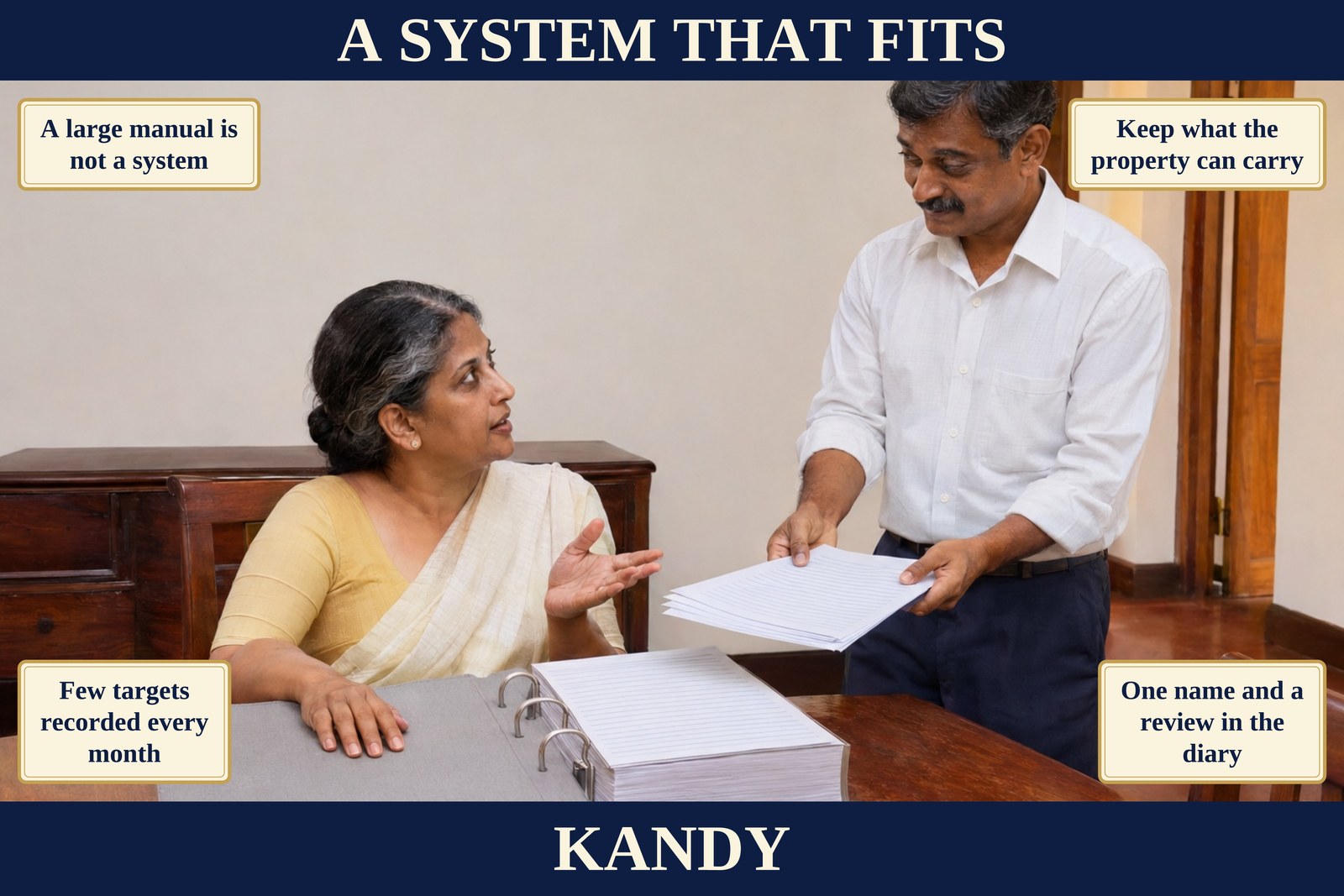
Concept Card 1.2 — A Management System Proportional to the Property
Setting: Kandy, Sri Lanka
The card shows the afternoon in Kandy when the owner puts a binder of one hundred and forty-six pages on the dining-room table and asks the general manager which page the hotel actually does. Copied from a four-hundred-room chain resort, it describes eleven committees, sixty-four indicators and risks for a marina it lacks. Fourteen months on, no committee has met, the indicator sheet was filled in twice and abandoned, and the head of housekeeping has never seen the signed policy. A certification body's application form is waiting.
The plaques at the top give the event: «A borrowed manual of many pages» and «Eleven committees that never met». The lower pair names the lesson: «Proportion is not a discount» and «A system that fits is used»: every element of the system must exist, in a form an eighteen-room hotel can actually carry.
The card does not say that the chain's manual was bad or the general manager lazy: it worked where it was written, with a full-time coordinator. Nor does it say that a small hotel may leave elements of the system out.
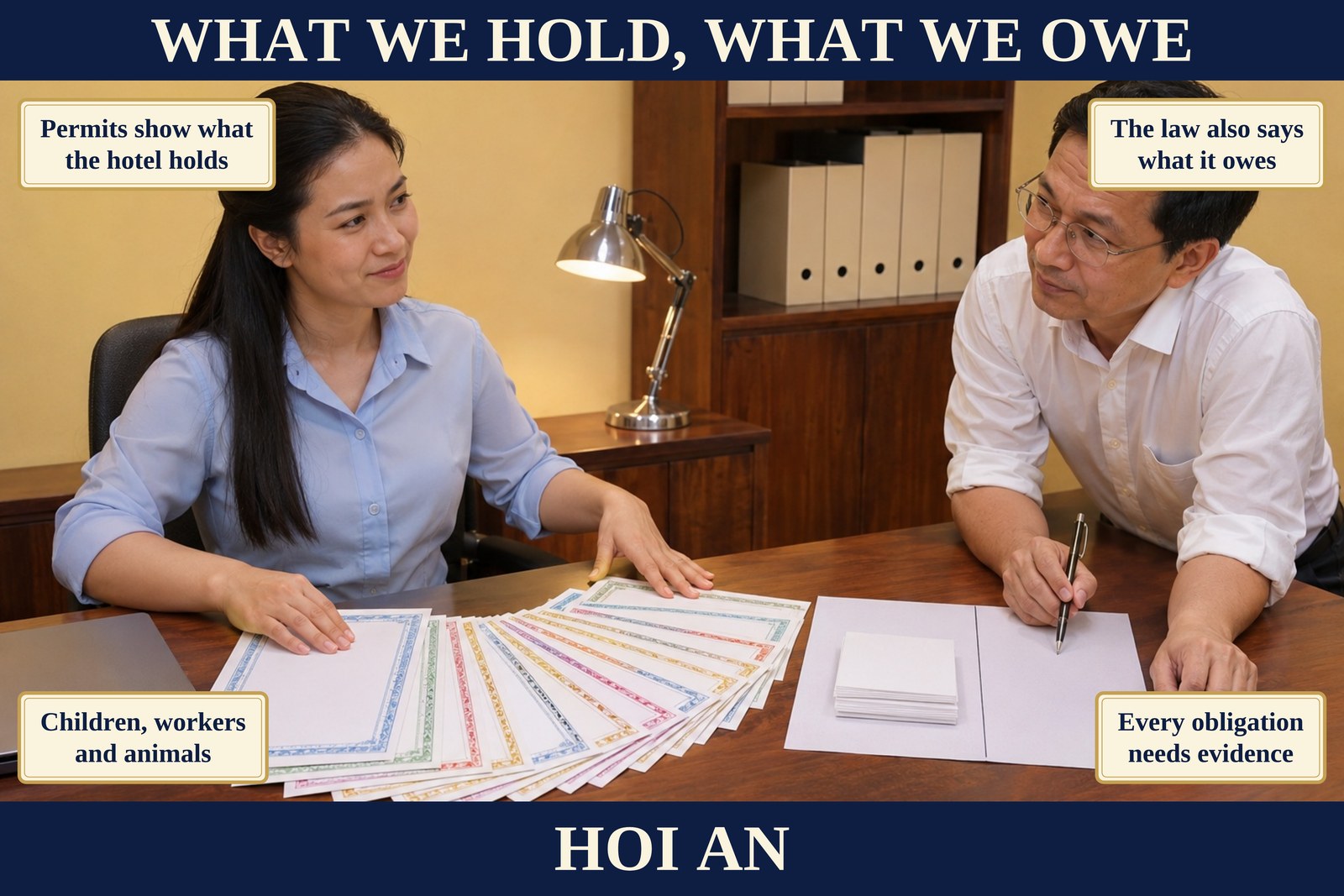
Concept Card 1.3 — The Register Nobody Reads: Legal Compliance Beyond Permits
Setting: Hoi An, Vietnam
The card shows a March morning in Hoi An, when the general manager reads criterion A2 aloud and finds that the hotel's immaculate register of fourteen permits has no row for labour rights, child protection, trafficking or animal welfare. Meanwhile a night receptionist recently checked in a man and a teenage girl without knowing what she could ask, a laundry contractor houses its workers on terms nobody knows, and the tour desk sells buffalo rides nobody has checked. He writes two headings: what we hold, and what we owe.
The plaques at the top give the event: «Fourteen permits, all valid» and «No row for child protection». The lower pair names the lesson: «A register of what the hotel owes» and «Laws that issue no permit still bind»: A2 asks for compliance with all relevant laws, including those no inspector comes to check.
The card does not say that the administrative manager failed: her register did exactly what it was built to do, and no permit lapsed in six years. Nor does it fault the night receptionist for a question nobody had prepared her to ask.
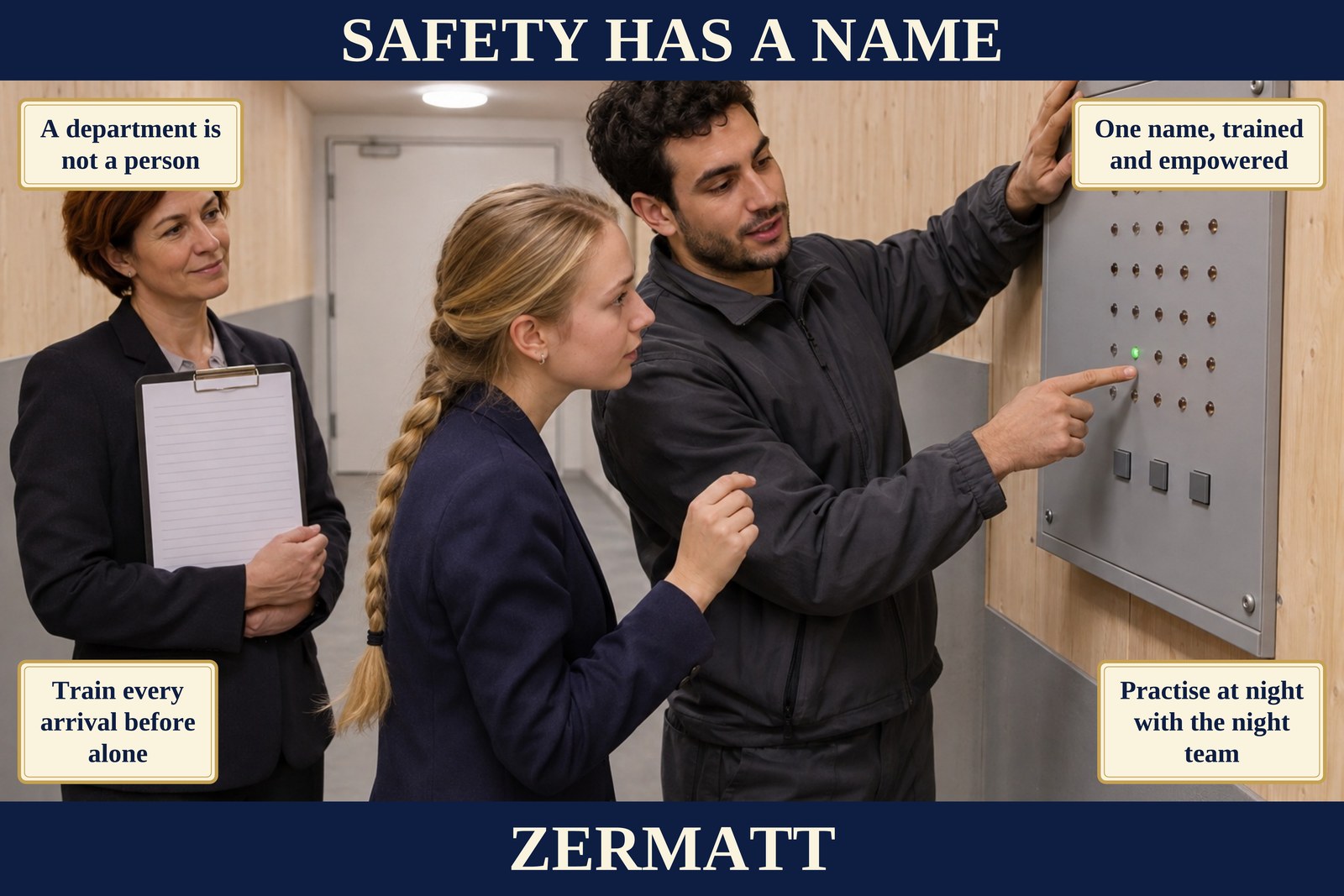
Concept Card 1.4 — Guest and Staff Welfare: A Name, Not a Department
Setting: Zermatt, Switzerland
The card shows the January morning in Zermatt after a fire alarm at twenty to three. A dryer had overheated; a night porter in his second week could not read the panel or name the assembly point, and forty guests stood in the snow by the main entrance. Nobody was hurt. Asked who is responsible for health and safety, the chief engineer, the human resources manager and the front-office manager each give a true answer about their own part. None of the answers is a name.
The plaques at the top give the event: «Alarm at twenty to three» and «Three answers, no single name». The lower pair names the lesson: «Safety needs one named person», since A3 asks for a designated overseer, and «Train before the first night alone», the book's practical answer for seasonal staff who arrive after the annual session.
The card does not say that the night porter was to blame: nobody had shown him the panel. Nor does it fault the departments, whose equipment and November training were sound; what was missing was one person responsible for the gaps between them.

Concept Card 1.5 — The Annual Sustainability Report
Setting: Funchal (Madeira), Portugal
The card shows a December afternoon in Funchal, when the quality manager, preparing the annual sustainability report, finds water consumption nineteen per cent above the previous year with occupancy almost unchanged. Laying twelve invoices in a row, she sees the rise begin in April. That afternoon maintenance finds a cracked pipe between a pool's balance tank and the irrigation line, leaking for eight months. Every invoice had been checked and paid; the figures were in the building, but they were collected for a report written once a year.
The plaques at the top give the event: «Water up, occupancy unchanged» and «A leak found eight months late». The lower pair names the lesson: «Monitor to manage, not to publish» and «Read the meters every month»: a monthly reading is the book's practice, so that the annual report records problems already caught.
The card does not say that the quality manager was careless: she did the task she was given, honestly and well. Nor does it say that reporting is pointless; the page telling the story of the leak became the one partners mention most.

Concept Card 1.6 — Accurate Promotion and the Price of a Green Word
Setting: Tulum, Mexico
The card shows a March morning south of Tulum, when the founding couple sit with a guest's printed review beside their homepage, which still promises "Zero plastic. One hundred per cent off-grid. Powered by the sun." The guest, an electrical engineer woken at one in the morning, photographed the diesel generator and the crates of bottled water by the service gate. A journalist and a certification body ask for evidence. Of the three claims, none can be supported with data, and two are contradicted by what guests can see.
The plaques at the top give the event: «Off-grid, except at night» and «Bottles stacked by the generator». The lower pair names the lesson: «A green word is a claim of fact» and «Figures instead of adjectives»: every claim made to guests should be one the hotel could prove tomorrow, with a figure and a date.
The card does not say that the owners set out to deceive: the solar array still supplies most daytime power, and their commitment is real. The gap opened one reasonable decision at a time, and nobody went back to the website.
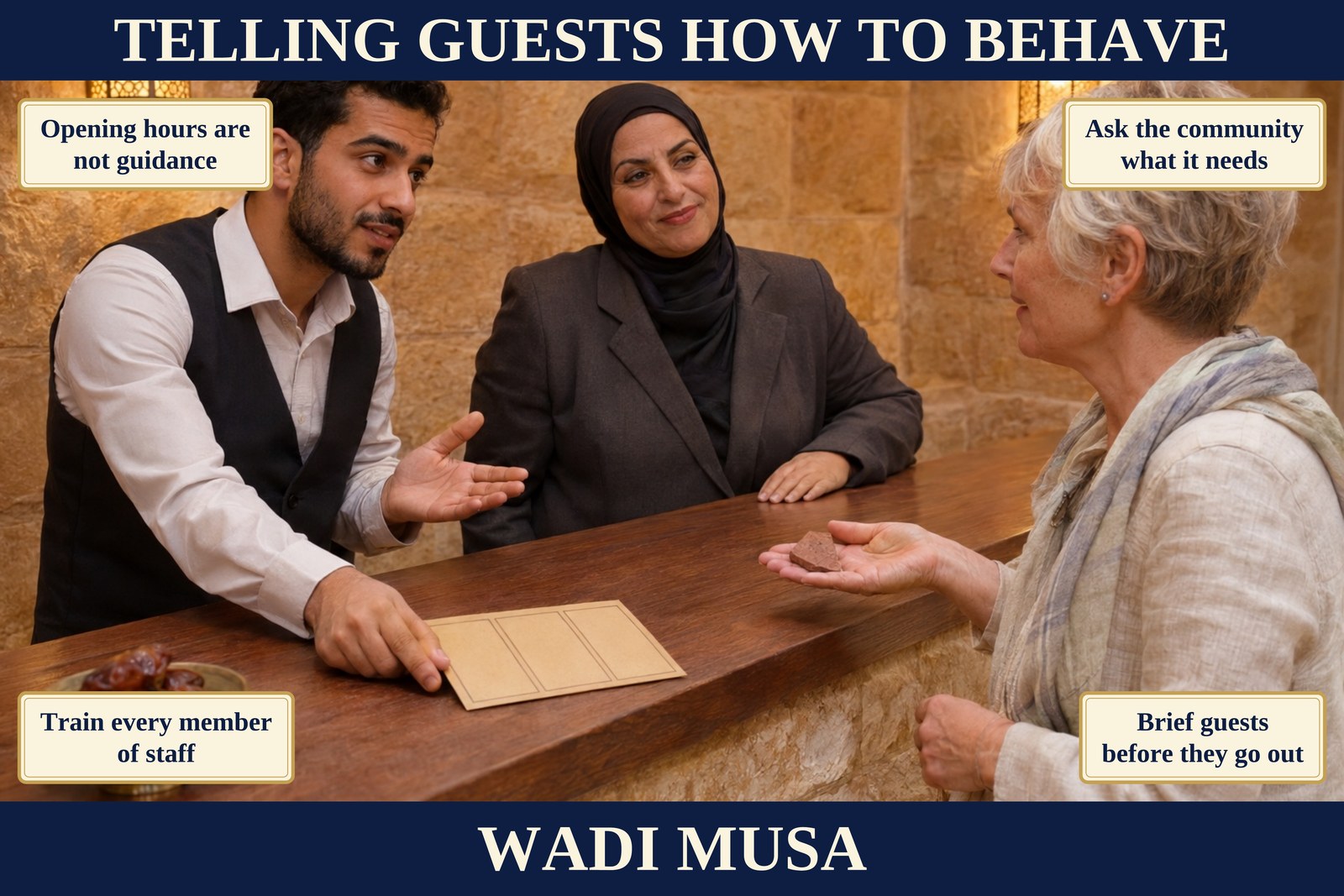
Concept Card 1.7 — Information Sharing: Telling Guests How to Behave Well
Setting: Wadi Musa (Petra), Jordan
The card shows a Monday meeting in Wadi Musa, when the general manager reads a guest review to her department heads. The writer's group walked a residential lane in beach clothes, photographed children selling postcards and left bottles at a viewpoint: "Nobody at the hotel told us anything. We would have listened." The same week a guest asked whether she could take home a stone fragment sold as ancient. Asked what they would tell guests about conduct, the team offers only hours, maps and guides.
The plaques at the top give the event: «We would have listened» and «Maps and hours, nothing on conduct». The lower pair names the lesson: «Guidance on behaviour is owed too» and «Staff are the first audience»: what a hotel tells guests about a place should include how to behave in it, and staff must know it first.
The card does not say that the staff were ignorant: they know the town and its customs better than any guidebook. Nor does it blame the guests or the guides; each side assumed the other had given the briefing.
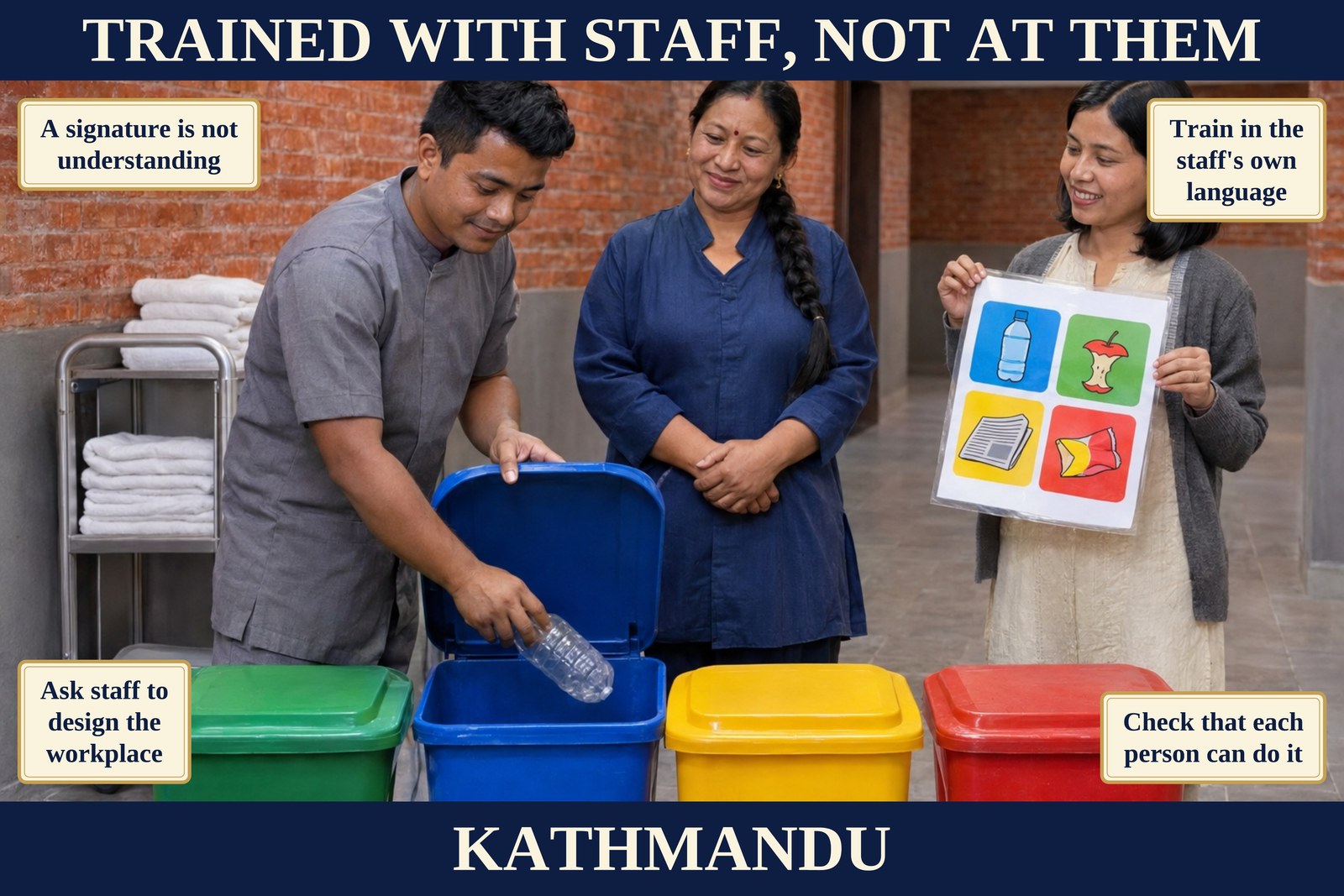
Concept Card 1.8 — Staff Engagement in Every Language Spoken Back of House
Setting: Kathmandu, Nepal
The card shows the moment, six weeks after an hour-long session in English on four colour-coded waste bins, when the training meets the landing. Forty-one employees signed the attendance list, and the hotel recorded the training as complete. Now the housekeeping supervisor, Sita, finds the bins used almost at random and asks a room attendant, in Maithili, what the colours mean. He does not know: he signed because everyone did. Four of five colleagues give the same answer; the fifth understood because her son translated the slides.
The plaques at the top give the event: «Forty-one signatures on the list» and «Bins used almost at random». The lower pair names the lesson: «Presence is not understanding» and «Train in the language staff speak»: engagement is shown by what staff understand and do, and understanding begins with their own language.
The card does not say that the coordinator was careless: the session was prepared with care and properly recorded. Nor does it fault the room attendant, who answered honestly. What was missing was any check that the people in the room could follow.
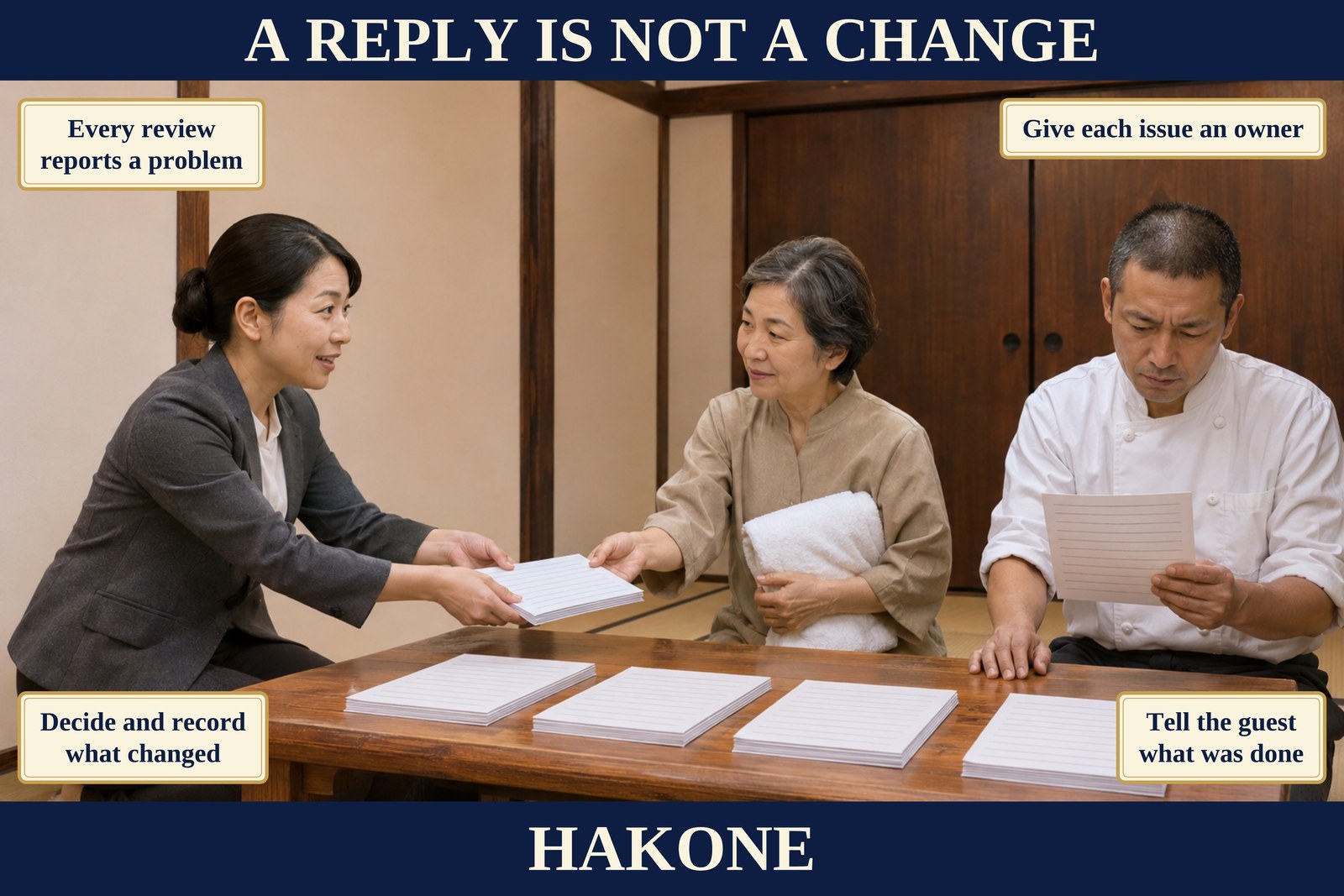
Concept Card 1.9 — Guest Experience: From Feedback to Corrective Action
Setting: Hakone, Japan
The card shows the morning after a returning guest's note and review at an inn in Hakone. A year earlier she had pointed out daily towel changes, plastic-wrapped amenities and oversized breakfast portions, and received a warm reply; this year nothing has changed. A search of the past year finds thirty-one similar comments in five languages, each courteously answered, none passed to housekeeping, the kitchen or maintenance. The inn had built a system for answering guests and none for acting on what they said.
The plaques at the top give the event: «Thirty-one replies, no change» and «The same towels a year later». The lower pair names the lesson: «A reply is not a corrective action» and «Tell guests what changed»: A8 asks for corrective actions to be documented and for guests to be told about them.
The card does not say that the guest relations manager was indifferent: she read more carefully and replied more personally than most. She did exactly what her role defined; nobody had given her a place to send a problem.

Concept Card 1.10 — Collaboration with the Destination
Setting: Ponta Delgada (Azores), Portugal
The card shows the half-hour in Ponta Delgada when the young sustainability coordinator, Inês, puts three things before the general manager: her note, the destination's published sustainability priorities and three years of unanswered invitations to its meetings. The priorities include spreading visitors across the island and the day; the hotel's best-selling excursion sends a dawn minibus to the most photographed crater-lake viewpoint with every other minibus. The hotel's plan was sound on its own terms and pulling against the destination's. He tells her to reply.
The plaques at the top give the event: «Three years of unanswered invitations» and «Every minibus at the same viewpoint». The lower pair names the lesson: «Align the plan with the destination» and «Engagement leaves a written record»: engagement is measured by the changes a hotel can trace to it, not by meetings attended.
The card does not say that the general manager despised the destination: he took the first invitation for a marketing scheme, and nobody had made engagement part of his duties. Nor does it say that the hotel's own plan was poor.
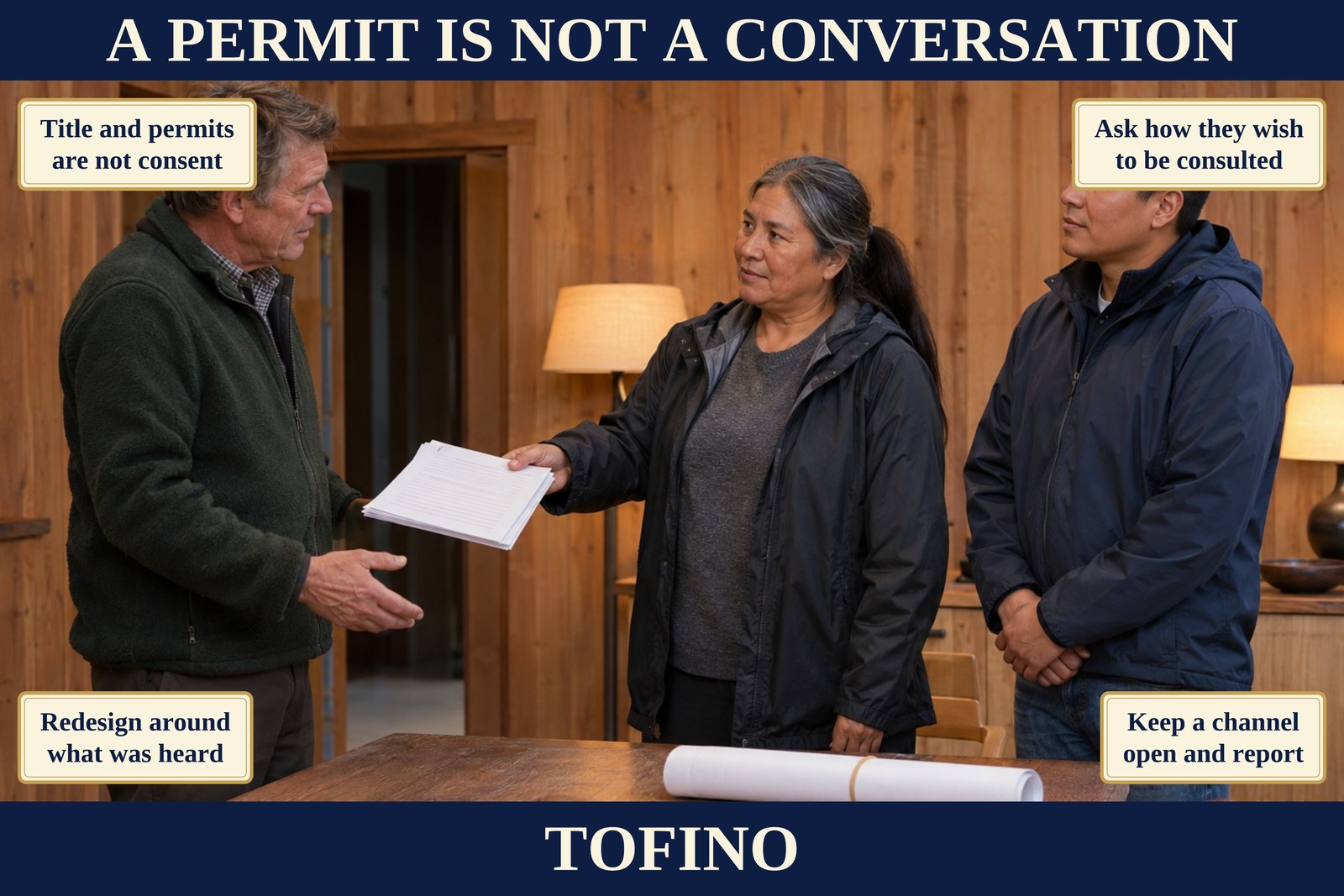
Concept Card 1.11 — Land, Water and the Rights of Those Who Were There First
Setting: Tofino, Canada
The card shows a March morning in Tofino, as contractors clear a newly bought parcel for cabins. Two representatives of a neighbouring First Nation explain that the land lies within their traditional territory, that their families have used its shoreline path for generations, and that the creek has a name in their language. Nobody from the lodge has spoken to them. The owner shows them his permits, because permits are what he has. They hand them back: the permits are between the lodge and the municipality.
The plaques at the top give the event: «Permits shown, then handed back» and «Nobody had asked the Nation». The lower pair names the lesson: «Permits do not replace consultation» and «Consult before the design is fixed»: A10 asks for consultation on new developments, and consulting early is the book's advice.
The card does not say that the owner acted in bad faith: he bought the land legally and followed every procedure required of him. Nor does it say what consent the Nation was owed in law; that depends on the applicable rules.
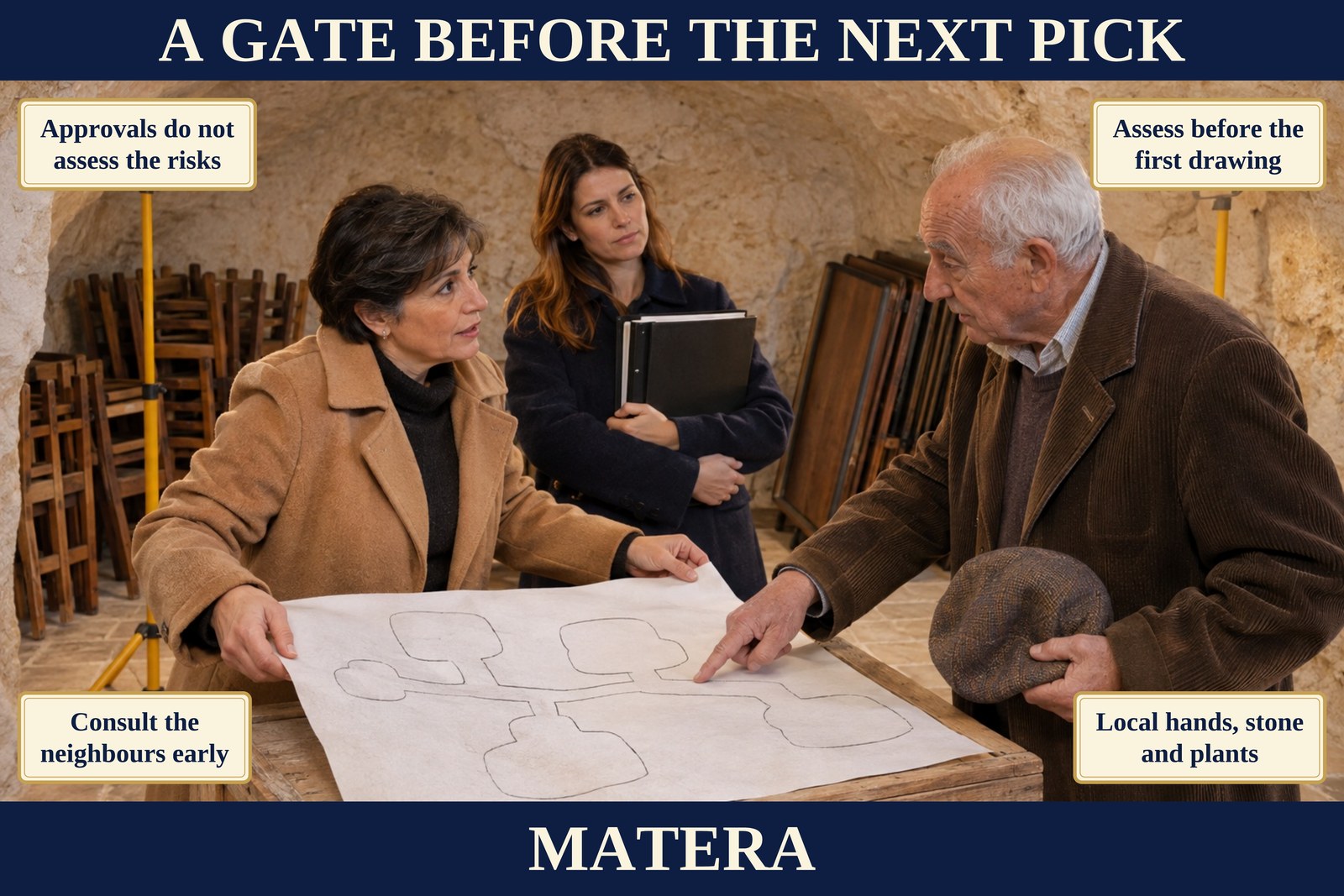
Concept Card 1.12 — Site, Buildings and the Weight of a Renovation
Setting: Matera, Italy
The card shows a March day in Matera, when the general manager prepares the hotel's first gap map for a cultural travel agency. The renovation of six cave dwellings passed every authority, and the binder of approvals is impeccable. Yet tiles came from four hundred kilometres away, spoil went unsorted into skips, limestone dust washed into a cistern the neighbours were cleaning, and the roof garden holds plants that spread in the ravine. Against the renovation criteria, the binder evidences one indicator out of ten.
The plaques at the top give the event: «Every stamp, one indicator of ten» and «Silt washed into the old cistern». The lower pair names the lesson: «Assess risks before the design» and «A permit is the floor, not the content»: A11 asks for sustainability risks to be assessed as part of planning, beyond the permits themselves.
The card does not say that the restoration was careless: the owner respected the façades and kept every carved niche, and the approvals were deserved. Nor does it blame the authorities. No permit had asked the sustainability question, and nobody inside had either.

Concept Card 1.13 — Responsible Procurement Beyond the Cheapest Quote
Setting: Oaxaca, Mexico
The card shows an April day in Oaxaca, when the general manager reads the head office's breakdown of the hotel's spending by supplier. A tour operator's questionnaire has asked for a procurement policy, local purchasing targets and the share of fresh goods from local producers; the group's policy mentions only quality, price and compliance. The wholesaler recorded for years as local resells produce from other states. Meanwhile the breakfast salsa comes from market tomatoes bought with petty cash, and weavers two streets away have never been asked.
The plaques at the top give the event: «A reseller recorded as local» and «Almost nothing from the valleys». The lower pair names the lesson: «Write the preference, then measure» and «Know the true origin of goods»: purchasing preferences become management only when written, targeted and checked against where goods really come from.
The card does not say that centralised purchasing was a mistake: it brought order, compliance and savings to six hotels. Nor does it blame the purchasing director; the system simply had no criterion beyond price, quality and paperwork.
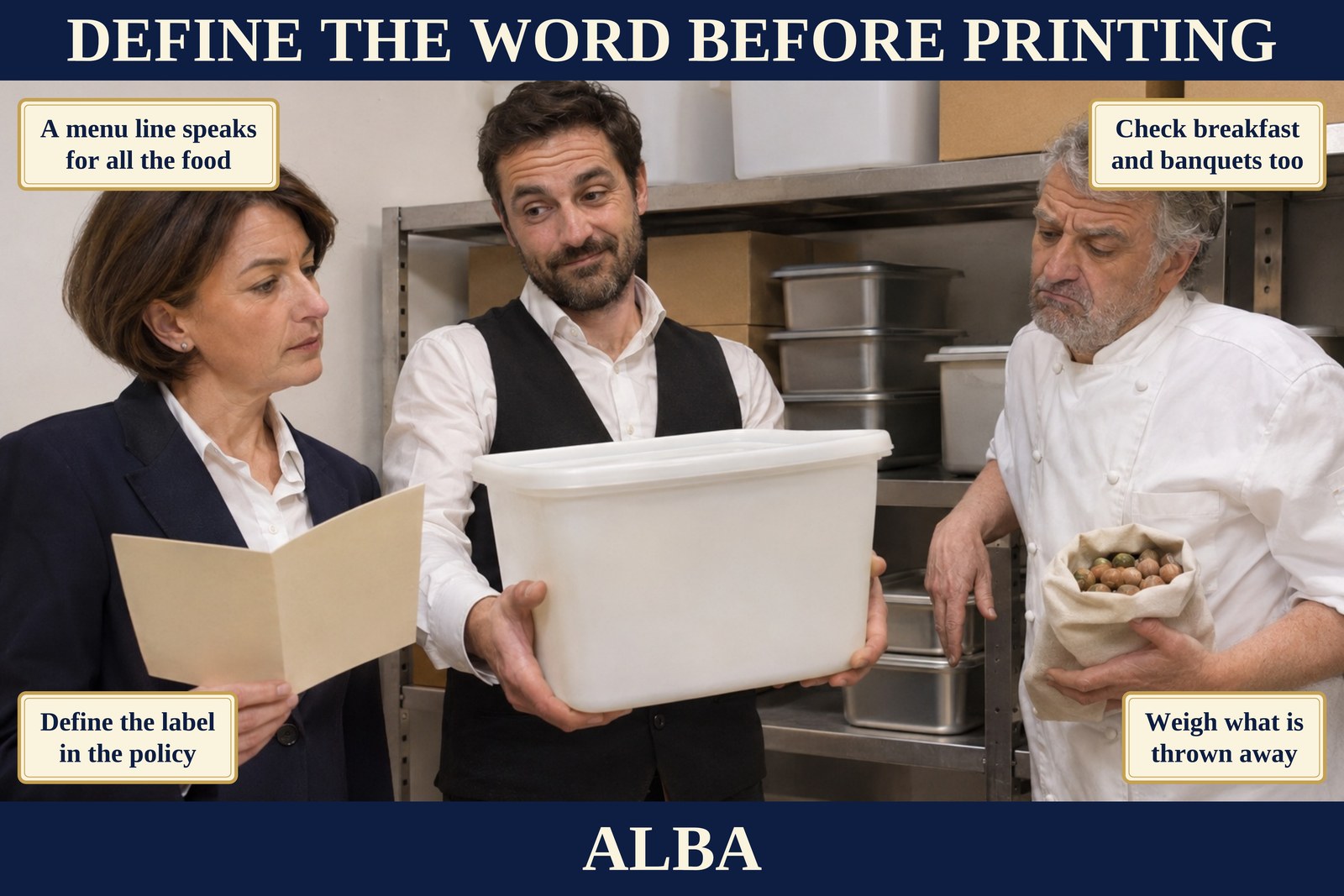
Concept Card 1.14 — Food and Beverages: What Reaches the Plate
Setting: Alba, Italy
The card shows an October walk through the store rooms of a country hotel above Alba, as the general manager prepares for a certification audit. Menu, website and slate all promise "zero-kilometre cuisine", and at dinner it is largely true. But the shelves hold catering tins, industrial hazelnut spread, packaged croissants and portioned jams, and dinner is perhaps a quarter of the kitchen's output: breakfast, weddings and the staff canteen are cooked from the store room. Nobody knows how much of the buffet is thrown away.
The plaques at the top give the event: «Zero-kilometre at dinner only» and «A store room the menu forgot». The lower pair names the lesson: «Define a label before printing it» and «True at breakfast as at dinner»: guests and auditors read a food claim as a statement about the whole hotel, not one service.
The card does not say that the head chef misled anyone: the line was written about his own cooking, and for that cooking it is honest. Nor does it say that industrial products are forbidden; the problem is a claim the store room contradicts.

Concept Card 1.15 — From Vision to System: What Chapter 2 Will Ask
Setting: Monteverde, Costa Rica
The card shows the Monteverde lodge one year after the questionnaire. The grey binder holds a policy, a revised plan, a legal register, a designated safety person and a procurement policy. The tour operator's sustainability manager, visiting for the first time, praises it and walks the kitchen and laundry, where staff answer well. Then the questions change: wages against a living wage, invasive plants, where the wastewater goes. There are no answers yet. The lodge stays in the programme "in transition".
The plaques at the top give the event: «A year on, the visitor walks» and «Still in transition, now with a plan». The lower pair names the lesson: «The frame must be filled» and «Prove the system outside the office»: section A shows that a hotel can manage; sections B, C and D show what it manages.
The card does not say that the son's year was a failure: he built in one year what the visitor expected to take two. Nor does it present "in transition" as a status the standard grants; it is the tour operator's own term.
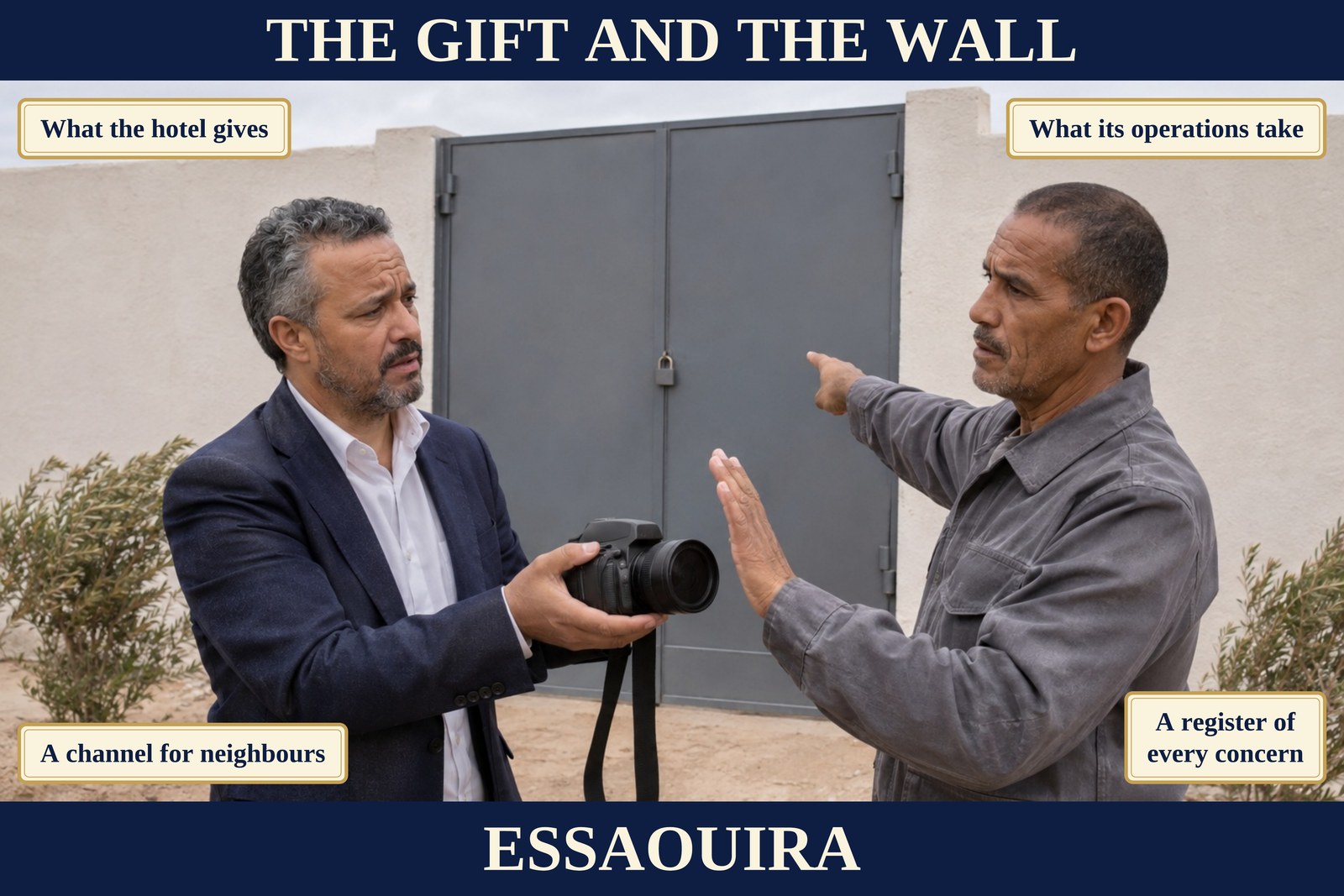
Concept Card 2.1 — Community Support That Does Not Drain the Community
Setting: Essaouira, Morocco
The card shows the evening near Essaouira when the general manager learns why the hamlet beside the hotel calls it "the wall". Two years earlier a rendered wall and a key-card gate closed the sandy track that fishermen and mussel gatherers used to reach the shore, adding twenty minutes each way with loads. Their questions had passed from drivers to a night porter who did not know whom to tell. For the first time he sets the photographed December gift of school bags beside the closed track.
The plaques at the top give the event: «A gift photographed every December» and «A wall across the fishermen's track». The lower pair names the lesson: «Giving does not offset taking» and «A neighbour needs a door to knock on»: B4 asks that operations do not restrict community access, and that a grievance channel exists.
The card does not say that the general manager built the wall or that the gifts were insincere: he inherited both, and the wall answered real thefts. Nor does it blame the night porter, who had never been told whom to tell.

Concept Card 2.2 — Local Employment and Local Entrepreneurs
Setting: Arusha, Tanzania
The card shows a March week in Arusha, after a housekeeping supervisor of eleven years learns that the executive housekeeper post, which she never knew was open, has been filled through an agency in another city. The report's headline is accurate: ninety-four per cent of staff are local. But of fourteen heads of department and deputies, two are local, and no supervisory post in three years was advertised in the hotel or the town. The lobby shop's "local crafts" come from a distant wholesaler.
The plaques at the top give the event: «A vacancy nobody was told about» and «Local staff, but not in the top posts». The lower pair names the lesson: «Count local staff level by level» and «Post every vacancy where staff can see»: B2 asks about advancement into management, which one headline figure cannot show.
The card does not say that the ninety-four per cent was false or that the agency was chosen to exclude anyone: it solved a real problem in the opening year. The fault was a temporary route that became the only one.
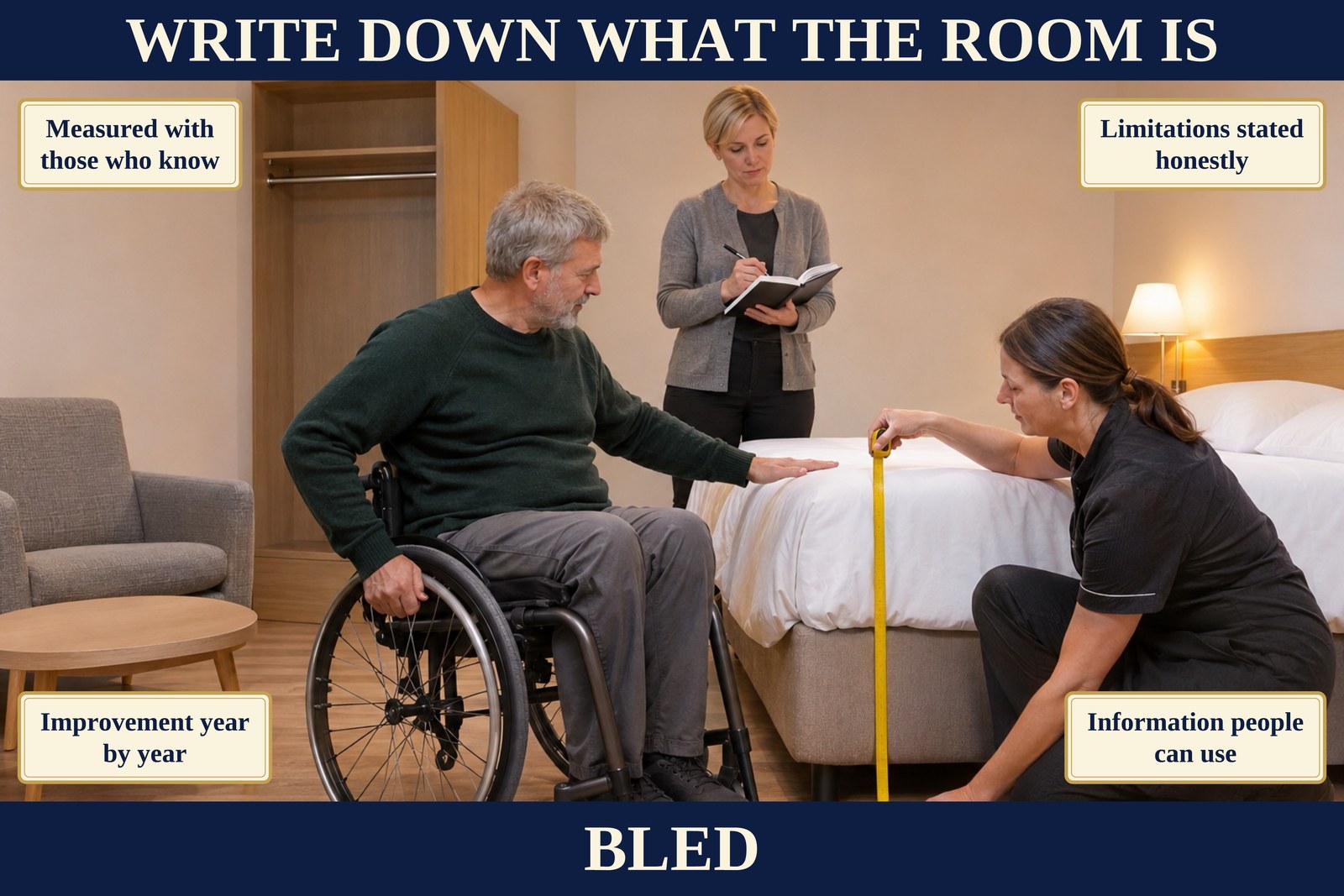
Concept Card 2.3 — Access for All
Setting: Bled, Slovenia
The card shows the accessible room of a lakeside hotel in Bled, after a guest who uses a wheelchair wrote a calm email listing nine points measured in centimetres: a raised shower tray, a bed too high, a rail out of reach, furniture in the only turning space, steps down to the breakfast terrace. The website said "wheelchair friendly". Had it described the room as it is, he wrote, they would have known what to bring. Now he walks the hotel with staff and a disability association.
The plaques at the top give the event: «Wheelchair friendly, said the website» and «Nine points measured in centimetres». The lower pair names the lesson: «State the limits as well as the features» and «Access is a direction, not a status»: B5 asks for accurate information including limitations, and for progressive improvement.
The card does not say that the hotel ignored access: its ramp and lift came when few properties by the lake had either. Nor does it blame the staff, who improvised kindly. The fault lay in a description written from a checklist.
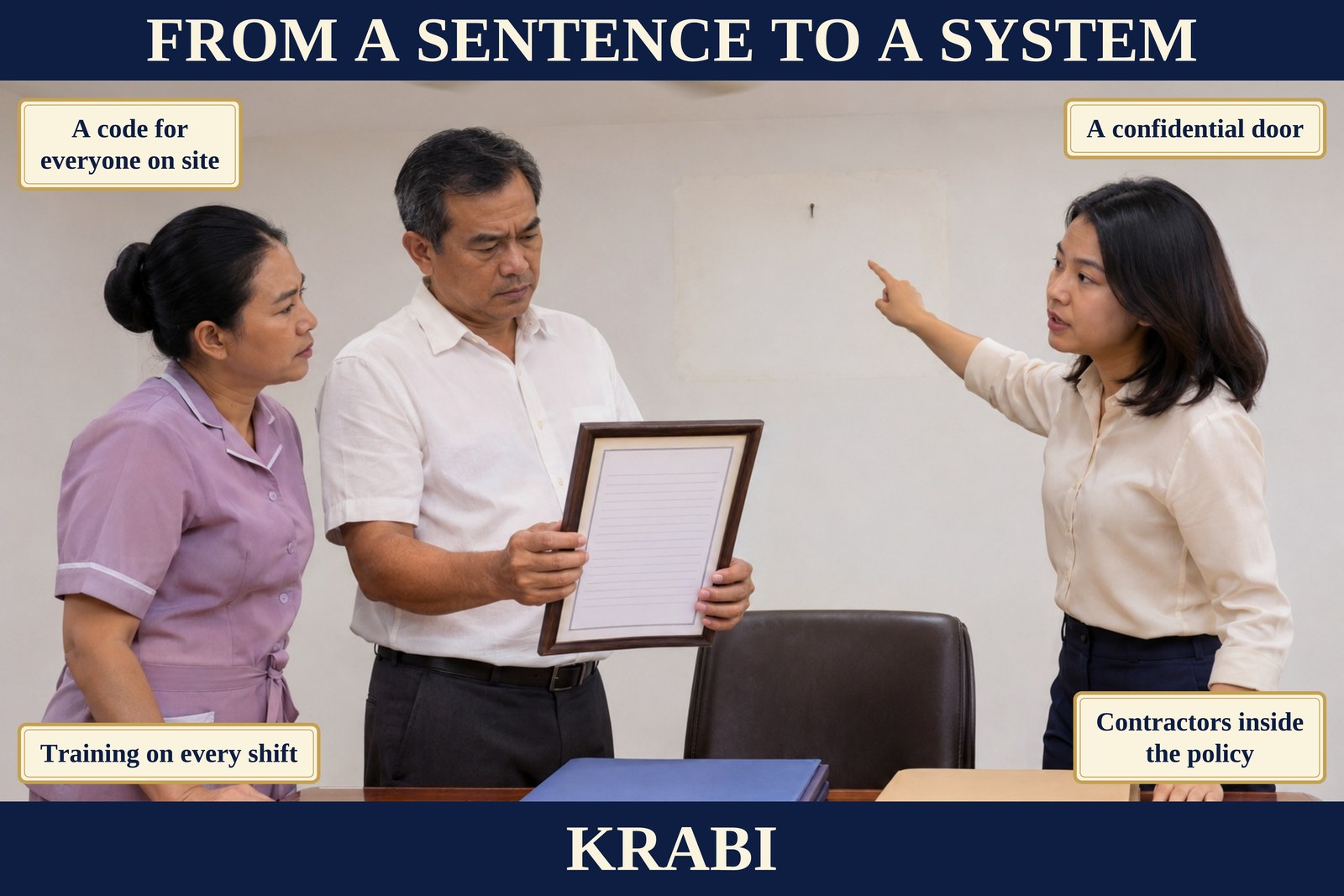
Concept Card 2.4 — A Code of Conduct and Zero Tolerance for Exploitation
Setting: Krabi, Thailand
The card shows the week in Krabi when two matters reach the general manager. A room attendant reported repeated remarks from a long-staying guest; her supervisor moved her within hours and the remarks stopped. In the gardens, the purchasing manager saw a crew member who looked much younger than the rest, and a foreman who kept all the workers' identity papers. The framed code promises zero tolerance but names no one to tell, no procedure, nothing for guests or contractors, nothing on children.
The plaques at the top give the event: «A code that named no one to tell» and «Workers' papers kept by the foreman». The lower pair names the lesson: «Zero tolerance is a promise of response» and «A confidential door on every shift»: B7 asks for procedures for reporting, confidential disclosure and response that work whoever is on duty.
The card does not say that anyone acted badly: each person responded decently and quickly. Nor does it conclude that the young worker was a child or that the foreman exploited anyone; the resort simply had no procedure for finding out.
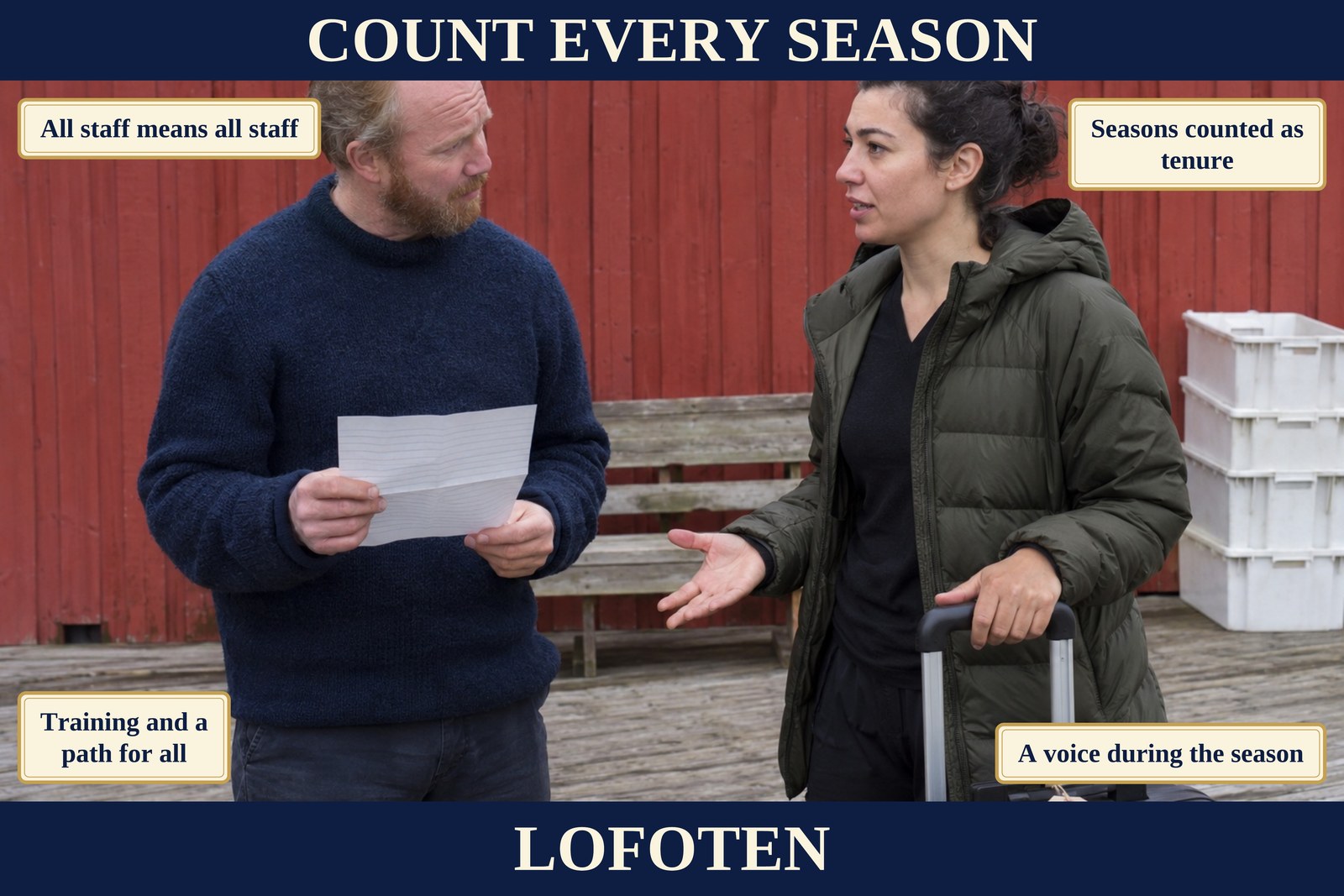
Concept Card 2.5 — Inclusion, Equality and Decent Work in a Seasonal Trade
Setting: Lofoten Islands, Norway
The card shows a late-August morning in Lofoten, when the managing director reads the letter a chef de partie left on her last shift. In her fifth season she is paid her first-season rate; her requests for winter work went unanswered, she has had no training since induction, and kitchen supervisor posts always went to permanent staff. A guest's remarks about a waitress's headscarf found no one prepared. The files confirm it: every season a new contract, surveys for permanent staff only. She will not return.
The plaques at the top give the event: «A fifth summer paid as the first» and «A letter left on the last shift». The lower pair names the lesson: «Every season counts as service» and «All staff means seasonal staff too»: B8 and B9 repeatedly say all staff; counting seasons as tenure is the book's response.
The card does not say that the property broke the law or mistreated anyone: it pays what its adviser confirmed and houses seasonal staff free. The system was built for students who came once, and nobody had checked whether it still fitted.
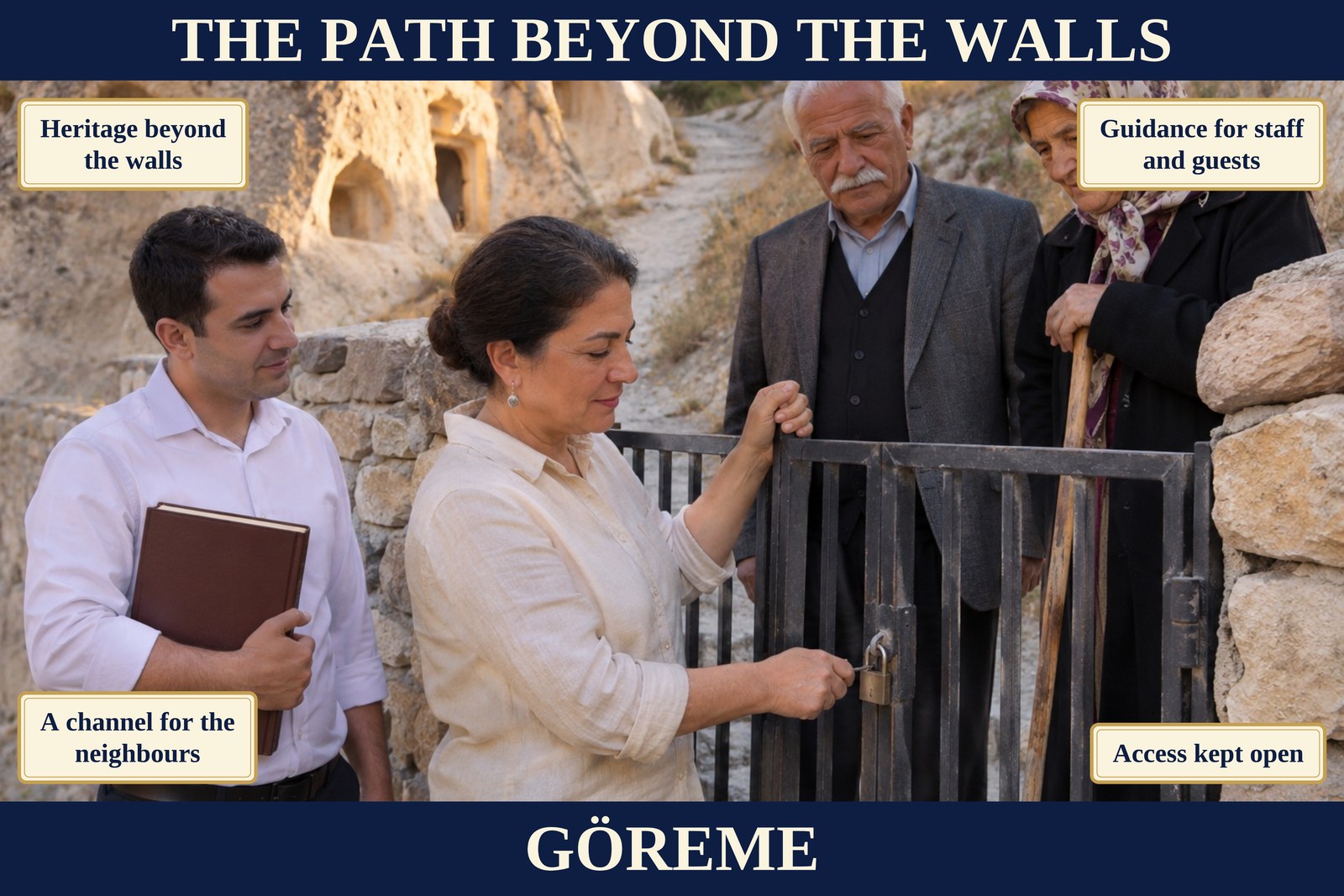
Concept Card 2.6 — Cultural Interactions and the Protection of Heritage
Setting: Göreme, Türkiye
The card shows the late-summer day in Göreme when the muhtar, the elected head of the neighbourhood, comes to reception with older residents. A gate locked after a guest slipped has closed the path to a rock-cut chapel; families walked round through a field for a yearly gathering, and an elderly woman fell. The same month, guests photographed women receiving condolences at a door. The muhtar asks whom the neighbourhood should have spoken to. Nobody knows. The owner has the gate unlocked that afternoon.
The plaques at the top give the event: «A locked gate on the chapel path» and «No one named for the neighbours». The lower pair names the lesson: «Heritage does not end at the walls» and «Ask residents before you tell guests»: guidance on local customs is credible only when written with the people who live with that heritage.
The card does not say that the owner was indifferent: the gate followed a real accident, and she did not know the path was still used. Nor does it blame the waiter who heard about the gate; there was nowhere to take it.
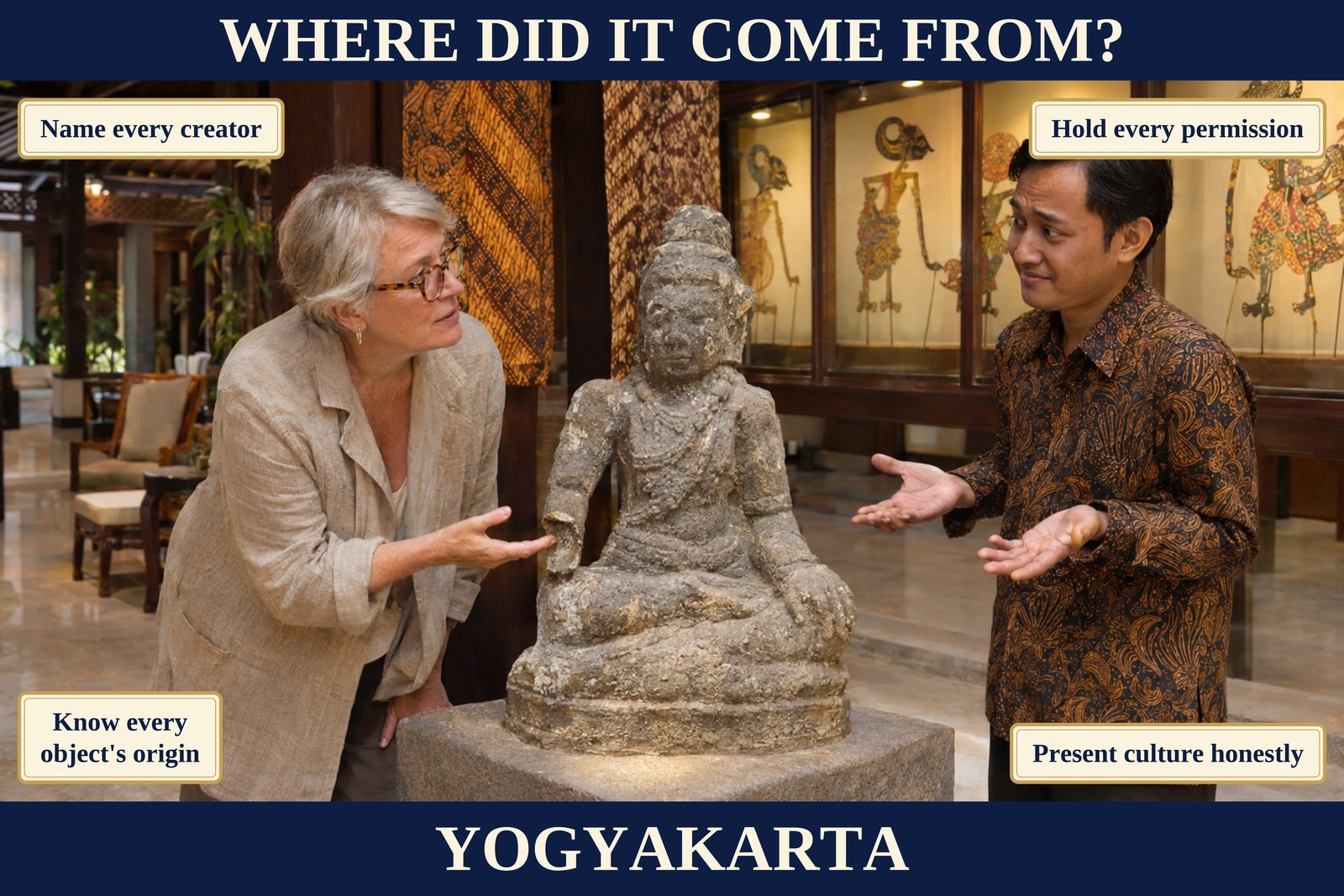
Concept Card 2.7 — Presenting Culture Honestly, and the Artifact in the Lobby
Setting: Yogyakarta, Indonesia
The card shows a Monday in Yogyakarta when two reports reach the general manager. An archaeologist has asked where the weathered stone figure in the lobby came from and whether the hotel holds papers for it. A wedding guest has recognised her mother's batik design printed, without permission, on the cushions in every room. The boutique sells old masks as "antique Javanese, collector's pieces". The general manager asks of every object who made it, how it was obtained and what permission the hotel holds. For most, nobody knows.
The plaques at the top give the event: «A stone figure with no papers» and «Her mother's batik on every cushion». The lower pair names the lesson: «Name the maker of every object» and «Hold permission for every design used»: presenting culture honestly means crediting creators and knowing where each object came from.
The card does not say that the stone figure was looted or that the general manager chose any of it: she inherited the figure and the masks, and the designer believed a traditional motif belonged to no one. The figure's history remains under advice.
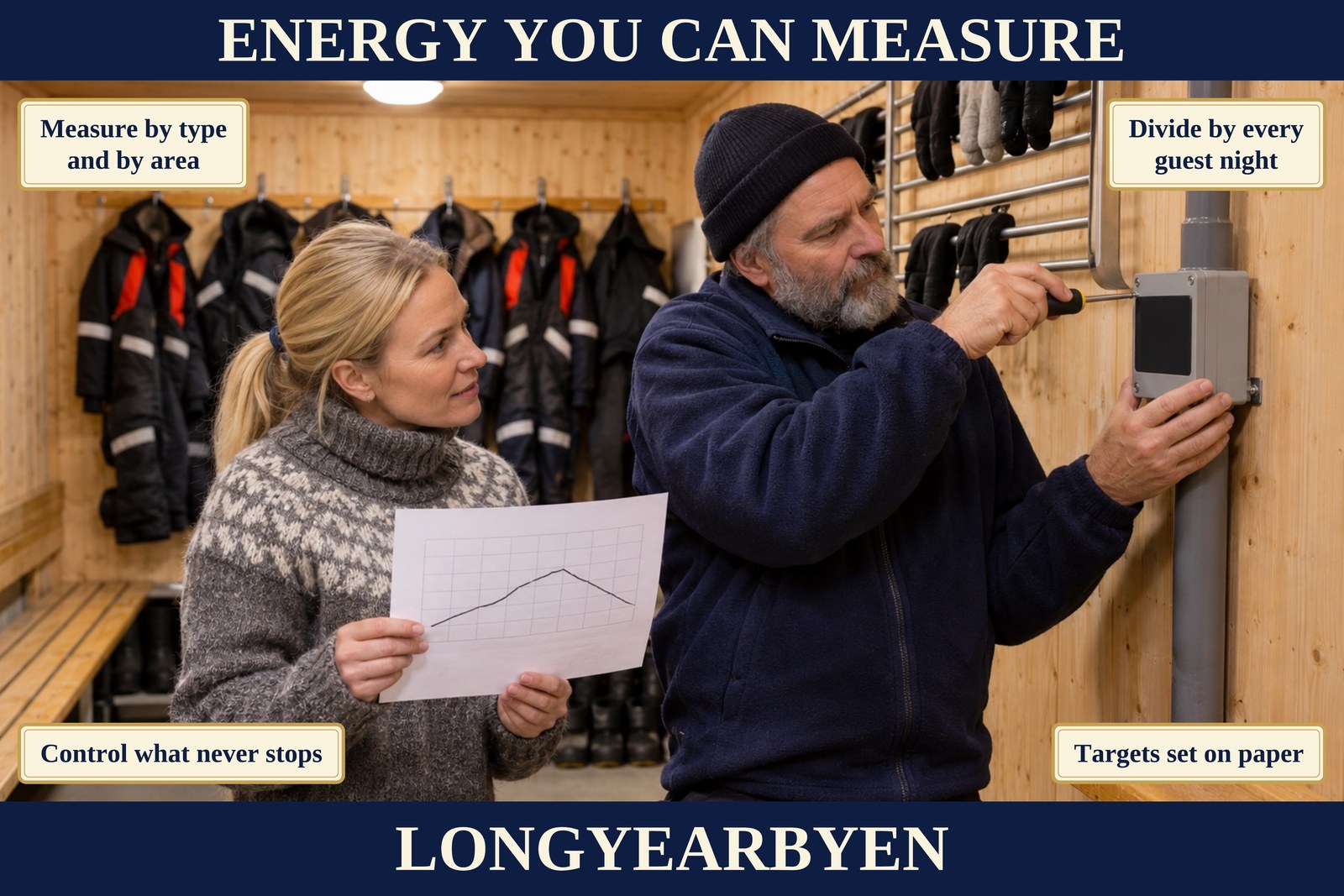
Concept Card 2.8 — Energy Conservation You Can Measure
Setting: Longyearbyen (Svalbard), Norway
The card shows the autumn in Longyearbyen after the owner asks the general manager to cut energy use by a tenth. She agrees, then realises she cannot say where a tenth goes. She has three invoices, paid elsewhere and broken down by nothing: not the boot room, the kitchen, the heated garage or the terrace heat lamps, not even energy per guest night. Turning two years of invoices into units beside guest nights, she finds summer use per guest night higher than winter.
The plaques at the top give the event: «A cut of a tenth with no baseline» and «Energy known only as invoices». The lower pair names the lesson: «Read the bill in units per guest night» and «Measure before you set a target»: energy can be reduced only once it stops being a cost and becomes a measured quantity.
The card does not say that the hotel wasted heat carelessly: in the Arctic, keeping everything running is a sound safety instinct, and no guest was ever cold. Nor does it call the owner's target wrong, only one set without a baseline.

Concept Card 2.9 — Water in a Place That Has Too Little
Setting: Swakopmund, Namibia
The card shows a May week in Swakopmund, on the edge of the Namib. A guest's review describes sprinklers watering the lawn at noon while a card asked her to reuse towels "to help save water in the desert". Then the municipal invoice arrives at nearly twice its usual amount: a split pipe under the garden path has been leaking for weeks. Nobody can say how much water the hotel uses, from which source or where it goes. The borehole feeding the irrigation has no meter.
The plaques at the top give the event: «A towel card and a lawn at noon» and «A leak found by the invoice». The lower pair names the lesson: «Know the place before the tap» and «Meter every source of water»: a water message is credible only once the hotel knows local water risk and measures its own use.
The card does not say that the towel card was hypocritical or that the general manager neglected the garden: she inherited the lawn, the borehole and the timer. Nor does it say that a garden is forbidden in a desert.
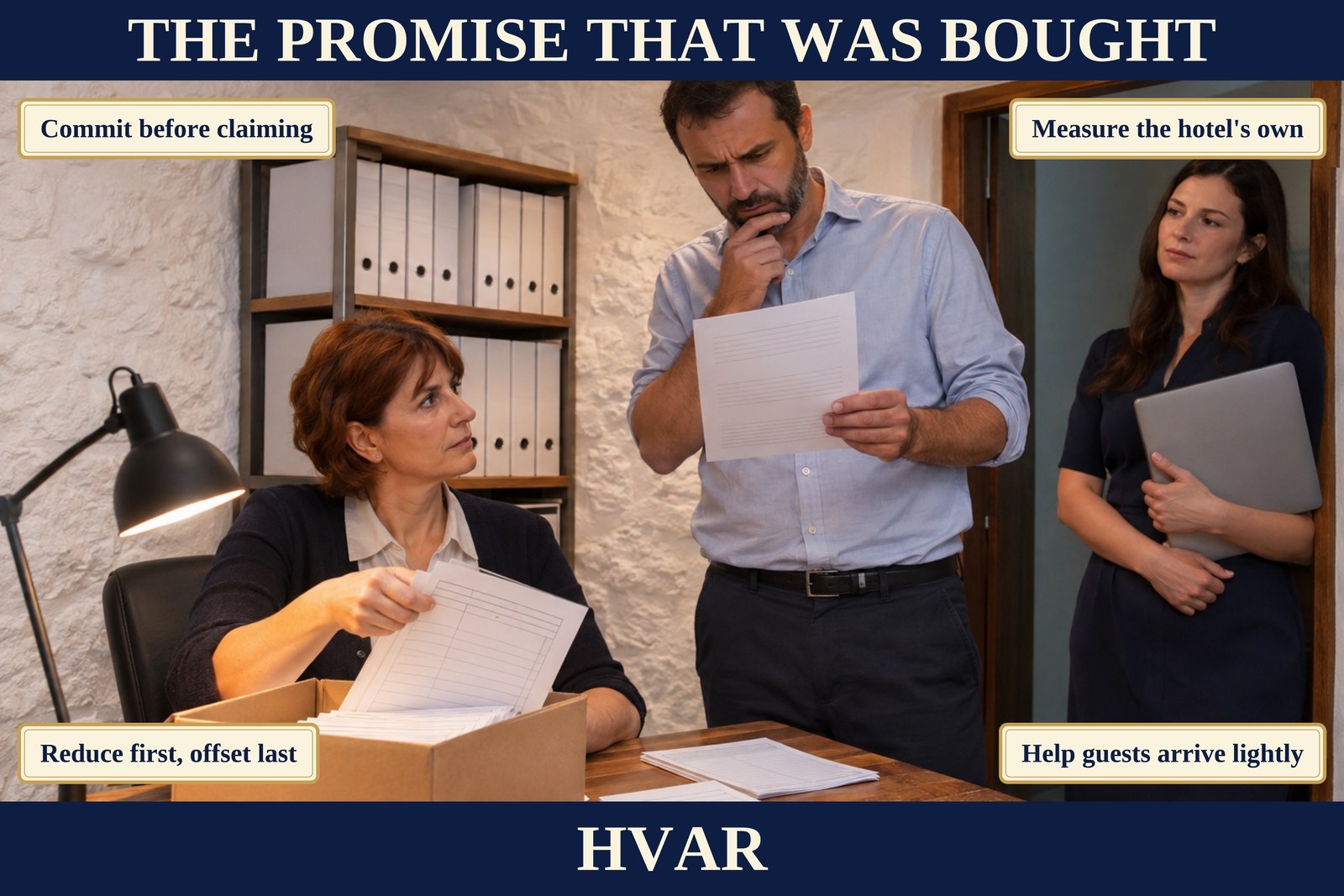
Concept Card 2.10 — Greenhouse Gas Emissions and How Guests Arrive
Setting: Hvar, Croatia
The card shows a March day in Hvar, when a company-retreat organiser sends four questions: last year's Scope 1 and Scope 2 emissions, reduction targets, the source and certification of the offsets, and how sixty participants can arrive without hiring cars. For three years the website has promised "a carbon-neutral stay", based on an offset add-on run by a booking partner. Nobody can answer the first three; the fourth gets a taxi from the port. That evening the owner removes the phrase from the website.
The plaques at the top give the event: «Carbon neutral, bought at checkout» and «Four questions with no answers». The lower pair names the lesson: «Measure and reduce before offsetting» and «Tell guests how to arrive without a car»: D3 places offsets after reduction, and guest transport is part of the footprint a hotel can influence.
The card does not say that the owner was cynical: he paid for offsets in good faith when nobody else on the island did anything visible. Nor does it say that offsetting is wrong, only that it cannot replace measurement and reduction.

Concept Card 2.11 — Wastewater, Harmful Substances and Pollution
Setting: El Nido, Philippines
The card shows the wet season at a cove resort near El Nido, after a guest reports a smell and a grey film around the wastewater pipe among the western rocks, and a fisherman says the rocks have turned green and his sons no longer set nets there. The treatment system has never been tested and has no records beyond the installer's handover sheet. Walking the property, the general manager finds unlabelled bottles, no safety data sheets, pesticide beside kayaks and floodlights on the sea.
The plaques at the top give the event: «A pipe that ends among the rocks» and «Bottles with no labels, no sheets». The lower pair names the lesson: «Follow every pathway past the fence» and «Test, record, then decide»: what leaves a property must be traced to where it ends, and treatment decided on tested evidence.
The card does not say that the resort alone turned the rocks green: the causes cannot be fully measured. Nor does it blame the head of maintenance, who was told the system needed no attention and kept running everything he was hired for.

Concept Card 2.12 — Solid Waste, Food Waste and the Island Without a Landfill
Setting: Maui (Hawaii), USA
The card shows a January evening on Maui, after an incentive-travel organiser asks for waste per guest night, the share diverted from landfill and a plan for its client's conference. The contractor's invoices show pickups and container sizes, never weights. The lobby recycling bins are emptied into the same dumpster as everything else, because the contract covers one stream. A third of the beach dinner returns uneaten, and mattresses went into the skips. The director of operations asks: what if the island had no landfill?
The plaques at the top give the event: «Bins sorted, then emptied together» and «Pickups counted, nothing weighed». The lower pair names the lesson: «Weigh waste by type before promising» and «Start by buying less»: D6 asks for waste measured by type and managed by the hierarchy, where prevention comes first.
The card does not say that the lobby bins were a deception: a previous team installed them in good faith, and the single-stream contract was signed on price by someone since gone. Nobody had looked at the system as a whole.
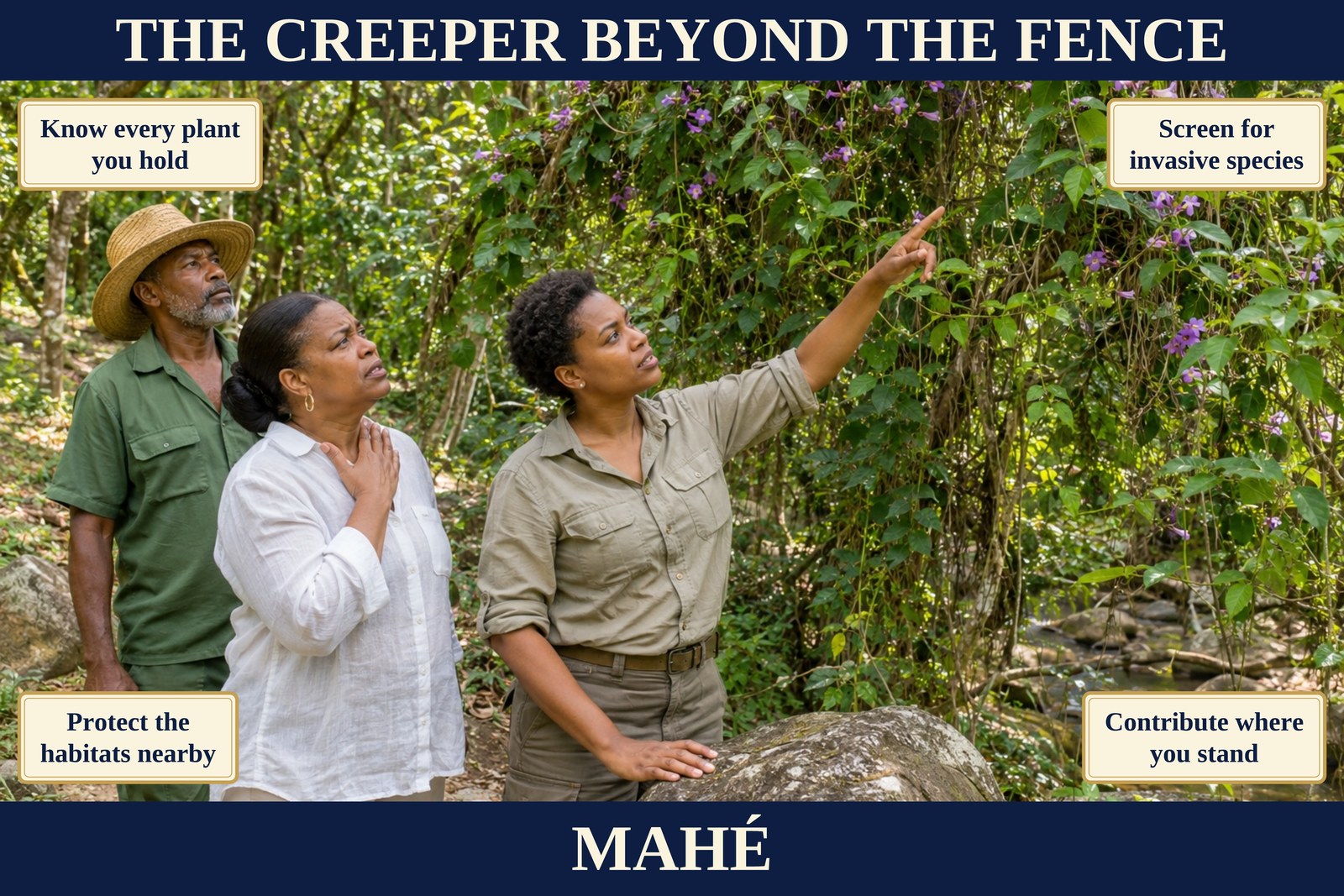
Concept Card 2.13 — Biodiversity and the Invasive Plant in the Garden
Setting: Mahé, Seychelles
The card shows a dry-season day on Mahé, after a conservation volunteer who leads walks for the hotel's guests reports that the violet creeper from the wedding pergola has climbed beyond the fence into native trees along a stream, smothering the seedlings. It is on her group's list of invasive plants. In the office, the general manager finds no plant inventory, no invasive species list and no screening of purchases. The group's report records a rainforest donation on another continent and nothing for conservation on Mahé.
The plaques at the top give the event: «A violet creeper over the fence» and «No list of what grows here». The lower pair names the lesson: «Screen every plant before it enters» and «Support nature where you stand»: D10 asks for an invasive species list, and D9 gives priority to the areas where the hotel operates.
The card does not say that the head gardener was to blame: the creeper was planted by a landscaping firm before he arrived, and he kept it exactly as asked. Nor does it call the distant donation worthless; it simply did nothing for Mahé.
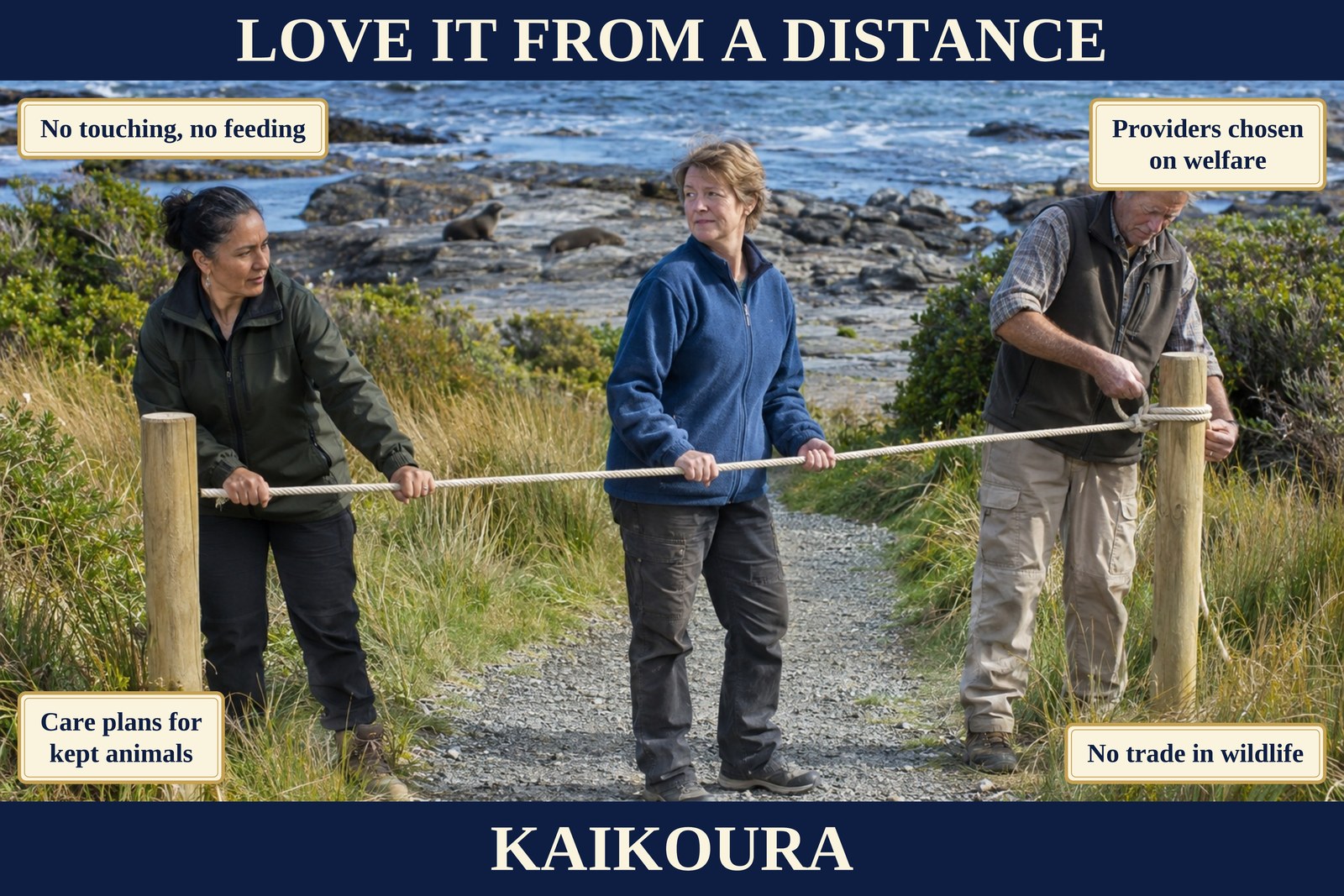
Concept Card 2.14 — Animals: Interaction, Welfare and Trade
Setting: Kaikoura, New Zealand
The card shows a late-summer week in Kaikoura, after a guest posts a photograph of her small child with a hand on a seal pup on the lodge's rocks. A ranger calls to ask who manages the shore and what guests are told; a nature-travel operator asks for its welfare policy, provider criteria and approach to wildlife products. The lodge has none. Nobody has asked providers how they operate, the alpacas have no care records, and a pendant sold as a shark tooth has no known origin.
The plaques at the top give the event: «A hand on a seal pup, shared online» and «No policy for tours, shore or shop». The lower pair names the lesson: «Welfare comes before closeness» and «Love the animal from a distance»: the standard rules out close contact, touching included, with wild animals where the hotel manages the setting.
The card does not say that the guest or her child is to blame, nor that the owners set out to exploit animals: their affection is real. It says that kindness without rules can harm the animals it means to celebrate.
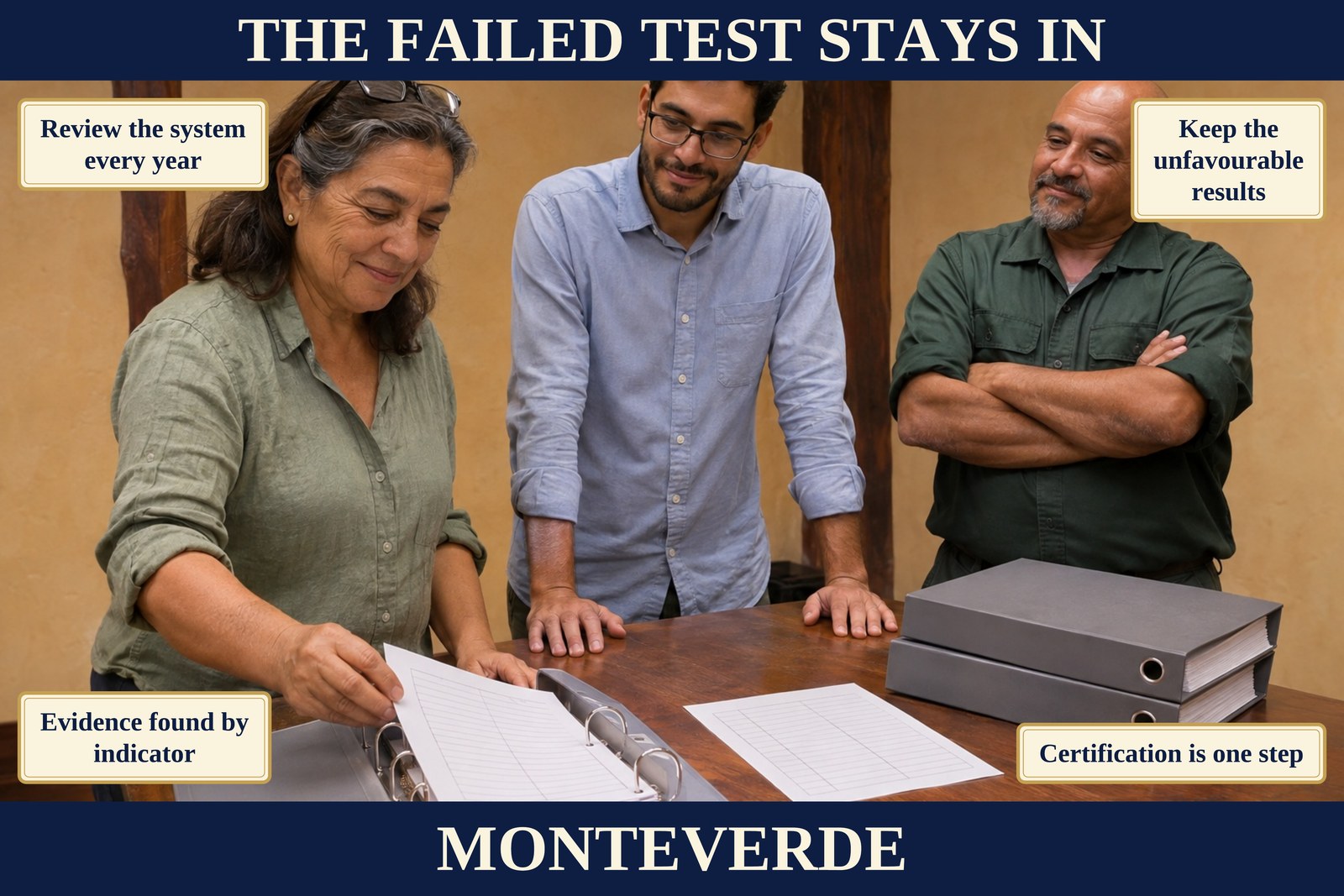
Concept Card 2.15 — From Criteria to Proof: Continual Improvement and the Road to Certification
Setting: Monteverde, Costa Rica
The card shows the Monteverde lodge two years after the questionnaire, weeks before a certification audit booked for May. The year brought unwelcome results: two housekeeping wages below the local living wage, since raised; an old septic system that failed its test, since rebuilt; an invasive tree the owner's parents had planted. Preparing the index of evidence, the son left out the failed septic test because the tank is now rebuilt. The owner puts it back: without the failure, the repair proves nothing.
The plaques at the top give the event: «The failed test goes back in» and «An audit booked for May». The lower pair names the lesson: «Keep the unfavourable results» and «A system that reviews itself yearly»: continual improvement can be shown only by problems found, recorded and solved, and reviewed every year.
The card does not say that the son meant to deceive: he left the page out because the problem had been solved. Nor does it promise that the lodge will be certified; the space for a seventh frame is still empty.
L’AUTORE