
The Helm and the Lens · English
Disponibile / Available
the Helm and the Lens – Vol. 1b
ISO 14001 · Environmental Management Systems in Hospitality
The Lens examines the verification side of ISO 14001:2026 in hospitality. Through thirty hotel-based cases, it explores internal auditing, evidence, corrective action, certification, accreditation and the real meaning of the certificate—showing how to distinguish a system that merely looks compliant from one that genuinely works.
533
Pagine
Volume 1b — The Lens is the second half of the ISO 14001:2026 pair within The Helm and the Lens series.
While Volume 1a — The Helm approaches environmental management from the perspective of ownership and leadership, this volume changes position. It looks at the system through the eyes of those required to verify it: first the internal auditor working within the hotel, and then the independent auditor responsible for external certification.
Across thirty detailed cases set in hotels on four continents, the book examines why internal audits fail, how evidence should be gathered and sampled, how defensible findings are written, and why corrective actions so often close the record without resolving the underlying cause. It then follows the complete certification journey—from choosing an accredited certification body and undergoing Stage 1 and Stage 2 audits to surveillance, recertification, multi-site extensions, suspension, withdrawal and transfer.
Written specifically for hospitality, the volume addresses the realities that generic auditing manuals often overlook: seasonal occupancy, outsourced activities, night operations, staff turnover, fragmented responsibilities and properties that continue operating when most of their management is no longer present.
This is not a collection of templates and does not treat certification as an end in itself. It is a practical, evidence-based guide to determining whether a hotel’s environmental management system still reflects what truly happens inside the property.
Its central argument is simple: a management system consists of statements an organisation has made about itself. Auditing is the disciplined practice of discovering which of those statements are still true.
Suggested Highlight
The information is usually already inside the building. What is missing is the moment when somebody stops, reads it and asks whether it is still true.
EDIZIONI · FORMATI
Formati disponibili
Le edizioni fisiche e digitali associate a questa scheda.
NEL LIBRO
Contenuto / Contents
La struttura del volume così come presentata nell’edizione pubblicata.
Table of Contents
- Preface.
- 3.1 Why Internal Audit Exists, and Why It Fails.
- 3.2 Building an Audit Programme That Survives Contact with Occupancy
- 3.3 Audit Criteria: What You Are Actually Checking Against.
- 3.4 Competence of the Internal Auditor.
- 3.5 Impartiality and Objectivity in a Property You Work at Every Day.
- 3.6 Planning a Single Audit: Scope, Timing and Access.
- 3.7 Gathering Evidence: What You Have Been Told and What You Have Established
- 3.8 Sampling: What a Handful of Records Can and Cannot Tell You.
- 3.9 Writing Findings That Survive Challenge.
- 3.10 Nonconformity Grading: What a Grade Is Actually a Statement About
- 3.11 Root Cause Analysis Beyond the First Answer.
- 3.12 Corrective Action: Closing the Loop Without Just Closing the Ticket
- 3.13 The Audit Trail Across Departments: Kitchen to Boardroom...
- 3.14 Reporting to Management: What Leadership Actually Needs to Hear
- 3.15 The Audit Programme Over Time: What Ten Years Say That One Year Cannot
- 4.1 What a Certification Body Actually Verifies.
- 4.2 Choosing a Certification Body.
- 4.3 Accreditation: Who Checks the People Who Check You.
- 4.4 Stage 1: The Audit Whose Subject Is Time.
- 4.5 Stage 2: When the System Speaks Through People Who Did Not Build It
- 4.6 What Certification Auditors Look For: Where a Stranger Starts.
- 4.7 Surveillance: The Audit of the Interval
- 4.8 Recertification: Reading Three Years as One Document.
- 4.9 Scope Extensions and Multi-Site: Buying a Hotel Is Not Adding a Site
- 4.10 When a Nonconformity Threatens the Certificate.
- 4.11 Suspension and Withdrawal: The Surface Area of a Claim...
- 4.12 Transferring Between Certification Bodies: The Door Is Open While You Do Not Need It
- 4.13 Integrated Audits: The Work Was Already Integrated.
- 4.14 What the Certificate Does Not Prove.
- 4.15 Certification as an Investment: Who Pays, Who Benefits, and When
- Afterword.
- Sources and Research Methodology — What This Book Verified, and How
- Glossary Terms as This Volume Uses Them...
- About the Author.
- Contact.
- The Series.
- The Online Platform...
- Acknowledgements.
- Analytical Index.
MATERIALI DI LAVORO
Materiali e download
Checklist, modelli, supplementi e file di lavoro collegati al volume.
FILES
1 · Working material 3.1 — Why Internal Audit Exists, and Why It Fails
ISO 14001:2026 · 1b · 3.1
Editable Word worksheet: Verification Pact, mistakes self-check, evidence questions, action table
FILES
3 · Working material 3.2 — Building an Audit Programme That Survives Contact with Occupancy
ISO 14001:2026 · 1b · 3.2
Editable Word worksheet: Verification Pact, mistakes self-check, evidence questions, action table
FILES
5 · Working material 3.3 — Audit Criteria: What You Are Actually Checking Against
ISO 14001:2026 · 1b · 3.3
Editable Word worksheet: Verification Pact, mistakes self-check, evidence questions, action table
FILES
7 · Working material 3.4 — Competence of the Internal Auditor
ISO 14001:2026 · 1b · 3.4
Editable Word worksheet: Verification Pact, mistakes self-check, evidence questions, action table
FILES
9 · Working material 3.5 — Impartiality and Objectivity in a Property You Work at Every Day
ISO 14001:2026 · 1b · 3.5
Editable Word worksheet: Verification Pact, mistakes self-check, evidence questions, action table
FILES
11 · Working material 3.6 — Planning a Single Audit: Scope, Timing and Access
ISO 14001:2026 · 1b · 3.6
Editable Word worksheet: Verification Pact, mistakes self-check, evidence questions, action table
FILES
13 · Working material 3.7 — Gathering Evidence: What You Have Been Told and What You Have Established
ISO 14001:2026 · 1b · 3.7
Editable Word worksheet: Verification Pact, mistakes self-check, evidence questions, action table
FILES
15 · Working material 3.8 — Sampling: What a Handful of Records Can and Cannot Tell You
ISO 14001:2026 · 1b · 3.8
Editable Word worksheet: Verification Pact, mistakes self-check, evidence questions, action table
FILES
17 · Working material 3.9 — Writing Findings That Survive Challenge
ISO 14001:2026 · 1b · 3.9
Editable Word worksheet: Verification Pact, mistakes self-check, evidence questions, action table
FILES
19 · Working material 3.10 — Nonconformity Grading: What a Grade Is Actually a Statement About
ISO 14001:2026 · 1b · 3.10
Editable Word worksheet: Verification Pact, mistakes self-check, evidence questions, action table
FILES
21 · Working material 3.11 — Root Cause Analysis Beyond the First Answer
ISO 14001:2026 · 1b · 3.11
Editable Word worksheet: Verification Pact, mistakes self-check, evidence questions, action table
FILES
23 · Working material 3.12 — Corrective Action: Closing the Loop Without Just Closing the Ticket
ISO 14001:2026 · 1b · 3.12
Editable Word worksheet: Verification Pact, mistakes self-check, evidence questions, action table
FILES
25 · Working material 3.13 — The Audit Trail Across Departments: Kitchen to Boardroom
ISO 14001:2026 · 1b · 3.13
Editable Word worksheet: Verification Pact, mistakes self-check, evidence questions, action table
FILES
27 · Working material 3.14 — Reporting to Management: What Leadership Actually Needs to Hear
ISO 14001:2026 · 1b · 3.14
Editable Word worksheet: Verification Pact, mistakes self-check, evidence questions, action table
FILES
29 · Working material 3.15 — The Audit Programme Over Time: What Ten Years Say That One Year Cannot
ISO 14001:2026 · 1b · 3.15
Editable Word worksheet: Verification Pact, mistakes self-check, evidence questions, action table
FILES
31 · Working material 4.1 — What a Certification Body Actually Verifies
ISO 14001:2026 · 1b · 4.1
Editable Word worksheet: Verification Pact, mistakes self-check, evidence questions, action table
FILES
33 · Working material 4.2 — Choosing a Certification Body
ISO 14001:2026 · 1b · 4.2
Editable Word worksheet: Verification Pact, mistakes self-check, evidence questions, action table
FILES
35 · Working material 4.3 — Accreditation: Who Checks the People Who Check You
ISO 14001:2026 · 1b · 4.3
Editable Word worksheet: Verification Pact, mistakes self-check, evidence questions, action table
FILES
37 · Working material 4.4 — Stage 1: The Audit Whose Subject Is Time
ISO 14001:2026 · 1b · 4.4
Editable Word worksheet: Verification Pact, mistakes self-check, evidence questions, action table
FILES
39 · Working material 4.5 — Stage 2: When the System Speaks Through People Who Did Not Build It
ISO 14001:2026 · 1b · 4.5
Editable Word worksheet: Verification Pact, mistakes self-check, evidence questions, action table
FILES
41 · Working material 4.6 — What Certification Auditors Look For: Where a Stranger Starts
ISO 14001:2026 · 1b · 4.6
Editable Word worksheet: Verification Pact, mistakes self-check, evidence questions, action table
FILES
43 · Working material 4.7 — Surveillance: The Audit of the Interval
ISO 14001:2026 · 1b · 4.7
Editable Word worksheet: Verification Pact, mistakes self-check, evidence questions, action table
FILES
45 · Working material 4.8 — Recertification: Reading Three Years as One Document
ISO 14001:2026 · 1b · 4.8
Editable Word worksheet: Verification Pact, mistakes self-check, evidence questions, action table
FILES
47 · Working material 4.9 — Scope Extensions and Multi-Site: Buying a Hotel Is Not Adding a Site
ISO 14001:2026 · 1b · 4.9
Editable Word worksheet: Verification Pact, mistakes self-check, evidence questions, action table
FILES
49 · Working material 4.10 — When a Nonconformity Threatens the Certificate
ISO 14001:2026 · 1b · 4.10
Editable Word worksheet: Verification Pact, mistakes self-check, evidence questions, action table
FILES
51 · Working material 4.11 — Suspension and Withdrawal: The Surface Area of a Claim
ISO 14001:2026 · 1b · 4.11
Editable Word worksheet: Verification Pact, mistakes self-check, evidence questions, action table
FILES
53 · Working material 4.12 — Transferring Between Certification Bodies: The Door Is Open While You Do Not Need It
ISO 14001:2026 · 1b · 4.12
Editable Word worksheet: Verification Pact, mistakes self-check, evidence questions, action table
FILES
55 · Working material 4.13 — Integrated Audits: The Work Was Already Integrated
ISO 14001:2026 · 1b · 4.13
Editable Word worksheet: Verification Pact, mistakes self-check, evidence questions, action table
FILES
57 · Working material 4.14 — What the Certificate Does Not Prove
ISO 14001:2026 · 1b · 4.14
Editable Word worksheet: Verification Pact, mistakes self-check, evidence questions, action table
FILES
59 · Working material 4.15 — Certification as an Investment: Who Pays, Who Benefits, and When
ISO 14001:2026 · 1b · 4.15
Editable Word worksheet: Verification Pact, mistakes self-check, evidence questions, action table
FILES
1 · The four-field corrective action record
ISO 14001:2026 · 1b · 3.12
Editable Word template: action, rung on the robustness ladder, effectiveness test and its date
FILES
3 · The three-reading worksheet
ISO 14001:2026 · 1b · 3.15
Editable Word template: coverage, recurrence by cause, and rung across years of audits
FILES
6 · The five-heading management report page
ISO 14001:2026 · 1b · 3.14
Editable Word template: one page for the management review, including what the programme did not examine
FILES
8 · The claim inventory
ISO 14001:2026 · 1b · 4.11
Editable Word template: every place the property states or implies certification, who can change it, how long it takes
XLSX
11 · Verification Pact register
ISO 14001:2026 · 1b · 3.1–4.15
Every Verification Pact row of the thirty subchapters, filterable, with a notes column
XLSX
12 · Common Mistakes register
ISO 14001:2026 · 1b · 3.1–4.15
Every Common Mistakes row with a Yes/Partly/No/N.A. answer column and a summary of counts
XLSX
13 · Certification calendar and transition to ISO 14001:2026
ISO 14001:2026 · 1b · 4.4–4.8
Accredited transition dates to April 2029, your own certification cycle, and the mandatory documents
PER CORSI E SCUOLE
Slide didattiche da proiettare
Apri le slide a schermo intero per lezioni e corsi oppure scarica i file alla risoluzione originale. Usa le frecce per passare da una slide all’altra.
Slide 3.1
Slide 3.2
Slide 3.3
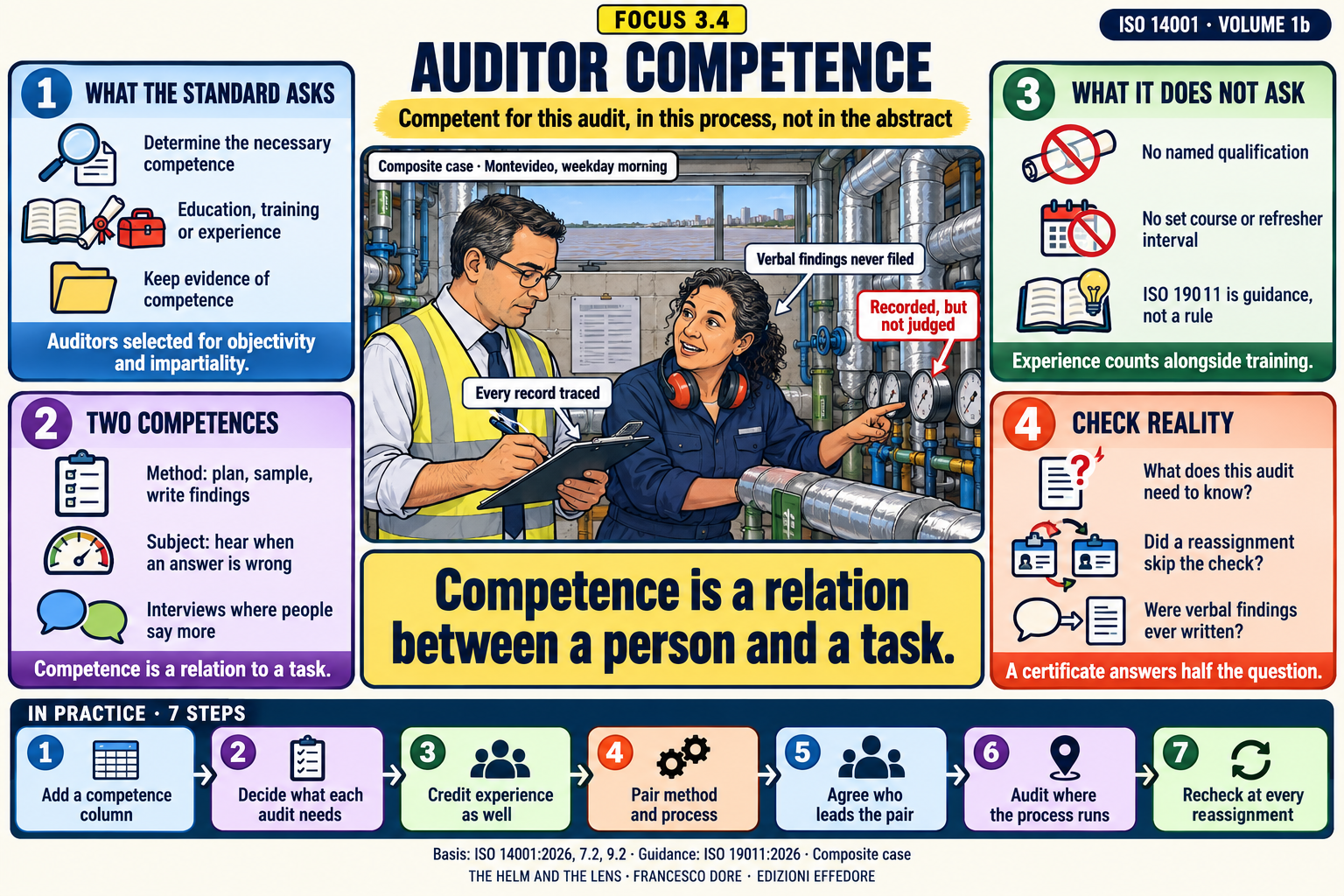
Slide 3.4
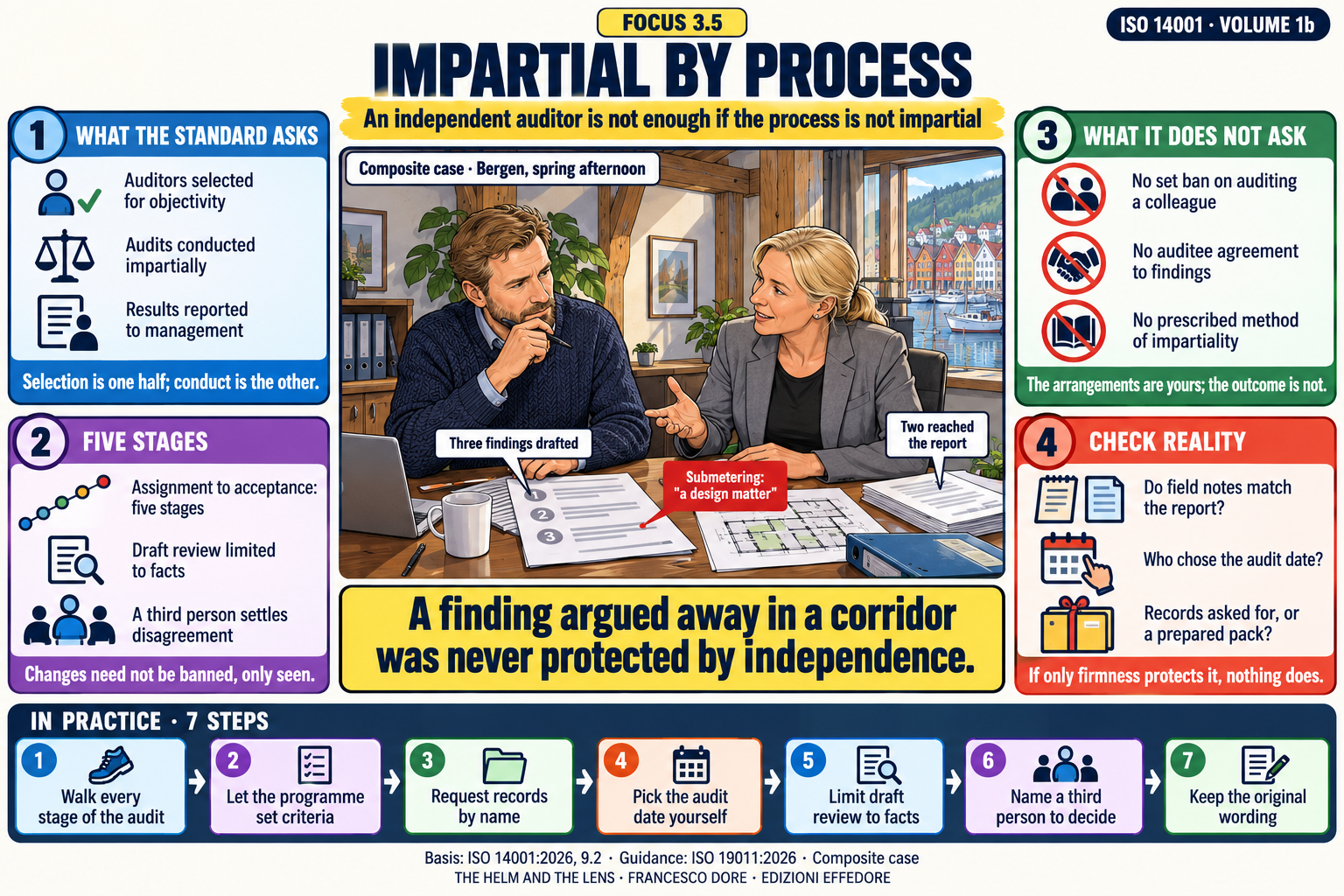
Slide 3.5
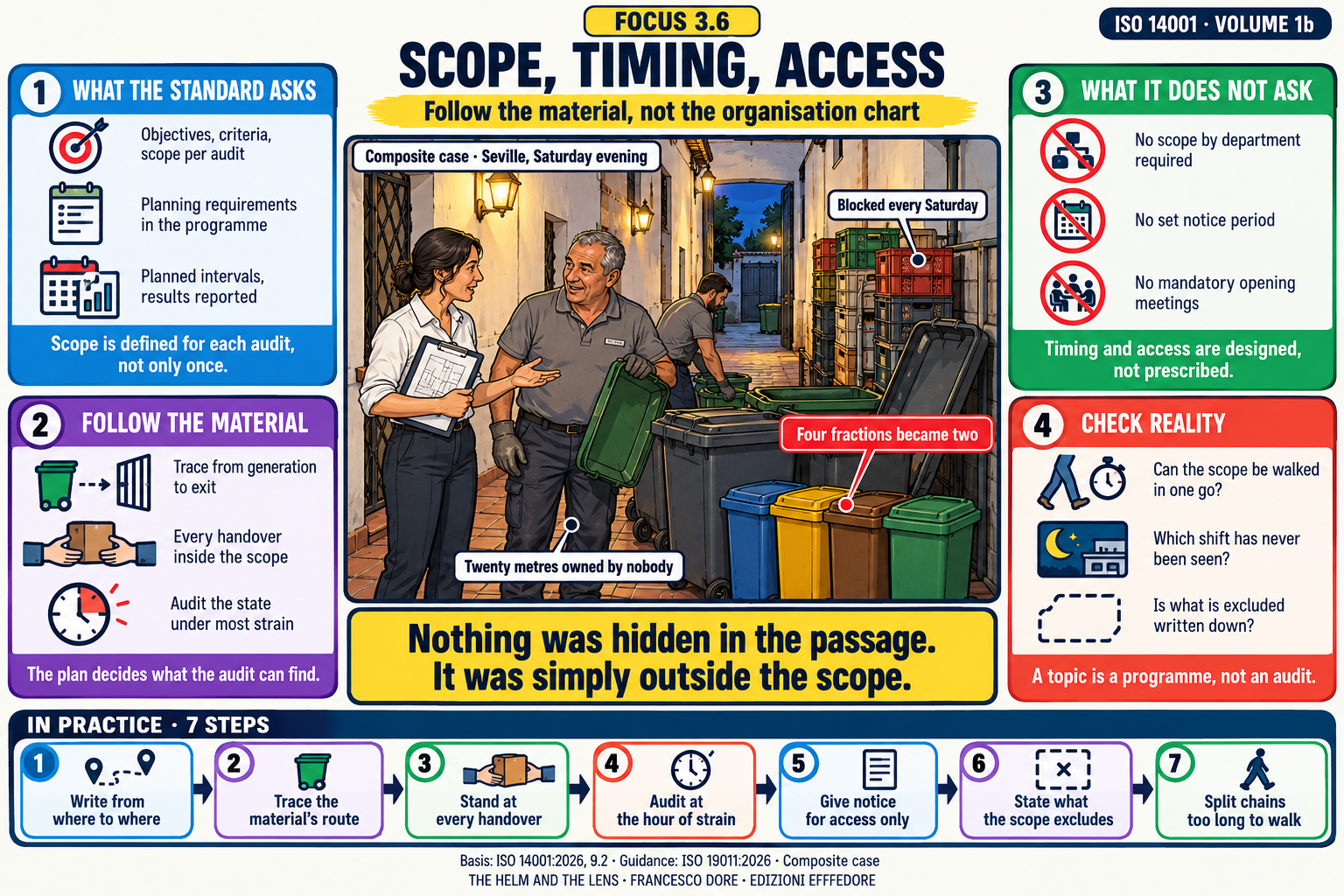
Slide 3.6
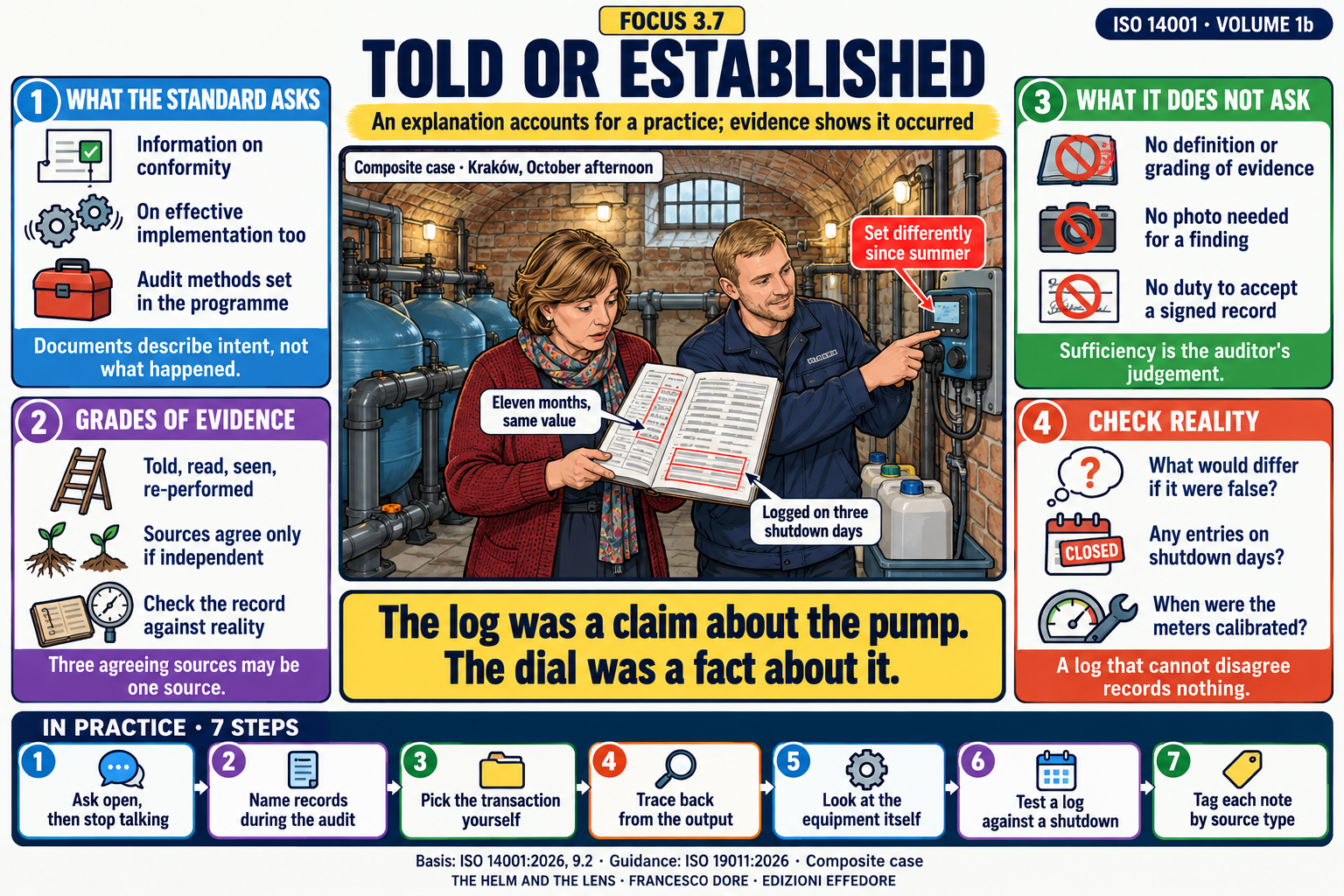
Slide 3.7
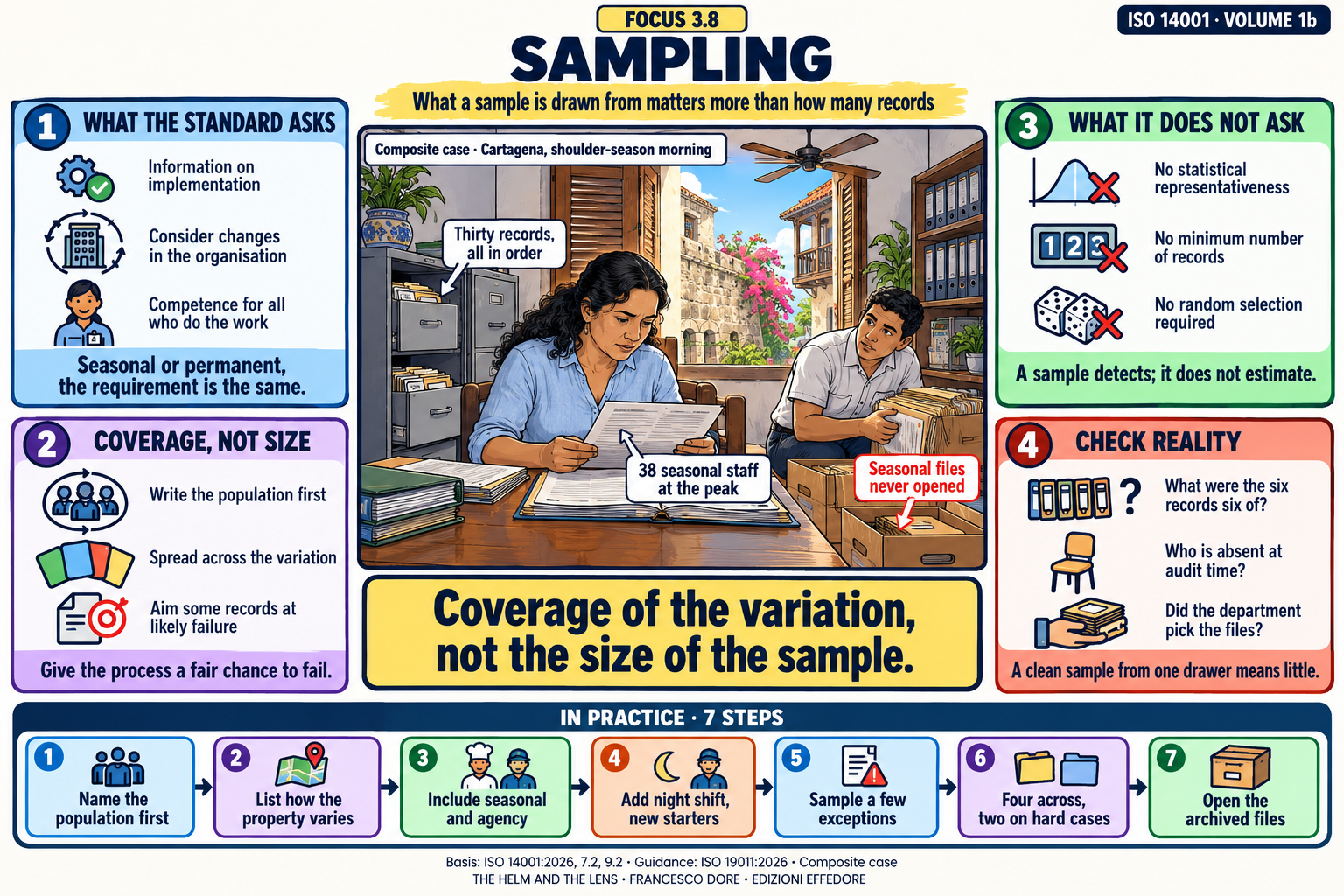
Slide 3.8
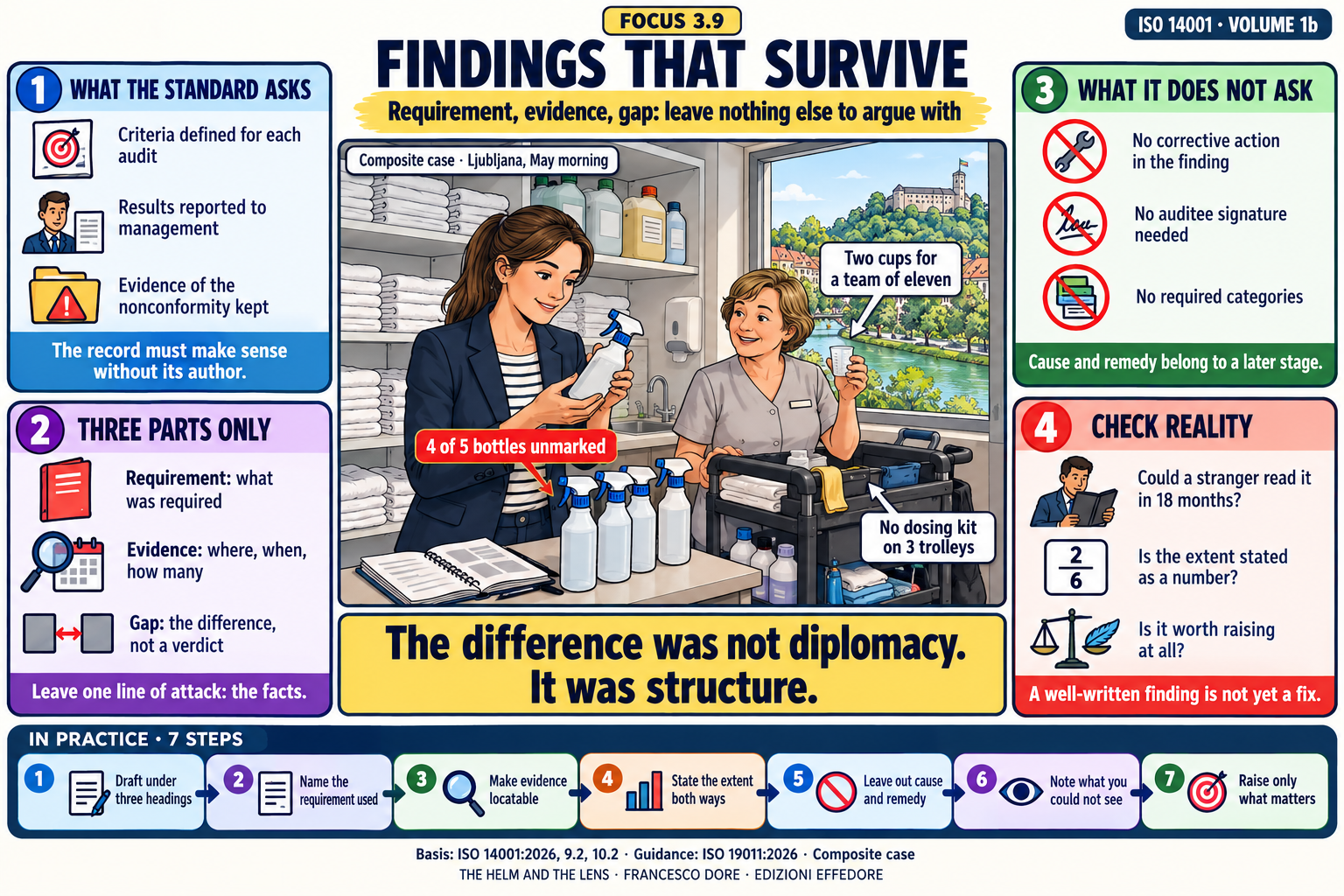
Slide 3.9
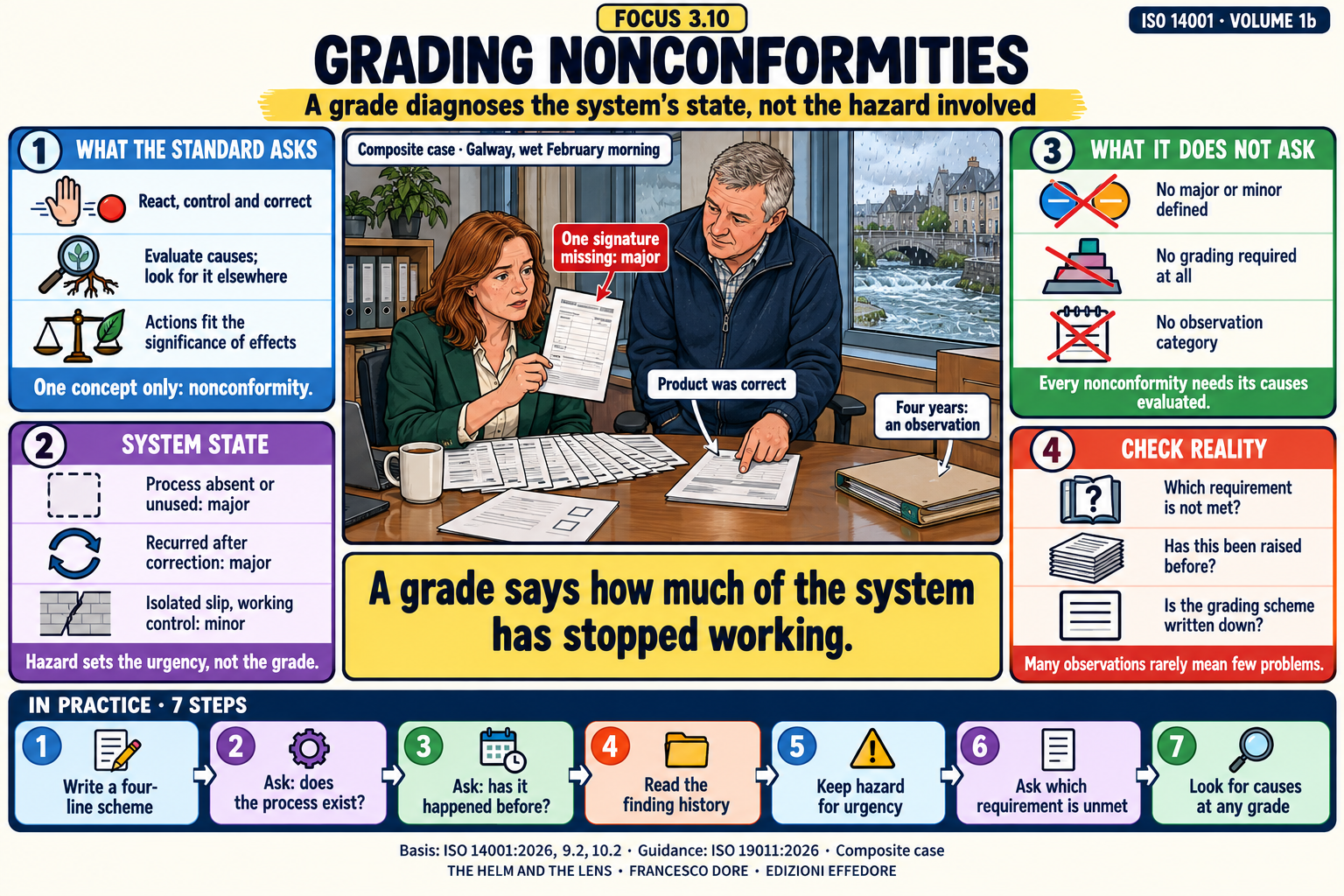
Slide 3.10
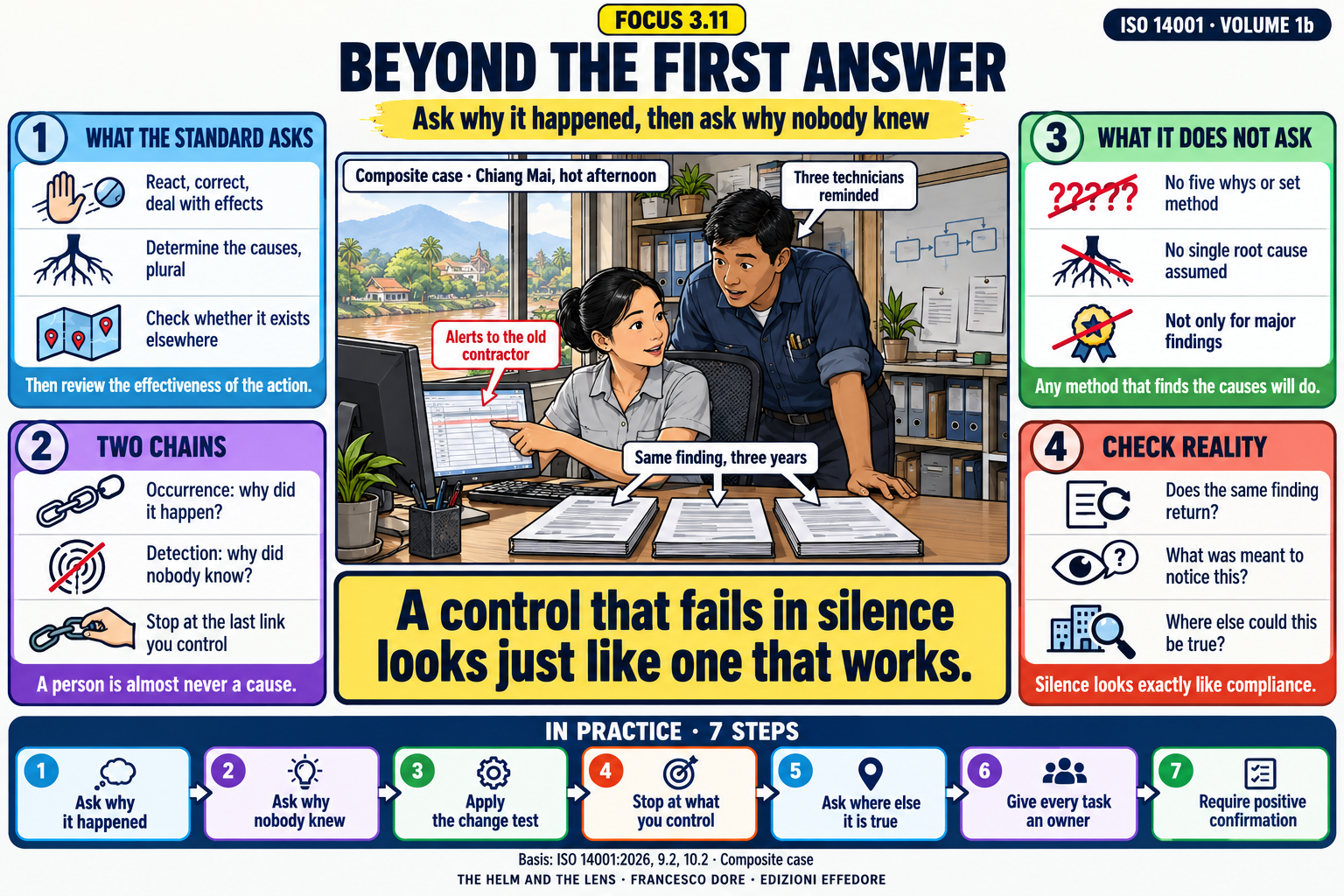
Slide 3.11

Slide 3.12
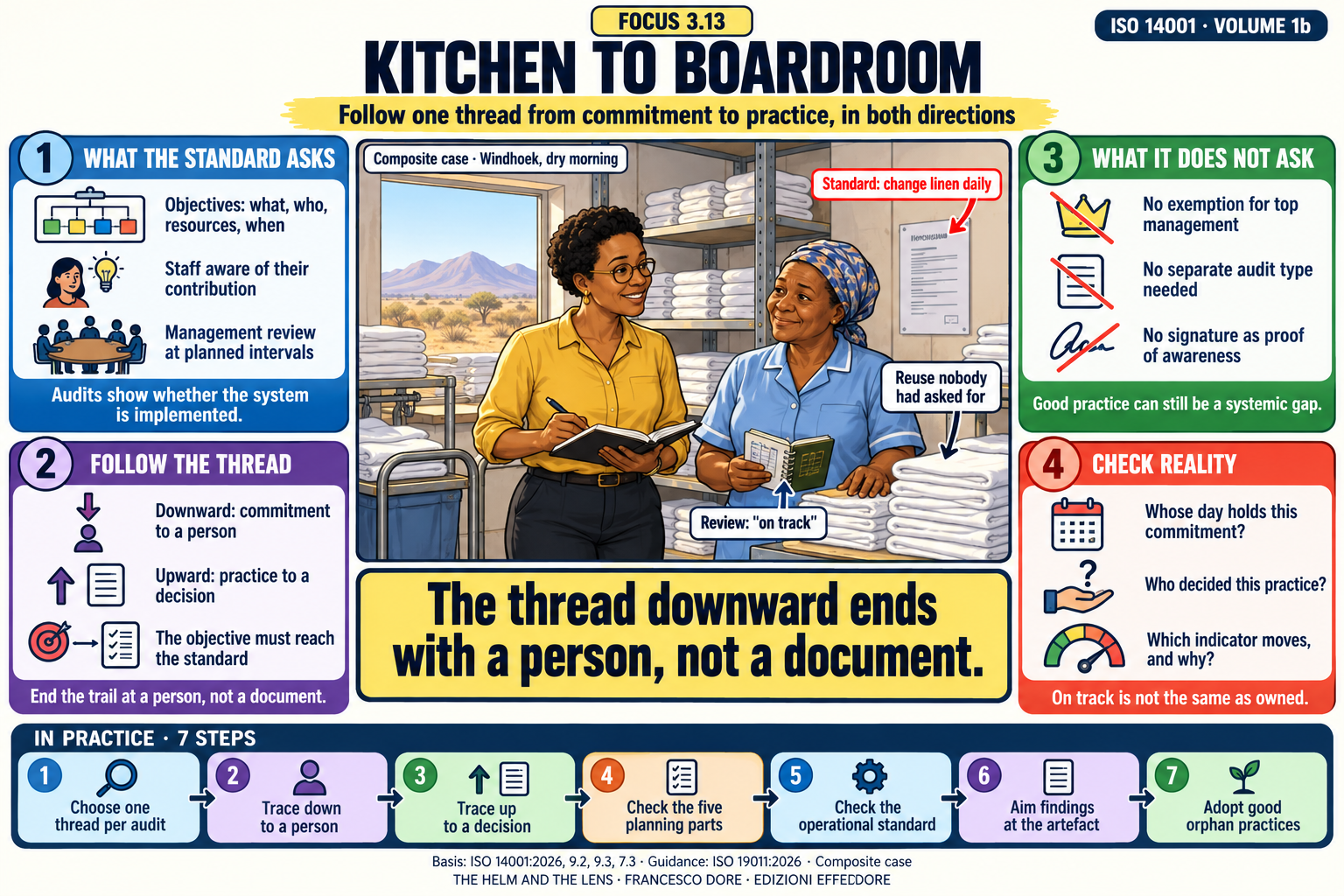
Slide 3.13
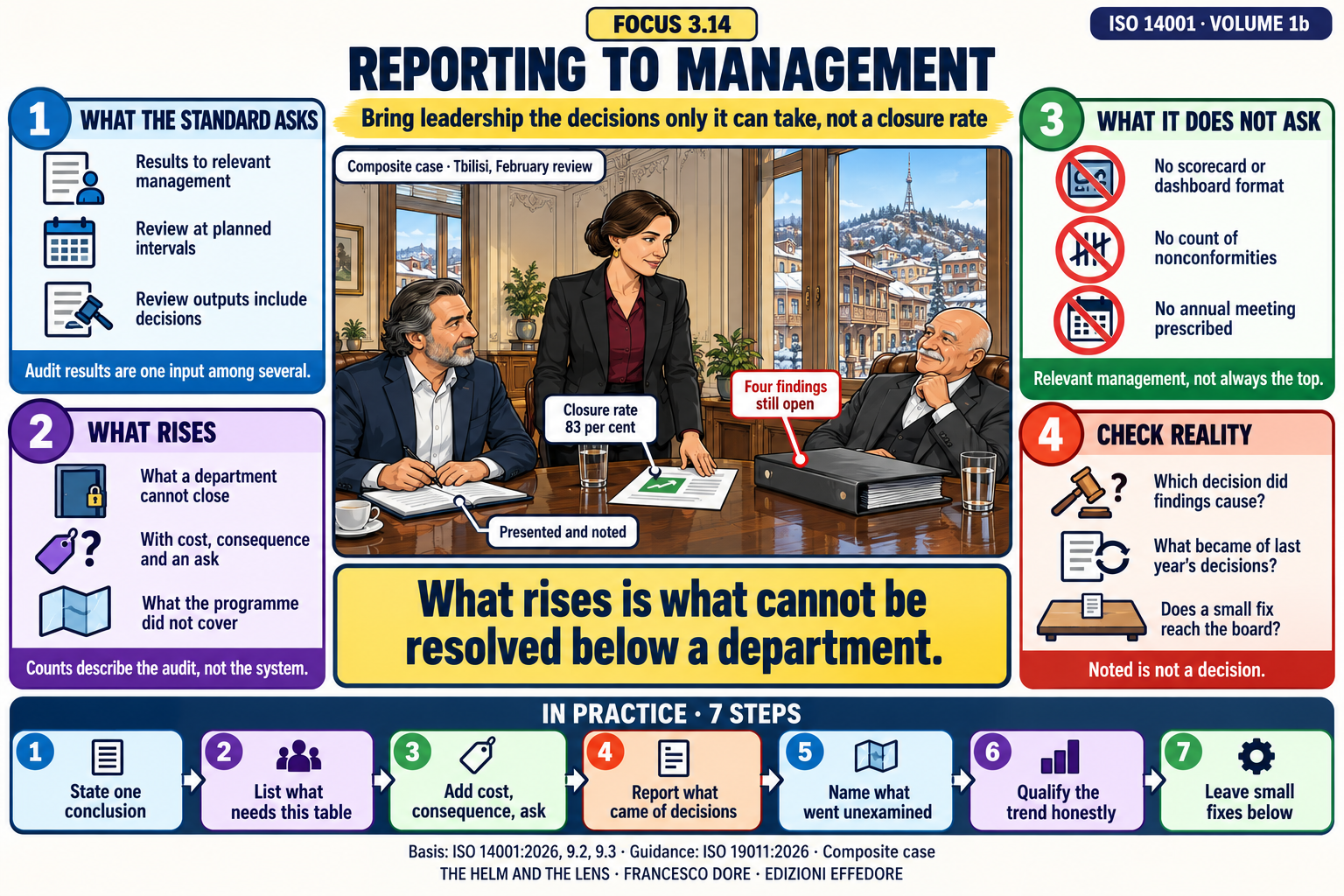
Slide 3.14
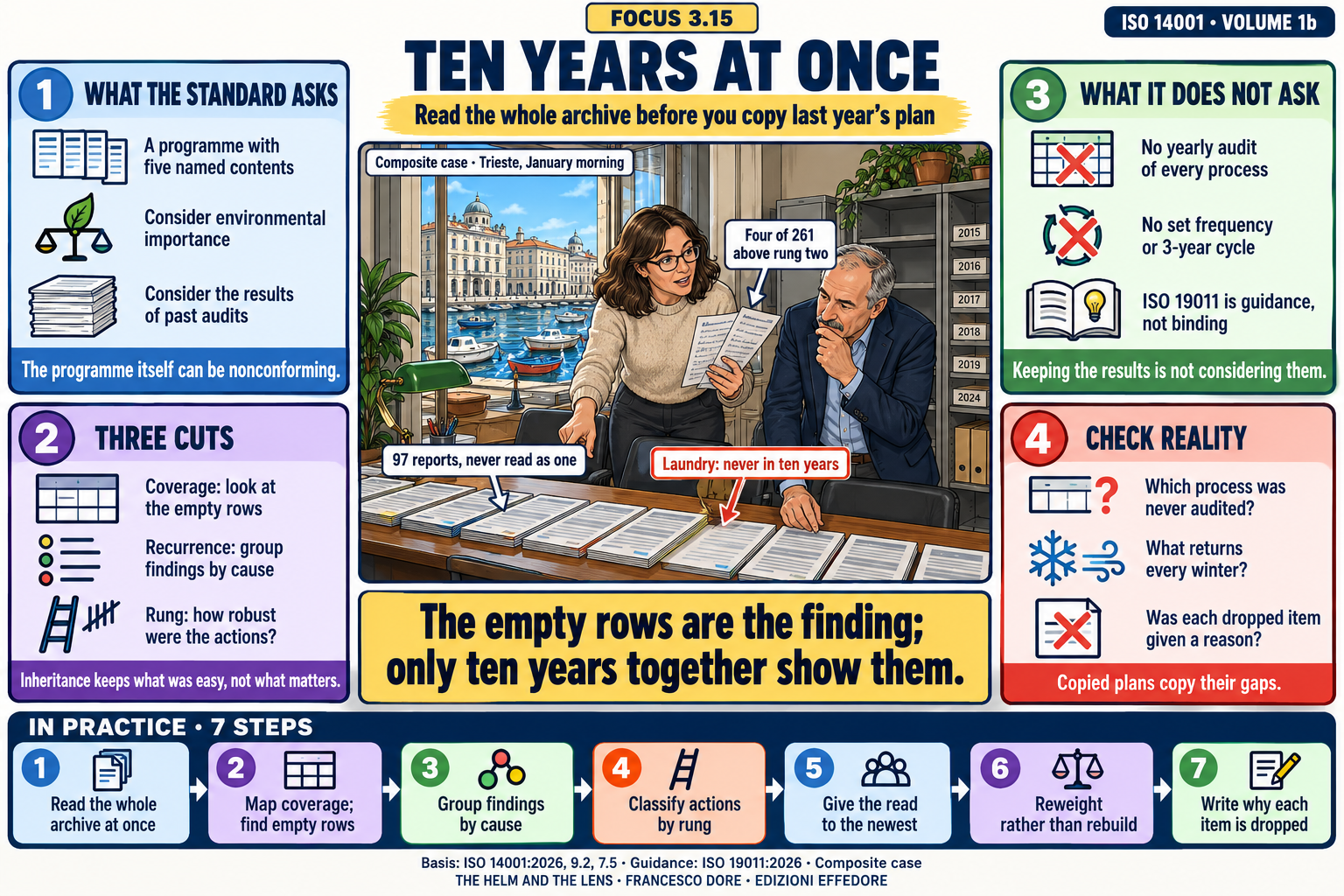
Slide 3.15
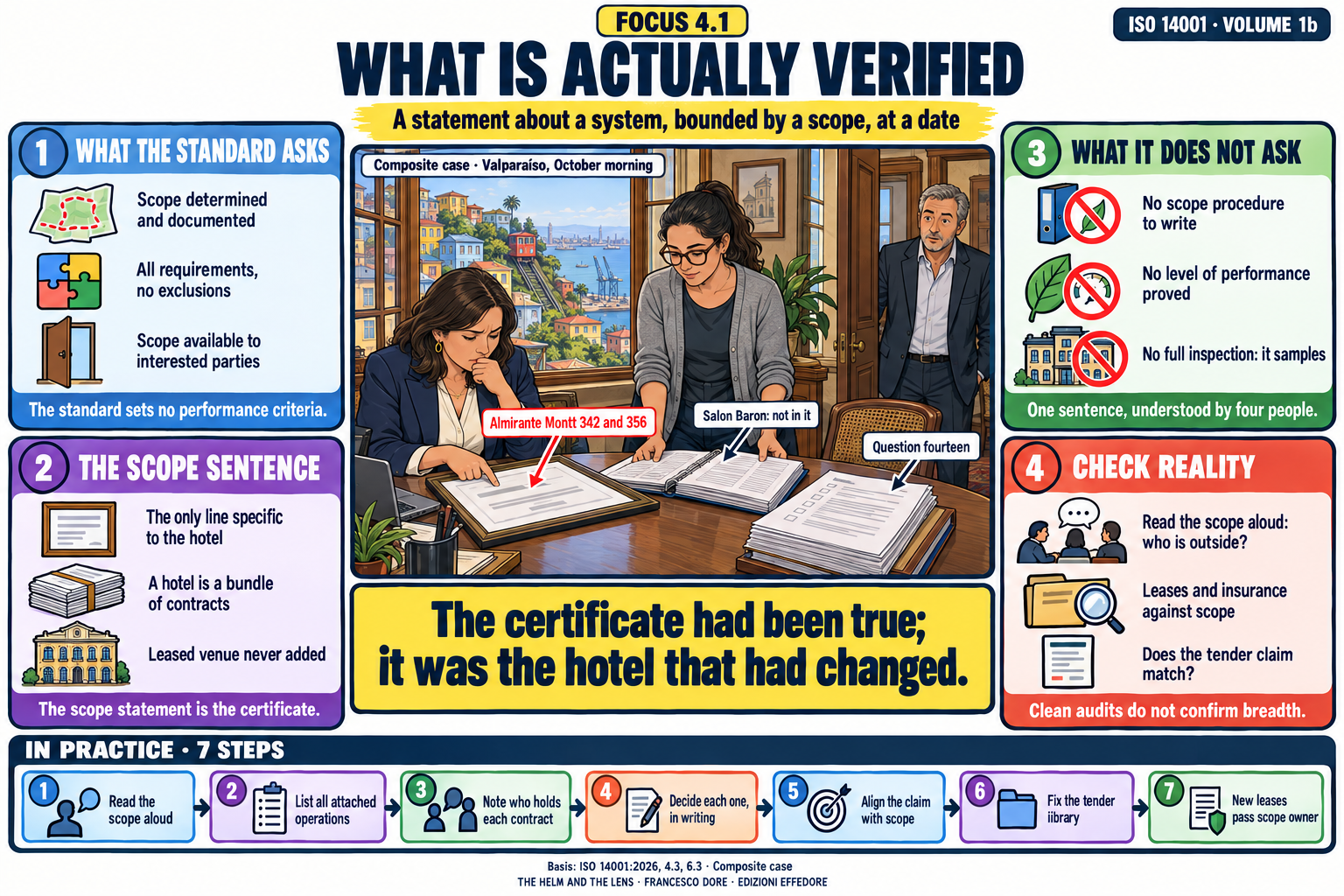
Slide 4.1

Slide 4.2
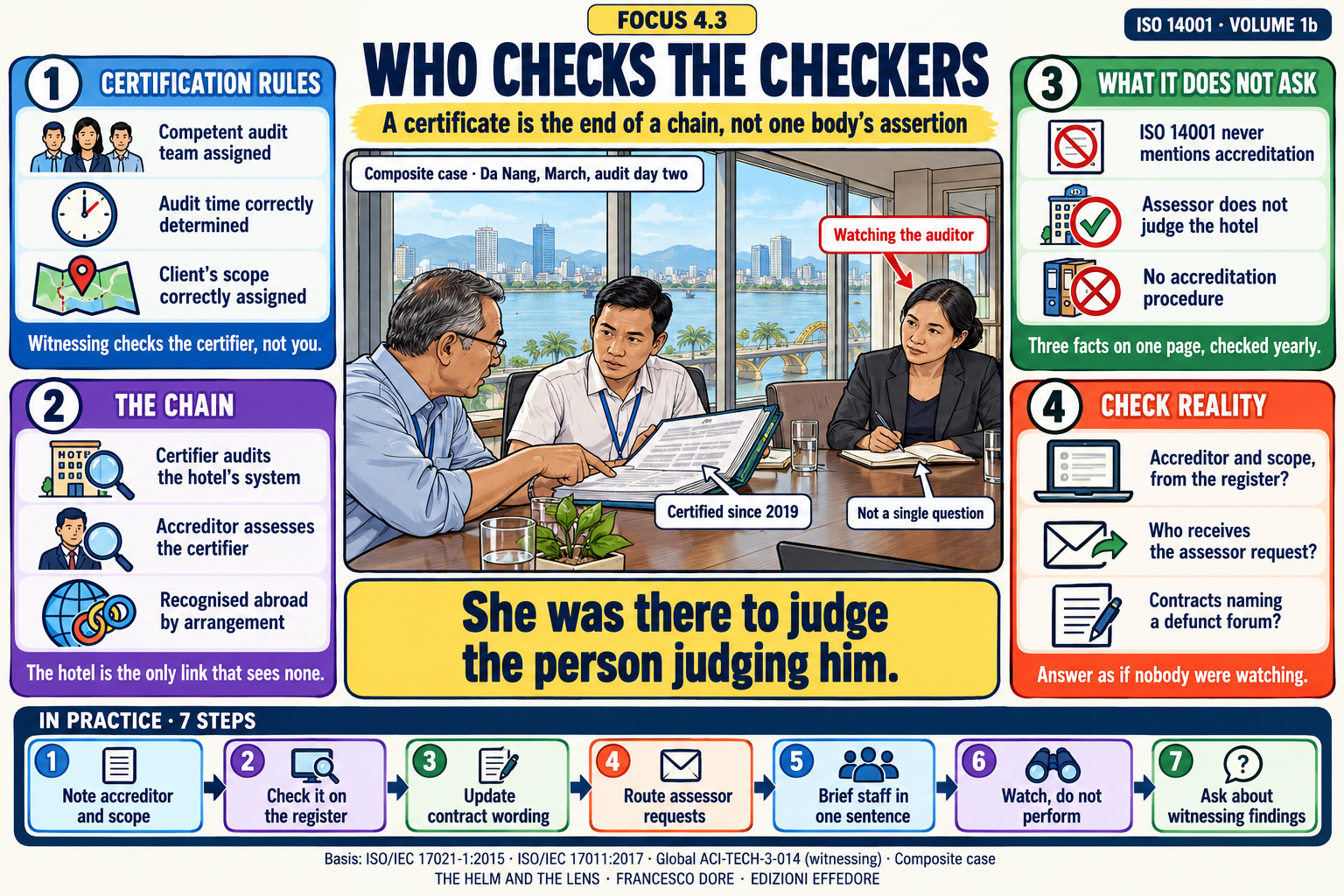
Slide 4.3
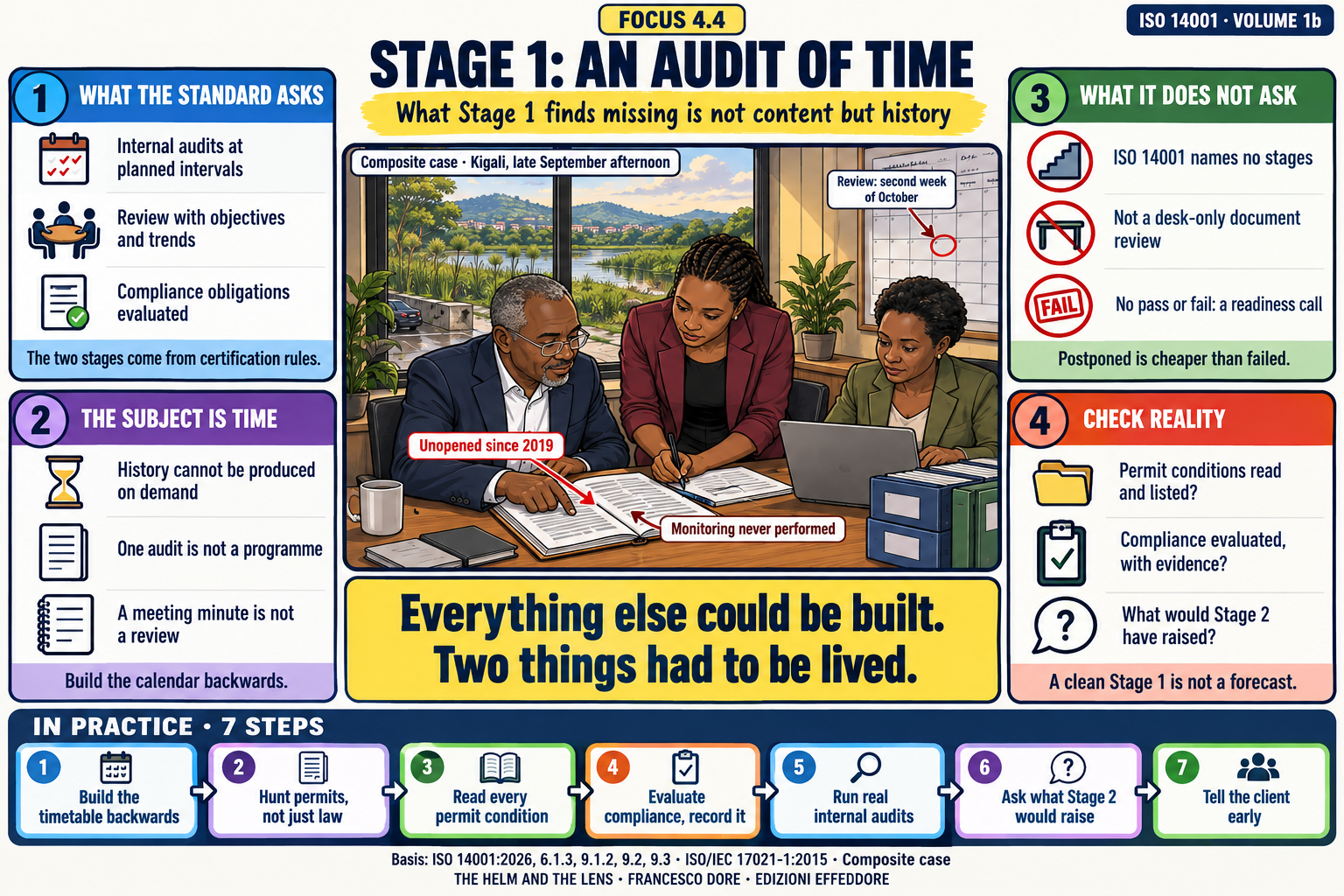
Slide 4.4
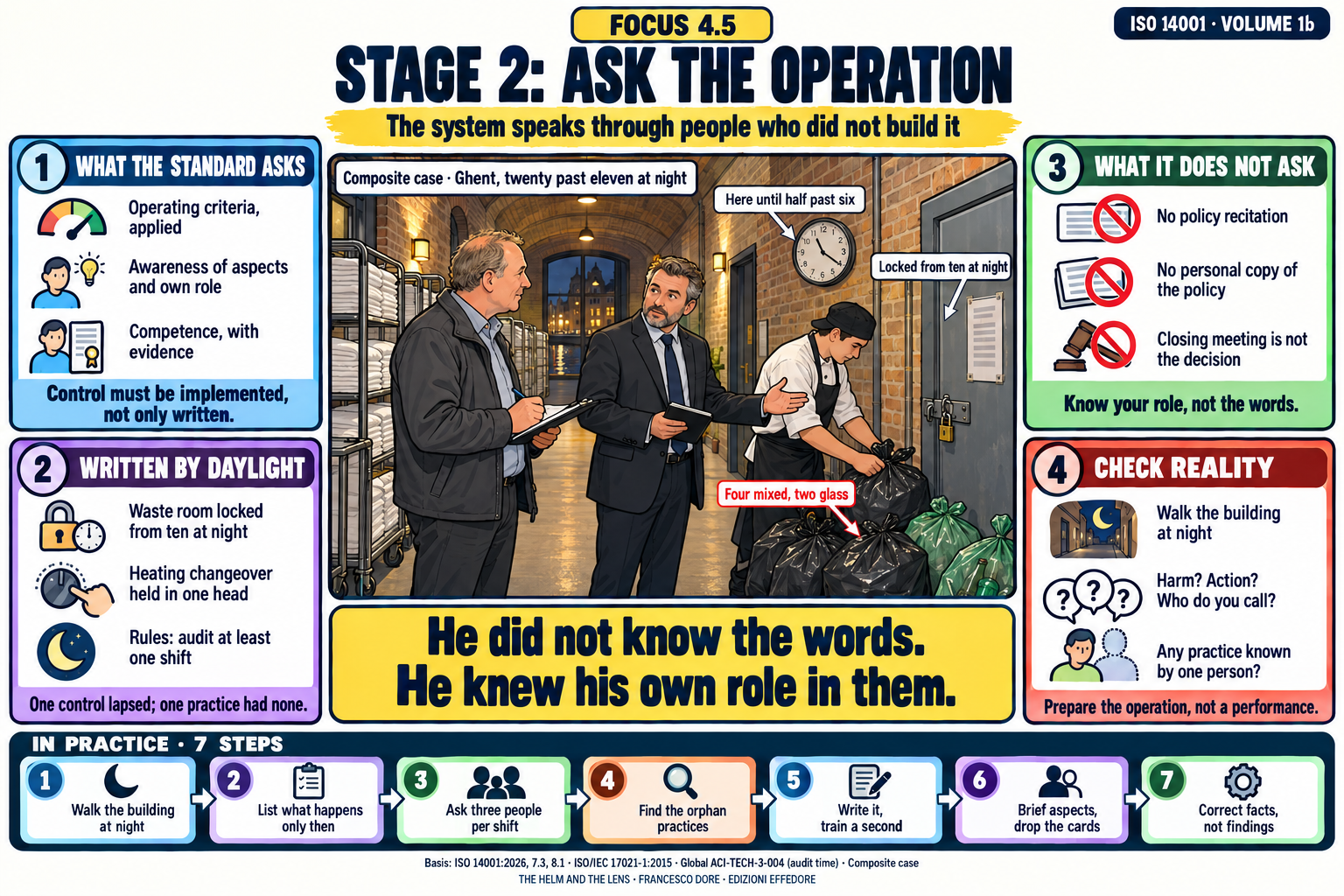
Slide 4.5
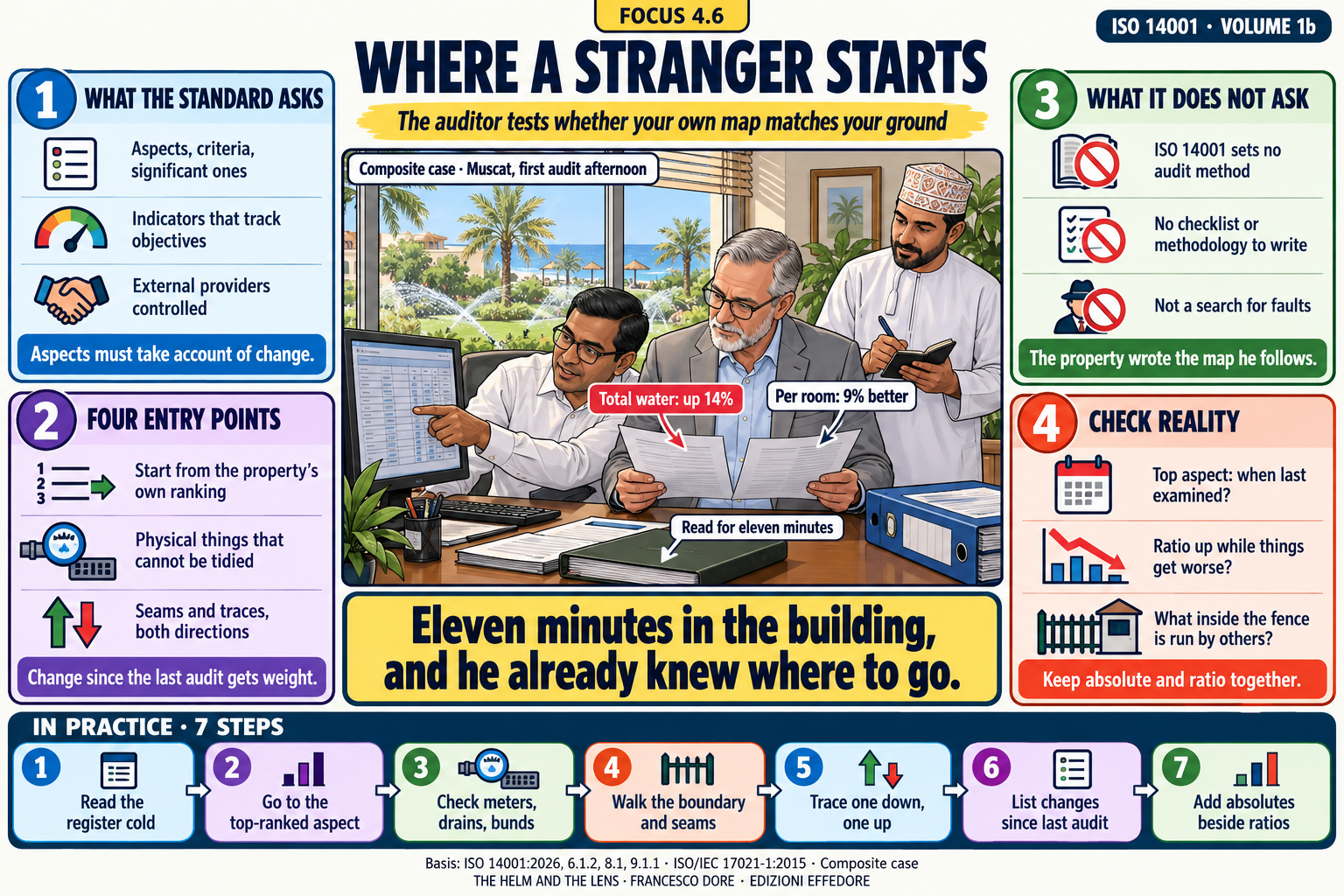
Slide 4.6
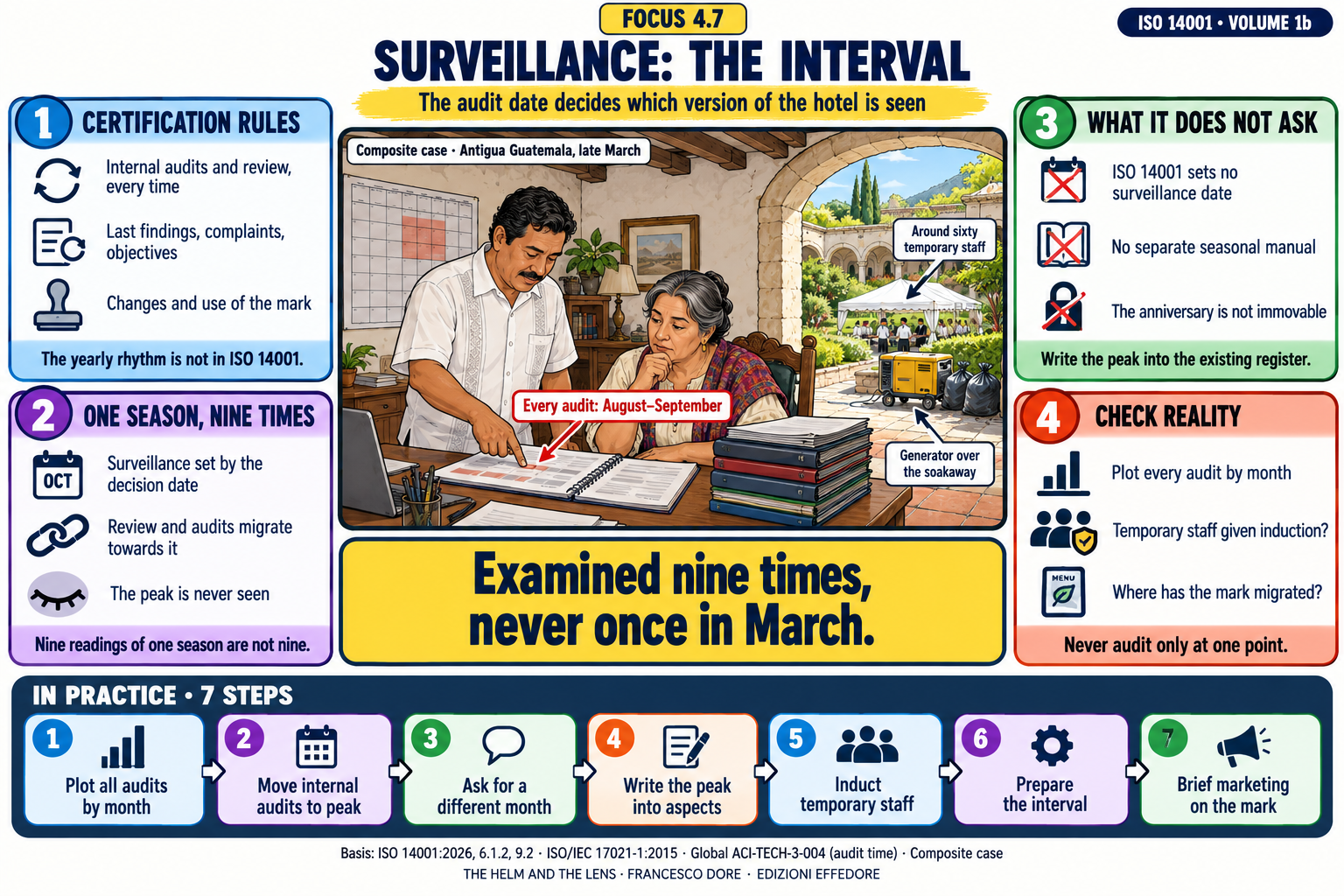
Slide 4.7
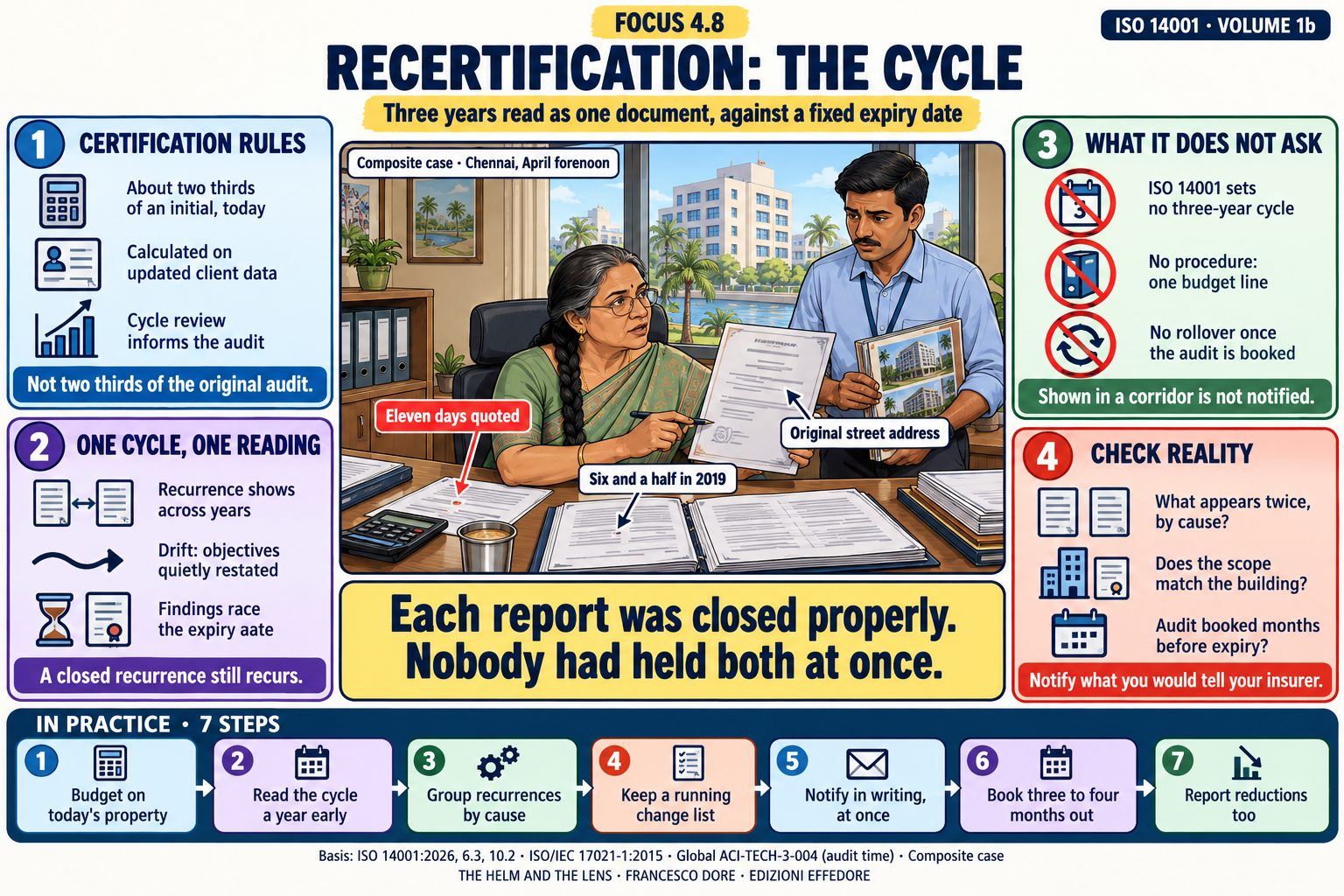
Slide 4.8
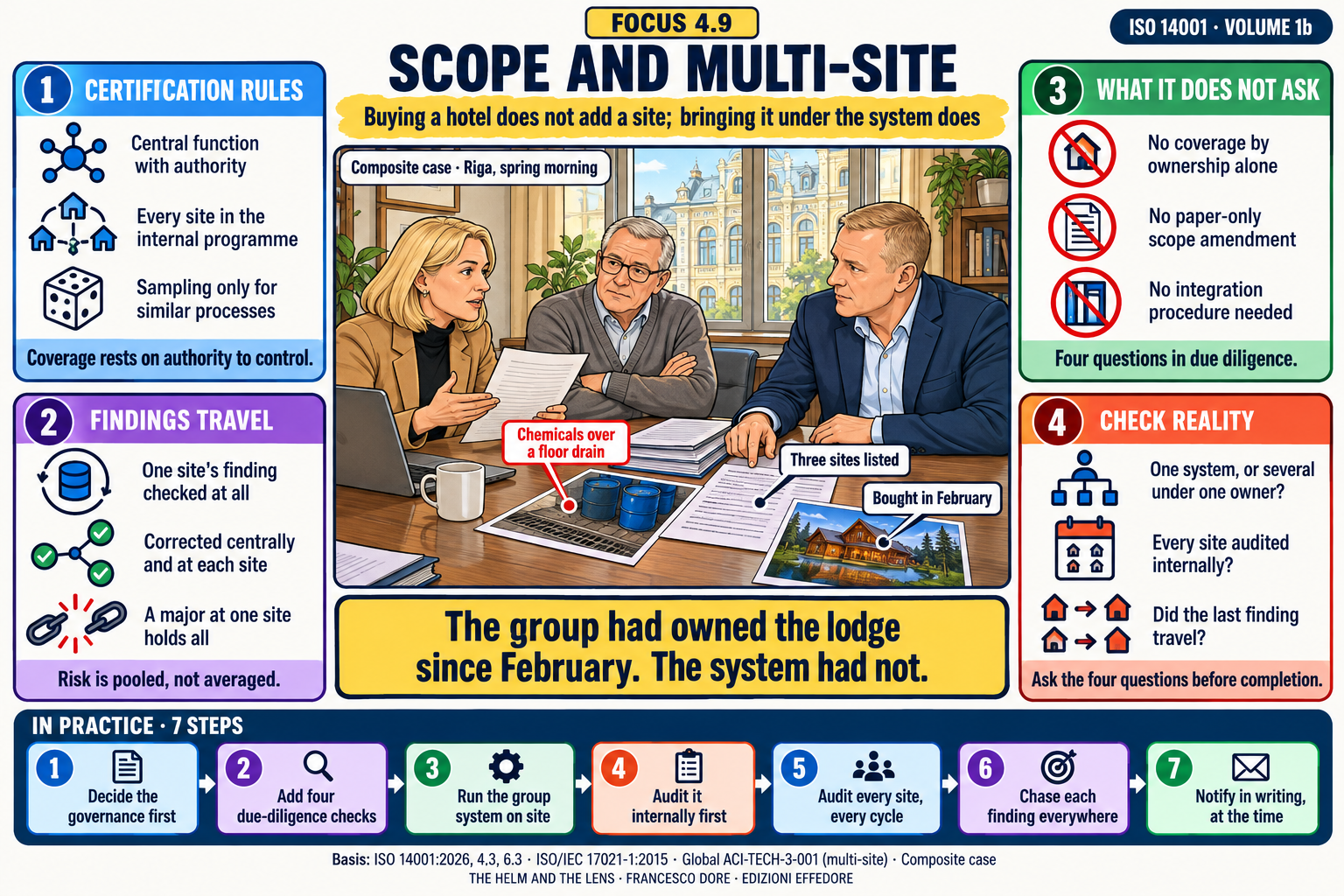
Slide 4.9
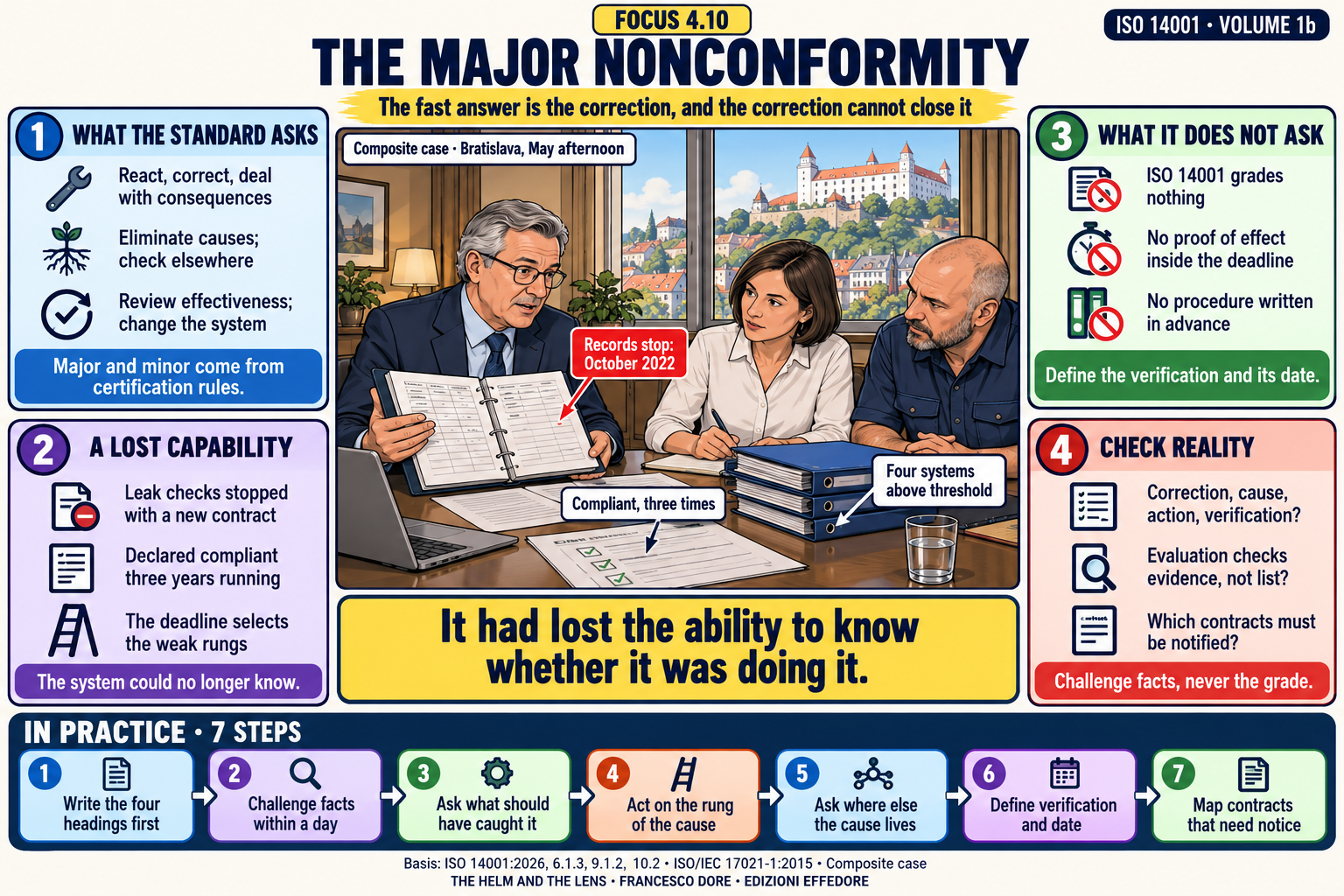
Slide 4.10
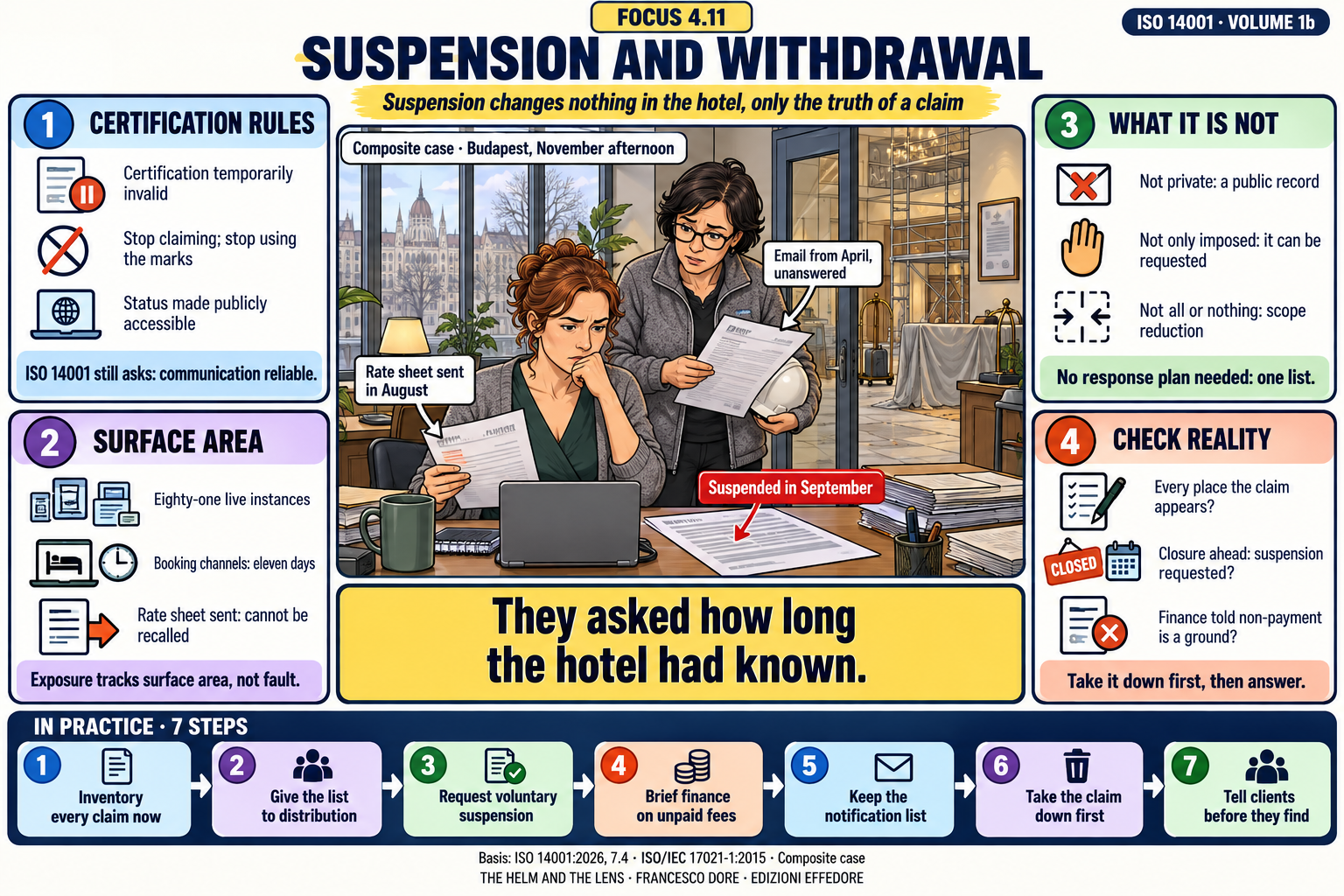
Slide 4.11
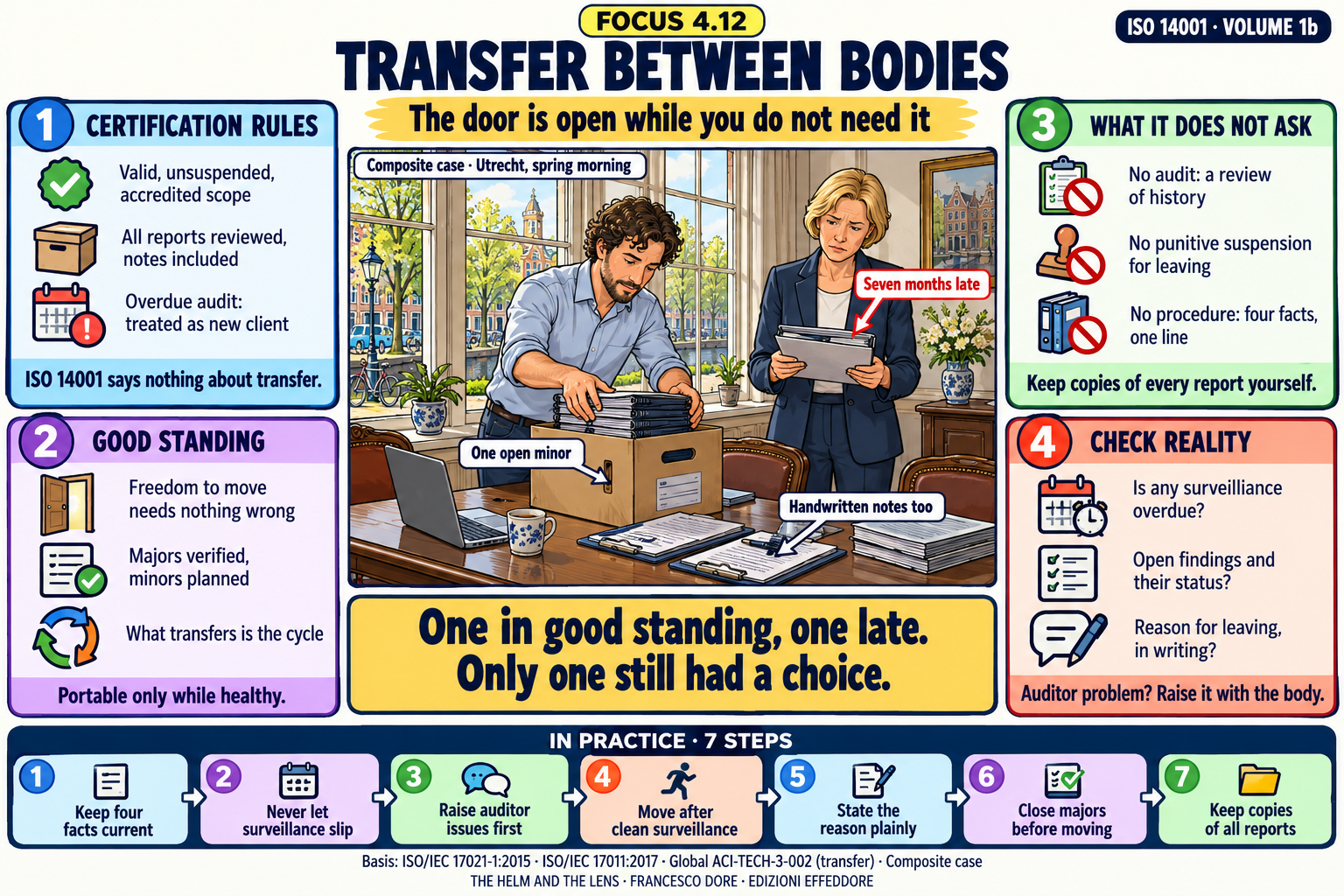
Slide 4.12
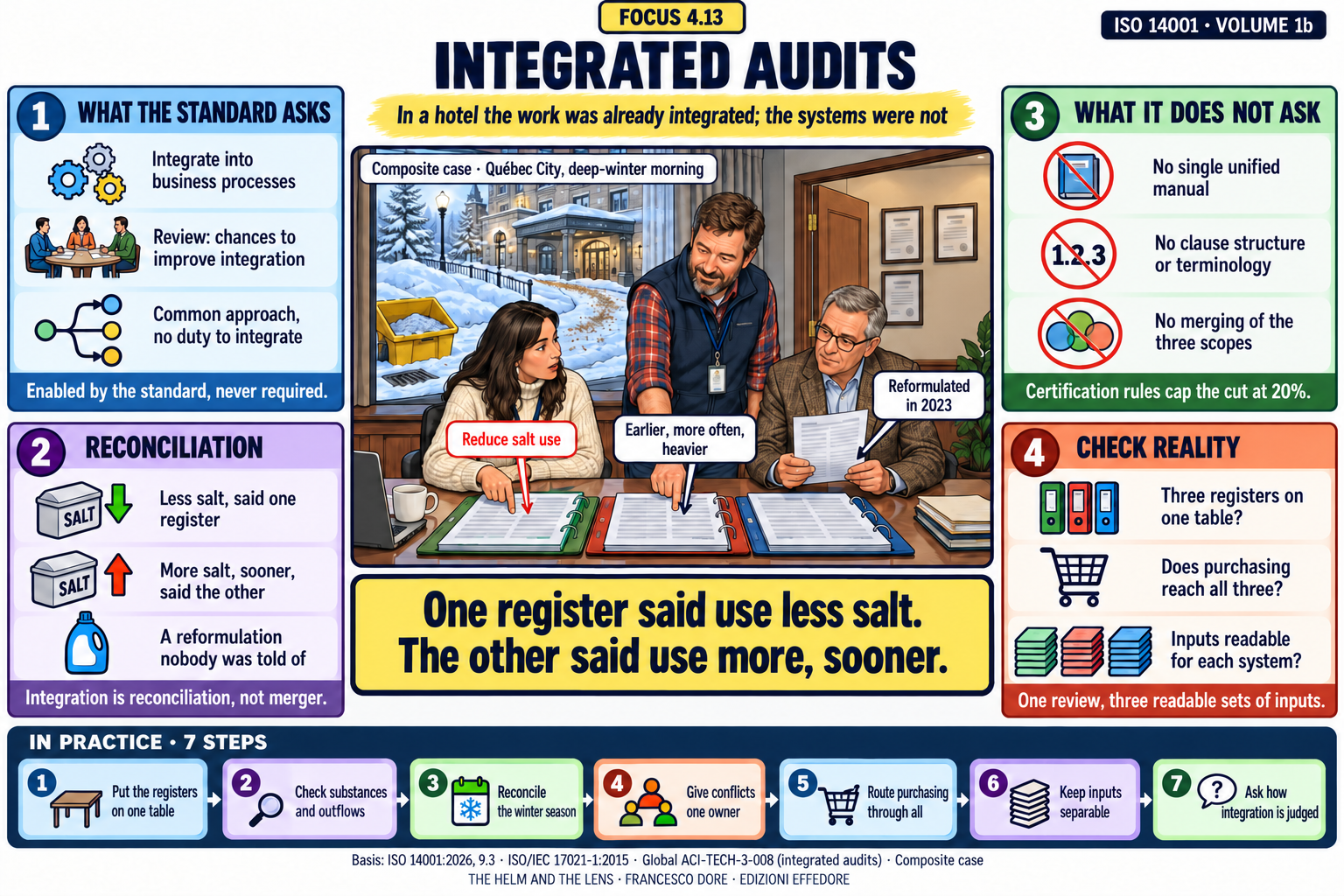
Slide 4.13
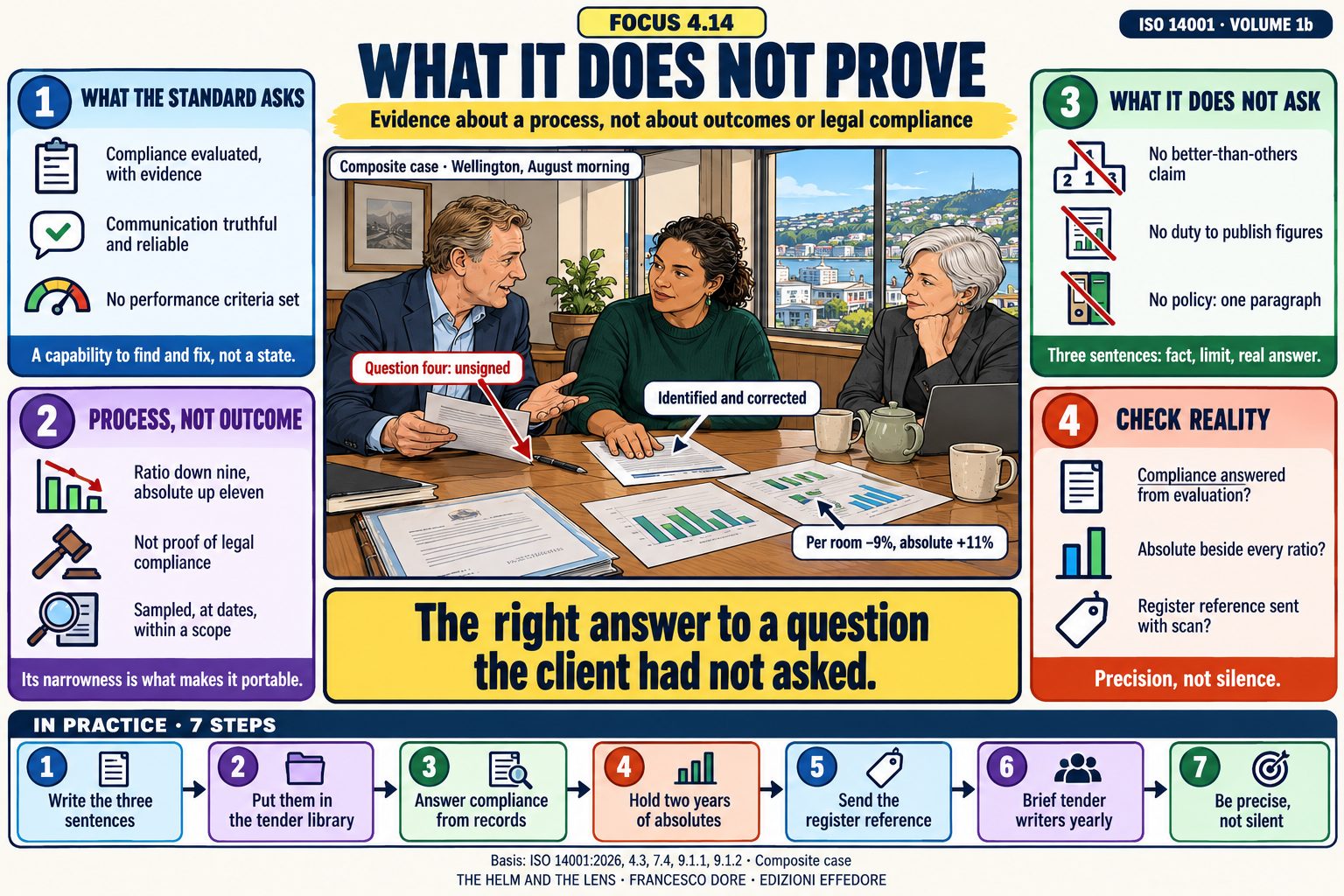
Slide 4.14

Slide 4.15
Immagini e tavole HD
Apri e proietta le foto direttamente dal sito, a schermo intero, oppure scarica gli originali.

Concept Card 3.1 — Why Internal Audit Exists, and Why It Fails
Independence as Architecture, Not as Virtue
Setting: Vancouver, Canada
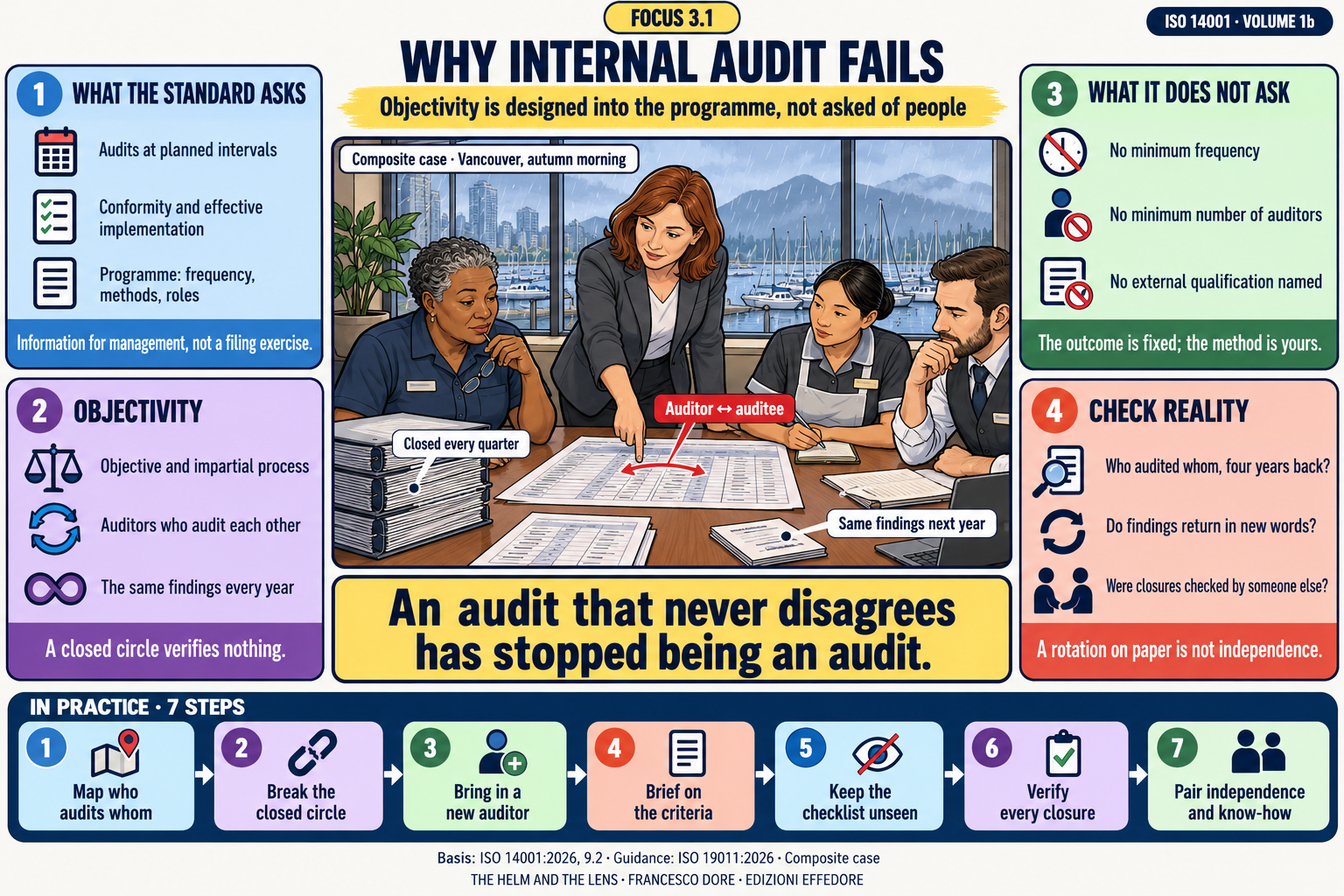
A small meeting room on an upper floor of the Pacific Rim Grand in Vancouver, on a grey, rainy morning. Beyond the wide, rain-streaked window lie the moored boats of Coal Harbour, the water and the North Shore mountains under low cloud. The new general manager, a woman of about forty-five with shoulder-length auburn hair, charcoal blazer and white blouse, stands leaning over the table, one finger on an audit schedule. On the left sits Rosalind Achebe, Chief Engineer, a Black woman of about fifty with short greying hair and a navy work shirt, chin on her hand, reading glasses in the other, eyes on the sheets. Opposite, the housekeeping supervisor, dark hair in a bun and grey tunic, studies the papers; beside her the food and beverage manager, in a dark suit, looks towards the general manager. Coffee cups and a binder share the table.
The card shows the meeting the new general manager called eleven days into the job. She has laid out four years of audit schedules and closure logs and seen that the auditor’s name and the department manager’s name were, every year, the same person or the one who had closed that department’s findings the year before. Achebe audited Housekeeping, Housekeeping audited Food and Beverage, Food and Beverage audited Engineering with a checklist Achebe had written. She has asked one question: would you trust a finding from this rotation if you had not written the checklist yourself? Nobody answers yes.
The plaques at the top give the event: Each auditor checked a neighbour, and Same findings back every year. The lower pair names the lesson. Independence must be designed: objectivity and impartiality are structural conditions the programme has to engineer, because good intentions are not a reliable substitute. Never audit your own checklist: an auditor working from questions written by the person audited can only confirm what that person already decided was acceptable.
The card does not say that the three auditors were incompetent or dishonest; every finding they raised was real and correctly closed. Nor does it say that ISO 14001 forbids auditing a colleague or prescribes a rotation, a number of auditors or an external qualification. The standard requires objectivity and impartiality of the audit process and leaves the mechanism to the organisation.
Source: Francesco Dore, The Helm and the Lens, Volume 1b — ISO 14001:2026, subchapter 3.1
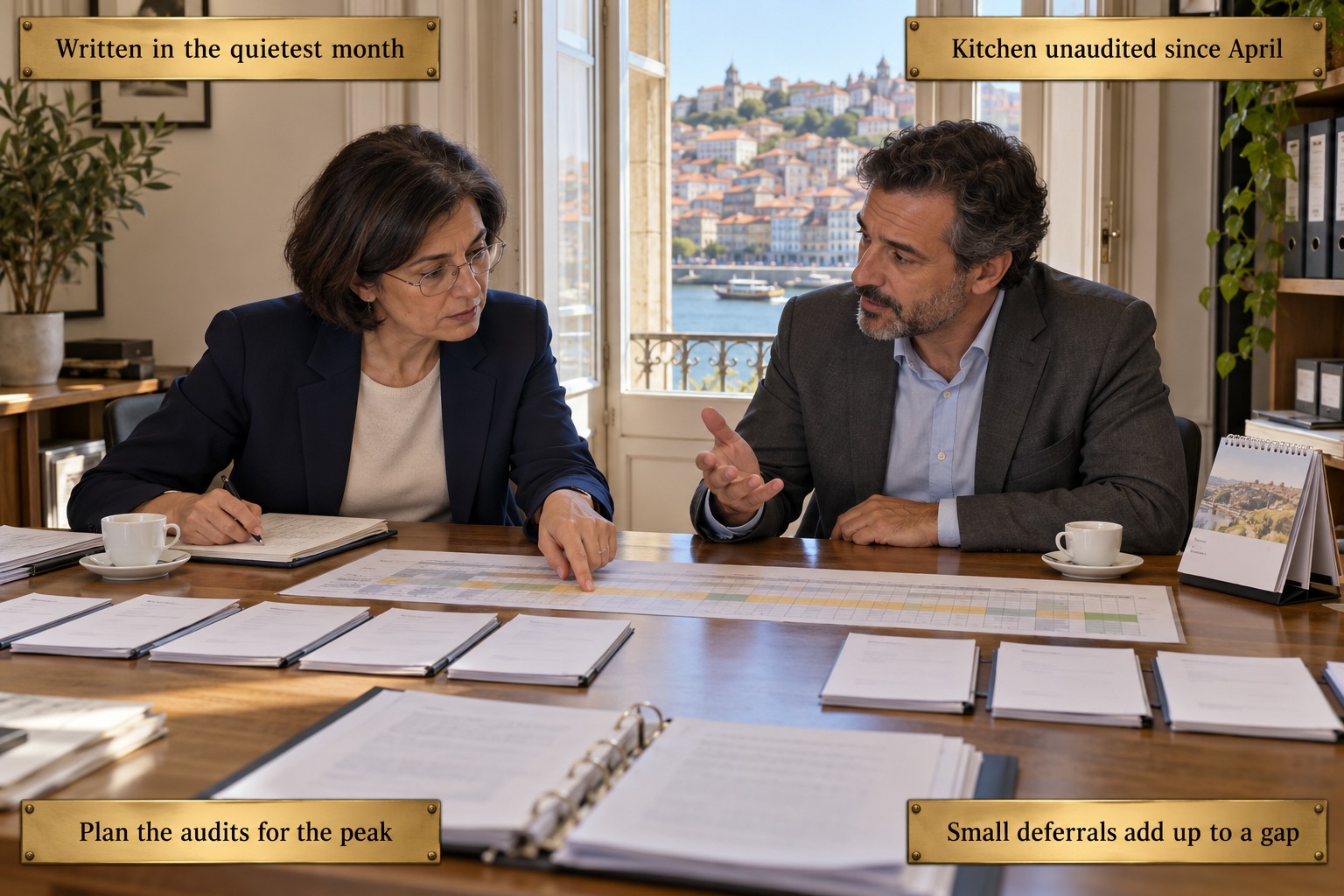
Concept Card 3.2 — Building an Audit Programme That Survives Contact with Occupancy
The Programme That Was Written in the Quiet Season
Setting: Porto, Portugal
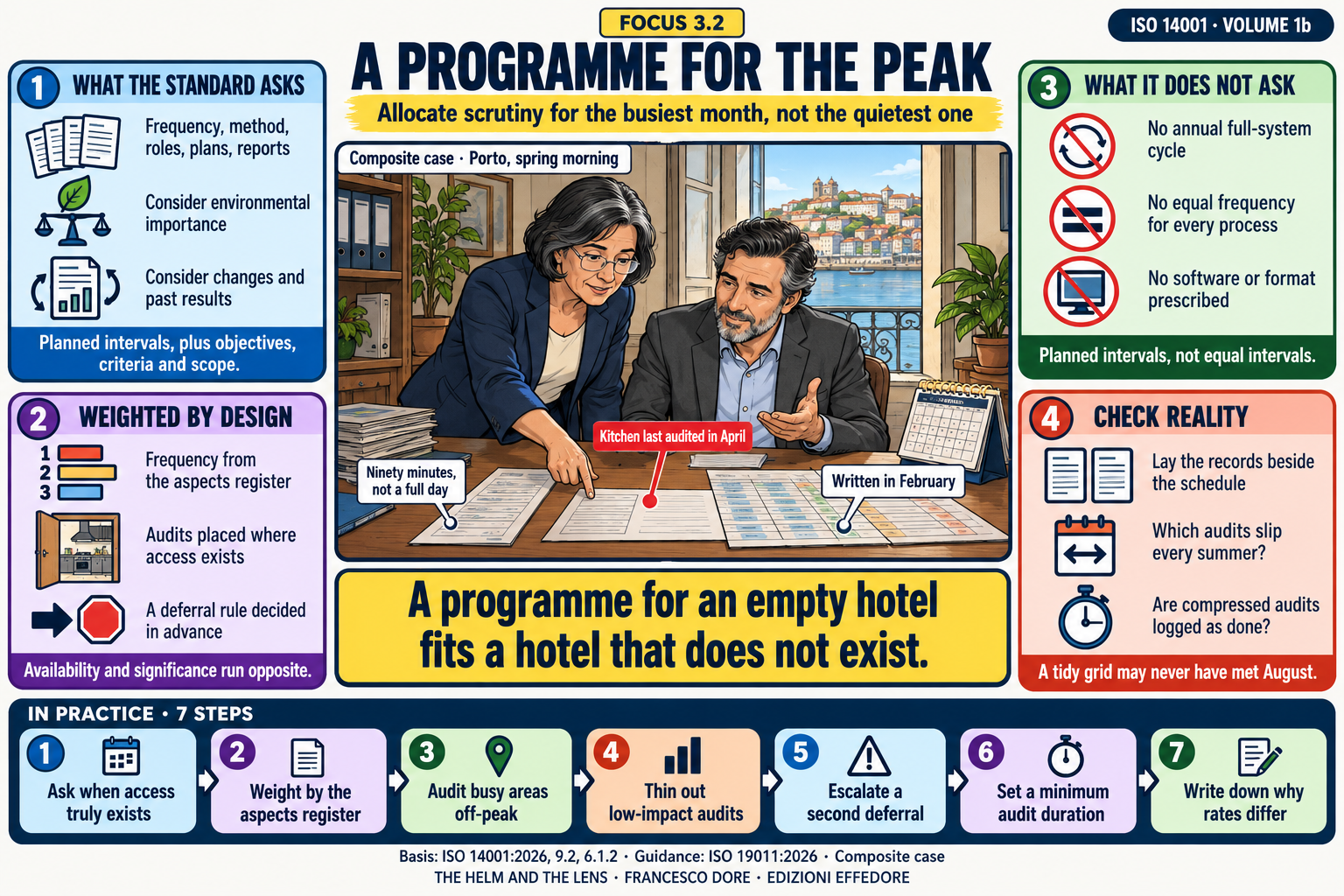
The back office of the Douro Palace in Porto on a bright spring morning. Through a tall open window with a small iron balcony, the river and the steep, terraced houses of the far bank glow in clear sunlight. At a long wooden desk sits the certification body’s auditor, a woman of about fifty with a dark bob and rimless glasses, navy jacket over a cream top, writing in her notebook with one hand while the index finger of the other rests on the wide annual schedule. Beside her Tomás Ferreira, Director of Operations, a man of about fifty with dark wavy hair and a greying beard, grey jacket and open blue shirt, turns to her with one open hand raised as he explains. Before them lie a sparse row of completed reports, an open binder and a desk calendar.
The card shows the moment, the spring after a hard summer, when the certification auditor has laid the year’s completed internal audit records beside the schedule. Ferreira’s programme, written in February at nineteen per cent occupancy, spread audits in even monthly blocks. Then June was cut to ninety minutes, July and August slipped, two audits were folded into one, and the kitchen, the largest source of waste, water use and energy, was last audited in April. Ferreira is explaining, truthfully, that every deferral was justified, which is precisely the problem.
The plaques at the top give the event: Written in the quietest month, and Kitchen unaudited since April. The lower pair names the lesson. Plan the audits for the peak: a programme has to be designed to survive its worst month, because the busiest processes are usually the most environmentally significant. Small deferrals add up to a gap: twelve individually reasonable postponements produced a year in which the property’s most important processes went largely unexamined.
The card does not say that Ferreira abandoned the programme or that the programme document was badly written; the auditor did not challenge it. Nor does it say that ISO 14001 requires audits in peak season or at equal intervals. The standard asks for planned intervals and for the programme to consider environmental importance, changes and previous results; how to weight the year is the property’s decision.
Source: Francesco Dore, The Helm and the Lens, Volume 1b — ISO 14001:2026, subchapter 3.2
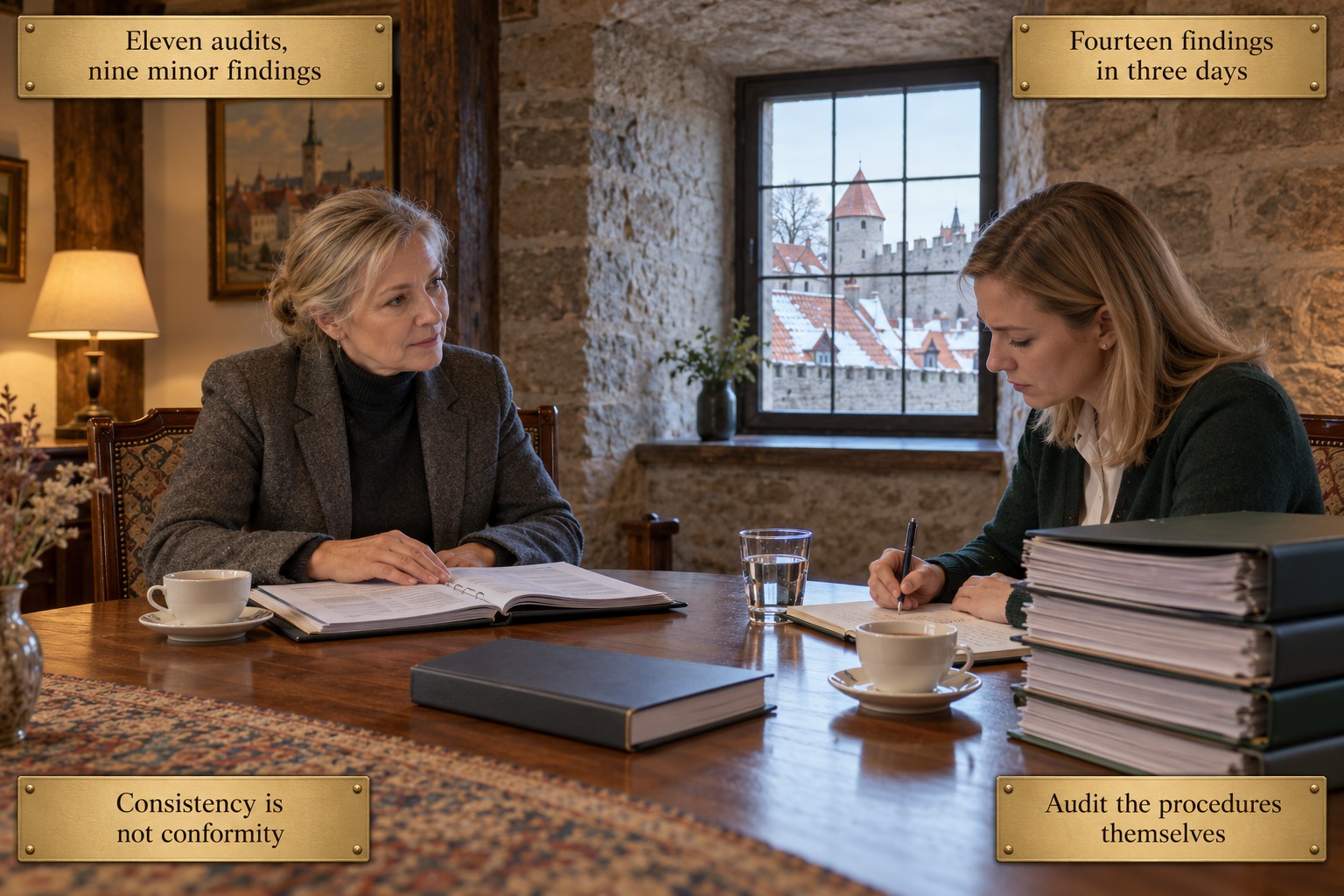
Concept Card 3.3 — Audit Criteria: What You Are Actually Checking Against
The Programme That Could Only Ever Agree With Itself
Setting: Tallinn, Estonia
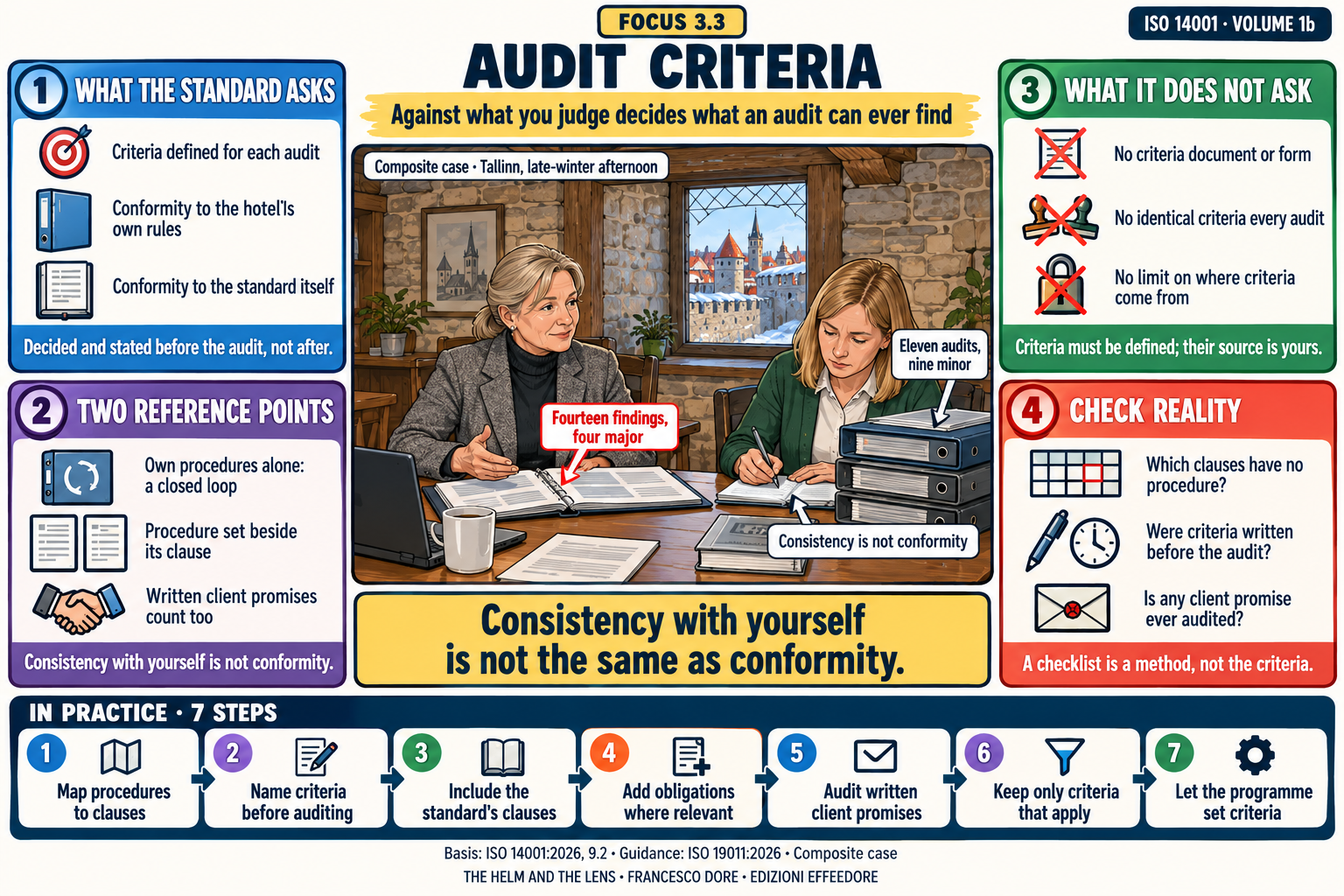
A small meeting room inside the Hanseatic Arms in Tallinn’s old town, on a late-winter afternoon. Thick stone walls and timber give the room its age; through a deep-set window, snow lies on steep red-tiled roofs below a stretch of crenellated wall and a round tower with a red conical roof, under pale daylight. On the left sits the lead auditor, a woman of about fifty-five with ash-blonde hair tied back, grey tweed jacket and dark roll-neck, both hands resting on an open report, looking steadily and kindly across the table. On the right Katrin Ilves, Quality and Environment Coordinator, a woman of about forty with straight fair hair and a dark-green cardigan over a white shirt, writes in her notebook, brow furrowed, eyes down. Beside her rises a tall stack of procedure binders; a closed bound book lies between them.
The card shows the closing meeting of a three-day recertification audit. Six years of certification and eleven internal audits had produced nine minor findings, all closed within the month. The new lead auditor has raised fourteen findings, four of them major, almost all on things the internal audits had examined and passed. The internal audits were careful, but they measured practice only against the procedures Ilves wrote in the first year. The auditor has just said that the system is internally consistent but that consistency with yourself is not conformity, and Ilves is writing that sentence down.
The plaques at the top give the event: Eleven audits, nine minor findings, and Fourteen findings in three days. The lower pair names the lesson. Consistency is not conformity: conformity is a relationship between a process and a stated requirement, and a system judged only against itself cannot notice its own drift. Audit the procedures themselves: holding the standard beside the procedure reveals where the two have diverged, often the most valuable internal finding of all.
The card does not say that Ilves’s internal audits were careless or that auditing against the property’s own procedures is wrong; those procedures are one of the two reference points the standard names. Nor does it say the standard prescribes a criteria form or level of detail. It requires that criteria be defined for each audit, and an audit programme that never uses the standard itself leaves one half unexamined.
Source: Francesco Dore, The Helm and the Lens, Volume 1b — ISO 14001:2026, subchapter 3.3

Concept Card 3.4 — Competence of the Internal Auditor
Two Competent Auditors, One Audit That Established Nothing
Setting: Montevideo, Uruguay
The plant room of the Rambla Sur in Montevideo on a mild weekday morning. Silver pipework, valves and round pressure gauges line the right side; at the back a wide window shows the flat expanse of the estuary and a distant city skyline under a pale sky, while a yellow walkway line runs along the painted floor. On the left stands Diego Halperin, Financial Controller, a man of about forty-five with short dark hair and thin-framed glasses, white shirt, navy tie and a yellow high-visibility vest, head bowed, writing on his clipboard. Beside him Marisol Ferrán, Chief Engineer, a woman of about fifty with dark curly hair and navy overalls with rolled sleeves, ear defenders round her neck, rests one hand on an insulated pipe and points with the other towards the gauges as she speaks to him. A schematic and a hard hat hang behind them.
The card shows one of the property’s two internal auditors at work, and why neither audit is complete. Halperin traces every claim to a record and has never closed a finding on someone’s word, yet in four years he has raised no finding about an operational practice; when Ferrán explains the condensate recovery loop, he records it and checks it matches the procedure. Ferrán, who audits other departments, has caught a failing heat exchanger and a badly commissioned dosing pump, but never asks for a record, and twice her verbal findings never reached a report.
The plaques at the top give the event: The controller checked every paper, and The engineer heard every fault. The lower pair names the lesson. Two auditors, no complete audit: method without subject knowledge is operationally blind, and subject knowledge without method finds problems but records none defensibly. Join method with process knowledge: the necessary competence for each audit has to cover both dimensions, in one person or in a deliberate pairing.
The card does not say that either auditor is bad at the job; each catches what the other cannot. Nor does it say that ISO 14001 names a course, a certificate or a refresher interval for internal auditors. The standard requires the organisation to determine the necessary competence, on the basis of education, training or experience, to ensure it and to retain evidence.
Source: Francesco Dore, The Helm and the Lens, Volume 1b — ISO 14001:2026, subchapter 3.4
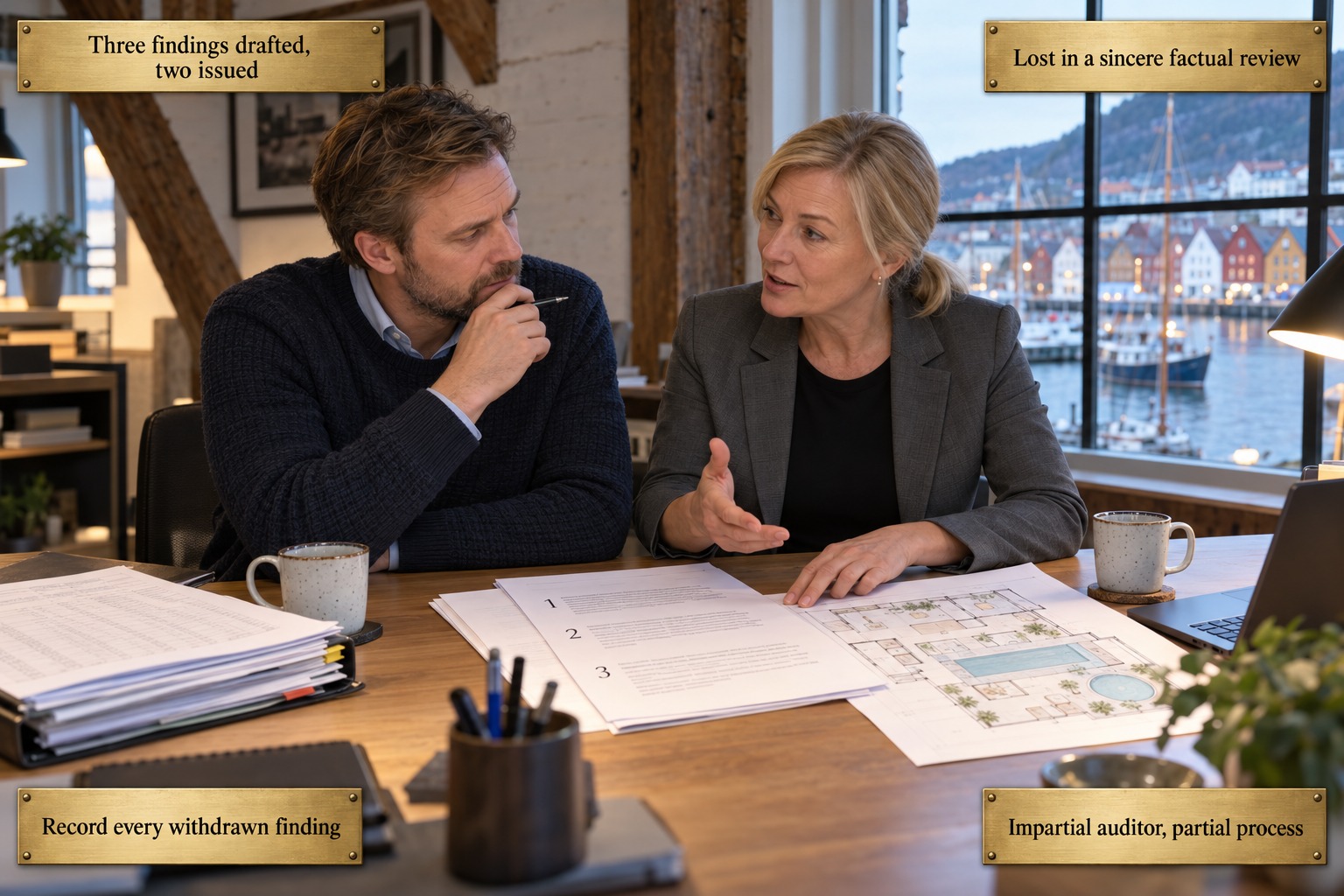
Concept Card 3.5 — Impartiality and Objectivity in a Property You Work at Every Day
The Finding That Left the Report After the Fieldwork Ended
Setting: Bergen, Norway
An upper-floor office in the Fjordvik, a converted warehouse on the quay at Bergen, late on a spring afternoon. Timber beams frame whitewashed walls; through a large window, moored boats with tall masts sit on the harbour and the row of coloured wooden quayside houses across the water shows its first lit windows. At the desk sits Aslak Nordvik, Rooms Division Manager and internal auditor, a man of about forty-five with tousled sandy hair, a short beard and a navy knitted sweater, pen held to his chin, looking at her with an uncertain expression. Beside him Elin Sørhaug, a woman of about fifty with blonde hair in a low ponytail, grey blazer over a black top, turns towards him, one hand open in explanation, the other resting on the papers. Before them lie the draft report with its three numbered blocks and a floor plan of the wellness floor.
The card shows the factual review of Nordvik’s audit of the wellness floor, Sørhaug’s project, which she fought for and defended twice at board level. Nordvik, independent by every structural measure, drafted three findings: the pool backwash never characterised against the consent, a five-week gap in dosing records, and the floor’s water use never separated from the building total. Sørhaug is explaining, at length and sincerely, that the submetering point is a design matter. Nordvik has no ready answer. Nobody leans on him, but the third finding will become an improvement opportunity, and no trace of it will remain.
The plaques at the top give the event: Three findings drafted, two issued, and Lost in a sincere factual review. The lower pair names the lesson. Record every withdrawn finding: a draft finding that changes or disappears must leave a trace, with the reason and who decided. Impartial auditor, partial process: impartiality can be lost at stages after the assignment, above all when the draft is renegotiated with the person it concerns.
The card does not say that Sørhaug acted in bad faith or that Nordvik was weak; she made an argument and he had no ready answer. Nor does it say that ISO 14001 requires or forbids factual review of drafts. The standard requires the audit process to be objective and impartial and leaves the arrangements to the organisation, which must be able to show what ensures it.
Source: Francesco Dore, The Helm and the Lens, Volume 1b — ISO 14001:2026, subchapter 3.5
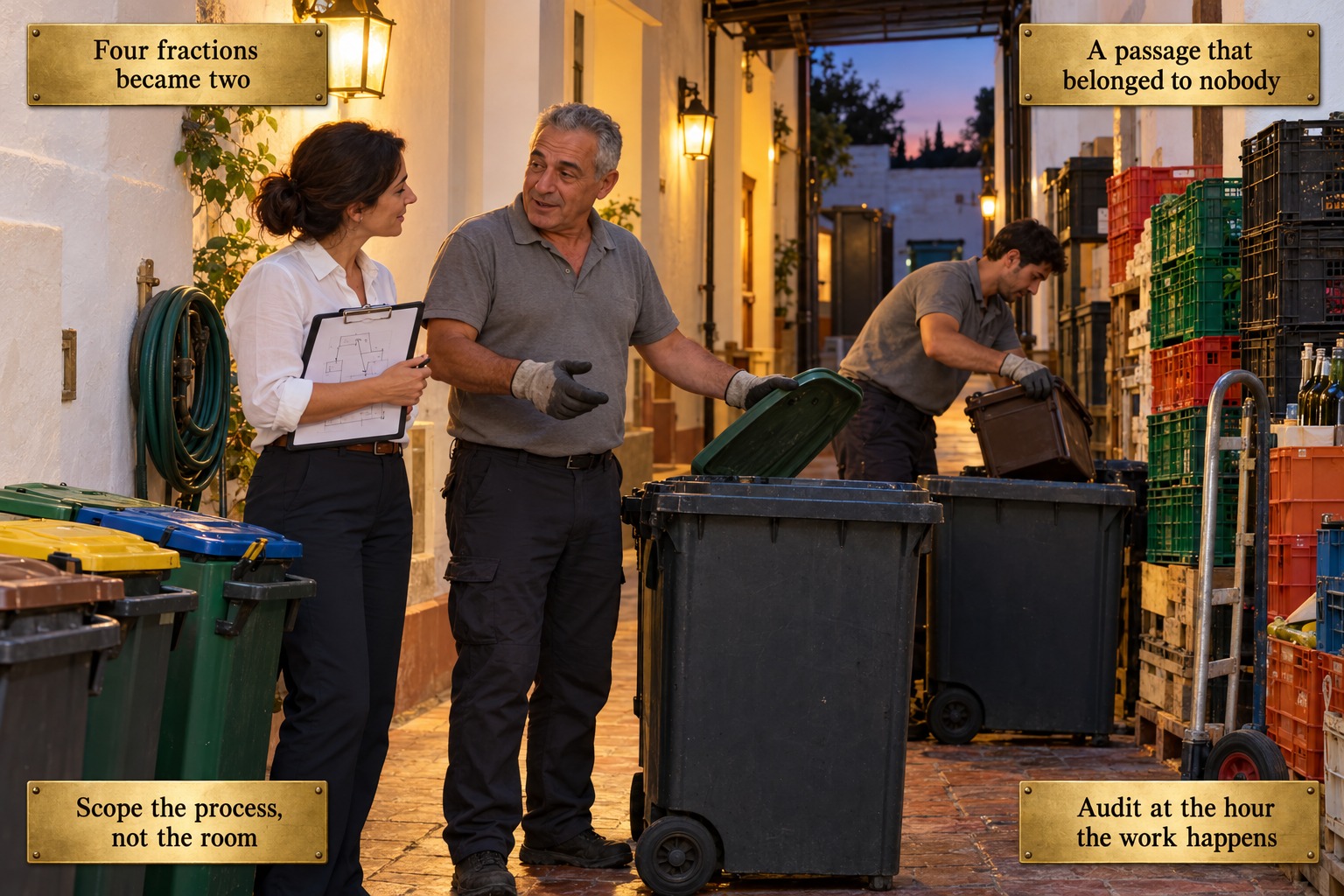
Concept Card 3.6 — Planning a Single Audit: Scope, Timing and Access
Twenty Metres That Belonged to Nobody
Setting: Seville, Spain
The covered service passage of the Casa de los Naranjos in Seville, on a warm Saturday evening after dinner service. Whitewashed walls glow under wall lanterns, and at the far end an opening shows the deep blue and pink dusk sky. Stacked crates of vegetables and bottles from the neighbouring restaurant, with a hand trolley, crowd the right side. On the left the internal auditor, a woman of about forty with dark hair in a low knot, white blouse with rolled sleeves and dark trousers, holds a clipboard with a route sketch and smiles at the senior porter. He, about fifty-five, grey-haired, in a grey polo shirt and gloves, holds a bin lid open and explains with an easy gesture. Behind them a younger porter empties a smaller container into a large wheeled bin, his face in profile. Four smaller coloured bins line the wall.
The card shows the first audit of the waste process walked end to end, at the hour the waste actually moves. For six years Beatriz Colomer’s kitchen audits had found the four fractions correctly segregated at source, and every one was right. None examined the twenty metres to the collection point, which belonged to nobody. On nights when the neighbour’s deliveries blocked the passage, the porters consolidated four fractions into two to carry the load in one trip. The senior porter answers openly: he reported the blockage when it began, and nothing changed.
The plaques at the top give the event: Four fractions became two, and A passage that belonged to nobody. The lower pair names the lesson. Scope the process, not the room: draw the scope from where the waste is generated to where it leaves the property, without breaking it where responsibility changes hands. Audit at the hour the work happens: a process audited only at a convenient time is known in one state and assumed in all the others.
The card does not say that the porters were at fault or concealing anything; the finding was about a procedure silent on internal transfer, not about them or the kitchen. Nor does it say ISO 14001 requires process-based scoping or evening audits. The standard requires scope to be defined for each audit and leaves its basis and timing to the organisation, which must plan them.
Source: Francesco Dore, The Helm and the Lens, Volume 1b — ISO 14001:2026, subchapter 3.6
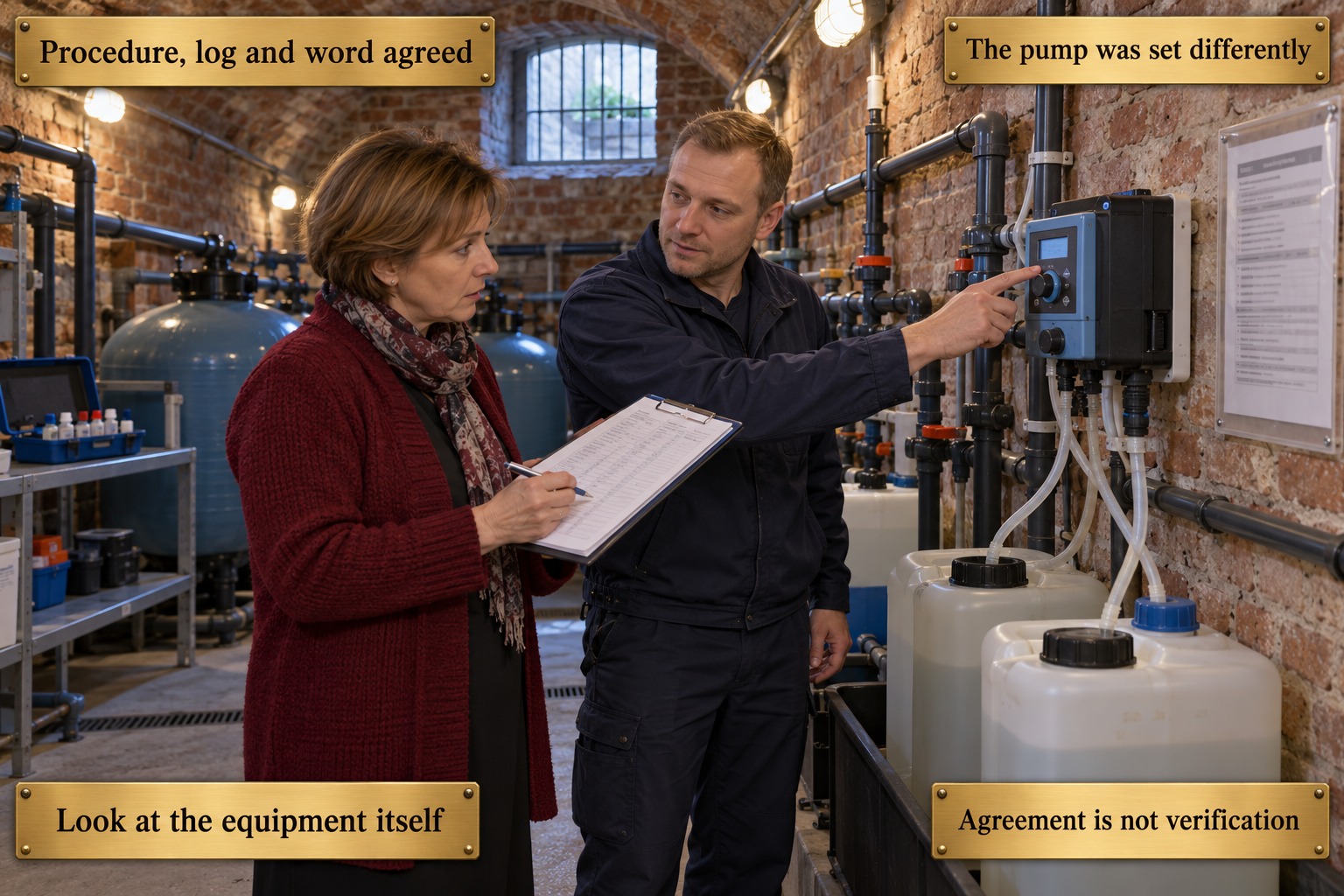
Concept Card 3.7 — Gathering Evidence: What You Have Been Told and What You Have Established
Three People Who Agreed, and One Dial That Did Not
Setting: Kraków, Poland
The pool plant of the Kamienica Wawel in Kraków, in a vaulted brick cellar that was once a wine store, on an October afternoon. Caged wall lamps light the brickwork; a small barred window high in the vault lets in a little grey daylight. Blue filter vessels and grey pipework stand along the walls,; chemical containers sit in a black containment tray below a wall-mounted dosing pump. Dorota Wiśniewska, Housekeeping Manager and internal auditor, a woman of about forty-five with short light-brown hair, a dark-red cardigan and a patterned scarf, holds a clipboard log and a pen, her gaze fixed ahead with quiet attention. Beside her the duty technician, a man of about thirty-five with short fair hair and stubble, in navy work clothes, points to the pump’s control dial as he speaks. A laminated procedure hangs on the wall and a test kit stands on a shelf.
The card shows the moment after the fifth audit of the pool dosing had already been written up as confirmed. Wiśniewska had read the procedure, heard the technician confirm the concentration and checked eleven months of log entries showing the correct value. Then she asked to see the pump. It is set to a different value, changed in the summer on the testing company’s recommendation; nobody updated the procedure. The log, filled in from the procedure, even recorded the value on three August days when the plant was shut down.
The plaques at the top give the event: Procedure, log and word agreed, and The pump was set differently. The lower pair names the lesson. Look at the equipment itself: only a record generated by the activity, or direct observation, can contradict the paperwork. Agreement is not verification: three statements from one system are testimony in three formats, and a log copied from the procedure can never disagree with it.
The card does not say that anyone was dishonest or that the water was unsafe; the new setting was sound and the plant was operating correctly. Nor does it say that ISO 14001 defines or grades audit evidence. The standard sets the purpose, information on conformity and effective implementation, and asks the programme to establish methods able to deliver it.
Source: Francesco Dore, The Helm and the Lens, Volume 1b — ISO 14001:2026, subchapter 3.7

Concept Card 3.8 — Sampling: What a Handful of Records Can and Cannot Tell You
Thirty Records, and the Half of the Property They Never Reached
Setting: Cartagena, Colombia
The records room of the Casa del Reloj in Cartagena on a hot, bright morning. A ceiling fan turns under a high ceiling; tall wooden shutters stand open onto a balcony, beyond which a carved wooden balcony, coral-stone walls and bright pink bougainvillea glow in sunlight. On the left a grey metal cabinet of permanent staff files stands with its drawers open. At a dark wooden table Yamile Restrepo, Quality Coordinator, a woman of about forty-five with long dark wavy hair tied back and a pale-blue linen blouse, reads an open seasonal file, a second file open on the table before her. Beside her lie a ticked sampling note, a glass of water and a desk fan. On the right the personnel assistant, a young man in a white short-sleeved shirt, crouches beside three open archive boxes, a bundle of files in his arms, looking towards her.
The card shows the day the seasonal files were opened for the first time. For five years the training records had been sampled six at a time from the open cabinet, thirty records, all in order. The audits were held in the shoulder season, so every record came from the permanent staff. The seasonal workers, thirty-eight at the peak, who do most of the housekeeping and waste handling, were filed in archive boxes. Their induction covered fire safety, food hygiene and guest service, and never environmental awareness, for anyone, in any season.
The plaques at the top give the event: Thirty records, all in order, and Seasonal files never opened. The lower pair names the lesson. Ask what the sample comes from: a clean sample proves only that this net, cast in this place, came up empty. The drawer decides the answer: when the auditor never chooses the population, the filing cabinet chooses it, and the consequential decision has already been made before the number six.
The card does not say that Restrepo’s six-record samples were too small; the number was the least important part of the choice. Nor does it say that ISO 14001 prescribes sample sizes or statistical methods. It requires audits to give information on effective implementation and the programme to consider changes, and its competence requirement draws no line between permanent and seasonal staff.
Source: Francesco Dore, The Helm and the Lens, Volume 1b — ISO 14001:2026, subchapter 3.8

Concept Card 3.9 — Writing Findings That Survive Challenge
The Finding That Was Right, Badly Written, and Withdrawn
Setting: Ljubljana, Slovenia
A housekeeping service room on the second floor of the Hotel Vodnik in Ljubljana, on a fresh May morning. Through the window the green Ljubljanica flows past trees and pale embankment houses, and the castle stands on its wooded hill in soft spring light. White shelves are stacked with folded towels, with large concentrate containers on the top shelf. At the counter the internal auditor, a woman of about thirty-five with chestnut hair in a ponytail, navy blazer over a striped top, turns one plain spray bottle in her hands and examines it; four more stand unmarked on the counter beside her open notebook. Next to her a room attendant of about fifty, short light-brown hair and grey housekeeping tunic, stands by her trolley, which holds cloths and bottles but no dosing equipment, and holds up a small graduated dosing cup as she answers.
The card shows the finding being reinstated, fourteen months after it was withdrawn. In March Maja Kovač had written that housekeeping staff were careless in dilution. The head of housekeeping disputed it well: her staff were experienced, nothing had been measured, and character is not a finding. A different auditor now records only facts: four of five made-up bottles observed bore no dilution marking, none of three trolleys carried graduated dosing equipment, and the storeroom held two dosing cups for a team of eleven. Meanwhile solutions went on being mixed by eye.
The plaques at the top give the event: Careless staff, said the finding, and Withdrawn, back fourteen months on. The lower pair names the lesson. Requirement, evidence, gap: a finding that names what should be, what was observed and the distance between them leaves nothing to argue about but the facts. Write facts, never character: a finding aimed at people invites a defence of character and has no owner who can fix the system.
The card does not say that Kovač was wrong about what she saw; the problem was real and the first finding failed on its wording. Nor does it say that ISO 14001 prescribes a format, a template or agreement with the auditee. The requirement-evidence-gap discipline is good practice; the standard asks only that the record of a nonconformity’s nature be adequate to its purpose.
Source: Francesco Dore, The Helm and the Lens, Volume 1b — ISO 14001:2026, subchapter 3.9
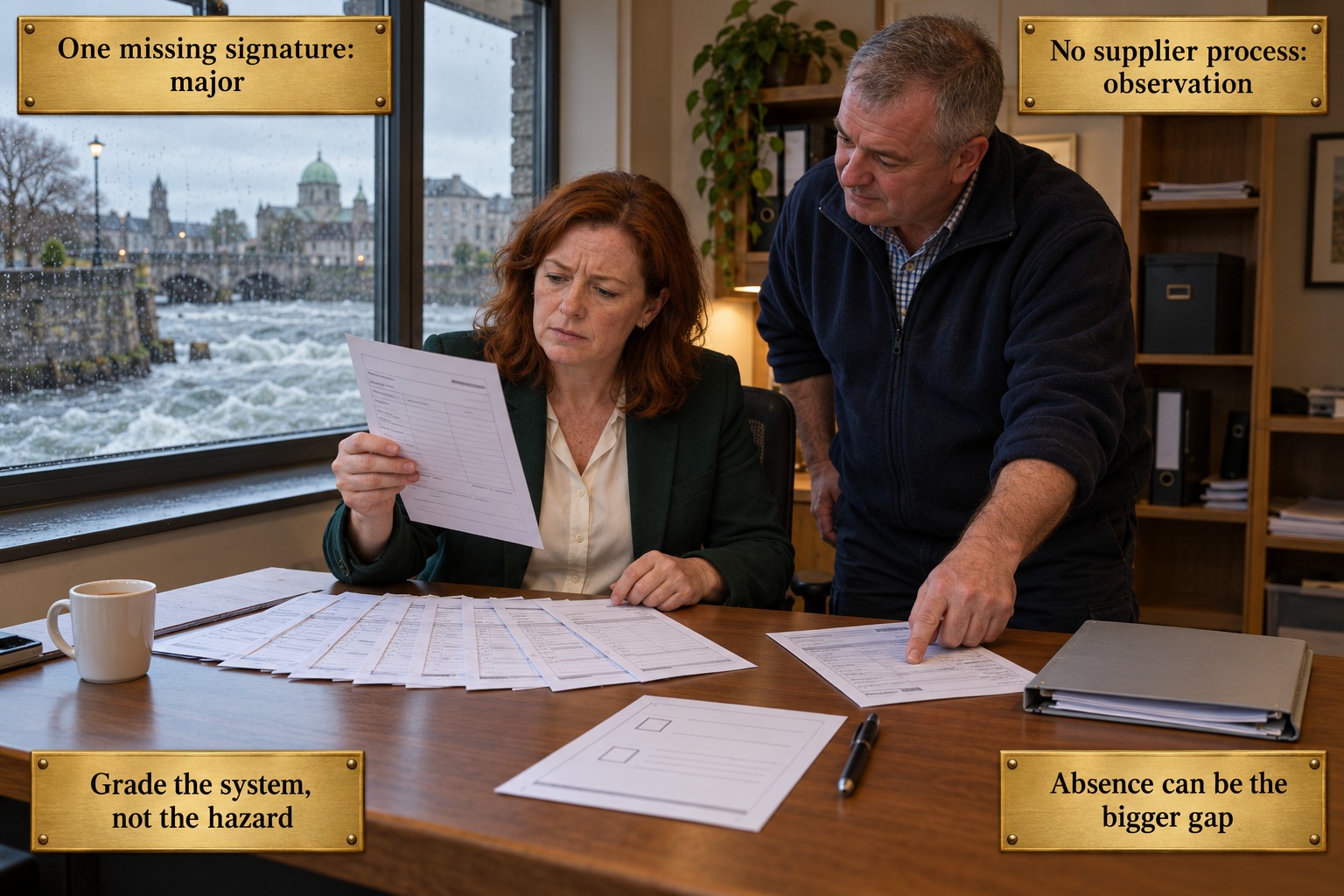
Concept Card 3.10 — Nonconformity Grading: What a Grade Is Actually a Statement About
The Spill Was Graded Major. The Empty Bracket Was Not.
Setting: Galway, Ireland
The back office of the Corrib House in Galway on a wet February morning. Rain streaks the window, beyond which the river runs high and white over a weir, past wet stone walls, a bridge and the green dome of a cathedral. At the desk sits Niamh Brennan, Deputy General Manager, a woman of about forty-five with shoulder-length red-brown hair and freckles, dark-green jacket over a cream blouse, holding up one delivery record with a frown. Before her the other records lie fanned across the desk, with a grading sheet showing two empty boxes. The duty engineer, a man of about fifty with short grey hair, navy fleece over a checked shirt, leans in beside her and points calmly at a supplier’s delivery note. At the far edge of the desk lies a slim grey binder that nobody is looking at.
The card shows the grading of the February audit’s two findings. One of eleven pool-chemical delivery records lacks the duty engineer’s signature; the product was correct, the engineer remembers checking, and the supplier’s note shows the same product. Brennan has graded it major because the chemicals are hazardous. Meanwhile four new suppliers in four years were appointed with no process for evaluating their environmental performance, because none existed; nothing went wrong, so she graded it an observation. She judged both by consequence, and got both wrong in opposite directions.
The plaques at the top give the event: One missing signature: major, and No supplier process: observation. The lower pair names the lesson. Grade the system, not the hazard: a grade is a statement about the state of the management system, not about how dangerous the substance felt. Absence can be the bigger gap: a required process that does not exist at all is a more serious condition than one lapse in a control that otherwise works.
The card does not say that the missing signature was unimportant; it remains a nonconformity to be corrected. Nor does it say that ISO 14001 defines major, minor or observation. The standard knows only nonconformity and does not require grading; grades are a convention of certification bodies and of the property’s own procedure, and the card is about using them well.
Source: Francesco Dore, The Helm and the Lens, Volume 1b — ISO 14001:2026, subchapter 3.10
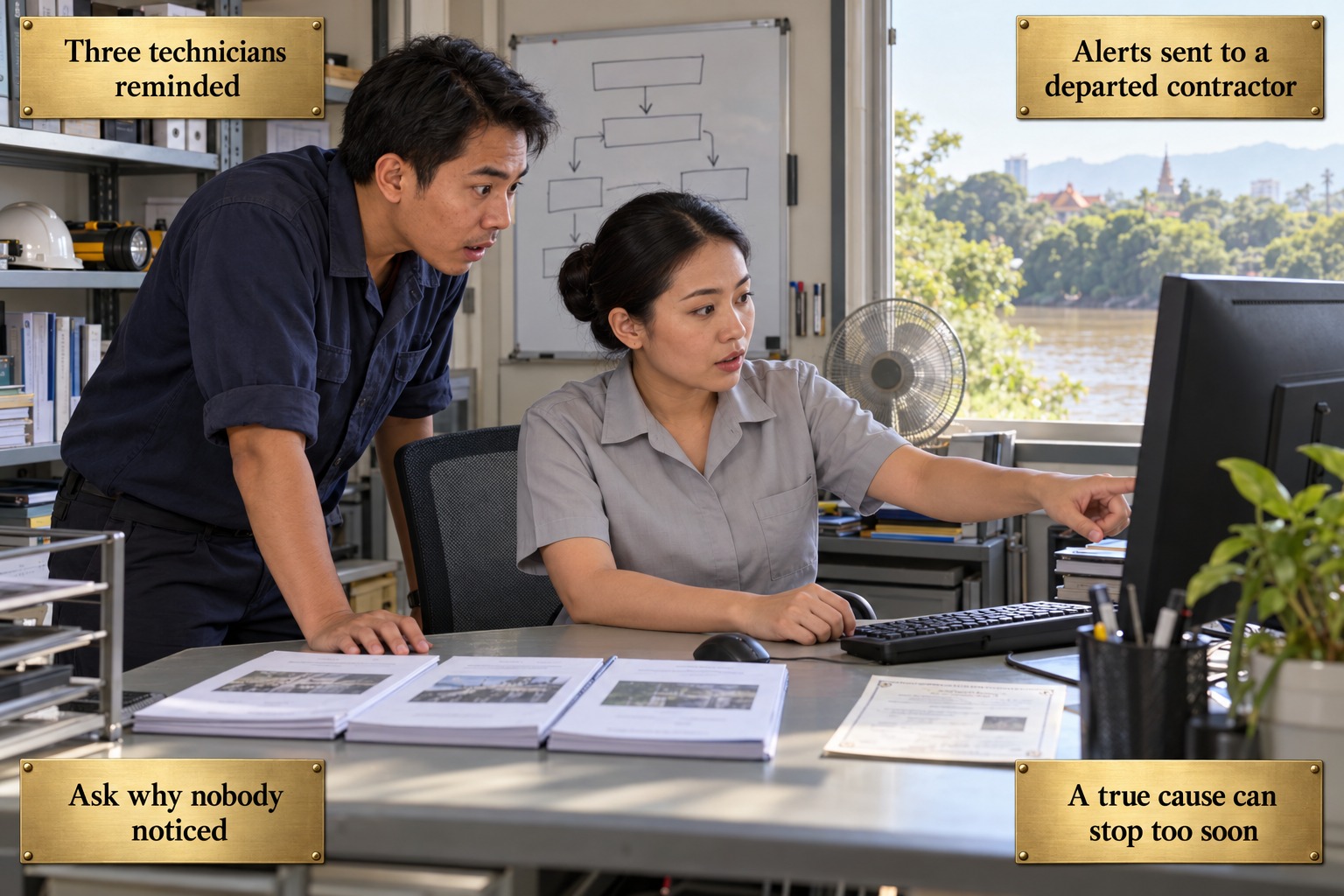
Concept Card 3.11 — Root Cause Analysis Beyond the First Answer
Three People Blamed Correctly for a Task Nobody Had Been Given
Setting: Chiang Mai, Thailand
The engineering office of the Ping Riverside in Chiang Mai on a hot, bright afternoon. Through a large window, the slow brown river, lush trees and, on the far bank, a red-roofed temple with a golden spire stand in hazy sunlight before distant hills. Shelves of manuals hold a hard hat and a torch; a whiteboard shows a hand-drawn chain of boxes, and a fan stands by the window. At the desk Anchalee Wong-Ubon, Assistant Manager for Engineering, a woman of about thirty-five with black hair in a neat bun and a grey short-sleeved uniform shirt, points at the monitor, startled and intent. Leaning over her shoulder, one hand on the desk, the maintenance technician, a man of about thirty with short black hair and a navy work shirt, stares at the screen in open surprise. Three internal audit reports lie side by side before them, with a servicing certificate.
The card shows the afternoon the inquiry finally went one question further. Three years running, the internal audit found missed quarterly services on the kitchen grease trap; each time the cause was recorded as the technician’s failure, and each time the correction was a reminder. With a third technician and the same finding, Wong-Ubon asked why the property had no way of knowing a service had been missed. The servicing spreadsheet, built by a contractor who left four years ago, has always sent its reminders to his own address.
The plaques at the top give the event: Three technicians reminded, and Alerts sent to a departed contractor. The lower pair names the lesson. Ask why nobody noticed: the useful question is not why the person forgot, but why nothing in the system was watching for the omission. A true cause can stop too soon: each analysis was accurate, and that is why it ended one question before anything could be fixed.
The card does not say that the three earlier analyses were false; each technician really had missed a service. Nor does it say that ISO 14001 requires five whys or any particular technique. The standard requires the causes, in the plural, to be determined, similar nonconformities to be sought and the effectiveness of action to be reviewed, by whatever method produces that.
Source: Francesco Dore, The Helm and the Lens, Volume 1b — ISO 14001:2026, subchapter 3.11
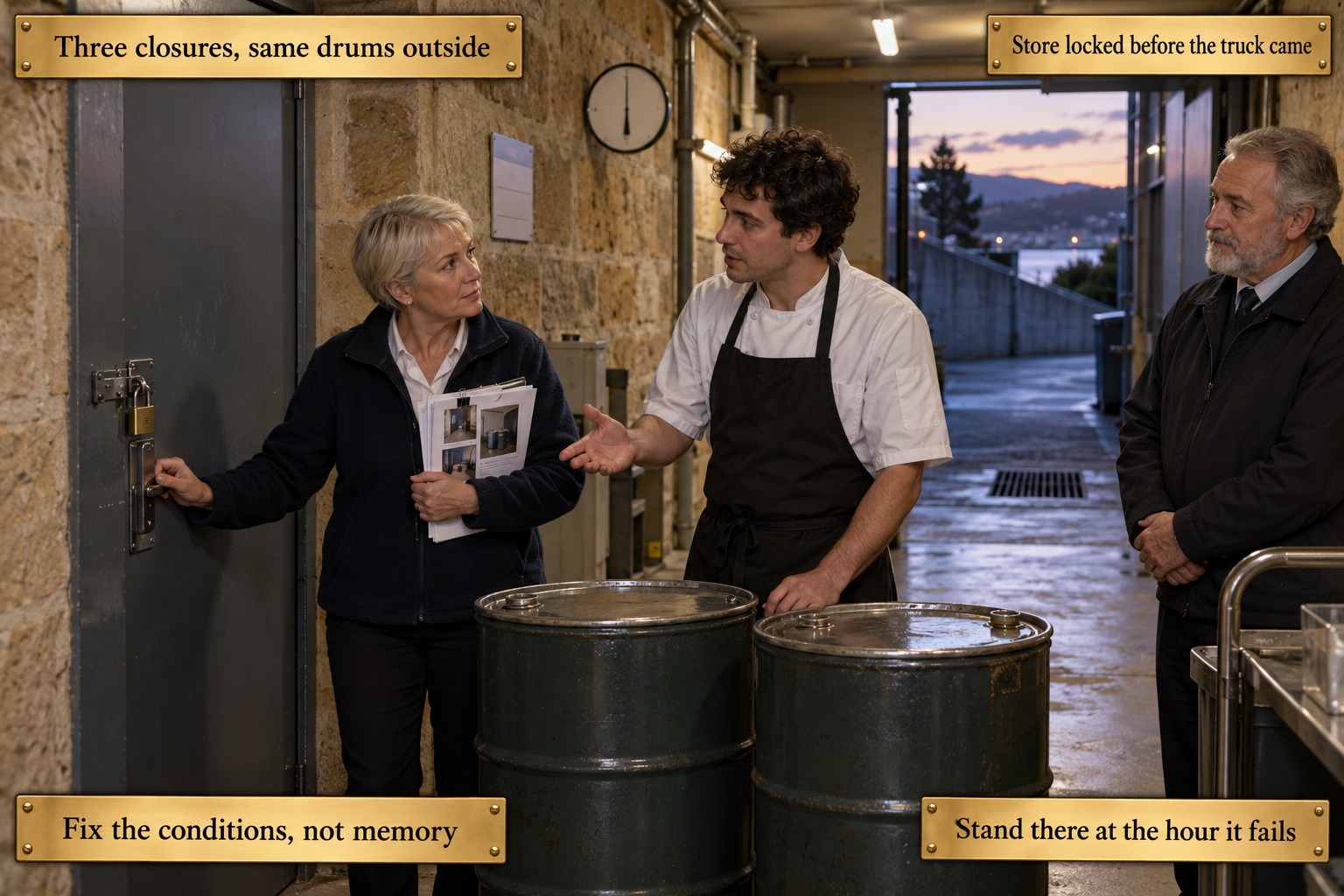
Concept Card 3.12 — Corrective Action: Closing the Loop Without Just Closing the Ticket
The Truck Arrives After the Yard Closes
Setting: Hobart, Australia
The back service corridor of the Salamanca Wharf in Hobart, at six on a late-autumn evening. Sandstone walls and ceiling lights; a wall clock with no numerals reads six. At the end a wide opening leads to the wet service yard, sloping down towards a stormwater grate, water and hills beyond under a pink dusk. On the left Bridget Nairn, Quality Coordinator, a woman of about fifty with short silver-blonde hair, navy fleece over a white shirt, holds closure records with photographs against her chest and grips the handle of the padlocked steel door of the chemical store, looking at the kitchen hand. He, a man of about twenty-five with dark curly hair, white chef’s jacket and black apron, stands behind two closed steel drums and explains with an open hand. On the right the night porter, about sixty, grey-bearded, in a dark jacket and tie, listens with hands clasped.
The card shows the third year of the same finding: drums of waste cooking oil in the yard, uphill of a grate that drains to the Derwent. Two corrective actions, instruct the kitchen, then instruct again and add a sign, were implemented, photographed, signed and closed in days. Nairn has come at six in the evening, the first person in the process to do so. The collection driver arrives between five and seven; the store is locked from five, when the duty engineer leaves with the key. The kitchen always knew where the drums belonged.
The plaques at the top give the event: Three closures, same drums outside, and Store locked before the truck came. The lower pair names the lesson. Fix the conditions, not memory: corrective action aimed at what people already know changes nothing when the circumstances prevent them from acting on it. Stand there at the hour it fails: the cause becomes visible only where and when the failure actually happens.
The card does not say that the kitchen team was careless or that the closure records were false; they were diligent records answering the wrong question. Nor does it say ISO 14001 requires on-site verification at a given hour. It requires causes to be evaluated, the effectiveness of action to be reviewed and action proportionate to environmental significance; the visit is how Nairn met that.
Source: Francesco Dore, The Helm and the Lens, Volume 1b — ISO 14001:2026, subchapter 3.12

Concept Card 3.13 — The Audit Trail Across Departments: Kitchen to Boardroom
A Thread That Ran Out Before It Reached Anybody
Setting: Windhoek, Namibia
The housekeeping linen room of the Auas View on the southern edge of Windhoek, on a clear, dry morning. Bright sunlight floods in through a tall window that looks out on dry bush, low buildings, arid hills and blue mountains under a pale sky. Shelves of folded white linen line the right side and laundry trolleys the left; a printed room standard is pinned to the wall. Selma Nangolo, Human Resources and Training Manager and internal auditor, a woman of about forty with short natural black hair, round gold-framed glasses and a mustard-yellow blouse, writes in an open notebook, smiling at the supervisor. The floor supervisor, a woman of about fifty-five in a patterned headscarf and light-blue housekeeping tunic, holds her small handwritten tally book to her chest and rests her other hand on a stack of sheets, looking at Nangolo with quiet pride.
The card shows Nangolo, chosen as auditor for independence rather than technical knowledge, following one thread in both directions. The floor supervisor, who lived through the 2019 rationing, has quietly been running a linen reuse programme against a room standard requiring daily changes; it has no procedure, budget or report. Downward, the water objective has a target and a date but no owner, resources or method, and the Chief Engineer did not know it existed. The management review recorded the objective as on track. The improvement was the supervisor’s.
The plaques at the top give the event: Savings from one supervisor, and The engineer never knew the target. The lower pair names the lesson. Follow the thread both ways: trace upward from what is seen and downward from what is written, and see where each trail runs out. On track is not the same as owned: a figure moving in the right direction says nothing about whether the system is delivering it.
The card does not say that the supervisor should be stopped or that her initiative was wrong; the finding is that the property relies on an arrangement it does not know it has, and the right response adopts and resources it. Nor does it say an internal auditor needs a technical background, or that leadership requirements are exempt from internal audit.
Source: Francesco Dore, The Helm and the Lens, Volume 1b — ISO 14001:2026, subchapter 3.13
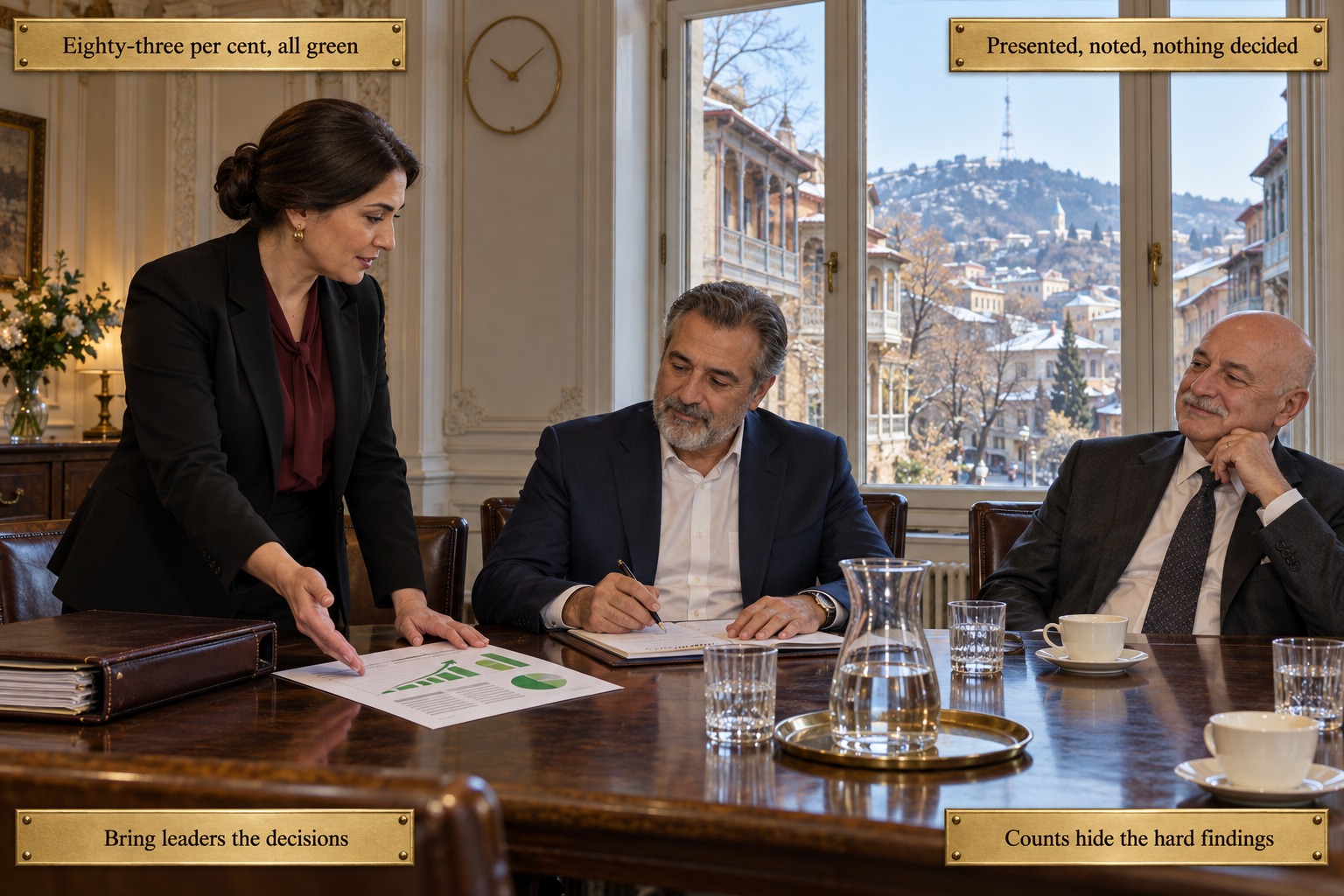
Concept Card 3.14 — Reporting to Management: What Leadership Actually Needs to Hear
A Green Page, Twelve Minutes, and Nothing Decided
Setting: Tbilisi, Georgia
The meeting room of the Sololaki Court in Tbilisi during the February management review. Panelled walls, a numberless gold clock and a polished dark table; through tall windows, old houses with carved wooden balconies climb a street towards the hill of Mtatsminda, snow-dusted and topped by a television tower, under a clear winter sky. Ketevan Dvali, Financial Controller and audit programme lead, a woman of about forty-five with dark hair in a low bun, gold earrings, black jacket and burgundy blouse, stands at the table, gesturing towards her one-page summary with its green bars and chart. Levan Kiknadze, General Manager, a man of about fifty-five with swept-back greying hair and grey beard, in a dark suit and open white shirt, writes on the minutes. Beside him the owner’s representative, bald, with a white moustache, rests his chin on his hand, smiling. A thick leather folder lies at Dvali’s elbow.
The card shows the twelve minutes of the review given to internal audit. Dvali’s page is a model: nine audits, twenty-three findings, a closure rate of eighty-three per cent, up from seventy-one, and a green box. The owner’s representative is encouraged; Kiknadze is unsurprised. The minutes will say presented and noted. Not on the page are three findings open for years, an unventilated chemical store on a listed façade, a waste corner shared with the bakery under an unread lease, an unmetered annexe boiler, which only the people in this room could resolve.
The plaques at the top give the event: Eighty-three per cent, all green, and Presented, noted, nothing decided. The lower pair names the lesson. Bring leaders the decisions: the report to management should name what only management can resolve, with the permit, money or authority it needs. Counts hide the hard findings: a closure rate is dominated by easy findings, and the ones that matter sit unseen in the remainder.
The card does not say that Dvali’s audits or her reporting were poor; her audit reports were the best the property ever had. Nor does it say that every finding must go to top management. ISO 14001 requires results to be reported to relevant management, and the outputs of management review to include decisions, which presented and noted is not.
Source: Francesco Dore, The Helm and the Lens, Volume 1b — ISO 14001:2026, subchapter 3.14
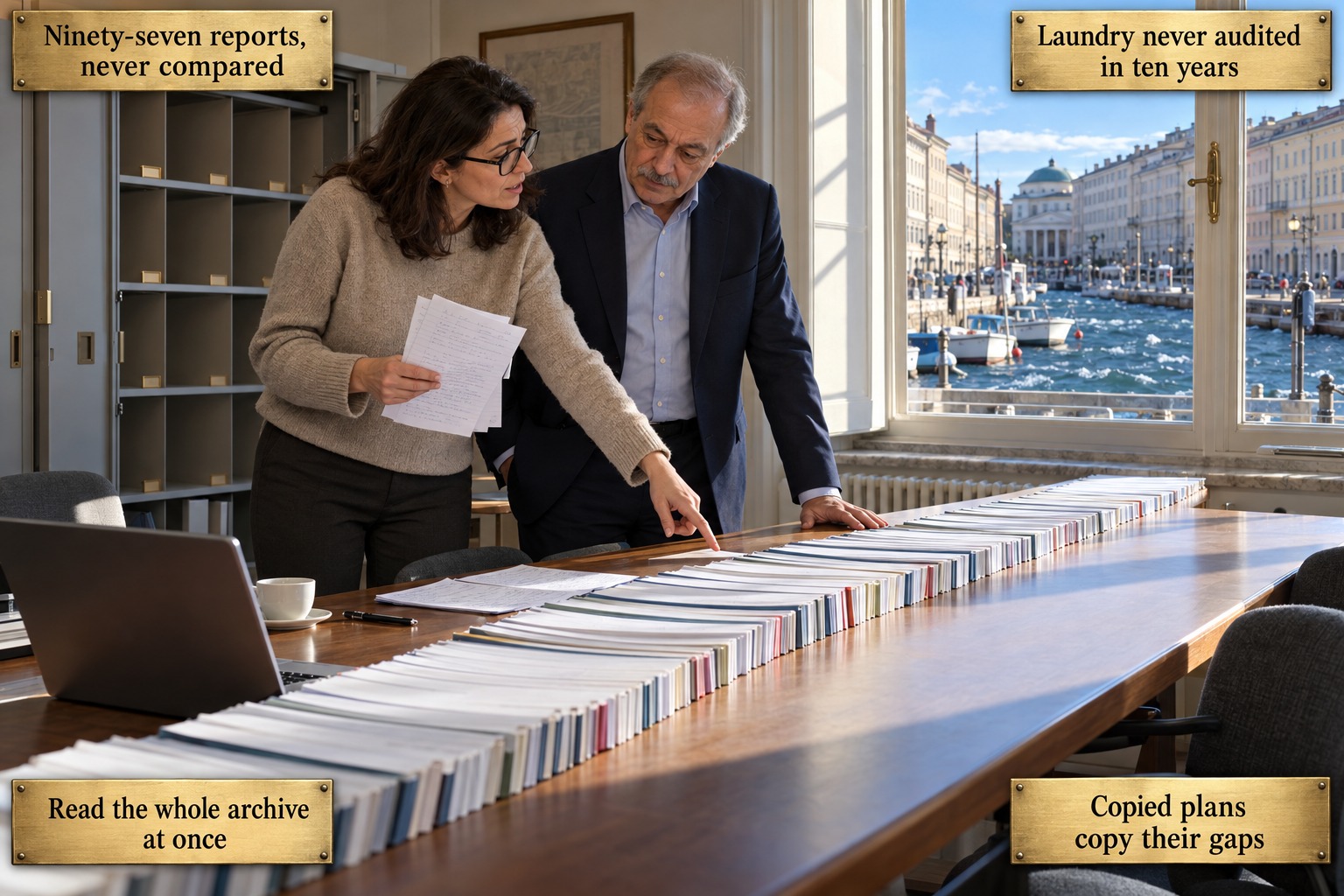
Concept Card 3.15 — The Audit Programme Over Time: What Ten Years Say That One Year Cannot
Ten Years on One Table, Read for the First Time
Setting: Trieste, Italy
The administration office of the Hotel Teresiano in Trieste on a cold, bright January morning. Through a tall window the canal is whipped into small waves by the bora, small boats tug at their moorings, and neoclassical façades lead to a domed, columned church at the far end, under a hard blue sky. Along the full length of a long wooden table runs a dense row of thin audit reports in date order. Ivana Vatta, internal audit coordinator, a woman of about forty with shoulder-length dark-brown hair, dark-rimmed glasses and an oatmeal sweater, holds three handwritten sheets and points to one report in the run, speaking earnestly. Beside her the Rooms Division Manager, a man of about sixty with thinning grey hair and a grey moustache, navy jacket over a light-blue shirt, leans on the table, studying the reports. Behind them stands an emptied cabinet.
The card shows the Monday after Vatta, recently moved from Purchasing, spent a weekend reading ten years of the archive at once: ninety-seven audits, all competent and correctly closed. Her three lists show coverage, recurrence and depth. The outsourced laundry was never audited in ten years; the policy and management review never at all; bora-scattered containers recur in nine winters; only four of two hundred and sixty-one actions went beyond the lowest rungs. Each plan was copied from the last, back to a consultant’s 2016 template, including the one she issued herself in September.
The plaques at the top give the event: Ninety-seven reports, never compared, and Laundry never audited in ten years. The lower pair names the lesson. Read the whole archive at once: coverage gaps and recurring conditions live in the relationship between reports, not in any single one. Copied plans copy their gaps: a programme built from last year’s plan never weighs previous results and inherits every omission of the first template.
The card does not say that the Teresiano’s audits or coordinators were negligent; every requirement attaching to a single audit was met ninety-seven times. Nor does it say that ISO 14001 requires a ten-year review or every process audited each year. It requires the programme to consider environmental importance, changes and the results of previous audits, which a copied template never asks.
Source: Francesco Dore, The Helm and the Lens, Volume 1b — ISO 14001:2026, subchapter 3.15
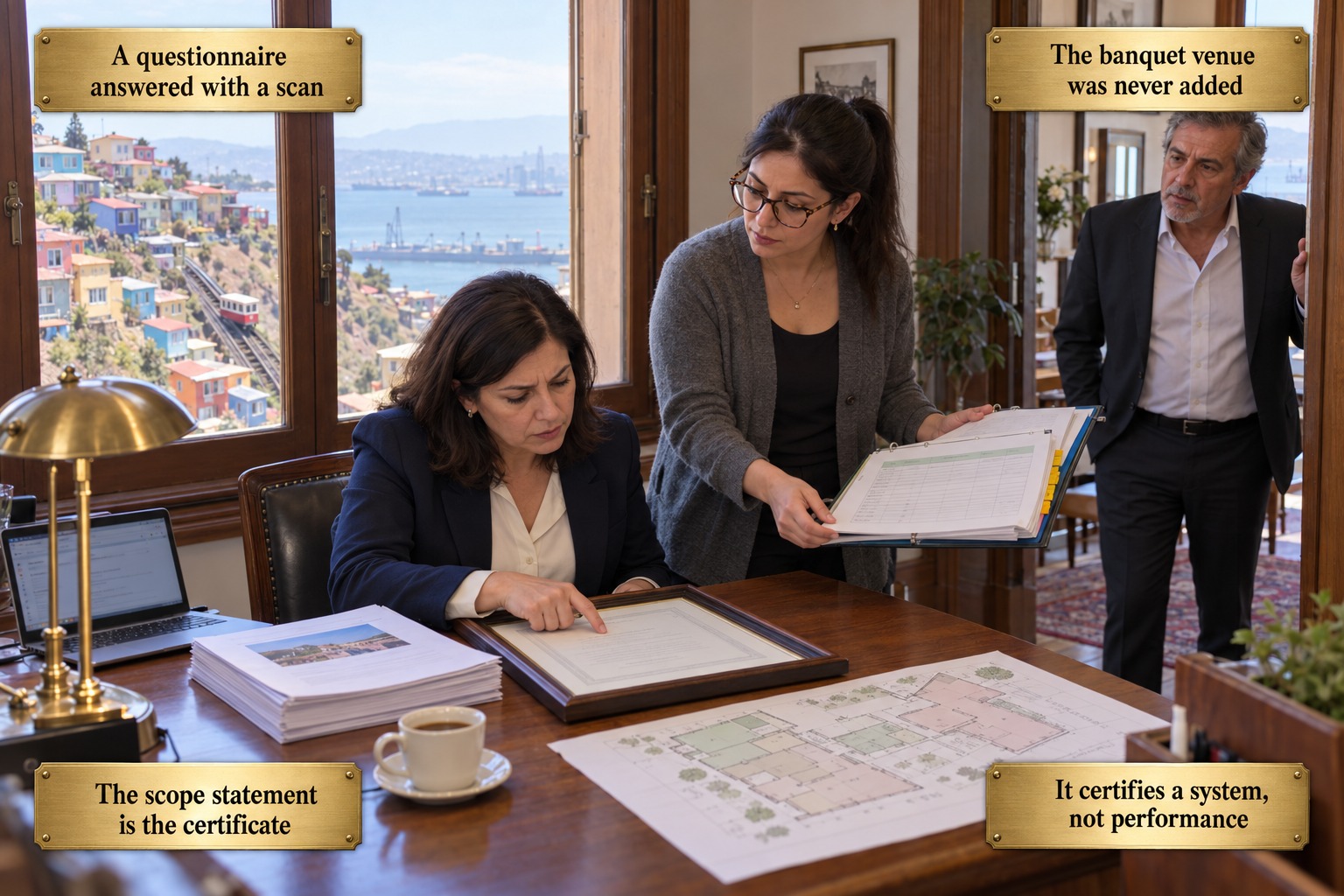
Concept Card 4.1 — What a Certification Body Actually Verifies
One Sentence on the Wall, Read by Everybody Except the Hotel
Setting: Valparaíso, Chile
A first-floor sales office in a restored casona on Cerro Alegre in Valparaíso, late morning, bright sea light through tall wooden windows. Outside, a hillside of painted houses falls away to a red funicular car and the harbour in haze. Constanza Pizarro, Director of Sales, about forty-five, dark shoulder-length hair, navy blazer over a cream blouse, sits frowning with a finger under the one line of a framed certificate lying face up before her. Paulina Reyes, the environmental coordinator, about thirty-five, ponytail, tortoiseshell glasses, grey cardigan, stands beside her holding out the open aspects register. In the doorway the General Manager, Rodrigo Ossandon, grey-haired, dark suit and open collar, one hand on the frame, has stopped and looks in. On the desk: a thick questionnaire, a laptop, a brass lamp, coffee and a floor plan of two joined buildings.
The card shows the morning after the client’s auditor asked one question: was Salon Baron, where the gala dinner and both plenaries were to be held, covered by the certificate? Pizarro had attached a scan of it to some two hundred questionnaires in four years without reading it. The scope covers Almirante Montt 342 and 356; the banqueting venue three streets away, leased in 2021, two years after certification, with its own kitchen, waste contract and gas supply, was never added. Reyes knew, because she had written the aspects register, but nobody had asked her. Ossandon had assumed it was covered.
The plaques at the top give the event: A questionnaire answered with a scan, and The banquet venue was never added. The lower pair names the lesson. The scope statement is the certificate: it is the only sentence on the document specific to the property, and it decides what may honestly be claimed. It certifies a system, not performance: the standard sets no environmental performance criteria, so the certificate attests a working system within a boundary, not good results.
The card does not say that the certificate was false or that the auditors failed: four years of surveillance audited exactly what the scope stated, and audited it properly. Nor does it suggest narrowing a scope to keep awkward operations out, which the guidance forecloses. The fault was an unplanned change: a new venue never routed past whoever owned the scope sentence.
Source: Francesco Dore, The Helm and the Lens, Volume 1b — ISO 14001:2026, subchapter 4.1
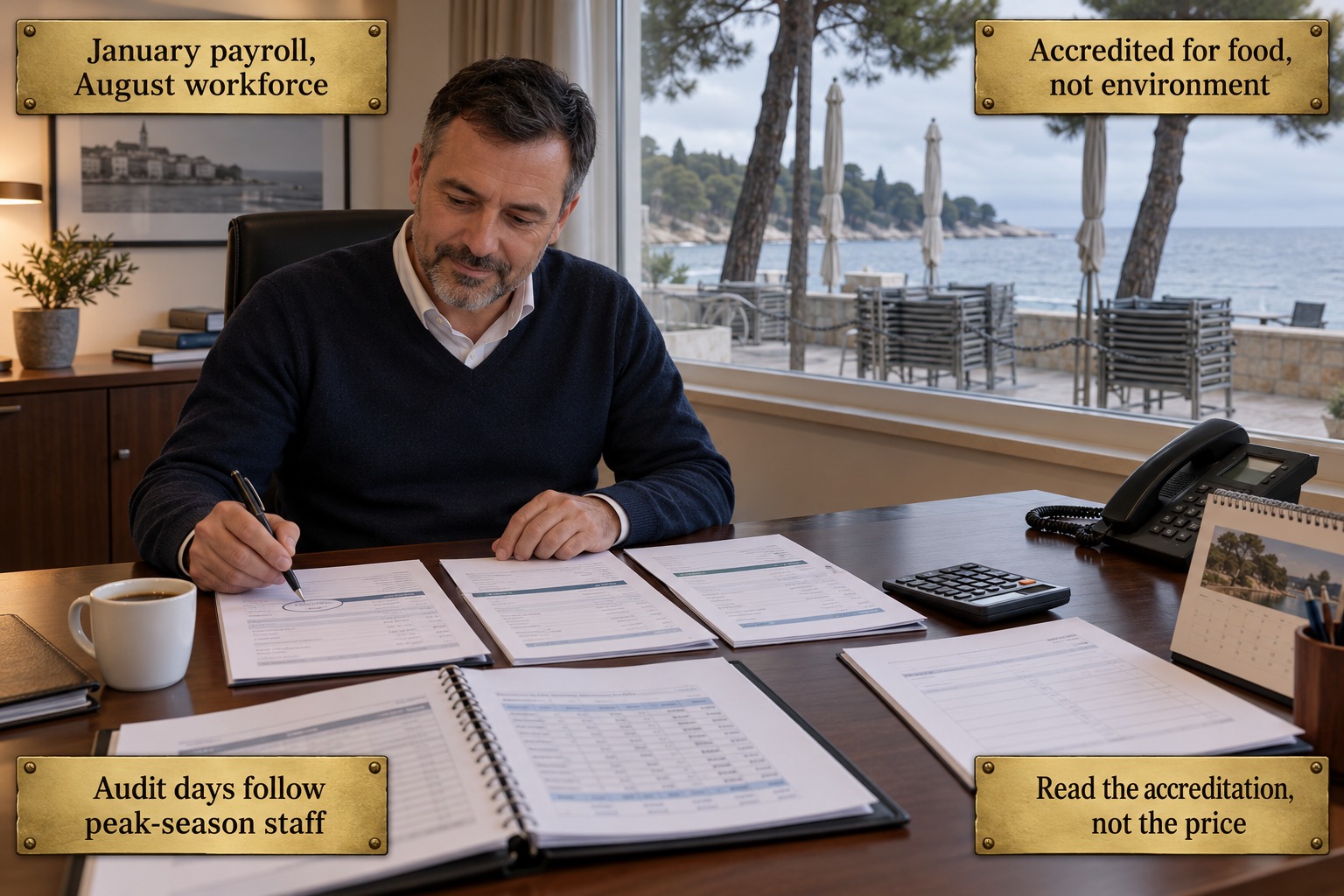
Concept Card 4.2 — Choosing a Certification Body
Three Quotations, Compared Carefully, on the Wrong Number
Setting: Rovinj, Croatia
The General Manager’s office in the older concrete block of a seaside hotel on a wooded point south of Rovinj, on a grey January afternoon out of season. Through a wide window: a terrace of stacked, chained chairs and furled umbrellas, pines, and a grey Adriatic. Vedran Sarić, General Manager, about forty-eight, short dark hair greying at the temples, trimmed greying beard, navy V-neck jumper over a white shirt, sits at his desk with a pen in his right hand. He looks down with quiet satisfaction at the first of three quotations laid side by side, on which he has just drawn a circle. In front of them lies the open board pack at its payroll table; beside them are a blank form, a calculator, a mug of coffee, a desk phone and a desk calendar.
The card shows January 2020, the moment of a competent procurement decision that would take four years to go wrong. A German tour operator had demanded environmental certification, and three bodies quoted seven, five and three days. Sarić is choosing the three-day body, which promised less disruption. On the application form he had given fifty-four people, the January payroll figure, while around a hundred and ninety work inside the property in August. In 2024 the operator required a body accredited for the standard: Sarić’s body was accredited, but for food safety, not for environmental management.
The plaques at the top give the event: January payroll, August workforce, and Accredited for food, not environment. The lower pair names the lesson. Audit days follow peak-season staff: audit time is calculated from the effective number of personnel, which for hotels means those typically present at peak season. Read the accreditation, not the price: accreditation is a scope-specific entry filter, verified on the accreditation body’s register before any price is compared.
The card does not say that ISO 14001 requires an accredited certification body, or certification at all; the demand for accreditation came from the tour operator. Nor does it say that the cheaper body acted unlawfully: an unaccredited certificate is lawful and was accurately described. The lesson is that differing audit days are different calculations, which the property can ask to see before signing.
Source: Francesco Dore, The Helm and the Lens, Volume 1b — ISO 14001:2026, subchapter 4.2

Concept Card 4.3 — Accreditation: Who Checks the People Who Check You
The Quiet Woman at the Far End of the Table
Setting: Da Nang, Vietnam
A meeting room high in a riverside tower hotel in Da Nang, late morning, bright and slightly hazy tropical light through floor-to-ceiling glass. Beyond lie a wide river, the city on the far bank, a yellow arched bridge and mountains in the haze. At the near end of a long table the lead auditor, mid-fifties, greying hair, reading glasses, light-blue shirt, seen in profile, points to a line in the papers. Facing him, Nguyen Hai Dang, Facilities and Compliance Manager, about forty-two, short black hair, white short-sleeved shirt and staff lanyard, sits upright holding an open plant-room file and watches him warily. At the far end a woman of about forty-five, black hair in a low bun, charcoal jacket, writes in a notebook with no hotel documents before her, her eyes on the lead auditor. Blank name cards, water glasses and a carafe stand on the table.
The card shows the second day of the Song Han’s recertification audit in March. The woman at the end of the table has taken notes since nine the previous morning and has not asked Dang a single question. At lunch the lead auditor explains that she is an assessor from the accreditation body, observing how the certification body conducts the audit, not assessing the hotel. Dang over-answers all afternoon. In six years of carrying the certificate on every contract, nobody had explained to him what it rested on, and the request to host her had been answered as a diary matter.
The plaques at the top give the event: An observer who never asked a question, and Six years, and nobody had explained it. The lower pair names the lesson. The assessor watches the auditor: a witnessed assessment examines the certification body’s team competence, audit time and assigned scope, not the hotel’s conformity. Accreditation stands behind the mark: the certificate is the end of a chain of accreditation and peer evaluation that lets a buyer abroad rely on it.
The card does not say that ISO 14001 requires accreditation; the standard never mentions it. Nor does it suggest that a witnessed assessment brings extra findings against the property: its findings concern the certification body, and the hotel’s audit outcome remains the certification body’s decision. Witnessing is arranged with the client in advance, and the property is free to watch and learn from it.
Source: Francesco Dore, The Helm and the Lens, Volume 1b — ISO 14001:2026, subchapter 4.3

Concept Card 4.4 — Stage 1: The Audit Whose Subject Is Time
A System Built in Seven Months, and Two Things That Could Not Be
Setting: Kigali, Rwanda
A small ground-floor meeting room of a hotel on the eastern edge of Kigali, late on a September afternoon, warm low light under a clearing sky. Outside lies a restored wetland with reeds, water, a footpath and green hills; at the right edge a concrete storm water channel leaves the car park. The Stage 1 auditor, a man of about fifty-five with close-cropped greying hair, rimless glasses and a navy blazer over an open white shirt, sits with his finger on a condition in an old, worn building permit. Solange Uwase, Rooms Division Manager, about thirty-eight, braids tied back, burgundy blazer over a black dress, stands leaning over the table with a pen. A consultant in an olive jacket, short natural hair, checks a ring binder beside her laptop. New binders stand in a row; a wall planner with one circled date hangs behind.
The card shows the afternoon of the Nyandungu’s Stage 1 audit, after the auditor’s two questions had changed its shape. He had asked what conditions were attached to the building permit; nobody knew, because it had sat unopened in the owner’s lawyer’s office since 2019. Fetched that afternoon, it carries a discharge condition, with monitoring, on the wetland channel, which the property had never performed. His second question found one internal audit, of housekeeping, and a management review not yet held. He proposed Stage 2 four months later: some evidence cannot be produced by working harder.
The plaques at the top give the event: A permit unopened in the lawyer’s office, and One internal audit, no review yet. The lower pair names the lesson. Stage One asks whether you are ready: it decides whether Stage 2 can usefully take place, what it will examine, and whether scope and days still hold. Some evidence can only be lived: an audit programme and a management review need history and trends that only elapsed time can produce.
The card does not say that the property failed Stage 1 or that its system was poorly built: Stage 1 issues a readiness decision, not a verdict, and the documentation was praised. Nor does the two-stage structure come from ISO 14001; it comes from the rules governing certification bodies. The standard supplies only the requirements that Stage 1 looks for.
Source: Francesco Dore, The Helm and the Lens, Volume 1b — ISO 14001:2026, subchapter 4.4
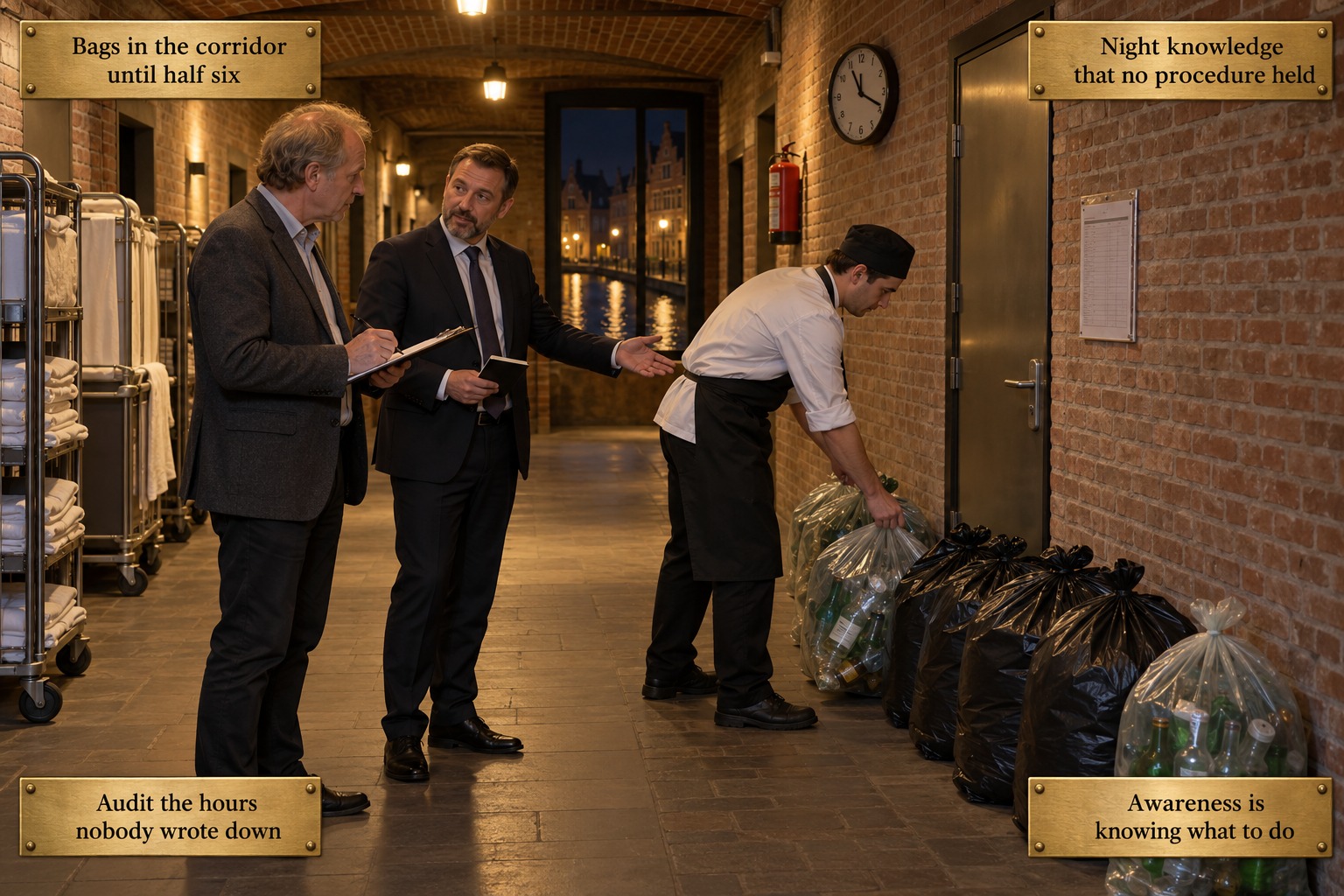
Concept Card 4.5 — Stage 2: When the System Speaks Through People Who Did Not Build It
Twenty Past Eleven, and the First Honest Answer of the Audit
Setting: Ghent, Belgium
A service corridor in a hotel made from converted brick warehouses on the Lieve in Ghent, late at night under warm lamps hung from a brick vaulted ceiling. At the far end a window shows dark canal water with lamplight reflections and gabled brick façades. Linen trolleys line the left wall; on the right hang a clock and an extinguisher beside a locked steel door with a procedure sheet pinned near it. The lead auditor, about fifty-five, untidy sandy-grey hair, grey tweed jacket, writes on a clipboard. Beside him Bram Verhoeven, night manager, about forty-eight, short greying hair and beard, dark suit and tie, notebook in hand, gestures calmly towards the door and the bags. A young kitchen porter in white jacket, black apron and cap bends in profile to set down a clear bag of bottles beside a row of tied black bags and further glass.
The card shows twenty past eleven on the second evening of the Lievekaai’s Stage 2 audit, when the lead auditor had asked to be in the building at night. The brasserie has closed, and the porters set four bags of mixed waste and two of glass against the corridor wall, because the waste room is locked from ten and the key is behind reception. They stay there until half past six, and no procedure describes it. Within the hour Verhoeven will also explain a heating changeover he performs from memory, and give the audit’s strongest answer on awareness without knowing the policy’s words.
The plaques at the top give the event: Bags in the corridor until half six, and Night knowledge that no procedure held. The lower pair names the lesson. Audit the hours nobody wrote down: Stage 2 hears the system through the people who operate it, at the hours they work it. Awareness is knowing what to do: what counts is knowing the significant aspects of one’s own work and what to do when something goes wrong, not reciting a policy.
The card does not say that the night staff were at fault or that the audit failed: Stage 2 ended with two minor nonconformities and a recommendation for certification. Nor is the closing meeting a verdict; the decision belongs to the certification body. It does not suggest that more documentation would have helped: the gap lay in the operation, not in the manual.
Source: Francesco Dore, The Helm and the Lens, Volume 1b — ISO 14001:2026, subchapter 4.5

Concept Card 4.6 — What Certification Auditors Look For: Where a Stranger Starts
Eleven Minutes with a Register Nobody Had Reopened
Setting: Muscat, Oman
The finance back office of a large low-rise beach resort west of Muscat on a hot afternoon, hard sunlight softened by half-drawn blinds. Through the window, date palms and lush lawns with sprinklers running in full sun lead down to a strip of blue sea and beach umbrellas. The certification auditor, about sixty, grey hair and short grey beard, light-grey suit with no tie, reading glasses, holds two sheets apart: one with a bar chart falling, the other a table with bars rising. Beside him the finance officer, about forty-five, glasses and a white shirt, points at a column on his monitor. Behind them stands Hilal Al Rawahi, Executive Assistant Manager, about thirty-eight, trimmed black beard, white dishdasha and embroidered kumma, writing in a small notebook. On the desk lie a thick lever-arch file, a bound register and a glass of water.
The card shows the first afternoon of the Bait al Falaj recertification audit. The auditor read the aspects register for eleven minutes and spent the morning on water, which the property had ranked highest six years before. He then asked about the objective: water per occupied room down nine per cent against a target of eight. Asked for absolute consumption, the finance office needed forty minutes to establish that total site water had risen fourteen per cent; the ratio improved because occupancy rose faster. Al Rawahi, six weeks in post, records not what the auditor asks but what he does.
The plaques at the top give the event: Eleven minutes, then a morning on water, and A target met on a rising denominator. The lower pair names the lesson. The register tells a stranger where: an auditor with no knowledge of the property starts from its own ranking of aspects and tests whether its map matches its ground. Read the absolute beside the ratio: an intensity indicator can improve while total consumption rises, so both must be read together.
The card does not say that the certification auditor was more competent than the six internal auditors before him; his advantage was ignorance turned by scarcity into a risk-based method. Nor does it make a per-room indicator wrong in itself. The method he used needs no outsider: the property can run it on itself with documents it already owns.
Source: Francesco Dore, The Helm and the Lens, Volume 1b — ISO 14001:2026, subchapter 4.6
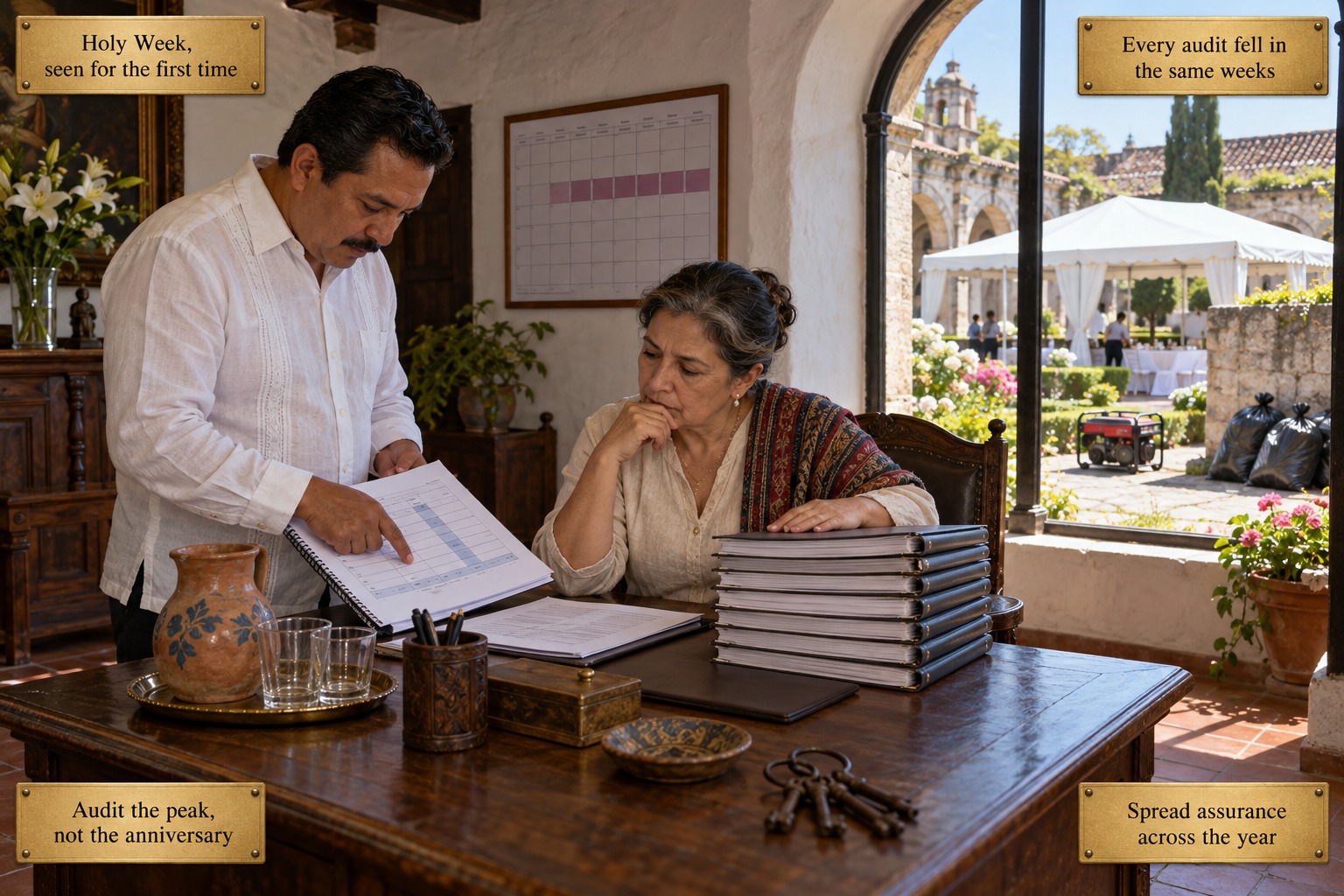
Concept Card 4.7 — Surveillance: The Audit of the Interval
Nine Audits, and the Same Eight Weeks Every Time
Setting: Antigua Guatemala, Guatemala
The owner’s office in a converted colonial convent in Antigua Guatemala on a bright, dry afternoon: whitewashed walls, dark beams, a terracotta floor, lilies on a carved chest. Through an arched window: a cloister garden with a white marquee being laid for dinner, a red hired generator on the flagstones, tied waste bags against a wall, and a bell tower beyond. The surveillance auditor, about forty-five, black hair and moustache, white guayabera, stands holding the spiral-bound internal audit programme and runs a finger down a block of dates. Lucía Sandoval, owner and manager, about fifty-five, greying hair pinned up, cream linen blouse and woven shawl, sits with one hand on a stack of bound reports and her chin in the other, thoughtful. On the wall a year-planner has one block of weeks shaded; on the desk lie a clay jug, glasses and a ring of iron keys.
The card shows the San Jerónimo’s ninth surveillance audit, moved from October to the last week of March, the week before Semana Santa, because the assigned auditor had changed region. For eleven days the hotel runs at ninety-eight per cent with some sixty temporary staff, a marquee, a rented generator over the soakaway and four times its usual waste. The aspects register described thirty-one employees and one restaurant service. The auditor now shows Sandoval that every internal audit in eight years fell in August or September, synchronised to the certification anniversary.
The plaques at the top give the event: Holy Week, seen for the first time, and Every audit fell in the same weeks. The lower pair names the lesson. Audit the peak, not the anniversary: in a seasonal hotel the date of an audit decides which version of the property it can see. Spread assurance across the year: internal audits, management review and surveillance locked to one calendar position leave the busiest weeks unexamined.
The card does not say that the system had deteriorated or that the earlier October audits were wrong; the same system was simply seen in a different hotel. Nor does ISO 14001 set surveillance dates: the annual rhythm comes from the certification framework. What the standard does require is that aspects take account of change and of start-up phases such as a seasonal peak.
Source: Francesco Dore, The Helm and the Lens, Volume 1b — ISO 14001:2026, subchapter 4.7

Concept Card 4.8 — Recertification: Reading Three Years as One Document
Two Reports, Three Years Apart, Never on the Same Desk
Setting: Chennai, India
The finance office of a large hotel in Chennai on an April forenoon, strong bright light through tinted glass. Through the window a newer white tower stands on the adjoining plot among coconut palms, with the river curving past below and the city hazy behind. Meera Raghavan, Chief Accountant, about fifty-two, a long plait of black hair streaked with grey, rimless glasses, muted green cotton saree, sits at her desk with a pen in one hand and the certificate in a clear sleeve in the other, looking up sharply. Before her lie the recertification quotation, documents in sleeves and two bound surveillance reports open side by side with photographs. The environmental coordinator, about thirty-two, short black hair and moustache, light-blue shirt and lanyard, stands beside the desk hugging a folder with a photograph of the tower, eyes lowered. A calculator and a steel tumbler of coffee complete the desk.
The card shows April 2025 at the Kotturpuram. Raghavan has queried a recertification quotation of eleven auditor days against six and a half in 2019, and learned that recertification is costed at about two thirds of an initial audit on the property as it is today: two hundred and sixty staff, a ninety-room tower, an in-house laundry and a sewage treatment plant. Now she has read the certificate’s address line, which covers only the original street address, and asks when the certification body was notified of the tower. The answer is that the auditor was shown it in 2022.
The plaques at the top give the event: Eleven days, not six and a half, and Shown the tower, never notified. The lower pair names the lesson. Recertification is costed on today: audit time is recalculated on the current property, not carried over from the last cycle. Read the reports as one document: recertification reads the whole cycle, where recurrence and drift become visible, as with the same waste finding in 2021 and 2024.
The card does not say that the quotation was wrong or inflated; the arithmetic was correct. Nor does it suggest that anyone concealed the tower: it was shown, but a site visit is not a notification and does not amend a scope. ISO 14001 contains no certificate and no cycle; it supplies the scope and change requirements that made these findings.
Source: Francesco Dore, The Helm and the Lens, Volume 1b — ISO 14001:2026, subchapter 4.8
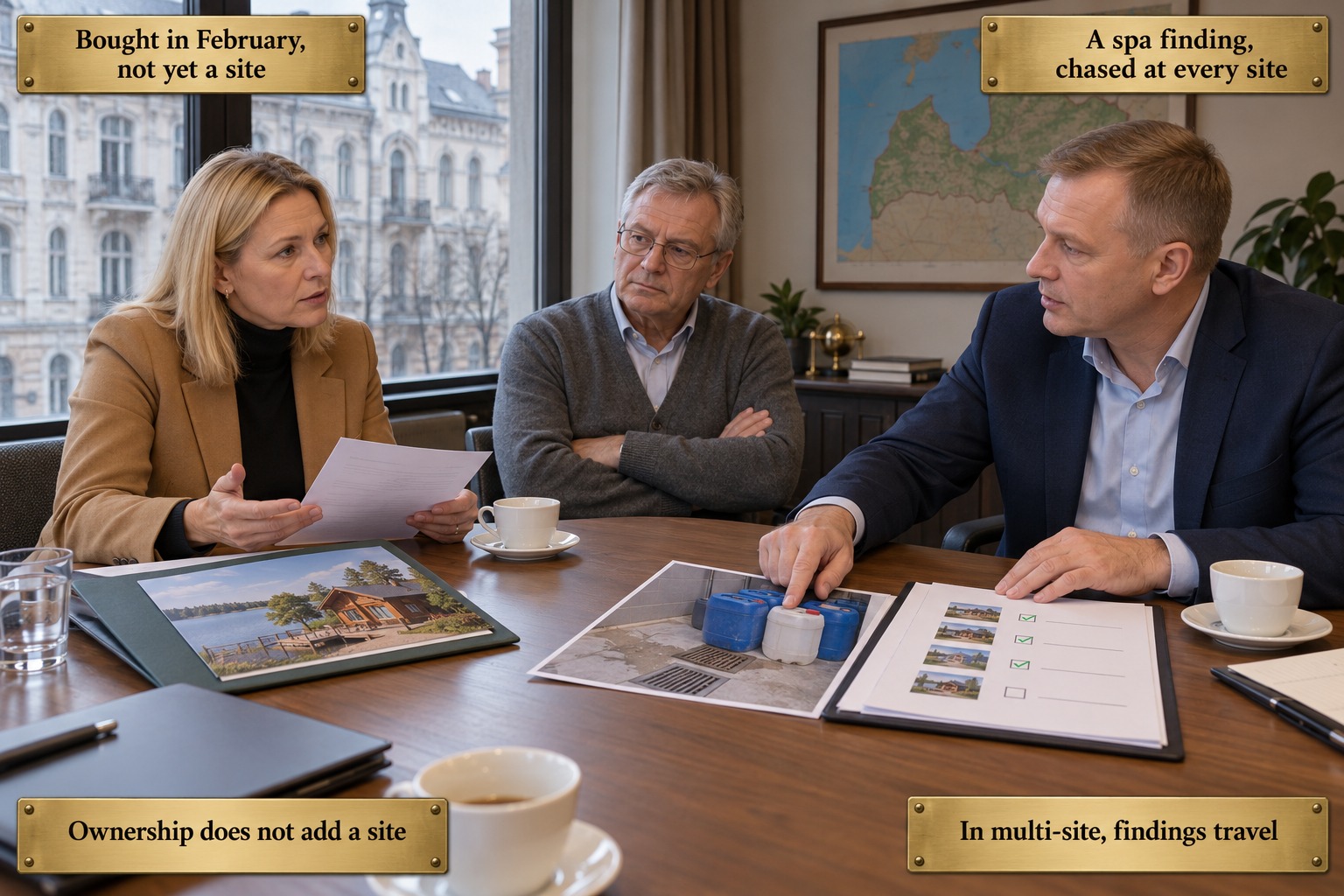
Concept Card 4.9 — Scope Extensions and Multi-Site: Buying a Hotel Is Not Adding a Site
Four Hotels, Three Sites, and a Boiler Nobody at Head Office Could Describe
Setting: Riga, Latvia
The meeting room of a small hotel group’s head office in Riga on a grey spring morning, soft even light. The window looks onto ornate Art Nouveau façades across the street; a framed map of Latvia hangs on the wall. On the right the certification auditor, about forty-eight, short fair hair, dark-blue suit and open collar, rests one hand on a site list with four entries, three ticked and one blank, and points with the other to a photograph of blue chemical drums standing over a floor drain. On the left Ilze Bērziņa, Group Development Director, about forty-five, straight blonde shoulder-length hair, camel jacket over a black polo-neck, holds a single sheet and makes her case. Between them the group operations director, about sixty, grey hair, thin-rimmed glasses, grey cardigan, listens with arms folded. A folder shows a wooden lodge on a lake; coffee cups stand about.
The card shows the surveillance visit at which the Dzintars group learned what its multi-site certificate covers. Bērziņa’s handover note said that the lodge on Lake Rāzna, bought in February, would join the certificate at this visit. It will not: it runs its own suppliers, a wood boiler and a septic discharge, and has not been brought under the group’s system or internal audit. Meanwhile the auditor has found pool chemicals stored over a floor drain at the Jūrmala spa, and the group must now check every other site for the same condition.
The plaques at the top give the event: Bought in February, not yet a site, and A spa finding, chased at every site. The lower pair names the lesson. Ownership does not add a site: a site joins only when it operates under the central function’s system and the certification body has evaluated it. In multi-site, findings travel: because only a sample is visited, a finding at one site must be pursued at the others.
The card does not say that multi-site certification is a bad arrangement; the saving is real. Nor does it say that the lodge can never be added: it becomes a site once it is brought under the system and evaluated. The rules on sites and sampling come from the certification framework, not from ISO 14001, which supplies the test of authority and control.
Source: Francesco Dore, The Helm and the Lens, Volume 1b — ISO 14001:2026, subchapter 4.9
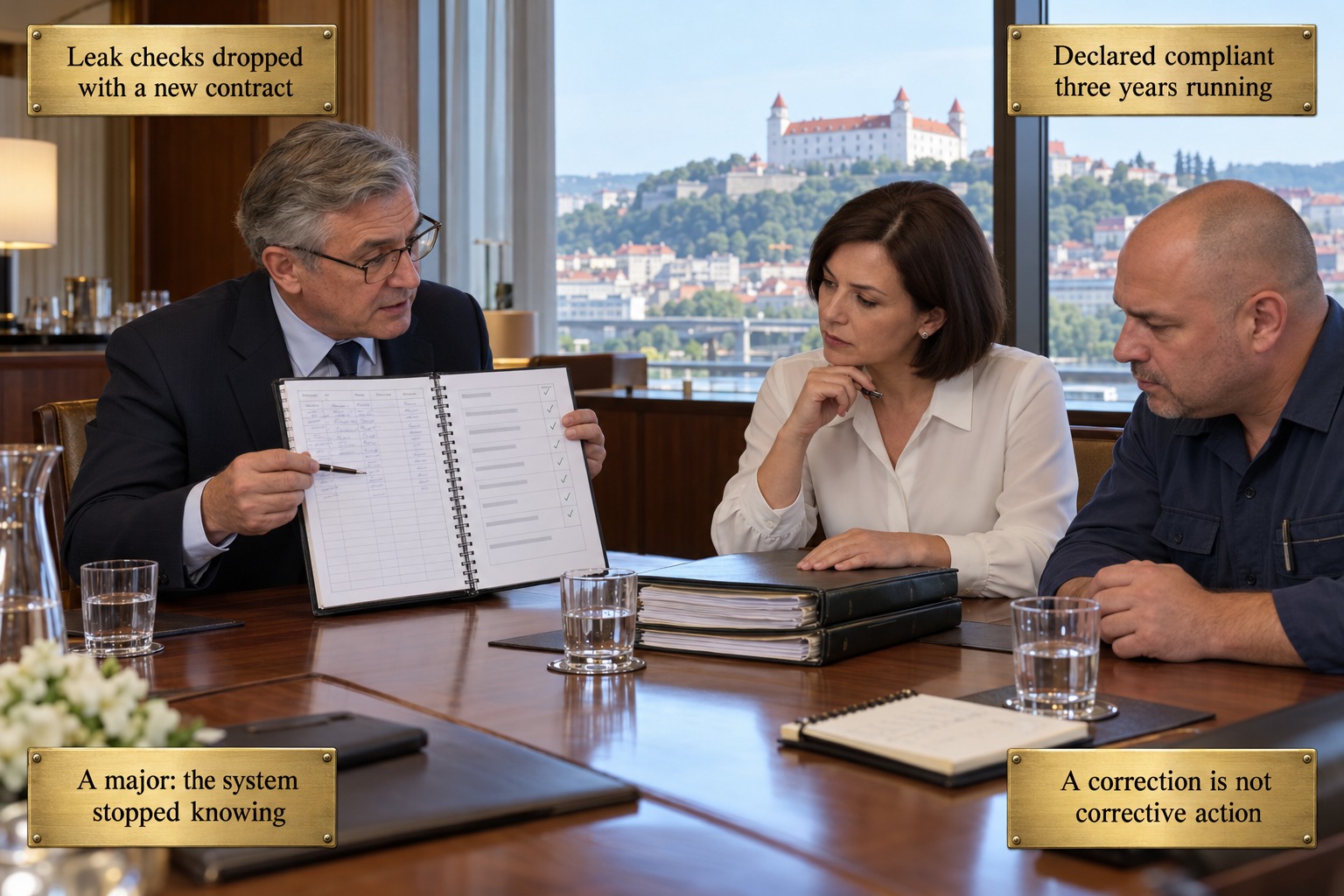
Concept Card 4.10 — When a Nonconformity Threatens the Certificate
Three Years of Dashes, and a Line Saying Compliant
Setting: Bratislava, Slovakia
A meeting room on the conference floor of a hotel below the castle in Bratislava on a clear May afternoon. Through the window the white castle with its corner towers stands on its wooded hill above red roofs and the river. The surveillance auditor, about fifty-eight, grey hair with a side parting, glasses, navy suit and tie, holds up an open spiral log and points with a pen: on the left page handwritten entries stop partway down, on the right a compliance evaluation runs with ticks. Katarína Bartošová, Contracts Manager, about forty-two, dark-brown bob, white blouse, sits with a pen at her chin and one hand on two binders of maintenance contracts, listening closely. The chief engineer, about fifty, shaved head, dark-blue work shirt with pens in the pocket, looks down soberly. Water glasses, a notebook and a carafe stand on the polished table.
The card shows the Podhradie’s surveillance visit in May, when Bartošová asked why the finding was major. Refrigerant leak checks on four systems had stopped in October 2022, when a new maintenance contract, negotiated on price and response time, left them out. That alone would have been minor. What made it major was that the hotel’s own compliance evaluation had declared it compliant three years running without checking. Eleven days later the hotel would send four fresh check certificates as a closure, and be told that this was only the correction.
The plaques at the top give the event: Leak checks dropped with a new contract, and Declared compliant three years running. The lower pair names the lesson. A major: the system stopped knowing: a major describes a failure of the system’s capability, here to know whether an obligation was being met. A correction is not corrective action: fixing the instance neither addresses the cause nor shows that a change has held.
The card does not say that ISO 14001 grades nonconformities as major or minor; the grading belongs to the certification framework. Nor does it advise contesting the grade, unless the finding is factually wrong. Evidence of effectiveness need not be complete within the deadline: a corrective action with a defined means of verification can be confirmed at the next visit.
Source: Francesco Dore, The Helm and the Lens, Volume 1b — ISO 14001:2026, subchapter 4.10
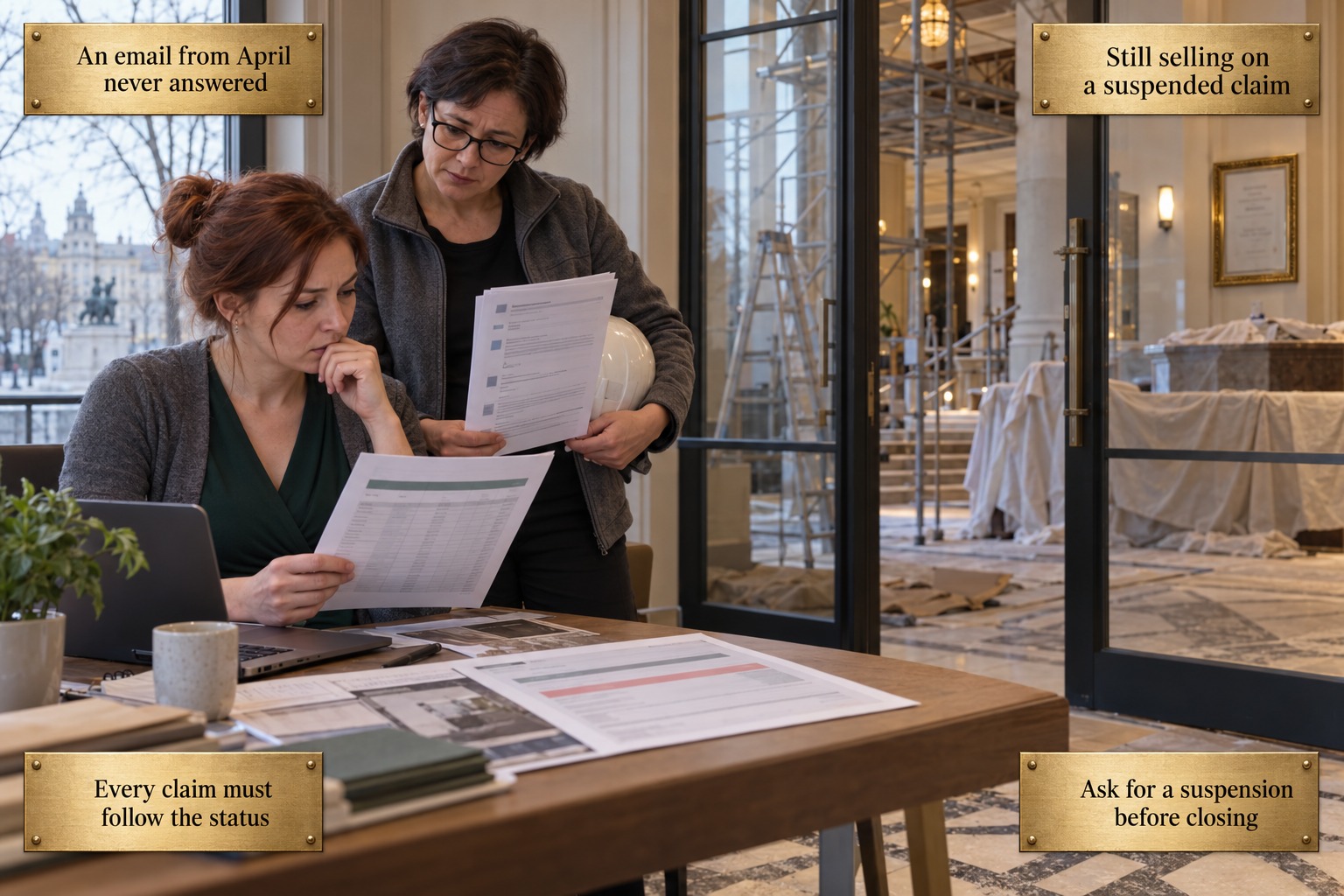
Concept Card 4.11 — Suspension and Withdrawal: The Surface Area of a Claim
A Hotel Closed for Nine Months, Selling on a Claim That Had Stopped Being True
Setting: Budapest, Hungary
A temporary sales office inside a 1912 hotel under restoration in Budapest on an overcast November afternoon. Through the window, bare trees and an equestrian statue stand on a city square before ornate buildings. Through glass doors the lobby is a building site: scaffolding, a stepladder, dust sheets over the reception desk and floor, and the framed certificate still hanging on the wall. Réka Tóth, Marketing and Distribution Manager, about thirty-six, auburn hair in a loose bun, dark-green wrap dress and grey cardigan, sits at her laptop with a hand at her mouth, reading the printed rate sheet, troubled. Behind her the environmental coordinator, about forty-five, short dark hair, glasses, grey fleece, a white hard hat under her arm, reads a printout of emails. On the desk a printout of a public register entry, one line marked in red, lies among the papers.
The card shows November at the Szabadság, closed since March for restoration. In April the certification body offered a voluntary suspension, and the email went unanswered. Surveillance could not take place, and in September the certificate was suspended and the status publicly recorded. Tóth, unaware, had kept selling the December reopening with the certification line in eighty-one places, including the 2026 rate sheet sent in August. Now an automotive client has checked the public record and asked one question: how long had the hotel known?
The plaques at the top give the event: An email from April never answered, and Still selling on a suspended claim. The lower pair names the lesson. Every claim must follow the status: on suspension the property must stop representing itself as certified everywhere, so the claim must be inventoried in advance. Ask for a suspension before closing: a voluntary suspension is the orderly instrument for a long closure.
The card does not say that the hotel’s environmental management was deficient; nothing in the operation changed at suspension, only the truth of a sentence. Nor does ISO 14001 govern suspension: it contains no certificate, and suspension, withdrawal and the use of marks belong to the certification framework and to the property’s contract with its body.
Source: Francesco Dore, The Helm and the Lens, Volume 1b — ISO 14001:2026, subchapter 4.11
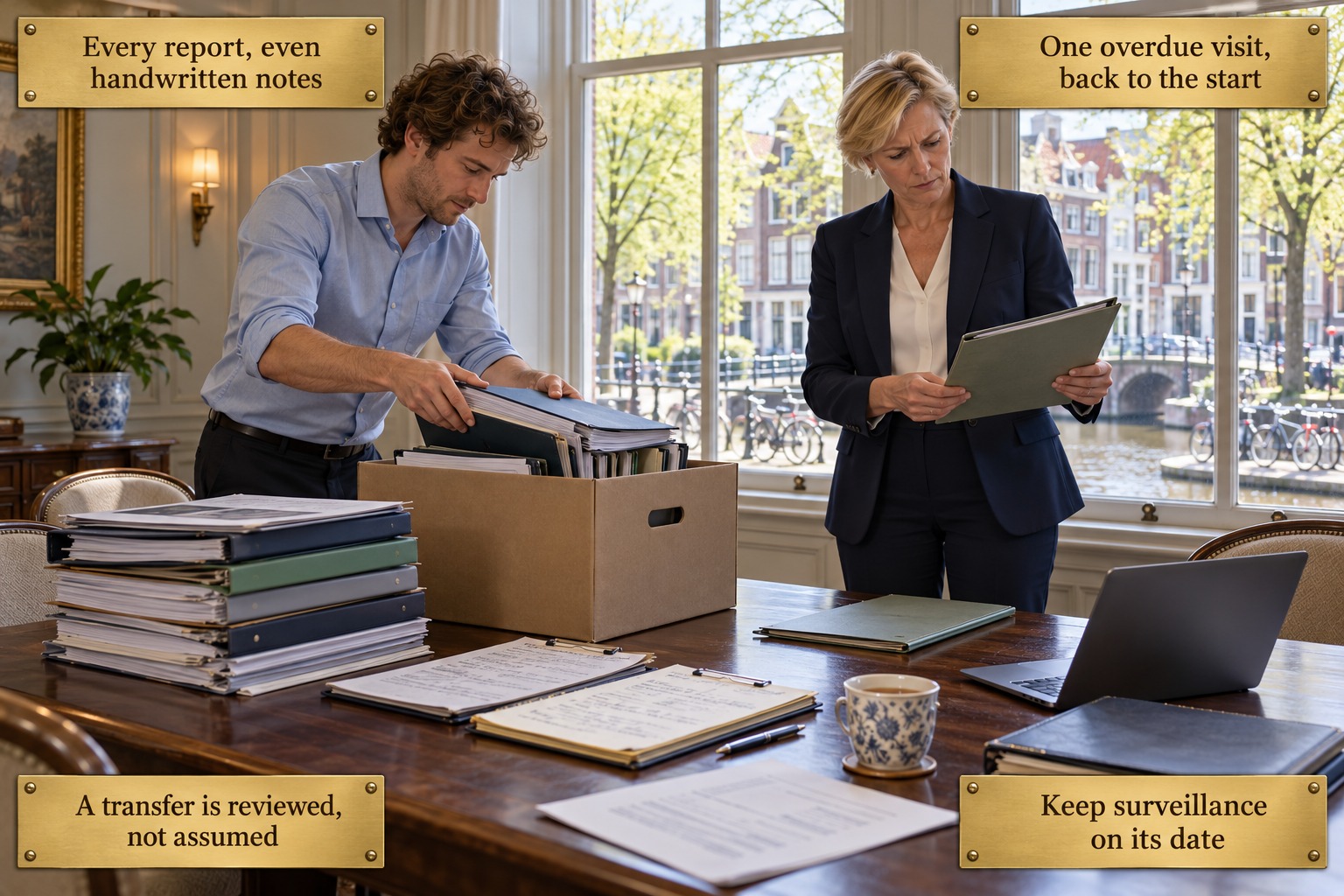
Concept Card 4.12 — Transferring Between Certification Bodies: The Door Is Open While You Do Not Need It
Two Properties Bought the Same Year, and Only One Could Leave
Setting: Utrecht, Netherlands
A meeting room in a nineteenth-century canal house hotel in Utrecht on a spring morning, clear light through tall sash windows. Outside, young leaves frame a tree-lined canal, a humpbacked bridge, rows of parked bicycles and gabled brick house fronts. The environmental coordinator, about thirty-four, curly brown hair, rolled-up light-blue shirtsleeves, lowers a stack of reports into an archive box beside a pile of binders. Sanne de Vries, the group’s Operations Director, about forty-eight, short blonde hair, navy trouser suit over a cream blouse, stands holding a thin green file and reads it with a frown. On the table lie clipboards of handwritten checklists, a printed list of questions, a second thin file, an open laptop and a cup of tea in blue-and-white china.
The card shows the pre-transfer review of 2025, after a regional group bought the Wittevrouwen and de Vries told it to move to the group’s certification body. The accepting body wants every report the previous body wrote, including handwritten notes and checklists, and asks why the client is leaving. The Wittevrouwen will transfer cleanly. The thin file belongs to the group’s twenty-eight-room property: its surveillance audit, due the previous September, slipped through a change of owner, so it cannot transfer and must start again from Stage 1.
The plaques at the top give the event: Every report, even handwritten notes, and One overdue visit, back to the start. The lower pair names the lesson. A transfer is reviewed, not assumed: the accepting body examines the certification’s validity, history, open findings and the reason for leaving before taking it on. Keep surveillance on its date: only a valid, current certification can move, so the door out is open only while nothing is wrong.
The card does not say that the smaller property’s system was worse; it was, if anything, tidier. Nor is the pre-transfer review an audit of the hotel. The rules come from the transfer document and the certification framework, not from ISO 14001, which says nothing on the subject. A body being left may not punish the departure.
Source: Francesco Dore, The Helm and the Lens, Volume 1b — ISO 14001:2026, subchapter 4.12
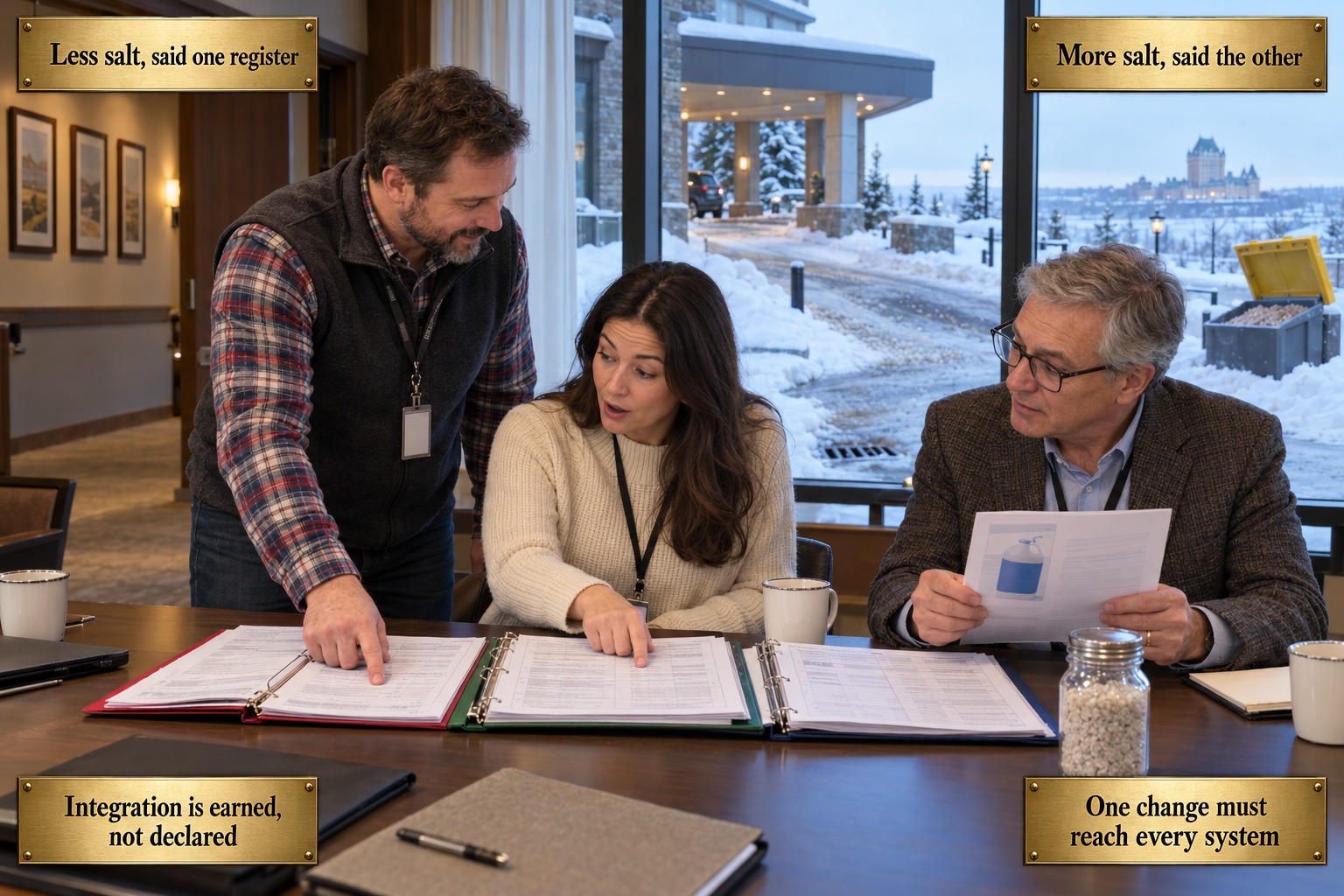
Concept Card 4.13 — Integrated Audits: The Work Was Already Integrated
Two Facing Pages, Three Winters Apart
Setting: Québec City, Canada
A meeting room at the front of a large hotel above Québec City on a deep-winter morning, pale blue-grey snow light. Through the window the porte-cochère and a snow-banked entrance ramp scattered with grit lead down to a storm drain grating; an open yellow salt bin stands in the snow, and a turreted château-style building rises on the far skyline. On the table, for the first time, three registers lie open side by side. Marc-André Ouellet, Health and Safety Manager, about forty-five, short brown hair and beard, checked flannel shirt under a fleece vest, lanyard, stands with a finger on one page, half-smiling. The environmental coordinator, about thirty-five, long dark hair, cream wool sweater, seated, points to the facing register and speaks to him. The quality manager, about fifty-eight, grey hair, glasses, tweed blazer, holds a product data sheet. A jar of de-icing salt stands among the mugs.
The card shows the winter the Hôtel Montmorency spent integrating its three certified systems after Ouellet proposed a combined audit. Laid on one table, the environmental register sought less salt on the ramp because chloride reached the river, while the safety register prescribed more salt, earlier, because slips were the leading cause of lost-time injury. Both entries were correct, owned and contradictory for three years. The quality manager holds the second problem: a laundry detergent reformulated in 2023, approved on whiteness and cost and never passed to environment or safety.
The plaques at the top give the event: Less salt, said one register, and More salt, said the other. The lower pair names the lesson. Integration is earned, not declared: the certification body assesses the level of integration before any reduction in audit time. One change must reach every system: a change approved in one discipline must be assessed by every system it touches.
The card does not say that ISO 14001 requires integration with other systems: the standard enables it and makes nothing depend on it. Nor does it suggest that integrating merges boundaries or inputs. A shared management review should keep each discipline’s inputs separable, so that a young environmental system is not carried by a mature one.
Source: Francesco Dore, The Helm and the Lens, Volume 1b — ISO 14001:2026, subchapter 4.13

Concept Card 4.14 — What the Certificate Does Not Prove
One Question Answered, Three Left Blank
Setting: Wellington, New Zealand
A small boardroom in a converted wool store above Thorndon in Wellington on a clear, cold late-winter morning, timber beams overhead. Through the window timber houses fall away down the hillside to the harbour and the hills beyond. Ngaire Baker, Sustainability Manager, about forty-two, dark curly hair tied back, green earrings, dark-green knit jumper, sits with a finger on a highlighted passage in a printed page, calm and firm. Across the table the commercial director, about fifty, sandy hair, navy blazer over an open-necked shirt, holds the draft and argues his case, a pen lying on a document before him. Between them the General Manager, a woman of about sixty with short silver hair and a dark jacket, rests her chin on her hand and listens. On the table lie the certificate in a clear sleeve, two energy charts, a thick binder of records, a teapot and cups.
The card shows the August argument over a government agency’s request for proposals. The draft answer to question four read: yes, our ISO 14001 certification confirms our legal compliance. Baker would not sign it. She printed the guidance that a non-compliance identified and corrected by the system is not necessarily a nonconformity: a certified system finds and fixes, it does not have nothing to find. The figures showed energy per available room down nine per cent over two years and absolute consumption up eleven. The answer was finally drawn from the compliance evaluation records.
The plaques at the top give the event: A tender line she would not sign, and Ratio down, absolute use up. The lower pair names the lesson. A certificate does not prove compliance: it attests a system that determines obligations and evaluates compliance, not that the property is compliant. Answer from records, not the certificate: performance and compliance questions are answered from the property’s own data, which a buyer can check.
The card does not say that the certificate is worthless; what it proves is considerable and usually undersold. Nor does it imply that certified hotels perform better than uncertified ones: the tender’s environmental section went to an uncertified property with clean absolute figures. Overstating the certificate fails the standard’s own requirement for reliable external communication.
Source: Francesco Dore, The Helm and the Lens, Volume 1b — ISO 14001:2026, subchapter 4.14

Concept Card 4.15 — Certification as an Investment: Who Pays, Who Benefits, and When
Eleven Properties, One Red Pen, and Two Correct Cuts
Setting: Chicago, United States
The executive meeting room high in a 1974 hotel tower in downtown Chicago on an autumn late afternoon, low golden light. Through the window dense towers catch the sun and an elevated train runs past on its tracks below, among autumn trees. Renee Alvarado, the fund’s asset manager, about forty-six, dark wavy shoulder-length hair, charcoal blazer, sits with a red pen and her chin on her hand, reading the papers before her, undecided. The director of sales, about fifty-five, shaved head, navy suit and tie, leans over beside her with a finger on a tabbed binder of client agreements. Across the table the environmental coordinator, about thirty, short red hair, grey cardigan, holds out a colour-coded spreadsheet and speaks to Alvarado. Budget printouts, charts, a laptop and glasses of water cover the table.
The card shows autumn 2025, when Alvarado, cutting operating expense across eleven hotels, flagged the Dearborn’s certification line because nobody could say what it returned. She asked three questions in writing. The all-in cost proved several times the fee, drawn from six departments. Sales named four corporate accounts and a citywide convention client whose agreements require current certification, with room nights against each. And stopping is not a pause, because of notification clauses and re-entry from the beginning. She kept it at the Dearborn and cut it at two other properties.
The plaques at the top give the event: The fee was the smallest cost, and Five contracts asked for the certificate. The lower pair names the lesson. Stopping is not a pause: once certification lapses, clients must be notified and re-entry means an initial certification with no credit for past history. Cut it only where nobody asks for it: where no buyer, lender or group requires it, certification may rightly be dropped.
The card does not say that certification itself saves energy or water; the measures do, and the system is what finds them and keeps them. Nor does it say that every hotel should be certified: for a property with no demand, operating the system honestly and declaring conformity itself is a legitimate route the standard names.
Source: Francesco Dore, The Helm and the Lens, Volume 1b — ISO 14001:2026, subchapter 4.15
L’AUTORE