
The Helm and the Lens · English
In attesa di approvazione / Pending approval
the Helm and the Lens – Vol. 1a
ISO 14001 · Environmental Management Systems in Hospitality Volume 1a — The Helm
600
Pagine

EDIZIONI · FORMATI
Formati disponibili
Le edizioni fisiche e digitali associate a questa scheda.
NEL LIBRO
Contenuto / Contents
La struttura del volume così come presentata nell’edizione pubblicata.
Table of Contents
- Preface.
- 1.1 Why an Environmental Management System, and Why Now..
- 1.2 Understanding the Organization and Its Context.
- 1.3 The Needs and Expectations of Interested Parties.
- 1.4 Defining the Scope of the Management System..
- 1.5 Leadership and Commitment from the Top.
- 1.6 The Environmental Policy as a Public Commitment.
- 1.7 Roles, Responsibilities, and Authorities.
- 1.8 Actions to Address Risks and Opportunities.
- 1.9 Identifying Environmental Aspects and Impacts.
- 1.10 Determining Compliance Obligations Without a Single Rulebook.
- 1.11 Setting Environmental Objectives That Mean Something.
- 1.12 Planning Actions to Achieve the Objectives.
- 1.13 The Life Cycle Perspective in a Hotel
- 1.14 Environmental Conditions: Beyond Climate Alone.
- 1.15 From Vision to System: What Chapter 2 Will Ask of Management.
- 2.1 Resources: What an Environmental System Actually Costs.
- 2.2 Competence: Building an Environmentally Literate Team..
- 2.3 Awareness Across Every Department.
- 2.4 Communication, Internal and External
- 2.5 Documented Information: What to Keep, What to Discard.
- 2.6 Operational Control in the Kitchen.
- 2.7 Operational Control in Housekeeping and Laundry.
- 2.8 Operational Control of Energy and Utilities.
- 2.9 Waste as a Managed Resource, Not a Problem..
- 2.10 Water Stewardship in a Water-Intensive Industry.
- 2.11 Emergency Preparedness and Response.
- 2.12 Monitoring, Measurement, Analysis and Evaluation.
- 2.13 Management Review: Turning Data into Decisions.
- 2.14 Nonconformity and Corrective Action: The First Response.
- 2.15 Continual Improvement and the Path to Certification.
- Afterword.
- Appendix A..
- Sources and Research Methodology —...
- Glossary.
- About the Author.
- Contact.
- The Series.
- The Online Platform..
- Analytical Index.
PRIMA DELL’ACQUISTO
Estratti / Extracts
Passaggi selezionati dal libro disponibili per la consultazione.
01 Preface Apri / Open
This is the second half of a pair. The first volume, the Helm, is written from the position of somebody who has to steer a hotel: the owner, the general manager, the person who decides what the property will commit to, what it will measure and what it will spend. It works through the environmental management system as something you build. This volume is written from the opposite position — the person who has to look at what was built and say whether it is true. That person appears twice in the life of a certified hotel, first as an internal auditor who works there and then as a certification auditor who does not, and the two chapters of this book take those two positions in turn.
They are separate books because they are separate acts. Building a system is a design problem, and it rewards ambition. Verifying one is an evidential problem, and it punishes it. A great deal of what goes wrong in hotel environmental management happens because the second act is performed by people who are still thinking in the vocabulary of the first — who look at a management system and see the intention behind it rather than the evidence in front of them. The lens of the title is not the certificate and it is not the audit. It is the willingness to look at what a property has already written about itself, and to find out whether it is still true.
Who this book is for
It is written for people in hotels: the coordinator who has inherited the system, the chief engineer who is asked to be an internal auditor without being asked whether he knows how, the director of sales who attaches a certificate to a tender without ever having read the only line on it that carries information, the owner’s asset manager deciding whether the line survives the budget. It assumes no prior knowledge of auditing and a great deal of knowledge about hotels. Every case in it is set in a property, at an hour, in a department, because that is where the questions actually arrive.
It will also be useful to consultants and to auditors who work in hospitality and have found that the manufacturing examples in the general literature do not transfer. A hotel is not a fence around a process. It is a bundle of contracts around an address, it runs twenty-four hours in a business that manages by daylight, and half of what it does environmentally is done by people who will not be employed there next season. Those three facts govern almost everything in this book.
What this book is, and what it is not
It is a practical and interpretive guide to applying ISO 14001:2026 in the hotel sector, aligned with the requirements of the standard, subject to the adaptations any individual organisation must make for its own context and compliance obligations. That sentence is deliberately careful, and the care is the point.
It is not a claim that reading this book makes a property conforming. Conformity requires that all the requirements of the standard are incorporated into an organisation’s own management system and met without exclusion, which is something a hotel does and not something a text can confer. It is not a substitute for the standard, which is a copyright document that this book paraphrases and never reproduces. And it is not a set of templates. Where a form, a threshold, a grading scale or a frequency appears in these pages, it appears as a proposal that has worked, clearly marked as such — because a book that presents its author’s method as the text of a standard is doing the exact thing this book exists to argue against.
The four fixed elements
Every subchapter in this volume, and in its companion, has the same shape. Four parts of it are worth knowing about in advance, because they are the load-bearing ones.
— The Guiding Question opens each subchapter and is the question the case actually turned on. It is not rhetorical. If you can answer it about your own property before reading further, the subchapter will confirm what you already know; if you cannot, it will tell you where to look.
— What the Standard Says summarises the applicable requirements in plain language, and — as often — states plainly where the standard says nothing at all. A surprising proportion of what the hotel industry believes ISO 14001 requires is not in it.
— The Verification Pact sets a claim commonly made in the market against what the requirements actually hold. It is the reason this book can be argued with: every assertion in it is placed next to its source, and where the source is thin the Pact says so.
A note on words
Three distinctions are used consistently throughout both volumes, and because two of them are commonly collapsed in practice, they are declared here rather than left to be inferred.
A finding is what an auditor writes: a requirement, the evidence, and the gap between them. A nonconformity is the non-fulfilment of a requirement. They are not the same thing and the difference is not pedantry — a finding can be badly written, successfully challenged and withdrawn, while a nonconformity either exists or does not. Subchapter 3.9 exists because that difference decides whether an audit survives contact with the people it examines. An observation, where this book uses the term at all, records something that is not a non-fulfilment of any requirement; the standard has no such category, and subchapter 3.10 explains why properties should be careful with it.
Compliance obligations is used in preference to legal requirements, permits or regulatory requirements, except when a specific document is being described, because the 2026 edition makes it the preferred term and because it covers commitments a hotel has chosen as well as those imposed on it. Documented information is used where the concept of the standard is meant, and document or record where the ordinary English word is meant — a distinction that does real work in a hotel, where the procedure and the log are habitually filed together.
A note on sources
Everything in Chapter 3 rests on ISO 14001:2026 itself. Chapter 4 does not, and it says so wherever that is the case. The standard contains no certificate, no certification body, no audit stages, no surveillance interval, no suspension and no transfer. Those belong to ISO/IEC 17021-1, which sets requirements for bodies auditing and certifying management systems, and to the mandatory documents applied by accreditation bodies, which are published free of charge and which any hotelier can read. Where this book relies on those, it names them; where it relies on the standard, it says so; and where it offers a method of its own, it labels it as such.
One matter of fact requires a date. Until the end of 2025 the international arrangement that made accreditation portable across economies was operated by two bodies, one for certification and one for laboratories. On the first of January 2026 both ceased to operate and their functions passed to a single organisation running one mutual recognition arrangement. Existing accreditations were unaffected, the underlying standards did not change, the regional cooperations continue their work, and the mandatory documents issued under the former arrangement remain in force until equivalents are adopted. This book therefore describes that machinery by what it does rather than by what it is called, and names the transition once, where it matters. Material of this kind ages faster than a printed book; where it changes, the correction will be published on the imprint’s platform rather than left to the next edition.
A note on the cases
The thirty properties in these two chapters are composites. The buildings, the people and the names are constructed; the conditions are not. Every case is assembled from situations that recur in hotels — the waste room locked at ten, the permit in a lawyer’s office, the irrigation controller nobody can reprogramme, the certificate that describes a hotel two wings smaller than the one it is attached to. No real property is depicted and no real person is described.
Figures are treated the same way. Where a cost, a saving or a period appears, it is marked as a modelled assumption rather than a benchmarked industry value, and it is there to show the shape of an outcome and not to promise one. A hotel’s numbers are its own, and the only honest use of somebody else’s is as an illustration of how the arithmetic behaves.
| A management system is a set of statements a property has made about itself. Auditing it — from the inside or from the outside — is the practice of finding out which of those statements are still true. Everything in this book follows from taking that sentence literally. |
02 4.8 Recertification: Reading Three Years as One Document Apri / Open
| GUIDING QUESTION
Your recertification quotation arrives at almost twice the cost of your original certification audit, for the same hotel. Is it a mistake? |
Opening
The Hotel Kotturpuram stands where the road bends toward the Adyar river in Chennai, and when it was certified in 2019 it had a hundred and eighty rooms, a hundred and forty staff, a banqueting floor, and its linen sent out to a contractor in Guindy. By 2025 it had two hundred and seventy rooms, because a ninety-room tower had opened in 2022; two hundred and sixty staff; a laundry brought in-house the same year to stop losing linen; and a sewage treatment plant in the basement of the new tower, installed because the extension consent required one.
Meera Raghavan is Chief Accountant. She has no role in the environmental management system and had never read the certificate. In April 2025 the recertification quotation came to her for approval, as everything with a number on it does, and she stopped at the first line. The certification body was proposing eleven auditor days. The original certification audit, in 2019, had taken six and a half. She wrote back asking the certification body to correct what she assumed was an error in the quotation.
The reply explained the arithmetic, and it is the arithmetic almost nobody in hospitality knows. The time for a recertification audit is calculated at roughly two thirds of what an initial audit would take if it were being carried out now, on the property as it exists today, using updated information about the client. It is not two thirds of what the original audit took. In 2019 the calculation had started from a hundred and forty people. In 2025 it started from two hundred and sixty, and the property had acquired an effluent treatment plant and an on-site laundry in the interval.
Raghavan approved the quotation, and then, being an accountant, went looking for what else had been assumed and never checked. She found the certificate. The scope on it read: provision of hotel accommodation, food and beverage and banqueting services at the property’s original street address. The tower stands on an adjoining plot with its own number, acquired in 2020. She asked the coordinator when the certification body had been notified of the extension. The coordinator said the auditor had been shown the tower at the 2022 surveillance visit and had seemed pleased with it.
That was true. It was also not a notification, and the scope had not been amended in consequence. For three years the property had been reporting a certified system covering a hundred and eighty rooms while operating two hundred and seventy, and had been sending the certificate, with its original address, to corporate clients booking events in the new tower.
The Problem
The Kotturpuram was recertified. It was recertified eleven weeks later than planned, with one major nonconformity, a scope amendment handled in parallel, and a fortnight in which nobody at the property was confident the certificate would still be valid on the day it expired. All of that was avoidable, and none of it was caused by the environmental management system working badly.
Two separate assumptions had done the damage, and they are the standard pair. The first was financial and belongs in this book because it is where the property’s attention actually lives: the recertification had been budgeted, three years earlier, at the cost of the last one. Nothing in a hotel is budgeted that way — not linen, not energy, not insurance — but certification is, because it feels like a renewal rather than a purchase. It is not a renewal. It is a fresh calculation on the property as it now is, discounted by a third, and a hotel that has grown during the cycle will meet a number it has not planned for at precisely the point in the cycle where it has least room to argue.
The second assumption was that the certification body knew what it had been shown. An auditor walked through the tower in 2022 and made an approving remark. From the property’s side that felt like disclosure. From the certification body’s side it was a site visit to a building; the scope of a certificate is amended by a defined process, not by an impression formed during a corridor. Nobody had lied and nobody had concealed anything, which is exactly what makes the pattern so common: the property believed it had told them, and in a meaningful sense it had, and the document that goes to clients still said something else.
There is a third element, which surfaced only because recertification looks backwards over the whole period. Reading the five surveillance reports together, the audit team found the same finding on waste segregation in the banqueting kitchen in 2021 and again in 2024. Each had been closed properly, with a correction, an analysis and evidence. Neither report mentioned the other, because neither auditor had been looking at more than one year, and the property’s own review had never put the two side by side. A finding that recurs after three years is a different fact from a finding that happens once, and nobody had been in a position to notice which one this was.
The Principle
A surveillance audit examines an interval. A recertification audit examines a cycle. That is the whole difference, and everything else about the visit follows from it.
Reading three years as one document is a different operation from reading three years one at a time, and it produces information that is genuinely unavailable within any single year. Recurrence is the obvious example, and it is invisible annually by construction: two findings three years apart look like two small events to anyone holding one report, and like a structural condition to anyone holding three. Drift is the other: objectives quietly restated, indicators changed, scopes that no longer describe the building, a management review that has slowly become shorter each year. None of that is visible in a snapshot and all of it is visible in a sequence.
Subchapter 3.15 argued that a mature audit programme should be read across ten years, and offered three readings for doing it. Recertification is the same operation performed by somebody else, on the property’s own record, at a moment when the certificate depends on the result. A property that has never read its own cycle is meeting that reading for the first time in the room where it matters most.
The second half of the principle is about the clock, and it is the reason recertification is the tensest audit in the cycle even when the system is healthy. A certificate has an expiry date. Surveillance findings can be closed at a reasonable pace, because nothing lapses while they are open. Recertification findings sit against a fixed external date that the property does not control and cannot extend by working harder. It is the one point in the whole arrangement where a hotel can lose something it already has, simply by running out of calendar.
What the Standard Says
ISO 14001:2026 contains no certificate, no cycle, no expiry and no recertification. Those belong to the standard governing certification bodies and to the free framework on audit time, both named here and neither quoted. What the standard supplies is why the three findings at the Kotturpuram were findings.
The audit-time framework is the source of the number that started the whole episode, and it is worth stating precisely because it is so widely misunderstood. Recertification time is calculated from updated information about the client, and is normally around two thirds of the time that an initial audit — Stage 1 plus Stage 2 — would require if such an audit were being carried out at the time of recertification. Explicitly, it is not two thirds of the time the original initial audit actually took. The framework also requires the audit time to take account of the outcome of the review of the system’s performance over the period of certification, and states that the review of system performance is not itself part of the recertification audit time.
That last provision is the clearest available evidence of what recertification is for. A whole activity — reading the cycle — is required to inform the audit and is deliberately excluded from the days spent auditing. The cycle review is not a portion of the visit. It is the frame the visit is planned inside.
The scope failure runs to two requirements in ISO 14001 itself. The organisation determines the boundaries and applicability of the system to establish its scope, considering among other things its organisational units, functions and physical boundaries and its activities, products and services; once the scope is defined, all activities, products and services of the organisation within that scope must be included in the system; and the scope must be available as documented information and available to interested parties. Separately, where the organisation determines the need for changes that affect or can affect the environmental management system, those changes must be carried out in a planned manner and managed so that the system continues to achieve its intended outcomes. A ninety-room tower on an adjoining plot, an in-house laundry and an effluent plant are such changes three times over. Notification to a certification body is a contractual matter belonging to the certification agreement rather than to the standard, but the internal obligation to plan and manage the change is squarely in the standard, and it was the internal obligation that failed first.
The recurrence finding rests on the corrective action clause, read as this book has read it since subchapter 3.11. The organisation evaluates the need for action to eliminate the causes of a nonconformity so that it does not recur or occur elsewhere, and reviews the effectiveness of any corrective action taken. A nonconformity that reappears three years later is direct evidence that the action taken in the first instance did not eliminate the cause, whatever the closure record says. And the management review requirement supplies the mechanism that should have caught it: the review takes as input information on environmental performance including trends in nonconformities and corrective actions, in monitoring and measurement results, in the meeting of compliance obligations and in audit results. Trends require more than one year. A review conducted annually on a single year’s material has not been given the input the clause names.
Verification Pact — what is claimed about recertification, set against what the requirements actually say.
| What is claimed | What actually holds |
| “Recertification costs about two thirds of what our original certification cost.” | It is around two thirds of what an initial audit would take if carried out now, on updated information about the property. A hotel that has grown during the cycle is quoted against today, not against 2019. |
| “Recertification is a large surveillance audit.” | Surveillance examines the interval since the last visit. Recertification examines the whole period of certification, and the review of that performance is required to inform the audit while being expressly excluded from its days. |
| “ISO 14001 sets the three-year cycle.” | The standard contains no certificate, cycle or expiry date. That structure comes from the certification framework, not from the requirements the property is audited against. |
| “We showed the auditor the new wing, so they know.” | Being shown a building during a visit is not notification, and a certificate’s scope is amended by a process rather than by an impression. Meanwhile the internal duty stands on its own: changes affecting the system must be planned and managed. |
| “The certificate rolls over if the audit is booked.” | It expires on its date. Recertification has to be completed, and findings resolved, against a deadline the property does not control — the one point in the cycle where something already held can be lost. |
| “A finding closed in 2021 is finished.” | Recertification reads the reports together. The same finding recurring three years later is evidence that the original action did not eliminate the cause, whatever the closure record shows. |
| “Our annual management review covers this.” | The review must take information on performance including trends in nonconformities, monitoring, compliance and audit results. Trends need more than one year of material, and an annual review of one year cannot produce them. |
Not Everything Here Needs a Dedicated Manual
No procedure is required and none would help. What is required is two things a property can do without writing anything into the system at all.
The first is a line in the three-year budget that says the recertification will be quoted against the property as it will be then, not as it was. The second is a half day, in the final year of the cycle, in which somebody reads all the audit reports of the cycle together — internal and external — and lists what appears more than once. Neither of those is documentation. The first is a number in a spreadsheet the finance office already maintains, and the second is an afternoon that produces a list nobody else ever sees.
What This Means in Practice
The cycle reading is the whole of the preparation worth doing, and it works best if it is done a year early rather than a month early. Lay the reports out by date: the internal audits, the surveillance reports, the management review minutes, the corrective action records …
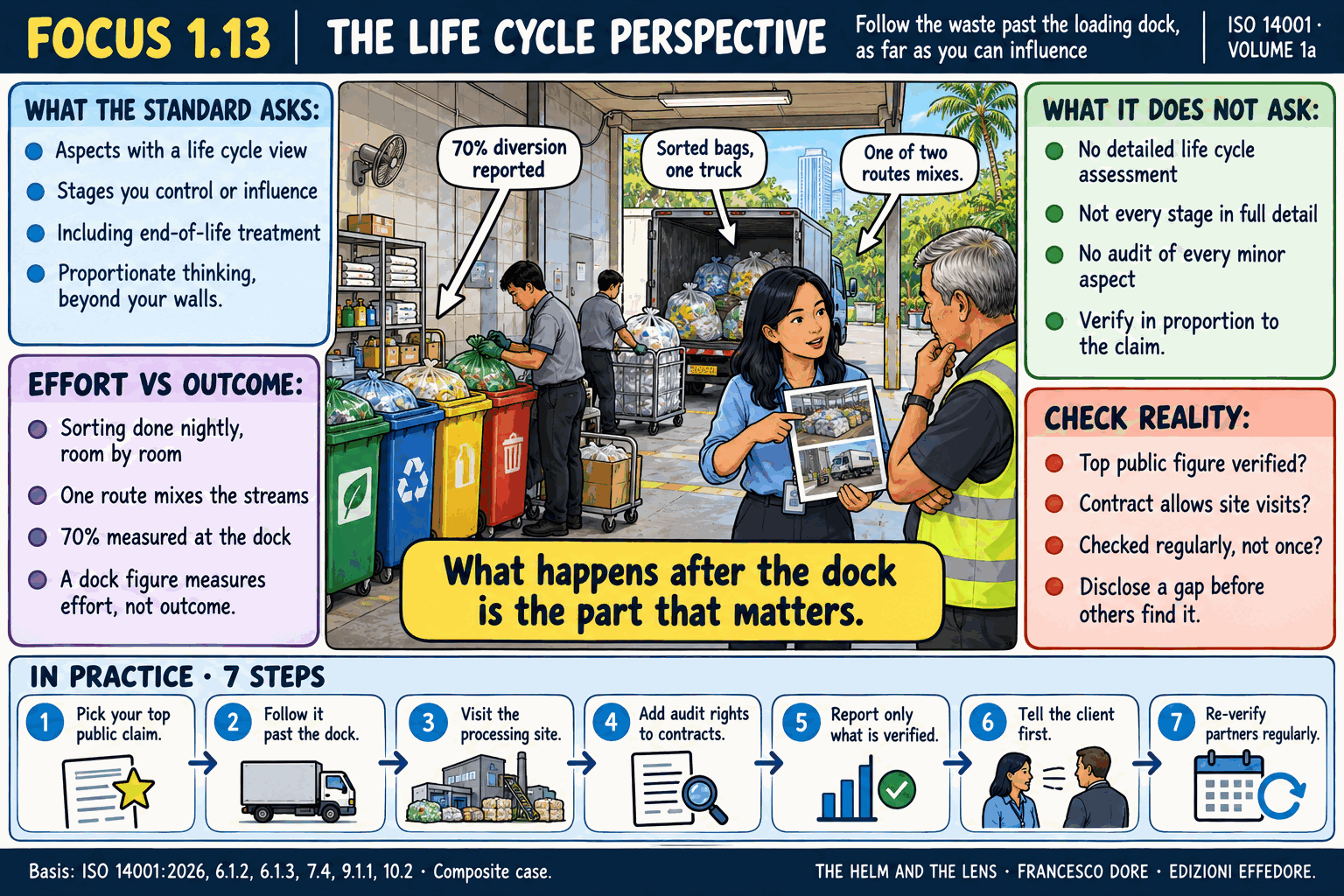
03 1.13 The Life Cycle Perspective in a Hotel Apri / Open
1.13 The Life Cycle Perspective in a Hotel
GUIDING QUESTION
A hotel’s recycling bins are the easiest environmental aspect in the entire building to see, photograph, and be proud of. What happens to their contents in the hour after they leave the loading dock is the hardest to see — and it decides whether the sorting meant anything.
Opening
A four-hundred-and-twenty-room business hotel in central Bangkok invests substantially, three years before this volume’s story begins, in a comprehensive recycling programme: colour-coded bins in every guest room and every back-of-house area, staff training on correct sorting across paper, plastic, glass, and organic waste, and guest-facing signage explaining the property’s commitment to diverting waste from landfill. The programme is, by every measure the hotel itself tracks, a considerable success — housekeeping and back-of-house staff sort meticulously, and the property’s internal metrics report a diversion rate of roughly seventy percent of total waste redirected away from landfill disposal.
It is worth noting, before the case turns to its consequence, how reasonable the seventy percent figure looked from every internal vantage point available at the time it was first calculated. Housekeeping supervisors signed off on sorting compliance nightly. The waste hauler’s own invoicing distinguished recyclable and general waste tonnage, which the property’s finance team took, not unreasonably, as evidence the distinction was maintained throughout. Every internal signal available pointed toward the figure being accurate. None of those signals had ever originated from beyond the loading dock.
This figure becomes a genuine point of pride, featured in the hotel’s own sustainability materials and, more consequentially, cited directly in response to a corporate client’s sustainability procurement questionnaire — a major multinational company evaluating the property as a preferred venue for its regional conference business, specifically asking for verified waste diversion performance as part of its own supplier sustainability criteria.
No one at the hotel has ever verified what happens to the sorted waste after the contracted waste hauler collects it. A newly hired sustainability coordinator, following up on a routine question about the hauler’s own processing certification for an unrelated report, arranges a site visit to the transfer station where the hotel’s waste is taken. What she observes there is not sabotage or fraud in any deliberate sense: the hauler’s own collection trucks, constrained by vehicle capacity and route economics that make separate collection runs for each waste stream commercially unviable on this specific route, combine the hotel’s carefully sorted recyclables with general waste at the point of collection roughly half the time, depending on which truck and crew is assigned that day.
It is worth being precise about what the coordinator actually found, because “half the time” understates the operational reality in an important way: the combining was not random but predictable, driven by which of the hauler’s two collection routes served the property on a given day, one genuinely maintaining separation and one not, due to a vehicle capacity difference between the two routes that the hauler’s own dispatch had never been asked to resolve. The gap was not a general failure of intention on the hauler’s part so much as an operational detail no one, on either side of the contract, had ever surfaced or discussed.
The meticulous sorting performed nightly by housekeeping staff, room by room, floor by floor, is in practice undone within the first hour after leaving the building on roughly half of all collection days — not through any single failure, but through a downstream reality the hotel’s own environmental management system had never once examined.
The Problem
The Structural Failure
The hotel’s environmental management system treated waste diversion as an aspect that begins and ends at the property’s own loading dock: sorting performed correctly on-site was recorded as achievement complete, with the waste hauler’s collection treated as the boundary beyond which the system’s own responsibility, and its own verification, stopped. This is precisely the boundary clause 6.1.2’s life cycle requirement exists to push past — the standard asks an organisation to consider aspects across a life cycle perspective specifically because an activity’s environmental consequence frequently continues well beyond the point where the organisation’s direct physical control ends.
A percentage figure calculated from what leaves the building, without any verification of what happens to it afterward, measures the organisation’s own effort rather than the environmental outcome the effort was meant to produce — a distinction that matters enormously once that figure is repeated externally as a verified performance claim.
The Cultural Failure
The deeper failure is an entirely understandable but consequential assumption: that a contracted waste hauler, presumably a specialist in waste management, can be trusted to handle downstream processing correctly without independent verification, because verifying a contractor’s own operations felt, to everyone involved, like overstepping a reasonable boundary of responsibility. The hotel’s own staff had done their part conscientiously. Checking whether the next link in the chain had done theirs never occurred to anyone as part of the environmental management system’s own job.
This pattern — trusting a downstream or upstream partner’s process without verification, simply because verifying it feels like it belongs to someone else’s responsibility — recurs wherever an organisation’s own environmental aspects genuinely depend on what a supplier, contractor, or waste handler does outside the organisation’s direct sight.
The Principle
A life cycle perspective, properly applied, asks an organisation to follow its own activities, products, and services across stages it does not directly control, and the Bangkok case shows what happens when that perspective stops at the most visible, most controllable stage alone.
| Life cycle stage | What it covers | How Bangkok addressed it |
| Upstream — raw material and supply | Where inputs come from and what their production involves | Not examined in this specific case, though a comparable gap frequently exists around linen and amenity sourcing |
| On-site use and operation | What happens within the organisation’s own
direct control |
Addressed thoroughly — sorting infrastructure, staff training, and guest communication were all genuinely well executed |
| Downstream — end-of-life treatment and disposal | What happens to an output after it leaves the organisation’s direct control | Never examined — the hauler’s actual processing practice was simply assumed rather than verified |
The middle row is genuinely strong at Bangkok, and it is worth stating plainly that the failure here is not a failure of effort. It is a failure of scope — a life cycle perspective that stops at the boundary of direct physical control has not actually adopted the perspective the standard asks for, however excellent the work within that boundary happens to be.
What the Standard Says
Clause 6.1.2 requires the organisation to determine its environmental aspects, and their associated environmental impacts, considering a life cycle perspective. Annex A clarifies this requirement’s actual scope directly: the organisation is not required to undertake a detailed life cycle assessment, and there is no requirement to evaluate every product life cycle stage in each level of detail — sufficient life cycle thinking is achieved by giving proper consideration to the stages of a product or service’s life cycle that the organisation can control or influence.
This is a genuinely light requirement in its formal demands, and it is worth being precise about that lightness so this subchapter is not read as demanding a full life cycle assessment where none is required. What the requirement does insist on, unambiguously, is that the consideration extend beyond the organisation’s own four walls to stages it can influence even without directly controlling them — and downstream waste handling, where an organisation selects and pays a specific contractor, sits squarely within influence even where it sits outside direct control.
Annex A further notes that life cycle stages typically include raw material acquisition, design, production, transportation or delivery, use, end-of-life treatment, and final disposal — naming end-of-life treatment as a stage that consideration can reach wherever the organisation can control or influence it, not merely a stage to gesture toward through a sorting programme whose actual downstream fate goes unverified.
Verification Pact: Market Claims Against the Standard
| What is claimed | Binding? | What actually holds |
| A well-designed on-site sorting programme satisfies clause 6.1.2’s life cycle requirement on its own | No | The requirement extends
to stages the organisation can influence, including how a contracted waste hauler actually processes what it collects |
| The standard requires a detailed, formal life cycle assessment for every significant aspect | No | Annex A explicitly states that a detailed life cycle assessment is not required; general, proportionate
consideration of relevant stages is sufficient |
| Once waste leaves the property in a contracted hauler’s vehicle, it is
outside the organisation’s environmental responsibility |
No | The organisation retains influence through its choice of contractor and the terms of that relationship, which the life cycle perspective expects it to exercise |
| A diversion-from-landfill percentage calculated from what leaves a building, without downstream verification, is an accurate measure | No | Such a figure measures sorting effort at the point of departure, not verified environmental outcome — presenting it as the latter without verification is a claim the |
| of environmental performance | organisation cannot actually support | |
| Verifying a waste contractor’s downstream
processing is the contractor’s responsibility, not the hotel’s |
Not under clause 6.1.2 | The organisation determining its own aspects under this clause is required to consider the life cycle perspective itself, regardless of which party physically performs each stage |
| Reporting an unverified diversion figure to a client’s sustainability questionnaire carries no consequence if the figure was calculated in good faith | Not addressed by 6.1.2
directly, but relevant elsewhere |
A good-faith calculation still requires a factual basis; an unverified figure presented as verified performance carries reputational and contractual risk entirely separate from the standard’s own requirements |
What This Means in Practice for a Hotel
A single question, applied to every significant aspect the property has identified, tests whether the life cycle perspective genuinely extends beyond the property’s own walls: for this aspect, what happens at the next stage this organisation does not directly control — and has anyone ever actually verified it, rather than assumed it?
| Aspect | The on-site stage
(usually well managed) |
The unverified stage (frequently assumed rather than checked) |
| Waste sorting and diversion | Correct sorting by trained staff | Whether the contracted
hauler actually processes sorted streams separately |
| Linen and amenity sourcing | Selection based on supplier claims or certifications | Whether the supplier’s own manufacturing process matches what its marketing materials describe |
| Food waste and composting | Correct separation of food waste on-site | Whether the collection contractor’s composting facility actually operates as described, or diverts to general waste under capacity pressure |
| Water treatment before discharge | On-site pre-treatment performed as specified | Whether the municipal or contracted downstream treatment facility can actually handle the volume and
composition delivered to it |
| Guest amenity refill or reuse programmes | Correct on-site dispensing and container reuse | Whether returned or collected containers are actually reprocessed as claimed, or discarded due to contamination or capacity limits
downstream |
Life Cycle Thinking Without a Single Rulebook
Waste management infrastructure, recycling processing capacity, and contractor practices vary enormously across the markets this series is written for — a downstream verification that is routine in one market may require considerably more effort to arrange in another. What travels everywhere is the discipline of asking the question at all, and adjusting the verification method to what is actually available locally rather than assuming a claimed process is real simply because no local mechanism exists to check it easily.
| Local infrastructure context | A proportionate verification approach | What to avoid |
| Mature, transparent waste management sector with public reporting | Request the contractor’s own processing certification or public compliance record directly | Assuming certification exists without ever requesting to see it |
| Developing or informal waste management
sector, as in much of Bangkok’s own context |
A direct site visit to the transfer or processing point, as the sustainability coordinator ultimately conducted | Relying solely on a contractor’s own verbal assurance with no independent check |
| Multiple potential contractors available | Include downstream verification access as a contract condition when selecting or renewing a waste hauler | Selecting solely on price without any contractual right to verify claimed processing |
| Single or limited contractor options available | Direct engagement and relationship-building with the contractor to understand actual, not claimed, capacity and practice | Publicising a diversion figure the property has no practical way to verify given limited contractor choice |
Where Later Clauses Depend on This One
| Later clause | How it depends on genuine life cycle consideration | What breaks if consideration stops at direct control |
| 6.1.3 — compliance obligations | Obligations may attach to downstream handling, not only on-site activity | A downstream
regulatory violation by a contracted party may still implicate the organisation’s own compliance obligations |
| 7.4 — communication | External claims should reflect verified
performance |
An unverified figure repeated externally, as at Bangkok, creates exposure entirely separate from the standard’s own requirements |
| 9.1 — monitoring and measurement | What is monitored should reflect the full aspect, not only its on-site portion | A metric measuring effort rather than outcome passes every internal review while remaining substantively false |
| 10.2 — nonconformity and corrective action | A downstream gap, once identified, requires genuine correction | Softening language, as in the counter-case, addresses exposure without addressing the underlying nonconformity |
Practical Application
Main Case — Bangkok Follows Its Own Waste Past the Loading Dock
Once the transfer station visit reveals the gap, the hotel’s leadership commissions a review of how the property verifies, rather than assumes, its downstream environmental claims. Four measures follow.
Measure 1 — The waste hauler contract is renegotiated with verification access built in. The renewed contract includes an explicit right to periodic site visits and requires the hauler to provide documented evidence of separated processing, rather than relying on the collection arrangement alone.
Measure 2 — The diversion metric is recalculated and reported honestly. Pending verified evidence of actual downstream separation, the property revises its internally reported diversion figure to reflect only the portion it can currently verify, rather than the full seventy percent calculated from what left the building.
Measure 3 — The corporate client is informed proactively, before the gap could be discovered independently. The hotel’s sales team, working with the sustainability coordinator, contacts the client directly to explain the finding and the corrective steps under way — a conversation considerably more difficult than continuing to report an unverified figure, and considerably less damaging than having the client discover the gap independently.
Measure 4 — The life cycle perspective is extended to other significant aspects systematically. The same downstream-verification question is applied to the property’s linen supplier and food waste contractor, surfacing a comparable, previously unexamined gap in the linen supply chain’s own water treatment practices. …
MATERIALI DI LAVORO
Materiali e download
Checklist, modelli, supplementi e file di lavoro collegati al volume.
35 materiali in 3 gruppi
Capitolo 115 materiali
FILES
1 · Why an Environmental Management System, and Why Now — Working Material
Subchapter 1.1
Editable sheet: guiding question, 6 Verification Pact claims, 3 review questions, 10 self-checks and a three-horizon action plan with owner and due date.
FILES
2 · Understanding the Organization and Its Context — Working Material
Subchapter 1.2
Editable sheet: guiding question, 6 Verification Pact claims, 10 self-checks and a three-horizon action plan with owner and due date.
FILES
3 · The Needs and Expectations of Interested Parties — Working Material
Subchapter 1.3
Editable sheet: guiding question, 6 Verification Pact claims, 10 self-checks and a three-horizon action plan with owner and due date.
FILES
4 · Defining the Scope of the Management System — Working Material
Subchapter 1.4
Editable sheet: guiding question, 6 Verification Pact claims, 5 review questions, 10 self-checks and a three-horizon action plan with owner and due date.
FILES
5 · Leadership and Commitment from the Top — Working Material
Subchapter 1.5
Editable sheet: guiding question, 6 Verification Pact claims, 5 review questions, 10 self-checks and a three-horizon action plan with owner and due date.
FILES
6 · The Environmental Policy as a Public Commitment — Working Material
Subchapter 1.6
Editable sheet: guiding question, 6 Verification Pact claims, 5 review questions, 10 self-checks and a three-horizon action plan with owner and due date.
FILES
7 · Roles, Responsibilities, and Authorities — Working Material
Subchapter 1.7
Editable sheet: guiding question, 6 Verification Pact claims, 5 review questions, 10 self-checks and a three-horizon action plan with owner and due date.
FILES
8 · Actions to Address Risks and Opportunities — Working Material
Subchapter 1.8
Editable sheet: guiding question, 6 Verification Pact claims, 5 review questions, 10 self-checks and a three-horizon action plan with owner and due date.
FILES
9 · Identifying Environmental Aspects and Impacts — Working Material
Subchapter 1.9
Editable sheet: guiding question, 6 Verification Pact claims, 5 review questions, 10 self-checks and a three-horizon action plan with owner and due date.
FILES
10 · Determining Compliance Obligations Without a Single Rulebook — Working Material
Subchapter 1.10
Editable sheet: guiding question, 6 Verification Pact claims, 5 review questions, 10 self-checks and a three-horizon action plan with owner and due date.
FILES
11 · Setting Environmental Objectives That Mean Something — Working Material
Subchapter 1.11
Editable sheet: guiding question, 6 Verification Pact claims, 5 review questions, 10 self-checks and a three-horizon action plan with owner and due date.
FILES
12 · Planning Actions to Achieve the Objectives — Working Material
Subchapter 1.12
Editable sheet: guiding question, 6 Verification Pact claims, 5 review questions, 10 self-checks and a three-horizon action plan with owner and due date.
FILES
13 · The Life Cycle Perspective in a Hotel — Working Material
Subchapter 1.13
Editable sheet: guiding question, 6 Verification Pact claims, 5 review questions, 10 self-checks and a three-horizon action plan with owner and due date.
FILES
14 · Environmental Conditions: Beyond Climate Alone — Working Material
Subchapter 1.14
Editable sheet: guiding question, 7 Verification Pact claims, 6 review questions, 11 self-checks and a three-horizon action plan with owner and due date.
FILES
15 · From Vision to System: What Chapter 2 Will Ask of Management — Working Material
Subchapter 1.15
Editable sheet: guiding question, 5 review questions, 10 self-checks and a three-horizon action plan with owner and due date.
Capitolo 215 materiali
FILES
16 · Resources: What an Environmental System Actually Costs — Working Material
Subchapter 2.1
Editable sheet: guiding question, 6 Verification Pact claims, 5 review questions, 10 self-checks and a three-horizon action plan with owner and due date.
FILES
17 · Competence: Building an Environmentally Literate Team — Working Material
Subchapter 2.2
Editable sheet: guiding question, 6 Verification Pact claims, 5 review questions, 10 self-checks and a three-horizon action plan with owner and due date.
FILES
18 · Awareness Across Every Department — Working Material
Subchapter 2.3
Editable sheet: guiding question, 6 Verification Pact claims, 5 review questions, 10 self-checks and a three-horizon action plan with owner and due date.
FILES
19 · Communication, Internal and External — Working Material
Subchapter 2.4
Editable sheet: guiding question, 6 Verification Pact claims, 5 review questions, 10 self-checks and a three-horizon action plan with owner and due date.
FILES
20 · Documented Information: What to Keep, What to Discard — Working Material
Subchapter 2.5
Editable sheet: guiding question, 6 Verification Pact claims, 5 review questions, 10 self-checks and a three-horizon action plan with owner and due date.
FILES
21 · Operational Control in the Kitchen — Working Material
Subchapter 2.6
Editable sheet: guiding question, 6 Verification Pact claims, 5 review questions, 10 self-checks and a three-horizon action plan with owner and due date.
FILES
22 · Operational Control in Housekeeping and Laundry — Working Material
Subchapter 2.7
Editable sheet: guiding question, 6 Verification Pact claims, 5 review questions, 10 self-checks and a three-horizon action plan with owner and due date.
FILES
23 · Operational Control of Energy and Utilities — Working Material
Subchapter 2.8
Editable sheet: guiding question, 6 Verification Pact claims, 5 review questions, 10 self-checks and a three-horizon action plan with owner and due date.
FILES
24 · Waste as a Managed Resource, Not a Problem — Working Material
Subchapter 2.9
Editable sheet: guiding question, 6 Verification Pact claims, 5 review questions, 10 self-checks and a three-horizon action plan with owner and due date.
FILES
25 · Water Stewardship in a Water-Intensive Industry — Working Material
Subchapter 2.10
Editable sheet: guiding question, 6 Verification Pact claims, 5 review questions, 10 self-checks and a three-horizon action plan with owner and due date.
FILES
26 · Emergency Preparedness and Response — Working Material
Subchapter 2.11
Editable sheet: guiding question, 6 Verification Pact claims, 5 review questions, 10 self-checks and a three-horizon action plan with owner and due date.
FILES
27 · Monitoring, Measurement, Analysis and Evaluation — Working Material
Subchapter 2.12
Editable sheet: guiding question, 6 Verification Pact claims, 5 review questions, 10 self-checks and a three-horizon action plan with owner and due date.
FILES
28 · Management Review: Turning Data into Decisions — Working Material
Subchapter 2.13
Editable sheet: guiding question, 6 Verification Pact claims, 5 review questions, 10 self-checks and a three-horizon action plan with owner and due date.
FILES
29 · Nonconformity and Corrective Action: The First Response — Working Material
Subchapter 2.14
Editable sheet: guiding question, 6 Verification Pact claims, 5 review questions, 10 self-checks and a three-horizon action plan with owner and due date.
FILES
30 · Continual Improvement and the Path to Certification — Working Material
Subchapter 2.15
Editable sheet: guiding question, 6 Verification Pact claims, 4 review questions, 10 self-checks and a three-horizon action plan with owner and due date.
Altri materiali5 materiali
XLSX
31 · Verification Pact Register
Whole volume
All 175 market claims from the Verification Pact tables, with the book’s verdict, filters and a column for your own notes.
XLSX
32 · Review Checklists of the Thirty Subchapters
Whole volume
All 138 review questions in the book’s order, with Yes / Partly / No / N.A. answer list, evidence column and summary per subchapter.
XLSX
33 · Transition Timeline 2015 → 2026
Whole volume
The five accreditation milestones of Global ACI-TECH-3-TR 2029-04-30 (M) to 30 April 2029, with columns for your status, date checked and source.
FILES
34 · Transition Guide 2015 → 2026 (updated October 2026)
Whole volume
What ISO 14001:2026 changes, what to rework and what to leave alone, steps, the timetable, and where the book covers each topic.
FILES
36 · The Thirty Concept Cards with Title and Text
Whole volume
One card per page: title, setting, picture and the four description paragraphs from the book.
PER CORSI E SCUOLE
Slide didattiche da proiettare
Apri le slide a schermo intero per lezioni e corsi oppure scarica i file alla risoluzione originale. Usa le frecce per passare da una slide all’altra. Dove disponibile, apri la spiegazione e scegli la lingua da leggere e ascoltare.
Slide 1.1
Slide 1.2
Slide 1.3
Slide 1.4
Slide 1.5
Slide 1.6
Slide 1.7
Slide 1.8
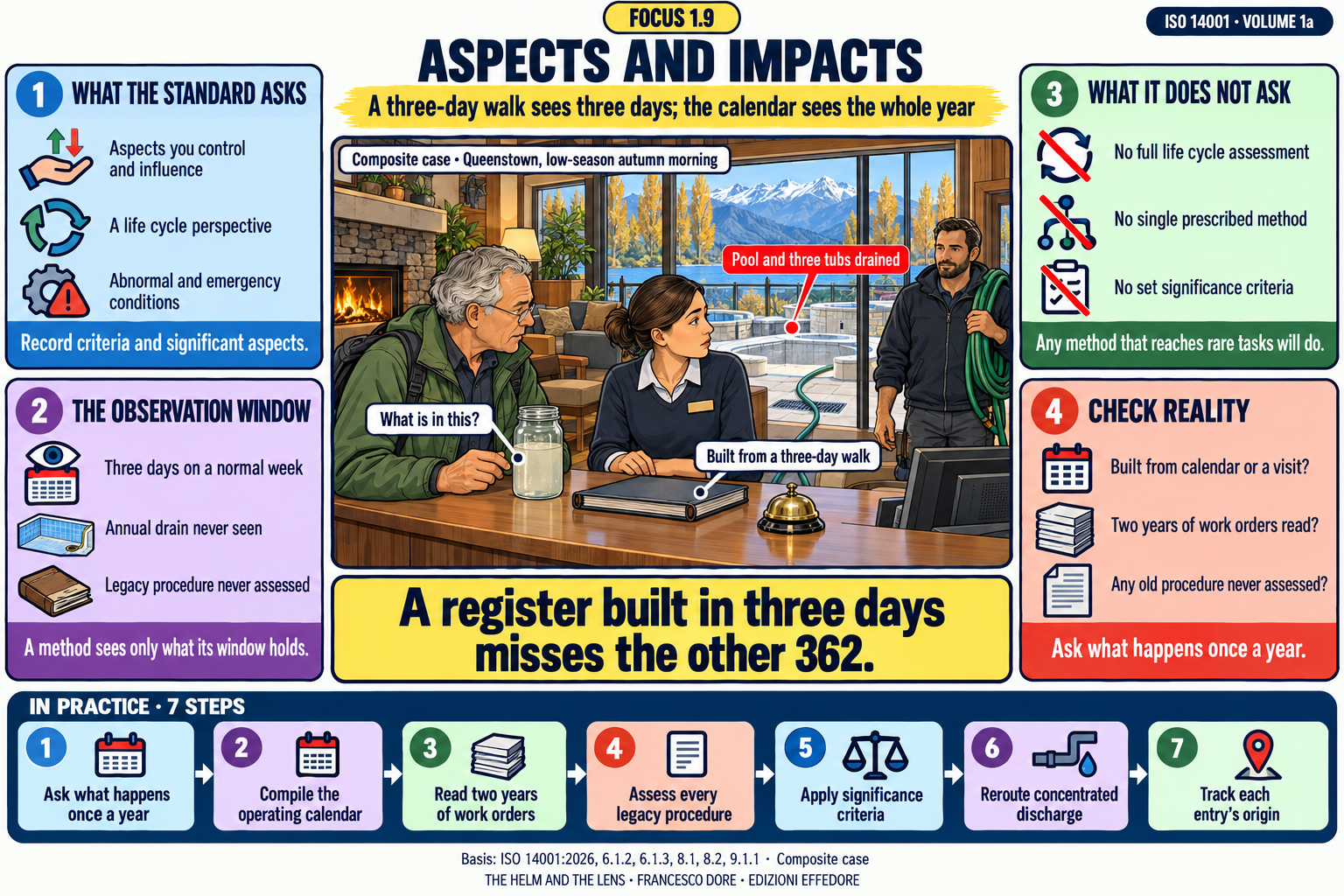
Slide 1.9
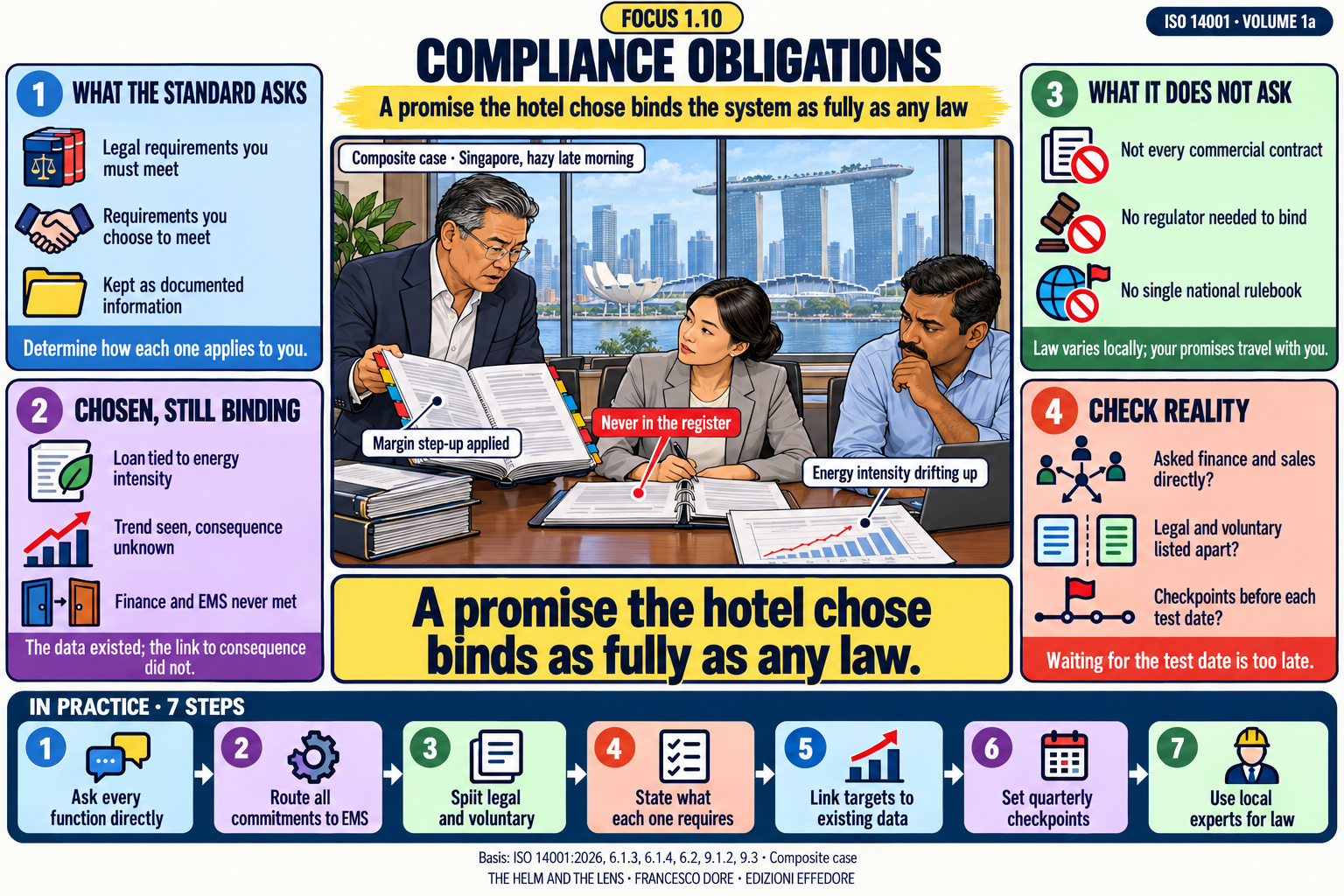
Slide 1.10
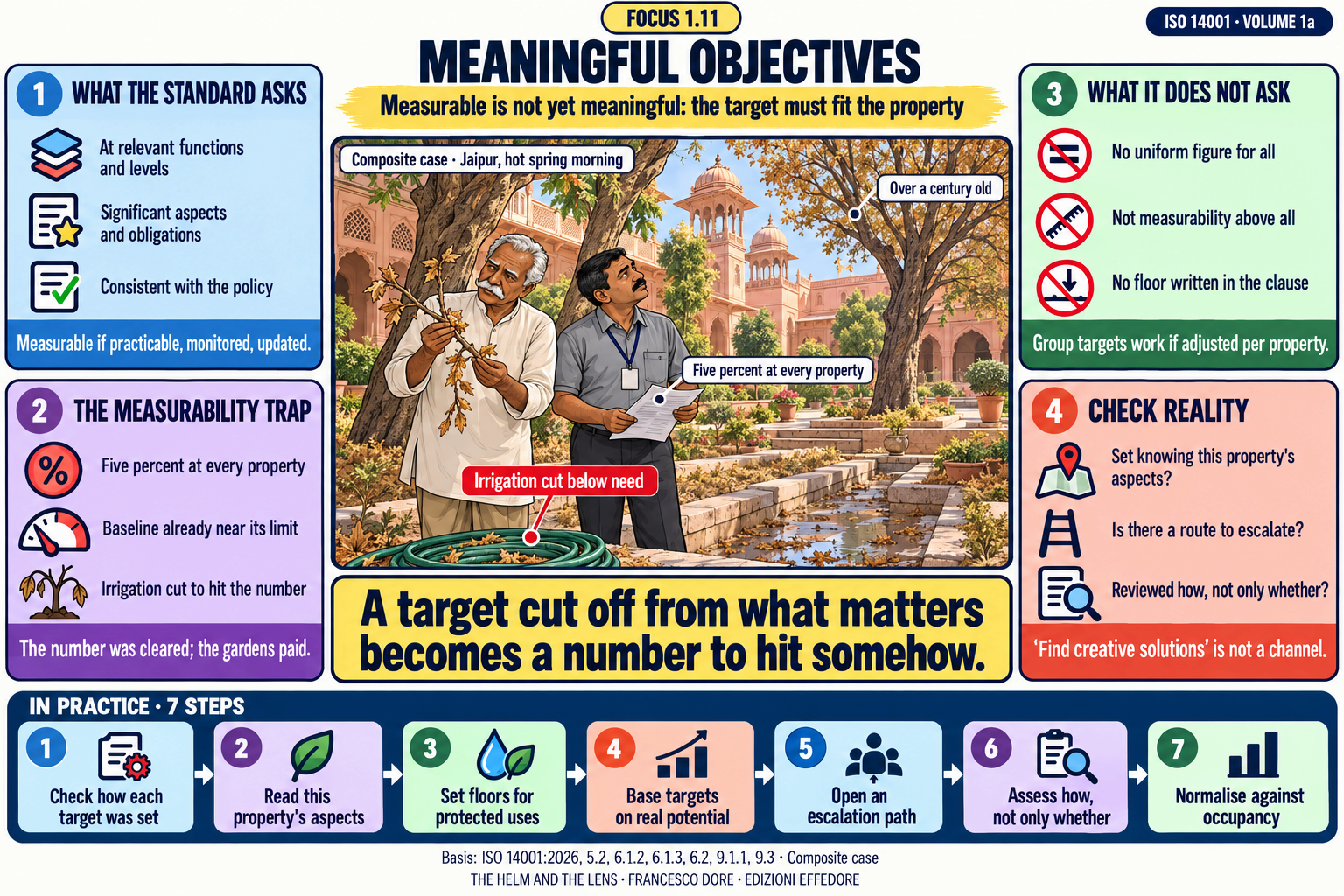
Slide 1.11
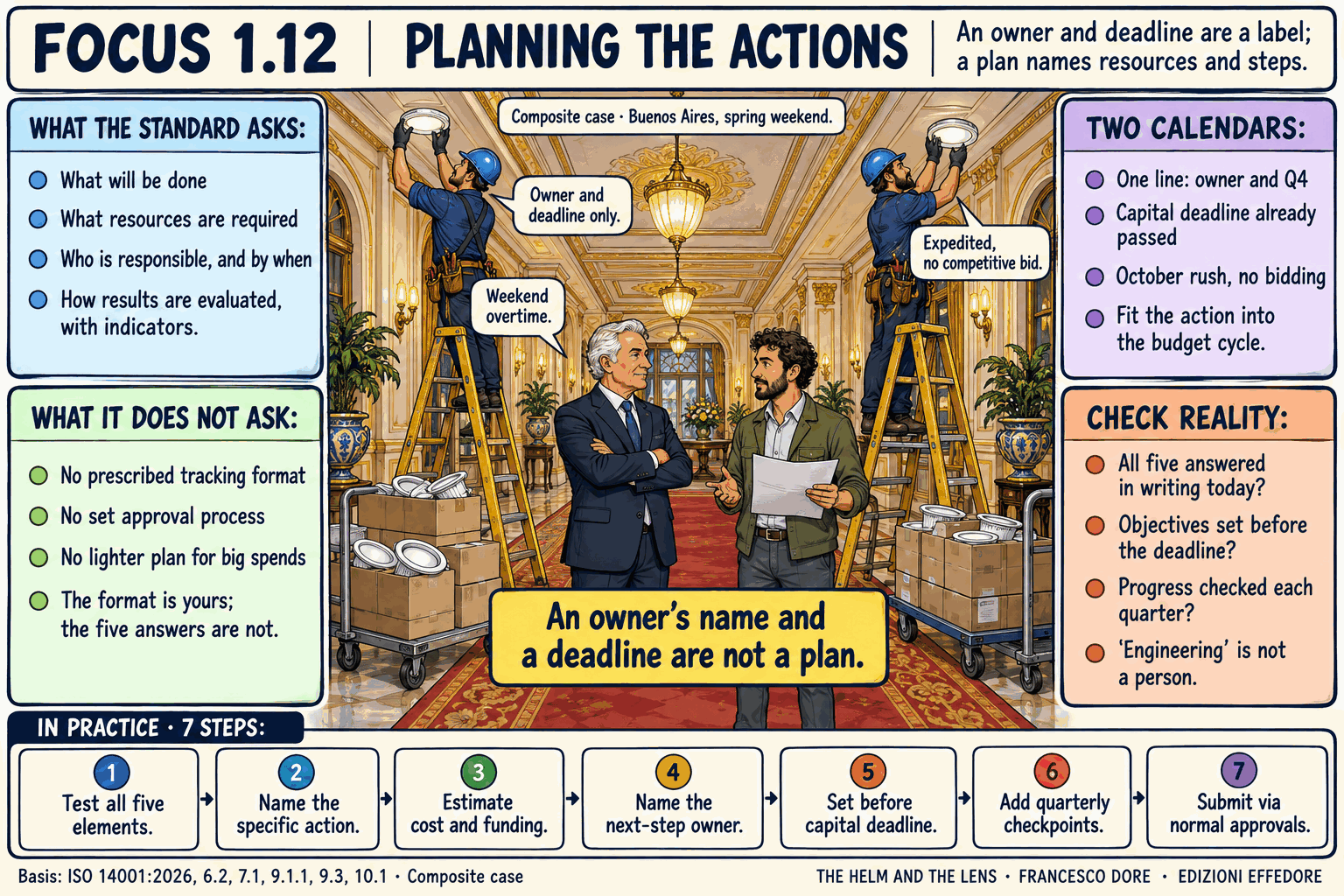
Slide 1.12
Slide 1.13
Immagini e tavole HD
Apri e proietta le foto direttamente dal sito, a schermo intero, oppure scarica gli originali.
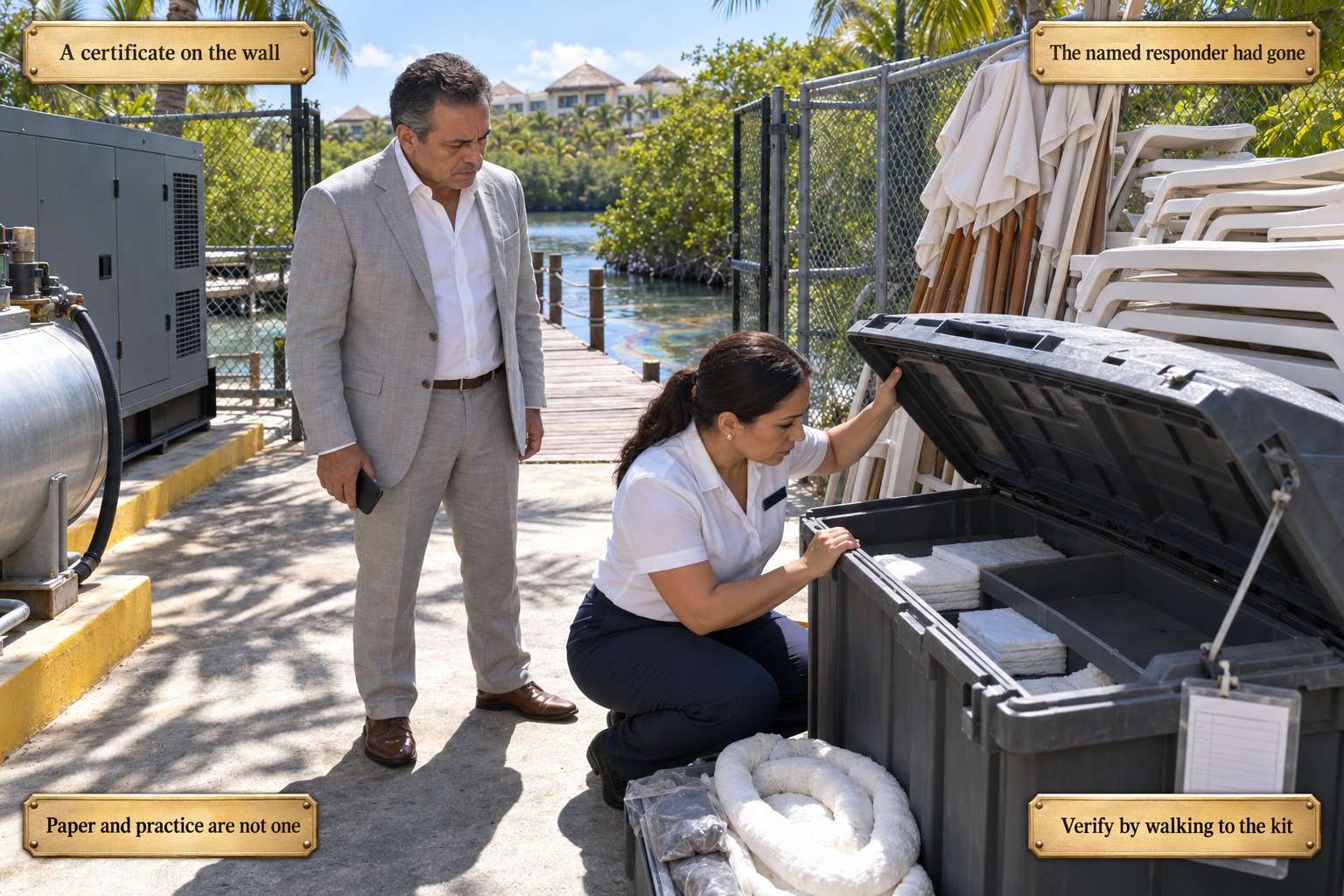
Concept Card 1.1 — Why an Environmental Management System, and Why Now
Setting: Cancún, Mexico
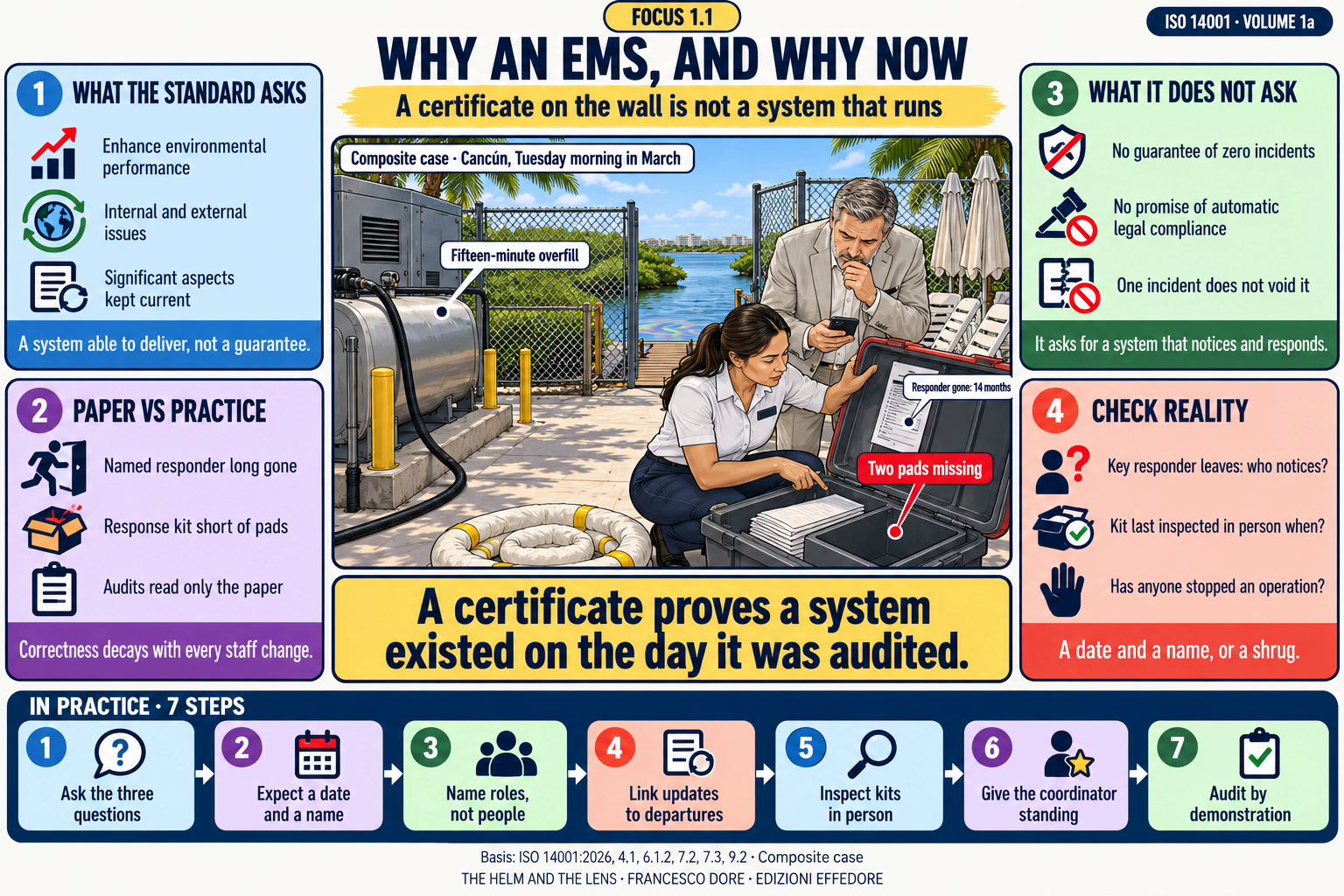
The picture shows the fenced generator compound of the lagoon-side resort in Cancún on a bright morning, palm shadows on the concrete. On the left stand a grey generator housing and a steel day tank with a black fuel hose; on the right, white pool loungers and folded parasols are stacked against the chain-link fence. Through the open gate a wooden boardwalk runs out between mangroves, and on the still water beside it spreads a rainbow sheen. In the foreground the environmental coordinator, about forty, dark ponytail, white blouse with a navy name badge, crouches at a large grey spill-response bin, holding its lid up: stacks of white absorbent pads, one compartment empty, a coiled boom on the ground beside it. Behind her the general manager, early fifties, greying hair, light grey linen suit, a phone held low, frowns into the bin.
The card shows the Tuesday morning in March when a fifteen-minute overfill of the day tank during a routine delivery has reached the mangrove reserve, and a guest's photographs of the sheen are already online. The aspects register named this risk, a procedure existed, a kit was listed and a responder was named. Now the paper meets the compound: the kit stood behind pool furniture awaiting refurbishment, two pads used on a kitchen spill had never been replaced, and the named responder had left fourteen months earlier. Six years of certification audits had sampled the register and the procedure, never the kit itself.
The plaques at the top give the event: A certificate on the wall, and The named responder had gone. The lower pair names the lesson. Paper and practice are not one: a documented system and a lived one are different objects, and only the second contains a spill. Verify by walking to the kit: whether the system works is established at the compound, through observation and drill, not at the desk where the procedure is filed.
The card does not say that the certificate was worthless or that the auditors were negligent: external audits sample, and a certificate rests on what was sampled. Nor does it blame the coordinator, who saw the gap and had no route to close it, or the contractor, who followed every step of the refuelling procedure but one. The system was one missing pad and one departed employee away from working as designed.

Concept Card 1.2 — Understanding the Organization and Its Context
Setting: Cape Town, South Africa
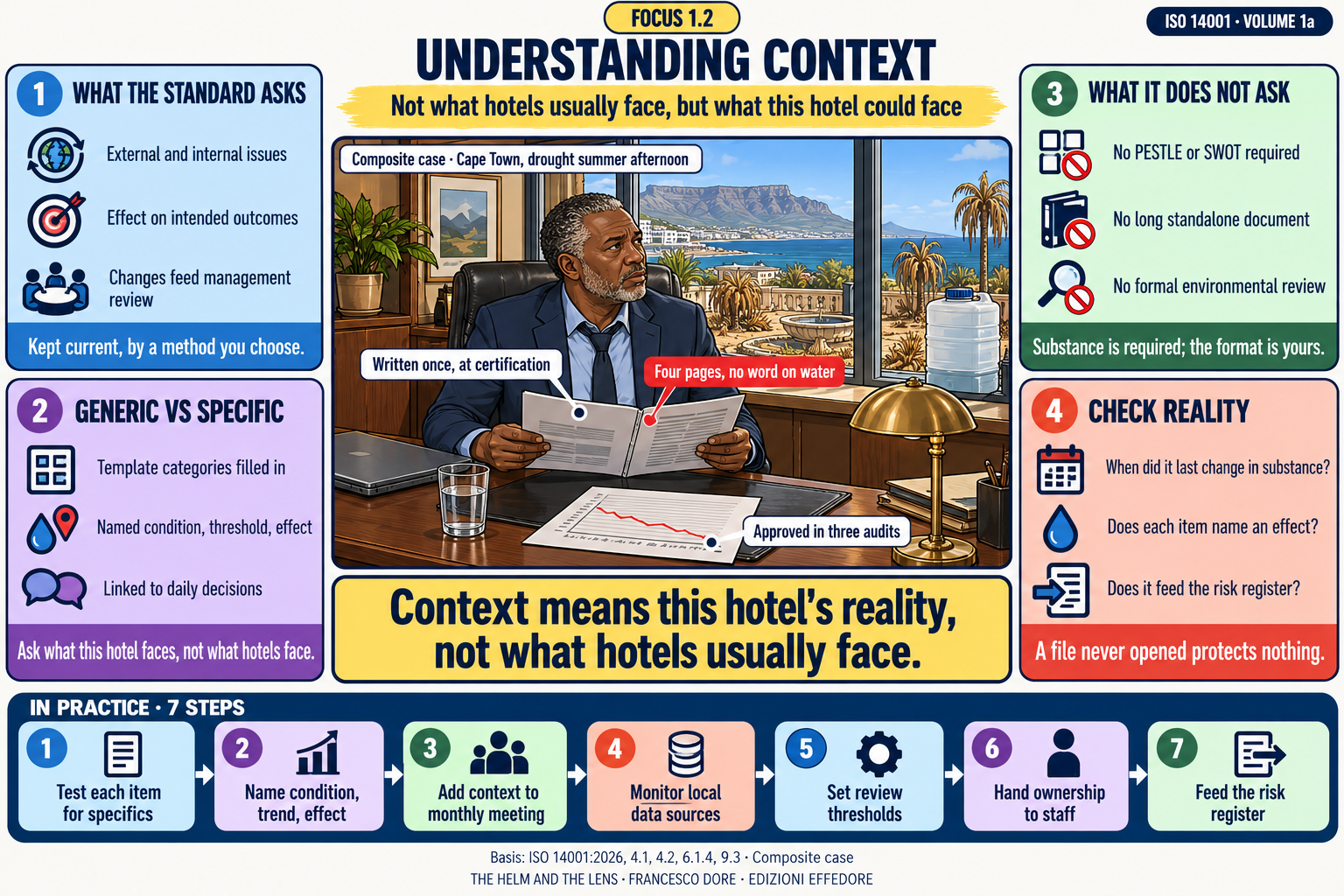
The picture shows the general manager's office of a large hotel on the Atlantic seaboard of Cape Town on a hot, dry summer afternoon, hard light falling across a dark leather-topped desk. Through the tall window lie the blue ocean, a bare brown headland and, below, a parched garden of palms and dry beds around a stone fountain that stands empty. On the window sill stands a large plastic water container without a label. The general manager, a Black South African of about fifty with close-cropped greying hair and a short grey beard, wearing a navy suit, light blue shirt and loosened dark tie, holds a thin stapled document open in both hands and has looked up from it towards the window, worried. On the desk lie a printed line graph sloping downwards, a half-full glass of water, a closed laptop and a brass lamp.
The card shows the drought year in which the city's water supply is heading towards what the authorities call Day Zero, and the general manager reads, for the first time with this crisis in mind, the context analysis on which the hotel's certified system rests. It is four pages long, written by a consultant at first certification, and lists currency volatility, competition, the labour market and climate change in general terms. It never mentions water. Nothing in it was careless; it was written once, from what a hotel's context usually contains, and never asked again what this hotel's context had become.
The plaques at the top give the event: Four pages, not a word on water, and The taps might run dry. The lower pair names the lesson. Context means this hotel's reality: the issues to determine are those of this property in this city, not a template of what hotels usually face. Ask what could change, and when: a context analysis earns its place only if it keeps asking which conditions could shift, and is revisited when they do.
The card does not say that the hotel needed a formal environmental review or a longer document: Annex A describes understanding context as a high-level, conceptual exercise, not a formal review. Nor does it say that the consultant should have foreseen this particular drought. Its point is that an analysis done once and filed becomes useless the moment conditions change beneath it.

Concept Card 1.3 — The Needs and Expectations of Interested Parties
Setting: Ubud, Bali
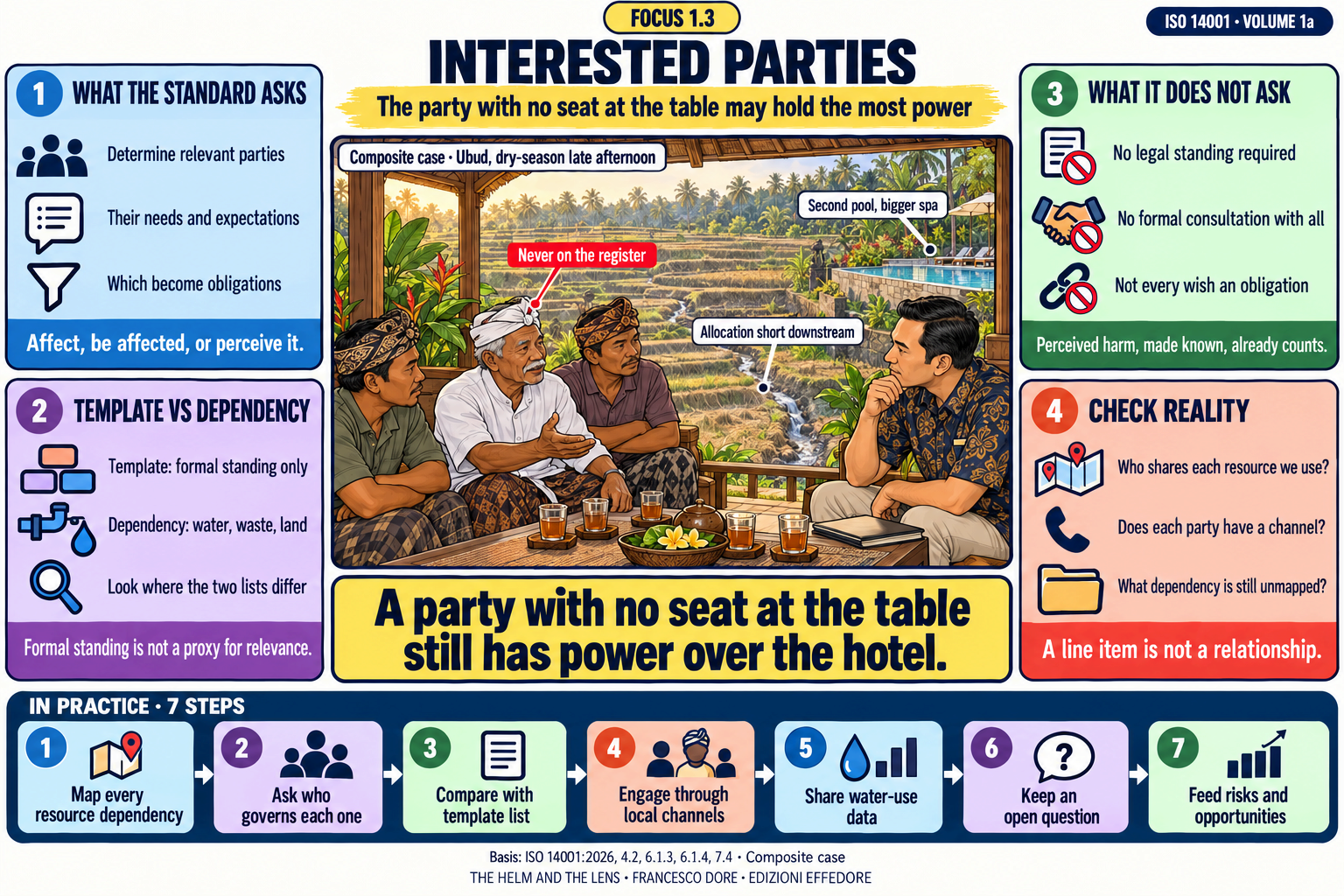
The picture shows an open-sided wooden pavilion at a small luxury resort above the rice terraces outside Ubud, in warm, low late-afternoon light. Beyond the pavilion the terraces fall away in steps, many of them dry and pale, a thin trickle in the channel between them; higher up on the right, behind palms, lies the edge of a turquoise pool. On the left sit three men of the subak: its head, about sixty-five, lean, grey moustache, white udeng headcloth, white shirt and chequered sarong, speaking calmly with an open hand stretched towards the terraces; beside him two farmers in patterned headcloths and plain shirts, one with arms folded. Opposite sits the general manager, about forty-five, short black hair, dark batik shirt and light trousers, leaning forward, a closed notebook under his hand. On the low table between them stands a tray of tea glasses.
The card shows the meeting the general manager did not schedule and had no template for. In the resort's second dry season after it opened a second pool and expanded its spa's water features, the subak's allocation downstream has fallen short for the first time in a generation. The connection is not proven, and a dry season alone could explain much of it, but the timing is impossible for the community to ignore. The resort has managed every party on its register well; the subak, the centuries-old association that governs irrigation for the terraces, was never on that register.
The plaques at the top give the event: The subak was never on the list, and A meeting with no template. The lower pair names the lesson. Ask whom the hotel depends on: the relevant interested parties include those with little formal standing and real power over whether the hotel can keep operating. Test the register against reality: a register built from a template must be checked against what this particular property actually depends on.
The card does not say that the resort caused the shortfall, or that every expectation of the subak becomes a compliance obligation: clause 4.2 asks the organisation to determine which needs and expectations it will comply with, while the rest still inform its risks and opportunities. Nor does clause 4.2 require formal consultation with every party identified.

Concept Card 1.4 — Defining the Scope of the Management System
Setting: Split, Croatia
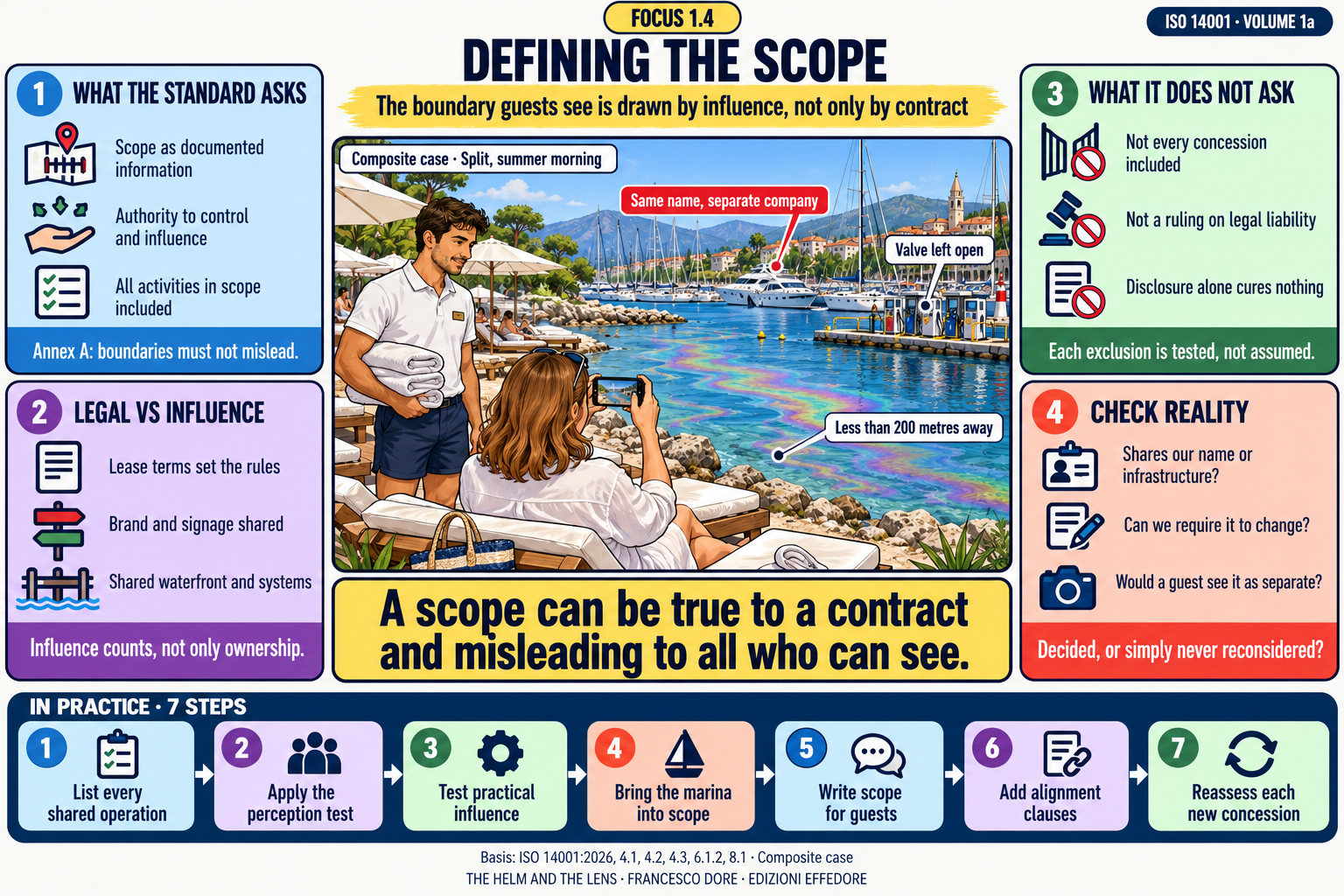
The picture shows the beach club of a resort on the Dalmatian coast near Split on a bright summer morning: rows of white-cushioned teak sunbeds and white parasols along a rocky shore, calm turquoise water in a sheltered bay. Across the bay lie a marina with sailing yachts and motor boats at their berths and a fuel dock with pumps. A broad rainbow sheen spreads from the marina towards the beach. In the foreground a guest, seen from behind, with shoulder-length light brown hair, sunglasses pushed up on her head and a white linen shirt, sits up on her sunbed and photographs the sheen with her phone. Beside her stands a beach club attendant, about twenty-five, short dark hair, white polo shirt and navy shorts, a stack of folded white towels on his arm, looking out over the water.
The card shows the moment, in the resort's fourth season, when a valve left open during routine refuelling at the marina's fuel dock has released diesel into the bay the beach club fronts. The marina carries the resort's name and signage and is bookable through its reservation system, but it is run by a separate concessionaire under a long-term lease, and the resort's scope statement leaves it out. The photograph will travel under the resort's name; the concessionaire's statement on corporate separation will change nothing about whose spill the public thinks it is.
The plaques at the top give the event: One waterfront, one name, and Diesel in the beach club bay. The lower pair names the lesson. Scope reaches what you influence: clause 4.3 asks the organisation to consider its authority and ability to influence, not only its legal control, and the resort influences the marina through lease, brand and shared infrastructure. Boundaries must not mislead: a scope that is legally accurate but gives guests a false impression of what is covered sits in tension with the guidance in Annex A.
The card does not say that every concession automatically falls inside a hotel's scope, or that the resort rather than the concessionaire was answerable in law for the release. Nor does it say that disclosing an exclusion cures it. It says that a scope drawn only along corporate lines, at a shared waterfront under one name, left out what clause 4.3 asks the organisation to consider.
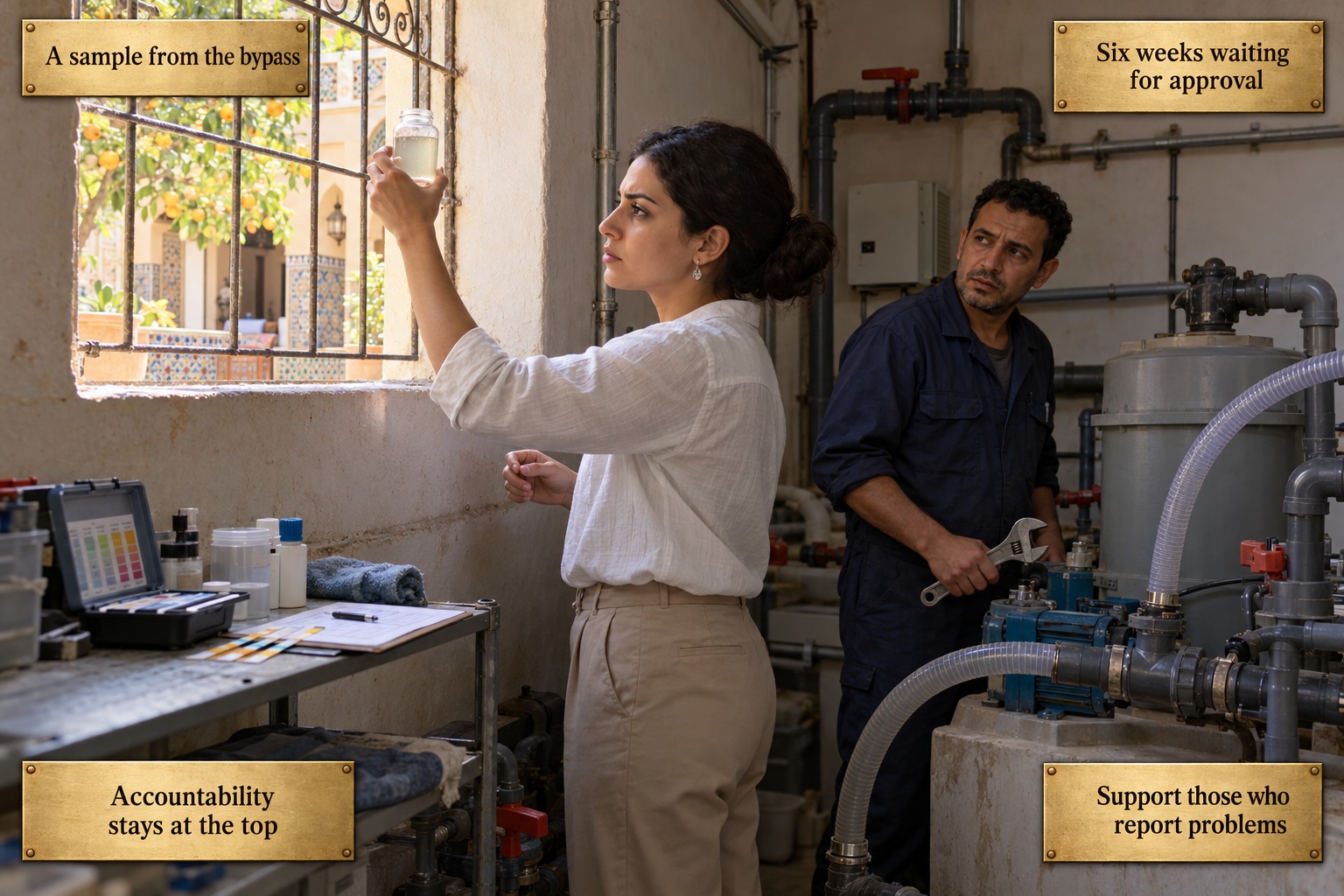
Concept Card 1.5 — Leadership and Commitment from the Top
Setting: Marrakech, Morocco
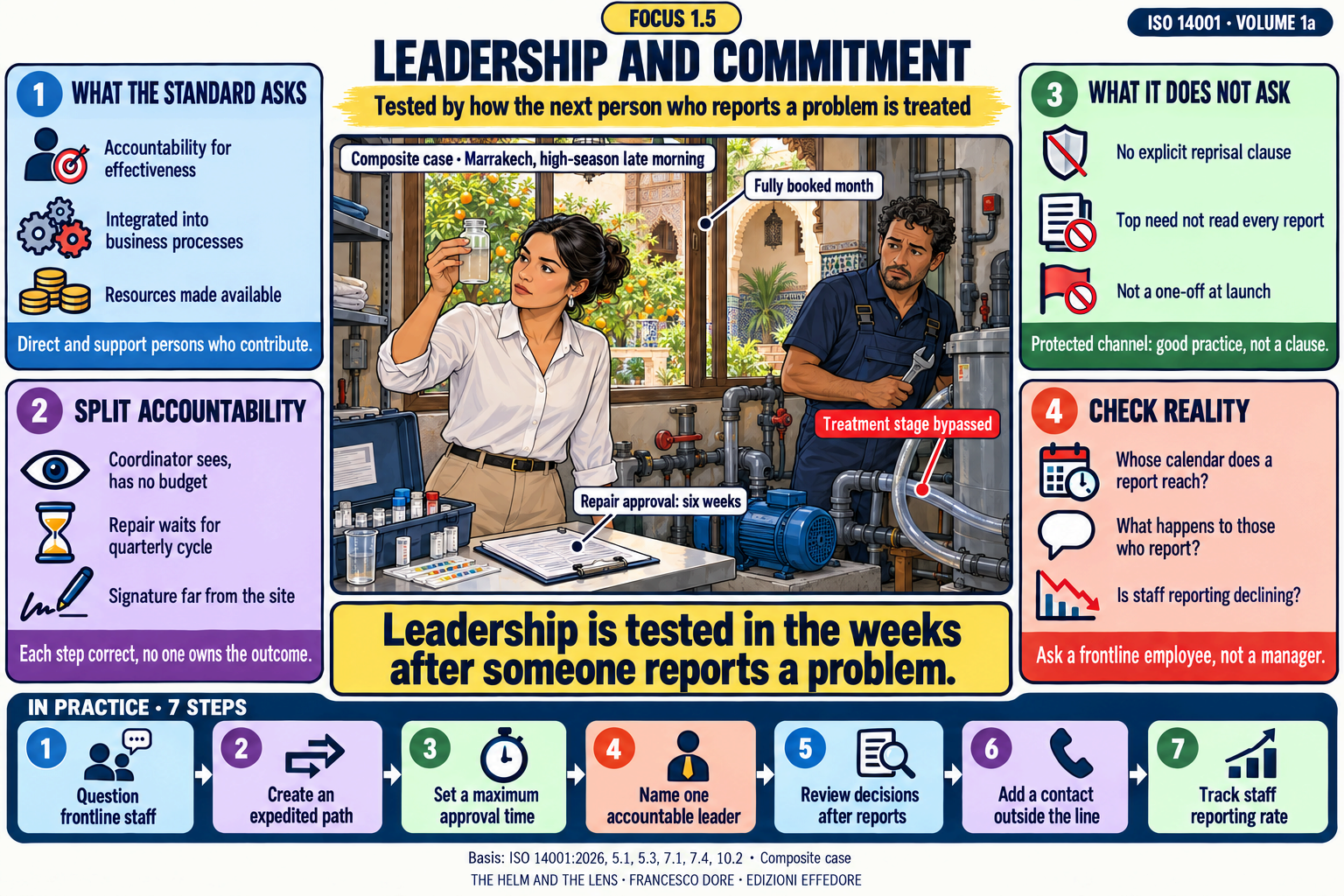
The picture shows the small technical room of a riad-style hotel in Marrakech in late-morning light. Through a grilled window set in the rough plastered wall lies a sunlit courtyard with orange trees, zellige tiles and a carved arcade. Inside, grey pipes and valves, a blue pump unit, a grey treatment tank and clear flexible hoses fill the room; on a steel shelf by the window lie an open water-testing kit, test strips and a clipboard with a form. The sustainability coordinator, about thirty, dark hair pinned up, small silver earrings, white long-sleeved blouse and beige trousers, holds a small glass bottle of cloudy water up to the window and studies it, serious and focused. Behind her, by the pump, stands a maintenance technician of about forty, dark curly hair, stubble, navy overalls, an adjustable spanner in his hand, glancing towards her uneasily and saying nothing.
The card shows the high-season morning when the coordinator's routine water-quality check reveals that the greywater treatment stage has been bypassed: after a pump failure, maintenance has been discharging partially treated water rather than closing a wing for repairs in a fully booked month. She will report it exactly as the procedure requires, to the general manager and the regional office. The repair, a modest sum, will wait six weeks for a quarterly capital review, and in the meantime her working hours will be quietly reduced.
The plaques at the top give the event: A sample from the bypass, and Six weeks waiting for approval. The lower pair names the lesson. Accountability stays at the top: clause 5.1 reserves accountability for the system's effectiveness to top management, even when daily operation is delegated to a coordinator without a budget. Support those who report problems: how the organisation treats the person who reports a problem is the practical test of leadership's duty to direct and support people.
The card does not say that ISO 14001 contains an explicit requirement to protect people from reprisal for reporting; that wording belongs to ISO 45001, and in ISO 14001 the duty flows from accountability, resources and support. Nor does it make a villain of the general manager, who escalated as required, or expect top management to review every incident report personally.

Concept Card 1.6 — The Environmental Policy as a Public Commitment
Setting: the Maldives
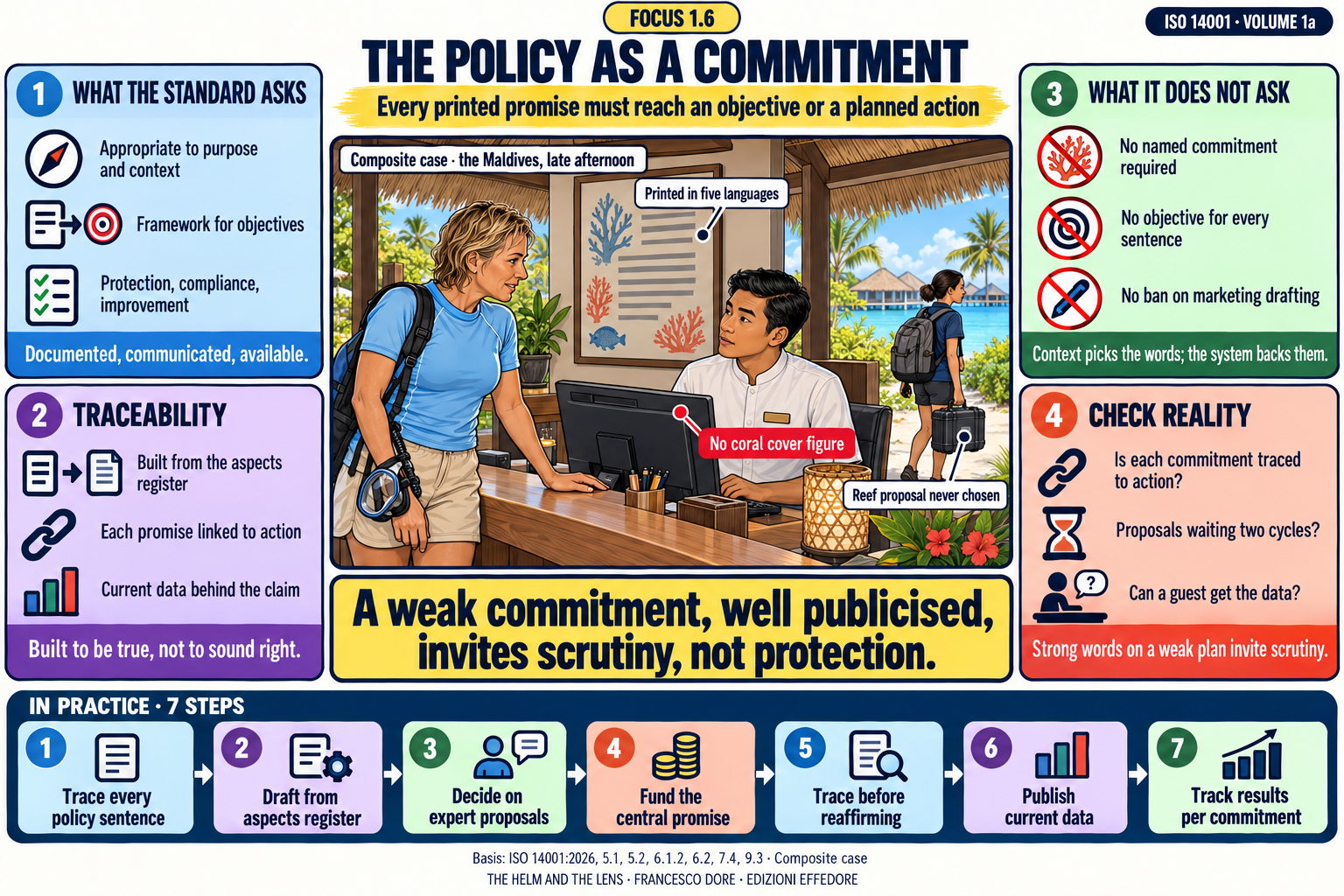
The picture shows the open-air reception pavilion of a small private-island resort in the Maldives in soft late-afternoon light: a thatched roof on dark timber beams, a long counter of pale wood, and beyond the open side white sand, palms and a turquoise lagoon. On the wall behind the desk hangs a large framed text with coral drawings, the environmental policy. A guest of about forty-five, just back from a dive, with damp short sandy hair, a light blue rash vest, beige shorts and a dive mask hanging from her wrist, stands at the counter, one hand resting on it, looking expectantly at the front office agent. He, about twenty-eight, short black hair, white mandarin-collar shirt, sits behind a computer screen and looks up at her with no answer. On the sand path behind, the marine biologist walks past with a backpack and a small hard case, not looking.
The card shows the moment a diving guest with a background in marine science asks the front office for the resort's coral cover data, the figure the policy on the wall implies the resort tracks. The policy, drafted by a marketing agency and printed in five languages in every villa's welcome folder, promises to protect coral reef ecosystems. The marine biologist the resort employs proposed a coral cover target, a nutrient threshold for the outfall and a bleaching-response protocol; her proposal was filed as a future consideration and never chosen, while energy and waste objectives were adopted. No one can produce the figure.
The plaques at the top give the event: A promise in five languages, and No coral figure to show. The lower pair names the lesson. A promise needs a plan: a commitment in the policy must be carried into objectives, controls or planned actions, or the policy is not working as the framework clause 5.2 requires. Fund what the policy says: the policy's central promise needs resources and a monitored objective, not only well-written words.
The card does not say that the energy and waste objectives were worthless; they are genuine targets, only disconnected from the promise. Nor does it suggest rewriting the policy so that it promises less: that may reduce exposure, but it moves further from what clause 5.2 asks. The gap it shows lies between what the policy says and what the system resources.
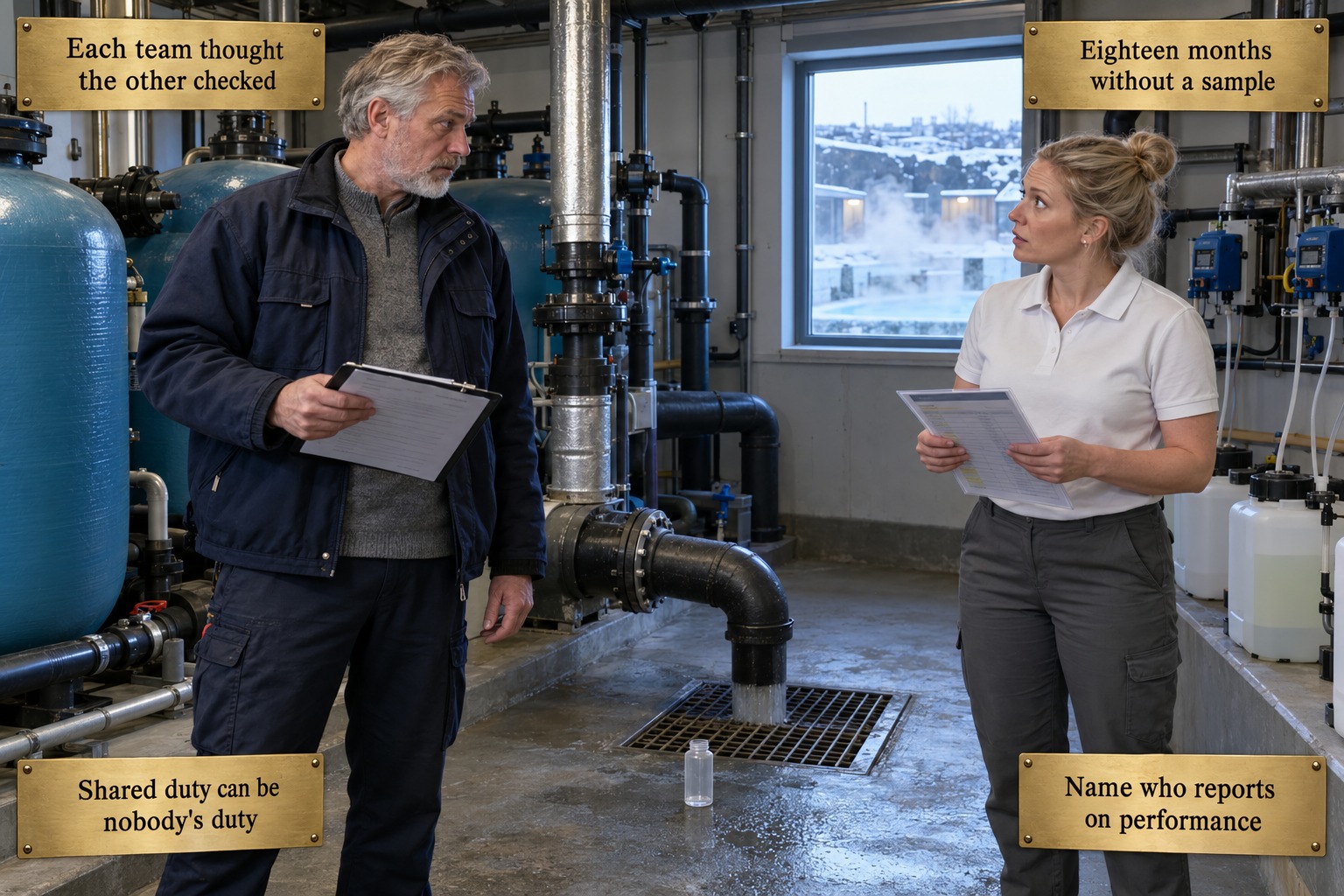
Concept Card 1.7 — Roles, Responsibilities, and Authorities
Setting: Reykjavik, Iceland
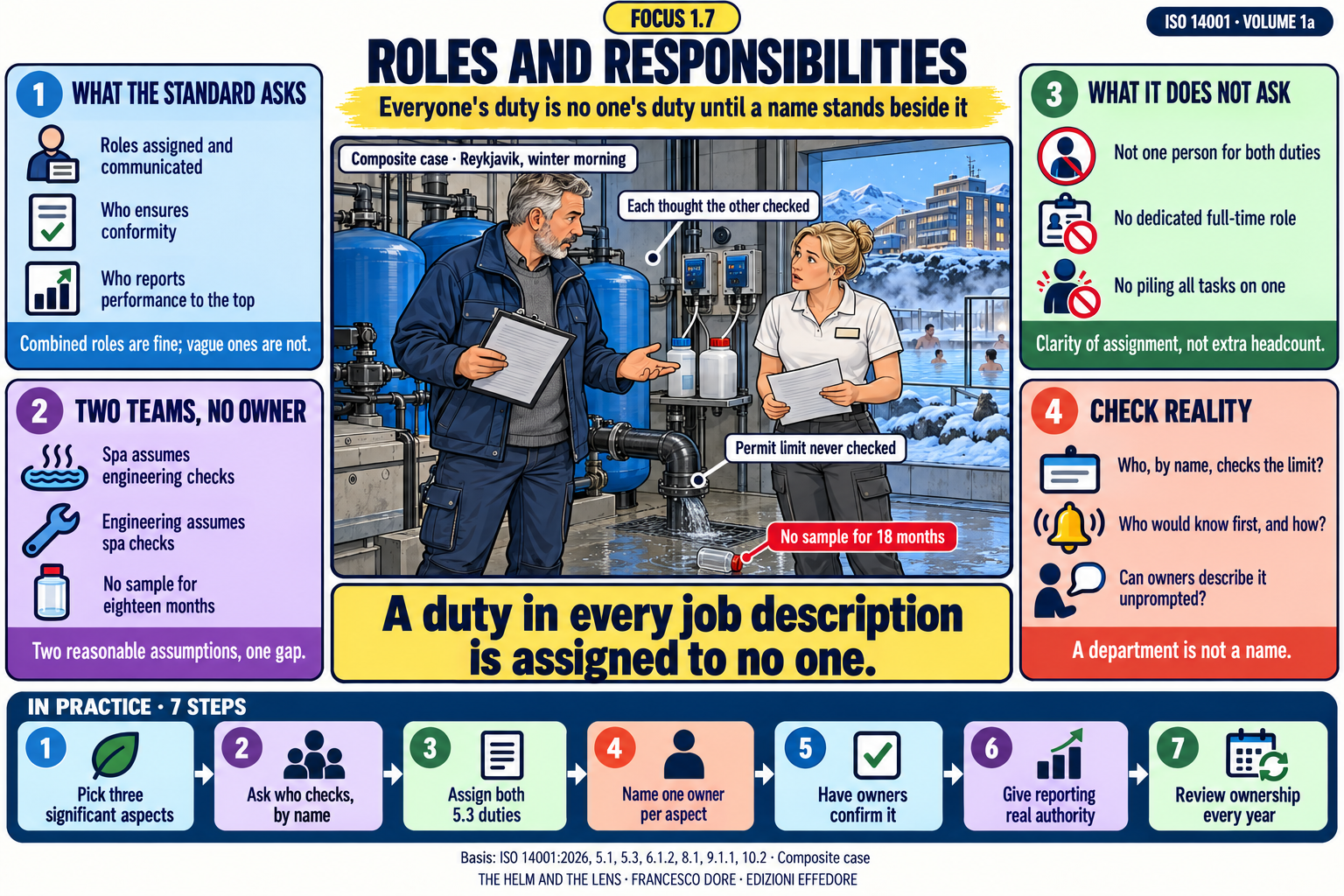
The picture shows the plant room behind the thermal spa of a large city hotel in Reykjavik on a winter morning, cold blue light through a window onto snow and the steaming outdoor pool. Inside stand blue filter tanks, wall-mounted dosing pumps with white chemical containers, and a black backwash discharge pipe running down into a floor grate, where water is flowing out. To the left of the pipe stands the chief engineer, about fifty-five, tall, grey hair and short grey beard, dark blue work jacket over a grey jumper, a clipboard in his hand; to the right the spa operations supervisor, about thirty-five, blonde hair in a bun, white polo shirt and grey trousers, holding her treatment protocol. They have looked up from their papers at each other, he questioning, she surprised. On the wet floor between them stands an empty sample bottle.
The card shows the moment the hotel discovers that for eighteen months no one has checked the spa's backwash discharge against the limits in its discharge permit. The spa team, following the manufacturer's treatment protocol, assumed engineering monitored what left the building; engineering, whose checklist had never been updated to include the backwash, assumed the spa team did. Each assumption was reasonable; together they meant no one checked. Every job description in the hotel says that every employee shares responsibility for environmental performance.
The plaques at the top give the event: Each team thought the other checked, and Eighteen months without a sample. The lower pair names the lesson. Shared duty can be nobody's duty: a responsibility written into every job description in general terms belongs to no one in the specific sense the standard requires. Name who reports on performance: clause 5.3 asks top management to assign, specifically, the responsibility for ensuring conformity and for reporting on the system's performance.
The card does not say that both responsibilities must sit with a single person or a full-time role; a smaller property may combine them with an existing position. Nor does it argue for loading every environmental task onto one overloaded individual. And it does not blame either team: their documents simply never met in the middle.

Concept Card 1.8 — Actions to Address Risks and Opportunities
Setting: New Orleans, USA
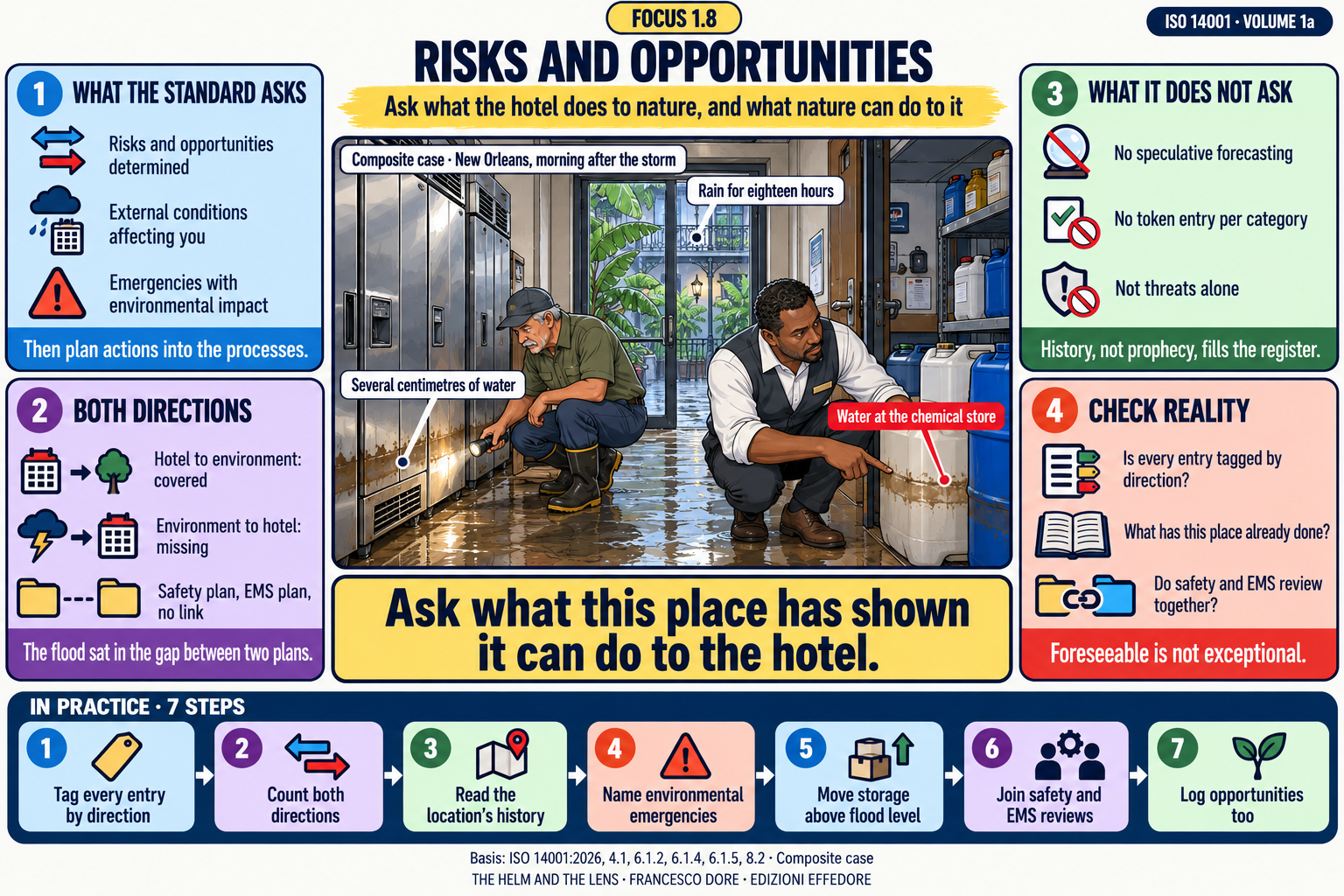
The picture shows the ground-floor service corridor of a small boutique hotel in a restored nineteenth-century house in New Orleans's Garden District on the grey, humid morning after the storm. The stone floor still glistens; at the end of the corridor a glazed door opens onto a courtyard with banana leaves and a wrought-iron balcony. On the left, steel refrigeration units carry a brown tide mark along their base; on the right, the chemical storeroom door stands open on white and blue plastic drums, on the floor and on shelves, ringed with the same dirty water mark. The hotel manager, about forty-eight, African American, white shirt with rolled sleeves, crouches at the door and points to the mark on a drum. Behind him the maintenance technician, about fifty-five, grey moustache, cap, olive work shirt and rubber boots, bends to shine a torch along the base of the refrigeration units.
The card shows the morning after a tropical storm, well short of hurricane strength, stalled over the city for eighteen hours. Street flooding has reached the ground floor by several centimetres: the backup generator's fuel storage, the room holding pool and cleaning chemicals, the base of two kitchen refrigeration units. The risks and opportunities register, a serious piece of work, lists everything the hotel might do to its environment and nothing the environment might do to the hotel. The environmental system has no procedure for any of this; the flood sat in the gap between the safety plan and the environmental plan.
The plaques at the top give the event: Rain for eighteen hours, and Water at the chemical store. The lower pair names the lesson. Ask what nature can do to you: risks and opportunities are determined with the external conditions of clause 4.1 in view, including conditions capable of affecting the hotel itself. Foreseeable is not exceptional: a routine seasonal storm, recorded every two or three years in the property's own insurance history, belongs in the register.
The card does not say that the hotel neglected flood safety: every member of staff knew the evacuation plan. Nor does it suggest that insurance answers the risk; insurance compensates for damage but neither keeps water from the chemical store nor satisfies the requirement to determine and plan for the risk. And it does not reduce clause 6.1.4 to threats: opportunities belong in the register too.
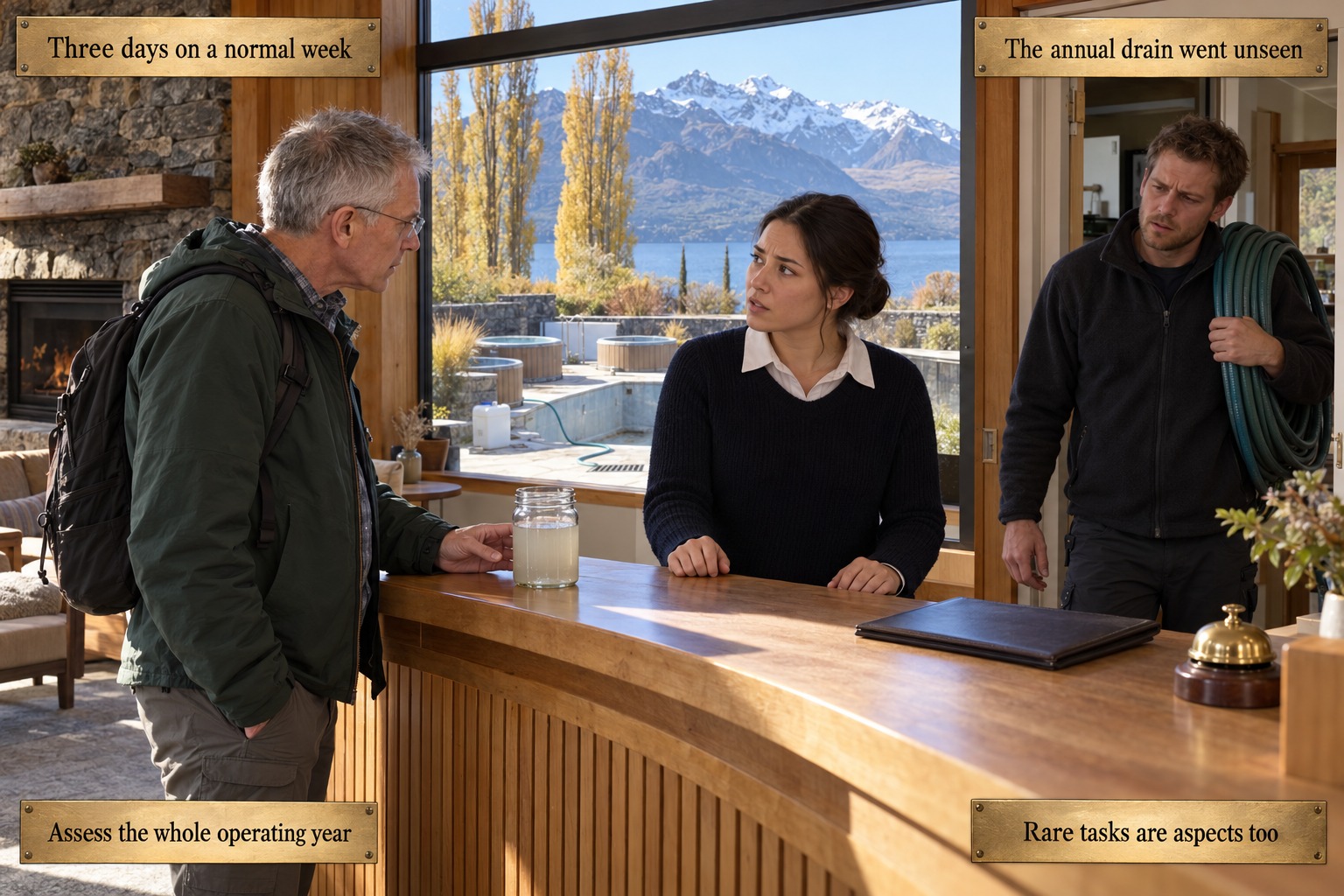
Concept Card 1.9 — Identifying Environmental Aspects and Impacts
Setting: Queenstown, New Zealand
The picture shows the reception hall of a forty-room lodge on the shore of Lake Wakatipu outside Queenstown on a clear late-autumn morning in the low season: warm timber, a stone fireplace with a fire burning, a curved front desk with a closed register and a brass bell. Through the large window behind the desk lie golden poplars, the clear lake and mountains with snow on their summits; just outside, the drained pool and empty hot tubs, a hose running to a drainage grate. At the desk stands a guest of about sixty, grey hair, rimless glasses, green outdoor jacket and backpack, one hand beside a glass jar of milky water. The receptionist, about thirty, navy pullover over a white collar, glances uncertainly towards the doorway, where a maintenance worker of about thirty-five, in a dark fleece, has stopped with a coiled green hose over his shoulder.
The card shows the low-occupancy week of the lodge's annual full drain and refill of its outdoor pool and three hot tubs. The concentrated cleaning and descaling solution has gone out in a single large discharge, by the same route as the routine backwash, towards a soakaway near the lake's watershed, under a procedure older than the management system. A guest, a hydrologist visiting the region, has recognised the runoff by its colour and smell and asks what no one on shift can answer: what is in this, and where is it certified to go? The aspects register was built from a three-day walk through a normal week.
The plaques at the top give the event: Three days on a normal week, and The annual drain went unseen. The lower pair names the lesson. Assess the whole operating year: aspects identification must reach abnormal conditions and reasonably foreseeable emergencies, which a normal-week walkthrough cannot capture by construction. Rare tasks are aspects too: an annual or periodic activity is within scope and may be among the most significant precisely because of its concentration and scale.
The card does not say that the consultant's three-day walkthrough was careless; it is close to the industry default, and its limitation is structural, not personal. Nor does it allow a procedure older than the management system to escape assessment, or call for a detailed life cycle assessment, which Annex A states is not required.

Concept Card 1.10 — Determining Compliance Obligations Without a Single Rulebook
Setting: Singapore
The picture shows a meeting room high in a large business hotel in Singapore's Marina Bay district on a hazy late morning. Through floor-to-ceiling glass lie the bay and the district's towers. At the table are three people. On the left stands the ownership group's finance director, about fifty-five, Chinese Singaporean, greying black hair, rimless glasses, dark navy suit and open white shirt, holding the thick loan agreement open at its coloured tabs and looking sternly across. On the right stands the director of facilities, about forty-five, Indian Singaporean, short black hair, moustache, light blue shirt, leaning on the table beside a printed utility report with a rising line graph, uneasy. Between them sits the director of compliance, about forty, dark hair in a low bun, light grey blazer, pen in hand over an open ring binder, looking up at the finance director.
The card shows the meeting after the loan's annual covenant test. The hotel was financed through a sustainability-linked loan whose interest margin depends on a defined yearly reduction in energy intensity per guest night. After a spa expansion and a new restaurant outlet, that figure has drifted upwards for two years, visible in the monthly utility reports facilities circulated as a cost concern. Independent verification confirms the miss, and the margin step-up applies to the whole outstanding balance. The compliance obligations register, built entirely from statute, never listed the covenant.
The plaques at the top give the event: The covenant was never listed, and A number nobody watched. The lower pair names the lesson. Agreements can be obligations too: under clause 6.1.3, requirements the organisation has chosen to comply with bind its system as fully as legal ones. Connect the data to consequence: the information existed in the building; what was missing was the link between the metric and what it triggered.
The card does not turn every commercial contract into a compliance obligation, nor treat a loan agreement as environmental law. It concerns a commitment with environmental content that the organisation has chosen to accept, here written into its financing, which belongs in the register beside statute. Nor does it blame the facilities team, who tracked the trend throughout and were never told what it triggered.
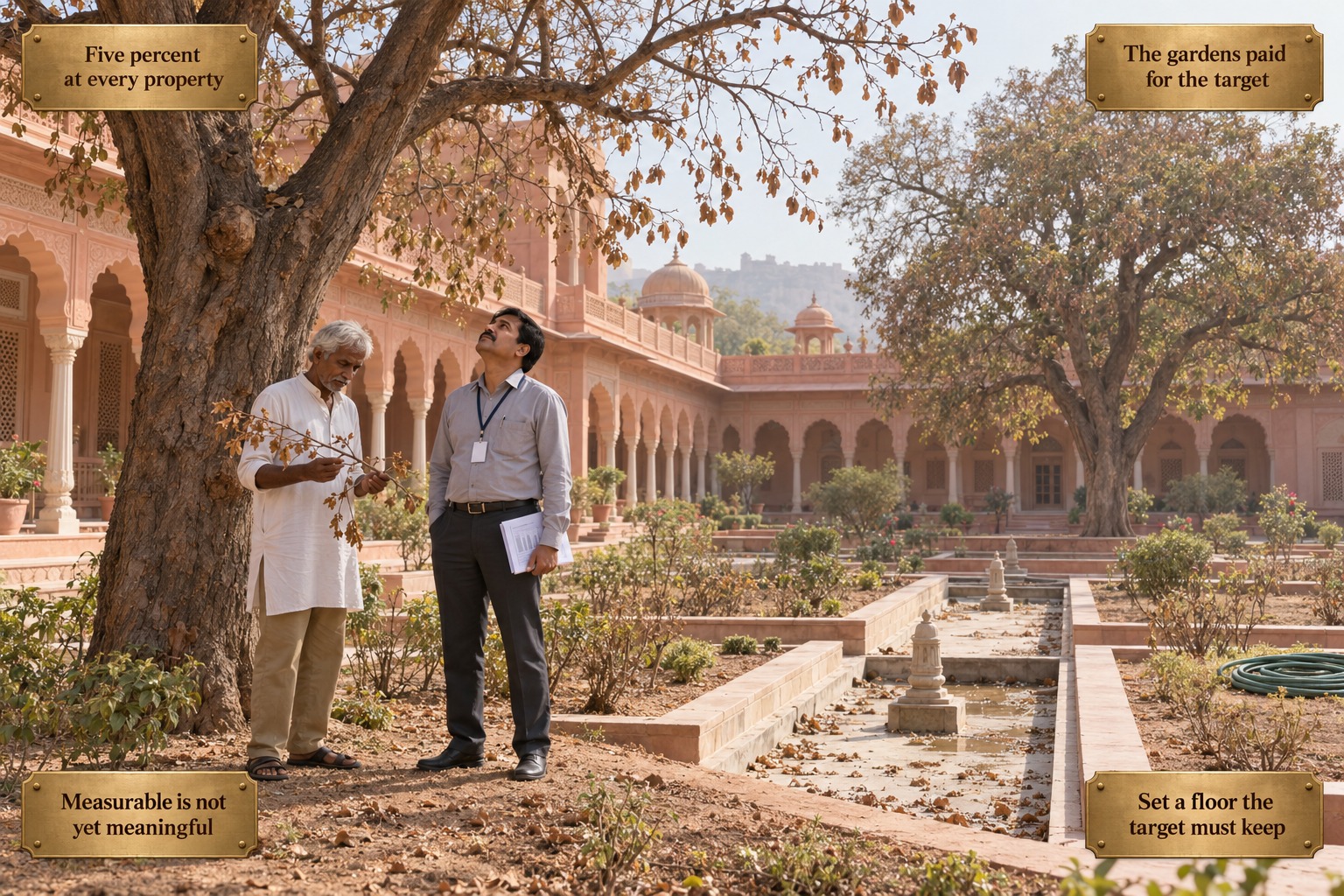
Concept Card 1.11 — Setting Environmental Objectives That Mean Something
Setting: Jaipur, India
The picture shows the courtyard garden of a restored eighteenth-century palace hotel on the edge of Jaipur on a hot, hazy spring morning, pale dusty light on rose-pink sandstone arcades, domed pavilions and lattice windows. A formal stone water channel runs through the garden, nearly dry, only shallow puddles left among fallen leaves; the beds around it are dusty, and a green hose lies coiled and unused. Two great old shade trees stand with thinned, browning crowns. Beneath the nearer one stand the head gardener, about sixty, lean, white hair and moustache, white kurta, khaki trousers and sandals, holding a dry, brittle branch and looking at it, and the facilities manager, about forty-five, short black hair and moustache, grey shirt and dark trousers, a lanyard with a blank badge, a folded report in his hand, looking up into the crown.
The card shows the spring after the group's headquarters set a single target for its forty properties: reduce water consumption by five percent a year at every one. Jaipur had captured most of its savings years earlier through greywater recycling, and there was nowhere left to find five percent. The facilities manager, whose assessment depended on the figure and who had raised its feasibility only to be told to find creative solutions, cut irrigation to the historic gardens. The target was cleared comfortably. Several of the oldest trees show stress, and two, planted over a century ago, do not recover.
The plaques at the top give the event: Five percent at every property, and The gardens paid for the target. The lower pair names the lesson. Measurable is not yet meaningful: clause 6.2.1 asks that objectives take the property's own significant aspects into account and be consistent with its policy; measurability serves that aim and does not replace it. Set a floor the target must keep: a protected level for heritage and essential uses, documented before any reduction target is set, keeps the trade-off from being made under pressure.
The card does not say that measurable targets are wrong or that group-wide reporting has no value; a single figure genuinely simplifies portfolio reporting. The floor is good practice this volume recommends, not a requirement written into the standard. Nor does the card make a villain of the facilities manager, who raised the problem and found no escalation path.
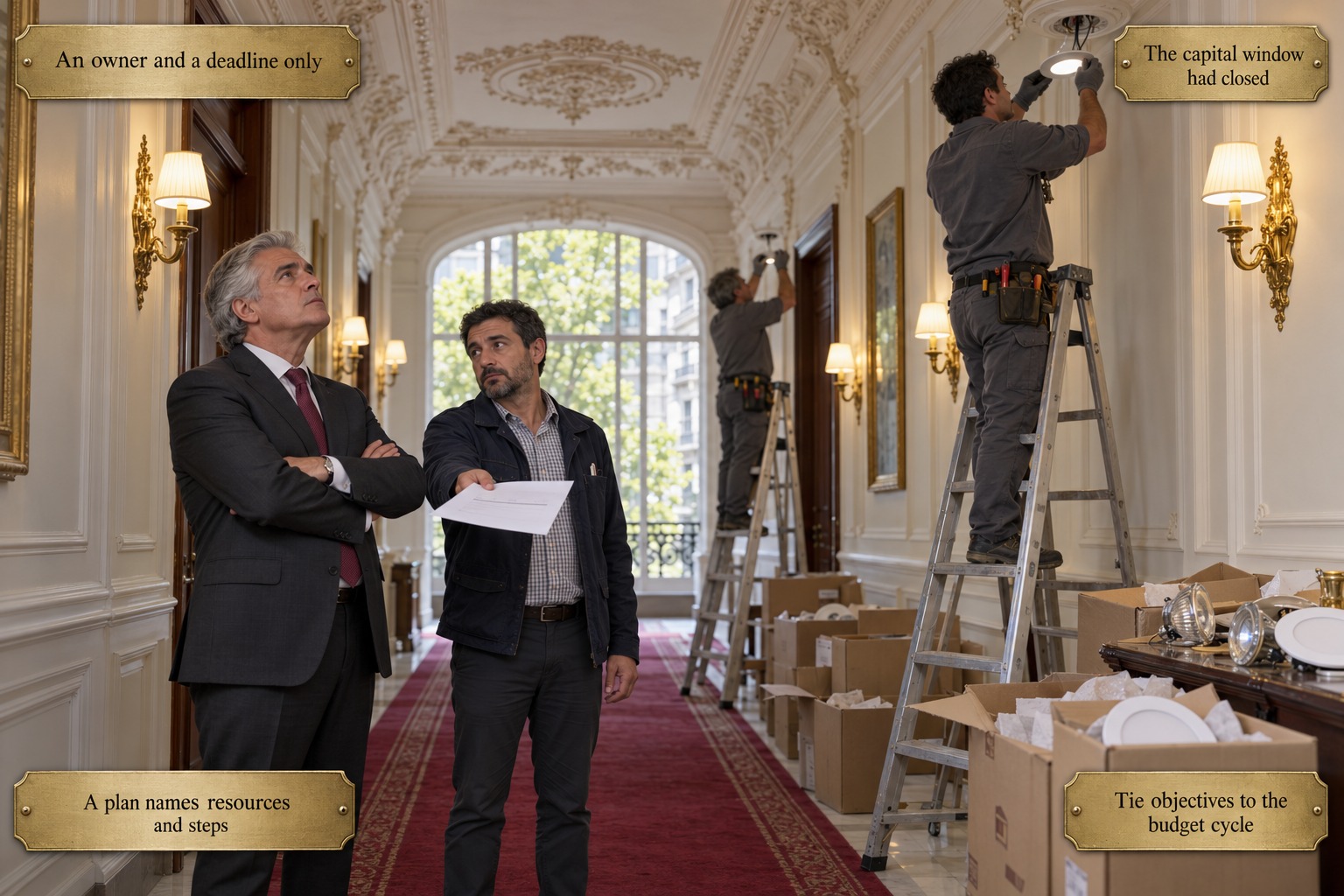
Concept Card 1.12 — Planning Actions to Achieve the Objectives
Setting: Buenos Aires, Argentina
The picture shows the long first-floor corridor of a grand nineteenth-century hotel in the Recoleta district of Buenos Aires on a quiet spring morning: an ornate white plaster ceiling, gilt-framed paintings, brass wall sconces with cream shades, a red carpet runner, and at the far end a tall arched window onto green plane trees and the façades opposite. Two electricians in grey work clothes stand on aluminium stepladders fitting new LED downlights into the ceiling; open cardboard boxes of new fittings and removed old fixtures line the wall. In the middle of the corridor stands the general manager, about sixty, silver hair combed back, charcoal suit, white shirt and burgundy tie, arms crossed, looking up at the ladders, tense. Beside him the chief engineer, about forty-five, short dark hair and beard, navy jacket over a checked shirt, holds out a single sheet of paper and looks at him, resigned.
The card shows a weekend late in the year. In January the hotel adopted a sound objective: an eight percent reduction in energy intensity per guest night, aimed at its ageing halogen and incandescent lighting. Its plan read, in full: reduce energy intensity 8% by year-end, owner Engineering, target Q4. No project, no budget, no milestone, and no link to the capital calendar, whose submission deadline had passed before the objective was adopted. By October the data showed almost no movement, and the general manager authorised an emergency partial retrofit: expedited shipping, weekend overtime, no competitive bidding.
The plaques at the top give the event: An owner and a deadline only, and The capital window had closed. The lower pair names the lesson. A plan names resources and steps: clause 6.2.2 asks what will be done, what resources are needed, who is responsible, when it will be complete and how results will be evaluated. Tie objectives to the budget cycle: the clause also asks the organisation to consider how the actions fit its business processes, and here that meant the capital calendar.
The card does not say that the objective was badly chosen; it fully satisfied clause 6.2.1. Nor does it accuse engineering of inaction: the team refined the specification, gathered quotes and raised the project twice. The five-field tracking sheet the subchapter proposes is a practical format, not one the standard prescribes.

Concept Card 1.13 — The Life Cycle Perspective in a Hotel
Setting: Bangkok, Thailand
The picture shows the back-of-house waste room by the loading dock of a large business hotel in central Bangkok on a hot, hazy late morning: white-tiled walls, green, blue, yellow and brown bins, clear bags of sorted bottles and tied bundles of paper along the wall. Through the open roller door lie the loading bay, the rear of a collection truck being loaded with mixed bags and two porters by a cart. On a stainless steel table lie a white hard hat, a folded high-visibility vest and four printed photographs of a single mixed heap of clear bags, paper and black bags. The sustainability coordinator, about thirty, shoulder-length black hair, light blue blouse, dark trousers, staff badge, a notebook held to her chest, lays down the last photograph. Beside her the hauler's site supervisor, about fifty-five, greying hair, high-visibility vest over a grey shirt, looks down at his clipboard.
The card shows the coordinator back from the transfer station where the hotel's waste is taken. For three years the hotel has reported a diversion rate of about seventy percent, and has cited it in a major corporate client's procurement questionnaire. She has found that one of the hauler's two collection routes, constrained by vehicle capacity, combines the carefully sorted recyclables with general waste: not fraud, but an operational detail neither side of the contract ever surfaced. On the days that route serves the hotel, the night's sorting is undone within an hour of leaving the dock.
The plaques at the top give the event: Seventy percent, on paper, and Sorted bags, one truck. The lower pair names the lesson. Follow the waste past the dock: a life cycle perspective reaches end-of-life treatment wherever the hotel can control or influence it, not only to the edge of the building. Know what your suppliers do: the hotel's influence lies in its choice of contractor and the terms of the contract, and the life cycle perspective expects it to use them.
The card does not say that the hotel must carry out a detailed life cycle assessment; Annex A states that none is required. Nor does it accuse the hauler of fraud, or belittle the sorting, which was genuinely well executed. It says that a percentage measured at the dock measures sorting effort, not a verified environmental outcome.
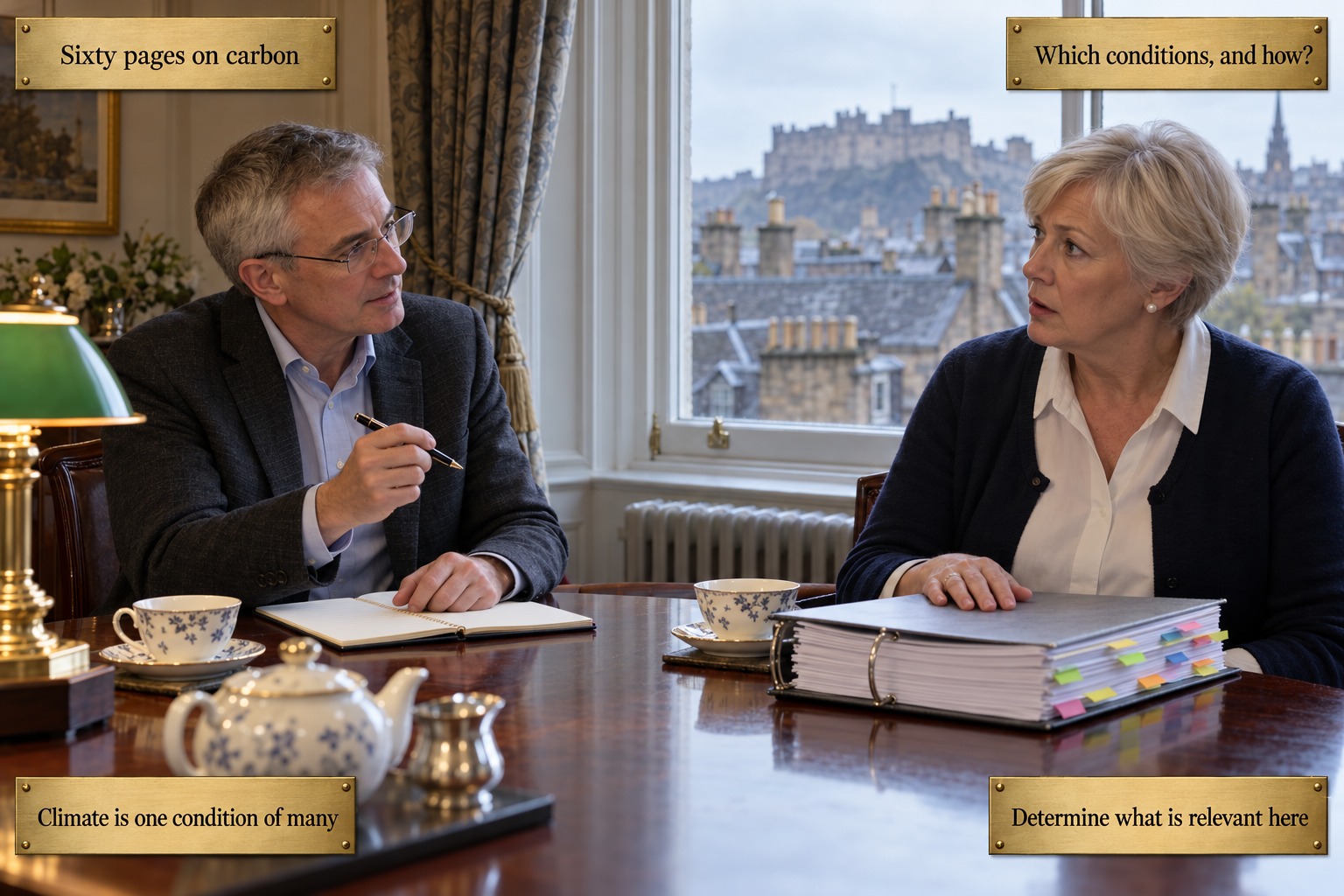
Concept Card 1.14 — Environmental Conditions: Beyond Climate Alone
Setting: Edinburgh, Scotland
The picture shows the first-floor drawing room of a small Georgian townhouse hotel in Edinburgh's New Town on an overcast spring morning. Through a tall sash window framed by patterned curtains lie wet slate roofs, chimney pots and, in the distance, the castle on its rock. At a polished mahogany table, set with a blue-and-white teapot and cups beside a green-shaded brass lamp, sit two people. The auditor, about fifty, short greying hair, glasses, dark grey jacket and light blue open-necked shirt, has a slim notebook open and a pen raised as he asks a question. Opposite sits the owner, about sixty, short silver-blonde hair, navy cardigan over a white blouse, pearl earrings, one hand resting on a thick closed ring binder bristling with coloured tabs; she looks at him, caught unprepared.
The card shows the transition audit to the standard's new edition. On a consultancy's advice, which presented it as a certification requirement, the owners paid for a sixty-page climate disclosure modelled on frameworks for large listed corporations: a full carbon footprint, a TCFD-style risk document, a science-based target. The auditor asks for none of it. He asks which environmental conditions this property determined to be relevant, and how. The sixty pages say nothing of the air quality management area, the ageing combined sewer network or the watercourse three streets away.
The plaques at the top give the event: Sixty pages on carbon, and Which conditions, and how?. The lower pair names the lesson. Climate is one condition of many: the revised standard names climate change alongside pollution, the availability of natural resources, biodiversity and ecosystem health as examples. Determine what is relevant here: the requirement is that the organisation determine which conditions matter in its own context, and how it reached that view.
The card does not say that climate disclosure is worthless; for large groups it may be warranted by investors and lenders, for reasons outside ISO 14001. Nor does it say that the revision requires a new programme for every condition the standard names as an example. The property must determine what is relevant to it, and climate alone does not answer that.

Concept Card 1.15 — From Vision to System: What Chapter 2 Will Ask of Management
Setting: Cancún, Mexico
The picture shows the general manager's office at the lagoon-side resort in Cancún on a bright Saturday afternoon in high season, a ceiling fan turning and a wall planner marked with coloured dots. Through the wide window lies the crowded pool deck: every lounger taken, waiters in white carrying trays, a queue at the thatched pool bar, and beyond, the lagoon and the green line of the mangroves. On the desk lies a ring binder open at the objective tracking sheet, every field filled in. The general manager, early fifties, greying dark hair, light grey linen suit and open white shirt, sits with one hand on the binder and his chin on the other, turned towards the window, thoughtful. The environmental coordinator, about forty, dark hair in a ponytail, white blouse with a navy badge, dark trousers, holds a tablet, leans in and points to the completed sheet.
The card shows the resort a year after the fuel spill. Responders are now named by role and updated when someone leaves, emergency equipment is inspected on a dated schedule, the coordinator reports directly to the general manager with authority to pause an operation, and every objective on the tracking sheet answers all five planning elements. By every test the chapter has proposed, the system is sound on paper. The general manager, reviewing it with real satisfaction, asks what no paper review can answer: does it work on a fully booked Saturday, with maintenance short-staffed and no one thinking about it?
The plaques at the top give the event: Every field on the sheet complete, and Will it hold on a full Saturday?. The lower pair names the lesson. A sound vision is not yet a system: clauses 4 to 6 build the plan, and planning is the first phase of a cycle, not its end. Operation proves what paper claims: whether the system holds is shown through resources, operational control, emergency preparedness and monitoring, the subjects of the chapters that follow.
The card does not say that the planning was wasted or that paper is worthless: without context, accountability and connected objectives there would be nothing for operation to test. Nor does it suggest that the rebuild has failed. It marks the point at which planning must prove itself in daily operation.

Concept Card 2.1 — Resources: What an Environmental System Actually Costs
Setting: Dubai, United Arab Emirates
A small back office in a Dubai business hotel, late on a spring afternoon. A floor-to-ceiling window shows the glass towers of the business district in a warm, hazy light, a construction crane above them and, close on the right, the curved flank of the property's second tower. At the desk sits the Environmental and Sustainability Coordinator, a woman of about forty with dark hair tied back, a navy blazer over a cream blouse and a lanyard round her neck. Her left hand rests on an open desk diary in which a single day is shaded; her right arm reaches across to slide a teal folder onto a small pile at the edge of the desk. In front of her a fan of slim coloured folders covers the desktop. Ring binders stand stacked high on both sides, with a laptop, a calculator and a desk lamp.
The card shows the quiet triage at the heart of the Dubai case. The property opened five years earlier with one tower, three objectives and a coordinator given one day a week. Since then a second tower, a conference centre, three new outlets and a set of voluntary commitments have arrived; the system now carries eleven objectives and several dozen significant aspects, and the coordinator still has one day a week. Each quarter she makes a reasonable local choice about what can wait, and none of these choices is ever reported upward. One of the folders she sets aside could be the water intensity covenant tied to the conference centre's green financing, left unmonitored for consecutive quarters.
The plaques at the top give the event: One day a week, five years on, and Eleven objectives, the same hours. The lower pair names the lesson. Adequacy is a ratio, not a budget line: a named role and a budget prove that resources were allocated once, not that they still match what the system now requires. Revisit resources as the system grows: every new tower, objective or obligation added to the system raises what has to be resourced, and top management has to check that the provision has kept pace.
The card does not say that the coordinator is failing at her job; she is committed and capable, and her triage is the visible sign of a resourcing gap, not its cause. Nor does it claim that ISO 14001 sets a review interval for resources or a fixed number of hours per objective: the standard requires resources to be determined and provided on an ongoing basis, and how often adequacy is re-tested is the organisation's own decision.

Concept Card 2.2 — Competence: Building an Environmentally Literate Team
Setting: Mykonos, Greece
The service side of a pool terrace at a beachfront resort on Mykonos, early on a June morning before guests arrive. Low golden sun falls on whitewashed walls; the pool lies still, and beyond it the sea, closed parasols and white cubic houses on a hillside. A small whitewashed store stands with its wooden door open. Inside, on a low shelf, a blue and a white treatment container carry hazard pictograms; gloves lie beside them, a skimmer net leans inside, and a clipboard hangs on the door. Two men in the same grey polo shirt and navy shorts face each other at the door. The departing colleague, about thirty, with sun-bleached brown hair and a backpack slung over one shoulder, gestures briefly towards the two containers. The new pool maintenance worker, in his mid-twenties with dark curly hair, stands with empty hands, head lowered, listening.
The card shows the handover that set up the Mykonos incident. The seasonal pool maintenance worker, hired three weeks earlier through the agency, has had a one-hour orientation and signed a sheet declaring the environmental policy reviewed and understood; nobody ever asked him to show how the chemicals are handled. Wanting to do the job properly, he asks a departing colleague, who answers confidently and quickly at shift changeover, with nothing written to check against. In late June he mixes the two treatment chemicals directly; the toxic release forces an evacuation, sends three people to hospital for observation and closes the pool for four days in peak season.
The plaques at the top give the event: Signed: reviewed and understood, and A hurried word at changeover. The lower pair names the lesson. Attendance is not competence: a signature records that an orientation took place, not that the person can now do the work safely. Competence is shown, not signed: the effectiveness of training is evaluated by watching the task performed correctly, which for chemical handling means a practical demonstration before anyone works alone.
The card does not blame the new worker or the departing colleague; the worker sought out competence, and the organisation had never given him a reliable source to find it. Nor does it suggest that agency staff fall outside the standard: people doing work under the organisation's control are within the competence requirement whoever employs them. The signed sheet remains useful evidence; it is simply not evidence that competence exists.

Concept Card 2.3 — Awareness Across Every Department
Setting: Kyoto, Japan
A guest-room corridor in a quiet Kyoto hotel built in the spirit of the ryokan, early on an autumn afternoon. Pale wood, paper screens and soft light; at the far end an inner garden with a red maple and raked gravel, and a branch arrangement in a lit niche. Beside a housekeeping cart piled with white towels, the housekeeping supervisor, a woman of about forty-five with black hair in a low bun and a dark grey tunic with a white collar, holds a stack of fresh towels against her body and turns, smiling, to a front desk colleague: a younger woman in a dark suit with a short black bob, one hand raised in a warm, explaining gesture. On the right a room door stands open. On the neatly made bed, two folded towels carry a small kraft-paper card marked only with a green leaf.
The card shows the moment a well-run reuse programme begins to come apart. The hotel invites guests, through a card in each room, to keep their towels and linen, and reports the resulting water and energy savings externally as part of a regional green certification. A regular business guest uses the card on every stay. A front desk colleague tells the housekeeping supervisor that he is a valued regular whom the hotel wants to look after especially well, and the supervisor, out of genuine hospitality, gives him fresh linen every day regardless. The habit then spreads to other frequent guests, and nobody connects it to the objective it undoes.
The plaques at the top give the event: The guest chose to reuse, and Fresh linen, out of kindness. The lower pair names the lesson. Awareness reaches every department: the people who shape a guest's experience at the desk influence the reuse programme as surely as the housekeepers who carry it out. Know what your choice undoes: staff need to understand what their own actions mean for the environmental commitments the hotel has made, so that kindness does not quietly overturn the guest's own choice.
The card does not accuse either colleague of misconduct or of breaking a rule; both acted on the hotel's own service culture, and no one in a guest-facing role had been told why the programme existed. Nor does it argue against personal care for regular guests. Its point is that awareness has to follow the real chain of influence over an aspect, not only the department formally assigned to perform it.
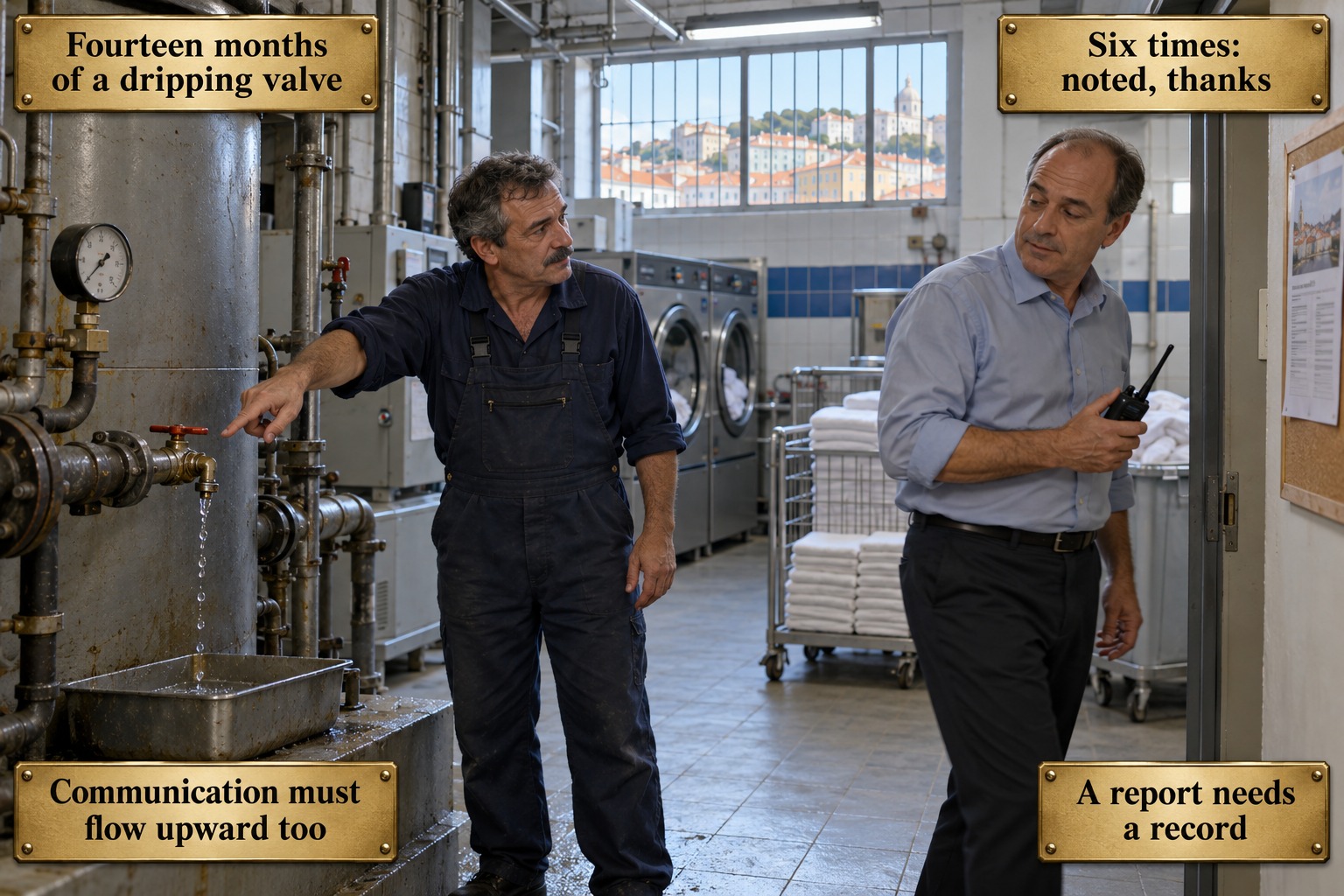
Concept Card 2.4 — Communication, Internal and External
Setting: Lisbon, Portugal
The laundry and boiler area in the basement of a large hotel in central Lisbon, mid-morning in winter. Fluorescent light, white tiles with a blue band, industrial washers and a trolley of folded towels; through a high barred window, terracotta rooftops and a domed church on the hill. In the foreground a worn boiler with pipework and a pressure gauge; from a valve with a red handle a steady thread of water falls into a metal tray set beneath it. The laundry technician, a man of about fifty with greying dark hair and a moustache, in navy overalls, points at the valve with his right arm and looks at his supervisor. The shift supervisor, in his fifties, receding hair, a light blue shirt with rolled sleeves and dark trousers, radio in hand, is already walking out of the door, glancing back. A newsletter hangs on a cork board.
The card shows the sixth telling of the same report. For about fourteen months the laundry technician has watched a boiler valve drip steadily, wasting heated water and the energy that heats it, and he has mentioned it to his shift supervisor at least six times. Each time the answer is a version of noted, will look into it, thanks. No ticket is raised and nothing is written down, so the drip never reaches anyone responsible for the property's energy intensity objective. The hotel's newsletters, posters and briefings all carry messages downwards; it takes an external energy audit, prompted by rising utility costs, to find the valve within its first visit.
The plaques at the top give the event: Fourteen months of a dripping valve, and Six times: noted, thanks. The lower pair names the lesson. Communication must flow upward too: internal communication has to enable the people doing the work to contribute to improvement, not only receive management's messages. A report needs a record: an observation passed on in conversation must turn into something written and tracked, so that it reaches the person who can act and does not depend on one supervisor's memory.
The card does not portray the supervisor as careless or the technician as resigned; the supervisor had competing priorities and no route to escalate, and the technician nearly raised the leak at an all-staff briefing but judged it the wrong forum. Nor does it say that ISO 14001 prescribes a ticketing system or a particular reporting form. The standard requires a process that lets people's observations into the system; how that is built is the hotel's choice.
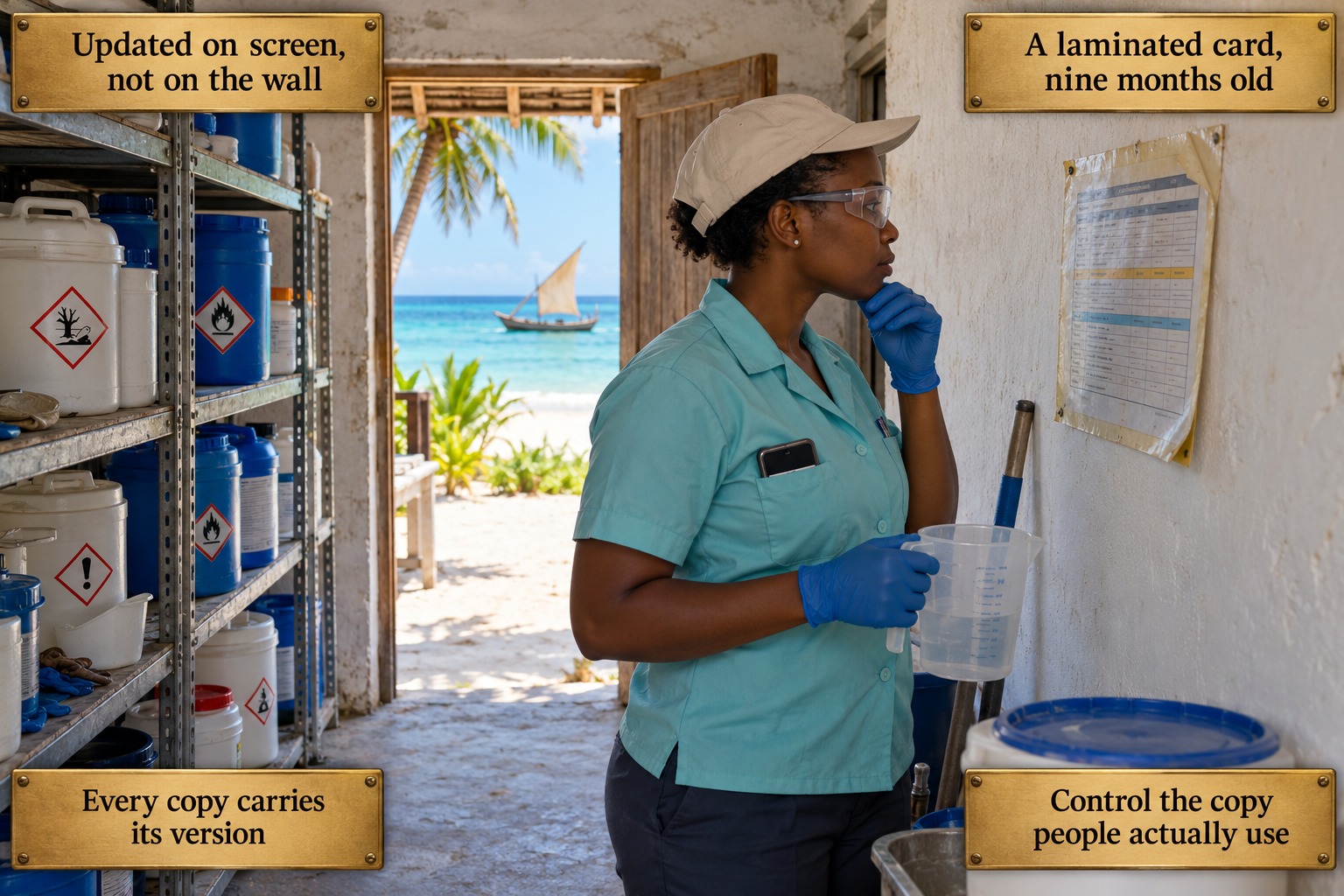
Concept Card 2.5 — Documented Information: What to Keep, What to Discard
Setting: Zanzibar, Tanzania
The pool chemical store of a beachfront resort on Zanzibar's northern coast, on a bright morning in the dry season. Rough plastered walls and steel shelving with white and blue containers bearing hazard pictograms; through a wooden door, white sand, a palm, turquoise water and a small sailing boat. On the wall at eye level hangs a laminated procedure sheet with a small table, yellowed, curling at the corners and held up with tape. In front of it stands a staff member covering an unfamiliar shift: a woman of about thirty, short natural hair under a light cap, a pale turquoise uniform shirt, blue gloves and clear safety glasses. She studies the sheet with one hand at her chin and a plastic measuring jug in the other. Her phone sits in her shirt pocket. Nothing has been spilled.
The card shows the moment before an outdated instruction is followed. After a safety notice from the supplier, the environmental and safety coordinator correctly updated the master chemical-handling procedure in the digital system, with a safer dilution ratio. Three laminated copies of the old procedure, carrying no date and no version number, stayed where they had hung for two years. Nine months later this staff member, trained on the current digital version but working an unfamiliar shift, reaches for the card on the storage room wall and follows the old ratio exactly. The mixture gives off stronger fumes, the area is briefly evacuated, and a nonconformity is raised once the two versions are compared.
The plaques at the top give the event: Updated on screen, not on the wall, and A laminated card, nine months old. The lower pair names the lesson. Every copy carries its version: a printed or laminated copy is documented information like any file and needs identification, so that anyone holding it can tell whether it is current. Control the copy people actually use: change control has to reach the instance consulted at the point of work, here the card on the store-room wall.
The card does not fault the staff member; she was competent, trained and wearing her protective equipment, and she followed the instruction in front of her exactly. Nor does it say that laminated copies at the workplace should be banned. They are often the most useful form of a procedure; the standard asks that they be identified, reached by changes, and withdrawn or replaced when superseded.

Concept Card 2.6 — Operational Control in the Kitchen
Setting: Toronto, Canada
The banquet kitchen of a large downtown hotel in Toronto on a busy Saturday evening. Warm light under steel hoods, steam, glistening red-brown tiles, and a long pass lined with plated dishes under heat lamps; cooks plate in the background, out of focus. In the foreground a steel oil collection container on a wheeled trolley is filled to the brim. A line cook of about thirty, with dark hair under a black skull cap, a white chef's jacket with sleeves pushed up, a black apron and heavy black gloves, holds a deep metal pan of used oil in both hands. He has stopped beside the full container and is looking down at a floor drain a step away. He has poured nothing. On the wall to the right, a procedure sheet hangs in a plastic sleeve.
The card shows the moment the Toronto practice began. The used-oil procedure was developed and observed on a quiet Tuesday afternoon, at perhaps a third of peak capacity, and worked perfectly: containers at each station, a porter collecting every two hours, a certified holding tank and a licensed recycler. On a Saturday in banquet season, with three functions running at once and temporary cooking stations far from the containers, a container fills ninety minutes before the next collection. The cook faces a full container, no known alternative and a service that cannot stop. What began here spread over the following months, until a grease trap overflow and a municipal inspection exposed it.
The plaques at the top give the event: Tested on a quiet Tuesday, and Three banquets on a Saturday night. The lower pair names the lesson. Prove the control at peak load: operating criteria have to hold under the conditions in which the process is really carried out, including its busiest nights, not only when it is convenient to observe. A full container needs a route: the procedure must say what happens when capacity runs out, so that a cook under pressure has a sanctioned alternative.
The card does not portray the cook as reckless or indifferent; he faced a genuinely full container, a genuinely absent alternative and genuine service pressure. Nor does it claim that ISO 14001 prescribes how a control must be tested or under which conditions. The standard leaves that to the organisation's proportionate judgement; the card shows what happens when the test misses the conditions that matter.

Concept Card 2.7 — Operational Control in Housekeeping and Laundry
Setting: Nassau, Bahamas
The environmental office and sample room of a large beachfront resort outside Nassau, early on a spring morning. White walls, a steel worktop beneath a wide window, clear daylight. Outside lie clear turquoise shallows with dark coral heads beneath the surface, a white beach lined with palms and, far along the coast, a hazy industrial building with a tall chimney. At the window the environmental technician, a Bahamian man of about thirty-five in a khaki shirt with rolled sleeves, navy shorts, wet rubber boots and blue gloves, raises a freshly filled sample bottle against the light. Beside him the environmental manager, a Bahamian woman of about forty-five with long braids tied back, a white linen shirt and light trousers, a tablet under her arm, bends over an open water test kit with coloured vials and a colour scale. A cool box stands on the floor.
The card shows the morning the reef-protection programme brings back bad news. Two years earlier the resort outsourced its laundry to a commercial contractor, a move that genuinely cut its own water and energy use. The resort's own aspects register treats phosphate detergents as a controlled substance, under a reef-safe certification that its dive-tourism partners require, but procurement selected the contractor on cost, capacity and quality, and the phosphate restriction never appeared in the service agreement. Eighteen months in, routine monitoring finds elevated phosphate levels in the coastal water beside the property, traced in the end to the contractor's discharge into a shared watershed.
The plaques at the top give the event: Laundry outsourced, rule left behind, and Phosphates found by the reef. The lower pair names the lesson. Control or influence the contractor: a process handed to an outside party remains within the system, and the organisation has to determine how far it can control or influence how that work is done. Requirements travel in the contract: relevant environmental requirements have to be determined and communicated to the provider, so that they cross the boundary together with the work.
The card does not accuse the contractor of breaking the law; its detergent complied with its own discharge permit, and nobody had ever asked it to work otherwise. Nor does it fault procurement for negligence, since environmental requirements had never been assigned to anyone to flag. The standard does not demand that every provider meet every standard of the resort; it demands that relevant requirements be determined and communicated.

Concept Card 2.8 — Operational Control of Energy and Utilities
Setting: Doha, Qatar
The engineering control room of a large hotel in Doha, early on a summer evening. Through a wide window the towers of the city stand against an orange sky, the sun low over the calm water of the bay and palms along the shore. Inside, cool light falls on a building management terminal with two large monitors: a floor plan in coloured zones and a three-dimensional view of the floors, some zones shaded orange. At the desk sits the senior facilities engineer, a man of about fifty with greying hair and a trimmed grey beard, in a grey engineering shirt with epaulettes, a desk phone receiver held to his ear, his right hand on the mouse. Behind him a younger colleague of about thirty in the same shirt holds a printed work order and watches the screen. Radio handsets stand in a charging rack.
The card shows the routine gesture that was quietly undoing a carefully modelled objective. The hotel had invested in a connected building management system and an optimised cooling setpoint schedule projected to cut energy intensity substantially. Engineering kept full local override authority, reasonably, for faults and urgent guest comfort. Over a year, overrides made in response to complaints reverted zones, floors and sometimes the whole building to more energy-intensive settings, for hours or in several cases for weeks. None was logged anywhere connected to the environmental management system, and the coordinator could see only unexplained shortfalls in her monthly data.
The plaques at the top give the event: A complaint, a quick override, and The setpoint stayed for weeks. The lower pair names the lesson. Overrides are logged and expire: a temporary departure from the optimised settings should be recorded and should end on its own, so that it cannot silently become the new normal. Tell operators what the target is: the people holding the controls need to know which environmental objective their settings serve, and that each change they make bears on it.
The card does not suggest that engineers should lose the ability to respond to guests or equipment faults; the override exists for good reason. Nor does it portray engineering as resisting the objective: the senior engineer was surprised to learn his routine practice touched a modelled target at all. Logging and automatic expiry are the property's practical remedies, not wording of the standard, which asks that control of a shared process actually hold.
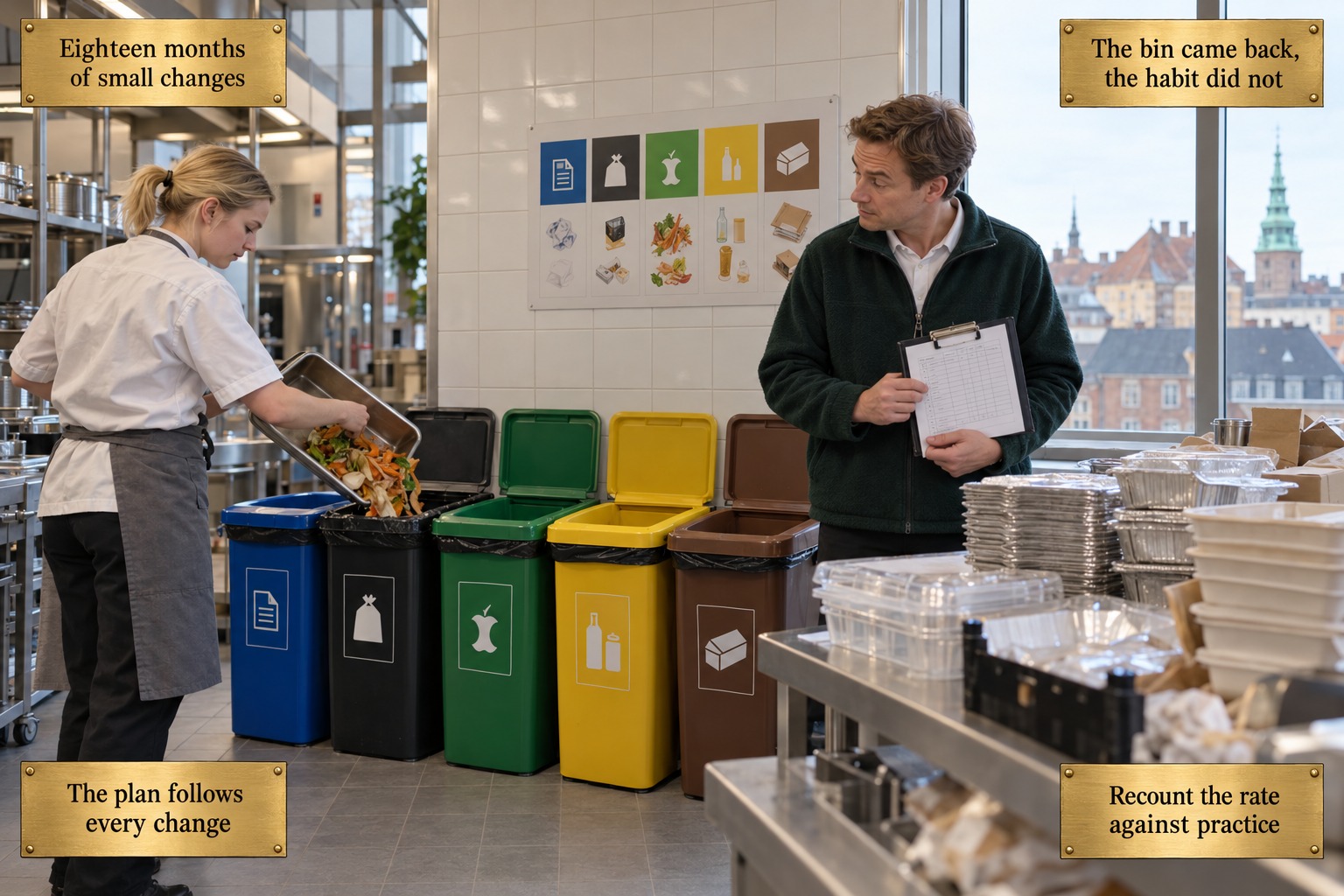
Concept Card 2.9 — Waste as a Managed Resource, Not a Problem
Setting: Copenhagen, Denmark
The main kitchen of a mid-sized hotel in central Copenhagen, late morning in early spring, shortly after a renovation. New pale tiles and steel; through a tall window, old roofs and a green copper spire. Against the wall stands the waste station: five bins in a row, blue, black, green, yellow and brown, each with a pictogram, beneath a sorting chart. A young cook, fair hair in a short ponytail, in a white jacket and grey apron, tips a steel tray of vegetable peelings into the black general waste bin, right next to the green organic bin standing open and empty. To the right, the waste coordinator, a man of about forty in a dark green fleece over a white shirt, holding a clipboard with a tally sheet, has stopped and turns to look. On the counter stand foil trays and plastic boxes left by an outside caterer.
The card shows the Copenhagen waste plan meeting eighteen months of small changes. The plan named five streams, verified every contractor's downstream handling and supported a diversion rate the hotel featured proudly. Since then a spa shop brought glass packaging, outside caterers brought their own disposables, and a three-month kitchen renovation moved the organic bin, so the cooks used general waste in the meantime. The bin is back in its place; for several staff the habit never came back. The reported diversion figure, never recalculated against any of these changes, is still cited as if nothing had moved.
The plaques at the top give the event: Eighteen months of small changes, and The bin came back, the habit did not. The lower pair names the lesson. The plan follows every change: new activities, products, suppliers and layouts are changes that should send the waste plan and its aspects back for review. Recount the rate against practice: a published figure has to be measured against what staff actually do today, not extrapolated from the assumptions of a plan written eighteen months earlier.
The card does not blame the cook, the spa team or the catering coordinator; each decision was reasonable within its own frame, and the renovation workaround solved a genuine problem at the time. Nor does it question the original plan, which was rigorous and properly verified. Its point is that a sound plan becomes outdated through accumulation, and the figure built on it goes stale with it.
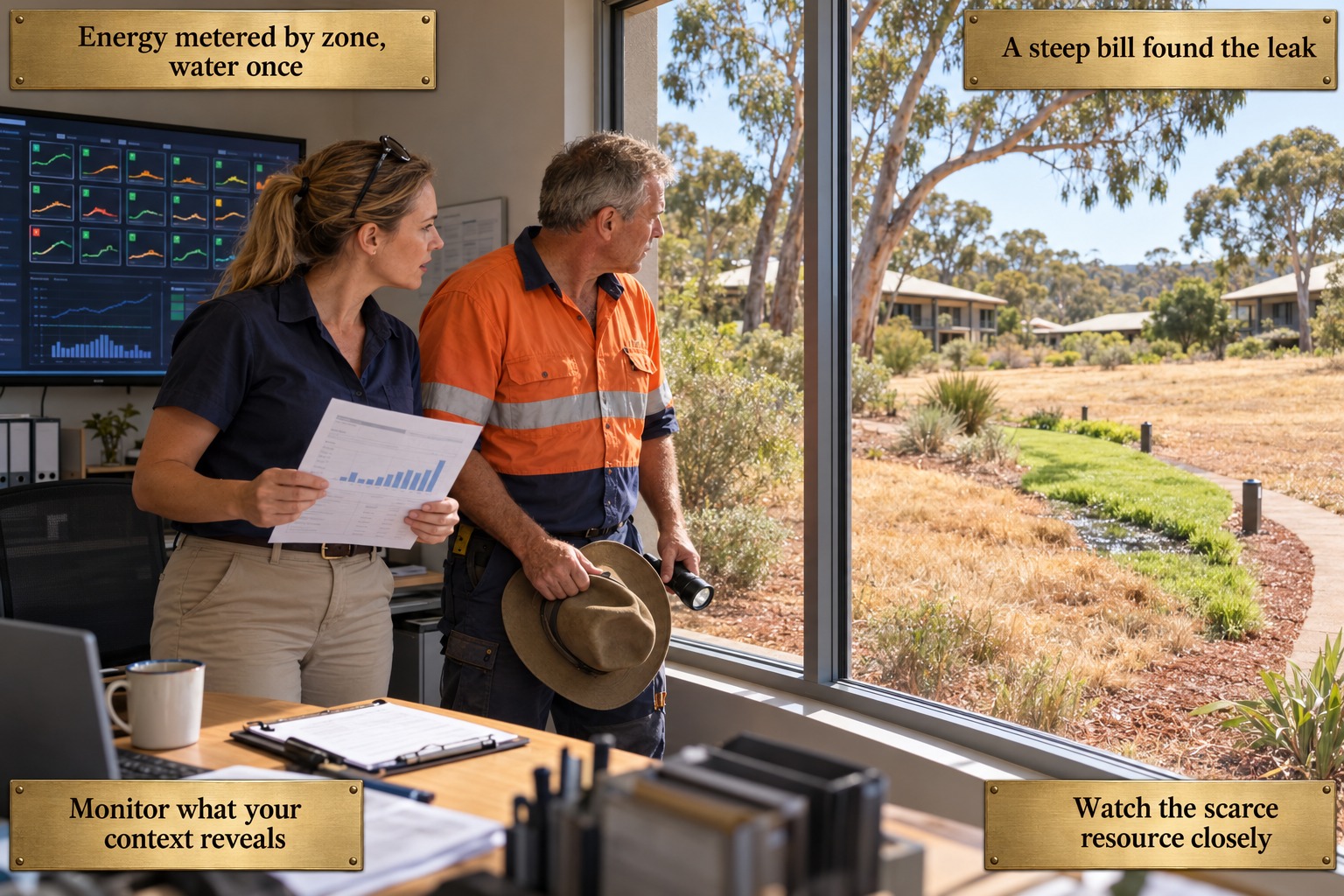
Concept Card 2.10 — Water Stewardship in a Water-Intensive Industry
Setting: Perth, Australia
The engineering office of a resort on the outskirts of Perth, Western Australia, late morning in summer in bright, dry light. A wall screen shows an energy dashboard of many small zone tiles. Outside, among eucalyptus trees and low resort buildings, the lawn is dry and straw-coloured, except for one strip along a curving garden path that is lush green, with a dark wet patch. The environmental coordinator, a woman in her late thirties with a light brown ponytail, sunglasses pushed up on her head, a navy shirt and beige trousers, holds a printed invoice with a rising bar chart and looks out at the green strip. Beside her the maintenance technician, a weathered man of about fifty with short grey hair, in a high-visibility orange and navy shirt, a wide-brimmed hat and a torch in his hands, turns towards the window.
The card shows the moment the Perth resort finds its leak. The property inherited its monitoring from a group whose hotels sit in water-rich markets: energy is submetered by zone and reviewed daily on the dashboard, while water passes through a single master meter read monthly with the invoice. The coordinator's own context analysis had concluded that water was the scarcer, more sensitive resource here, but monitoring never followed. An underground irrigation line has been leaking for months, invisible within the aggregate figure. Only a steep invoice prompts the manual search, by which time the regional water authority's large-user programme has already noticed the consumption.
The plaques at the top give the event: Energy metered by zone, water once, and A steep bill found the leak. The lower pair names the lesson. Monitor what your context reveals: when the organisation's own analysis identifies a resource as significant, monitoring has to be built to match that conclusion, not inherited from another setting. Watch the scarce resource closely: in a drought-stressed region water deserves the submetering and leak detection that the group reserved for energy.
The card does not criticise the energy programme, which was genuinely good and justly admired across the group. Nor does it claim that ISO 14001 dictates which resource must be monitored most closely or requires a separate objective for every significant aspect. The standard leaves this to the organisation's own context work; Perth's analysis was right, and the gap lay between that analysis and what was actually monitored.
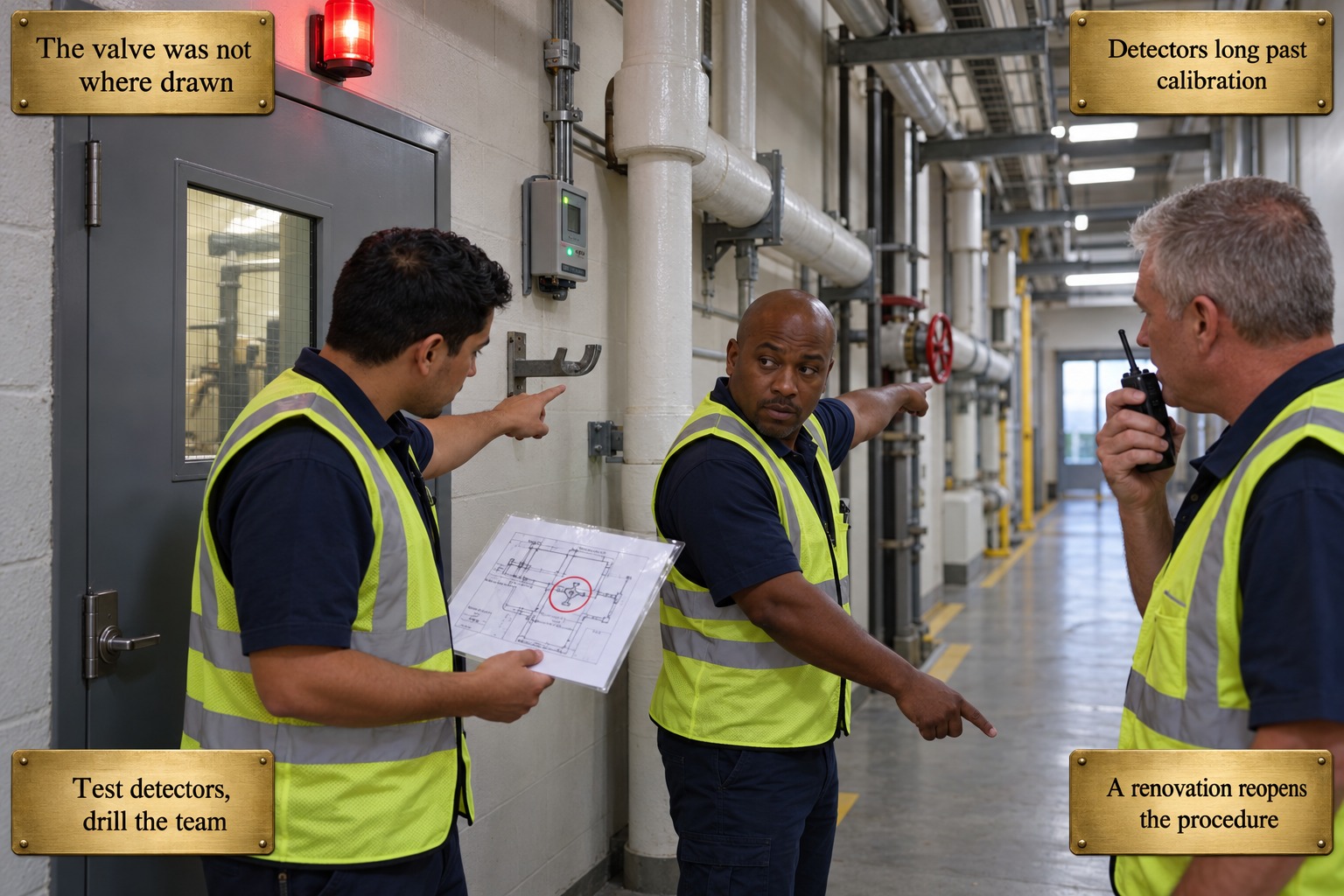
Concept Card 2.11 — Emergency Preparedness and Response
Setting: Orlando, USA
A service corridor outside the refrigeration plant room of a large convention resort in Orlando, under fluorescent light. Insulated pipework runs along the wall; the steel plant-room door is closed, a red beacon glowing above it. Beside it a wall-mounted gas detector shows a green light, and below it an empty pipe bracket juts out. Three engineers in navy work shirts and high-visibility vests stand outside. The first, a Hispanic man of about thirty with short dark hair, holds a laminated diagram with a valve position ringed in red and points at the empty bracket. The second, an African American man of about forty with a shaved head, points with one arm at a red valve wheel on the pipe run a few metres along and with the other further down the corridor. The third, grey-haired, about fifty, radios for help. No one goes through the door.
The card shows the minutes lost in the Orlando ammonia release. When the system was installed five years earlier, the property wrote a sound response procedure: detectors linked to the alarm, an isolation valve closable from outside the plant room, and call-out to a specialist contractor and the fire service, who alone would enter. Since then the detectors have drifted eighteen months past calibration, a kitchen renovation has moved the valve without the diagram being updated, and almost every trained engineer has been replaced. When a compressor seal leaks, the alarm comes late and the team searches the drawn position first. Once the plant is isolated, they keep the area evacuated and wait for the specialists.
The plaques at the top give the event: The valve was not where drawn, and Detectors long past calibration. The lower pair names the lesson. Test detectors, drill the team: emergency equipment needs periodic testing, and a response procedure needs periodic practice by the people currently on duty, not a reading at induction. A renovation reopens the procedure: any physical change near an emergency system should trigger a review of the procedure and its diagrams before the next emergency does.
The card does not suggest that the engineers should have entered the plant room or tackled the release themselves; they did right to isolate from outside, keep the area clear and wait for trained, equipped responders. Nor does it blame the new staff, who had never been shown the procedure in practice. The standard requires testing where practicable and review after emergencies; the frequency is left to the organisation.

Concept Card 2.12 — Monitoring, Measurement, Analysis and Evaluation
Setting: Seoul, South Korea
The lobby of a large modern hotel in Seoul, late on an autumn afternoon. Polished stone, warm light, a reception counter and white orchids; through the glass façade, towers, autumn trees and a hazy hill crowned by a tower. Along the right-hand wall runs a dashboard of many screens, every panel showing a rising line or growing bars. In front of it stand two women. The new sustainability analyst, in her late twenties with shoulder-length straight black hair, a light grey suit and a white top, holds out a tablet and points at its simple line chart, whose line runs steadily downwards, as she asks her question. The environmental manager, in her late forties with a short dark bob streaked with grey and a dark navy suit, stands with one arm folded and her hand at her chin, looking from the wall to the tablet.
The card shows the plain question that broke fourteen months of reassurance. The Seoul hotel's lobby dashboard, cited by clients and investors, tracks forty-five metrics, almost all of them cumulative totals since some starting point, such as kilowatt-hours saved since the retrofit, which can only grow. A newly arrived analyst asks what the month-over-month energy intensity trend looks like now. The answer is that energy intensity per guest night has been rising for fourteen months, as equipment degraded, while the early retrofit gains kept the 'saved since launch' figure climbing. The downward line on her tablet stands for that recent performance going the wrong way.
The plaques at the top give the event: Forty-five metrics, all rising, and Totals since launch only grow. The lower pair names the lesson. Track the rate, not the total: performance is evaluated through indicators that can show change over time, such as intensity per guest night month by month, which a cumulative total cannot. Fresh eyes ask the plain question: a newcomer, free of the familiarity that settled over everyone else, saw what the display's design had made invisible.
The card does not accuse the environmental manager of negligence; she reviewed the dashboard regularly, and its design gave her no signal to notice. Nor does it say that cumulative totals are false or forbidden: every figure on the wall is accurate, and totals have their place. The point is that they cannot serve as the main indicator of whether current performance is improving or declining.
Concept Card 2.13 — Management Review: Turning Data into Decisions
Setting: Prague, Czech Republic
A historic boardroom in a large hotel in Prague's Old Town, on a grey morning in early winter. Dark panelling, bound volumes of earlier minutes on a side table, and tall windows onto snow-dusted red roofs, Gothic spires and a green dome. The quarterly management review sits around a polished oval table with agendas, glasses and a carafe. At the head the general manager, about sixty, silver-haired, dark grey suit and burgundy tie, sits with hands folded, listening. On the left the chief engineer, about fifty, with glasses, a navy jumper over a checked shirt, rests a hand on a thin report showing a photograph of a boiler and speaks towards the head of the table. On the right the finance director, blonde hair in a low bun and a black blazer, writes on her agenda. In the foreground the minute-taker, seen from behind, types on a laptop.
The card shows the twelfth discussion of the same boiler. The Prague hotel's quarterly review is well run: every input clause 9.3 lists is on the agenda, decision-makers attend, and minutes go out promptly. For three years the ageing central heating boiler has been discussed at real length at every meeting, its efficiency falling, its emissions drifting out of line with tightening standards and its fuel costs rising. Each time the minutes record that it remains a priority for future capital planning; no budget, owner, deadline or reasoned deferral ever follows. In a severe cold spell the combustion chamber cracks, emissions exceed normal limits, and the authority opens an inquiry.
The plaques at the top give the event: Twelve meetings, one sentence, and Still a priority for the future. The lower pair names the lesson. A review ends in a decision: management review must produce decisions on improvement and on resources, not only discussion and acknowledgement. Act, defer with reason, or escalate: each significant item leaves the meeting with a named action, owner and date, or a recorded and reasoned deferral, or it is taken to the level that can fund it.
The card does not portray the general manager or the team as indifferent; each quarter a more urgent item genuinely competed for the time a proposal needed. Nor does it claim that ISO 14001 prescribes the action-owner-date format or the three-way choice; those are the property's own tools. The standard requires that the review end in decisions, and twelve acknowledgements are not one.

Concept Card 2.14 — Nonconformity and Corrective Action: The First Response
Setting: Hong Kong
The laundry wastewater filtration plant room of a flagship hotel in Hong Kong, mid-morning, in bright even light. A row of stainless steel filtration vessels with gauges and valves runs along the wall; through a window at the end, the harbour, ferries and towers in soft haze. A wall calendar shows a date circled in red. At a steel bench the environmental manager, a woman of about forty with shoulder-length black hair, a charcoal suit and a white blouse, signs a form on a clipboard. Beside her the chief engineer, a man of about fifty with short greying hair in a navy work jacket, closes his toolbox. In the doorway on the right, the owner's representative, in a dark navy suit and an open-necked white shirt, glances at his wristwatch with a satisfied smile. No one looks at the identical units further along the wall.
The card shows the Hong Kong finding being closed in time. A routine internal audit, two weeks before an institutional investor's site visit, found that the laundry filtration system had failed and that discharge had exceeded the permitted chemical concentration several times in a month. Ownership made clear that the finding must be closed before the visit. The failed component was replaced, testing confirmed compliance, and the finding was signed off; the visit went well. Nobody asked why the part had failed, which would have revealed a maintenance scheduling gap across the group's identical systems. Seven months later the same failure, larger, struck a sister property, caught by the investor's own monitoring.
The plaques at the top give the event: Two weeks to the investor visit, and New part fitted, cause unasked. The lower pair names the lesson. Correct the cause, not just the part: replacing the failed component deals with the symptom; corrective action means determining why it failed, so that it does not recur. Ask where else it can happen: the review extends to whether similar nonconformities exist or could occur elsewhere, here in the identical units of the group's other properties within the same system.
The card does not suggest that anything was falsified; the replacement was genuine, the discharge was brought back into compliance, and correcting it quickly was right. Nor does it blame the environmental team, which meant to return to the root cause but had no formal tracking to carry that intention forward. The standard asks for both steps: correct the immediate nonconformity, and evaluate the need to remove its cause.

Concept Card 2.15 — Continual Improvement and the Path to Certification
Setting: Cancún, Mexico
A meeting room at the lagoon-side resort in Cancún, on a weekday morning. White walls, a framed photograph of a heron over mangroves and a wall planner with one date circled. Through the window lie the calm lagoon, the mangrove reserve and a wooden boardwalk. Four people sit at a wooden table with open binders, coffee cups and a water jug. At the head, the general manager, in his early fifties, greying hair, a light grey linen jacket and an open white shirt, leans back smiling, both hands open in a relaxed gesture. On his right the environmental coordinator, in her late thirties, dark hair in a low ponytail, a white short-sleeved blouse with a navy name badge, turns towards him, pen lifted. The executive housekeeper, short curly hair and a grey tunic, and the chief engineer, stocky with a moustache in a navy polo shirt, look on.
The card shows the pre-audit briefing at the Cancún resort, two years after the fuel spill that opened the volume and two weeks before its next external audit. The resort was certified throughout; these two years went into restoring and sustaining an existing system, with roles tied to positions, honest resourcing, competence shown by demonstration, an upward channel for staff, controlled copies, peak-tested controls, trend indicators and reviews that end in decisions. The general manager, the same man who once asked why a certified property had a spill at all, now says that once they are certified they will finally be able to relax a little. The coordinator is about to question that sentence before anyone repeats it.
The plaques at the top give the event: Two weeks before the audit, and Finally able to relax a little. The lower pair names the lesson. A certificate is not a resting point: an external audit confirms the system at one moment and marks no finish line for the work behind it. Improvement does not finish: continual improvement means returning, again and again, to the suitability, adequacy and effectiveness of the system, because every case in the volume shows what happens to a system left to rest.
The card does not mock the general manager or doubt his commitment; he has led the rebuild, and his wish to rest after two demanding years is entirely human. Nor does it claim that improvement must be constant in every area at once: continual means recurring over time, not uninterrupted. The certificate is not belittled either; it simply names no endpoint, because clause 10.1 names none.
L’AUTORE